(PALM SPRINGS, Calif) — Law enforcement officials are expected to announce the arrest of an individual allegedly linked to the primary suspect in the car bombing outside a fertility clinic in Palm Springs, California, last month, sources familiar with the matter told ABC News.
The suspect is expected to appear in a Brooklyn federal court Wednesday afternoon before he’s moved to California, according to sources familiar with the matter.
The primary suspect in the case, 25-year-old Guy Edward Bartkus, was found dead next to the detonated vehicle, the assistant director in charge of the FBI’s LA field office said last month.
This is a developing story. Please check back for updates.
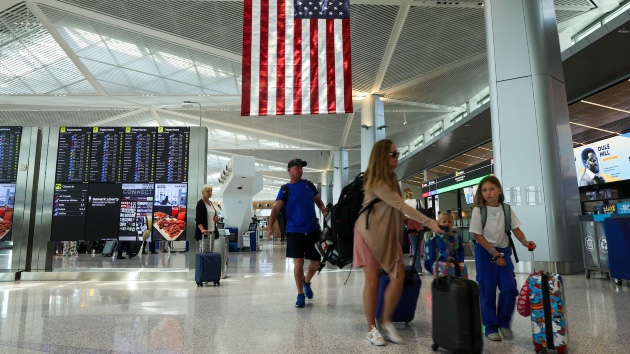
(NEW YORK) — Millions of Americans are gearing up to head to the airport or hit the highway for summer vacations.
Here’s what you need to know before you travel:
Air travel
The Federal Aviation Administration said it predicts over 50,000 flights (including cargo flights) per day this summer, citing a 4% increase of summer flight schedules compared to last year.
United Airlines is projecting a record-breaking summer with about 50 million passengers from June to August — about 3 million more than last year.
American Airlines said it expects to operate 5% more flights this summer than it did last year. The airline said nearly five flights will depart every minute over the course of the summer.
American Airlines forecasts its busiest day to be Sunday, July 6, with nearly 6,800 flights.
Expedia said some of the busiest travel days are expected to be Thursday, June 19 (Juneteenth); Friday, June 27; Tuesday, Aug. 5, and Tuesday, Aug. 26.
Hopper recommends flying midweek, like Tuesday or Wednesday, to save up to 20% on airfare.
According to Expedia, the cheapest days to fly domestically this summer will be Tuesday, Aug. 19, and Monday, Aug. 25, due to the drop in demand as summer travel wraps up.
Expedia said the most popular domestic travel spots are Las Vegas; New York City; Orlando, Florida; Miami; Chicago; San Juan, Puerto Rico; Honolulu, Hawaii; Seattle; Los Angeles; and Myrtle Beach, South Carolina.
Internationally, Expedia said popular destinations include Cancun, Mexico; Punta Cana, Dominican Republic; Paris; London; Tokyo; Rome; the Bahamas; and Barcelona, Spain.
Road travel
Good news for those taking road trips: Hopper said car rental prices are remaining steady from last year, averaging $47 per day.
The cities seeing the highest car rental demand are Orlando, Las Vegas and Denver, followed by Miami and Chicago, according to Hopper.
Cities in Florida are seeing the most affordable car rental rates this year, with daily average costs at $26 or less in Miami, Fort Lauderdale, Orlando and Tampa.
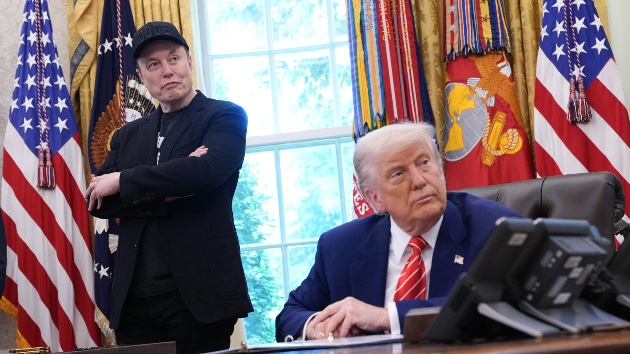
(WASHINGTON) — Elon Musk’s grievances with the Trump administration extend beyond the level of spending in the president’s signature bill, sources tell ABC News.
Multiple people who have spoken to the president and Musk described a widening rift on a range of recent moves by the administration.
Musk has privately expressed frustration about a portion of the spending bill that would cut the electric vehicle tax credit, multiple people who have spoken with the billionaire said.
After the November election, Musk called for ending the tax credit, but more recently, his company, Tesla, has become a vocal opponent of removing the provision.
“Abruptly ending the energy tax credits would threaten America’s energy independence and the reliability of our grid,” the company posted on social media.
Musk had also grown increasingly frustrated with the Trump administration striking artificial intelligence deals with his competitor OpenAI, sources tell ABC News.
Behind the scenes, Musk raised objections about a deal that did not include his AI start-up company, but it ultimately moved forward, sources said.
Another source of tension: the withdrawal of Musk ally Jared Isaacman’s nomination as NASA administrator over the weekend, according to sources who stated that Musk was deeply disappointed by the move.
There have also been deep disagreements on trade policy. In April, Musk called trade advisor Peter Navarro a “moron” and “dumber than a sack of bricks” in a series of posts on X.
On Tuesday, Musk took to X to lambaste the funding bill to advance Trump’s legislative agenda, calling it a “disgusting abomination.” He continued to attack the bill in a flurry of X posts Tuesday night into Wednesday morning.
“Mammoth spending bills are bankrupting America! ENOUGH,” Musk wrote in one post.
The White House declined to comment. A representative for Musk did not respond to a request for comment.
Some of these details were first reported by Axios.
(BOULDER, CO) — The suspect in Sunday’s Molotov cocktail attack in Boulder, Colorado, tried to buy a handgun in November but was denied, according to the Colorado Bureau of Investigation.
Mohamed Soliman — who was arrested after allegedly throwing Molotov cocktails during a pro-Israel demonstration, injuring 12 — tried to buy the weapon on Nov. 22, 2024, but was denied based on National Instant Criminal Background Check System, according to the bureau.
The reason for his denial wasn’t disclosed. He didn’t appeal the denial, the bureau said.
About a month later, on Dec. 30, 2024, CBI denied his application for a concealed handgun permit.
After Soliman was arrested Sunday, he allegedly told investigators that he took a concealed carry class to learn how to fire a gun, but “had to use Molotov cocktails [for the attack] after he was denied the purchase of a gun due to him not being a legal citizen,” state court documents said.
Soliman said he used YouTube to learn how to make the Molotov cocktails, documents said. Sixteen unused Molotov cocktails were within “arm’s reach” when he was arrested, the FBI said.
Soliman has been charged with a federal hate crime and state charges, including 16 counts of attempted first-degree murder, according to court documents. He appeared in court virtually on Monday. He has yet to enter a plea.
Soliman is accused of attacking a group advocating for the hostages being held in Gaza by Hamas.
Soliman told police “he wanted to kill all Zionist people and wished they were all dead,” court documents said. “SOLIMAN stated he would do it (conduct an attack) again.”
He “said this had nothing to do with the Jewish community and was specific in the Zionist group supporting the killings of people on his land (Palestine),” documents said.
Soliman, a husband and father of five, was born in Egypt and lived in Kuwait for 17 years before moving to Colorado Springs three years ago, court documents said.
Soliman has been in the U.S. on an expired tourist visa, officials said. He was granted a work permit, but that had also expired in March.
His wife and children are in the custody of U.S. Immigration and Customs Enforcement and the family is being processed for expedited removal, according to the Department of Homeland Security.
Soliman allegedly said he had been planning Sunday’s attack for one year but waited until his daughter graduated from high school last Thursday to carry it out, state and federal documents said.
ABC News’ Kevin Shalvey, Emily Shapiro and Luke Barr contributed to this report.
(BOULDER, CO) — The suspect in Sunday’s attack in Boulder attempted in November to purchase a handgun, but was denied, according to the Colorado Bureau of Investigation.
Mohamed Sabry Soliman, 45, the suspect, attempted to purchase the weapon on Nov. 22, 2024, but was denied based on National Instant Criminal Background Check System, according to the bureau.
The reason for his denial wasn’t disclosed. He didn’t appeal the denial, the bureau said.
About a month later, on Dec. 30, 2024, CBI denied his application for a concealed handgun permit.
Soliman has been charged with a federal hate crime and state charges, including 16 counts of attempted first-degree murder, according to court documents. He appeared in court virtually on Monday. He has yet to enter a plea.
His wife and children are in the custody of U.S. Immigration and Customs Enforcement and the family is being processed for expedited removal, according to the Department of Homeland Security.
“We are investigating to what extent his family knew about this heinous attack, if they had knowledge of it, or if they provided support to it,” Secretary of Homeland Security Kristi Noem said Tuesday. “I am continuing to pray for the victims of this attack and their families. Justice will be served.”
Soliman — who was arrested after allegedly throwing Molotov cocktails in an “act of terrorism” during a demonstration advocating for hostages being held in Gaza on Sunday on Sunday — has been in the U.S. on an expired tourist visa, officials said.
The father of five was granted a work permit, but that had also expired in March.
Soliman was born in Egypt and lived in Kuwait for 17 years before moving to Colorado Springs three years ago, court documents said.
Soliman allegedly said he had been planning Sunday’s attack for one year but waited until his daughter graduated from high school last Thursday to carry it out, state and federal documents said.
Sixteen unused Molotov cocktails were within “arm’s reach” of the suspect when he was arrested, FBI Denver Special Agent in Charge Mark Michalek said on Monday.
The unlit Molotov cocktails were “comprised of glass wine carafe bottles or Ball jars containing clear liquid and red rags hanging out of the bottles,” court documents said. Police also found a “backpack weed sprayer, potentially containing a flammable substance. The clear liquid in the glass bottles and weed sprayer was determined to be 87 octane gasoline, which was determined to contain xylene.”
ABC News’ Kevin Shalvey, Emily Shapiro and Luke Barr contributed to this report.
(WASHINGTON) — After generations of stigma and secrecy around sightings of unidentified anomalous phenomena (UAPs), or what the public calls UFOs, investigators probing hundreds of unsolved cases say the second Trump administration could be a turning point for transparency.
“We’re trying to get as much of the raw evidence out as we can without putting our partners’ equities at risk,” said Jon Kosloski, director of the Pentagon’s All-Domain Anomaly Resolution Office, the government-wide task force leading research into mysterious sightings.
“The office has hired additional personnel and we’re investing in automated security review software that can redact the sensitive information from videos,” he said of an effort to release more currently classified material related to the probes.
Congress established the Resolution Office in 2022 to “detect, identify and attribute” mysterious objects of interest in the air, outer space, and underwater, with special focus on mitigating potential threats to military operations and national security.
More than 1800 cases have been reviewed by the Pentagon so far, with the vast majority ultimately resolved as likely balloons, drones, debris or animals based on a comprehensive review of available data.
Kosloski says “several dozen” cases remain anomalous even after rigorous analysis of evidence. They continue to receive new reports of anomalies by military service members and the general public every month.
“It’s a potential problem, a national security problem, safety of flight issue,” Kosloski told ABC News. “We seem to have the full support of the administration” in pursuing answers.
Trump vows greater transparency
President Donald Trump has famously been a UFO skeptic. “It’s never been my thing. I have to be honest,” he told podcaster Joe Rogan in an October 2024 interview. “I have never been a believer.”
But the president, who has full access to all government secrets as commander in chief, has also hinted on several occasions that there may be more information than has previously been revealed about alleged extraterrestrial life and unusual technological capabilities.
“I won’t talk to you about what I know about it but it’s very interesting,” Trump told his son, Donald Trump Jr., in an online video during the 2020 campaign. “But Roswell’s a very interesting place with a lot of people that would like to know what’s going on.”
Since taking office a second time, Trump has vowed “radical transparency” across government. Last month, he ordered the release of all remaining classified files related to the assassination of President John F. Kennedy Jr.
Some UFO enthusiasts across the political spectrum are pushing for a similar release of government files related to extraterrestrial mysteries.
“When you have only certain information that’s shared with the American people, that’s when conspiracy theories happen. And it’s, in my opinion, that conspiracy theories can be detrimental,” said Rep. Anna Paulina Luna, R-Fla., in April as she opened the House Task Force on the Declassification of Federal Secrets.
Lawmakers from both parties have proposed legislation to force government agencies to disclose more information on UAPs, but Congress has yet to pass it.
“The issue is when we mix secrecy with a stigma, and that we create such a stigma around a phenomenon that it becomes difficult, if not impossible, for agencies, for people to look at the issue seriously,” said former Associate NASA Administrator Mike Gold, who served on the agency’s UAP Independent Study Team.
Gold, who is now part of the UAP Disclosure Fund, an independent group of scientific and national security experts, says Congress must fund more aggressive analysis of troves of existing government data.
“If we study UAP, not only can we help with national security,” Gold said, “but even if we don’t discover something exotic, what’s the worst case scenario? We discover an incredible new physical phenomenon?”
Whistleblowers, advocates allege secret evidence long denied
Critics of the Pentagon effort led by Kosloski say it has been hobbled by “staffing shortfalls,” bogged down by “bureaucratic confusion,” and mired in “excessive secrecy.”
In recent testimony before Congress, whistleblowers insist the government is still hiding evidence of non-human intelligence, which top officials have long denied.
Kosloski has accelerated the release of intensive investigations, publishing unclassified resolution reports for some of the most high-profile cases, detailing the technical and intelligence analysis behind the conclusion.
“Our hope is to be able to triage them, identify those that have the best scientific data, the nexus with national security interests and the true anomalies behind them, and focus our attention on those really anomalous cases,” Kosloski said.
Last year, the Pentagon completed a historic review of 80 years of records related to unidentified anomalous phenomena, concluding there is “no evidence that any U.S. government investigation, academic-sponsored research, or official review panel has confirmed that any sighting of a UAP represented extraterrestrial technology.”
“That stands true,” said Kosloski.
Government and private UAP investigators say it will take substantially more data to resolve the most persistent mysteries on file.
As for whether he can categorically rule out the existence of an intact spacecraft or part of a spacecraft in government possession, Kosloski said he has not been able to corroborate any claims but promised to push for public release of any likely findings of non-human intelligence.
“There’s no precedent for that, obviously, but I think that we would take that up through the Secretary of Defense and allow him to make that decision.”
(NEW YORK) — Executives at major corporations, including Target, Goldman Sachs and Pepsi, have invoked the same one-word boogeyman on recent earnings calls: “Uncertainty.”
Concern among companies big and small about the unsteady business environment has centered on President Donald Trump’s tariff policies, which the White House has altered numerous times since Trump took office.
A pair of court rulings last week thrust Trump’s steepest tariffs into limbo, adding another layer of uncertainty as federal appeals court judges determine whether a major swath of the policies pass legal muster.
In response to the tariff shifts, many U.S. companies have opted to put hiring and investment plans on hold out of fear that a fresh levy could otherwise spark regret, experts told ABC News.
That paralysis risks sapping momentum from the economy and tipping the U.S. into a downturn, they added, while acknowledging the ultimate outcome remains unclear.
“These pretty significant policy changes – whether they’re coming out of the administration or the courts – can have a big financial impact on companies,” Gregory Brown, a finance professor at the University of North Carolina, told ABC News. “Profits can turn to losses, and vice versa.”
“It has to be nerve-racking for people on the front lines of this in terms of having their businesses or jobs highly affected,” Brown added.
The Trump administration has rebuked criticism of its on-again, off-again tariff approach, saying the flexibility affords White House officials leverage in trade negotiations with countries targeted by the levies.
Speaking to ABC News’ “This Week” in April, Treasury Secretary Scott Bessent described the posture as “strategic uncertainty.”
“You’re not going to tell the person on the other side of the negotiation where you’re going to end up. And nobody’s better at creating this leverage than President Trump,” Bessent said.
In the meantime, a host of major companies have warned that they may suffer losses due to the lack of clarity.
Target CEO Brian Cornell last month warned of “massive potential costs” due to tariffs, lamenting difficulties posed by “the rates we’re facing and the uncertainty about how these rates in different categories might evolve.”
In April, Goldman Sachs CEO David Solomon voiced alarm about possible damage that could result from the murky outlook.
“This uncertainty around the path forward and fears over the potentially escalating effects of the trade war have created material risks to the U.S. and global economy,” Solomon told analysts.
A survey of CEO confidence fell to its lowest level since 2022, the Conference Board found last month. More than half of CEOs expect conditions to worsen over the next six months, the survey said.
The policy uncertainty puts businesses in a bind because they cannot evaluate the costs and benefits of important long-term decisions, such as investment and hiring, Brett House, a professor of professional practice at Columbia University and former deputy chief economist at Scotiabank, told ABC News.
“Companies always have risks ahead of them. They can price those risks in terms of the cost of lending or borrowing and the prices of goods or services,” House said. “In a period of uncertainty, it’s hugely chilling of business activity because there’s almost now way to anticipate what the price of an activity should be.”
The uncertainty facing businesses has coincided with an anxious moment for consumers. Consumer attitudes have soured for four consecutive months as tariffs have taken hold, according to a survey conducted by the University of Michigan.
Consumer spending, which accounts for about two-thirds of U.S. economic activity, could weaken if shopper appetites diminish. In theory, a slowdown of spending could hammer some companies at the same time they attempt to navigate the ever-shifting business environment, some experts said.
“If consumption starts coming down and companies are not investing, that’s when you start to see little parts of gross domestic product come down,” Jadrian Wooten, a professor of economics at Virginia Tech University, told ABC News. “We’re in that danger zone.”
The Federal Reserve Bank of St. Louis released a study in April that found a sudden surge of economic uncertainty could set the conditions for an economic recession.
So far, key measures of the economy have largely defied fears of a downturn.
The unemployment rate stands at a historically low level and job growth remains robust, though it has slowed from previous highs. In recent months, inflation has cooled, reaching its lowest level since 2021.
The Organization for Economic Co-operation and Development, or OECD, forecast on Tuesday continued growth for the U.S. economy in 2025 and 2026, albeit at a slower pace than last year. Recession forecasts on Wall Street faded in recent weeks after Trump rolled back some tariffs.
Brown, of the University of North Carolina, said the uncertainty facing businesses is unmistakable, but its precise economic effect remains to be seen.
“The uncertainty is real,” Brown said. “How much of it really comes to fruition and really shows up in the data — that’s a different question.”
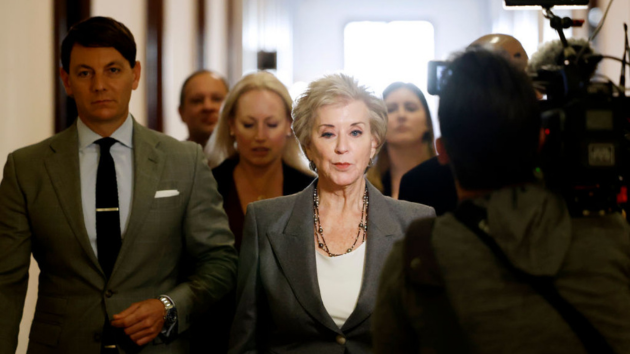
(WASHINGTON) — Congressional Democrats are demanding that Department of Education Secretary Linda McMahon cooperate with the agency’s Office of Inspector General review of the Trump administration’s efforts to overhaul the agency.
In a letter first obtained by ABC News, a group of Democrats on the Education, Oversight, Homeland Security and Governmental Affairs, and Appropriations committees in the House and Senate sent the secretary a letter accusing her of stonewalling the agency’s inspectors general.
“The OIG must be allowed to do its job,” they wrote.
“We urge the Department to immediately meet its obligation under the law to fully comply with the OIG’s review,” the letter said. “Congress and the public need to understand the full extent and impact of the Administration’s actions on the Department and the students, families, and educational communities it may no longer be able to serve.”
ABC News reached out for comment from the Department of Education on the allegations but did not receive an immediate reply.
McMahon will face these questions in person when she testifies before the House Education and Workforce Committee on Wednesday.
The letter stems from what McMahon calls her “final mission” as the 13th education secretary to shutter the department, and the administration’s first steps to diminish the agency through a reduction in force that slashed nearly half its staff in early March. The lawmakers are requesting a response no later than Friday. After several attempts to conduct its review over the last two months, an OIG letter said the prolonged had resulted in “unreasonable denials” and “repeated delays” to its work.
According to a recent OIG letter sent to the House and Senate committee members, the Education Department blocked it from “timely access to all records, reports, audits, reviews, documents, papers, recommendations, or other materials available to the department.” House Education and Workforce Committee ranking Democrat Bobby Scott told ABC News, “I think the fact that they have indicated that there is a lack of cooperation ought to be concerning to people when inspectors general can’t do their jobs.”
The OIG contends its “statutory mission” to oversee the changes at the department under the Inspector General Act have been impeded.
“Our review has been delayed by the refusal of the Department to provide the OIG with a majority of the information and documents requested or direct access to staff for interviews,” acting Inspector General René L. Rocque wrote last month in a letter fulfilling her dual reporting requirement.
The department has canceled scheduled OIG interviews with its staff and insists that an Office of the General Counsel lawyer be present for any rescheduled interviews, according to the OIG. The OIG alleges those requests from the department are unprecedented and contrary to the OIG’s longstanding practice.
The OIG office is the statutory, independent entity within the department responsible for identifying fraud, waste, abuse and criminal activity involving department funds, programs, and operations, according to its website. By denying the federal watchdog access to the department’s records, the lawmakers believe McMahon is failing to meet her obligation as an agency head. There is no basis to withhold department documents from the OIG regardless of the privileged nature of the information or if it’s subject to litigation, the OIG said.
The news comes as McMahon testifies before Congress on the agency’s priorities and policies, specifically calling for a $12 billion cut to education under President Donald Trump’s fiscal year 2026 budget outline. McMahon has stressed she will continue all statutory functions of the agency and work to abolish it in a “lawful fashion.”
Ahead of his committee’s hearing with McMahon, Scott said, “We hear all these pronouncements about what’s going to happen. What is the plan? They’ve acknowledged they can’t get rid of the Department of Education without legislation. Are they supporting legislation?”
Democrats, including Scott, have decried the administration’s work force reductions, particularly the impact the layoffs could pose to the department’s critical responsibilities such as administering Federal Student Aid services and ensuring students’ civil rights. Their three-page letter to McMahon claims states have experienced delays in accessing relevant portals to receive federal funding, college financial aid advisors have experienced significant delays in getting answers from FSA personnel, parents with pending Office for Civil Rights OCR cases have been left in the dark.
“When they have all these cases of discrimination in the Office for Civil Rights enforcing Title VI, including anti semitism, how is the job going to get done if you fired most of the staff in the Office of Civil Rights?” Scott said.
“If the inspector general can’t get an answer, then oversight is lost,” he added.
(DALLAS) — The immigration cases of some of the Venezuelan migrants who were deported to El Salvador under the Alien Enemies Act in March have been dismissed, their attorneys said, raising concern from advocates and lawyers who say the move is a violation of due process.
For more than two months, John Dutton, a Houston-based immigration attorney, fought to keep one of his client’s immigration case open. Henrry Albornoz Quintero, who was detained in Dallas in January after showing up to a routine check-in with Immigration and Customs Enforcement, was deported to the notorious CECOT prison in El Salvador in March.
After Quintero was deported, Dutton continued to show up to his client’s immigration hearings where he says the government attorneys declined to answer questions about his client and pushed for dismissal. Quintero’s case was dismissed “due to a lack of jurisdiction,” Dutton said.
“There’s just nothing [the judge] could do,” Dutton said. “Henrry is not here because the president shipped him out of the country. What’s an immigration judge going to do to stop that?”
Dutton previously told ABC News that Quintero’s wife, who entered the U.S. with him last year, had a baby in April.
Michelle Brane, the executive director of the immigration support group Together and Free, told ABC News that her team has tracked at least 15 immigration cases of migrants who were sent to CECOT that were recently dismissed. Some of the cases include active pending asylum applications.
Brane said she believes immigration courts should “administratively close” the cases, which would allow them to be reopened “if and when” the person is brought back.
“Dismissing as opposed to administratively closing is sort of making an assumption that these people will never come back,” Brane said. “And I think that’s premature and certainly based on the court decisions, so far, they should be brought back to receive some kind of due process.”
If the Venezuelan migrants were to be brought back, there is no process for reopening their immigration cases, Brane said.
The Department of Homeland Security did not respond to ABC News’ request for comment.
Mark Prada, an attorney representing a 24-year-old Venezuelan, said he was able to have his client’s case administratively closed.
“I was able to cut the head off the snake before it could poke out of its hole,” he told ABC News.
Isabel Carlota Roby, an attorney for the Robert F. Kennedy Human Rights organization, told ABC News that at least seven of the 10 men her group represents had some form of legal protection in the U.S., including Temporary Protected Status or pending asylum applications before being deported to CECOT in El Salvador.
Roby said her group represents them internationally — filing habeus petitions in El Salvador and other types of advocacy — but does not represent them in U.S. immigration court. However, she said many of them have had their cases dismissed recently. She told ABC News that most of the migrants her group represents do not have immigration attorneys.
“They basically represented themselves in court and presented their own asylum cases,” Carlota Roby said. “Most of them simply were deported and their cases were just left behind and that was it.”
“They were denied due process, they are disappeared, and they are now in this legal limbo where they remain in a prison with no legal protections, excluded from the protection of the law, and they don’t know if they’ll ever have a chance at a fair trial,” she added.
The Trump administration invoked the Alien Enemies Act — an 18th century wartime authority used to remove noncitizens with little-to-no due process — to deport more than 200 alleged migrant gang members to CECOT by arguing that the Venezuelan gang Tren de Aragua is a “hybrid criminal state” that is invading the United States.
An official with the ICE acknowledged that “many” of the men deported on March 15 lack criminal records in the United States — but said that “the lack of specific information about each individual actually highlights the risk they pose.” Many of their families have also denied gang involvement.
The government is temporarily barred from removing migrants under the proclamation after the Supreme Court extended its injunction last month and remanded the case to the 5th U.S. Circuit Court of Appeals to resolve the question of how much time should be afforded for detainees to contest their removals.
Some attorneys told ABC News they are appealing the dismissals.
The lawyer for Jose Franco Caraballo Tiapa, a 26-year-old Venezuelan migrant who was seeking asylum in the U.S., and was detained after showing up to his routine check-in with ICE, filed an appeal after his client’s case was dismissed.
“The dismissal results in what can be construed as a violation of due process, as he was not given the opportunity to be heard on his asylum claim,” said Martin Rosenow.
Lindsay Toczylowski, the attorney who represents Andry Hernandez Romero, a gay makeup artist who was sent to CECOT in El Salvador, said in a statement that her client was denied due process.
“DHS is doing everything it can to erase the fact that Andry came to the United States seeking asylum and he was denied due process as required by our Constitution,” Toczylowski said. “The idea that the government can disappear you because of your tattoos, and never even give you a day in court, should send a chill down the spine of every American.”
In the statement posted by Immigrant Defenders Law Center, the group said the dismissal of Hernandez’s dismissal is “not the end.” The group said it will file an appeal and continue its advocacy to bring the 32-year-old back to the U.S.
(LONDON) — Zimbabwe has announced that dozens of its elephants will be killed to control the population size and the meat from the carcasses will be distributed to people.
The Zimbabwe Parks and Wildlife Management Authority, also known as ZimParks, said it has issued permits to Save Valley Conservancy, a large private game reserve in the southeast, “for an elephant management exercise.”
“The management quota is meant to address the growing elephant population in the region and will initially target 50 elephants,” the agency said in a statement Tuesday. “According to the 2024 aerial survey, there are 2,550 elephants against an ecological carrying capacity of 800 elephants in Save Valley Conservancy.”
The reserve has translocated 200 elephants to other areas in the southern African nation over the past five years “to manage the elephant population and protect the wildlife habitat,” according to ZimParks.
“Elephant meat from the management exercise will be distributed to local communities while ivory will be State property that will be handed over to the ZimParks for safekeeping,” the agency added.
A global ban on ivory trade bars Zimbabwe from selling its stockpile of elephant tusks.
ZimParks spokesperson Tinashe Farawo told ABC News on Wednesday that the “management exercise” is “not culling,” as the latter “involves wiping [out] the whole herd in huge numbers.” He did not respond to a question about how many elephants in total will be killed in this instance and over what period of time.
ABC News has reached out to Save Valley Conservancy for comment.
Zimbabwe is home to the second-largest population of elephants in the world, after neighboring Botswana.