(WASHINGTON) — The Trump administration is looking to speed up its ability to fine those in the United States illegally — up to $1,000 per day — according to a rule set to be published Friday in the Federal Register that was obtained by ABC News.
Currently, the government can alert those in the U.S. illegally 30 days before it starts issuing fines.
The rule proposed by the departments of Justice and Homeland Security allows the government to immediately start fining those in the U.S. illegally. “DHS believes that the nature of the failure-to-depart and unlawful entry penalties supports the need for more streamlined procedures,” the proposed rule says.
The new process will apply to those who enter the U.S. illegally, ignore final orders of removal, and those in the U.S. illegally who do not comply with a judge’s voluntary departure order.
Fines will range from $100 to $500 per illegal entry into the U.S., up to almost $10,000 for failure to voluntary deport after a judge orders it, and up to $1,000 per day for those who do not comply with a removal order.
Fining migrants illegally in the U.S. started during President Donald Trump’s first term in office and was stopped during the Biden administration. Trump started it again after he took office in January.
“The law doesn’t enforce itself; there must be consequences for breaking it,” said Assistant DHS Secretary Tricia McLaughlin said Thursday. “President Trump and [DHS] Secretary [Kristi] Noem are standing up for law and order and making our government more effective and efficient at enforcing the American people’s immigration laws. Financial penalties like these are just one more reason why illegal aliens should use CBP Home to self-deport now before it’s too late.”
Those who use the Customs and Border Protection’s CBP Home app to self-deport will have any fines levied against them waived, according to the DHS. As of June 13, DHS has issued 10,000 fine notifications.
Lev Radin/Pacific Press/LightRocket via Getty Images
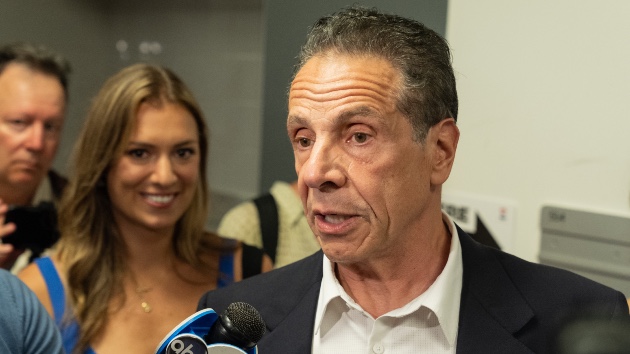
(NEW YORK) — Former New York Gov. Andrew Cuomo will stay on the New York City mayoral ballot in November on the independent ballot line that he qualified for, a source close to the campaign confirmed to ABC News.
Cuomo qualified in May to run on the “Fight and Deliver” ballot line in the general election through an independent nominating petition submitted to the New York City Board of Elections, which at the time he said was meant to reach voters disillusioned with the Democratic Party. He would have been allowed to appear on both the Democratic Party and “Fight and Deliver” lines on the general election ballot if he had won the Democratic primary.
CNN first reported on Thursday night that Cuomo, who conceded to state assemblymember Zohran Mamdani in the Democratic primary for New York City mayor on Tuesday, would not withdraw from the independent ballot line but had not yet decided whether to actively campaign in the coming months.
In a speech to supporters Tuesday night, Cuomo told supporters, “Tonight was not our night; tonight was Assemblyman Mamdani’s night… He deserved it. He won. We’re going to take a look and make some decisions.”
Candidates have until the end of Friday, June 27 to withdraw from running on an independent ballot line they qualified for, according to the New York State Board of Elections calendar. A source close to the campaign told ABC News on Thursday that the former governor is looking at all of the data, including that the New York City Board of Elections would only start releasing ranked-choice voting tabulations on July 1.
Cuomo told CBS 2 New York on Wednesday, “So I have that independent line. I qualified for that. And I’m on that line in November. And we’re going to be looking at the numbers that come in from the primary. And then we have to look at the landscape in the general election, which is a totally different landscape.”
He added later, “We’ll take it one step at a time because we haven’t even gotten the [full] numbers yet from the primary election, and we have some time.” Cuomo’s run for mayor comes four years after he resigned as governor after several women accused him of sexual harassment and inappropriate conduct. He has denied the allegations and recently told The New York Times he regrets resigning.
On Thursday, incumbent Democratic Mayor Eric Adams, who’s also running as an independent in the general election, officially kicked off his reelection campaign.
Republican candidate Curtis Sliwa and independent candidate Jim Walden will also be on the ballot in November.
(WASHINGTON) — Despite a setback to President Donald Trump’s megabill Thursday morning, the president is set to hold an event in the East Room of the White House to rally Republicans behind his tax legislation.
“Later this afternoon, here at the White House, the president will host a ‘One Big, Beautiful Event’ in the East Room to rally Republicans to get the one big, beautiful bill across the finish line. At that event, he will be joined by everyday Americans from across the country, who will massively benefit from the common-sense policies and provisions within this bill,” White House press secretary Karoline Leavitt said during the briefing Thursday afternoon.
Among the special guests expected at the event are delivery drivers, a barber from Arkansas, law enforcement officers and Border Patrol agents, Leavitt added. Border czar Tom Homan is also expected to deliver remarks.
This event will “show the American people how this bill works for them and how there are provisions in this bill that will change their lives,” she said.
Earlier Thursday, the Senate parliamentarian rejected key Medicaid provisions in the bill — a major blow to Senate Republicans and their plan to slash costs in the budget package.
When asked if there is enough time for Congress to work through the issues that come up with the parliamentarian’s ruling, the White House remained adamant that the president expects to sign it next week on Independence Day.
“We expect that bill to be on the president’s desk for signature by July Fourth. I know that there was a ruling by the Senate parliamentarian this morning. Look, this is part of the process. This is part of the inner workings of the United States Senate. But the president is adamant about seeing this bill on his desk here at the White House by Independence Day,” she said.
This comes as frustrated Republican senators balked at the parliamentarian’s ruling — with some seeking to rework the language in order to get it passed.
When asked what the president is doing to push his legislation across the finish line, Leavitt indicated that the president is hosting meetings at the White House.
(WASHINGTON) — “We didn’t do it for recognition. We did it out of duty to one another and to our country.”
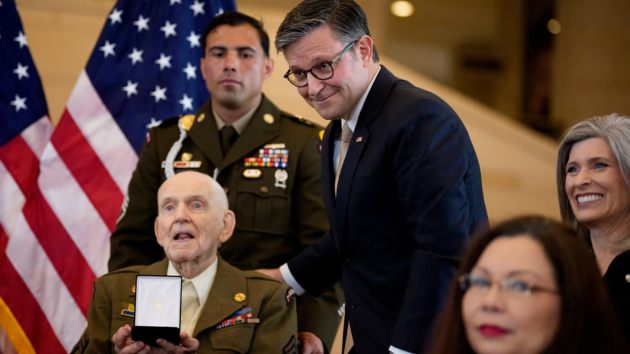
Those are the humble words of Pfc. John Wardell, 99, as he and U.S. Army Ranger veterans from World War II were honored with the Congressional Gold Medal on Thursday.
“To be a Ranger is to live by a code: Courage. Sacrifice. Resolve,” Wardell said. “That legacy lives on in every Ranger who follows. Our motto has stood the test of time, and it always will. Rangers lead the way!”
Wardell, who served in E Company, 2nd Ranger Battalion, joined Sgt. Joe Drake as two of five surviving Army Rangers — among more than 6,500 who served in WWII — for a patriotic ceremony in Emancipation Hall at the U.S. Capitol.
“On behalf of all the Rangers, I accept this special award,” Drake, 100, said. “I’d like to thank each member of this Congress for giving me and every Ranger this extraordinary award.”
The Congressional Gold Medal, which is struck from 24-karat gold, is the highest civilian award given by Congress to people who have made a major and long-standing impact on American history and culture.
“This band of brothers is so deserving, and this day, to be frank, is long overdue,” House Speaker Mike Johnson said. “They formed the spearhead of American special operations in the Second World War, and today, we express our most profound gratitude for their courageous contributions with the highest honor that this body can bestow, and that is the Congressional Gold Medal.”
Today marked the 159th time that Congress has awarded the medal. Ranging from its first recipient George Washington to Robert Frost, Walt Disney, Rosa Parks and the Tuskegee Airmen, Speaker Johnson remarked the U.S. Army Rangers who served in World War II came from “every corner of American life,” from welders and waiters to factory hands and musicians.
“There were ordinary men called to extraordinary valor, who stared death in the face and by the grace of God, achieved the incredible and defended freedom,” Johnson said. “They were America’s best.”
That sentiment was bipartisan, as congressional leaders and military officials honored the Rangers.
“What the Army Rangers achieved in Normandy, they did again and again and again throughout the war, across every theater, against overwhelming odds,” Senate Minority Leader Chuck Schumer said. “With the fate of the free world on the line, Army Rangers led the way.”
It was during the D-Day invasion on the beaches of Normandy in France that the Rangers gained their motto.
Following the United States’ strikes against Iran’s nuclear sites last weekend and a trip with President Donald Trump to a NATO summit at The Hague earlier this week, Secretary of Defense Pete Hegseth appeared at the ceremony, as did Gen. Dan Caine, the chairman of the Joint Chiefs of Staff.
“Today we celebrate real heroes,” Hegseth said. “We point the spotlight exactly where it deserves to go.”
“It is altogether fitting and proper that we are here today honoring these two men and the other three at home, and all the Army Rangers of World War Two and all generations who’ve been willing to put it all on the line for the rest of us,” Hegseth said. “There are heroes among us, ordinary people who did extraordinary things.”
(WASHINGTON) — Defense Secretary Pete Hegseth on Thursday said the U.S. military bomb strikes on three Iranian nuclear facilities had “significantly damaged [Iran’s] nuclear program” and “set it back by years” in a confrontational news conference called to counter an early intelligence assessment from the Defense Intelligence Agency that said Iran’s program had been set back only by months.
Hegseth described news reports about the leaked DIA report as “half-truths” intended “to cause doubt and manipulate” and instead said he would focus on what he called the “bottom line” of Saturday’s strikes involving seven B-2 stealth bombers that dropped 14 massive ordnance penetrators on two of the three Iranian sites.
“President Trump directed the most complex and secretive military operation in history, and it was a resounding success, resulting in a ceasefire agreement and the end of the 12-day war” in Iran, Hegseth said.
“Because of decisive military action, President Trump created the conditions to end the war, decimating – choose your word – obliterating, destroying Iran’s nuclear capabilities.”
Asked twice during the briefing about enriched uranium that may have been moved from nuclear sites before the attack — a key outstanding question as the intelligence community assesses post-strike realities — Hegseth said the Pentagon was “watching every aspect” and did not say the U.S. believed it was under rubble at the sites.
But he said he hasn’t reviewed any intelligence “that says things were not where they were supposed to be,” whether “moved or otherwise.”
The director general of the UN’s nuclear oversight agency, Rafael Grossi, has said he believes the material was moved from the sites before the attacks.
Hegseth lashed out against news media reporting about the early DIA assessment and said it was a “re-strike report” intended to gauge whether a site would need to be hit again.
Gen. Dan Caine, chairman of the Joint Chiefs of Staff, standing next Hegseth, referred questions about damage assessments to the intelligence community.
Hegseth said Caine told him in the White House Situation Room “that the first reports are almost always wrong.”
“They’re almost always incomplete,” he said Caine told him.
The defense secretary appeared to read from the preliminary DIA assessment that he said “admits itself, in writing, that it requires weeks to accumulate the necessary data to make” the assessment it made.
That assessment was made with “low confidence,” according to Hegseth, and was not coordinated with the broader intelligence community.
Hegseth said the DIA report was based on a “linchpin assumption,” which, he said, means “your entire premise is predicated on a linchpin” and “if you’re wrong, everything else is wrong.”
Caine, who had noticeably refrained from repeat Presdient Trump’s “obliterated” claim at a Sunday news conference the morning after the strikes, told reporters Thursday that “the Joint Force does not do [battle damage assessments] … the intelligence community does.”
Instead, he focused on tactical details and seemingly described a mission that unfolded without a hitch.
Describing “what we know,” Caine said “the weapons functioned as designed, meaning they exploded.” Planners “accounted for everything,” the chairman said.
“We know that the trailing jets saw the first weapons function and the pilots stated, quote, ‘This was the brightest explosion that I’ve ever seen. It literally looked like daylight.'”
Hegseth told reporters it was “my lane” as the top civilian leader at the Defense Department, to “do politics.” He said it was part of his job to “translate and talk about those types of things.”
“So, I can use the word ‘obliterated.’ He could use ‘defeat, destroyed,’ [and] assess all of those things.”
When asked, “Have you been pressured to change your assessment or give a more rosy intelligence assessment to us by any political factors, whether it’s the president or the secretary? And if you were, would you do that?” Caine said that was an “easy” question to answer.
“I’ve never been pressured by the president or the secretary, to do anything other than tell them exactly what I’m thinking,” he said. “And that’s exactly what I’ve done.”
(WASHINGTON) — Many Republican senators dismissed the idea of overruling the Senate parliamentarian after she rejected key Medicaid provisions in Trump’s tax and immigration bill Thursday, which dealt a blow to Republicans’ plan to slash costs in the budget package.
This sentiment comes as Senate Majority Leader John Thune has said for months that he was opposed to going against the Senate’s rule enforcer.
Senate Parliamentarian Elizabeth MacDonough on Thursday denied the GOP plan to cap states’ ability to collect more federal Medicaid funding through health care care provider taxes — a controversial provision that would have funded much of the bill’s tax cuts. Most of the savings in the bill came from the changes in Medicaid.
MacDonough’s ruling means that Senate Republicans will need to retool the provision or scrap it entirely if they want to move forward with attempting to pass the bill using only GOP votes.
The ruling is a major setback for Republican leadership, who are under pressure to expeditiously move it to the Senate floor to meet Trump’s Fourth of July deadline for passage. This ruling will require potentially major reworks of the bill with relatively little time to accomplish them. And no matter how they change it, leaders are likely to frustrate some faction of the Republican conference, which could imperil the bill’s passage.
A number of Republicans said on Thursday morning that they’d work to tweak language in the bill and send it back to MacDonough for review — but would not overrule her. It’s also unlikely that the Senate would move forward with the bill without the provider tax provisions, some said.
The Senate has “no intention of overruling her,” Republican Sen. Lindsey Graham said of MacDonough. “But I think we’ll take another shot.”
Other Republican senators said that this will delay the timeline for passing the bill, which was set to move through the chamber this weekend.
“I think we’ll make another run at it … my guess is that they’ll continue to work,” Republican Sen. Eric Schmitt said.
“Yeah, could push [the timeline] back,” Schmitt said about MacDonough’s ruling. “We’ll see. But we’re committed to being here through the weekend, so I don’t think it changes that overall time frame.”
Republican Sen. Rick Scott said MacDonough’s ruling is “pretty frustrating,” but rejected the idea that the Senate would overrule the parliamentarian.
“What we’ve got to do is work through this process and come up with something that fulfills the Trump agenda — also has fiscal sanity. So I’m going to keep working hard to do that,” Scott said, adding he’s “optimistic” it can be accomplished.
Republican Sen. John Kennedy stated clearly that “we would never overrule the parliamentarian.”
Other Republicans, however, fumed over the parliamentarian and her ruling.
Republican Sen. Tommy Tubberville came out brashly against MacDonough — calling for Thune to fire her “ASAP” and accused her of being partisan. He did not mention overruling her, however.
“The WOKE Senate Parliamentarian, who was appointed by Harry Reid and advised Al Gore, just STRUCK DOWN a provision BANNING illegals from stealing Medicaid from American citizens. This is a perfect example of why Americans hate THE SWAMP,” Tubberville said in a post on X.
“Unelected bureaucrats think they know better than U.S. Congressmen who are elected BY THE PEOPLE. Her job is not to push a woke agenda. THE SENATE PARLIAMENTARIAN SHOULD BE FIRED ASAP,” he added.
Republican Sen. Markwayne Mullin suggested that MacDonough made her rulings as part of a “political decision.”
“I’m concerned about the parliamentarian’s ability to make these decisions,” Mullin said.
He later added, “If it’s a political decision on [her] part, then that’s not OK.”
The provider tax credit provisions had been emerging as a thorn in leadership’s side even before MacDonough’s ruling.
For days, a small but critical faction of the Senate GOP conference has been raising major flags about the way this cut to states’ Medicaid revenue might kneecap rural hospitals in their states. A number of Republicans in the Senate were threatening to withhold their votes for the package because of these changes to the provider tax, so for that group, MacDonough’s ruling is likely a welcome one.
If changes are made to the Medicaid provision to accommodate MacDonough’s ruling, all eyes will be on a handful of Senate Republicans. Some changes could be deal breakers for those whose vote is critical to moving the bill over the finish line.
Last weekend, MacDonough carefully scrutinized the House-passed bill for possible violations of the Senate’s rules. She has already issued a number of decisions that Democrats are touting as major victories.
This review, called the Byrd Bath — named after the late Sen. Robert Byrd, who helped institute the rules governing budget reconciliation packages, is still underway in the Senate.
Any provision that MacDonough rules out of order with the Senate’s rules will have to be stripped or else the legislation will be subject to the 60-vote threshold in the Senate. Republicans need to avoid this, or they won’t be able to pass the bill.
(FORT WORTH, Texas) — A man was sentenced to 60 years in prison on Thursday for murdering a Texas college student in a random shooting in 2023.
Wes Smith, a 21-year-old junior at Texas Christian University, was shot multiple times outside a Fort Worth bar in September 2023, prosecutors said.
Matthew Purdy, 23, pleaded guilty to his murder during a hearing in Tarrant County on Thursday. A judge then sentenced him to 60 years, under the terms of a plea agreement.
Smith’s parents addressed the court during Thursday’s hearing.
“Your actions caused catastrophic, monumental mourning by thousands of people,” his father, Philip Smith, said while addressing the defendant, saying he believed Purdy has a “dark and ugly soul, if you have any soul at all.”
He remembered his son as a “beautiful human being” who had a great laugh and quick wit.
“He was a true leader of people,” Philip Smith said. “He was a gifted athlete. He was an honor student. He was a loved son. He was a cherished brother.”
His mother, Dorree Smith, remembered him as a “competitor to the core in a way that encouraged and brought out the best in everyone.”
“He thought being a mentor was so important, along with putting others before yourself and serving others however needed,” she said. “He wasn’t perfect, but he was striving for growth, building a foundation and leaving warmth and laughter in his wake.”
She said her son’s last evening was spent doing the two things he loved most — football and mentoring young athletes, while helping coach middle school students — before heading to a bar to meet up with friends.
He was helping women find safe rides home when he was shot, she said.
Addressing Purdy directly, she said, “You didn’t know Wes. You never met him. But in that moment, you made a devastating, evil choice. You decided you mattered more than he did. And you took Wes’ earthly life. And now Wes’ loss is not just a personal loss but a communal wound.”
The shooting occurred in Fort Worth’s West 7th entertainment district shortly after 1 a.m. local time on Sept. 1, 2023.
An officer patrolling the district heard gunshots and found Smith suffering from multiple gunshot wounds, according to the affidavit. Smith was transported to a local hospital, where he was pronounced dead a short time later.
The gunman hit another TCU student who was fleeing the scene in the back of the head with the gun, causing a laceration, according to the affidavit.
Purdy was arrested two blocks from the bar and admitted to shooting Smith three times for no discernible reason, according to the affidavit. He told police he didn’t shoot the other TCU student “because he ran out of bullets,” prosecutors said.
After being read his rights, Purdy agreed to provide a statement, in which he “admitted to approaching Wes, who he didn’t know and shooting him three times” in the stomach, shoulder and back of the head after he fell, the affidavit stated.
“Matthew could not provide a clear reason as to why he shot Wes,” the affidavit stated, noting that Purdy asked the victim if he knew his father, who was assaulted in the past in the area, before shooting him.
Purdy also pleaded guilty Thursday to aggravated assault for pistol-whipping the other TCU student and was sentenced to 20 years in prison. In a police interview, he said he didn’t shoot her because he ran out of bullets.
He was additionally sentenced on eight other felony charges, for a total of 206 years in prison. The sentences will run concurrently, the Tarrant County District Attorney’s Office said.
His trial had been scheduled to start in July. ABC News has reached out to his attorney for comment but did not immediately receive a response.
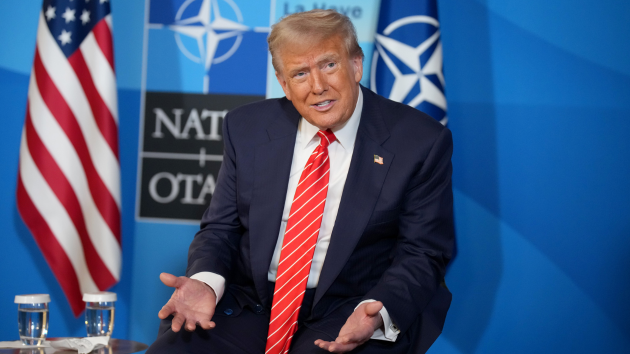
(WASHINGTON) — President Donald Trump on Thursday offered enthusiastic praise of Defense Secretary Pete Hegseth’s briefing at the Pentagon, where he provided more information about the U.S. strikes on Iran and defended the president.
“One of the greatest, most professional, and most ‘confirming’ News Conferences I have ever seen! The Fake News should fire everyone involved in this Witch Hunt, and apologize to our great warriors, and everyone else!” Trump wrote on his conservative social media platform, where earlier he had encouraged followers to tune in.
Hegseth’s news conference came amid a full-court press from Trump’s top officials dispute a preliminary U.S. intelligence assessment that said the bombings may have only set it back by a few months.
“You want to call it destroyed. You want to call it defeated. You want to call it obliterated. Choose your word. This was an historically successful attack and we should celebrate as Americans,” a defiant Hegseth said from the podium as he railed against the news media coverage of the events and the leaked initial intelligence assessment.
“This is preliminary but leaked because someone had an agenda to try to muddy the waters and make it look like this historic strike wasn’t successful,” he said.
“Classified information is leaked or peddled for political purposes to try to make the president look bad,” he added.
The day prior, CIA Director John Ratcliffe and Director of National Intelligence Tulsi Gabbard posted statements saying their intelligence supported Trump’s description of the damage inflicted by the U.S. military operation.
“CIA can confirm that a body of credible intelligence indicates Iran’s Nuclear Program has been severely damaged by the recent, targeted strikes,” Ratcliffe wrote in a statement.
Gabbard wrote on X: “New intelligence confirms what @POTUS has stated numerous times: Iran’s nuclear facilities have been destroyed. If the Iranians chose to rebuild, they would have to rebuild all three facilities (Natanz, Fordow, Esfahan) entirely, which would likely take years to do.”
Joint Chiefs Chairman Gen. Dan Caine, who on Sunday had said it was “way too early” to make complete damage assessments, at Thursday’s news conference declined to give a detailed assessment.
“By design, we don’t grade our own homework. The intelligence community does,” Caine said.
“But here’s what we know following the attacks and the strikes on Fordo,” Caine continued. “First, that the weapons were built, tested and loaded properly. Two, the weapons were released on speed and on parameters. Three, the weapons all guided to their intended targets and to their intended aim points. Four, the weapons functioned as designed, meaning they exploded.”
“We know this through other means, intelligence means that we have that we were visibly able to see them,” Caine added. “And we know that the trailing jets saw the first weapons function and the pilots stated quote this was the brightest explosion that I’ve ever seen. It literally looked like daylight.'”
Caine was asked if he felt any political pressure on how to describe the strikes or their impact. “No, I have not, and no, I would not,” Caine responded.
Hegseth momentarily interrupted the questioning.
“The chairman here, who’s not involved in politics, he doesn’t do politics. That’s my lane — to understand and translate and talk about those types of things. So, I can use the word ‘obliterated,'” Hegseth said, the term Trump has used repeatedly.
Still, several questions remain not fully answered, particularly how far exactly the strikes set back Iran’s nuclear capabilities and whether Iran was able to move uranium away from the Fordo site before the bombings.
Hegseth and Caine were asked about the uranium during their 45-minute news conference. Neither provided a clear answer.
Hegseth first attacked the news reporter who asked the question, before saying: “We’re looking at all aspects of intelligence and making sure we have a sense of what was where.”
President Trump, who was watching the news conference, took to his social media account to weigh in on speculation that Iran may have moved uranium because of satellite images showing trucks lined up at Fordo in the days leading up to the attack.
“The cars and small trucks at the site were those of concrete workers trying to cover up the top of the shafts. Nothing was taken out of facility. Would take too long, too dangerous, and very heavy and hard to move!” Trump wrote on his social media site.
(WASHINGTON) — The Advisory Committee on Immunization Practices (ACIP), made up of members recently hand-selected by Health and Human Services Secretary Robert F. Kennedy Jr., voted 5-1 on Thursday to recommend against flu vaccines containing the preservative thimerosal.
One committee member, Vicky Pebsworth, abstained on each vote.
A few moments before, the CDC’s vaccine advisory committee voted 6-0 to recommend all Americans aged 6 months and older receive an annual influenza vaccine.
This is a developing story. Please check back for updates.
“On behalf of my children and myself, I want to express our deepest sympathies to the Hortman and Hoffman families,” Jenny Boelter said in a statement released by her attorneys on Thursday. “We are absolutely shocked, heartbroken and completely blindsided.”
“It is a betrayal of everything we hold true as tenets of our Christian faith,” she continued. “We are appalled and horrified by what occurred and our hearts are incredibly heavy for the victims of this unfathomable tragedy.”
When Vance Boelter allegedly fled the Hortmans’ home, sparking a massive manhunt, investigators recovered a list of about 45 elected officials in notebooks in his car, according to prosecutors. Two other lawmakers were spared the night of the shootings, officials said.
Jenny Boelter stressed in her statement that her family has cooperated with law enforcement from the start. She said when the authorities called her on the morning of June 14, she immediately drove to meet them.
“We voluntarily agreed to meet with them, answer their questions, provide all items they requested, and cooperate with all searches,” she said.
Hours after the shootings, Vance Boelter allegedly texted his family, “Dad went to war last night … I don’t wanna say more because I don’t want to implicate anybody,” according to an affidavit. He also allegedly texted his wife, “Words are not gonna explain how sorry I am for this situation … there’s gonna be some people coming to the house armed and trigger-happy and I don’t want you guys around.”
In a search of Jenny Boelter’s car, law enforcement recovered at least one gun, about $10,000 in cash and family passports, the affidavit said.
After a nearly 48 hour manhunt, Vance Boelter was apprehended without incident.
“We thank law enforcement for apprehending Vance and protecting others from further harm,” Jenny Boelter said at the conclusion of her statement.
Vance Boelter faces federal charges including stalking and state charges including first-degree murder. He has not entered a plea and is due in court on Friday for a preliminary hearing.
ABC News’ Christiane Cordero contributed to this report.