(CHEROKEE COUNTY, N.C.) — A North Carolina detention officer was fatally shot during a “scuffle” at a medical facility after a federal inmate who had been taken to the facility for treatment managed to seize his weapon, authorities said.
The inmate was apprehended after fleeing in a stolen vehicle and now faces a murder charge, according to Cherokee County Sheriff Dustin Smith.
“This has probably been one of the worst days of my career,” Smith said during a press briefing Monday evening. “This is a tough day for law enforcement for Cherokee County.”
The inmate — identified as 48-year-old Kelvin Simmons — had been transported to a medical facility for orthopedic treatment after he complained of foot pain, according to Smith.
Two detention officers were escorting Simmons — a heightened protocol after the inmate had previously attempted a failed escape from the Cherokee County detention center last year, Smith said.
One of the officers, 56-year-old Francisco Flattes, was shot at the medical facility, the sheriff said.
“There was a scuffle, and that’s when the officer’s weapon was taken from him,” Smith said.
Flattes was rushed to the hospital, where he was pronounced dead. The other officer, George Feinauer, was injured during the incident but is expected to recover, Smith said.
Simmons is then accused of carjacking a vehicle from someone who was at the medical facility and fleeing the scene. He was later apprehended in Macon County, North Carolina. No one else was in the vehicle. He was transported to a hospital in the area after complaining of foot pain, the sheriff said.
Simmons is a federal inmate who was being housed in Cherokee County on bank robbery charges, according to Smith. Online records show he pleaded guilty to bank robbery by force or violence and motor vehicle theft in 2023 but has not yet been sentenced.
Simmons also faces escape charges after attempting to break out of the Cherokee County detention center in October 2024 by climbing over a fence, according to Smith.
He is going to be charged with first-degree murder in Flattes’ death, according to the local district attorney, Ashley Hornsby Welch.
“We anticipate that more charges will be forthcoming,” she said at the briefing. “We’ve also been in contact with the United States Attorney’s Office, and I do believe that charges are likely coming from them as well.”
Flattes had been with the sheriff’s office for four years, Smith said. His wife also works for the Cherokee County detention center and his son-in-law works for the sheriff’s office.
“I just ask that you pray for our office, for Officer Flattes’ family,” Smith said.
(WASHINGTON) — President Donald Trump is traveling to the new “Alligator Alcatraz” migrant detention center in Florida’s Everglades on Tuesday.
“We’re going out to Alligator Alcatraz. It’s the East Coast version, and it should be very exciting, very good,” Trump said as he left the White House on Tuesday morning. “Worked very hard on it with Ron [DeSantis] and everybody, and I think it’s going to be great.”
The Trump administration is turning the remote Dade-Collier Training and Transition Airport into a facility that officials say will eventually hold up to 5,000 people. Officials say operations will start on Tuesday. The facility is part of Trump’s efforts to ramp up deportations by expanding detention capacity. The president has already sent migrants to Guantánamo Bay and the mega-prison in El Salvador.
Leavitt said Trump’s visit will be a chance for the president to tout the funding for more detention facilities and efforts to enact Trump’s mass deportation policy that are in his megabill that the Senate could vote on Tuesday before sending to the House before Trump’s Fourth of July deadline.
“I think his trip to this detention facility actually underscores the need to pass the One Big, Beautiful Bill because we need more detention facilities across the country,” Leavitt said.
A source familiar with the planning tells ABC it will cost Florida $450 million a year, and officials say some of that money will be reimbursed from FEMA’s Shelter and Services Program.
Leavitt described the facility’s remote location in her briefing on Monday.
“There’s only one road leading in, and the only way out is a one-way flight,” she said. “It is isolated and surrounded by dangerous wildlife and unforgiving terrain. The facility will have up to 5,000 beds to house, process and deport criminal illegal aliens.”
“This is an efficient and low-cost way to help carry out the largest mass deportation campaign in American history,” Leavitt added.
When asked about the remote and dangerous location, Leavitt said that it was a feature of the facility to help prevent detainees from escaping.
“Well look, when you have illegal murderers and rapists and heinous criminals in a detention facility surrounded by alligators, yes, I do think that’s a deterrent for them to try to escape,” she said. “We do know that some of these illegal criminals have escaped from other detention facilities, like one in New Jersey, which I know was recently reported on. So, of course, we want to keep the American people safe, and we want to remove these public safety threats from our streets, and we want to effectively detain them as best as we can.”
Florida Attorney General James Uthmeier posted on X that the facility is a “one stop shop” to carry out Trump’s mass deportation agenda, claiming the location saves money on security since it’s surrounded by dangerous animals.
“You don’t need to invest that much in the perimeter. People get out, there’s not much waiting for them other than alligators and pythons. Nowhere to go, nowhere to hide,” Uthmeier posted.
Among officials who will join Trump at the facility are Department of Homeland Security Secretary Kristi Noem, Florida Gov. Ron DeSantis and Florida Congressman Byron Donalds.
In a statement released Monday, Noem said, “Alligator Alcatraz, and other facilities like it, will give us the capability to lock up some of the worst scumbags who entered our country under the previous administration. We will expand facilities and bed space in just days, thanks to our partnership with Florida. Make America safe again.”
DeSantis touted the facility last week as “as safe and secure as you can be.”
Environmental groups are suing to stop construction, alleging the government violated the Endangered Species Act by building on protected land.
Protesters gathered along the highway that cuts through the Everglades to demonstrate on Saturday. They included environmental activists and Native Americans advocating for their ancestral homelands. Others demonstrated against the treatment of migrants.
destroyed house caused by Noto Peninsula earthquake on New Year’s Day 2025/ Buddhika Weerasinghe/Getty Images)
(HONG KONG) — Some believe she foretold the devastating 2011 tsunami in Japan that killed more than 15,000 people and urban legend goes she also predicted the COVID-19 pandemic. Now, another premonition of a major disaster from manga artist Ryo Tatsuki is about to hit its alleged due date, spooking tourists in Asia and even causing some cancelled flights.
Social media is abuzz with Tatsuki’s prophecy of a catastrophic earthquake and tsunami wrecking her home country of Japan — a place prone to natural disasters but also a top destination for many in Asia — sometime between July 5 and 7.
In a 1999 Japanese comic book, also known as manga, Tatsuki wrote of a “great disaster” striking in March 2011. That same month, a 9.0 magnitude earthquake triggered a deadly tsunami, causing a meltdown at the Fukushima nuclear plant, leading to one of the biggest nuclear disasters in history.
Tatsuki updated her book, titled “The Future I Saw,” in 2021, claiming that “the real catastrophe” was due in July this year.
The predictions have irked local officials, with one local governor calling it a “serious issue” that “unscientific rumors are impacting tourism.”
Seismologists say there is no scientific basis for these predictions and, in a post on X last month, the Japanese Cabinet Office Disaster Prevention Division said that “with current scientific knowledge, it is difficult to predict an earthquake by specifying its date, time and location,” adding that “earthquakes can occur at any time.”
But with other psychics sharing warnings similar to Tatsuki’s foretelling, some travelers are getting cold feet, cancelling trips and prompting travel agencies to incentivize Japan-bound journeys by offering discounts.
Demand has plummeted so much that regional carrier Hong Kong Airlines cancelled all its flights to the southern Japanese prefectures of Kagoshima and Kumamoto in July and August.
However, statistics released by Japan’s National Tourism Organization in May showed that overall inbound tourism remains strong this year for the country.
(WASHINGTON) — Republican Sen. Ron Johnson of Wisconsin — a staunch deficit hawk has been critical of President Donald Trump’s sweeping tax and immigration bill — signaled Monday that he would back the bill when it comes to a vote.
On Saturday Johnson flipped his vote to support a motion to move the One Big Beautiful Bill Act to the Senate floor only after huddling with Republican leaders about further reductions to the federal debt.
CNN’s Jake Tapper prompted Johnson to say he was a yes vote on the bill, to which the senator corrected him, saying he was “a yes on the motion to proceed” and “hopefully” add a provision that would prevent new enrollees in Medicaid expansion states from receiving Federal Medical Assistance Percentage (FMAP) if they are are not disabled and don’t have dependent children.
Johnson then pivoted to signal his support for the final bill, which will come to a floor vote when an ongoing vote-a-rama wraps up.
“This is about as good as we can get. I don’t like it. I would like to get a lot more. But at some point in time you have to recognize reality. And if we don’t pass this bill, we have a massive $4 trillion tax increase,” Johnson said.
The FMAP amendment, led by fellow conservative holdout Sen. Rick Scott of Florida, had not yet been considered Monday evening.
The Senate plowed ahead toward a final vote on the bill as Republicans rush to get it across the finish line by July 4, with lawmakers voting on amendments through the night into Tuesday morning.
The self-imposed deadline by Trump meant a rare weekend session for lawmakers, one filled with partisan drama and some GOP infighting.
On Monday morning, senators began the “vote-a-rama” — a series of votes on proposed amendments to the megabill.
There is no limit to the number of amendments lawmakers can seek. Senate Minority Leader Chuck Schumer, the chamber’s top Democrat, promised his party would bring amendment after amendment during the marathon session. Democrats forced a reading of the 940-page bill over the weekend, which took nearly 16 hours. “Every senator will soon have an opportunity to reject this nonsense and vote for common-sense budgeting. Americans will be watching,” Schumer said on Monday as he slammed Trump’s bill as a break for billionaires that will hurt working-class families.
Democrats used the early hours of the vote-a-rama to force votes highlighting cuts the megabill makes to Medicaid, SNAP and rural hospitals and to hammer Republicans on the tax cuts they say the measure gives to the wealthiest Americans.
The Senate voted down, 47-53, an amendment led by Schumer that he said would have undone “the travesty that is at the core of the Republican bill.”
“Their bill the so-called big beautiful bill, which is really a big, ugly betrayal, cuts taxes for billionaires by taking away health care for millions of people. So what my amendment simply says, if people’s health care costs go up, the billionaire tax cuts vanish,” Schumer said.
Democratic Sen. Ed Markey’s effort to strip provisions that would negatively impact rural hospitals due to cuts to Medicaid also failed, but did receive the support of two Republicans: Sens. Lisa Murkowski of Alaska and Susan Collins of Maine.
The two moderate Republicans, who both have a history of voting across party lines, have raised concerns about how cuts to Medicaid and SNAP would hit their constituents. In total, Murkowski supported five Democratic-led measures in the ongoing vote-a-rama and Collins supported four.
Collins proposed her own amendment that aimed to increase the amount of money in the rural hospital relief fund. It failed by a vote of 22-78, with Collins subsequently criticizing what she called the “hypocritical approach” of the Democrats that voted against it.
Sen. Amy Klobuchar, the top Democrat on the Senate Agriculture committee, argued that the SNAP provisions in the bill creates “chaos for state budgets and hardship for families” and violate budget rules. Her motion related to SNAP was waived by Republicans.
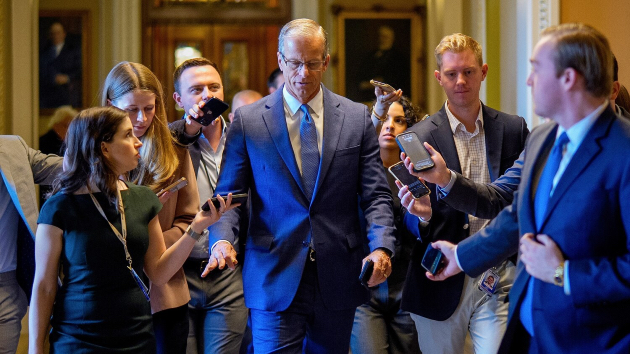
Senate Majority Leader John Thune defended the bill as delivering Trump’s campaign promises to eliminate tax on tips and overtime pay while boosting spending for defense and border security.
“It’s been a long debate,” Thune said in his own floor remarks ahead of the votes on amendments. “I know people are weary. But at the end of the day, we want to get this done so that this country is safer and stronger and more prosperous, not only for today but for future generations of Americans.”
So far, Republicans have defeated all Democratic efforts to modify or reconsider the bill — but the session ran into Tuesday morning.
As he walked off the floor in the early hours of Tuesday, Thune was asked if he could pull the bill back or if he may be forced to hold a final passage vote on the bill, even if he knows it will fail.
“Those are options I don’t want to have to worry about,” Thune replied.
Senate Finance Committee chairman Mike Crapo, a Republican, argued against several of the Democratic amendments.
“The reality is, the reforms we are putting into place are to try to reign in control of wasteful and fraudulent and abusive spending that actually diverts resources away from the people who these programs really deserve to receive,” Crapo said of Schumer’s amendment on Medicaid.
The vote-a-rama is the last hurdle before a vote on final passage of the bill in the Senate.
There is little room for error in the Republican-controlled chamber. A procedural vote on Saturday night to open debate on the bill narrowly passed in a 51-49 vote after two Republican defections.
GOP Sens. Rand Paul of Kentucky and Thom Tillis of North Carolina voted against advancing the bill. Tillis railed against the changes to Medicaid in the bill, saying it would hurt his constituents and would represent a betrayal of Trump’s promise not to touch the entitlement program upon which millions of people rely for health care coverage. Tillis’ opposition drew Trump’s ire, with the president threatening to support a primary challenger to the two-term senator. Tillis then suddenly announced he would not seek reelection, saying later he texted Trump on Saturday night suggesting he “probably needed to start looking for a replacement.”
“I respect President Trump. I support the majority of his agenda, but I don’t bow to anybody. When the people of North Carolina are at risk. And this bill puts them at risk,” Tillis said.
As of early Tuesday morning, the GOP leadership were still pushing for sufficient support.
One of the main targets was Murkowski, whose indecision came after reports that the Senate parliamentarian may have ruled some carve out provisions meant for her home state of Alaska’s Medicaid recipients out of order.
Also under pressure were Scott and Sen. Mike Lee, who were yet to receive a vote on their amendment that strips back additional funding for Medicaid. Collins had also not yet said which way she would vote.
Paul, meanwhile, offered an amendment that would significantly reduce the amount of money attributed to raise to the federal debt limit. The current bill raises the debt limit by $5 trillion dollars. Paul’s amendment would raise it by only $500 billion.
What’s next for OBBB in the House?
If the “One Big Beautiful Bill Act” passes in the Senate, it will have to go back to the House for members to consider the changes made to the bill.
House Republican leaders say Wednesday is the earliest chance for a megabill vote.
“Members are advised that votes are now expected in the House as early as 9 a.m. Wednesday, July 2. Please stay tuned to future updates for additional information regarding this week’s schedule,” a notice from Majority Whip Tom Emmer’s office said.
Speaker Mike Johnson expressed optimism that the Senate’s version of the One Big Beautiful Bill will pass in the GOP-led House despite opposition from moderates and conservatives.
“We’re going to pass this bill one way or the other,” Johnson said leaving the Capitol Monday evening. “And I have prevailed upon my Senate colleagues to please, please, please, put it as close to the House product as possible. I have been very consistent from the very beginning.
Johnson did not rule out passing the Senate version as is and said, “there’s still a lot of amendments, and a lot of game to play.”
Asked if GOP House leaders would make changes to what the Senate sends over, Johnson said, “We’ll see what the final product is. I am very hopeful as always. We will get this job done. We’ll see what happens.”
The speaker did not respond to a question about passing the bill by the Fourth of July deadline.
Republican leaders have told members they will receive 48 hours notice before a vote is called and will have 72 hours to review the bill text.
The House passed the Trump megabill by just one vote back in May. The Senate version of the bill will face an uphill battle in the House, given the GOP’s razor-thin majority.
California moderate Republican Rep. David Valadao said he will vote no given the Medicaid changes in the Senate bill. Several conservatives, including Reps. Chip Roy of Texas, Josh Breechen of Oklahoma and Eric Burlison of Missouri have also expressed opposition to the Senate’s version of the bill.
Johnson and other Republican leaders worked through the weekend to lock down the votes even as several lawmakers have expressed opposition to the Senate’s version, which is still not finalized. Johnson can only afford to lose three defections if all members are voting and present.
White House press secretary Karoline Leavitt said President Trump was working “hand in hand” with Johnson and Thune, and that the two leaders had met with him at the White House earlier Monday.
“Republicans need to stay tough and unified during the home stretch, and we are counting on them to get the job done,” Leavitt said during the White House briefing.
But sources familiar with the matter told ABC News Thune and Johnson have not met with President Trump at the White House, and as of now the two leaders have no current plans to meet with the president on Monday as the “One Big Beautiful Bill Act” progresses in the Senate.
A spokesman for Thune said he is preoccupied as the Senate moves through amendments to the megabill.
“Teams are obviously in close contact/coordination, as always, but we’re continuing to move through vote-a-rama in the Senate as we work to move this bill one step closer to the president’s desk,” the spokesman said in a post on X.
Speaker Johnson is in Washington working through House members’ concerns as the Senate works through the bill, including several provisions that could spell problems later in the week if the bill is sent back to the House.
ABC News’ John Parkinson contributed to this report.
(NEW YORK) — President Donald Trump campaigned for president on the promise of mass deportations that targeted criminals — and while ICE agents have arrested over 38,000 migrants with criminal convictions, new data shows a recent shift toward also arresting those who have not been accused of crimes.
In recent weeks, the Trump administration has arrested an increasing number of migrants with no criminal convictions, according to an ABC News analysis of Immigration and Customs Enforcement data.
The numbers, which were obtained through a public records lawsuit and released by the Deportation Data Project at the University of California Berkeley, give the first real glimpse of how Trump’s immigration enforcement policy is playing out in the streets.Over the first five months of the Trump administration, ICE has arrested over 95,000 individuals, according to data analyzed by ABC’s owned television stations’ data team.
At the start of the administration, ICE tended to target migrants with pending or criminal convictions. From Inauguration Day to May 4, 2025, 44% of those arrested had a criminal conviction, while 34% of those arrested had pending charges and 23% had no criminal history, according to the data.
But beginning May 25, the data appears to show there was a shift in enforcement — with individuals with criminal convictions making up only 30% of those arrested. Those arrested with pending criminal charges accounted for 26% of the individuals arrested and 44% had no criminal history.
“It looks like there’s been a shift from about Memorial Day this year up until now, to an increasing number of people who have been detained who have no criminal charges,” said Austin Kocher, a professor at Syracuse University who reviewed the data.
“We hear a lot about the administration deporting the worst of the worst. And as far as we can tell from all available data up to this point, the data has not really supported that,” Kocher said.
The data is largely divided into three groups of individuals: those who have criminal convictions, those with pending charges, and those who may be facing civil immigration charges, labeled as “other immigration violators.” However, the data provides no indication of what kind of crimes the individuals may be accused or convicted of.
In Los Angeles, where ICE raids recently sparked large demonstrations, and in the New York City area, almost 60% of those arrested by ICE in the first ten days of June had no criminal convictions nor any pending criminal charges, according to the data.
Asked about the shift, Department of Homeland Security Assistant Secretary Tricia McLaughlin told ABC News, “We are not going to disclose law enforcement sensitive intelligence and methods. 70% of the arrests ICE made were of criminal illegal aliens.”
“We are continuing to go after the worst of the worst — including gang members, pedophiles, and rapists,” McLaughlin said. “Under Secretary [Kristi] Noem, we are delivering on President Trump’s and the American people’s mandate to arrest and deport criminal illegal aliens and make America safe.”
The majority of administration’s migrant arrests have taken place in Texas, the state with the longest southern border. But the data also shows that enforcement has largely shifted away from apprehensions at the southern border to apprehensions in the interior of the country.
John Sandweg, the former acting director of ICE under President Barack Obama, told ABC News that the shift in enforcement is not a surprise, considering that illegal border crossings are down dramatically.
“For the last probably 15 years at least, the majority of ICE arrests, people booked into ICE custody or ICE apprehensions, were individuals apprehended at the border. But now, the administration is very sensitive to the numbers and has started putting ICE under pressure,” Sandweg said, referring to Trump’s call for more migrants to be deported.
“The problem is that you are now engaged in operations that are, frankly, more likely to find non-criminals than criminals,” Sandweg said.
As ABC News previously reported, ICE’s latest tactic has been arresting individuals at immigration courts. In most cases, when a deportation case is dismissed, it is a positive outcome for a migrant, attorneys told ABC News — but according to immigration attorneys and advocates, immigration enforcement officers have been waiting in immigration court buildings and coordinating with DHS lawyers to arrest migrants promptly after their cases are dismissed, after which the migrants are placed into expedited removal proceedings without allowing them to fight their case.
“If there’s anything that says this isn’t about serious criminal enforcement, it’s this wholesale dismissal of cases of the people who are showing up in immigration court,” Sandweg said. “I mean, you want to find the place where you’re least likely to find dangerous criminals — it’s the people who show up for their immigration court hearings.”
Sandweg said these new types of enforcement, including courthouse arrests, are being made in an effort to achieve quotas set by the Trump administration.
“It’s another way to just quickly make some arrests,” Sandweg said.
The administration, meanwhile, says it’s continuing its efforts to target accused criminals.
At a press conference on Friday, Attorney General Pam Bondi said federal authorities have arrested 2,711 alleged multinational gang members since Trump re-took office in January.
“You should all feel safer that President Trump can deport all of these gangs and not one district court judge can think they’re emperor over this Trump administration and his executive powers,” she said.
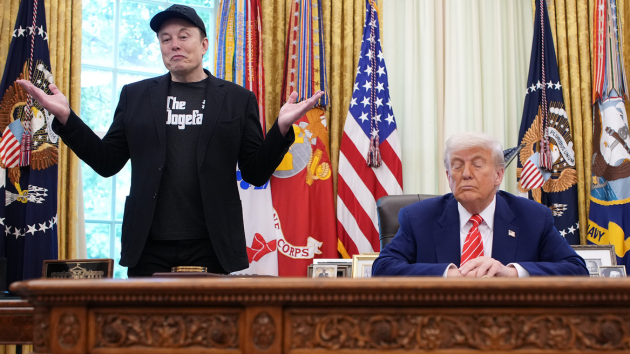
(WASHINGTON) — Elon Musk, the world’s richest man, on Monday said he would back challengers to members of Congress who vote for President Donald Trump’s “big, beautiful bill.”
Musk broke his short-lived X silence about the bill over the weekend, unloading on it for being “utterly insane.” On Monday, Musk criticized “every member of Congress who campaigned on reducing government spending and then immediately voted for the biggest debt increase in history,” vowing that “they will lose their primary next year if it is the last thing I do on this Earth.”
This is a developing story. Please check back for updates.
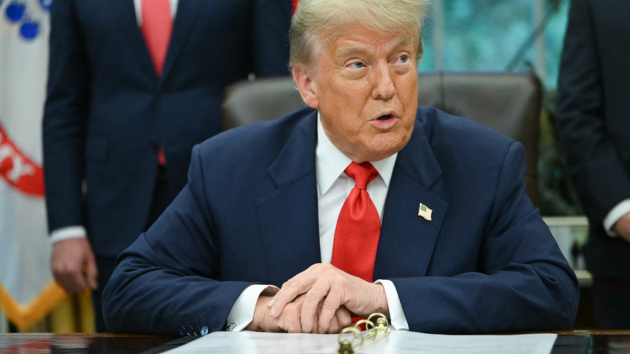
(WASHINGTON) — President Donald Trump on Monday lifted U.S. sanctions on Syria, signing an executive order to carry out a promise he made in May.
White House press secretary Karoline Leavitt told reporters ahead of the signing that Trump’s action was designed to “promote and support the country’s path to stability and peace.”
When he met with Syria’s new president Ahmad al-Sharaa last month, Trump announced he would lift the crippling U.S. sanctions against Syria and urged al-Sharaa to meet specified conditions in hopes that it will stabilize the country.
Those conditions included normalizing relations with Syria’s neighbors, including Israel, as well as the United States.
Ahmad al-Sharaa is a former al-Qaeda insurgent who fought against U.S. forces in Iraq and served time in the infamous Abu Ghraib priso.
Senior Trump administration officials who previewed the president’s action terminating the Syria sanctions program said it would dismantle the architecture of the program established by the executive branch while maintaining provisions targeted at Bashar Al Assad, his collaborators, and other destabilizing forces still at work in the region.
U.S. Ambassador to Turkey and the administration’s Special Envoy for Syria Tom Barrack cast the executive order — which is intended to work in tandem with the general waiver significantly easing sanctions that was issued by the U.S. in May — as a move by the president to “give these guys a chance,” referring to Syria’s interim government.
“You have a general who transitioned from wartime into a position of being the leader of a reframed new country that needs everything, and that’s basically what’s happened, but the vision and the execution was limited by our imposition of sanctions,” he said. “Syria needs to be given a chance, and that’s what’s happened.”
Barrack also said the purpose driving Trump was not to hold leverage over the newly-formed government.
“But one thing is clear, neither the president or the secretary of state is nation building. They’re not dictating, they’re not requiring. They’re not giving the framework of the democratic model that needs to be implemented to their architecture or desire. They’re saying we are going to give you an opportunity. We have a bunch of criteria that we want to watch along the way,” he said, referencing the Abraham Accords, integrating foreign fighters in Syrian society, protecting U.S. allies who fought against ISIS, and other issues.
Brad Smith, the acting under secretary for terrorism and financial intelligence at the Treasury Department, spoke about the more technical aspects of the order and emphasized that it would allow the administration to retain restrictions “where appropriate.”
“The significance of this moment cannot be overstated,” Smith said. “While we remain hopeful for the country’s future and its new government, we are also clear eyed that threats to peace remain, the United States will remain ever vigilant where our interests and security are threatened, and Treasury will not hesitate to use our authorities to protect us and international financial systems.
Abraham Accords
A senior administration official insisted that the Trump administration wasn’t looking to maintain “leverage” over Syrian authorities as it seeks to encourage its leadership to sign onto the Abraham Accords.
“Leverage is not what we’re interested in doing. The president ripped the sanctions off without any conditions,” they said. “It’s to Syria’s benefit to lean towards Israel.”
The senior administration official continued to note that it has been reported that Syria and Israel have been having conversations “on a backchannel basis.”
“So the way to entice them to get to the Abraham accords is to make it fruitful for them on an economic basis, on a on a civilization basis, on a peace and prosperity basis, and that’s all coming together. And what’s happened between Israel and Iran gives that window,” the official said. “So we’re not interested in leveraging them into anything.”
Despite the action Monday and previous suspension of many sanctions against Syria, a senior administration official acknowledged that it may take further action from Congress to permanently lift the penalties.
“We are now — pursuant to the executive order — going to look at suspension criteria for the Caesar Act,” the official said.
The Caesar Syria Civilian Protection Act of 2019 enhanced sanctions on any foreign entity that engaged in significant transactions in the Syrian government. Secretary of State Marco Rubio, back in May, issued a 180-day waiver of the Caesar Act sanctions.
“Ultimately Congress has the power to repeal the act,” the official said on Monday.
(WASHINGTON) — The Justice Department on Monday charged four North Koreans in a brazen scam to pose as IT workers with stolen credentials and use them to get hired by U.S.-based companies and scam those companies out of hundreds of thousands of dollars.
Kim Kwang Jin, Kang Tae Bok, Jong Pong Ju and Chang Nam Il are all allegedly “citizens of North Korea who used stolen and false personally identifiable information to pose as non-North Koreans and thereby obtain employment with technology companies, gain victim companies’ trust, obtain access to virtual currency assets controlled by victim companies, steal those virtual currency assets, and launder the proceeds of that activity.”
Federal authorities in Atlanta, Georgia said that the four allegedly stole $900,000 in cryptocurrency from one company, according to prosecutors, and the scheme has been ongoing since at least 2020.
In one instance, a U.S. company hired who they thought was Malaysian IT worker “Bryan Cho,” but in reality they hired Jong Pong Ju, who was a North Korean bad actor, according to the Justice Department.
Hiring “Byran Cho” also allowed for other North Koreans to be brought into the fold, including Chang Nam Il, the department said.
“On or about March 29, 2022, defendant KIM KW ANG JIN, without Company-1’s knowledge or consent, modified the source code for two smart contracts owned and controlled by Company-1 that resided on the Ethereum and Polygon blockchains. Defendant KIM KW ANG JIN’ s modifications to these smart contracts changed the rules governing the withdrawal of virtual currency from two funding pools controlled by Company-1,” the court record says.
The four are not in the U.S., the department noted.
In total, the Justice Department seized 29 known or suspected “laptop farms” across 16 states, and seized 29 financial accounts used to launder illicit funds and 21 fraudulent websites, and charged four North Korean nationals, six Chinese nationals and two Taiwanese nationals for their involvement in separate information technology worker schemes, DOJ officials told reporters on a call with reporters on Monday.
In Massachusetts, the Justice Department alleges that nine more North Koreans posed as IT workers and were able to cause $3 million in losses from more than 100 U.S. companies, including some Fortune 500 companies over a four-year period, as well as steal “export controls and US military technology off the company’s network,” the official said.
Kejia Wang, a U.S. citizen, worked with others abroad to “to facilitate the criminal schemes” alleged by the Justice Department. According to senior DOJ officials, Wang was arrested on Monday.
Similar to the case unsealed earlier today in Georgia, workers posing as tech workers used fraudulent identification cards to dupe U.S. companies., according to the department.
Authorities said that it is not only profitable for the North Koreans, but they attempt to steal U.S. secrets as well.
“These schemes target and steal from U.S. companies and are designed to evade sanctions and fund the North Korean regime’s illicit programs, including its weapons programs,” John A. Eisenberg, Assistant Attorney General for the Department’s National Security Division, said in a release. “The Justice Department, along with our law enforcement, private sector, and international partners, will persistently pursue and dismantle these cyber-enabled revenue generation networks.”
Medicaid is a joint federal and state health insurance program for disabled and low-income Americans. The Centers for Medicare & Medicaid Services works with state programs to administer Medicaid, which enrolls more than 71.2 million people.
The original measure passed by the House made around $600 billion in cuts to Medicaid, which then faced deeper cuts in the Senate.
New estimates from the Congressional Budget Office project federal spending on Medicaid will be reduced by $1 trillion and that the current version of the bill in the Senate would increase the number of uninsured by 11.8 million by 2034.
Health policy experts and health care workers say sharp Medicaid cuts could result in vulnerable Americans no longer being able to receive care, either by losing coverage or by closing the centers that provide such care.
Work requirements could result in lost coverage
The bill imposes new 80-hour per month work requirements on able-bodied Medicaid recipients aged 19 to 64 who don’t have dependents. These requirements include working or other approved activities, such as volunteering.
There are exemptions for parents or guardians of children under age 14 and those with disabilities. Under the bill’s current text, these work requirements won’t kick in until 2026.
An analysis published last week from the UC Berkley Labor Center found that work requirements could have a devastating impact on older Americans, between ages 50 and 64.
Nari Rhee, director of the Retirement Security Program at the UC Berkeley Labor Center and author of the analysis, told ABC News that after age 50, employment becomes increasingly difficult.
For instance, many older workers become physically unable to continue employment until they reach retirement age.
“Most people hope and plan to retire at something like age 65, but life happens and quite often what happens is people start having health issues,” Rhee said. “If you’ve had blue collar work or manual work, often you started working probably in your late teens. And so, by the time you get into your 50s, your late 50s, your body is just really worn out, and you’re not no longer able to work the kinds of jobs that you used to do.”
She added that some older workers who are physically unable to do the jobs they used to do or who were laid off have a hard time finding employment again due to age discrimination.
Additionally, many older adults are responsible for caring for family members including spouses and parents, which may mean leaving the workplace entirely.
“In practical terms, there are all kinds of legitimate reasons why, especially older adults, might not be able to meet the work requirements in terms of actually putting in the number of hours, and that’s before we even get to all the administrative issues,” Rhee said. “Even if you do work, you might not be able to navigate the red tape.”
AARP, an interest group that focusing on issues affecting those 50 and older in the U.S., sent a letter over the weekend to Sen. Majority Leader John Thune and Sen. Minority Leader Chuck Schumer expressing opposition to a provision that would disqualify people who fail to meet Medicaid work requirements from receiving Affordable Care Act premium tax credits.
“This creates a steep coverage cliff for those in their 50s and early 60s — particularly for those nearing retirement or working part-time — who may be left with no affordable coverage option at all.”
Risk of rural hospitals, health centers closing
Jennifer Mensik Kennedy, president of the American Nurse Association, said cuts to Medicaid could force rural hospitals and community health centers to close.
Although Senate Republicans have proposed a $25 billion rural health stabilization fund due to cuts to the Medicaid provider tax, it is unclear if that will be enough to prevent hospitals from closing.
“These hospitals have been on the verge of tight finances for years, and this could be enough to shut them down,” Mensik Kennedy told ABC News. “If we have cuts to Medicaid, we’re going to see these hospitals start to shutter their doors, and people are going to have to drive three, four, hours to deliver a baby, to go have emergency care to get seen, and that’s got to be unacceptable to everyone.”
Arnulfo De La Cruz, president of SEIU 2015, the nation’s largest long-term care union and California’s largest labor union, concurred, saying cuts to Medicaid would impact states’ ability to provide health coverage and long-term care, particularly for rural and low-income Americans.
“Any cuts to Medicaid, the impact in California would be devastating … Medicaid is really the core of how the long-term care system is structured and funded,” he told ABC News. “Medicaid helps to fund clinics, hospitals, nursing homes, home care — it’s all connected as part of our health delivery system. If you were to dismantle or cut to the extent that they’re talking about, I think you see clinics close, you see hospitals close, you see nursing homes close.”
He went on, “I think it would have a devastating impact on the ability for rural Californians and low-income Californians to be able to access their health care, thereby becoming sicker and having to look to much more high-cost alternatives.”
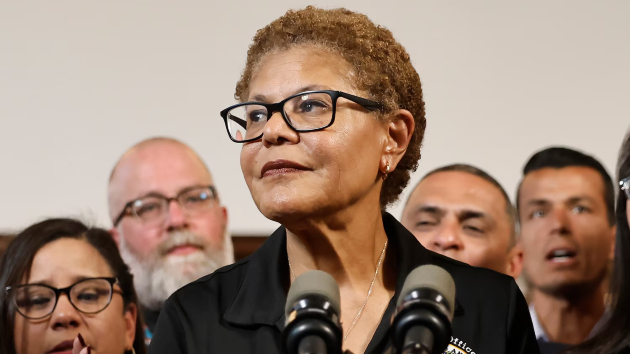
(WASHINGTON) — The Department of Justice is suing the city of Los Angeles over its sanctuary city policy, alleging it interferes with the enforcement of federal immigration laws, officials announced on Monday.
“The challenged law and policies of the City of Los Angeles obstruct the Federal Government’s enforcement of federal immigration law and impede consultation and communication between federal, state, and local law enforcement officials that is necessary for federal officials to carry out federal immigration law and keep Americans safe,” the lawsuit states.
The lawsuit is targeting Ordinance Number 188441, which prohibits city resources, including personnel, from being used for immigration enforcement. The DOJ is seeking a permanent injunction barring the city from enforcing the ordinance.
The Los Angeles City Council and the city’s mayor, Karen Bass, are named among the defendants in the lawsuit, which was filed Monday in California’s Central District federal court.
The lawsuit comes after President Donald Trump deployed National Guardsmen and Marines to the city, over the objections of local and state leaders, in response to protests against the government’s immigration crackdown.
“Sanctuary policies were the driving cause of the violence, chaos, and attacks on law enforcement that Americans recently witnessed in Los Angeles,” Attorney General Pamela Bondi said in a statement Monday. “Jurisdictions like Los Angeles that flout federal law by prioritizing illegal aliens over American citizens are undermining law enforcement at every level — it ends under President Trump.”
Bill Essayli, U.S. attorney for the Central District of California, said in a statement that the lawsuit holds Los Angeles “accountable for deliberately obstructing the enforcement of federal immigration law.”
This is a developing story. Please check back for updates.