
Democrat Hakeem Jeffries, in marathon ‘magic minute’ speech, blasts Trump bill

Democrat Hakeem Jeffries, in marathon ‘magic minute’ speech, blasts Trump bill
Kevin Dietsch/Getty Images

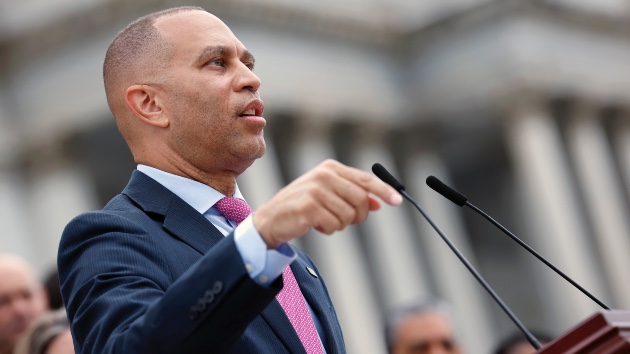
(WASHINGTON) — House Democratic Leader Hakeem Jeffries is making a marathon last stand against President Donald Trump’s major tax cut and spending bill.

Jeffries took to the House floor just after 5 a.m. on Thursday and has now been speaking for more than four hours, delaying a final vote in the chamber on the domestic policy bill at the heart of Trump’s second term agenda.

Jeffries has stacks of binders next to him at the podium. It does not appear he is wrapping any time soon.

“I’ve been given 15 minutes each on a bill of such significant magnitude as it relates to the health, the safety and the well being of the American people and because that debate was so limited, I feel the obligation, Mr. Speaker, to stand on this house floor and take my sweet time to tell the stories and that’s exactly what I intend to do,” Jeffries said.

The “magic minute” speech is a procedure that grants members of House leadership unlimited time to speak after debate on a bill has concluded. For context, then-House Minority Leader Kevin McCarthy, a Republican, spoke for more than eight hours in 2021 when the House passed President Joe Biden’s Build Back Better Act.

Jeffries has focused much of his speech on the bill’s projected impact on Medicaid, the federal program that primarily serves seniors and people with disabilities, sharing personal stories from people he says will struggle as a result of the megabill.

“People will die. Tens of thousands, perhaps year after year after year, as a result of the Republican assault on the healthcare of the American people,” Jeffries said. “I’m sad. I never thought I would be on the House floor saying this is a crime scene.”

According to the nonpartisan Congressional Budget Office, the Medicaid cuts and changes passed by the Senate could cause 11.8 million Americans to lose their health insurance over the next decade.

Jeffries is excoriating the Trump-backed megabill’s “assault on healthcare.”

“Every single house Democrat is fighting hard to protect your Medicaid,” Jeffries said. “We value you and we’re working hard to defend you.”

Republicans have defended the changes as reforms to entitlement programs they claim are riddled with “waste, fraud and abuse.” The Trump administration has also pushed back on the nonpartisan budget office itself and its analysis, claiming bias.

Jeffries didn’t stop at health care and is criticizing other portions of the bill, including its impact on the Supplemental Nutrition Assistance Program (SNAP) and its immigration provisions.

“You see, budgets are moral documents. And in our view, Mr. Speaker, budgets should be designed to lift people up,” he said. “This reckless Republican budget that we are debating right now on the floor of the House of Representatives tears people down.”

“This reckless Republican budget is an immoral document,” Jeffries continued. “And everybody should vote no against it because of how it attacks children, seniors, and everyday Americans, and people with disabilities. This reckless Republican budget is an immoral document. And that is why I stand here on the floor of the House of Representatives with my colleagues in the House Democratic caucus to stand up and push back against it with everything we have.”

Those comments prompted House Democrats gathered near Jeffries to stand in applause.

Copyright © 2025, ABC Audio. All rights reserved.

4 killed, 14 hurt in Chicago mass shooting: ‘Absolute chaos’

4 killed, 14 hurt in Chicago mass shooting: ‘Absolute chaos’
Chicago Fire Department cleans up the crime scene where numerous people were shot at Artis Restaurant and Lounge/Kyle Mazza/Anadolu via Getty Images

(CHICAGO) — Four people were killed and 14 others wounded in a mass shooting Wednesday night in Chicago, police said.

The carnage erupted in the River North neighborhood, on the 300 block of West Chicago Avenue, when a vehicle pulled up to a location and at least one gunman opened fire on a crowd standing outside, Chicago police said.

The vehicle fled the scene immediately and no one has been taken into custody, police said.

Four people were killed — two men and two women — and 14 others were wounded, including several who were hospitalized in critical condition, according to police.

“When I arrived last night it was absolute chaos,” Pastor Donovan Price, who works to help victims of violence, told reporters. “From people screaming, to blood on the streets, to people laying on the streets, a massive police presence. Just horrific. More than I’ve ever seen.”

The hospitals were “almost as chaotic” as the crime scene as people searched for their loved ones, Price said.

The injured victims are all in their 20s and 30s and 11 of the 14 people hurt are women, police said.

“Seems there was some album release party, people coming from that. An SUV pulls up and just opens fire on a crowd of people,” Price said.

“It can happen anywhere,” he warned. “It’s devastating.”

Despite the shooting, murders were down 32% year-to-date in the city as of June 29 and shooting incidents were down 39%, according to Chicago’s crime data.

Copyright © 2025, ABC Audio. All rights reserved.

Hiring surged in June, defying concern about Trump’s tariffs

Hiring surged in June, defying concern about Trump’s tariffs
Narisara Nami/Getty Images

(NEW YORK) — Hiring surged in June as businesses navigated uncertainty surrounding President Donald Trump’s tariffs, federal government data on Thursday showed. The reading exceeded economists’ expectations.

The U.S. added 147,000 jobs in June, according to data from the U.S. Bureau of Labor Statistics. That figure showed a slight increase from 139,000 jobs added in the previous month. The unemployment rate ticked down to 4.1%, putting it at near-historic lows.

Key measures of the economy have proven resilient in recent months, defying fears of resurgent inflation and a possible economic downturn. Hiring has kept up a solid pace, humming along with less disruption than some economists anticipated.

Federal government employment declined by 7,000 jobs in June, bringing total losses in the federal government to 69,000 since January, when Trump established the Department of Government Efficiency, or DOGE. The Elon Musk-led organization has sought to slash federal spending, in part by eliminating some federal jobs.

Employment showed little change in the manufacturing sector, which Trump has sought to boost with levies on foreign goods.

The fresh data arrived less than a week before a deadline established by the Trump administration for the completion of dozens of trade deals with countries facing the threat of so-called “reciprocal tariffs.”

So far, the White House says it has reached trade agreements with the United Kingdom and Vietnam, as well as a preliminary accord with China.

In recent weeks, Trump has dialed back some of his steepest tariffs. Another batch of tariffs remains in legal limbo following a pair of federal court rulings in May, though the levies remain in place for now.

Prices accelerated slightly in May, the most recent month for which such data is available, but inflation remains near its lowest level since 2021.

Warning signs point to the possibility of elevated prices over the coming months, however. Nationwide retailers like Walmart and Best Buy have voiced alarm about the possibility that they may raise prices as a result of the levies.

The Fed held its benchmark interest rate steady last month, continuing a wait-and-see approach adopted by the central bank in recent months as it observes potential effects of Trump’s tariff policy. Four meetings and six months have elapsed since the Fed last adjusted interest rates.

The Fed is guided by a dual mandate to keep inflation under control and maximize employment. In theory, a lowering of interest rates could help stimulate economic activity and boost employment, especially while inflation remains low.

Powell, in recent months, has warned about the possibility that tariffs may cause what economists call “stagflation,” which is when inflation rises and the economy slows.

Stagflation could put the central bank in a difficult position. If the Fed raises interest rates as a means of protecting against tariff-induced inflation under such a scenario, it risks stifling borrowing and slowing the economy further.

On the other hand, if the Fed lowers rates to stimulate the economy in the face of a potential slowdown, it threatens to boost spending and worsen inflation.

On Tuesday, Powell appeared to signal an openness to cutting interest rates as early as this month.

When asked about a possible interest rate cut at the Fed’s upcoming meeting, Powell said, “I wouldn’t take any meeting off the table or put any on the table. It depends on how the data evolves.”

Powell affirmed that a majority of members of the Fed’s policy-making board support additional interest cuts this year. The central bank will hold four rate-setting meetings over the remainder of 2025, and the first will happen on July 29 and 30.

“A majority of us do feel it will be appropriate in the remaining four settings of the year to begin reducing rates again,” Powell told the audience at the European Central Bank forum in Sintra, Portugal.

Copyright © 2025, ABC Audio. All rights reserved.
175+ Democrats supporting NAACP suit against dismantling Department of Education

175+ Democrats supporting NAACP suit against dismantling Department of Education
Jemal Countess/Getty Images for Student Borrower Protection Center

(WASHINGTON) — More than 175 Democratic members of Congress are filing an amicus brief on Thursday opposing the Trump administration’s overhaul of the U.S. Department of Education.

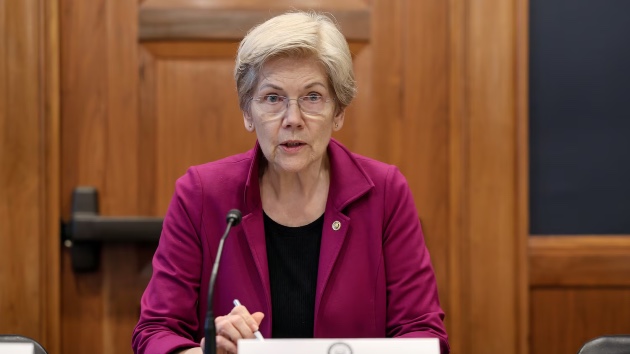
“The law couldn’t be clearer: the president does not have the authority to unilaterally abolish the Department of Education,” Sen. Elizabeth Warren wrote in a statement first obtained by ABC News, adding, “Donald Trump is not a king, and he cannot single-handedly cut off access to education for students across this country.”

Warren and Reps. Jamie Raskin, Bobby Scott and Rosa DeLauro — the ranking members of the House’s Education and Judiciary committees — are leading the 15-page legal document. They’re joined by Senate Minority Leader Chuck Schumer, more than 20 Senate Democrats, and more than 150 other members of the House Democratic caucus.

The lawmakers’ brief attempting to block the administration from abolishing the Department of Education is in support of the NAACP’s suit against the government this past spring. In March, that case argued that downsizing the department through a workforce reduction that slashed nearly half the agency’s staff — among other measures like terminating statutory grant programs — violates the separation of powers and lacks constitutional authority.

The NAACP, the National Education Association (NEA), and a coalition of groups filed a preliminary injunction with the U.S. District Court in the District of Maryland this week, arguing the judge’s consideration of this case is needed after the administration’s recent decision to pause more than $6 billion in congressionally appropriated education programs ahead of the school year.

“The motion seeks a remedy for the serious harm that the Trump Administration has inflicted on students, educators, schools, and colleges and universities, and asks the Court to direct the Department to fulfill its statutory obligations to students nationwide,” according to a statement released by the NEA, which represents more than 3 million educators.

Raskin condemned the administration’s efforts to curb public education, contending President Donald Trump and Education Secretary Linda McMahon can’t abolish the agency without congressional approval.

“Congress created the Department of Education to ensure that every student in America could obtain a high-quality, free public school education,” Raskin wrote in a statement. “This is the right of every citizen and an essential democratic safeguard against political tyranny,” he said.

“No president has the authority to dismantle a federal agency created by law. We’re going to court to defend not only congressional power but the department’s national educational mission, itself a pillar of American democracy,” Raskin added.

The power to reorganize the executive branch belongs to Congress and is underscored by the fact that when presidents have reorganized the executive branch, they have done so “through legislation and subject to appropriate restraints,” according to the brief by the lawmakers.

Their brief argues that only Congress has the authority to create, restructure, and abolish federal agencies, it has to be done through legislation, and the Department of Education can’t be unilaterally abolished because it’s statutorily mandated.

Rep. Joe Neguse, D-Colorado, told ABC News closing the department would strip “vital support” from tens of millions of students and teachers.

“I’m proud to stand with my colleagues in the House and Senate to uphold Congress’ responsibility to ensure every student has access to a quality education and to defend the essential work of the Department of Education,” Neguse said.

Efforts to dismantle the department have been blocked by lower courts this spring. The Supreme Court is expected to weigh in on a Massachusetts case that could decide whether the firing of nearly 2,000 employees at the agency stands. McMahon has stressed the critical functions of the department remain and that services like students with disabilities, for example, could ultimately be moved to other agencies.

The brief is part of Warren’s larger Save Our Schools campaign that she started after Trump signed an executive order to diminish the Department of Education.

“The federal government has invested in our public schools,” Warren told ABC News in April. “Taking that away from our kids so that a handful of billionaires can be even richer is just plain ugly, and I will fight it with everything I’ve got.”

The senator has previously requested the agency’s Office of Inspector General review the Department of Government Efficiency’s alleged “infiltration” of the agency’s internal federal student loan database. Prior to the Save Our Schools campaign, she investigated the firing of federal student aid employees and how a reduction in staff at the agency could have “dire consequences” for borrowers.

The brief also comes after Raskin and several other House Democrats met with McMahon about the future of the agency. That meeting appeared to leave many with unanswered questions, like Rep. Frederica Wilson, a senior member of the House Education and Workforce Committee, who also signed on to the amicus brief.

“For the Department of Education to be dismantled, it is going to bring a shock to this nation,” said Wilson, a former principal and lifelong educator. “Schools are the bedrock of this nation. When schools are working, our country is, too.”

Copyright © 2025, ABC Audio. All rights reserved.

Supreme Court could release more on high-profile cases from its ‘cleanup conference’

Supreme Court could release more on high-profile cases from its ‘cleanup conference’
Ryan McGinnis/Getty Images

(WASHINGTON) — There is the potential for more news out of the U.S. Supreme Court on Thursday when the justices release a list of orders and dispositions from the “cleanup conference,” the last in-person gathering before summer recess.

The timing of the release is somewhat unusual — the conference was held last week, and typically the results of that session are released the day after the final opinion comes down, which would have been Monday.

Veteran court watchers suspect that there could be a lot of writing from the justices, such as dissents or concurrences, on matters that they will address without oral argument.

There are five outstanding emergency petitions involving President Donald Trump.

Mass federal layoffs: Trump v. American Federation of Government Employees. Whether the Court should stay a nationwide injunction barring the executive branch from developing plans to initiate large-scale reductions of the federal workforce

Dismantling the Department of Education: McMahon v. NY. Whether the court should stay a district court order requiring the government to reinstate Department of Education employees fired as part of a reduction in force.

Florida immigration law: Uthmeier v Florida Immigrant Coalition. Whether the court should stay a preliminary injunction preventing Florida from enforcing SB4c, a law that criminalizes entry into and presence within Florida of those who have illegally entered the U.S.

Jan. 6 police officers: Doe v Seattle Police Department. Whether to stay Washington state court mandates requiring four anonymous former and current Seattle police officers who attended the Jan. 6, 2021, rally at the Capitol to refile their lawsuit regarding public record requests under their true names.

Deportation: Gomez v U.S. Whether the court should stay a lower court mandate certifying petitioner’s extradition to Ecuador to stand trial for a charge of sexual abuse.

The court also address other cases implicated by the ruling in the birthright citizenship case, the transgender health care case and others.

Copyright © 2025, ABC Audio. All rights reserved.

Family of man charged in deadly Boulder Molotov cocktail attack can be deported, judge rules

Family of man charged in deadly Boulder Molotov cocktail attack can be deported, judge rules
Boulder Police Department

(TEXAS) — A federal judge in Texas has ruled that the family of the man charged in the deadly Molotov cocktail attack in Boulder, Colorado, can be deported, dismissing a challenge to their removal filed last month.

Hayam El Gamal, the wife of Mohamed Sabry Soliman, was apprehended following the attack and was initially slated for expedited deportation.

The deportation case involving Soliman’s wife and five children was transferred to Texas. Last month, a judge issued a temporary order halting the family’s deportation, which remained in place until now.

Dismissing the family’s legal challenge, U.S. District Judge Orlando Garcia wrote, “Upon review of the parties’ advisories, the record, and the applicable law, the Court finds that it lacks jurisdiction to grant Petitioners the relief they seek and must dismiss this case without prejudice.”

Soliman has been hit with several state charges, including first-degree murder, attempted first-degree murder and assault. A preliminary hearing in the state case is set for July 15.

Soliman, who is being held in federal custody, has pleaded not guilty to federal hate crime charges.

Authorities said Soliman threw Molotov cocktails at a group of marchers who were advocating for the release of the Israeli hostages outside the Boulder courthouse on June 1, yelling “Free Palestine” during the attack.

Earlier this week, authorities said 82-year-old woman hurt in the attack had died.

Copyright © 2025, ABC Audio. All rights reserved.

‘Hero’ B-2 pilots expected to keep low profile at July 4 White House visit

‘Hero’ B-2 pilots expected to keep low profile at July 4 White House visit
USAF via AFP via Getty Images

(WASHINGTON) — The B-2 bomber pilots and crews who helped to strike Iranian nuclear sites earlier this month are being told to keep a low profile this weekend if they take up President Donald Trump on his offer to come to the White House on Friday on the July Fourth holiday.

Trump insists the pilots “obliterated” Iran’s nuclear program entirely during a June 21 bombing mission and that the B-2 pilots were “devastated” by news reports that questioned his assessment.

Insisting the pilots should be feted as heroes, Trump invited them and their crews to celebrate the July 4 holiday in Washington, which the White House said would include flyovers with B-2 bombers, as well as F-22 and F-35 fighter jets, which were also part of the recent bombing operation.

Officials say though that as of Wednesday no public ceremony is planned and the pilots’ identities are not being disclosed for security reasons.

“Our adversaries are skilled at exploiting the digital realm, collecting and analyzing open-source information, and leveraging advanced technologies to target U.S. military personnel, operations and activities,” according to an Air Force statement.

“Airmen involved in sensitive missions are briefed on the risks and vulnerabilities posed by the changing information environment to assist in managing the public release of information in a manner that protects the safety and security of personnel and assets,” the statement added.

According to the Pentagon, the 14 pilots aboard seven B-2 Spirit bombers flew more than 36 hours straight from Whiteman Air Force Base in Missouri as part of “Operation Midnight Hammer.”

The pilots dropped 14 bunker-buster bombs on the Fordo and Natanz nuclear sites in Iran. A third site, Isfahan, was struck by Tomahawk missiles.

In the immediate hours following the attack, the Defense Intelligence Agency produced an early assessment estimating that the sites endured significant damage but estimated that Iran’s nuclear program was set back by “months.”

According to the two people familiar with the classified report, the bombing sealed off the entrances to two of the three nuclear sites targeted in the attack but that most of the damage was done to structures above ground, leaving the lower structures intact.

Defense Secretary Pete Hegseth and CIA Director John Ratcliffe later said “new intelligence” found the bombing campaign set the program back by years.

The disclosure of the DIA findings, first reported by CNN, enraged Trump who said the pilots were “devastated.”

“You know, I got a call from Missouri — great state that I won three times by a lot,” Trump said. “And I got a call that the pilots and the people on the plane were devastated because they [the press] were trying to minimize the attack … I spoke to one of them [who] said, ‘sir, we hit the site. It was perfect. It was dead on.”

“Because they don’t understand fake news, because they have a normal life except they have to fly very big, very fast planes. But it’s a shame. You should be making them heroes,” Trump said.

Copyright © 2025, ABC Audio. All rights reserved.

9-year-old Texas girl dies in hot car while mother was at work: Police

9-year-old Texas girl dies in hot car while mother was at work: Police
KTRK

(GALENA PARK, Texas) — A 9-year-old girl has died in after she was intentionally left alone in a hot car while her mom was at work, according to Harris County, Texas, Sheriff Ed Gonzalez.

The girl’s 36-year-old mother left the child unattended in a white Toyota Camry on Tuesday from approximately 6 a.m. to 2 p.m. while she worked at a manufacturing plant in Galena Park, Texas, near Houston, the sheriff’s office said during a press conference.

The mother left the child with some water, partially rolled down the windows of the vehicle and then “proceeded to go to work for the day,” officials said.

“There’s never an excuse to leave a child unattended,” Gonzalez said during the press conference.

Upon returning to the vehicle later in the afternoon when her shift ended, the mother found her daughter unresponsive. Law enforcement was contacted at approximately 2:06 p.m. and detained the mother, officials said. Temperatures in the Houston area reached around 93 degrees Fahrenheit on Tuesday, according to the National Weather Service.

The child was transported to a local hospital, where she was pronounced dead, officials said.

Detectives continue to speak with the mother to gain more insight on why the child was kept in the car and the exact timeline of how long she was alone in the vehicle, the sheriff said. Officials are also waiting to receive the child’s autopsy results before deciding whether to press any charges.

Gonzalez said the incident, “which could have been prevented,” is a “unique” situation, since most hot car deaths are typically an accident.

“Maybe she has to make ends meet and keep food on the table and work. But the risk of death or harm — there’s just no reconciling that in my mind. You got to make other arrangements. It’s not worth it to put a child at risk like this, for any particular reason,” Gonzalez said.

He went on to say that nothing at this point shows that the mother “thought this would be the outcome.”

This tragedy marks the third hot car death to occur in Texas in the last four days and at least the 13th child to die in a hot car nationwide this year, according to Kids and Car Safety, an organization focused on “saving the lives of children and pets in and around vehicles.”

Copyright © 2025, ABC Audio. All rights reserved.

US dollar is off to its worst start in 50 years. Here’s why that matters for you.

US dollar is off to its worst start in 50 years. Here’s why that matters for you.
Costfoto/NurPhoto via Getty Images

(NEW YORK) — The United States dollar is suffering its worst start to a year in more than five decades, likely triggering a price hike for some everyday items and a jump in expenses faced by travelers abroad, some analysts told ABC News.

The greenback has fallen more than 10% in value this year relative to a group of foreign currencies that belong to top U.S. trading partners.

Investors have fled U.S. dollars out of fear inflation could devalue the currency, especially as Congress has moved forward with a large spending bill set to worsen a decades-long trend of ballooning U.S. debt, analysts said.

Even more, they added, President Donald Trump’s fluctuating trade policy and sharp criticism of the Federal Reserve have prompted uncertainty about the nation’s economic stewardship, eroding trust in the dollar as the world’s preeminent “safe haven” asset.

Here’s what to know about the weakening of the U.S. dollar and what it means for you:

Why has the U.S. dollar weakened this year?

The value of the U.S. dollar – like most assets – is set by supply and demand.

For decades, the U.S. dollar has garnered eager demand due to the strength and stability of the U.S economy, which offers foreign investors a safe place to park their funds. In periods of global economic or political crisis, the U.S. dollar often receives a burst of interest from asset holders.

As a result, the value of the U.S. dollar has proven robust for generations.

The unusually sharp decline at the outset of this year owes in part to concern about a resurgence of inflation, which would reduce the spending power of the dollar and put downward pressure on its value, analysts said.

Trump’s tariff policy has stoked worry about price increases, since importers typically pass along a share of the tax burden in the form of higher prices. A potential increase in the national debt could also push up inflation, as the U.S. issues bonds to cover the cost burden.

“If I’m a central bank holding half a trillion dollars of U.S. Treasuries, essentially the value of that would decline with more inflation if I don’t take action now. If I think it might happen, I might shift to other assets like gold or the [Japanese] yen.”

Investors’ faith in the continued stability of the U.S. economy has also diminished, analysts said, pointing to growing U.S. debt, fluctuating tariffs and Trump’s attacks on the central bank.

Paolo Pasquariello, a professor of finance at the University of Michigan, attributed the decline of the dollar to “the recent erratic policy making by U.S. authorities.”

U.S. Treasuries, Pasquariello said, are no longer viewed as quite as safe an asset, meaning investors are less likely to “park their money during normal times and especially during times of distress.”

What does a weaker U.S. dollar mean for you?

A weaker U.S. dollar could result in higher prices for imported goods and steeper costs for travelers abroad, analysts said.

The anticipated rise in prices for U.S. consumers stems from the uptick in costs faced by importers paying for goods in U.S. currency. A foreign firm would likely demand a higher price since the dollars paid by a customer carry less purchasing power than they previously did, analysts said.

“If you’re buying light fixtures from a firm in India and they’re taking dollars, and they get fewer rupees for those dollars, they’re going to start to charge more dollars,” Richard Michelfelder, a professor of professional practice at Rutgers University, told ABC News.

The potential surge in the price of imports could compound the inflation risk posed by tariffs, analysts said, but the dollar-related price hike would hit just about every import entering the U.S.

“If you go online and buy a product that doesn’t come from the U.S., the price is likely to go up,” Michelfelder said.

A weaker dollar also means U.S. travelers abroad are likely to face higher costs since what’s in their pocket will exchange at a lower rate with foreign currencies, analysts said.

“If it takes more dollars to buy a euro and you’re going to Europe, everything you buy will cost more,” Michelfelder said.

The decline in the dollar does deliver some benefits, however. Foreign buyers face lower prices for purchasing U.S. goods, meaning exporters could receive a boost as their products become more competitive on the global market.

The favorable outcome for exporters could improve employment in industries like car manufacturing or advanced technology, while the relative strength of foreign currencies could bring additional tourists and expand the hospitality sector, Michelfelder said.

Copyright © 2025, ABC Audio. All rights reserved.

Newlywed Palestinian woman released from ICE custody after months in detention

Newlywed Palestinian woman released from ICE custody after months in detention
Obtained by ABC News

(NEW YORK) — Ward Sakeik — a stateless Palestinian woman who was detained on her way back from her honeymoon — has been released from ICE detention nearly five months after her arrest, her husband confirmed to ABC News.

Sakeik, who is married to a U.S. citizen, was arrested at the St. Thomas Airport in the U.S. Virgin Islands in February.

“The Trump administration’s brazenly unconstitutional attempt to deport this young woman in violation of a federal court order should shock the conscience of every American. Had we not intervened, she may very well be in a foreign country right now, separated from her family like so many others illegally deported to third countries,” Eric Lee, Sakeik’s attorney, said in a statement Wednesday.

The government had attempted to deport Sakeik twice — the first of which was to Israel just hours before it launched its attack on Iran in June. The second attempt to deport her was made despite a federal judge ordering that she remain in the northern district of Texas and not be removed from the U.S.

Sakeik’s family is from Gaza, but she is legally stateless and has lived in the U.S. since she was 8 years old. Her family had traveled to the U.S. on a tourist visa and applied for asylum, according to Shaikh.

Sakeik was issued a deportation order more than a decade ago after her asylum case was denied, but she was permitted to stay in the U.S. under what’s known as an “order of supervision,” in which she was given a work permit and regularly checks in with federal immigration authorities, according to her attorney and her husband.

The first stage of her Green Card application was approved last week, according to her husband, Taahir Shaikh.

This is a developing story. Please check back for updates.

Copyright © 2025, ABC Audio. All rights reserved.