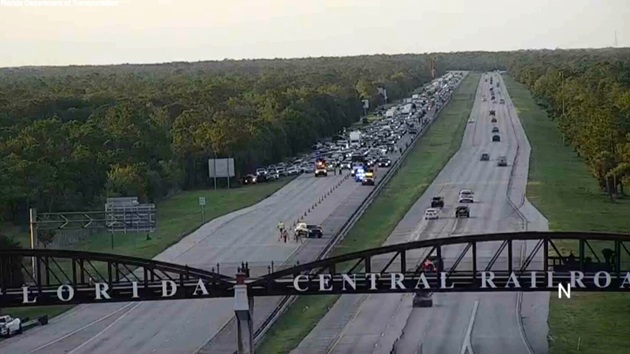
(INDIAN RIVER COUNTY, Fla.) — A 77-year-old Vermont man was killed on Sunday afternoon while attempting to rescue a turtle on Interstate 95 in Indian River County, Florida, authorities said.
The fatal accident occurred around 4:20 p.m. on the southbound lanes of I-95, just north of Sebastian Boulevard, according to the Florida Highway Patrol.
The man was crossing the lanes when a chain-reaction crash unfolded, investigators said. A Miami woman driving a vehicle slowed down to avoid hitting the pedestrian, but a Dodge Ram pickup truck behind her failed to brake in time, authorities noted.
The pickup truck rear-ended the first vehicle, which then veered off the road, crashed through a fence and came to rest on the west side, according to authorities. The Ram continued southbound and struck the Vermont man, who was thrown to the left shoulder of the highway, officials said.
First responders pronounced the man dead at the scene, officials noted.
The driver of the Dodge Ram, identified as a 53-year-old Port St. Lucie man, and the occupants of the other vehicle — a 44-year-old woman and her 49-year-old male passenger — were not injured in the crash, authorities said.
The southbound lanes of I-95 were closed following the incident while authorities investigated.
(WASHINGTON) — Some Trump supporters living in rural areas say they have concerns about the impact of President Donald Trump’s tax and policy megabill, which he signed into law on Friday. The bill’s potential health care impacts, both personally and on their communities, were top of mind for some, while others anticipated a positive impact on business but were wary of the bill’s price tag.
ABC News spoke with these people after the Senate passed the bill on July 1 but before the House did two days later.
Provisions in the bill enacting stricter eligibility requirements for Medicaid could impact finances for rural hospitals, which tend to rely more on Medicaid funding than urban hospitals and often already operate on tight margins.
The American Hospital Association called the potential impact on rural hospitals and patients “devastating.” In the leadup to the bill’s passage, Democratic senators working with researchers from the University of North Carolina Chapel Hill compiled a list of 338 rural hospitals that could be at risk of “financial distress,” “service reductions” or closure.
Some Republican senators, including Sen. Bill Cassidy, R-La., a physician, and Sen. Susan Collins, R-Maine, had expressedconcerns about the bill impacting health care providers in their states.
In response to these worries, Senate Republicans included a measure setting aside $50 billion over five years in the bill to support these rural hospitals, but advocates and experts say it may not be enough to prevent hospital shutdowns and loss of care. The National Rural Health Association said in a statement that the fund would “fall short of” offsetting the impact of other provisions.
James, a 62-year-old man who lives in a semi-rural area in North Carolina, is on Medicaid and gets Supplemental Nutrition Assistance Program (SNAP) benefits. He said the bill would cut around $300 worth of those benefits for him per month.
“It’s going to be hard to pay the rent and everything else,” he said. He added that he didn’t have family that could help support him, now that his brother has died and his mother was in a nursing home.
Identifying as an independent, James said he did not vote in 2024 but had liked Trump as a candidate more than Democratic nominee Kamala Harris.
“I thought Trump was the lesser of two evils,” he said. “But I was wrong … If you want to make the poor people poorer, he’s doing real good.”
Insurance agent Bryan Shaver, who lives in Hattiesburg, Mississippi, voted for Trump in 2024.
Shaver, 62, said he was not worried about the Medicaid provisions in the bill affecting his clients. “Because they’re elderly and they make very little money,” he was confident they would meet the new criteria.
However, Shaver said he was “absolutely worried” that the Medicaid cuts could affect rural hospitals in Mississippi, some of which he had worked with in the past.
“It was extremely difficult for them to take care of who they needed to take care of … it’s very difficult for them to survive in Mississippi,” Shaver said.
He said hospitals’ financial struggles sometimes reduced access to care for the people living around them.
“A lot of the hospitals here can’t afford [to provide care for] maternity,” Shaver said. “For example, a hospital up in Batesville, Mississippi. [Patients] have to drive to Memphis to deliver a baby, and that’s kind of ridiculous.”
Shaver said he would wait to see how the provisions in the bill would affect voters. If there was a negative impact, he said he hoped Republican lawmakers would “correct it” or otherwise “get booted out.”
Stephen Caraway, who also voted for Trump, lives in a rural area around 70 miles east of Cincinnati. He said he anticipated a positive effect for himself and his community from the bill. Caraway was appointed to the state’s Elections Commission by Ohio Governor Mike Dewine in 2023 and will serve until 2027.
“There are service jobs, a lot of restaurant positions in my part of Ohio, and I absolutely think that no tax on tips or overtime would be great for the middle class and for those employees,” Caraway said. He said he would personally benefit from some of the tax cuts the bill extended.
To Caraway, the tightened eligibility requirements for Medicaid seemed reasonable, and he did not buy into worries that the bill would take millions of people off the benefits and potentially hurt rural hospitals like the one he lives near.
Caraway’s one concern is the effect the bill would have on U.S. debt. The Congressional Budget Office estimates that it would add $3.4 trillion to the deficit over a decade.
“Regardless of what party was in control, I would tell you that the federal government needs an overhaul, and has needed it for a long time. The only thing that would give me pause is some of those CBO projections,” Caraway said. “But I believe that those projections can just as easily be incorrect as they can be correct. And I’m going to trust my national leaders to do what is right and be fiscally responsible.”
(NEW ORLEANS) — Justice Ketanji Brown Jackson, in her first public appearance since the Supreme Court sharply limited the ability of federal judges to check presidential power, said Saturday she believes recent rulings by the court’s conservative majority pose an “existential threat to the rule of law.”
“Sometimes we have cases that have those kinds of implications, and, you know, are there cases in which there are issues that have that kind of significance? Absolutely,” Jackson told ABC News Live Prime anchor Linsey Davis during a wide-ranging conversation at the Global Black Economic Forum.
The court’s newest justice and member of the liberal minority first leveled the charge last month in a remarkable solo dissent in the case Trump v Casa, which partially lifted nationwide injunctions against President Donald Trump’s executive order to effectively end birthright citizenship.
Jackson also wrote in her dissent that she has “no doubt that executive lawlessness will flourish because of the decision” and that she predicts “executive power will become completely uncontainable.” The unusually blunt and sobering assessment drew sharp criticism, including from her colleagues.
Justice Amy Coney Barrett accused Jackson of a “startling line of attack that is tethered neither to [precedent and the Constitution] nor, frankly, to any doctrine whatsoever.”
While Jackson did not directly address the case or specific criticism, she defended her right to express her views on the law and suggested that public scrutiny of the debate is welcomed.
“I am actually heartened that people are focused on the court and the work that we’re doing on the state of the government,” she told Davis. “As a democracy, the people are supposed to be the rulers. The people are supposed to be leading in terms of the policies and the way in which our government operates. And so, the more that people are engaged with our institutions the better.”
Jackson’s appearance came at the ESSENCE Festival of Culture in New Orleans, Louisiana, and was part of a promotional tour for her new memoir, “Lovely One,” which chronicles her journey from south Florida to the Ivy League and on to the high court.
President Joe Biden appointed Jackson in 2022 to replace retiring Justice Stephen Breyer. She is the first former public defender, for Florida-raised judge, and first Black woman to serve as a justice.
“I’m aware that people are watching,” Jackson told Davis. “They want to know how I’m going to perform in this job and in this environment, and so I’m doing my best work as well as I can do, because I want people to see and know that I can do anything just like anyone else.”
In her recently-concluded third term on the court, Jackson wrote more than 24 opinions — second only to Justice Clarence Thomas — and was the justice most often in dissent.
“We have very different opinions,” Jackson said, “and it’s a tradition of the Court that justices get to voice their opinions in the context of their opinions and writings.”
During oral arguments, Jackson was also among the most vocal on the bench — by one count uttering 79,000 words, more than any other colleague.
“It’s funny to me how much people focus on how much I talk in oral argument,” Jackson said. “It’s been a bit of an adjustment because as a trial court judge, you have your own courtroom so you can go on as long as you want. So, trying to make sure that my colleagues get to ask some questions has been a challenge for me, but I’ve enjoyed it.”
Jackson said she believes the justices are “good at separating out the work” and maintaining cordial personal relationships with each other despite their disagreements.
(NEW YORK) — As state and local officials in Texas have come under scrutiny over the lack of sirens to warn people of impending flash flooding on the Guadalupe River that killed more than 100 people, records reviewed by ABC News show authorities of one of the hardest hit counties have had discussions about implementing such an alert system for nearly a decade.
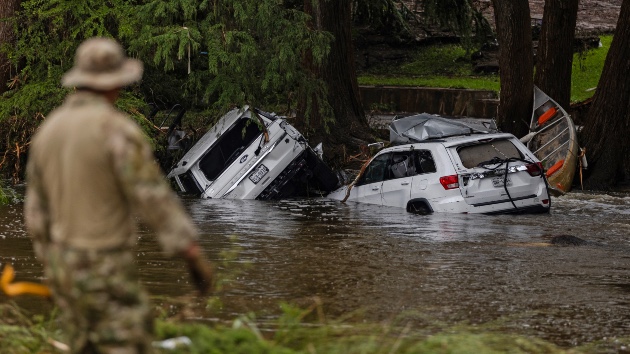
The destructive flooding hit in the early morning hours of the Fourth of July, causing the Guadalupe River in Kerr County to rise by 26 feet in less than an hour, spilling its banks and flooding multiple summer camps and RV parks along the winding river.
On Monday, the death toll from the flooding climbed to more than 100, according to officials. At least 84 of the deaths occurred in Kerr County, including 27 children at Camp Mystic, an all-girls Christian summer camp near the banks of the Guadalupe, authorities said.
Ten girls and a counselor from Camp Mystic remained unaccounted for on Monday as search-and-rescue efforts stretched into their fourth day.
Since the catastrophe, local officials have faced questions about how warnings were sent out to the community, why evacuations weren’t ordered in low-lying areas and why there were no audible warning systems to alert campers along the Guadalupe.
“There should have been sirens here,” Texas Lt. Gov. Dan Patrick told Fox News on Monday, adding that the subject will likely come up in a special session of the state legislature to analyze what occurred during the flooding.
Patrick added, “Had we had sirens around this area, up and down — the same type of sirens they have in Israel when there’s an attack coming, that would have blown very loudly — it’s possible that would have saved some of these lives.”
‘I’ve spent hours in those helicopters pulling kids out of trees’
Records reviewed by ABC News show that many of the same questions have been under discussion, specifically in Kerr County, for nearly a decade.
The minutes from a March 28, 2016, meeting of the Kerr County Commissioners’ Court, show that former Kerr County Sheriff Rusty Hierholzer pushed the commission to upgrade the county’s flood-warning system. At the time, Hierholzer told the commission that he was in favor of placing high-decibel outdoor sirens along the river that could go off and be heard from a distance of 3 miles when water gauges indicated flooding, according to the online minutes of the meeting.
According to the meeting minutes, first reported by The Wall Street Journal, then-Commissioner Tom Moser said there are state-of-the-art warning systems, including those with sirens, in other parts of the state, “even though this [Kerr County] is probably one of the highest flood-prone regions in the entire state.”
Hierholzer told the commission that the sirens, in addition to the county’s CodeRED emergency notification system, would work to quickly spread the word of imminent danger, according to the meeting minutes.
In that meeting, according to the minutes, Hierholzer raised what he called the “most important” issue — that of warning the summer camps along the Guadalupe, recalling a 1987 flash flood in which 10 children from the Pot O’ Gold Ranch Christian camp in Comfort, Texas, were killed attempting to evacuate the camp in a bus.
“I’ve spent hours in those helicopters pulling kids out of trees,” Hierholzer told the commission, according to the meeting minutes.
At the time, Hierholzer added that a lot of people in the county were not signed up for CodeRED alerts and that it was difficult to get people to sign up for the phone alerts.
“So yes, you need both. You need the sirens, and you need CodeRED to try to make sure we’ll notify everybody we can when it’s coming up,” Hierholzer said, according to the meeting minutes.
Moser, according to the meeting minutes, told his fellow commissioners that upgrading the warning system to include sirens was “not hugely expensive,” adding that the units would cost around $40,000 each.
The Kerr County Commissioners’ Court applied for a nearly $1 million FEMA grant, according to the meeting minutes. The county’s application was not selected, but it was not immediately clear why.
Moser could not be reached for comment by ABC News on Monday. He told The Wall Street Journal on Sunday that the county considered paying for the upgrade of its flood warning system, but eventually decided not to include it in its annual budget.
“It was probably just, I hate to say the word, priorities. Trying not to raise taxes,” Moser told the newspaper.
Reached by ABC News by phone on Monday, Hierholzer declined to comment on the statements he made to the commissioners more than nine years ago.
“This is probably one of the worst disasters Kerr County has ever seen. So right now, I don’t want to get into all this kind of political stuff — what we could’ve, would’ve, should’ve done,” Hierholzer told ABC News.
Officials concede they were caught off guard
Kerr County officials said during a news conference on Saturday that they were caught off guard by the torrential rains that caused the Guadalupe River to rise to near-historic levels in a matter of minutes.
“We didn’t know this flood was coming,” Kerr County Judge Rob Kelly said. “We have floods all the time. This is the most dangerous river valley in the United States, and we deal with floods on a regular basis. When it rains, we get water. We had no reason to believe that this was going to be anything like what’s happened here, none whatsoever.”
But during a news conference on Sunday, Texas Gov. Greg Abbott said the state began preparing for the storm last Wednesday by pre-positioning assets and resources in flood-prone areas of the state, including Kerr County.
Chief W. Nim Kidd of the Texas Division of Emergency Management said alerts were also sent out.
“From a technical perspective, there were multiple warning systems that are out there, and all of us can choose to sign up for warning systems in certain areas depending on the local government that they’re in and the way their system works,” Kidd said during the governor’s press conference. But he added that some places have spotty cell phone reception.
Kidd added, “There can be all kinds of alert systems that are sent, and we know that some general messaging was sent early, some urgent warnings were sent at various times. But just sending the message is not the same as receiving the message, having a plan to do something when you receive the message and then the ability to implement that plan.”
During a news conference on Monday, Kerrville City Manager Dalton Rice said staff at some of the summer camps on the Guadalupe were monitoring the rising river at 3:30 a.m. on the day of the flood and managed to move campers to higher ground.
Asked by reporters why mandatory evacuations were not issued by the city or county, Rice said, “Evacuations are a delicate balance because if you evacuate too late, you then risk putting buses, or cars, or vehicles, or campers on roads … trying to get them out, which can make it more challenging because these flash floods happen very quickly.”
When pressed on why evacuations were not announced far in advance of the storm, Rice added, “It’s like disasters in Texas everywhere — it’s very tough to make those calls because what we also don’t want to do is cry wolf.”
(MILWAUKEE) — A federal magistrate judge in Wisconsin has recommended that the case against a Milwaukee judge accused of helping an undocumented man evade arrest by immigration authorities not be dismissed.
Judge Hannah Dugan, 65, was arrested in April and charged in a two-count federal indictment alleging that she knowingly concealed a person sought for arrest by immigration authorities and for obstruction of official Department of Homeland Security removal proceedings.
Lawyers for Dugan, in part citing the U.S. Supreme Court’s decision in President Donald Trump’s immunity case, have argued she has judicial immunity for official acts and that her prosecution is unconstitutional.
Late Monday — in a non-binding decision — U.S. Magistrate Judge Nancy Joseph issued a 37-page report and recommendation, reaching the conclusion that there is no shield from prosecution in this case.
The recommendation will be presented to U.S. District Judge Lynn Adelman, who will make the final decision on the motion.
“It is well-established and undisputed that judges have absolute immunity from civil lawsuits for monetary damages when engaging in judicial acts,” the magistrate judge wrote in her decision. “This, however, is not a civil case. And review of the case law does not show an extension of this established doctrine to the criminal context. Accordingly, I recommend that Dugan’s motion to dismiss the indictment on judicial immunity grounds be denied.”
Joseph noted that while many of Dugan’s alleged actions could arguably be considered judicial acts, that does not mean prosecution is barred “where the indictment alleges that the acts were done ‘corruptly’ or to facilitate a violation of the criminal law.”
“What matters is whether the judge, even in performing her official duties, is accused of committing a crime,” Joseph wrote.
According to federal prosecutors, Dugan encountered federal agents in Milwaukee County Circuit Court on April 18, who were there to arrest an undocumented man appearing in her courtroom on a battery charge.
According to prosecutors, after speaking to the agents, Dugan directed them to the chief judge’s down the hall and then sent the man and his attorney out a non-public door in an alleged attempt, authorities claim, to help him evade arrest on immigration violations.
The man was later arrested.
The magistrate judge also recommended that Dugan’s motion to dismiss the case based on the contention that her prosecution violates the 10th Amendment’s separation of powers be denied.
The magistrate stressed that her recommendation is not a ruling on the merits of the case or on facts disputed by the parties.
“Dugan is presumed innocent, and innocent she remains, unless and until the government proves the allegations against her beyond a reasonable doubt to a jury at trial,” Joseph wrote.
The parties in the case have 14 days to file any written objections to Joseph’s report and recommendation.
“We are disappointed in the magistrate judge’s non-binding recommendation, and we will appeal it,” one of Dugan’s attorney Steven Biskupic said in a statement to the Associated Press. “This is only one step in what we expect will be a long journey to preserve the independence and integrity of our courts.”
Dugan has pleaded not guilty to the federal indictment. The case had been set for trial for July 21, but was pushed back until the immunity issue was settled. A new trial date has not been set.
The Wisconsin Supreme Court suspended Dugan in the wake of her arrest, stating in an order that it found it was “in the public interest that she be temporarily relieved of her official duties.”
(ALVARADO, Texas) — State and federal officials announced on Monday that 10 people were arrested for engaging in a “planned ambush” on an ICE detention facility in Texas over the Fourth of July holiday.
The individuals were charged with attempted murder of a federal officer, according to court records.
The incident occurred at the Prairieland Detention Facility in Alvarado, Texas, on Friday, according to Nancy Larson, the U.S. attorney for the Northern District of Texas.
At approximately 10:37 p.m., 10 to 12 individuals dressed in black, military-style clothing began shooting fireworks and engaging in acts of vandalism at the facility, Larson said during a press conference.
Larson said the incident “was a planned ambush with the intent to kill ICE corrections officers.”
Some individuals drew correction officers out of the facility using the fireworks while others damaged vehicles and vandalized the facility with graffiti, Larson said.
When an Alvarado police officer arrived on the scene, one of the individuals shot him in the neck. Another individual shot 20 to 30 rounds at the facility correction officers, according to Larson.
All assailants fled the scene, though all have since been apprehended, the U.S. attorney said.
Bradford Morris, who goes by Megan, was one of the suspects that allegedly fled the scene, according to court records. He was stopped a short while later, with a magazine clip and Kevlar vests.
Morris allegedly told police that he met some people online who wanted to “make a little noise” at the detention center, according to court records.
Law enforcement found 12 sets of body armor, spray paint, a flag saying “resist fascism, fight oligarchy,” flyers saying “fight ice terror with class war free all political prisoners,” more fireworks, weapons and cell phones across multiple searches over the weekend.
Police also found two AR-15s nearby, according to court records.
No employees at the Prairieland Detention Facility were harmed during the shooting incident and the officer who was shot is expected to recover, according to Josh Johnson, the acting field office director for ERO Dallas.
The U.S. attorney’s office has charged the individuals with three counts of attempted murder of a federal officer, and each of the suspects is also charged with three counts of discharging a firearm in relation to a crime of violence.
The FBI is working alongside local and state law enforcement on this investigation.
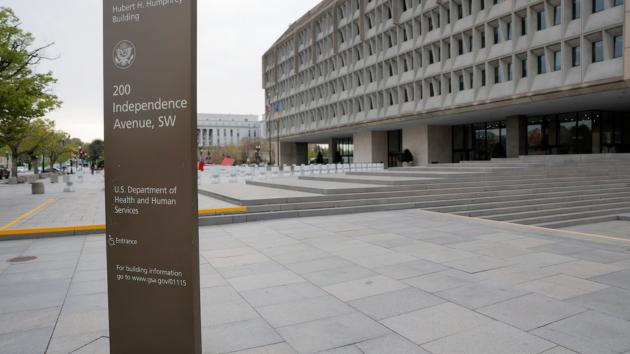
(WASHINGTON) — Several major medical organizations filed a lawsuit against the Department of Health and Human Services (HHS) and Secretary Robert F. Kennedy Jr. on Monday over what they are calling “unlawful, unilateral vaccine changes.”
The six groups — including the American Academy of Pediatrics (AAP), the American College of Physicians (ACP) and the Society for Maternal-Fetal Medicine (SMFM) — as well as a pregnant woman filed the lawsuit in the U.S. District Court for the District of Massachusetts.
The organizations, representing pediatricians, infectious disease physicians and public health professionals, accused the HHS and Kennedy of intentionally taking away vaccines, such as the COVID-19 vaccine, and unjustly replacing the Centers for Disease Control and Prevention’s (CDC) entire vaccine advisory panel.
The lawsuit seeks preliminary and permanent injunctions to enjoin Kennedy’s new COVID vaccine recommendations and a declaratory judgment pronouncing the change as unlawful.
Kennedy “has been on a warpath. It’s gotten to the point that we are going to … ask the court to put a stop to it,” Richard H. Hughes IV, a partner at Epstein Becker Green and lead counsel for the plaintiffs, told ABC News. “This decision to unilaterally overturn the COVID recommendation based on a history of bias — it was an arbitrary, capricious decision. They didn’t make any effort to follow any ordinary processes.”
Hughes said the HHS violated the Administrative Procedure Act, a U.S. federal law that establishes procedures federal agencies must follow when making rules.
In response to a request for comment, an HHS spokesperson told ABC News, “The Secretary stands by his CDC reforms.”
Additionally, the agency said it would allow vaccine manufacturers to conduct large studies to assess the safety and efficacy of COVID vaccines in children and younger, healthy adults.
At the time, an HHS spokesperson told ABC News, “The COVID-19 public health emergency has officially ended, and we are entering a new phase in our response to the virus. A rubber-stamping approach to approving COVID boosters in perpetuity without updated clinical trial data under the Biden administration is now over.”
About a week later, Kennedy cut COVD-19 vaccine recommendations for “healthy children and pregnant women” without a vote from the committee and posted the announcement on X rather than through official federal channels, in a break with tradition and stunning doctors.
In the video posted X, Kennedy claimed there was no clinical data to support the repeat booster strategy for children.
The anonymous pregnant woman, who is also a plaintiff, has been unable to receive a COVID-19 vaccine since Kennedy made the announcement, the suit states. The woman is a physician in a hospital, which could place her at high risk for exposure to infectious diseases, according to the lawsuit.
“Secretary Kennedy’s changes to vaccine recommendations have frustrated our members’ ability to effectively counsel patients regarding the COVID-19 vaccine and compromised the standard of care,” Dr. Sindhu K. Srinivas, president of the SMFM, said in a statement.
The statement went on, “Every second the Secretary’s dangerous and unsupported decisions regarding the COVID-19 vaccines stay in effect, the Directive is putting up barriers for our members’ high-risk pregnant patients to access the COVID-19 vaccine, which is increasing the risk of serious infection and illness and eroding patient trust in all recommended vaccinations.”
The plaintiffs also expressed alarm over Kennedy’s move last month to remove all 17 members from the CDC’s Advisory Committee on Immunization Practices (ACIP) and appoint seven new members. Kennedy originally appointed eight members, but one of them dropped off the panel shortly after.
At the time, the HHS put out a press release justifying the removals, with Kennedy saying. “A clean sweep is necessary to reestablish public confidence in vaccine science.”
Kennedy previously told ABC News that the replacements for ACIP would not be “anti-vaxxers.” However, some of the new members have previously espoused anti-vaccine sentiments, especially around COVID-19 vaccines and mRNA technology.
During the first ACIP meeting featuring the new members, the chair, Martin Kulldorff, said two new work groups would be established, one focusing on the cumulative effects of children and adolescents receiving all recommended vaccines on the schedule and another reviewing vaccines that haven’t been examined for more than seven years.
The latter group may discuss whether the hepatitis B vaccine is necessary at birth before a baby leaves the hospital, according to Kulldorff. Infectious disease experts have said vaccinating babies at birth has been key to virtually eliminating the virus among children.
“The American Academy of Pediatrics is alarmed by recent decisions by HHS to alter the routine childhood immunization schedule,” Dr. Susan J. Kressly, president of the AAP, said in a statement. “These decisions are founded in fear and not evidence and will make our children and communities more vulnerable to infectious diseases like measles, whooping cough and influenza. Our immunization system has long been a cornerstone of U.S. public health, but actions by the current administration are jeopardizing its success.”
ABC News’ Youri Benadjaoud contributed to this report.
(WASHINGTON) — Stocks closed down significantly on Monday after President Donald Trump announced steep tariffs on seven countries and threatened to impose new levies on others.
The Dow Jones Industrial Average closed down 422 points, or 0.9%, while the S&P 500 dropped 0.7%. The tech-heavy Nasdaq declined 0.9%.
Tesla, the electric-vehicle company led by tech billionaire Elon Musk, fell 6% after the CEO reignited a feud with Trump by announcing plans to launch a political party.
The selloff interrupted a weekslong market surge propelled in part by strong economic data and expectations of interest rate cuts at the Federal Reserve.
On Monday morning, Trump unveiled 25% tariffs on South Korea and Japan that would take effect at the beginning of August. Within hours, Trump announced fresh tariffs on five additional countries, including South Africa and Malaysia.
Trump plans to sign an executive order on Monday setting Aug. 1 as the new start date for so-called “reciprocal tariffs,” White House Press Secretary Karoline Leavitt told reporters. Those levies had targeted dozens of countries with a range of tariffs as high as 50%.
Trump delayed the country-specific tariffs in April, vowing to strike roughly 90 trade deals in 90 days. That pause had been set to expire on Wednesday.
So far, the White House says it has reached trade agreements with only the United Kingdom and Vietnam, as well as a preliminary accord with China.
On Monday, Trump also threatened to place an additional 10% tariff on countries that align with BRICS nations, suggesting he had not backed off his commitment to use levies as a diplomatic policy tool.
BRICS nations, which recently voiced “serious concerns” about unilateral tariffs, are made up of founding members Brazil, Russia, India and China, among a few others.
Key measures of the economy have proven resilient in recent months, defying fears of resurgent inflation and a possible economic downturn. The stock market has also surged, hitting fresh record highs and eliciting cautious optimism from some Wall Street analysts.
(WASHINGTON) — The White House and Republican Sen. Ted Cruz defended the National Weather Service and accused some Democrats of playing politics in the wake of devastating floods in Texas.
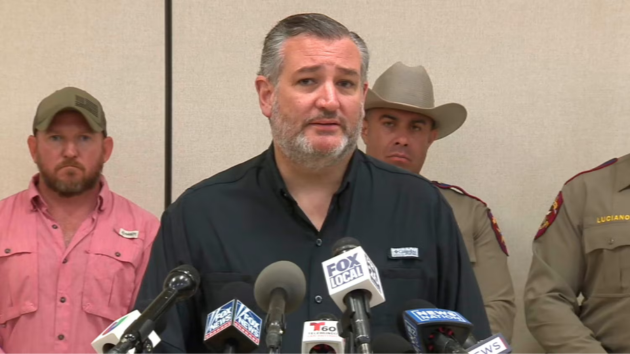
“I think this is not a time for partisan finger-pointing and attacks,” Cruz said at a news conference with local officials in Kerr County on Monday morning.
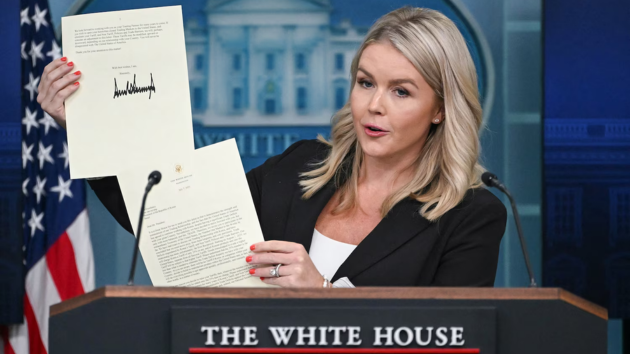
White House press secretary Karoline Leavitt later began her briefing on the offensive, calling out those who’ve questioned whether federal cuts to the NWS impacted staffing levels or forecasting abilities as the tragedy unfolded.
“Unfortunately, in the wake of this once in a generation natural disaster, we have seen many falsehoods pushed by Democrats such as Senator Chuck Schumer and some members of the media,” Leavitt said. “Blaming President Trump for these floods is a depraved lie, and it serves no purpose during this time of national mourning.”
Schumer, the Senate’s top Democrat, on Monday called for an investigation into whether cuts made to NWS in the administration had any correlation to the level of devastation.
“Following the disastrous and deeply devastating flash flooding in Texas this weekend, I write to urge you to immediately to open an investigation into the scope, breadth, and ramifications of whether staffing shortages at key local National Weather Service (NWS) stations contributed to the catastrophic loss of life and property during the deadly flooding,” Schumer wrote in a letter sent to Commerce Department Acting Inspector General Roderick Anderson.
At least 94 people, including more than two dozen children, are dead after heavy rain led to flash flooding in Texas.
The National Oceanic and Atmospheric Administration told ABC News that NWS planned for extra staffing at the NWS Austin/San Antonio local office ahead of the event. The local office had five NWS employees working compared to the two that would normally be scheduled.
In a statement to ABC News, the NWS highlighted that they gave briefings to emergency management the day before the tragic event and mentioned some alert lead times.
“The National Weather Service is heartbroken by the tragic loss of life in Kerr County. On July 3, the NWS office in Austin/San Antonio, TX conducted forecast briefings for emergency management in the morning and issued a Flood Watch in the early afternoon. Flash Flood Warnings were issued on the night of July 3 and in the early morning of July 4, giving preliminary lead times of more than three hours before warning criteria were met. The National Weather Service remains committed to our mission to serve the American public through our forecasts and decision support services,” the NWS said.
Leavitt, from the podium on Monday, ran through the specific timeline of alerts sent by the NWS and emphasized the extra staff in place at the NWS Austin/San Antonio office.
She noted the office issued a flood watch at 1:18 p.m. on Thursday, July 3. Then, a flash flood warning was issued for Bandera and Kerr counties at 1:14 a.m. on Friday, July 4 that was upgraded with more serious warnings at 3:35 a.m..
“So, to any person who has deliberately lied about these facts surrounding this catastrophic event, you should be deeply ashamed,” she said.
Leavitt was asked on Monday why the warnings were sent at a time when people were likely asleep and what, if anything, the administration is doing to ensure that these alerts come out sooner in the future.
“This was an act of God, it is not the administration’s fault that the flood hit when it did but there were early and consistent warnings,” Leavitt said. “And again, the National Weather Service did its job.”
Cruz, at the local news conference in Texas, pushed back on NWS claims but said there would be a “period of retrospection” after the immediate recovery efforts to analyze what happened and what went wrong.
“In the wake of every tragedy, there are things that are predictable,” Cruz said. “One of the things that’s predictable is to see some people engaging in, I think, partisan games, and trying to blame their political opponents for a natural disaster. And you see that with a hurricane, with a tornado, with a wildfire, with this flooding, where people immediately say, ‘Well, the hurricane is Donald Trump’s fault.’ I think most normal Americans know that’s ridiculous, and I think this is not a time for partisan finger pointing and attacks.”
“Now, after we come through search and rescue, after we come through the process of rebuilding, there will naturally be a period of retrospection where you look back and say, ‘Okay, what exactly transpired, what was the timeline, and what could have been done differently to prevent this loss of life?’ And that’s a natural process,” Cruz added. “I think it should not happen in a bitter and partisan sense, but it should happen in a reasonable sense of saying, what lessons can we learn?”
President Trump is still planning on visiting Texas on Friday, the White House said, though plans are not yet finalized.
Trump was asked about NWS on Sunday if he was going to investigate whether cuts at NWS left key positions vacant.
“No, no. They didn’t,” Trump said.
Trump then tried to pin blame on former President Joe Biden, his Oval Office predecessor, before walking the comment back.
“I’ll tell you: If you look at that — what a situation that all is. That was really the Biden setup. That was not our setup. But I wouldn’t blame Biden for it either. I would just say this is a hundred-year catastrophe, and it’s just so horrible to watch,” Trump said.
ABC News’ Mariam Khan and Matthew Glasser contributed to this report.
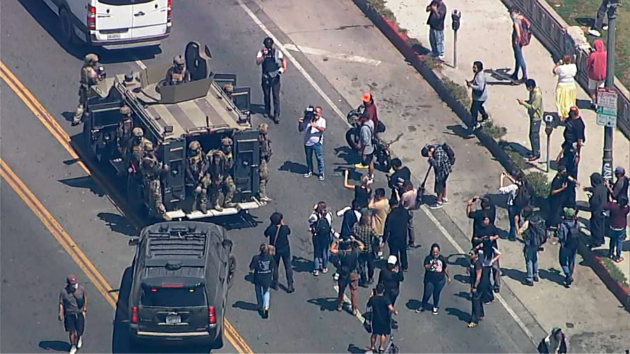
(LOS ANGELES, Calif. ) — A large immigration enforcement operation is underway in Los Angeles with U.S. troops on the ground.
According to a post on X by the Defense Department, U.S. military personnel were on the ground to ensure the safety of federal agents.
“We will protect federal law enforcement and assist by establishing a security perimeter,” DOD wrote.
Defense officials said that 90 armed troops were involved in the operation in support of immigration authorities.
It was not immediately clear who or what was targeted, as the local Fox News Channel affiliate aired video of agents in a mostly empty park.
Defense officials had said the troops were deployed to set up a security perimeter to protect federal law enforcement officials against potentially hostile crowds.
All of the troops involved in the operation were activated members of the California National Guard.
The operation included some 17 Humvees, four military cargo trucks and two military ambulances, officials said.
The armed troops were told in advance of the raid that they could defend themselves and federal employees if needed. If a person was a threat, the troops could detain the individual briefly before handing them off to law enforcement, officials said.
Earlier this summer, Trump deployed some 4,700 troops to California under a law known as Title 10, which allows the use of military forces to protect federal personnel and federal property.