
8 of 9 missing skiers found dead following California backcountry avalanche

8 of 9 missing skiers found dead following California backcountry avalanche
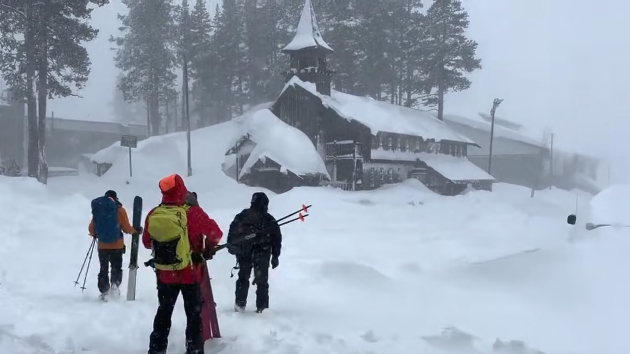
A rescue ski team makes their way to the area of an avalanche in the Castle Peak area of Truckee, Calif., February 17, 2026. (Nevada County Sheriff’s Office)

(NEVADA COUNTY, Calif.) — Eight backcountry skiers have been found dead, and one remains missing following an avalanche in California’s Sierra Nevada Mountains, officials announced Wednesday.

Search crews on Tuesday braved “highly dangerous” conditions to rescue six other skiers who were part of the same guided group, authorities said.

Crews were working on Wednesday to bring the remains of the eight dead skiers off the mountain to be reunited with their families after autopsies are performed to determine the cause of death, authorities said.

Perilous conditions near Donner Pass, where the avalanche occurred, continued on Wednesday morning. Rescuers faced a winter storm dumping more than 2 inches of snow an hour in the area, grounding rescue helicopters and hampering ground crews trying to reach the missing skiers, according to the Sierra Avalanche Center.

Tuesday’s avalanche was reported around 11:30 a.m. PT in the Castle Peak area at an elevation of 8,200 feet in the Sierra Nevada northwest of Lake Tahoe, according to the Nevada County Sheriff’s Office.

A group of 15 skiers, including four guides from the company Blackbird Mountain Guides, encountered the avalanche, according to the sheriff’s office.

“The group was in the process of returning to the trailhead at the conclusion of a three-day trip when the incident occurred,” Blackbird Mountain Guides said in a statement.

Preliminarily, the slide measured a D2.5 on the Destructive Force Scale, the avalanche version of the Enhanced Fujita Scale for rating tornadoes, meaning it was strong enough to injure, bury, or kill a person, according to the Sierra Avalanche Center. A D3 on the scale is strong enough to destroy a house.

Six people were successfully rescued Tuesday evening by search-and-rescue teams with varying injuries, authorities said. The survivors had been taking cover under a tarp when they were found alive, a source who communicated with the group told ABC News.

The survivors made a 911 call using an iPhone satellite SOS message, the sheriff’s officer said. Emergency beacons also helped rescuers find the stranded skiers, the sheriff’s office said.

“Due to extreme weather conditions, it took several hours for rescue personnel to safely reach the skiers and transport them to safety where they were medically evaluated by Truckee Fire,” the Nevada County Sheriff’s Office said in a statement. “Two of the six skiers have been transported to a hospital for treatment.”

Authorities initially said 16 skiers were in the group, and 10 were missing.

Rescuers faced very difficult conditions, including avalanche danger themselves, according to Brandon Schwartz, director of the Sierra Avalanche Center, which forecasts avalanche conditions in the area around Lake Tahoe. The area saw 2 to 3 feet of new snow in the last 36 hours and more was still falling at 2 to 4 inches per hour, Schwartz told ABC News.

The Blackbird Mountain Guides said the avalanche happened near the Frog Lake Backcountry Huts in the Castle Peak area, northwest of Truckee.

The group of skiers had been staying at the huts — which the company describes in online advertisements as “luxury-dormitories” — since Sunday. A 3-to-4-day stay at the huts normally costs $1,795, according to the company’s website.

The company lists prerequisites for customers, including requiring skiers to be “adept with their backcountry touring skills and have a solid foundation of touring before the trip.” Customers are also required to be in good physical shape, according to the company, “able to hike 4-6 miles and climb 1,500-2,500 vertical feet throughout the course of a day.”

The Sierra Avalanche Center said there was “high” avalanche danger in the backcountry on Tuesday, raising questions of why the group was in the rugged area.

On Monday, Blackbird Mountain Guides posted a video on Instagram showing what it described as “atypical layering from our normal mid season snowpack.”

“The result is a particularly weak layer in many northerly aspects, across various elevation bands,” a company employee said in the video. “As we move into a large storm cycle this week, pay close attention to places where faceting has been particularly strong — avalanches could behave abnormally and hazards could last longer than normal.”

The Sierra Avalanche Center said rapidly accumulating snowfall, weak layers of existing snowpack and gale-force winds that blow and drift snow “have created dangerous avalanche conditions in the mountains.”

“Natural avalanches are likely, and human-triggered avalanches large enough to bury or injure people are very likely,” the center said.

The center has issued an avalanche warning for the Central Sierra Nevada Mountains between Yuba Pass on the north and Ebbetts Pass on the south, including the greater Lake Tahoe area, through Wednesday morning.

In an updated statement on Wednesday morning, the center said, “HIGH avalanche danger continues,” and added, “travel in, near, or below avalanche terrain not recommended.”

“Increased uncertainty exists with ongoing reactivity of these buried weak layers under this large storm snow load.  The potential continues for large to very large avalanches occurring in the backcountry today.”

Whiteout conditions have been reported in the region where the avalanche occurred.

The California Highway Patrol’s Truckee office warned that high winds are “creating full whiteout conditions” across the Donner Summit.

Interstate 80 over Donner Summit was closed in both directions on Tuesday and remained closed on Wednesday morning due to whiteout conditions and poor visibility.

Copyright © 2026, ABC Audio. All rights reserved.
8 of 9 missing skiers found dead following California backcountry avalanche

8 of 9 missing skiers found dead following California backcountry avalanche
A rescue ski team makes their way to the area of an avalanche in the Castle Peak area of Truckee, Calif., February 17, 2026. (Nevada County Sheriff’s Office)

(NEVADA COUNTY, Calif.) — Eight backcountry skiers have been found dead, and one remains missing following an avalanche in California’s Sierra Nevada Mountains, officials announced Wednesday.

Search crews on Tuesday braved “highly dangerous” conditions to rescue six other skiers who were part of the same guided group, authorities said.

Crews were working on Wednesday to bring the remains of the eight dead skiers off the mountain to be reunited with their families after autopsies are performed to determine the cause of death, authorities said.

Perilous conditions near Donner Pass, where the avalanche occurred, continued on Wednesday morning. Rescuers faced a winter storm dumping more than 2 inches of snow an hour in the area, grounding rescue helicopters and hampering ground crews trying to reach the missing skiers, according to the Sierra Avalanche Center.

Tuesday’s avalanche was reported around 11:30 a.m. PT in the Castle Peak area at an elevation of 8,200 feet in the Sierra Nevada northwest of Lake Tahoe, according to the Nevada County Sheriff’s Office.

A group of 15 skiers, including four guides from the company Blackbird Mountain Guides, encountered the avalanche, according to the sheriff’s office.

“The group was in the process of returning to the trailhead at the conclusion of a three-day trip when the incident occurred,” Blackbird Mountain Guides said in a statement.

Preliminarily, the slide measured a D2.5 on the Destructive Force Scale, the avalanche version of the Enhanced Fujita Scale for rating tornadoes, meaning it was strong enough to injure, bury, or kill a person, according to the Sierra Avalanche Center. A D3 on the scale is strong enough to destroy a house.

Six people were successfully rescued Tuesday evening by search-and-rescue teams with varying injuries, authorities said. The survivors had been taking cover under a tarp when they were found alive, a source who communicated with the group told ABC News.

The survivors made a 911 call using an iPhone satellite SOS message, the sheriff’s officer said. Emergency beacons also helped rescuers find the stranded skiers, the sheriff’s office said.

“Due to extreme weather conditions, it took several hours for rescue personnel to safely reach the skiers and transport them to safety where they were medically evaluated by Truckee Fire,” the Nevada County Sheriff’s Office said in a statement. “Two of the six skiers have been transported to a hospital for treatment.”

Authorities initially said 16 skiers were in the group, and 10 were missing.

Rescuers faced very difficult conditions, including avalanche danger themselves, according to Brandon Schwartz, director of the Sierra Avalanche Center, which forecasts avalanche conditions in the area around Lake Tahoe. The area saw 2 to 3 feet of new snow in the last 36 hours and more was still falling at 2 to 4 inches per hour, Schwartz told ABC News.

The Blackbird Mountain Guides said the avalanche happened near the Frog Lake Backcountry Huts in the Castle Peak area, northwest of Truckee.

The group of skiers had been staying at the huts — which the company describes in online advertisements as “luxury-dormitories” — since Sunday. A 3-to-4-day stay at the huts normally costs $1,795, according to the company’s website.

The company lists prerequisites for customers, including requiring skiers to be “adept with their backcountry touring skills and have a solid foundation of touring before the trip.” Customers are also required to be in good physical shape, according to the company, “able to hike 4-6 miles and climb 1,500-2,500 vertical feet throughout the course of a day.”

The Sierra Avalanche Center said there was “high” avalanche danger in the backcountry on Tuesday, raising questions of why the group was in the rugged area.

On Monday, Blackbird Mountain Guides posted a video on Instagram showing what it described as “atypical layering from our normal mid season snowpack.”

“The result is a particularly weak layer in many northerly aspects, across various elevation bands,” a company employee said in the video. “As we move into a large storm cycle this week, pay close attention to places where faceting has been particularly strong — avalanches could behave abnormally and hazards could last longer than normal.”

The Sierra Avalanche Center said rapidly accumulating snowfall, weak layers of existing snowpack and gale-force winds that blow and drift snow “have created dangerous avalanche conditions in the mountains.”

“Natural avalanches are likely, and human-triggered avalanches large enough to bury or injure people are very likely,” the center said.

The center has issued an avalanche warning for the Central Sierra Nevada Mountains between Yuba Pass on the north and Ebbetts Pass on the south, including the greater Lake Tahoe area, through Wednesday morning.

In an updated statement on Wednesday morning, the center said, “HIGH avalanche danger continues,” and added, “travel in, near, or below avalanche terrain not recommended.”

“Increased uncertainty exists with ongoing reactivity of these buried weak layers under this large storm snow load.  The potential continues for large to very large avalanches occurring in the backcountry today.”

Whiteout conditions have been reported in the region where the avalanche occurred.

The California Highway Patrol’s Truckee office warned that high winds are “creating full whiteout conditions” across the Donner Summit.

Interstate 80 over Donner Summit was closed in both directions on Tuesday and remained closed on Wednesday morning due to whiteout conditions and poor visibility.

Copyright © 2026, ABC Audio. All rights reserved.

Oklahoma declares state of emergency due to wildfires: ‘Conditions remain dangerous’

Oklahoma declares state of emergency due to wildfires: ‘Conditions remain dangerous’
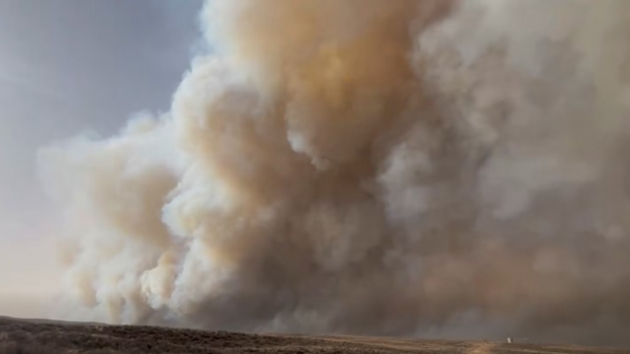
Oklahoma Forestry Services captured footage of the Ranger Road fire in Beaver County, Oklahoma. (Oklahoma Forestry Services)

(BEAVER COUNTY, Okla.) — The Oklahoma governor declared a state of emergency on Wednesday due to multiple wildfires in the state’s panhandle region, as critical fire weather conditions persist in the region.

A “series of destructive wildfires” is burning across northwest Oklahoma, the governor’s office said.

The largest, the Ranger Road Fire, has burned 145,000 acres since igniting in Oklahoma’s Beaver County on Tuesday and crossing into Kansas, according to fire officials. It was 0% contained as of Wednesday morning, according to the Oklahoma Forestry Services.

Additional local task forces are being deployed to Beaver County, the governor’s office said Wednesday.

Three other “significant” wildfires in Oklahoma’s Texas and Woodward counties were 20% to 25% contained as of Wednesday morning, according to fire officials.

Four firefighters were injured and several homes destroyed in the wildfire in Woodward County, according to Oklahoma Gov. Kevin Stitt.

The town of Tyrone in Texas County was also evacuated earlier Wednesday “as a precaution,” Stitt said.

The governor’s executive order stated that the state’s emergency operations plan has been activated and resources of all state departments and agencies are available “to meet this emergency.”

“As we head into today and tomorrow, conditions remain dangerous,” Stitt said in a statement Wednesday. “We need every Oklahoman to stay alert and continue taking fire warnings seriously.”

A red flag warning is in effect Wednesday across western and central Oklahoma and west of the I-35 corridor, according to the Oklahoma Forestry Services. The critical threat of fire danger is expected to continue into Thursday.

“Fire weather conditions will expand eastward across a larger part of Oklahoma as high winds combine with low humidity across most of the state,” the Oklahoma Department of Emergency Management said Wednesday.

Red flag warnings, fire weather watches and high wind warnings are also in effect across Kansas.

“There should be NO outdoor burning of any kind until this event is over, as the slightest ember could become tomorrow’s inferno,” the Kansas Division of Emergency Management said on social media.

Copyright © 2026, ABC Audio. All rights reserved.

Unruly passenger detained after incident on Delta flight, police say

Unruly passenger detained after incident on Delta flight, police say
Cars make their way to Hobby Airport in Houston on Tuesday, July 9, 2024. Elizabeth Conley/Houston Chronicle via Getty Images

(HOUSTON) — A man has been detained by police after allegedly exhibiting “unruly and unlawful behavior towards other customers” that caused a flight to return to Houston shortly after taking off, according to Delta Airlines and law enforcement. 

The flight, departing from William P. Hobby Airport, was headed to Hartsfield-Jackson Atlanta International Airport, according to the Federal Aviation Administration.

“The safety of our customers and crew is paramount, and Delta has zero tolerance for unruly behavior. We apologize to our customers for this experience and delay in their travels,” Delta said in a statement on Wednesday.

After taking off, it landed at the William P. Hobby Airport in Houston around 5:40 a.m. local time, according to the FAA. The flight was only in the air for about 15 minutes.

Earlier reports and air traffic controller audio alleged the man was attempting to breach the cockpit of a Delta Airlines flight but Delta said he “did not make contact with or attempt to access the flight deck,” in a statement to ABC News.

A call reporting that “apparently an individual tried to gain entry into a cockpit” was made at around 5:35 a.m., according to the Houston Police Department. Police officers were dispatched to Gate 32 at the airport, where multiple police cars surrounded the aircraft, according to KTRK.

On air traffic controller audio, one of the pilots can be heard telling controllers, “we had a passenger get up and try to access the cockpit,” and that “he assaulted another passenger,” who the pilot said they wanted to get checked out.  

Video reviewed and verified by ABC News shows a passenger whose hands are bound being escorted off a Delta flight 2557 on Wednesday morning in Houston.

The FAA said the flight “returned safely” to Hobby “after the crew reported a passenger disturbance.” The FAA said it will investigate the incident. 

There were 85 passengers and five crew on board the plane. The flight re-departed and arrived in Atlanta, about 90 minutes behind schedule, Delta said.

This is a developing story. Please check back for updates.

Copyright © 2026, ABC Audio. All rights reserved.

Mark Zuckerberg takes the stand in landmark trial over social media addiction claims

Mark Zuckerberg takes the stand in landmark trial over social media addiction claims
Mark Zuckerberg (R), CEO of Meta testifies before the Senate Judiciary Committee at the Dirksen Senate Office Building on January 31, 2024 in Washington, DC. (Anna Moneymaker/Getty Images)

(WASHINGTON) — Mark Zuckerberg took the stand on Wednesday in a landmark Los Angeles trial alleging that major social media platforms were intentionally designed to be addictive for children and teens.

The case, which began last Monday in Los Angeles County Superior Court, centers on claims against Meta — the parent company of Facebook and Instagram — and YouTube, which is owned by Google. Plaintiffs argue the companies knowingly built features that encouraged compulsive use among young users, contributing to long-term mental health harm.

The lawsuit was brought by a now-20-year-old woman identified as “Kaley” and her mother, who allege she was exposed to addictive design features as a child. Her lawyers claim she got hooked on social media apps starting as young as age 6. She says features like auto-scrolling got her addicted to the platforms — ultimately leading to anxiety, depression and body image issues.

In opening statements, the plaintiffs’ attorney Mark Lanier told the jury the case was “as easy as ABC,” which he said stood for “addicting the brains of children.”

The case is the first of more than 1,500 similar lawsuits nationwide to go before a jury, potentially setting a precedent for how tech companies are held liable for product design.

Zuckerberg has appeared before Congress multiple times to address concerns over youth safety and online harms, but Wednesday marks the first time he will testify before a jury on these claims.

Several parents of children who died by suicide or accidental harm linked to online trends are expected to attend the proceedings. Some previously watched Zuckerberg apologize during a 2024 Capitol Hill hearing, where he acknowledged families who said social media contributed to their children’s deaths.

The companies deny the allegations, arguing that mental health outcomes are shaped by a range of factors beyond social media use. They say they have implemented safeguards aimed at protecting young users, including parental controls and accounts designed specifically for teens.

In a statement to ABC News at the start of the trial, a Meta spokesperson said, “We strongly disagree with these allegations and are confident the evidence will show our longstanding commitment to supporting young people.” 

Meta said that the company has made “meaningful changes” to its services, such as introducing accounts specifically for teenage users.

Zuckerberg’s appearance follows testimony last week from Instagram head Adam Mosseri, who disputed characterizing Instagram use as an “addiction,” while acknowledging what he described as “problematic use.”

Mosseri testified that there’s always a tradeoff between “safety and speech,” saying users don’t like it when they remove options from Instagram. 

The Los Angeles trial is part of a broader wave of litigation targeting social media companies. Meta is also facing a separate child safety lawsuit in New Mexico, while lawsuits brought by school districts — modeled after tobacco litigation in the 1990s — are expected to head to trial later this year.

Social platforms Snapchat and TikTok were previously named in the lawsuit but reached settlements with the plaintiffs last month.

Copyright © 2026, ABC Audio. All rights reserved.

More renderings of Trump’s planned White House East Wing ballroom submitted to fine arts panel ahead of meeting

More renderings of Trump’s planned White House East Wing ballroom submitted to fine arts panel ahead of meeting
A 31-page report on the White House ballroom submitted to the panels reviewing the project show the proposed addition to the White House from additional angles and features new renderings of the project. Commission of Fine Arts

(WASHINGTON) — More renderings of President Donald Trump’s planned White House ballroom were made available in a 31-page report submitted to the Commission of Fine Arts, which is set to meet on Thursday.

The report showed the proposed 90,000-square-foot addition in the location of the demolished East Wing from several new angles, including the view from Pennsylvania Avenue.

The Commission of Fine Arts was formed by Congress as an independent agency to weigh in on major capital-area building projects.

Thursday’s meeting, which will take place via videoconference, will feature new members recently appointed by Trump after the president dismissed all six of its members last fall.

The new members include James McCrery, the architect who previously led the ballroom project before being replaced; Roger Kimball, a critic and conservative columnist for The Spectator who has written favorably about the president; and Chamberlain Harris, a 26-year-old White House Deputy Director of Oval Office Operations who worked in the first Trump White House. 

In a statement to ABC News, the White House called Harris a “loyal, trusted, and highly respected advisor to President Trump” who will be “a tremendous asset to the Commission of Fine Arts.”

“She understands the President’s vision and appreciation of the arts like very few others, and brings a unique perspective that will serve the Commission well,” White House Communications Director Steven Cheung said in the statement.

The commission wrote on its website that “upon the completion of President Donald J. Trump’s first term, [Harris] continued her work in Florida at the Office of the 45th President, managing President Trump’s Presidential Portrait Project in conjunction with the National Portrait Gallery of the Smithsonian Institution and the White House Historical Association.”

The Commission of Fine Arts is one of two panels tasked with reviewing projects in Washington. The report was also submitted with the National Capital Planning Commission ahead of its March meeting.

The administration has faced legal pressure to submit the plans to both panels for review after the initial demolition of the East Wing. 

The White House first announced the ballroom construction project, a longtime goal of Trump, last July.

Trump at first said the project would not interfere with the existing White House structure. But then in October, the entire East Wing was razed to make way for the ballroom, which Trump said would cost $400 million.

The National Trust for Historic Preservation has sued to stop the project. The judge in the case has expressed skepticism of the government’s arguments that the president has the power to build a ballroom with private donations and without express authorization from Congress, and said he hoped to issue a decision this month.

Copyright © 2026, ABC Audio. All rights reserved.

5 dead in pile-up crash in Colorado involving over 30 vehicles, including multiple semis: Police

5 dead in pile-up crash in Colorado involving over 30 vehicles, including multiple semis: Police
Stock image of police lights. Douglas Sacha/Getty Images

(PUEBLO, Colo.) — At least five people are dead following a pile-up crash involving dozens of vehicles in Colorado that occurred as high winds blew dirt, making for low to zero visibility, authorities said.

The incident occurred around 10 a.m. local time Tuesday on I-25 near Pueblo, which is about 40 miles south of Colorado Springs, authorities said. 

Over 30 vehicles, including seven semis, were involved in the crash, according to Colorado State Patrol. Pickups pulling horse trailers, SUVs and passenger vehicles were also involved, according to Maj. Brian Lyons with Colorado State Patrol.

The pile-up occurred during “adverse weather conditions,” Lyons said, with heavy winds blowing dirt and causing “brownout” conditions.

“Visibility was next to nothing,” Lyons said during a press briefing Tuesday.

There were four fatalities in separate vehicles — two men from Walsenburg, Colorado, and two women, one from Rye and one from Pueblo — authorities said Tuesday.

A fifth person who had been transported to a hospital later succumbed to his injuries, Colorado State Patrol said Wednesday.

Another 28 people were transported to area hospitals, with moderate to serious injuries, Colorado State Patrol said.

Authorities were working to account for everyone in the vehicles involved in the crash, Lyons said.

One of the vehicles was a pickup hauling a gooseneck trailer containing 32 goats, Colorado State Patrol said. Four of the goats died, while the rest were safely removed, it said.

Northbound I-25 was closed for several hours as crews worked to clear vehicles, before reopening late Tuesday.

“Due to low visibility, drivers are urged to delay traveling until conditions improve,” Colorado State Patrol said. “If travel is necessary, avoid I-25 in this area, use caution, and reduce speed.”

High wind warnings were in effect for the region on Tuesday. The National Weather Service in Pueblo warned that “significant blowing dust” was possible on the plains, where gusts could be up to 65 mph. Gusts of at least 85 mph were also forecast for mountain areas, it said.

Copyright © 2026, ABC Audio. All rights reserved.
Health and environmental groups sue EPA over endangerment finding repeal

Health and environmental groups sue EPA over endangerment finding repeal
U.S. President Donald Trump (L) speaks alongside U.S. Environmental Protection Agency Administrator Lee Zeldin during an event to announce a rollback of the 2009 Endangerment Finding in the Roosevelt Room at the White House on February 12, 2026 in Washington, DC. (Photo by Anna Moneymaker/Getty Images)

(WASHINGTON) — Less than a week after the Environmental Protection Agency repealed its own endangerment finding, which gave the agency authority to regulate greenhouse gas emissions, a coalition of health and environmental organizations sued the agency over its decision.

The case, filed in the U.S. Court of Appeals for the District of Columbia Circuit, is being brought by the American Public Health Association, the American Lung Association, the Center for Community Action and Environmental Justice, Physicians for Social Responsibility, the Union of Concerned Scientists, the Center for Biological Diversity, the Natural Resources Defense Council and the Sierra Club, among others.

The lawsuit names EPA Administrator Lee Zeldin and the EPA as defendants.

Made during the Obama administration, the 2009 decision found that certain greenhouse gases endanger public health and welfare. The regulations that resulted cover everything from vehicle tailpipe emissions to the release of greenhouse gases from power plants and other significant emission sources.

President Donald Trump announced the repeal at the White House last Thursday, alongside Zeldin.

“The Endangerment Finding has been the source of 16 years of consumer choice restrictions and trillions of dollars in hidden costs for Americans,” Zeldin said in a statement at the time.

The litigants in the case say that “Under the Clean Air Act, the EPA is legally required to limit vehicle emissions of any ‘air pollutant’ that the agency determines ’cause or contribute to air pollution that may reasonably be anticipated to endanger public health or welfare.’ “

The coalition says the Trump Administration is “rehashing legal arguments” that were already rejected by the Supreme Court in its 2007 Massachusetts v. EPA case.

“In keeping with a longstanding practice, EPA does not comment on current or pending litigation,” the agency said in a statement to ABC News.

Copyright © 2026, ABC Audio. All rights reserved.
A 600-acre AI data center could cost some Wisconsin residents their land

A 600-acre AI data center could cost some Wisconsin residents their land
ABC News

(SAUKVILLE, Wis.) — Tom Uttech has lived on his 52-acre property in Saukville, Wisconsin, for nearly 40 years.

From outside Uttech’s home art studio, the landscape is filled with rolling hills, topped with wildflowers that build to the highest point in the township, where rows of evergreens that Uttech says he planted by hand in 1988 have since grown into mature trees.

“That kind of scares me because I didn’t think I was that old,” Uttech said of the trees that he’s watched grow over the decades.

The 83-year-old renowned landscape painter, whose work has been displayed at museums across the country, has spent hundreds of hours and years of work over the last few decades maintaining and curating his land into a sweeping prairie that has come to serve as the inspiration for his work and his livelihood.

It’s a lifetime of work that Uttech now says has come under threat after receiving a letter in the mail from his utility company informing him that a massive power line would need to be built through his property, undoing years of work and stripping away the muse for his art.

“I couldn’t believe it, and I still don’t,” Uttech told ABC News correspondent Elizabeth Schulze when asked what his initial reaction was to the news. “They’d be putting power lines that are 300 or something feet tall, taller than apparently the Statue of Liberty.”

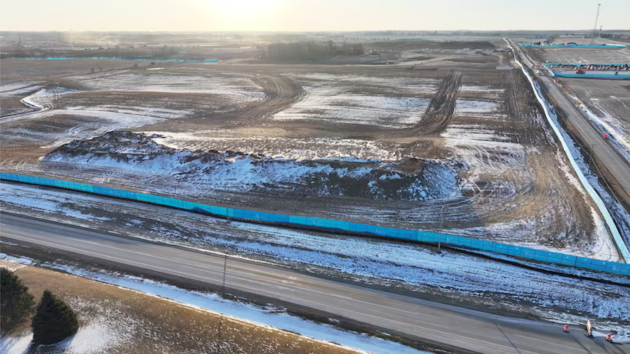
Uttech later learned that the transmission line would be used to help power a massive $15 billion data center campus that’s set to be built on over 500 football fields’ worth of farmland in nearby in Port Washington — a signature part of the Trump administration’s $500 billion Stargate partnership with OpenAI and Oracle, which President Donald Trump hopes will help supercharge the artificial intelligence revolution. 

Uttech is facing what other residents in his town — and others around the country — are facing more and more: the risk of losing parts of his land to eminent domain, the government’s legal authority to seize private property for public use, in support of the growing expansion of AI data centers as the demand to power them continues to grow.

The threat, in some ways, is a physical manifestation of what many people like Uttech fear the artificial intelligence boom could mean for their work.

Across the United States there currently more than 3,000 data centers, and that number will soon grow by 1,200 more now under construction, according to Data Center Map, an industry service that tracks data center development.

​​”These facilities are so energy-intensive,” Ari Peskoe, who directs the Electricity Law Initiative at Harvard University, told ABC News. “A single sort of warehouse can use as much electricity as a large U.S. city. The amount of new infrastructure that has to be built to power that facility is unlike anything we’ve seen in generations.”

The Trump administration has pushed to rapidly build and deploy AI with urgency, arguing it will be vital to stay ahead of rivals like China and protect national security.

“I’m going to help a lot through emergency declarations, because we have an emergency, we have to get this stuff built,” Trump said at a White House event announcing the Stargate initiative last January. “So they have to produce a lot of electricity. And we’ll make it possible for them to get this production done easily, at their own plants if they want.”

‘It’s going to transform our community’
In nearby Port Washington, Mayor Ted Neitzke wants to make sure that investment is made right in his town, which he says is desperate for it.

“It’s exciting because it’s going to transform our community, it’s going to create a tax base and jobs and secondary and tertiary workforce and opportunities that we have not even envisioned, and it’s going to lead us into a real renaissance,” said Neitzke, who told ABC News the project would bring thousands of new jobs and much needed tax revenue.

“In a few years when the financing and everything is all done and the deal solidifies, they will pay the overwhelming majority of property taxes for the citizens of the city of Port Washington,” he said.

A representative for the industry group Data Center Coalition, when asked about the Port Washington project, told ABC News that the industry is making “multi-billion-dollar investments across the nation, including Wisconsin, to advance the digital economy, and in the process, provide significant benefits to local communities.”

“These include creating hundreds of thousands of high-wage jobs, providing billions of dollars in economic investment, and generating significant local, state, and federal tax revenue that helps fund schools, transportation, public safety, tax relief for residents and small businesses, and other community priorities,” the group said.

On top of outcries from the community over growing eminent domain concerns, the project has ignited backlash from some residents who are fearful that, as has been the case in some other communities around the country, the data center’s potential stress on the current electrical grid could lead to higher electric bills.

Nationwide, electricity prices jumped 6.9% in 2025 — more than double the inflation rate of 2.9% — according to new analysis by Goldman Sachs economists, who said they “expect data centers to boost electricity demand significantly, accounting for about 40% of total power demand growth over the next five years.”

In response, activists in Wisconsin, led by the community group Great Lakes Neighbors, have organized protests including a rally at the state capitol earlier this month. The tensions in the city were on full display last December when multiple anti-AI data center protesters were arrested, and one was dragged out of the city council meeting after chanting “Recall, recall, recall,” directed at Mayor Neitzke, after her allotted time had ended.

“I did go to the council meeting purely intending to speak. I had a speech prepared. Again, I had spoken earlier in other council meetings,” Christine LeJeune, the protester who was forcibly removed from the council meeting, told ABC News about the incident, adding that from her perspective, “the message was if you speak out, then this is what will happen to you.”

Pressed on the arrests at the recent council meeting, Neitzke, who faced a failed recall attempt over his support for the data center project, defended law enforcement when asked about the incident, while adding that incidents like that are “not the norm here.”

“I stand right next to our police department,” Neitzke said. “I thought they were very kind. They were very cordial, multiple warnings. Please, please, please.”

The mayor told ABC News that amid the backlash over the project, he’s been on the receiving end of threats to him and his family.

“I can play you the voicemails of the threats I receive from all over the country to my family’s safety,” he said. “What I did not see coming was that our officers following the law and enforcing the law would lead to people threatening our physical safety. That’s not OK.”

Paying their own way
With the construction of the data center already underway, local activists around Port Washington are hoping to push for commitments from companies to cover increases to their bills and not pass any increases on to customers.

Both OpenAI and Oracle said in statements to ABC News that they were committed to paying their own way and said they would mitigate the impact of these data centers on customers and their electricity bills by pledging to build out renewable energy sources to create more power.

“In Wisconsin, and across all of our U.S. Stargate sites, we are committed to paying our own way on energy so that our operations do not increase local electricity prices,” OpenAI spokesperson Jamie Radice said in a statement. “Our Port Washington site will help support AI services used by millions of people and businesses across the country — the majority of whom use it for free — and it will bring jobs and long-term investment to the region.”

In a statement to ABC News, Oracle said, “In partnership with WE Energies, we’re paying our own way on energy so ratepayers’ bills and electric grid reliability are never impacted by our data center. Seventy percent of the energy used for the Port Washington campus will come from zero-emission sources, including wind, solar, and batteries. The project will add about 2,000 MW of new zero-emission power to Wisconsin’s grid, which means more reliable, affordable energy will be available to local families and businesses. Oracle — not ratepayers — will fund these electrical infrastructure upgrades.”

The fate of Uttech’s land rests with whether the American Transmission Company (ATC) moves forward with what the company has called either the “preferred route” for the new transmission lines — or the “preferred alternative route,” the latter of which follows existing transmission lines. The Public Service Commission of Wisconsin, the state agency that regulates utilities, will review ATC’s project application for the data center, including the proposed route options, and will select the final route.

Vantage, the data center operator, told ABC News in a statement that it supports the alternative route and that they are “committed to being a good neighbor” and are “prioritizing investing in sustainable energy, minimizing local impact and partnering closely with the community to be an economic driver for the state while enhancing the daily lives of residents.”

“Residents and businesses in Port Washington will not see an increase in their electric bills due to this project,” the Vantage statement said.

A representative from ATC told ABC News that they consider “several factors such as cost to ratepayers, landowner impacts, environmental sensitivities, and engineering considerations when studying power line routes and locations for supporting infrastructure” and that “The route designated as ‘preferred’ offers a lower cost to ratepayers and maximizes the use of existing corridors.”

“We understand that others may favor the alternative route for different considerations,” the ATC representative said.

‘I’m not going to just roll over’
Uttech, who at 83 still regularly jumps on a four-wheeler to traverse his sprawling property in search of inspiration, is working with the Wisconsin Institute for Law & Liberty, a conservative law firm, to take on the data center that could cost him his land.

“The use of eminent domain power must be the absolute last resort … This is not such a case,” the firm wrote in a letter to ATC. “We will do all we can to protect the Uttech family’s private property rights.”

“Building the power lines on their land would cause irreparable damage to the natural beauty and wildlife the Uttech family has spent decades developing, and which Tom enjoys as inspiration for his work,” WILL deputy council Lucas Vebber said.

While Uttech says he understands that AI is a growing billion-dollar industry that is already in motion and can’t be stopped, he is vowing to continue his fight.

“They brought the fight to me and I’m not going to just roll over,” he told ABC News, saying he plans to fight “right to the end.”

Copyright © 2026, ABC Audio. All rights reserved.

Day 2 of US-Ukraine-Russia peace talks in Geneva conclude, official says

Day 2 of US-Ukraine-Russia peace talks in Geneva conclude, official says
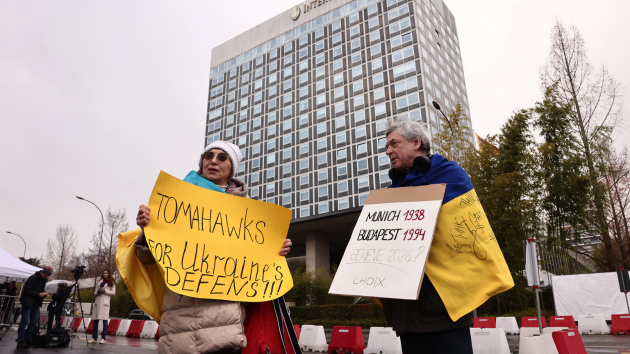
People gather in support of Ukraine as delegations from the United States, Ukraine and Russia meet for talks about a potential peace deal at the Intercontinental Hotel on February 17, 2026 in Geneva, Switzerland (Sedat Suna/Getty Images)

(LONDON) — American, Ukrainian and Russian negotiators convened again in Geneva, Switzerland, on Wednesday for trilateral peace talks, with the second day of meetings concluding after around two hours.

The delegations met Tuesday for the opening sessions of the third round of U.S.-brokered trilateral talks, the first two rounds of which were held in the United Arab Emirates starting in late January.

In a post to X, President Donald Trump’s special envoy Steve Witkoff said both Ukraine and Russia had agreed to keep working towards a peace deal following Tuesday’s meetings.

“President Trump’s success in bringing both sides of this war together has brought about meaningful progress, and we are proud to work under his leadership to stop the killing in this terrible conflict,” Witkoff wrote.

“Both parties agreed to update their respective leaders and continue working towards a deal,” he added.

The Russian delegation to Geneva was led by Vladimir Medinsky, an aide to President Vladimir Putin known for his ultraconservative and nationalistic messaging.

“The negotiations were difficult, but businesslike,” Medinsky said after the conclusion of Tuesday’s talks. Medinsky also said that a new round of negotiations are expected to be held soon.

Rustem Umerov, the secretary of Ukraine’s National Security and Defense Council and the leader of Kyiv’s delegation, said in a post to Telegram before Wednesday’s meetings that the Ukrainian team was “focused on substantive work.”

Umerov also said Tuesday that the Ukrainian team held talks with European representatives from France, the U.K., Germany, Italy and Switzerland.

Ukrainian President Volodymyr Zelenskyy said Wednesday that the first reports he had received from Kyiv’s delegation showed that the “military” aspect of the talks had been “constructive.”

“There are two tracks: military and political. Here I want to say that all three sides were constructive on the military track — in my view, based on the briefing I have just received,” Zelenskyy said.

“The military basically understand how to monitor a ceasefire and the end of the war, if there is political will. They have basically agreed on pretty much everything there,” the Ukrainian president added.

Before that, Zelenskyy had described the first day of talks on Tuesday as “difficult meetings” in another social media post.

“Russia is trying to drag out the negotiations, which could have already reached the final stage,” he wrote. “Thank you to the American side for their attention to details and patience in talks with the present representatives of Russia.”

Zelenskyy posted to social media on Tuesday after the first round of meetings, saying, “Ukraine is ready. We do not need war. And we always act symmetrically — we are defending our state and our independence.”

“Likewise, we are ready to move quickly toward a just agreement to end the war. The only question is for the Russians: what do they want?” Zelenskyy added.

The Ukrainian president again urged foreign partners to increase pressure and costs on Russia over Moscow’s continued long-range strike campaign against Ukrainian cities and critical infrastructure.

The attacks have focused on energy targets throughout the war’s fourth winter, plunging millions of Ukrainians into periodic darkness amid bitterly cold weather.

“The team absolutely must raise the issue of these strikes — first of all with the American side, which proposed that both us and Russia refrain from attacks,” Zelenskyy said.

“‘Shaheds,’ missiles and fantasy chatter about history matter more to them than real diplomacy, diplomacy and lasting peace,” Zelenskyy said of Moscow.

Russian officials have said little about the latest round of talks. Kremlin spokesperson Dmitry Peskov told reporters on Tuesday, “There are no plans to make any announcements on this matter. Everything will be closed to the press.”

In an interview with Sputnik Radio published on Wednesday, Russian Foreign Ministry spokesperson Maria Zakharova said of the talks, “Any step that could lead to, or lead down a path that leads to, a resolution to the situation is of great importance,” as quoted by the state-run Tass news agency.

Zakharova again accused Ukraine’s European partners of trying to sabotage the peace negotiations and pressuring Kyiv to continue the war, echoing a long-held Russian disinformation narrative.

Ukraine and Russia continued their nightly drone and missile exchanges despite the ongoing talks in Geneva.

Ukraine’s air force said in a post to Telegram on Wednesday morning that Russia launched one missile and 126 drones into the country overnight, of which 100 drones were shot down or suppressed. The missile and 23 attack drones impacted across 14 locations, the air force said.

Ukraine’s State Emergency Service (SES) said in posts to Telegram that six people were injured and one person killed in a Russian strike on the southern city of Zaporizhzhia on Tuesday evening. The SES also reported an overnight attack in the Dnipropetrovsk region.

Russia’s Defense Ministry, meanwhile, said its forces shot down at least 43 Ukrainian drones overnight.

Russia’s federal air transport agency, Rosaviatsiya, said in posts to Telegram that temporary flight restrictions were introduced at airports in Volgograd, Saratov, Cheboksary, Kazan and Kaluga.

Copyright © 2026, ABC Audio. All rights reserved.