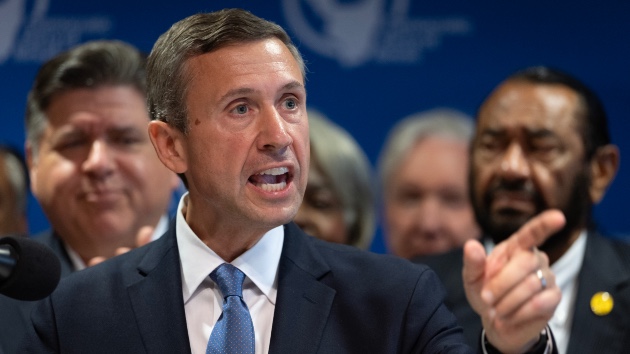
U.S. Transportation Secretary Sean Duffy boards a NextGen Amtrak Acela train for a trip to Boston following a news conference for the upgraded train’s first day of service along the Northeast Corridor on August 27, 2025 in Washington, DC. Andrew Harnik/Getty Images
(WASHINGTON) — The Department of Transportation announced new high-speed Acela trains during a Wednesday news conference, which included details about how the agency is “reclaiming the management” of Union Station in Washington, D.C., in an effort to restore it and bolster financial opportunities in it.
Joined by Amtrak leaders, Transportation Secretary Sean Duffy helped announce the launch of the NextGen Acela, which Amtrak is calling a high-speed rail service. The NextGen Acela had its inaugural ride from Washington to New York City’s Penn Station Wednesday morning following the announcement.
Duffy said that high-speed trains should be available in the United States — not just abroad. He said these high-speed trains will carry more people, which will lead to better pricing and an overall “better traveling experience for the American public.”
Amtrak President Roger Harris described the new trains as “premium, convenient and comfortable.” The trains are being marketed as the future of high-speed rail with Harris saying they will travel 160 miles per hour. Harris also noted that 95% of the trains are made in the United States and the investment in the new Acela trains helped generate 15,000 new jobs across the country.
While Amtrak is promoting that the trains are high speed, its schedules show the new train is slower than existing ones on the route — by 3-7 minutes per trip between Washington and New York City.
“Trip time improvements will continue to be determined based on infrastructure improvements we will also make along the Corridor. This includes updating and modernizing the tracks and overhead wires,” an Amtrak spokesperson said in response.
Duffy also announced that Union Station is “back under DOT control” in an effort to better restore and monetize it. Though the Union Station has previously been owned by the Department of Transportation, it has been under various agreements and leases.
“Not a power play — we’ve always had it, but we think we can manage the property better,” Duffy said of control of Union Station. “Bring in more tenants, bring in more revenue and that revenue is going to allow us to make investments in this beautiful building.”
Duffy said the effort aligns with President Donald Trump’s plan to reduce crime and homelessness in Washington and beautify Union Station. He added that Trump “wants Union Station to be beautiful again, he wants transit to be safe again, and he wants our nation’s capital to be great again. And today is part of that.”
“We are going to make the investments to make sure that this station isn’t dirty, that we don’t have homelessness in Union Station,” Duffy said. “We want a place where businesses want to obtain leases and set up shop and serve the community of D.C. and also the people who travel into D.C. via train. But also … if you want to go to a great meal and you want to go shopping, you want to come to Union Station because it’s gorgeous, it’s beautiful, it’s safe.”
Last week, Vice President JD Vance and Secretary of Defense Pete Hegseth visited Union Station to thank National Guard members stationed there. During the visit, Vance spoke to reporters about Union Station and crime there.
“You have vagrants, you have drug addicts, you have the chronically homeless. You have the mentally ill who harass, who threaten violence, who attack families, and they’ve done it for far too long. This should be a monument to American greatness. There should be a place where you can come and share a meal or go shopping with your family. It should not be a place where parents of small children are afraid to bring them,” Vance said.
Images from a court document shows Sean Charles Dunn throwing a Subway sandwich at a CBP officer in Washington, D.C., August 10, 2025. U.S. District Court
(WASHINGTON) — Prosecutors failed to secure an indictment against the man accused of throwing a sandwich at a Customs and Border Patrol agent in Washington, D.C., sources familiar with the matter confirmed to ABC News on Wednesday.
It’s not immediately clear whether prosecutors with the D.C. U.S. Attorney’s Office would make another attempt at seeking a felony assault indictment against Sean Dunn.
Prosecutors similarly failed to convince a federal grand jury in D.C. to indict a woman, Sidney Reid, accused by the government of assaulting and FBI agent during an inmate swap with ICE, despite three separate attempts.
The D.C. U.S. Attorney’s Office instead moved this week to charge the woman with a misdemeanor which would not require sign off from a grand jury.
Under the federal Speedy Trial Act, prosecutors technically have 30 days from the date of Dunn’s arrest to continue to seek his indictment or they will similarly have to choose between dropping the case altogether or moving to charge him with misdemeanor offenses.
The video of Dunn’s confrontation with a CBP agent earlier this month went viral and provoked an all-out public relations blitz from the White House and Justice Department touting his arrest and the federal assault charge against him.
The White House went as far as releasing a video showing a cadre of heavily armed agents carrying out his arrest, despite his attorney saying he had previously offered to surrender willingly.
Dunn’s attorney and the D.C. U.S. Attorney’s Office did not immediately respond to a request for comment from ABC News.
Kilmar Abrego Garcia speaks during a rally and prayer vigil for him before he enters a U.S. Immigration and Customs Enforcement (ICE) field office on August 25, 2025 in Baltimore, Maryland. Andrew Harnik/Getty Images
(WASHINGTON) — A federal judge has temporarily blocked the Trump administration from deporting Kilmar Abrego Garcia until at least early October.
U.S. District Judge Paula Xinis said Wednesday she will extend her temporary restraining blocking his removal until Abrego Garcia’s latest deportation challenge in court is resolved.
Judge Xinis scheduled an evidentiary hearing for Oct. 6 in the case challenging Abrego Garcia’s deportation to Uganda. She said during a hearing on Wednesday that she will issue a ruling within 30 days of the Oct. 6 hearing.
The judge also said that Abrego Garcia, who is currently being held in a detention center in Virginia, must remain in custody within a 200-mile radius of the court in Maryland.
Judge Xinis said she will not order Abrego Garcia released from immigration custody, saying that issue should be decided by an immigration judge. On Monday, Abrego Garcia’s attorneys moved to reopen his immigration case and apply for asylum.
Abrego Garcia, a Salvadoran native, was deported in March to El Salvador’s CECOT mega-prison — despite a 2019 court order barring his deportation to that country due to fear of persecution — after the Trump administration claimed he was a member of the criminal gang MS-13, which his family and attorneys deny.
He was brought back to the U.S. in June to face charges in Tennessee of allegedly transporting undocumented migrants within the U.S. while he was living in Maryland, to which has pleaded not guilty.
After being released on Friday while awaiting trial, he was taken into immigration custody upon checking in with the ICE office in Baltimore on Monday, and transferred to a detention center in Tennessee where authorities said he could be deported to Uganda on immigration charges.
Attorneys for Abrego Garcia filed an emergency motion Monday to reopen his immigration case to seek asylum, arguing that because Abrego Garcia was deported and then brought back to the U.S., he is now eligible to apply for asylum within one year of his last entry into the U.S.
In the filing, the attorney also said that reopening the case is warranted to allow Abrego Garcia to designate Costa Rica as the country of removal should be be deported.
(MINNEAPOLIS) — At least two people were killed and more than a dozen were hurt in a shooting during morning drop-off at Annunciation Catholic School in Minneapolis, multiple sources told ABC News.
The shooter is “contained” and there’s “no active threat to the community,” city officials said. The suspect is believed to be deceased from a self-inflicted gunshot wound, sources said.
Students in pre-K to eighth grade attend the school. Young children wearing their uniforms were seen leaving the school holding their parents’ hands.
“I’m praying for our kids and teachers whose first week of school was marred by this horrific act of violence,” Minnesota Gov. Tim Walz wrote on social media.
“My husband’s a firefighter, and he got a phone call this morning [that] said that there was a incident at Annunciation, and that’s where my niece and nephew go to school … so he just took off on foot,” Emily Feste told Minneapolis ABC affiliate KSTP. “We heard about 15 minutes ago that they’re safe. But it’s so awful and it’s so scary.”
Walz said state authorities are at the scene. Agents from the FBI and the Bureau of Alcohol, Tobacco, Firearms and Explosives also responded.
President Donald Trump wrote on Truth Social that he’s been “fully briefed on the tragic shooting.”
“The White House will continue to monitor this terrible situation. Please join me in praying for everyone involved!” he wrote.
The Department of Homeland Security is monitoring the shooting, DHS Secretary Kristi Noem said in a statement.
“I am praying for the victims of this heinous attack and their families,” she said.
This is a developing story. Please check back for updates.
ABC News’ Pierre Thomas, Jack Date, Luke Barr, Aaron Katersky, Sasha Pezenik and Michael Pappano contributed to this report.
Catelin Drey, Democratic candidate for the Iowa State Senate, is seen in an advertisement for her campaign. Catelin Drey Campaign
(WASHINGTON) — National Democrats are celebrating the results of a special election for the Iowa State Senate, after Democrat Catelin Drey won in a district President Donald Trump carried by 11 points in 2024 to break a Republican supermajority of the chamber.
Republicans argue the low turnout race won’t reflect the voters who come out to support the party in the midterms, and that the results are influenced by the Democratic National Committee’s efforts to inject national money and volunteers into the race.
But the results are a potential warning sign for Republicans and suggest Democratic voters may be more engaged heading into next year’s elections, where control of Congress is at stake.
Drey won with 55% of the vote, with Republican Christopher Prosch garnering 44%, according to preliminary results from the Woodbury County Auditor’s Office.
“For the fourth special election in a row, Iowa voted for change,” Iowa Democratic Party Chair Rita Hart said after Drey’s victory.
“Our state is ready for a new direction and Iowa Democrats will keep putting forward candidates who can deliver better representation for Iowans,” Hart added.
Ken Martin, chair of the Democratic National Committee, said on Wednesday the party mobilized more than 30,000 volunteers to aid Drey and Iowa Democrats.
Martin, in a statement touting Drey’s victory, said Iowans are “putting Republicans on notice and making it crystal clear: any Republican pushing Trump’s unpopular, extreme agenda has no place governing on behalf of Iowa families.”
“That’s why all year long, Iowans have been electing Democrats ready to fight for working Iowans. Make no mistake: when Democrats organize everywhere, we win everywhere, and today is no exception,” Martin said.
This is the second time this year that Democrats have won a special election in Iowa. In January, they flipped another Iowa State Senate seat in a GOP area that President Trump won by 21 points last November.
The result of Tuesday’s special election also has practical implications for the state. Without a supermajority, Republicans can no longer confirm the governor’s appointees without Democratic support.
Iowa Republican Party chair Jeff Kaufman, on social media, downplayed the win for Democrats.
“National Democrats were so desperate for a win that they activated 30,000 volunteers and a flood of national money to win a state senate special election by a few hundred votes,” Kaufman wrote on X. “If @DNC thinks things are suddenly so great again for them in Iowa, they will bring back the caucuses.”
Diana, Princess Of Wales.(Photo by Tim Graham Photo Library via Getty Images)
(LONDON) — A time capsule that was laid by Princess Diana in 1991 at Great Ormond Street Hospital (GOSH) in London has been opened, with officials revealing a collection of 1990s artifacts just days before the 28th anniversary of her death on August 31st, 1997.
Jason Dawson, the hospital’s executive director who opened the capsule earlier this year as GOSH started its new project to develop a new children’s cancer center, called the moment “really quite moving, almost like connecting with memories planted by a generation gone by.”
Inside lay a snapshot of 1991 — a Kylie Minogue CD, Casio pocket television, solar calculator and other artifacts that were cutting-edge three decades ago.
As winners of a BBC competition 34 years ago, the items were chosen by David Watson, a then-11-year-old boy from Devon, and Sylvia Foulkes, a then-9-year-old girl from Norwich, to represent life in the 1990s.
Watson contributed the Kylie Minogue “Rhythm of Love” album and a European passport, along with a pocket TV and recycled paper.
Foulkes added British coins, tree seeds from Kew Gardens in London, a hologram snowflake and a solar calculator. Princess Diana included her own photograph and a copy of The Times newspaper that featured Gulf War headlines at the time.
As Great Ormond Street Hospital’s president from 1989 until her death, Diana played a central role in GOSH’s Wishing Well Appeal, raising £54 million — equivalent to £200 million today – considered the largest U.K. charity appeal at the time, according to GOSH.
Princess Diana famously made regular ward visits, sitting on children’s beds, holding hands and providing physical comfort at a time when many feared contact with seriously ill patients.
After her divorce in 1996, Diana reduced her charitable commitments from over 100 organizations to just six focused causes, with Great Ormond Street Hospital being one of the remaining ones.
Stephen Lee, director of the U.K. Institute of Charity Fundraising Managers, called her impact “probably more significant than any other person’s in the 20th century.”
Modern royal philanthropy directly traces to Diana’s deeply personal approach, living on through Prince William’s homelessness work and Harry’s veteran advocacy, according to Emma Hart, director of the McNeil Center for Early American Studies at the University of Pennsylvania, who notes that notes Diana “forced the British monarchy to move into the 21st century” and that she “showed how the royal family could be a force for good.”
Meanwhile, following the opening of the capsule and the continuation of construction of the new cancer center, officials say that the new facility aims to increase patient capacity by 20% when it opens in 2028.
“Replacing outdated facilities on Great Ormond Street itself, the centre will be a national resource for the treatment of childhood cancers, with a focus on research and innovation,” GOSH said in a statement following the announcement of the time capsule being opened. “Developed with families and clinicians, the centre’s design will make it easier for clinical teams to develop kinder, more effective treatments, all delivered in a child-focused environment where children can play, learn and be with their family while at hospital.”
The Flag of Greenland, known nationally as “Erfalasorput”, flies above homes on March 28, 2025 in Nuuk, Greenland.(Photo by Leon Neal/Getty Images)
(LONDON) — The top U.S. diplomat in Denmark was summoned for a meeting at the country’s foreign ministry, Foreign Minister Lars Lokke Rasmussen confirmed on Wednesday, over alleged pro-American influence operations in Greenland.
“We are aware that foreign actors continue to show an interest in Greenland and its position in the Kingdom of Denmark,” Rasmussen said in a statement. “It is therefore not surprising if we experience outside attempts to influence the future of the kingdom in the time ahead.
“Any attempt to interfere in the internal affairs of the kingdom will of course be unacceptable,” Rasmussen said. “In that light, I have asked the Ministry of Foreign Affairs to summon the U.S. chargé d’affaires for a meeting at the ministry.”
“The cooperation between the governments of Denmark and Greenland is close and based on mutual trust, just as there is close cooperation and dialogue between the relevant Greenlandic and Danish authorities,” Rasmussen added.
The meeting came after Danish public broadcaster DR published a report in which unnamed government and security sources said that three Americans with connections to President Donald Trump were conducting influence operations in the semi-autonomous Danish territory.
DR said it was unclear whether the Americans were acting on their own initiative or under orders from others.
Trump has repeatedly expressed his desire to take control of Greenland, framing the huge Arctic territory as vital for American national security. The president has proposed purchasing the island and refused to rule out taking military action to take control of it.
Politicians in Denmark and Greenland have said that the island is not for sale.
In a statement sent to ABC News on Wednesday, the Danish Security and Intelligence Service said it is aware that Greenland has been the target of “various types of influence campaigns” aimed at “creating discord in the relationship between Denmark and Greenland.”
“Influence activities can generally be carried out via traditional physical influence agents or via disinformation, i.e. deliberate production and dissemination of misleading information,” the statement added.
ABC News’ Dada Jovanovic contributed to this report.
Ken Martin, chairman of the Democratic National Committee, speaks during a press conference with Texas Democrats at the International Union of Painters and Allied Trades union hall on August 05, 2025 in Aurora, Illinois. (Photo by Scott Olson/Getty Images)
(WASHINGTON) — The Democrats are in a tough stretch. Their fundraising and voter registration lags Republicans. And polls show American voters find the party generally unfavorable.
But at this week’s Democratic National Committee summer meeting in Minneapolis, members are desperate to turn a page, shed a rudderless reputation, and more clearly define their platform as they look to deliver wins in upcoming governor’s races and the midterms next year.
In fact, at least a half dozen members who spoke to ABC News say that they are eager to start fighting back more aggressively against President Donald Trump and feel like some of the problems the party finds itself in is due to compounding factors, rather than the direct fault of Chair Ken Martin, who was elected in early February.
One of the ways Democrats believe they can get their footing back is leaning into the recent outrage around Republican efforts to pursue mid-decade redistricting and take a page out of California Gov. Gavin Newsom’s playbook to give Trump a taste of his own rhetoric. Many members also believe they can resonate with voters as they push back against the impacts Trump’s spending and policy bill have on health care and costs.
“We all know that this is going to be an uphill battle. We all know that there’s tremendous challenges ahead, but we also know that the American people are not happy with the way things are turning out, and you see it in the polling,” said Maria Cardona, a member from Washington, D.C., who brushed off anxieties about Democrats in disarray as “b——t.”
“All of this internal b——t is exactly that — it’s b——t,” Cardona said.
This week’s meeting is the first major gathering of Martin’s tenure — and an early litmus test of his popularity and trust in his leadership, as his first few months have been mired in growing pains.
The DNC reported having around only $14 million cash on hand as of the end of July — far less than the Republican National Committee, which reported having $84.3 million cash on hand. The DNC also fundraised less than the RNC in July.
The news is better for Democrats’ official U.S. House campaign arm. The Democratic Congressional Campaign Committee reported having $40.4 million cash on hand by the end of July, while its GOP counterpart, the National Republican Congressional Committee, reported having $37.6 million cash on hand. The DCCC also outpaced the NRCC in fundraising in July.
Martin has faced increased scrutiny and criticism over infighting surrounding Gen Z activist David Hogg, who resigned from his role as vice chair after he promised to support primary challenges of incumbent Democrats he saw as complacent. American Federation of Teachers President Randi Weingarten also stepped away from the DNC in June, writing in her resignation letter she is “out of step” with new party leadership. Weingarten endorsed Martin’s most prominent chair challenger, Ben Wikler, the former Wisconsin Democratic Party chair.
When asked by ABC News about Democratic voter registration lagging as reported by The New York Times last week, Martin said the party has “work to do, for sure,” and pointed to the committee’s new organizing summer project, a volunteer training and voter registration initiative that sets to train Democrats to engage — and ideally convert voters — in non-political spaces in battleground areas and online as proof of concept.
“We’ve got to get back to registering voters — that’s what the DNC has already started this year with our summer organizing program. We are doing that with our state parties now,” Martin said during an event at the Minnesota State Fair.
Shasti Conrad, a DNC member from Washington state, said that grief over the election loss has permeated several conversations with fellow members, but has felt a recent energy shift, particularly after Texas House Democrats denied a quorum to delay the passage of new congressional district maps — which now await the signature of Texas Gov. Greg Abbott.
“When you lose an election like we did last year, you’re going to feel people’s rage, their sadness, their despair, all of that, and that is very much, has been what has been reverberating through every conversation that I’ve had,” Conrad said. “I think we’re all trying to move through this.”
Conrad continued: “We are starting to really get on solid footing, and that’s my hope with this meeting, is that we’ll be able to walk out of here feeling ‘Ok, we’re settled.'”
Conrad finds some of the handwringing about fundraising and voter registration “slightly overblown” and feels like the organization is in a solid place and has room to grow.
That doesn’t mean internal concerns have evaporated — but members feel concern is finally resulting in consensus.
“This is the crows coming home to roost. We’ve abandoned partisan voter registration for a very long time and it’s no surprise that we’re not only losing elections, but we’re also losing voters,” said progressive DNC member Michael Kapp from California. Kapp says he is “so happy” that Martin, in his view, is focused on righting the wrong.
Kapp said he believes it’s a “new day at the DNC” and that many members are frustrated with national Democratic top brass — like Senate Minority Leader Chuck Schumer and House Minority Leader Hakeem Jeffries — for not doing enough. He also suggested that some members are galvanized to be a more active resistance.
“I see anger. I see willingness to stand up and defend the communities that are being impacted by this administration. I see frustration that we can’t move fast enough, and I know that that’s a frustration that Chair Martin himself feels, but he’s working like crazy,” Kapp said.
“A number of members arrived concerned about the direction of the party, but the focus on unity and messaging has been well received,” North Dakota member Jamie Selzler said. Selzler added that while he expects conversations about the fundraising figures to keep coming up, “There’s a sense that standing up against Republican overreach over the next few years and winning in Virginia and New Jersey this year will be an important factor in proving we can fight back.”
Andre Treiber, a Texas DNC member and youth council chair, feels like the committee is nearing the end of a “rebuild phase.”
“This is going to be repouring the final cement,” Trieber said. “The Democratic Party definitely has a brand issue, and I think that is what so many people here this week care a lot about fixing.”
For John Verdejo, a DNC member from North Carolina, the next step for the party is to keep things simple — focus on core issues like affordability, for instance — and stop feeling sorry for yourself.
“We need to get our message straight,” said Verdejo, who stressed the party should keep things simple: focus on core issues like affordability, for instance.
Verdejo understands why some members of the party may be licking their wounds post-loss, but believes the complaining should wrap as the committee reaches a critical transition point. Internally, there’s a desire for more fighters, Verdejo said, which he does see reflected in Martin, who he and other Democrats who spoke to ABC maintain is broadly well-liked despite the early challenges of his tenure.
“We need to, we need to think differently, strategically, dirty even, take the gloves off. Never mind the polling, never mind what the stats say. Never mind what the numbers say … people want to see that fire in us. Let’s give it to them. This is life or death out here,” Verdejo added.
Heavy machinery is tearing through what locals are calling “Wet Wipe Island,” an 820-foot shoreline of flushed bathroom debris that has transformed a stretch of London’s Thames River into an environmental nightmare. ABC News / Dakota Bennett
(LONDON) — Heavy machinery is tearing through what locals are calling “wet wipe island,” an 820-foot shoreline of flushed bathroom debris that has transformed a stretch of London’s Thames River into an environmental nightmare.
The clean-up near Hammersmith Bridge in West London represents the United Kingdom’s first attempt to mechanically remove wet wipes from a river and, over the next month, excavators will extract an estimated 180 tons of congealed waste — equivalent to the weight of 15 double-decker buses spread across an area the size of two tennis courts.
“We’re doing the first mass removal of wet wipes that’s ever taken place in the country,” Emily McLean, senior technical advisor for the Port of London Authority, which is coordinating the operation, told ABC News.
The mechanical intervention comes after nearly a decade of volunteers painstakingly collecting wet wipes by hand. Thames21, an environmental charity, has documented the problem since 2017, with volunteers removing 140,000 individual wipes while mapping the contamination’s spread.
“It’s a validation of eight years of work,” said Ann Willard Sullivan, a Thames21 volunteer who leads cleanup efforts in the area. “It’s a sign that there can be big change, don’t give up.”
The volunteer data proved crucial in convincing authorities to act and, what started as citizen science, became the foundation for both this cleanup and potential broader policy changes down the line.
The Thames’ 23-foot tidal range creates a narrow window for the cleanup work meaning excavators can only operate during a four-hour window around low tide when the debris becomes accessible.
McLean said that engineers are using a “rake and shake” method to separate wet wipes from river sediment, ensuring that essential materials for the Thames ecosystem remain on the riverbed while removing only the contamination.
“We’re removing that contaminated layer while retaining as much of the foreshore as we can,” explained Grace Rawnsley, sustainability director for the Port of London Authority.
The cleanup represents the latest chapter in the clean-up of the Thames after it was declared “biologically dead” by the Natural History Museum in 1957.
“This is a huge moment — after years of campaigning, wet wipe island hopefully is no more!” said Fleur Anderson, the MP for Putney, Southfields, Roehampton and Wandsworth Town. “The ban I’ve introduced will mean 3.8 billion wipes removed from the network every year. A win for our waters, sewers and environment!”
Now, nearly 70 years later, it supports 125 different fish species and serves as a nursery for five types of sharks, according to the Zoological Society of London.
Wet wipes, however, have recently threatened this recovery, with the plastic-laden debris breaking down into microplastics that clog digestive systems of fish and disrupt feeding patterns, according to the World Wide Fund for Nature.
Recent scientific research indicates that an estimated 70% of Thames flounder contain plastic fibers in their stomachs.
“They get stuck in fish stomachs,” McLean said. “So, we really think that by removing them, we’re taking out those contaminants, and that will help the water quality.”
The Hammersmith cleanup coincides with Britain’s groundbreaking approach to wet wipe pollution when, in April 2024, the U.K. government announced plans to ban plastic-containing wet wipes, with implementation expected by 2026.
Currently, Britons use approximately 11 billion wet wipes annually, with an estimated 2.5 billion flushed down toilets, according to Thames21.
Thames Water says that it spends £18 million ($24 million) yearly removing 3.8 billion wipes from London’s sewage system alone, costs that are ultimately passed to consumers through higher water bills.
The wet wipe issue extends far beyond the Thames, however, with water companies across the U.K. collectively spend £100 million ($135 million) annually clearing 300,000 sewer blockages, with 93% caused by flushed wipes, according to an October 2021 research report from United Utilities.
“These wet wipes should never be entering into the river,” Felicity Rhodes, Thames program manager at Thames21, told ABC News.
The charity advocates for a “multi-stakeholder approach” involving manufacturers, water companies, government regulation and consumer behavior change.
The Port of London Authority estimates the monthlong operation will cost “hundreds of thousands” of pounds, a fraction of the ongoing costs of wet wipe pollution.
For the rowers gliding past the cleanup site, the mechanical intervention represents both an end and a beginning: the removal of London’s most embarrassing landmark and a step toward the Thames that millions of Londoners want their river to become.
ABC News’ Maggie Rulli and Charlotte Gardiner contributed to this report.
A Social Security Administration office in suburban Detroit. Jim West/UCG/Universal Images Group via Getty Images
(WASHINGTON) — A whistleblower complaint filed on Tuesday alleges that the Department of Government Efficiency uploaded a copy of all federal Social Security numbers and information to an unsecured server in June, creating “enormous vulnerabilities.”
The complaint, filed by Social Security Administration Chief Data Officer Chuck Borges, alleges that a live copy of the “entire country’s Social Security information” is now being held by a “vulnerable cloud environment” that lacks oversight from the agency or the ability to track who is accessing the data.
Borges, who began his role at SSA in January 2025, alleges that the database of Social Security information contains all data that has been submitted through the application process for a United States Social Security card, “including the name of the applicant, place and date of birth, citizenship, race and ethnicity, parents’ names and social security numbers, phone number, address, and other personal information.”
“Should bad actors gain access to this cloud environment, Americans may be susceptible to widespread identity theft, may lose vital healthcare and food benefits,” the complaint reads, claiming the file risks “the security of over 300 million Americans’ Social Security data.”
A spokesperson for SSA told ABC News that the agency stores all data in safe environments and that the data mentioned in the complaint stored in a “long-standing environment used by SSA.”
“Commissioner [Frank] Bisignano and the Social Security Administration take all whistleblower complaints seriously. SSA stores all personal data in secure environments that have robust safeguards in place to protect vital information,” the SSA spokesperson said.
“The data referenced in the complaint is stored in a long-standing environment used by SSA and walled off from the internet. High-level career SSA officials have administrative access to this system with oversight by SSA’s Information Security team. We are not aware of any compromise to this environment and remain dedicated to protecting sensitive personal data,” the spokesperson said.
Borges claims he had raised concerns within the agency, “and to date has not been made aware of any remedial action.”
A Navy veteran, Borges previously held positions at the General Services Administration, the Office of Management and Budget, and the Centers for Disease Control.