(BLACK ROCK CITY, Nev.) — Officials in Nevada are investigating a homicide after a Burning Man participant was found dead, according to the Pershing County Sheriff’s Office.
On Saturday at approximately 9:14 p.m., a sheriff’s deputy was alerted by an event participant at Burning Man — an annual festival that takes place in Black Rock City, Nevada — that there was a man “lying in a pool of blood,” the sheriff’s office said in a statement on Sunday.
Officials “immediately responded” to the campsite and found a “single white adult male lying on the ground, obviously deceased,” according to authorities.
Law enforcement then created a perimeter around the area, with the Washoe County Sheriff’s Office’s Forensic Science Division assisting in “processing the scene and collection of evidence,” officials said. The sheriff’s office also noted that they interviewed “several participants in the immediate area.”
But as of Sunday, the investigation was “still ongoing,” with portion of the festival’s “City” having “heavy law enforcement presence until the scene can be released,” according to officials.
“Although this act appears to be a singular one, all participants should always be vigilant of their surroundings and acquaintances,” the sheriff’s office said.
On Monday, the Pershing County Sheriff’s Office told ABC News that detectives are actively receiving tips and tracking down information related to the death.
There have been no arrests, officials said.
The identity of the body, which will be transferred to the Washoe County Medical Examiner’s Office, has not been identified by officials, the sheriff’s office noted.
Burning Man said in a statement they are “cooperating with law enforcement” as the investigation continues, and three public WiFi spots will be available for attendees who “need to communicate with loved ones,” the festival said.
As of Monday, no further information regarding the incident was available, officials said.
Officials said anyone with any additional information regarding the incident should contact the Pershing County Sheriff’s Office Investigator Josh Nicholson through dispatch at 774-273-2641.
Burning Man is a “temporary metropolis in Nevada’s Black Rock Desert,” according to its website.
“Tens of thousands of people converge on a dry lakebed in Nevada, build a fully functional city where they live and work for week, then make it disappear without a trace. In this crucible of creativity, all are welcome!” the festival’s website said.
The sheriff’s office told ABC News investigation is made more difficult by the fact that Black Rock City is a temporary city that is disappearing Monday, now that attendees have left, so officials have to work before evidence disappears. Because that death happened in such a remote location in the desert, cell phone service is non-existent in most areas, so video and surveillance evidence is not as available as it would be elsewhere, officials said.
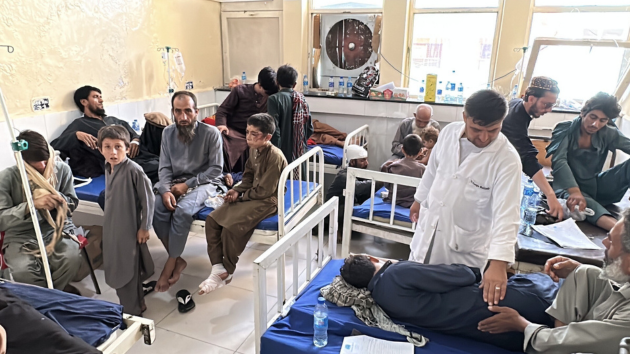
(ISLAMABAD, Pakistan) — The death toll from the earthquake in eastern Afghanistan that all but destroyed several villages rose on Tuesday to at least 1,411 people, a government spokesperson said.
Another 3,124 were injured in the 6.0 magnitude quake, which struck just before midnight on Sunday, Zabihullah Mujahid, the spokesperson, said on social media.
“Rescue operations are still underway in all the affected areas today,” Hamdullah Fitrat, the deputy spokesperson, said on Tuesday. “Dozens of commandos have been airlifted to areas where planes could not land to pull out the injured from the rubble and transport them to a suitable location.”
Shah Mahmood, a Taliban official in Nangarhar Province, said destroyed some 8,000 houses. Emergency responders have yet to reach some villages, where they fear there may be more dead and injured under the rubble, he said.
The powerful earthquake’s epicenter was about 17 miles east of Jalalabad, according to the U.S. Geological Survey.
Almost all of the deaths were in Kunar Province, officials said in a statement shared Monday by Zabihullah Mujahid, a government spokesperson. Others were killed in Nangarhar Province, said Mufti Abdul Matin Qani, spokesperson for the Ministry of Interior.
Deadly earthquakes have struck Afghanistan several times in recent years, including a 5.9 magnitude quake in June 2022 and a 6.3 magnitude one in October 2023. The death toll for each of those quakes rose to over 1,000 people, local officials said in their aftermaths.
Earthquakes are common in both eastern and western Afghanistan, where the India plate and the Eurasia plate intersect underneath the Hindu Kush mountains range, according to USGS.
“Since 1950, 71 other magnitude 6 or larger earthquakes occurred within 250 km of the August 31 earthquake, including six magnitude 7 and larger earthquakes,” USGS said in a summary of the activity it recorded during Sunday’s quake and the aftershocks.
The first strong quake struck at about 11:47 p.m. local time on Sunday and was followed by four weaker-but-still-powerful aftershocks into Monday, the USGS said. Those aftershocks measured 5.2, 5.2, 4.7 and 4.6, the organization said.
An estimated 12,000 people have been directly affected by Sunday’s, according to the World Health Organization in Afghanistan.
The hardest hit districts and villages in Kunar were Chawkay, Nurgal, Chapa Dara, Dara-e-Pech and Watapur, the WHO said in a report dated Monday. Structures in other villages in Nangarhar and Laghman provinces were also damaged, the report said.
“As the scale of devastation from the Afghanistan earthquake becomes clearer, my deepest condolences go to the victims and their families,” Richard Bennett, the U.N. special rapporteur for the country, said on social media on Tuesday.
Many of the health facilities in the affected regions appeared to be “functional” after the quake, the WHO said, adding that its local staff were working on-site at several locations in the region, including Nangarhar Regional Hospital.
At that hospital in Nangarhar, several injured children were being treated without their parents or relatives, according to a spokesperson for the Ministry of Health.
“These are painful and unbearable moments,” Dr. Sharafat zaman Amar, the spokesperson, said in a social media post that included pictures of several children with visible injuries and bandages.
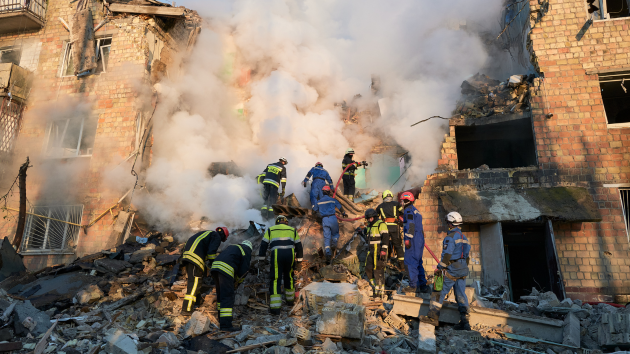
(LONDON) — August saw an easing in the scale of Russia’s long-range strike campaign on Ukraine, according to data published by Ukraine’s air force and analyzed by ABC News, though Moscow continued to launch massed and deadly bombardments on Kyiv, other major cities and critical infrastructure targets.
Over the course of August, Russia launched 4,216 air attack vehicles — 4,060 attack or decoy drones and 156 missiles — at a daily average rate of nearly 131 drones and five missiles, Ukraine’s air force data showed. No night of August passed without a Russian attack, the Ukrainian government said.
The reason for the apparent drop off in the overall intensity of the attacks is unclear. Moscow has shown no sign of abandoning its maximalist demands in the ongoing peace talks. Meanwhile, Ukrainian long-range strikes have been targeting military industrial targets across Russia, including facilities involved in the production of drones and missiles.
Ukrainian forces said they shot down or suppressed just over 85% of the drones and nearly 68% of missiles launched by Russia during August.
The overall number of long-range Russian drones and missiles launched in August was around 34% less than in July, according to the Ukrainian air force’s figures.
But the month ended with a notable uptick in Russian activity. From Aug. 1 to 15 — the day of the summit between Presidents Donald Trump and Vladimir Putin in Alaska — Ukraine’s air force said Russia launched a total of 1,131 drones and 21 missiles, at a daily average of 75.4 drones and 1.4 missiles.
But from Aug. 16 to 31, the scale of attacks increased. In the second half of the month, Ukraine’s air force reported 3,001 Russian drones and 135 missiles at a daily average of 187.5 drones and 8.4 missiles.
Neither Russia nor Ukraine publish data on their own strike campaigns. Ukraine’s air force publishes a daily tally of Russian drone and missile strikes, while Russia’s Defense Ministry only publishes figures of Ukrainian drones it claims were shot down.
The overall number of Russian drones and missiles reported by Kyiv in August was the lowest monthly total since May. Still, three nights during August each saw more than 500 drones and missiles launched into the country, despite the comparatively smaller scale of month’s attacks.
The human toll continues to rise in Ukraine, despite Trump’s repeated appeals for Moscow to end long-range strikes — and despite his public frustration over Putin’s refusal to do so.
The U.N. Human Rights Monitoring Mission in Ukraine said that July marked the deadliest month for Ukrainian civilians since May 2022, with 286 people killed and 1,388 people injured. The mission said it verified casualties in 18 of the country’s 24 regions in July. The mission attributed nearly 40% of the casualties in July to “long-range weapons such as missiles and loitering munitions.”
The mission is yet to publish its data for August. But there were several high casualty events during the month, perhaps most notably the drone and missile barrage on Kyiv that killed at least 23 people on the night of Aug. 27-28.
The bombardment on the night of Aug. 20-21 also saw one person killed and more than a dozen more injured, while another large combined strike on the night of Aug.29-30 killed one person and injured at least 29 people.
In July, Russia set a new monthly record for the number of drones and missiles fired at Ukraine. The month saw Russia launch 6,443 aerial vehicles — 6,245 drones and 198 missiles — into the country, of which 89% of drones and around 61% of missiles were defeated, according to Ukrainian figures.
June saw 5,438 drones and 239 missiles fired into Ukraine, with a daily average of 181 drones and nearly eight missiles. The air force downed or suppressed 87.2% of all drones and 73% of missiles during June.
And in May, Russia launched a total of 3,835 drones and 117 missiles, for an average of around 124 drones and nearly four missiles each day. Across the month, 85.7% of drones and 57% of missiles were defeated.
Despite the nightly attacks, August saw two key diplomatic summits, intended as springboards to end Russia’s full-scale invasion of its neighbor which began in February 2022.
First, Putin traveled to Alaska to meet with Trump — the first face-to-face meeting between Russian and American leaders since 2019.
Ukrainian President Volodymyr Zelenskyy, accompanied by a host of European leaders, then traveled to the White House to discuss possible peace terms.
Trump framed both meetings as positive and encouraging. But subsequent developments have been lacking. Trump’s proposal for a meeting between Putin and Zelenskyy — an idea the Kremlin has repeatedly dodged since the two men last met in 2019 — has yet to come to fruition, with Kyiv accusing Moscow of continued evasion.
Data published by Russia’s Defense Ministry suggests that Ukraine maintained the level of its own drone strike campaign through August.
The ministry said its forces shot down 2,783 Ukrainian drones over the course of the month, at an average rate of nearly 90 per day.
Across July, the Defense Ministry in Moscow reported downing 3,008 Ukrainian drones at an average of around 97 per day.
In June, the ministry reported downing a total of 2,368 Ukrainian drones, with an average of almost 79 drones per day across the month. Those figures were down from May, during which the ministry said it shot down 3,611 drones with an average of 116 per day.
Local governments in Russia often publicly state death tolls for specific attacks, although the Kremlin doesn’t release a regular country-wide tally, making it difficult to track over a period of time.
Last month, Rodion Miroshnik — a Foreign Ministry ambassador-at-large responsible for analyzing Ukrainian attacks in Russia — told the TASS state news agency that 15 people were killed and 140 injured during one week of attacks in August. The toll included casualties in frontline regions, as well as those deep inside Russia caused by long-range drone strikes.
Zelenskyy said on Sunday that Kyiv is planning “new strikes.”
Siavosh Hosseini/SOPA Images/LightRocket via Getty Images
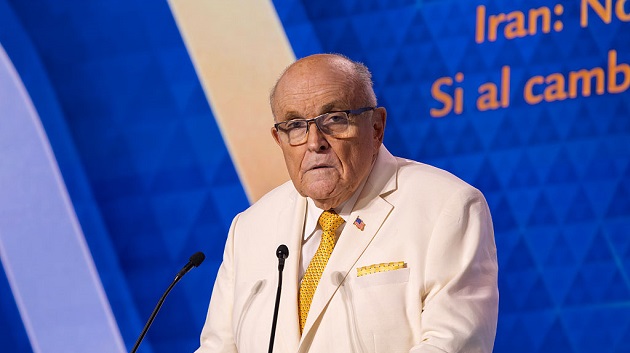
(NEW YORK) — Former New York Mayor Rudolph Giuliani was injured in a vehicle accident Saturday evening in New Hampshire, his security chief said in a statement on Sunday.
A source familiar with his condition told ABC News on Monday that Giuliani is now out of the hospital and in good spirits. He remains in New Hampshire, the source added.
Giuliani’s security chief, Michael Ragusa, said on Sunday that Giuliani was taken to a nearby trauma center after the accident, where he was diagnosed with “a fractured thoracic vertebrae, multiple lacerations and contusions, as well as injuries to his left arm and lower leg.”
Before the incident, Ragusa said Giuliani was flagged down by a woman who was the victim of a domestic violence incident and that he rendered assistance and contacted 911. He remained on the scene until responding officers arrived to ensure her safety, Ragusa said in a statement.
After the incident while traveling on a highway, Giuliani’s vehicle was struck from behind at high speed, Ragusa said. His business partner and medical provider were contacted and arrived at the hospital to oversee his care.
Ragusa later said in a statement on X: “He sustained injuries but is in good spirits and recovering tremendously. Thank you for the prayers & support.”
He later followed up on his post, saying, “This was not a targeted attack. We ask everyone to respect Mayor Giuliani’s privacy and recovery, and refrain from spreading unfounded conspiracy theories.”
(HOUSTON) — An 11-year-old Texas boy has died after being shot in the back when he allegedly attempted a door-knocking prank on a neighbor, police said.
The shooting unfolded around 10:55 p.m. on Saturday at a home in southeast Houston, Shay Awosiyan, a spokesman for the Houston Police Department, told ABC News.
The child, who police initially said was 10 years old, was pronounced dead at a hospital on Sunday, according to a statement released by police. The boy’s name was being withheld by police pending an autopsy.
“Officers were told the male was ringing doorbells of homes in the area and running away. A witness stated the male was running from a house, after ringing the doorbell, just prior to suffering a gunshot wound,” Houston homicide detectives said.
One person detained for questioning had been released, but was detained again as a possible suspect in the shooting after police were notified around 2 p.m. local time on Sunday that the child had died, Sgt. Michael Cass of the Houston Police Department said at a news conference on Sunday.
Cass said it was unclear if the man being detained was the owner of the home where the deadly door-knocking prank occurred.
A search warrant was served on the home, and Cass said a significant amount of weapons were found inside the house.
“The possible suspect has been detained and interviewed but not yet formally charged,” Cass said.
Cass said the victim, who lived about a block away, was running away from the house with at least two friends when a witness saw a man exit the home with what appeared to be a handgun and fire multiple rounds in their direction.
After being hit in the back, the victim ran about a block before collapsing in the street, Cass said.
The prank allegedly committed in Houston is similar to what’s being dubbed the “Door Kicking Challenge,” a national trend based on an old prank called “Ding Dong Ditch,” in which groups of kids record videos of themselves kicking and banging on doors of homes and apartments before running away and then posting the videos on social media platforms such as TikTok.
In July, a 58-year-old Texas homeowner was arrested and charged with aggravated assault when he allegedly fired multiple rounds at a vehicle fleeing his home in Frisco after someone banged on the front door, according to a statement from the Frisco Police Department.
The driver of the car that was shot at around 10:50 p.m. on July 28 and two passengers contacted police to file a complaint, showing officers three bullet holes in the vehicle, according to police.
“However, during subsequent interviews, all admitted to ding, dong, ditching in a random neighborhood when they were confronted by a male with a firearm,” the Frisco police said in a statement.
In June, police in Chandler, Arizona, released video footage of a group of juveniles committing the “Door Kicking Challenge,” alleging the group pulled the prank on the same home at least 18 times, prompting the homeowner to move out.
“Let’s be clear: These ‘pranks’ can have serious consequences and lead to charges such as criminal damage, disorderly conduct, or harassment,” the Chandler Police Department said in a message to parents in the community. “Parents — please take a moment to talk with your children. Know where they are, who they’re with, and what they’re doing.”
Police in Fort Worth, Texas, posted a similar community message in May after receiving more than 20 complaints of young people committing the “Door Kicking Challenge.”
“It can be mistaken as an attempted break-in, potentially prompting dangerous or defensive responses from homeowners,” the Fort Worth Police Department said in a statement. “What may seem like a prank can result in very real trouble and/or danger.”
(MINNEAPOLIS, Minn.) — As Minneapolis public schools prepare to begin the first day of classes on Tuesday, police confirmed three more children were injured in last week’s shooting at the Annunciation Catholic School.
Minneapolis Police Department on Monday announced the revised number of injured, bringing the total amount of victims who were injured by gunfire to 21.
Authorities said 18 children between the ages of 6 and 15 were hurt in the shooting, along with three adults in their 80s who were attending mass at the time of the incident on Wednesday.
The gunfire erupted during morning Mass, when a 23-year-old shooter opened fire through the windows of the school’s church, police said.
Two children, 8-year-old Fletcher Merkel and 10-year-old Harper Moyski, died in the shooting, their families confirmed on Thursday.
“Yesterday, a coward decided to take our 8-year-old son, Fletcher, away from us. Because of their actions, we will never be allowed to hold him, talk to him, play with him, and watch him grow into the wonderful young man he was on the path to becoming,” Jesse Merkel, Fletcher’s father, said on Thursday.
Harper’s parents remembered her as a “bright, joyful and deeply loved 10-year-old whose laughter, kindness, and spirit touched everyone who knew her.”
Hennepin Healthcare said four patients — three children and one adult — remain hospitalized at the Hennepin County Medical Center.
While other Minneapolis schools are coming back into session with a substantially increased visible patrol presence, Annunciation will remain closed.
Police continue to actively investigate the shooter and have yet to determine a motive.
The shooter, who previously attended the school, died at the scene from a self-inflicted gunshot wound, authorities said last week.
“There has been conversation” with the shooter’s mother, Minneapolis Police Assistant Chief Christopher Gaiters said on Friday, though he did not elaborate.
Annique London, one mother of three daughters who all attended Annunciation in recent years, told ABC News she and her children feel a mix of community support and anxiety as school starts.
London’s daughter recently graduated from Annunciation — which teaches children in pre-K to eight grade — and will start high school nearby.
“She’s going to the public school Southwest High School and is terrified to go to school. And I don’t think she’s unique. I don’t even think the public school administration has yet come to terms with the support that might be needed for some students,” London said.
ABC News’ Ahmad Hemingway, Christiane Cordero and Briana Stewart contributed to this report.
(WASHINGTON) — Dr. Richard Besser explains why he and other former directors of the CDC wrote an op-ed criticizing Health Secretary Robert F. Kennedy Jr.’s handling of the CDC and public health. Nine former directors of the Centers for Disease Control and Prevention (CDC) are speaking out, saying Health and Human Services (HHS) Secretary Robert F. Kennedy Jr. is endangering the health of Americans.
Seven former directors and two former acting directors — whose tenures stretch back to the administration of former President Jimmy Carter — published an op-ed in The New York Times on Monday, just days after the ousting of the CDC’s new director Dr. Susan Monarez.
Sources told ABC News that Kennedy and Stefanie Spear, his principal deputy chief of staff, called on Monarez to support changes to COVID vaccine policy and the firings of high-level staff, which Monarez would not commit to.
The directors said Monarez’s removal is the latest in a series of actions that could have a “wide-ranging impact” on “America’s health security.”
One of the co-authors, Dr. Richard Besser, president and CEO of the Robert Wood Johnson Foundation and acting director of the CDC during the administration of former President Barack Obama, said he and his colleagues are stunned at what they’ve seen.
“What we are seeing taking place in the Department of Health and Human Services, and at CDC in particular, is not businesses as usual,” he told ABC News. “There are always changes, different policy priorities when administration changes. But what we’re seeing under the leadership of Secretary Robert F. Kennedy [Jr.] is something different altogether.”
“He has come into his role as Secretary of Health and Human Services with a strong agenda that is centered on dismantling our vaccine system in America and limiting people’s access to these life-saving, health-preserving interventions,” Besser added.
HHS did not immediately reply to ABC News’ request for comment.
In the op-ed, the former directors point to several decisions made by Kennedy including the firing of thousands of federal health workers, touting unproven treatments as measles was spreading in the U.S., and canceling $500 million in federally funded mRNA vaccine research.
The directors also referenced Kennedy’s removal of all 17 members of the CDC’s vaccine advisory committee and replacing them with his own hand-selected members, many of whom have shared vaccine-skeptic views.
Besser said the ousting of Monarez, along with the resignation of at least four top leaders, compelled him and his colleagues to speak out.
He told ABC News that their departures leave the U.S. vulnerable to every day health challenges as well as public health threats.
“We can’t predict when the next pandemic will be here, but we know there will be future pandemics,” Besser said. “There will be other infectious threats. There will be other public health challenges, and with this Secretary performing in the way that he is, it puts us all at risk.”
He said he and the co-authors “don’t agree on everything, but we agree that our federal public health system is in major jeopardy. The CDC, which had been looked to as the world’s leading public health institution, is on life support and needs our attention immediately.”
The op-ed called on Congress to oversee HHS, which it has authority to do. It echoes a social media post from Sen. Bill Cassidy (R-Louisiana), who said the departure of CDC leaders require oversight from the Senate committee he chairs.
The former directors also called on state and local governments to fill funding gaps left behind by some of Kennedy’s actions.
“We represent individuals who served in every administration from Jimmy Carter through Donald Trump, Republicans and Democrats, and we were unified in our feeling that what we’re seeing is extremely alarming and that Congress needs to step up and perform its oversight function,” Besser told ABC News. “And so, we’re hoping that our voices will add to some of the other voices that have been calling this out and that Congress will do its part.”
At least five people have been killed and 30 others injured in shootings across Chicago over Labor Day weekend, including a drive-by attack that left seven victims wounded late Saturday night, according to police.
The violent holiday weekend came as President Donald Trump renewed threats to send federal agents and National Guard troops to Chicago over the objections of Illinois Gov. JB Pritzker and Chicago Mayor Brandon Johnson.
Trump on Saturday sent a warning to the Illinois Gov. JB Pritzker in a post on his social media platform, referencing recent crime in Chicago and saying Pritzker “better straighten it out, FAST, or we’re coming!”
Illinois Gov. Pritzker, a Democrat, responded in a news conference a week ago to an earlier Trump threat to “straighten out Chicago, just like we did D.C.,” by saying that the president’s plan was “unprecedented and unwarranted. It is illegal, it is unconstitutional, it is un-American.”
Mayor Johnson responded last week by saying in part that he had “grave concerns about the impact of any unlawful deployment of National Guard troops to the city of Chicago,” and calling Trump’s approach “uncoordinated, uncalled for, and unsound.” Johnson also said that deploying the National Guard in Chicago could “inflame tensions between residents and law enforcement.”
On Saturday, Mayor Johnson signed an executive order dubbed the “Protecting Chicago Initiative,” which he described in a news conference as “the most sweeping campaign of any city in the country to protect ourselves from the threats and actions of this out-of-control administration,” and which “directs our department of law to pursue any and every legal mechanism to hold this administration accountable for violating the rights of Chicagoans.”
“We have received credible reports that we have days, not weeks, before our city sees some type of militarized activity by the federal government,” Johnson said, in part. “We take these threats seriously and we find ourselves in a position where we must take immediate, drastic action to protect our people from federal overreach.”
At least 20 separate shootings occurred in Chicago between 10:32 p.m. Friday and 3 a.m. Sunday morning, according to a review by ABC News of police incident reports published online.
The victims included a 17-year-old girl who was inside her home when a bullet came through a front window and hit her in the arm, a 31-year-old man who was shot in the leg after getting caught in the crossfire of gunmen shooting at each other from two vehicles, and a 25-year-old woman who was shot and injured while driving down a street, all according to the incident reports.
Fewer than five hours after Trump posted a message on social media on Saturday criticizing Pritzker’s handling of crime in Chicago, a mass shooting occurred in the Bronzeville neighborhood of Chicago’s South Side that left seven people wounded.
“He better straighten it out, FAST, or we’re coming!,” Trump said in his post about Pritzker.
The shooting in Bronzeville occurred about 11:10 p.m. on Saturday on South State Street, according to police. A group of people were gathered outside in the area when a vehicle drove by and at least one occupant opened fire on the crowd. All seven people shot, five men and two women ranging in age from 28 to 32, were taken to hospitals with non-life-threatening injuries to their lower extremities, police said. No suspects have been arrested.
The first of five homicides that police say occurred over the long holiday weekend happened at 11:56 p.m. on Friday at the South Shore apartment complex on East Essex Street, where two women were discovered shot, according to police.
A 25-year-old woman was found in the apartment suffering from two gunshot wounds to her stomach and one to her leg, according to a police incident report. She was taken to the University of Chicago Medical Center where she was pronounced dead, according to authorities. The victim’s name was not immediately released.
The second victim, a 23-year-old woman, suffered gunshot wounds to both legs and was in fair condition at the University of Chicago Medical Center.
Investigators were interviewing a person of interest in the East Essex Street homicide but no arrests have been announced, according to police.
Elsewhere, two men were shot, one fatally, in the East Garfield Park neighborhood of Chicago around 11 a.m. on Saturday, according to police. The victims were standing outside on North Sawyer Avenue when a dark SUV approached them and a gunman exited the vehicle and opened fire, according to a police incident report.
A 29-year-old man, whose name was not immediately released, was shot multiple times and taken to Mount Sinai Hospital where he was pronounced dead, according to police. The second victim, a 32-year-old man, suffered a gunshot wound to his right side and was in stable condition at Mount Sinai, police said. No arrests have been announced in the incident.
Also on Saturday, gunfire erupted in the Altgeld Gardens neighborhood. Around 7:46 p.m., a 43-year-old woman was standing outside on E. 131st Street when five armed men approached her and opened fire, striking her multiple times, according to police. The victim, whose name was not immediately released, was taken to Christ Hospital where she was pronounced dead, police said.
No arrests have been announced in the Altgeld Gardens homicide.
Around 1:39 a.m. on Sunday, a 46-year-old man, whose name was not immediately released, was killed in a triple shooting that occurred in the Pilsen neighborhood of Chicago’s Lower West Side, according to police. The victims were standing on West 17th Street when a gunman walked up to them and opened fire, police said.
The two other victims, a 41-year-old man and a 43-year-old man, suffered gunshot wounds to their legs and were in good condition at Mount Sinai Hospital, police said.
Around 2:52 a.m. on Sunday, a 33-year-old man was killed in the West Inglewood neighborhood on the Southwest Side of Chicago, police said. The victim got into a argument inside a residence with a man who shot him in the head, according to police. The victim, whose name was not immediately released, was pronounced dead at the scene, according to police. No arrests were announced.
The series of shootings came after President Donald Trump said last week that he is prepared to order National Guard troops to American cities in addition to those in the nation’s capital, but that he wanted local officials to request his help.
Trump threatened to make Chicago the next city he would target after he declared what he said was a public safety emergency in Washington, D.C., and he put the city’s police force under federal control on Aug. 11.
Violent crime in Chicago has dropped significantly in the first half of the year, according to official data released by the city. Shootings are down 37% and homicides have dropped by 32% compared to the first half of 2024, while total violence crime dropped by over 22%, according to the crime statistics.
“Do not come to Chicago, you are neither wanted here nor needed here,” Pritzker further said in response to Trump during a news conference last week. “Donald Trump wants to use the military to occupy a U.S. city to punish its dissidents and score political points. If this were happening in any other country, we would have no trouble calling it what it is – a dangerous power-grab.”
(NEW YORK) — A 10-year-old Texas boy was shot and critically injured when he allegedly attempted a door-knocking prank on a neighbor, police said.
The shooting unfolded around 10:55 p.m. on Saturday at a home on Membrough Street in southeast Houston, Shay Awosiyan, a spokesman for the Houston Police Department, told ABC News on Sunday.
“A 10-year-old was apparently knocking on neighbors’ doors and running away when someone apparently fired shots,” Awosiyan said.
Awosiyan said one person was detained at the scene of the shooting and was being questioned, but no charges have been filed.
The injured child, who was out committing the prank with friends, was treated at the scene by the Houston Fire Department and taken to a nearby hospital, where he was in critical condition on Sunday afternoon, Awosiyan said.
The investigation continued on Sunday, but police released no additional details.
The prank allegedly committed in Houston is similar to what’s being dubbed the “Door Kicking Challenge,” a national trend based on an old prank called “Ding Dong Ditch,” in which groups of kids record videos of themselves kicking and banging on doors of homes and apartments before running away and then posting the videos on social media platforms such as TikTok.
In July, a 58-year-old Texas homeowner was arrested and charged with aggravated assault when he allegedly fired multiple rounds at a vehicle fleeing his home in Frisco after someone banged on the front door, according to a statement from the Frisco Police Department.
The driver of the car that was shot at around 10:50 p.m. on July 28 and two passengers contacted police to file a complaint, showing officers three bullet holes in the vehicle, according to police.
“However, during subsequent interviews, all admitted to ding, dong, ditching in a random neighborhood when they were confronted by a male with a firearm,” the Frisco police said in a statement.
In June, police in Chandler, Arizona, released video footage of a group of juveniles committing the “Door Kicking Challenge,” alleging the group pulled the prank on the same home at least 18 times, prompting the homeowner to move out.
“Let’s be clear: These ‘pranks’ can have serious consequences and lead to charges such as criminal damage, disorderly conduct, or harassment,” the Chandler Police Department said in a message to parents in the community. “Parents — please take a moment to talk with your children. Know where they are, who they’re with, and what they’re doing.”
Police in Fort Worth, Texas, posted a similar community message in May after receiving more than 20 complaints of young people committing the “Door Kicking Challenge.”
“It can be mistaken as an attempted break-in, potentially prompting dangerous or defensive responses from homeowners…,’ the Fort Worth Police Department said in a statement. “What may seem like a prank can result in very real trouble and/or danger.”
(NEW YORK) — A federal judge on Sunday blocked the Trump administration from deporting 76 unaccompanied Guatemalan children from the United States to Guatemala.
A judge had temporarily blocked the administration from removing the minors and set an emergency hearing for 3 p.m. Sunday, but U.S. District Judge Sparkle Sooknanan moved the hearing to 12:30 p.m. after the court was notified the Guatemalan children were “in the process of being removed from the U.S.”
“The Court ORDERS that the Defendants cease any ongoing efforts to transfer, repatriate, remove, or otherwise facilitate the transport of any Plaintiff or member of the putative class from the United States,” Sookananan wrote. “The putative class includes all Guatemalan unaccompanied minors in Department of Health and Human Services Office of Refugee Resettlement custody as of 1:02 AM on August 31, 2025, the time of the filing of the Complaint, who are not subject to an executable final order of removal,” the order said.
All of the children had been deplaned and were in the process of returning to the custody of the Office of Refugee Resettlement Sunday evening, Deputy Assistant Attorney General Drew Ensign said.
The government will notify the court when the transfer of all of the children is confirmed, he said.
Attorney Efrén Olivares had asked the judge to keep the hearing going until all of the children were deplaned, saying there have been several instances where “allegations of confusion and misunderstanding have resulted in irreparable harm.”
The hearing on Sunday is reminiscent of an incident in March when several Venezuelan migrants were deported to the CECOT prison in El Salvador under the Alien Enemies Act, despite a judge issuing a temporary restraining order barring the removals.
This time, however, Ensign said that the flight he believed might have departed had returned and that he expects the children to deplane because of the judge’s order.
Sooknanan expressed skepticism during the hearing over the legality of the administration’s attempt to repatriate the children. She said she received notice of the complaint at 2 a.m. Sunday and that she personally tried to reach the U.S. attorney’s office, leaving a voice message at 3:43 a.m. saying that she wanted to hear from the government before she issued her temporary restraining order
“We are here on a holiday weekend where I have the government attempting to remove unaccompanied minors from the country in the wee hours of the morning on a holiday weekend, which is surprising, but here we are,” she said.
Ensign argued that the Trump administration was removing the children in accordance with the law and at the request of the Guatemalan government and the legal guardians of the children.
“The government of Guatemala has requested the return of these children and all of these children have their parents or guardians in Guatemala who are requesting their return, and United States government is trying to facilitate the return of these children to their parents or guardians from whom they have been separated,” Ensign said.
Olivares strongly disagreed with that argument.
“Some of the children do not have either parent, some of the children have fear of returning to Guatemala so have not requested to return, do not want to return,” he said.
The National Immigration Law Center believes more than 600 Guatemalan children could be at risk of being returned to their home country.
Sooknanan appeared to question the validity of the government’s argument.
“I have conflicting narratives from both sides here on whether what is happening here is an attempt to reunite these children with their parents or just return these children to Guatemala where they face harm,” she said.
Sooknanan read declarations from some of the children submitted in court filings, including one from one child who said their parents had received a “strange phone call” notifying them that the U.S. government was trying to deport them to Guatemala along with other minors.
“Every one of these 10 declarants who are named plaintiffs speak about being afraid of going back to Guatemala,” she said, adding that some of the children had faced abuse and neglect from some of their family members.
In earlier court filings, attorneys accuse the Trump administration of attempting to repatriate more than 600 unaccompanied Guatemalan minors in coordination with the Guatemalan government in violation of laws that prevent such moves without giving them the opportunity to challenge the removals.
Unaccompanied minors are migrants under the age of 18 who have come to the country without a legal guardian and do not have legal status. The children in question in the lawsuit are all reportedly in the custody of the Office of Refugee Resettlement.
In a statement, the National Immigration Law Center, which filed the lawsuit, said the Trump administration is denying the Guatemalan children from being able to present their case before an immigration judge.
“It is a dark and dangerous moment for this country when our government chooses to target orphaned 10-year-olds and denies them their most basic legal right to present their case before an immigration judge,” said Olivares, vice president of litigation at the NILC. “The Constitution and federal laws provide robust protections to unaccompanied minors specifically because of the unique risks they face. We are determined to use every legal tool at our disposal to force the administration to respect the law and not send any child to danger.”
In another court filing, NILC said that after it attempted to inform the government that it had filed a motion for a temporary restraining order, it learned shelters in South Texas had been “notified to prepare Guatemalan children in their custody for discharge.”
“Upon information and belief, ICE agents and their contractors have started attempting to pick up Guatemalan unaccompanied children from shelters in South Texas to transport them to the airport for potential removal from the United States as soon as the early morning of Sunday, August 31, 2025,” NILC said in the filing.
The lawsuit was filed on Sunday after legal service providers received notices from the Office of Refugee Resettlement that children in their program have been identified for reunification. In the notice, the agency said that court proceedings for children identified by the agency “may be dismissed.”
“ORR Care Providers must take proactive measures to ensure UAC are prepared for discharge within 2 hours of receiving this notification,” the notice said.
In one of the notices submitted in court filings, ORR has informed certain attorneys for unaccompanied minors that the “Government of Guatemala has requested the return of certain unaccompanied alien children in general custody” to be reunited “with suitable family members.”
In the statement, NILC said that because most Guatemalan children in U.S. custody are indigenous and many speak languages other than English or Spanish, they are more vulnerable to “being misled by officials looking to deport them.”
One of the children represented in the case is a 10-year-old indigenous girl who speaks a rare language.
“Her mother is deceased and she suffered abuse and neglect from other caregivers,” the complaint says.