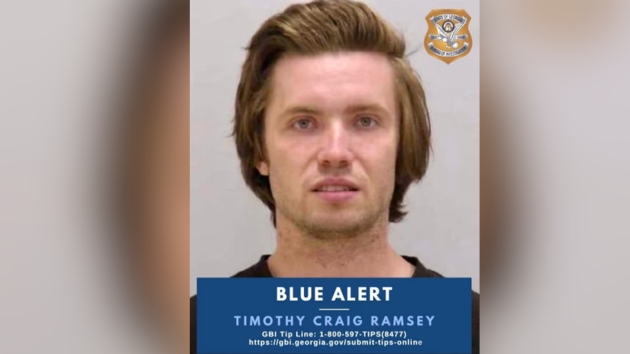
(NEW YORK) –The man suspected of shooting and critically wounding a police officer in northern Georgia on Friday night has been taken into custody after an hourslong manhunt, officials announced.
The Georgia Bureau of Investigation said 26-year-old Timothy Craig Ramsey was taken into custody at about 6 p.m. Saturday.
Authorities did not provide any other details about the arrest.
Ramsey is alleged to have shot McCaysville Police Capt. Brantley Worley after officers were called to a report of a suspicious person, according to ABC Atlanta affiliate WSB.
Ramsey ran from the scene wearing a “bright green chemical-resistant type suit,” the Georgia Bureau of Investigation said in a post on X.
Worley, a 3-year veteran of the department, was airlifted to a hospital in Chattanooga, Tennessee, in critical condition, according to WSB.
“Marty, the girls, and I are asking all Georgians to join us in praying for this officer who was shot in the line of duty, as well as all law enforcement who face this kind of danger on a regular basis to protect their communities,” Georgia Gov. Brian Kemp said in a statement Saturday.
McCaysville is a city of about 1,200 residents along Georgia’s border with Tennessee.
(NEW YORK) — Gov. Spencer Cox, R-Utah, said Sunday that the suspect in the shooting that killed conservative activist Charlie Kirk is not cooperating with authorities.
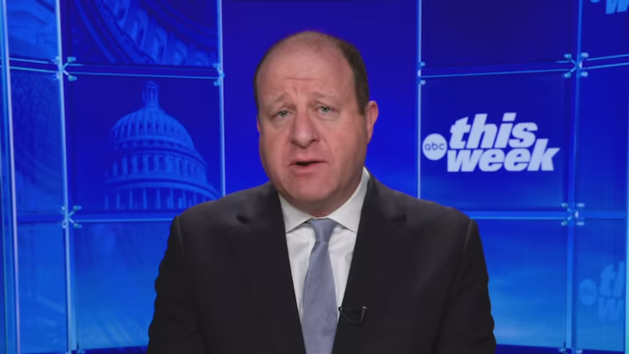
“He has not confessed to, to authorities. He is, he is, he is not cooperating, but, but, but all the people around him are cooperating. And I think that’s, that’s, that’s very important,” Cox told ABC News’ “This Week” co-anchor Martha Raddatz.
Authorities identified Kirk’s alleged shooter as 22-year-old Tyler Robinson, who now remains in custody. Charges are expected to be formally filed on Tuesday, Cox said.
Cox was also asked about a Sunday New York Times report that alleged Robinson had communicated with others on Discord after the shooting. The Times reported Robinson had made jokes about being the alleged gunman.
ABC News has not independently confirmed the Discord messages.
“All we can confirm is that those conversations definitely were happening, and they did not believe it was actually him. It was, it was all joking until, until he, you know, until he admitted that it actually was him,” he said.
The Utah governor, who has been the public face of the investigation, also addressed reports Saturday that the suspect’s roommate is transitioning from male to female.
Cox previously told the Wall Street Journal that Robinson was “deeply indoctrinated with leftist ideology.” Asked if investigators have uncovered evidence to show that, Cox replied, “Well, so far that — that has come from his acquaintance and his family members. That’s where that initial information has come from. Certainly, there will be much more information that is released in the charging documents as they’re bringing all of that together.”
Cox said there will be “much, much more information” revealed in the coming days when charges are filed. The governor urged Americans to choose kindness in a time of high political tension.
“These are very tragic circumstances that impact all of us,” Cox said.
Here are more highlights from Cox’s interview and those with Gov. Jared Polis, D-Colo., and Sen. John Curtis, R-Utah:
On Trump not talking about political violence against Democrats Raddatz: President Trump said nothing about the political violence against Democrats. In fact, he blamed the radical left. What’s your reaction to that? Is that something you think he should be doing?
Cox: Well, look, President Trump is very angry and, Charlie is his close personal friend. There is a lot of anger, a lot of anger on the right, on my side of the aisle. And I’ve certainly felt that. And in this case, it does appear that that’s true. Again, more, more information is coming and we’ll learn more over time.
You know, I don’t know that that that matters as much as the the radicalization piece. I brought up the, the Democrats who were assassinated recently. And how quickly we move on from these things. But, but the body count is, is piling up. And so I’m so concerned about this radicalization piece. And that’s what we’re trying to understand. Again, this person made a choice, and it was this person’s choice. And this person will be held responsible.
Cox on how to get out of the ‘dark place’ the country is in Cox: Right now, we’re in a dark place. Everybody gets that, I think, and we have choices and we in my political philosophy and my, and my religious philosophy, we believe in agency, that every one of us gets to make our own decisions … Every one of us has to make a decision. Are we going to hate our neighbor? Are we going to hate the other side? Are we going to return violence with violence? Or are we going to find a different path? Are we going to get out of those social media, those dark places of the internet where the conflict entrepreneurs reside, who are praying upon us, these, these companies with trillion dollar market caps who are using dopamine just like fentanyl, to addict us to their product and, and lead us again — those algorithms — lead us to more outrage. Can we put that aside? Can we go and serve our fellow human beings? Can we do some good in our neighborhood? Can we hug a family member? Can we talk to a neighbor that we disagree with? That’s, that’s up to us. And that’s the only way out of this. There is nothing else we can do to, to solve this, this dark chapter in our history.
Polis on the country’s political division Raddatz: How did we get to these moments?
Polis: I think, as Governor Cox said, it really is an important reflection point. Violence in political theater, in our schools, on college campuses, is unacceptable. It’s fine, and we should even celebrate, having different opinions on things, right? Charlie Kirk’s catchphrase, “prove me wrong,” encouraging peaceful debate, discussion.
But it’s wrong to resort to violence and killing. And I think that’s a message we need to reemphasize in this age when sometimes there’s to many conflicting messages out there. We need to speak unequivocally, celebrate our differences. They should lead to discussion, not violence.
Curtis on the pervasiveness of political violence Curtis: If it were up to me, I think you need to take the word “radical” and remove “right” or “left,” and radical coming from any direction is not good, it’s not healthy, and it should be called out. And that’s, that’s my mission, is to say, look, this to me, this is this is not right. This is not left. We’re talking about radicals, and that’s where we need to put our attention…
Raddatz: Senator, how do you think we got to this point in this country with so much political violence?
Curtis: You know, I was — you mentioned I live not far from the university. I was mayor of Provo, Utah, right next to it. I know you know where that is. That was just a decade ago, and it wasn’t like this.
And I think a number of things have come along. I don’t think COVID helped. I think — we have to look really hard. I mentioned social media before. I think we have to look really hard at what’s just occupying nearly 100% of brain weight of not just the youth, but of all generations, and what’s coming across, and actually what we’re allowing to come across, and there’s just zero liability for what people are putting out there. And I just think that’s if we’re going to fix this, we have to look really hard at that.
(STANFORD, Calif.) — Some college chapters of the Democratic and Republican parties are trying to turn down the temperature on discourse surrounding Turning Point USA founder Charlie Kirk’s assassination, as several groups across the country issued joint statements condemning the attack and calling for non-violence.
One of the first examples came from Rhode Island, where the Rhode Island Young Republicans and Rhode Island Young Democrats issued a rare joint statement on Wednesday evening.
“We may disagree on policy, but we are united in our belief in the value of life, civil discourse, and mutual respect,” said Ken Naylor, chairman of the Young Republicans. Anthony Cherry, vice president of the Young Democrats, added that young leaders must “make political nonviolence our pledge,” warning that “when our dialogue becomes toxic it has unimaginable consequences.”
In a phone interview, Naylor told ABC News that Kirk’s death “hit home with a lot of activists” who came of age watching his videos and campus debates. He said he immediately called up the leaders of the Democratic group and they agreed to put out a statement together.
“All of us believe that if you’re independent, Republican or Democrat there’s no reason for this to be happening. In this country we have the right to express ourselves and nobody should be silenced,” he said.
That message soon echoed across the country.
The Ohio College Republican Federation and College Democrats of Ohio released a joint statement on Thursday, rejecting “political violence in all its forms” and calling the killing “unacceptable,” writing that “violence undermines the very foundations of our republic” and urging students to “foster a culture where disagreement never escalates to harm.”
At The Ohio State University, the OSU College Democrats and OSU College Republicans issued their own joint statement on Wednesday, warning that political violence “erodes trust in our institutions” and “threatens the very foundations of civil discourse.” They said college campuses should remain “institutions of education and free speech” and affirmed their commitment to making OSU “a place where students feel safe to express their opinions, regardless of their political affiliation.”
The College Democrats at the University of Utah condemned the killing on Wednesday evening and offered condolences to Kirk’s family and to the students who witnessed it. Their statement said the tragedy “underscores the need to address the epidemic of gun violence in the U.S.” while also affirming the right of all Americans “to engage in civil dialogue without fear of violence.”
At Georgetown University, the Georgetown Bipartisan Coalition, Georgetown University College Democrats, and Georgetown University College Republicans Thursday said violent attacks “inject poison into the very heart of political dialogue” and urged Hoyas of all ideologies to “foster an environment of respect” and reject all forms of aggression. They emphasized that “the right to express one’s political beliefs without fear for one’s personal safety — particularly on college campuses — is fundamental to American life and a key component to a healthy, fully functioning democracy.”
U.S. Secretary of State Marco Rubio and Israeli Prime Minister Benjamin Netanyahu on February 16, 2025. Photo courtesy: Koby Gideon (GPO)/Handout/Anadolu via Getty Images
(LONDON) — U.S. Secretary of State Marco Rubio arrived on Sunday morning in Israel, where he met with Israeli Prime Minister Benjamin Netanyahu to discuss the war in Gaza.
“My focus will be on securing the return of hostages, finding ways to make sure humanitarian aid reaches civilians, and addressing the threat posed by Hamas,” Rubio said on social media ahead of his flight to Israel.
He added, “Hamas cannot continue to exist if peace in the region is the goal.”
The secretary and his wife, Jeanette Dousdebes Rubio, were greeted upon arrival at Ben Gurion airport by U.S. Ambassador to Israel Mike Huckabee and his wife, Janet Huckabee.
Rubio later met one-on-one with Netanyahu before the two visited the Western Wall in Jerusalem, also called the the “Wailing Wall,” one of the world’s most significant religious sites for the Jewish people. While there, Netanyahu said he and Rubio “buried a note among the stones.”
Rubio and Netanyahu toured the archaeological site along with Netanyahu’s wife, Sara, Rubio’s wife, and Huckabee and his wife.
“I think his visit here is a testament to the resilience and strength of the American-Israeli alliance, which is as durable and strong as the stones of the Western Wall that we just touched,” Netanyahu said of Rubio’s visit.
Netanyahu and Rubio, according to the prime minster’s statement, offered a joint prayer for the safety of the hostages, as well as a special prayer honoring President Donald Trump, whom Netanyahu described as “a true friend of the Jewish people and the State of Israel.”
“Under President Trump, Secretary Rubio and their entire team, this alliance has never been stronger, and we appreciate it very much,” Netanyahu’s statement said. “Not only on behalf of the people of Israel today, but also on behalf of the generations of Jews who came before us, in the hope that we will rebuild our country with friends like you. Thank you, Marco.”
During his meetings with Netanyahu and other Israeli officials, Rubio is expected to “convey America’s priorities in the Israel-Hamas conflict and broader issues concerning Middle Eastern security, reaffirming U.S. commitment to Israeli security,” according to the U.S. State Department.
Netanyahu and Rubio are also expected to discuss the planned Israeli operation to seize control of Gaza City, the largest city in the Gaza Strip, the State Department said.
Israel last week issued an order calling for residents of the city to evacuate, saying the Israeli military would operate “with great force” within the city.
(NEW YORK) — A manhunt is underway in Georgia after a suspect shot an officer late Friday night, according to officials.
Police said they’re searching for 26-year-old Timothy Craig Ramsey who is alleged to have shot McCaysville Police Captain Brantley Worley.
“Marty, the girls, and I are asking all Georgians to join us in praying for this officer who was shot in the line of duty, as well as all law enforcement who face this kind of danger on a regular basis to protect their communities,” Georgia Gov. Brian Kemp said in a statement Saturday.
Ramsey is described by police as a white male, 5 foot 11 inches who weighs around 185 pounds and has long brown hair and blue eyes.
“Ramsey is considered armed and dangerous. If you see him or see any suspicious activity, please take immediate precautions and notify 911.If you have any information on the whereabouts of this dangerous suspect, please contact 911 or the Georgia Bureau of Investigation by calling 1-800-597-TIPS(8477),” the Georgia Bureau of Investigation said in a statement.
(NEW YORK) — Monsoonal flow will likely cause heavy rain and scattered storms over the Plains this weekend, while hot and stormy weather is expected to continue in southern Florida.
The monsoonal flow continues to draw ample moisture from the Gulf and Pacific, allowing for a lingering chance of heavy rain and scattered storms over parts of the Four Corners and parts of the Plains this weekend.
A level 2 of 4 threat for excessive rainfall is in place for parts of eastern New Mexico and the western Texas due to rainfall rates of 1 to 2 inches per hour possible in the heaviest storms.
More spotty storms and heavy rain are possible (Level 1 of 4 threat) from the Rio Grande Valley of Texas and Arizona up to southern Wyoming and Nebraska, where some of the heaviest storms could produce rainfall rates up to 1 inch per hour.
Ruidoso, New Mexico, is on alert yet again for flooding along its burn scar on Saturday, which has already produced deadly flash flooding earlier this year.
Meanwhile, parts of the High Plains saw spotty storms on Friday — one of which produced a weak visible tornado in a very rural part of northwest North Dakota.
Some of these same spots of the High Plains will have scattered storms fire up later Saturday, some of which could be strong enough to produce scattered flash flooding and strong winds.
Scattered storms are possible for parts of the Midwest as well today from Wisconsin down to Indiana, including Milwaukee and Chicago, where 1 to 2 inches with the heaviest storms could produce spotty flash flooding.
These storms in the Midwest are not associated with the monsoonal moisture and will fire up from an unrelated front in the area.
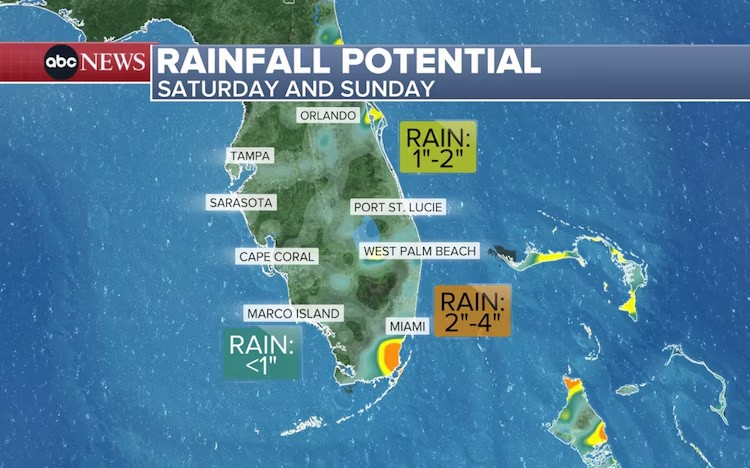
The southern part of Florida is expected to continue to deal with hot and stormy weather into the weekend.
Much of the southeast coast of Florida has gotten in on the heaviest rain this past week, with the Miami area reporting 10.51 inches of rain since Sunday. Other spots have seen between 4 to 7 inches over this week.
Fortunately, the wettest storms have already come for South Florida. Some scattered storms will still fire up later Saturday, dropping an another 1 to 2 inches with the heaviest storms for spots.
Some spotty storms will still be possible for South Florida going into next week, but these will not be as widespread or heavy — making for a slightly drier pattern.
The central and eastern part of the country will warm up for this weekend, with warmer temperatures likely for next week as well, cutting the fall-like feel for many.
The most seasonably warm temperatures this weekend will be over parts of the Mississippi Valley, where high temperatures will be in the 90s from the Deep South up to Minnesota and South Dakota.
While this is only slightly warmer than what is normal for mid-September for the Gulf Coast, this is 10 to 15 degrees warmer than what is normal for this time of the year for much of the Mississippi Valley — including for parts of Arkansas, Missouri, Iowa, Illinois, South Dakota and Minnesota.
Combined with increased humidity, some places could have feel-like temperatures well into the 90s and up to 100 for a few spots. There are no heat alerts currently in effect for anywhere in the country.
Next week, the warmth will begin to spread to parts of the eastern U.S. Much of the eastern half of the country from the Heartland to the coast will be 5 to 10 degrees warmer than what is normal for mid-September, breaking up the fall-feel that millions have been enjoying for the region.
(NEW YORK) — Mortgage rates have fallen rapidly in recent months, offering homebuyers an opportunity for some borrowing relief if they move ahead with the big-ticket purchase.
The average interest rate on a 30-year fixed mortgage stands at 6.35%, dropping from 6.5% over the week ending on Thursday, which amounted to the largest one-week drop in mortgage rates this year, FreddieMac data shows. As recently as January, the average 30-year fixed mortgage rate exceeded 7%.
The sharp drop in mortgage rates owes in part to government data showing a significant decline in hiring, which has heightened expectations that the Federal Reserve will slash interest rates and in turn put downward pressure on borrowing costs, some analysts told ABC News.
Each percentage point decrease in a mortgage rate can save thousands or tens of thousands in additional cost each year, depending on the price of the house, according to Rocket Mortgage.
“This is a significant drop,” Ken Johnson, a real estate economist at the University of Mississippi, told ABC News.
The trend poses a quandary for homebuyers, the experts added: Do buyers move quickly to snap up a favorable mortgage or wait to see if interest rates fall even further?
Mortgage rates closely track the yield on a 10-year Treasury bond, or the amount paid to a bondholder annually. Bond yields are shaped in part by expectations of the benchmark interest rate set by the Fed, some experts said.
Five meetings and nine months have elapsed since the Fed last adjusted interest rates. The federal funds rate stands between 4.25% and 4.5%, preserving much of a sharp increase imposed in response to a pandemic-era bout of inflation.
That posture is expected to shift, however. Fed Chair Jerome Powell recently hinted at the possibility of an interest rate cut, appearing to indicate greater concern for flagging employment growth than for rising prices.
Investors peg the chances of three quarter-point rate cuts by the end of this year at about 76%, according to CME FedWatch Tool, a measure of market sentiment.
The anticipated decline of interest rates has already been priced into the level of mortgage rates, however, meaning the path of rate cuts would need to become more aggressive than expected in order to push mortgage rates down further, Lu Liu, a professor at the Wharton School at the University of Pennsylvania, told ABC News.
A further slowdown of the job market could prompt the Fed to cut interest rates more than expected, but a continued resurgence of inflation could deter central bankers from easing rates at the risk of exacerbating price increases.
“Expectations of lower near-term rates are being priced in, so current mortgage rates look a bit more attractive,” Liu said.
Julia Fonseca, a professor at the Gies College of Business at the University of Illinois at Urbana-Champaign, cautioned against homebuyers attempting to predict the level of mortgage rates.
“Trying to time the market or predict future rate movements is notoriously hard to do,” Fonseca told ABC News.
Meanwhile, the typical price of a home has fallen in recent months. The median sales price of a home in the U.S. registered at $410,800 over three months ending in June, which marked a decline from a price of $423,100 over the previous three-month period, U.S. Census Bureau data shows.
“Prices have cooled, inventory is up, time on the market is up,” Fonseca said. “All of this suggests it’s a more favorable market for buyers relative to recent years. That said, it’s really hard to predict what will happen with prices in the future.”
If homebuyers move forward with a purchase but later find that mortgage rates have continued to fall, they can opt to refinance their homes, Fonseca added. She suggested homebuyers avoid mortgage contracts that include pre-payment penalties, since such fees could add to the cost of a potential decision to refinance.
“I would be guided by your needs and your personal financial situation, rather than try to make predictions about future prices and future interest rates,” Fonseca added.
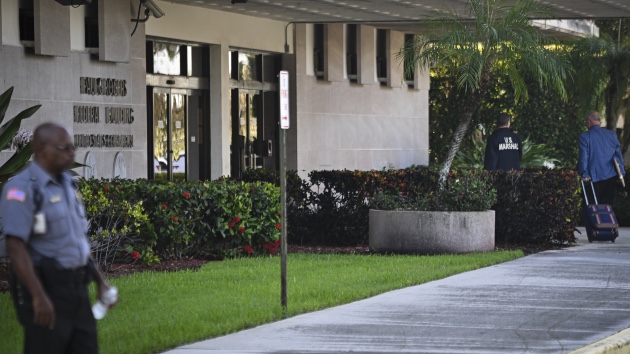
ederal law enforcement officers stand guard at the Paul G. Rogers federal courthouse on September 16, 2024 in West Palm Beach, Florida. The courthouse is the site of the trial of Ryan Wesley Routh, a suspect in the attempted assassination of former President Donald J. Trump. (Photo by Miguel J. Rodriguez Carrillo/Anadolu via Getty Images)
(WEST PALM BEACH, Fla) — Jurors in the criminal trial of the man accused of trying to assassinate Donald Trump on his golf course last year got to see with their own eyes Friday how close Ryan Routh came to carrying out his alleged plan.
Routh, who is representing himself despite not being a lawyer or having a legal education, is on trial in Florida on charges that include the attempted assassination of a major presidential candidate.
Erin Casey, a media specialist with the FBI, use a trove of drone video, photographs, and laser imagery to create a “fly-through” video showing Routh’s alleged sniper post in relation to Trump’s location on the golf course.
“It’s like an animated camera in a Pixar movie,” she told the jurors, saying the video is a “tool to bring you back to the scene.”
FBI Special Agent Katherine Rose also showed the jury the rifle, ammunition, and items recovered from the crime scene.
“Shots fired — that’s all I heard,” said Mayes. “Without much information, I tried to figure out what was going on and where it was going on.”
As Routh appeared fixated on her testimony from across the room, Rose showed the jurors the SKS semiautomatic rifle that Routh allegedly used. The jurors saw his scope, the magazine he used, and the single bullet chambered in the rifle that prosecutors say was intended to kill the now-president.
“What do we have here?” asked prosecutor Maria Medetis Long.
“This would be the rifle recovered from the scene,” Rose said.
Rose also displayed the two bags that Routh allegedly attached to the fence of the golf course. Inside the spray-painted bags were two metal plates that prosecutors say Routh sought to use as armor to protect himself from incoming fire.
‘Blue, blue!’
Two other witnesses testified about the frantic response to the shooting.
Kenneth Mayes, a sergeant with the Palm Beach County Sheriff’s Office who was with a tactical unit positioned at Trump’s golf course on the day of the shooting, testified that local police used a different radio channel than the Secret Service, so his unit initially had no details about the incident.
Operating with little information, Mayes said he followed another officer’s car out of the course’s parking lot, though he later returned after realizing he was driving away from the incident. He said he decided to drive in the opposite direction, where he eventually came across the crime scene.
“When I arrived, there was one person there, and they had no information,” he said. “I went into the bushes to see what we were dealing with.”
He said he shouted “Blue, blue!” when he arrived to prevent others from mistaking him for Routh.
Lieutenant William Gale was also one of the first to arrive at the scene, though Routh had allegedly fled before he showed up. He told jurors that he was eventually able to locate Routh because a bystander, who testified Thursday, was able to identify Routh’s car and license plate number.
“He said he had some information about this incident,” Gale said. “He mentioned that the car was a black Nissan Xterra.”
Vienna-style sausages
Meanwhile, an unlikely object has taken center stage in the prosecution’s case: Vienna sausages.
Four different witnesses have so far mentioned the processed meat product during their testimony, and prosecutors encouraged jurors in their opening statement to see the sausages as a way to link Routh, 59, to the crime scene.
All four of those witnesses told the jury that they found an empty can of Vienna sausages near Routh’s alleged sniper perch, and that unconsumed sausages littered the crime scene.
During Rose’s testimony, the jury was able to see the empty can and lid that brought into the courtroom for them to examine.
“Could you tell what kind of items these were?” asked Medetis Long.
“Yes, I could,” answered Rose. “They appear to be Vienna-style sausages.”
In his opening statement, Assistant U.S. Attorney John Shipley said the sausages link Routh to the crime scene, pointing to a selfie Routh sent a romantic partner from his car that showed the same sausages in the background.
Prosecutors say that in the month leading up to the attempted assassination, Routh was living in his car at a nearby gas station while he was “obsessively researching the movements of Donald Trump online.” Shipley alleged that Routh lied to his family and friends about the trip to conceal its purpose, including sending his romantic partner a selfie inside his car to prove he was “camping.”
The Vienna sausages in that photograph, prosecutors say, is another piece of evidence that demonstrates Routh was the person who hid in the bushes of Trump’s golf course to try to kill the now-president.
A quick pace
While prosecutors originally estimated needing about three weeks to conclude their case against Routh, they signaled on Thursday that their case might conclude sooner than planned because of the quick pace of the first few witnesses’ testimony.
Jurors at the trial in Fort Pierce, Florida, heard from the Secret Service agent who confronted an armed Routh on the golf course before Routh fled, and a witness who identified Routh to police.
Prosecutors allege that Routh put together a methodical plan — including purchasing a military-grade weapon, researching Trump’s movements, and utilizing a dozen burner phones — to kill Trump based on political grievances.
Hiding in the bushes of Trump’s Palm Beach golf course and armed with a rifle, Routh allegedly came within a few hundred yards of the then-presidential nominee before a Secret Service agent spotted his rifle poking out of the tree line.
Routh allegedly fled the scene but was later arrested by a local sheriff’s office on a nearby interstate.
He faces five criminal charges, including attempted assassination of a major presidential candidate, using a firearm in furtherance of a crime, assaulting a federal officer, possessing a firearm as a felon, and using a gun with a defaced serial number.
Routh has been rebuked several times by Cannon after making unexpected and off-topic comments. During opening statements Thursday, Routh launched into a speech about the origin of the human species, global conflicts, and his political grievances, before the judge cut him off after about six minutes for making arguments that she said have “absolutely nothing to do with the evidence in this case.”
Prosecution plans to rest case
After flying through eight law enforcement witnesses on Friday, prosecutors said they plan to rest their case against Ryan Routh this coming Thursday.
The unexpected speed of the case is in part attributable to Routh’s approach to his defense; he has rarely objected to testimony and briefly cross examined some of the witnesses.
“Seems like we got nowhere. Thanks for your useful testimony,” Routh told one of the witnesses after his questions fell flat.
Prosecutors sped through four additional witnesses this afternoon. FBI Special Agent Jose Loureiro testified about the chain of custody for Routh’s car, and Special Agent David Gilbert told the jury about disarming Routh’s rifle.
Digital analyst Elizabeth Reidel testified about the trail camera that police found at Routh’s alleged sniper perch. According to Reidel, most of the video stored on the device was from August 2024 when Routh relocated to Florida to allegedly begin planning his assassination attempt. Jurors saw some wobbling footage that appeared to be taken from inside a bush, though prosecutors did not explicitly make clear if the footage was taken from Routh’s perch.
Special Agent Tristan Bailey also testified about the process of collecting DNA and fingerprint samples from Routh. During a brief cross examination, Routh appeared to praise her work while highlighting how she also took hair samples from him.
“You left the hair out. You pulled all my hair out, and it’s not in evidence,” Routh said. “I can attest we did a very good job.”
The trial is scheduled to resume on Monday at 9:00 a.m. after prosecutors ran out of additional witnesses to call today, earning themselves a rare rebuke from U.S. District Judge Aileen Cannon.
“I don’t want this to happen again,” she said to conclude the day.
(WASHINGTON) — President Donald Trump said Friday that he will send National Guard troops to Memphis, Tennessee, as part of his push to combat crime.
The president said on “Fox & Friends” that he wanted to replicate the results of his deployment of the National Guard in Washington, D.C.
“Memphis is deeply troubled,” he said during the interview. “We’re going to fix that, just like we did in Washington.”
Trump said part of the crime crackdown could include federal forces, National Guard and even “the military, too,” if needed into Memphis.
“And anybody else we need,” Trump said of the forces he planned to send into Memphis.
Trump has said that local leaders across the country should ask for federal help and indicated that he has such backing from Tennessee officials.
“The mayor is happy. He’s a Democrat mayor, the mayor is happy. And the governor, Tennessee, the governor is happy,” he said.
Republican Tennessee Gov. Bill Lee’s office said in a statement on X that he would be speaking with Trump to “work out the details.”
“I’m grateful for the President’s unwavering support and commitment to providing every resource necessary to serve Memphians, and I look forward to working with local officials and law enforcement to continue delivering results,” he said in the post on Friday afternoon.
Memphis Mayor Paul Young confirmed at a news conference Friday afternoon that the National Guard will be sent to the city, but the Democrat added he didn’t ask for the National Guard.
Young added he needed more details on the Guard’s deployment from the governor and the federal government.
“When will they come? How many people are gonna come? How long will they be here? What are they going to wear?” Young asked.
The mayor cited the city’s drop in crime over the last year.
There have been 29,978 reported crime incidents in Memphis in 2025 as of Sept. 11, a roughly 44% drop from the same period in 2024 when there were 53,805 reported incidents, according to data from the city.
Homicides in the city dropped nearly 30% during the year with 182 reported incidents in 2025 so far compared to 261 during the same period last year, the data showed.
However, before Trump began his deployment, the city had seen a two-year decline in crimes, according to police data. As of Friday, there have been 17,806 reported crime incidents in the city so far this year, compared to 19,501 during the same period last year — a nearly 8% drop, the data showed.
D.C. Mayor Muriel Bowser said Friday, in her first public news conference since the federal surge expired earlier this week, that the city will continue to partner with federal law enforcement.
“We have a long history of working with federal law enforcement, and we’re going to continue to partner in ways that make sense for D.C. safety,” Bowser said. “This also gives me the opportunity just to emphasize that we’ve always been about safe communities, safe streets and driving down crime.”
Washington, D.C., Attorney General Brian L. Schwalb filed a lawsuit last week that sought to end the D.C. Guard deployment arguing it was a “military occupation.”
Critics have noted that the president has focused his threats of federal deployments on cities that are led by Democratic mayors.
For the last few weeks, Trump has made threats that he was going to send National Guard troops to Chicago, citing its crime rate, and was met with vocal protests from Illinois Gov. JB Pritzker and Mayor Brandon Johnson.
“I want to help people, not hurt them,’ says the guy who just threatened an American city with the Department of War,” Pritzker wrote on X on Monday.
The president continued to argue that federal intervention was needed in Chicago.
“You’re about to lose Chicago,” Trump said Friday. “I can fix Chicago, much bigger than D.C., but we can bring in the military. We can bring in the National Guard. We’ll do what we have to do.”
ABC News’ Oren Oppenheim and Matt Foster contributed to this report.
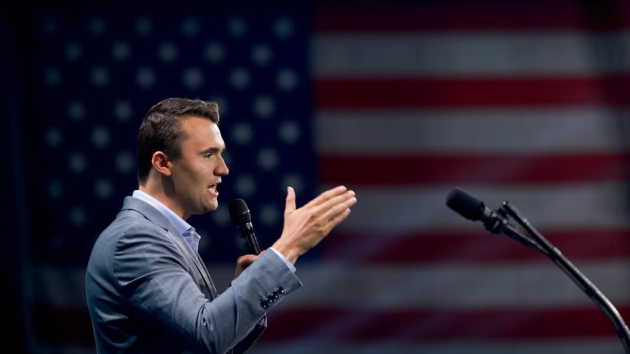
Charlie Kirk, who founded Turning Point USA, speaks before former President Donald Trump’s arrival during a Turning Point USA Believers Summit conference, July 26, 2024, in West Palm Beach, Fla. Joe Raedle/Getty Images, FILE
(UTAH) — Just hours after an assailant gunned down conservative commentator Charlie Kirk on the Utah Valley University campus Wednesday, voice messages containing a torrent of expletive-laden insults were sent to Democratic members of the Utah state House, blaming them for Kirk’s killing, according to audio of two calls obtained by ABC News.
The calls came in just after 10 p.m. on Wednesday night to House Democrats’ staff work numbers from an unidentified male caller, who called the Democrats “demons” and “enemies to the American people.”
“You should find somewhere else to f—ing live. You murderous terrorist animals, you despicable f—ing subhuman, f—ing violent, disgusting f—ing animals. You murdered that man in front of his f—ing family, you evil f—ing pieces of s—, subhuman f—ing garbage,” the man said. “I don’t even want to see the f—ing color blue in the state of Utah ever again. I’m gonna burn everything blue in my entire f—ing house.”
In a second message, the same caller directly addressed a staff member by name and told them to “leave the f—ing state.”
“You murdered that man in front of his f—ing family,” the caller said, adding, Democrats nationwide belonged in “hell.”
Utah House Democrats have shared with law enforcement the threatening voicemails and emails they’ve received in the wake of Kirk’s assassination, House minority leader Rep. Angela Romero told ABC News.
Romero added that the calls were particularly intimidating at this raw time of heightened political tension and rhetoric.
“It made me feel uneasy, especially being a woman and a woman of color in a super red state — so it’s not like this is my first rodeo, but this really made me feel uncomfortable,” Romero said.
She said a separate caller told her, “I was despicable, I shouldn’t serve in office, it’s my fault that Mr. Kirk was murdered.”
Other lawmakers have said they received threats following Kirk’s killing. Rep. Nancy Mace, a Republican who is running for governor in South Carolina, announced Friday her office had been “bombarded” with “threatening phone calls” — and accused Democrats for the “hateful” messages.
The vitriol levied at uninvolved lawmakers since Wednesday’s shooting has had a chilling effect on the American tradition of lawmakers’ community engagement — as well as the open debate and political discourse Kirk himself espoused.
Romero said she has canceled her own door-knocking that had been scheduled for this weekend. She had planned on canvassing and “getting people’s feedback” as they’re poised to go through redistricting. She has recommended that others in her caucus consider doing the same.
“I decided this probably wasn’t the best time, and I’d rather people be safe than be put in a compromising position,” Romero said.
“I don’t maybe agree with [Kirk’s] political ideology, but he still had a family that loved him, he still had a partner, he still had children. Just because you don’t agree with someone on their policy stances doesn’t mean that you silence their voice by murdering them, whether it was Mr. Kirk or whether it was Representative Hortman,” Romero said, referring to the Minnesota Democratic lawmaker gunned down on her doorstep with her spouse earlier this year in another act of political violence.
“At the end of the day, we’re all human. And it’s sad that we’ve gotten to this place in our country where people can’t even have conversations anymore,” Romero said.