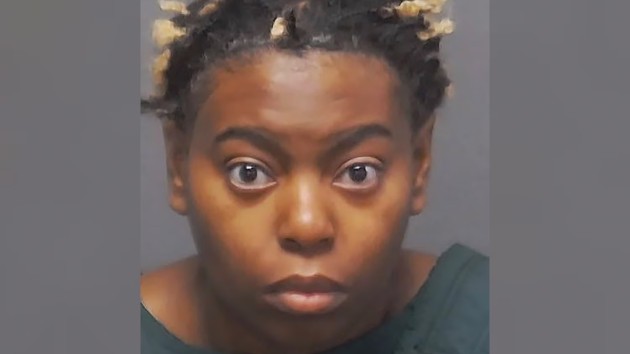
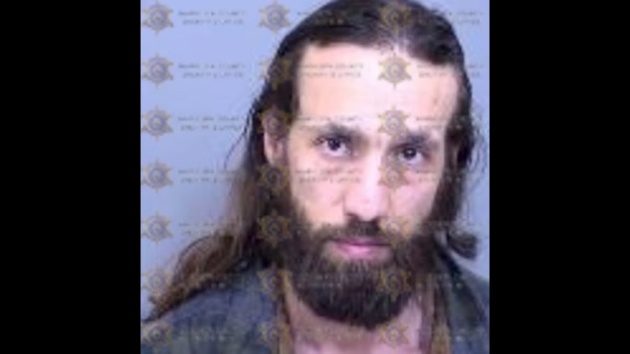
Tiona Islar has been arrested on charges of injury to a child. Bexar County Sheriff’s Office
(SAN ANTONIO) — Authorities in San Antonio are investigating the apparent hot car deaths of a 3-year-old girl and her 6-year-old brother after the local sheriff said there were “inconsistencies with the story” told by the children’s mom.
The mother, Tiona Islar, allegedly told authorities she last saw her son and daughter in the home around 10 a.m. Saturday, Bexar County Sheriff Javier Salazar said. Islar said she fell asleep, and then around 3 p.m. she found the children in the car and took them inside, Salazar said. Authorities were called around 3:25 p.m., the sheriff said.
A responding deputy “was simultaneously trying to perform CPR on both children, but unfortunately was not successful,” Salazar said. The siblings were pronounced dead at the scene, Salazar said.
Islar, 28, has been arrested on charges of injury to a child, according to the sheriff’s office.
Islar was “mostly cooperative” when taken in for questioning on Saturday, the sheriff told reporters, but he added the circumstances surroundings the deaths were not clear.
“The initial report was for, that the children were left in a car,” the sheriff said on Saturday. “However … there just are some inconsistencies with the story that we’re being given.”
“Something’s not adding up with this case,” Salazar said.
A sheriff’s office spokesperson said on Monday that authorities are still investigating and they’re awaiting the cause and manner of death from the medical examiner.
At least 29 children have died in hot cars in the U.S. this year, according to national nonprofit KidsAndCars.org. At least 1,159 children have died in hot cars since 1990.
Salazar warned, “Every second counts when you’re talking about a child in a hot car.”
“If you come upon a child locked in a car, make every intent to open the doors initially,” he told reporters. “If they’re locked, at that point, it’s safe to say, break a window, do whatever you have to do to get that kid out of there.”
View of the Great Smoky Mountains National Park are seen in Tennessee. (Patrick Gorski/NurPhoto via Getty Images)
(NEW YORK) — A 21-year-old man was found dead in Great Smoky Mountains National Park after a multi-day search, according to the National Park Service.
Ryan Lake was last seen in Nashville on Thursday, with officials locating his vehicle on Saturday, the NPS said in a press release on Sunday.
On Monday, park officials said Lakes was found dead at approximately 2:45 p.m. on Sunday in the Big Creek area of the national park.
“Please respect the privacy of the family during this time,” the NPS said in a press release obtained by ABC News.
According to the NPS website, the Big Creek area is a “dense forest” and a “secluded area on the northeast edge of the park near the North Carolina-Tennessee border.”
The area is also known for “numerous streams and waterfalls,” according to the NPS website.
Park officials previously said “several organizations” were assisting the NPS with search efforts.
To learn more about how to stay safe when embarking on a multi-day hike excursion, click here.
View of the Great Smoky Mountains National Park are seen in Tennessee. (Patrick Gorski/NurPhoto via Getty Images)
(NEW YORK) — Park rangers in the Smoky Mountains are searching for a missing 21-year-old man who was last seen in Nashville four days ago, according to the National Park Service.
Ryan Lakes was last seen in the Tennessee capital on Thursday, with park officials locating his vehicle on Saturday, the NPS said in a press release on Sunday.
Park officials are scanning the Big Creek area of the Great Smoky Mountains National Park in their search for Lakes, officials said. According to the NPS website, the Big Creek area is a “dense forest” and a “secluded area on the northeast edge of the park near the North Carolina-Tennessee border.”
The area is also known for “numerous streams and waterfalls,” according to the NPS website.
Lakes is a white male with brown hair and hazel eyes, is approximately 5 feet, 5 inches tall and weighs 130 pounds, the NPS noted.
He was last seen wearing dark-colored gym shorts, a dark-colored T-shirt, brown tennis shoes and a black backpack, according to the NPS.
Park officials said “several organizations” are assisting the NPS with search efforts.
Officials asked that anyone who has seen Lakes or has any information on his whereabouts contact the NPS Tip Line at 888-653-0009 or submit a tip on their website.
The National Park Service did not immediately respond to ABC News’ request for comment.
To learn more about how to stay safe when embarking on a multi-day hike excursion, click here.
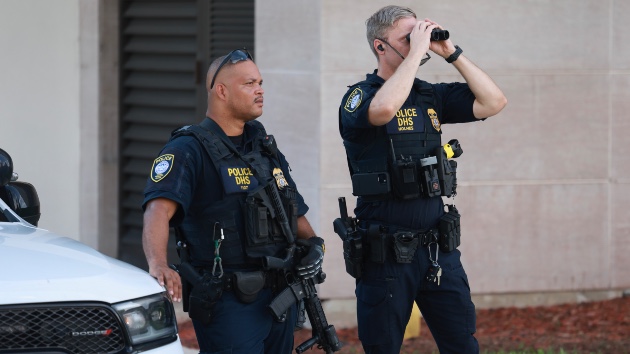
Members of the Department of Homeland Security, Federal Protective Service police provide security as Ryan Wesley Routh, the suspect in the apparent assassination attempt on Donald Trump, is brought before a judge at the federal courthouse for an initial appearance on September 16, 2024, in West Palm Beach, Florida. (Photo by Joe Raedle/Getty Images)
(WEST PALM BEACH, Fla.) — Ryan Routh, the man accused of trying to kill Donald Trump on his West Palm Beach golf course last year, is defending himself before a Florida jury.
Routh, who is representing himself despite lacking any legal education or experience, plans to call three witnesses on Monday — a gun expert and two character witnesses — as he tries to make a case why a jury should spare him from the possibility of spending the rest of his life in prison.
His defense case is expected to take about half the day, with closing arguments currently scheduled for Tuesday.
Routh has broadly described his defense strategy as emphasizing his “gentleness, peacefulness, and nonviolent caring for humanity,” according to court filings.
Among the exhibits Routh plans to use are a design for a DIY skatepark, videos and photos showing him recruiting and fundraising for the Ukrainian military, a photo of a flash mob he organized, and a church bulletin from 1980 when he was awarded an Eagle Scout award.
U.S. District Judge Aileen Cannon — who has repeatedly clashed with Routh over his unusual courtroom tactics — has curtailed much of Routh’s defense. She blocked many of his proposed witnesses, including an ex-girlfriend and several Palestinian scholars, and prohibited him from arguing that his actions were justified or that he would not have followed through with the assassination attempt.
Routh’s unorthodox defense case follows seven days of testimony from 38 witnesses called by federal prosecutors seeking to prove Routh came within a few hundred yards of killing then-candidate Trump on Sept. 15. Jurors heard from the Secret Service agent who said he spotted Routh hiding in the bushes of Trump’s golf course with an assault rifle, the man who illegally sold the gun to Routh, and a series of law enforcement witnesses who tied Routh’s fingerprints and DNA to the gun abandoned at the crime scene.
FBI agents also testified that Trump would have been less than 130 feet from Routh had Routh not been spotted by a Secret Service agent. Routh’s rifle, they argued, can hit a target ten times that, and the shot could have been made without a scope.
Two brothers who worked with Routh also testified about receiving a box from him in April 2024 — five months before the alleged assassination attempt — that contained wires, pipes, and bullets. After Routh’s arrest, the brothers said they opened the box to find a 12-page letter that prosecutors argue amounts to a confession from Routh.
“This was an assassination attempt on Donald Trump, but I failed you. I tried my best and gave it all the gumption I could muster. It is up to you now to finish the job; and I will offer $150,000 to whomever can complete the job,” the handwritten letter said.
Routh has argued that the letter does not describe the alleged assassination attempt.
At the conclusion of the government’s case on Friday, Routh argued that prosecutors had failed to prove their case and that Judge Cannon, who previously oversaw and dismissed one of Trump’s criminal cases, should toss the case. Routh claimed that the area in the bushes where he was allegedly found was a public area where anyone could carry a gun.
“They maybe proved that someone was outside the fence with a gun, but the gun was never fired,” Routh argued.
Judge Cannon denied Routh’s motion, concluding that prosecutors have provided enough evidence to let the jury decide the case.
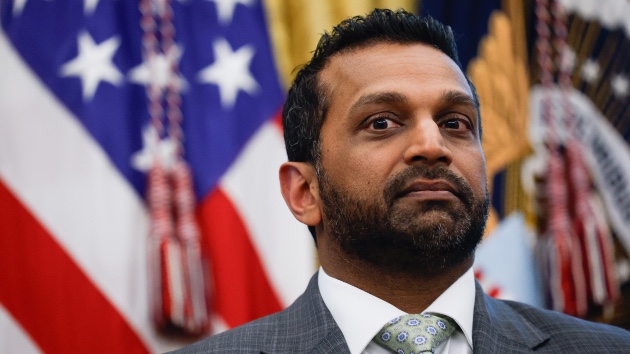
FBI Director Kash Patel listens as U.S. President Donald Trump delivers remarks before signing a Presidential Memorandum in the Oval Office on September 15, 2025 in Washington, DC. (Kevin Dietsch/Getty Images)
(WASHINGTON) — During Charlie Kirk’s memorial service on Sunday, FBI Director Kash Patel posted an update on the investigation of Kirk’s assassination, saying the FBI is “pursuing every lead.”
Tyler Robinson, 22, was arrested and charged with Kirk’s murder, but Patel said the FBI is looking into the “possibility of accomplices.”
“We are meticulously investigating theories and questions, including the location from where the shot was taken, the possibility of accomplices, the text message confession and related conversations, Discord chats, the angle of the shot and bullet impact, how the weapon was transported, hand gestures observed as potential ‘signals’ near Charlie at the time of his assassination, and visitors to the alleged shooter’s residence in the hours and days leading up to September 10, 2025,” Patel said in a post on X.
Patel made similar assertions during two days of House and Senate oversight hearings last week.
The online messaging platform Discord confirmed reports that about two hours before Robinson was taken into custody, he allegedly posted messages to a small group of friends on the platform that said, “Hey guys, I have bad news for you all … It was me at UVU yesterday. im sorry for all of this.”
Patel addressed the Discord message during his hearing before the Senate Judiciary Committee, saying that the FBI is investigating “anyone and everyone involved in that Discord chat” with Robinson. Patel said there are “a lot more” than 20 people linked to Robinson on Discord, “and we’re running them all down. … Every single one.”
“There are a number of individuals that are currently being investigated and interrogated, and a number yet to be investigated and interrogated, specific to that chat room. So we are very much in our ongoing posture of investigation,” Patel told senators, adding that other people could be involved.
In his post on Sunday, Patel said, “The entire FBI mourns the loss of Charlie Kirk. We will not rest until justice is served, and our investigation into this assassination will continue until every question is answered.”
Robinson was charged with numerous offenses on Tuesday, including aggravated murder, with prosecutors last week announcing their intent to seek the death penalty.
Robinson didn’t enter a plea on Tuesday. The judge said the court would appoint an attorney for him before his next court appearance on Sept. 29.
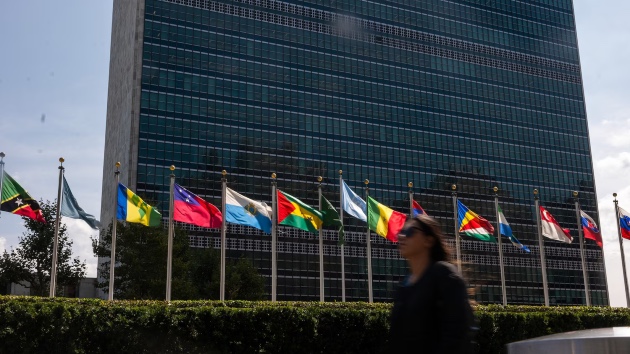
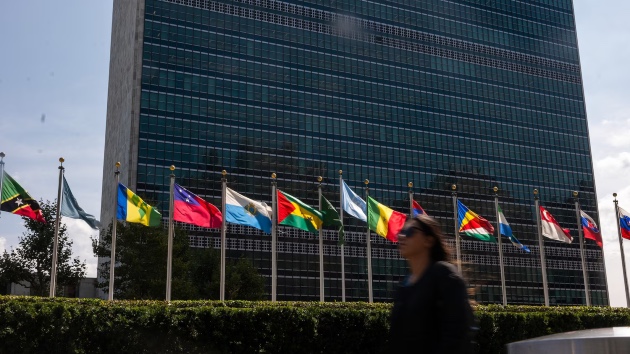
The United Nations headquarters is seen in Manhattan on Sept. 9, 2025 as the annual U.N. General Assembly, the 80th, began with thousands of delegates and world leaders expected to attend over the next few weeks. (Spencer Platt/Getty Images)
(NEW YORK) — President Donald Trump and foreign world leaders will meet this week at the United Nations General Assembly where Trump is expected to deliver the first address of his second term to the annual gathering of global leaders on Tuesday — though Trump will largely be isolated from more than half of the member nations and key allies over the war in Gaza.
All eyes will be on Trump, who in recent months has initiated massive cuts to U.S. foreign aid since his return to the White House, eliminating support for U.N. agencies and aid as overseas humanitarian crises continue to grow.
Trump’s appearance at the 80th session of the U.N. General Assembly comes as several prominent world leaders — and key allies — of the U.S. are set to formally recognize Palestinian statehood as international alarm continues to build over the ongoing war and starvation crisis in Gaza.
On Monday, France and Saudi Arabia will hold an international peace conference in support of the two-state solution that will take place in New York. France and several other countries are expected to recognize Palestinian statehood, joining more than 140 countries which have already recognized Palestinian statehood.
Leaders from the United Kingdom, France, and Canada have maintained there should be an end to the war in Gaza, including the immediate release of all remaining hostages, and the understanding that Hamas would no longer be a leading authority in Gaza after the war.
The French have said that 10 countries would formally recognize Palestinian statehood at the meeting — Andorra, Australia, Belgium, Canada, Luxembourg, Portugal, Malta, Britain and San Marino alongside France.
The U.S. will not participate in the conference and was one of only 10 countries who voted against the General Assembly resolution backing the high-level gathering.
Israel, for its part, has vowed to take action in retaliation of the formal recognition, which may include annexing parts of the occupied West Bank.
Israeli Prime Minister Benjamin Netanyahu was unequivocal in rejecting the planned international conference in a statement Sunday.”I have a clear message to those leaders who recognize a Palestinian state after the terrible massacre on October 7th, 2023: You are giving a huge reward to terrorism,” Netanyahu said.
“And I have another message for you: It will not happen. A Palestinian state will not be established west of the Jordan River.”
Critics of the recognition — which include the U.S. and the Israeli governments — have long condemned the plan, saying it only moves to embolden Hamas and further isolate Israel and the Trump administration on the international stage.
U.S. officials have said the action is largely “performative” and “symbolic” and will do nothing to help mend the relationship between the Palestinians and the Israeli government.
“I think much of that is a reaction to several nations around the world deciding to unilaterally declare a Palestinian state,” said Secretary of State Marco Rubio on reports that Israel was seriously debating annexing parts of the West Bank, which some say would be illegal under international law.
“We warned them that we thought that was counterproductive. We actually think its undermined negotiations, because it emboldened Hamas, and we think it undermines future prospects of peace in the region. We thought it was unwise to do that, and I think you’re seeing that as a counterreaction,” Rubio told reporters last week.
The U.S. — Israel’s main ally — has opposed the recognition and last month moved to deny and revoke visas to the Palestinian delegation, including for Palestinian President Mahmoud Abbas ahead of Monday’s international conference, accusing the Palestinian leadership of undermining peace efforts. The Palestinian state holds permanent observer status at the U.N. and is not a full-blown member state.
But on Friday, the U.N. General Assembly voted overwhelming to allow Abbas to address this week’s gathering of world leaders virtually after the Trump administration declined to grant Abbas a visa. The motion passed by a vote of 145-5 with six abstentions. The U.S. and Israel voted against the motion.
On Sunday, the United Kingdom, Canada, and Australia formally recognized a Palestinian state — three countries who are some of the U.S. and Israel’s closest allies. The move came after an official state visit from Trump to the United Kingdom, during which he voiced his disapproval of the plan.
Other experts remain wary of the recognition, suggesting that while the acknowledgment of a Palestinian state is a long-overdue decision, it must be accompanied with more concrete action against the Israeli occupation, which launched a ground invasion last week. Such action could include an arms embargo, sanctions and more support for international tribunals investigating Israel’s possible crimes.
Trump is expected to meet with Netanyahu on the sidelines at this year’s UNGA.
Trump is also expected to meet with other foreign leaders throughout the week, including Syria’s President Ahmed al-Sharaa, who will be a prominent new addition to the gathering. The meeting with Trump will mark their second meeting this year as the Syrian leader confronts the challenges of rebuilding the country after years of civil war under Bashar al-Assad’s regime.
Iran’s nuclear program will also be a top-agenda item this year as sanctions against Tehran that were lifted 10 years ago are set to be reinstated. France, Germany and the United Kingdom moved last month to trigger the “snapback mechanism,” which automatically reimposes all U.N. sanctions that were in effect before the nuclear deal.
Trump will also meet with Ukrainian President Volodymyr Zelenskyy on the sidelines this week over promised postwar security guarantees, which Zelenskyy has said are critical to resolving the war with Russia. Russian President Vladmir Putin has so far refused to engage in a good faith effort to end the war after almost four years of fighting.
The United Nations headquarters is seen in Manhattan on Sept. 9, 2025 as the annual U.N. General Assembly, the 80th, began with thousands of delegates and world leaders expected to attend over the next few weeks. (Spencer Platt/Getty Images)
(LONDON) — Ukrainian President Volodymyr Zelenskyy urged attendees of this week’s United Nations General Assembly sessions in New York to use the meeting of world leaders to apply “strong political pressure” on Russia, as Moscow’s war on its neighbor wears on.
Zelenskyy posted to social media on Monday morning, following Russia’s latest overnight strike on Ukrainian cities across the country. Drones hit Donetsk, Dnipro, Sumy, Kyiv, Kharkiv, Zaporizhzhia and Kherson regions, Zelenskyy said.
At least three people were killed in Zaporizhzhia, the president said. Ukraine’s air force said Russia launched 141 drones into the country, of which 132 were downed or suppressed.
“This is already the fourth time that Russia accompanies one of the highest annual global diplomatic events with killings,” Zelenskyy said in his post, referring to this week’s UNGA sessions.
“That is why it is so important for this diplomatic week to be productive,” he added. “We must act so that killings and war do not become routine.”
“There is a real need for strong pressure on Russia, new joint steps from everyone in the world who believes that international law must work again,” Zelenskyy said, calling specifically on “Europe, the USA, the G7 and G20 countries — all those who have real influence on Russia.”
“Strong sanctions, strong political pressure, Russia’s accountability for the war — all of this is necessary,” Zelenskyy wrote. “All of this will happen.”
U.S.-led peace talks have thus far failed to produce a ceasefire in Ukraine, where Russian forces remain on the offensive at multiple points along the front line three-and-a-half years into Moscow’s full-scale invasion.
Russian attacks on Ukraine have intensified since U.S. President Donald Trump met with Russian counterpart Vladimir Putin in Alaska in August.
And in recent weeks, repeated Russian drone and aircraft violations of NATO airspace in Poland, Romania and Estonia have further raised tensions between Moscow and its Western adversaries.
At Tallinn’s request, the United Nations Security Council will convene an emergency meeting on Monday to discuss the violation of Estonian airspace by three Russian fighter aircraft on Sept. 12.
Trump — who is expected to meet with Zelenskyy in New York this week — has repeatedly expressed his frustration with Putin over the failure of peace efforts and Moscow’s continued long-range strikes. While in the U.K. last week, Trump said Putin had “let me down.”
Nonetheless, Trump has refused to impose on Russia the full raft of additional sanctions and tariffs that he has threatened. The White House did introduce additional 25% tariffs on all Indian imports in response to New Delhi’s continued purchases of Russian oil and military goods.
Trump said last week that he would not introduce further measures until European nations — who have broadly been more full-throated than the White House in their continued military and political backing for Kyiv — impose steep tariffs on India and China.
Oleksandr Merezhko, a member of the Ukrainian parliament and chair of the body’s foreign affairs committee, told ABC News that the planned Trump-Zelenskyy meeting in New York this week is positive.
“It’s always good and gives a chance to make him more receptive to our needs,” he said. “At the same time, I don’t have high expectations. Trump seems reluctant to employ serious sanctions against Russia and its allies.”
Kyiv will be watching closely to see how many states back a planned resolution expressing support for Ukraine. “It’s indicative of our support in the world, including in the Global South,” Merezhko said.
Russian officials, meanwhile, have signaled no imminent willingness to agree to a ceasefire or to a meeting between Putin and Zelenskyy, an idea proposed by Trump after his Alaska summit with the Russian president.
Last week, Russian Foreign Minister Sergei Lavrov said Trump’s disappointment with the pace of the negotiations with Russia can be “partly explained by the fact that he wants quick solutions.”
ABC News’ Anna Sergeeva and Ellie Kaufman contributed to this report.
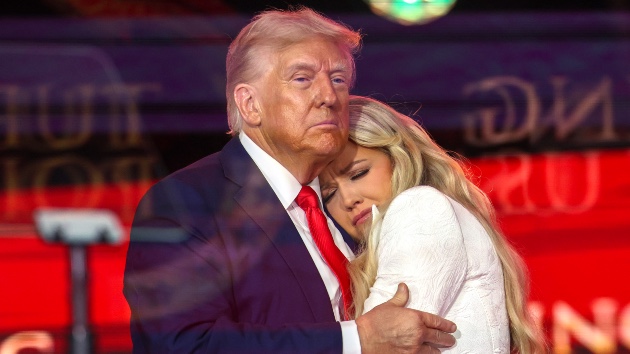
Erika Kirk joins U.S. President Donald Trump onstage during the memorial service for political activist Charlie Kirk at State Farm Stadium on September 21, 2025 in Glendale, Arizona. (Photo by Win McNamee/Getty Images)
(GLENDALE, Ariz.) — Tens of thousands of people packed State Farm Stadium in Arizona on Sunday to pay tribute to Charlie Kirk, who was hailed a “martyr” by President Donald Trump and other leading conservative figures.
“I know I speak for everyone here today when I say that none of us will ever forget Charlie Kirk, and neither now will history,” Trump said.
Kirk, 31, was fatally shot on Sept. 10 while speaking at Utah Valley University for his The American Comeback Tour, which invited students on college campuses to debate on hot-button issues.
After founding Turning Point USA at age 18, Kirk rose to become one of the most prominent conservative voices in the country. But some of his comments on gun violence, LGBTQ issues, race and more often drew criticism from liberals and others.
At Sunday’s public memorial service, administration officials cast him as a “warrior” for the MAGA movement and his wife, Erika, said he died with “incomplete work but not with unfinished business.”
Here are the key takeaways.
Conservatives memorialize Kirk as ‘martyr’ and ‘warrior’
Kirk was lionized by several speakers as a modern-day martyr, many using the word in the context of his Christian faith.
“Charlie Kirk is now a martyr. His power will only grow,” conservative commentator Benny Johnson said in spirited remarks. “Evil thought there’d be a funeral today, God has created a revival right here in this house right now,” Johnson added.
Vice President JD Vance, a close friend of Kirk who escorted his casket back to Arizona on Air Force Two, said, “We must remember that he is a hero to the United States of America. And he is a martyr for the Christian faith.”
President Trump called Kirk a martyr for “American freedom.”
Others praised Kirk as a “MAGA warrior,” and Florida Congresswoman Anna Paulina Luna compared him to George Washington, John F. Kennedy and Martin Luther King Jr.
The service mixed politics and religion, as the day started with hours of Christian music before the program began. Many in the crowd stood worshipping with their hands in the air.
Speakers pledge that Kirk’s movement will continue
White House deputy chief of staff for policy Stephen Miller, in some of the most heated remarks of the program, said Kirk’s death created a “fire in our hearts.”
Miller railed against an unnamed enemy, telling the crowd: “They cannot imagine what they have awakened. They cannot conceive of the army that they have arisen in all of us because we stand for what is good, what is virtuous, what is noble.”
Trump praised Kirk’s organization as a “juggernaut of American politics” that he believed is “going to be bigger and better than ever before.”
Trump and several administration officials watched the program in a suite behind bulletproof glass, and nearly his entire Cabinet sat in the front row.
Vance noted, “Now our whole administration is here, but not just because we love Charlie as a friend, even though we did, but because we know we wouldn’t be here without him. Charlie built an organization that reshaped the balance of our politics.”
Erika Kirk says she forgives alleged shooter in emotional speech
Erika Kirk, Charlie’s widow, in emotional remarks, revealed that she forgives the alleged shooter, who has been charged with his murder.
“That young man, I forgive him,” she said as she was holding back tears, with the crowd jumping to their feet in a standing ovation.
Tyler Robinson, 22, was charged with a slew of offenses for allegedly killing Charlie Kirk, including aggravated murder.
“The answer to hate is not hate,” she said at the memorial service.
She also recounted the moments when she saw her husband’s body after he had been assassinated, saying she experienced “a level or heartache I didn’t even know existed.”
When she saw his body, she said she saw the “faintest smile” on his lips, telling her that he “didn’t suffer” and there was no “fear” or “agony” when he died.
“While Charlie died far too early, he was also ready to die. There was nothing that he was putting off,” she said.
Erika Kirk said taking over Turning Point USA is not something she takes lightly, after recently being elected to replace her husband as CEO, but that she and her husband share the same mission.
She said campus events will continue, stressing the need for debate and the importance of the First Amendment. “No assassin will ever stop us for standing up to defend those rights ever,” she said.
President Trump gave closing remarks, called Kirk ‘immortal’
In closing remarks for the memorial service, President Donald Trump said Charlie Kirk, whom he described as “our greatest evangelist for American liberty,” is now “immortal.”
He emphasized that Kirk was someone who had a “good heart” and was a “great American hero” who had the “will to fight, fight, fight” — a phrase that has become a rallying cry for Trump supporters since the attempted assassination attempt on him in July 2024.
The president said Kirk was a “missionary with a noble spirit and a great, great purpose” but that he differed with the conservative activist on one point, specifically that Kirk “did not hate his opponents.”
“That’s where I disagree with Charlie. I hate my opponent and I don’t want the best for them,” Trump said.
Trump also continued to predominantly blame “the left” for political violence in the U.S. He called the alleged shooter a “radicalized cold-blooded monster” and reiterated his direction to the Justice Department to investigate groups he claims contribute to political violence.
Throughout his speech, Trump strayed from talking about the conservative activist several times. His remarks on Kirk were briefly interrupted when he discussed a forthcoming announcement about autism, his tariff policy and his grievances about the 2020 election. He also added that “violence comes largely from the left.”
As Trump closed the program, he invited Erika Kirk back on stage and the two embraced.
(GLENDALE, Ariz.) — A man has been arrested and charged after he allegedly impersonated a law enforcement officer and brought a weapon to the stadium where Charlie Kirk’s memorial service will be held on Sunday, according to officials.
Joshua Runkles, 42, was booked on charges of carrying a weapon into a prohibited place and impersonating a police officer, according to the Arizona Department of Public Safety.
Runkles was arrested at State Farm Stadium in Glendale, Arizona, after showing “suspicious behavior,” according to Arizona DPS.
Runkles is not a law enforcement officer, according to DPS. He was taken into custody by the DPS and booked into the Maricopa County Jail.
“An investigation is ongoing to determine his intent and purpose at the stadium. Runkles has since been released on bond,” according to Arizona DPS.
Later, in a statement posted on X, Turning Point USA spokesman Andrew Kolvet said the individual “was doing advance security for a known guest planning to attend the memorial service tomorrow. We do not believe this person was attempting anything nefarious, however the advance was not done in proper coordination with the TPUSA security team or US Secret Service.”
Kolvet said the arrest came before the site had been fully sealed and locked down.
The U.S. Secret Service said it was investigating in coordination with local law enforcement an “individual who was observed exhibiting suspicious behavior” at State Farm Stadium.
The individual was approached by Secret Service agents and said during the encounter that he was a member of law enforcement and that he was armed, a Secret Service spokesperson told ABC News.
This individual was not a member of authorized law enforcement working the event and an investigation is ongoing as to why he was there, the spokesperson said.
(NEW YORK) — Immigration can be a hot-button topic, something frequently discussed on cable news and splashed across the headlines. But to one enterprising young author, it’s also the perfect material for a children’s book that helps young people understand each other’s roots.
Last month, Scarsdale, New York, high school senior Max Reddy Spencer wrote and self-published a children’s book titled “We Are All Immigrants.”
Spencer, the son of an Indian American mother and a white American father, said he was motivated to share the message that we are all more alike than different.
“We Are All Immigrants” follows the story of a young boy with a very similar background as Spencer’s. But he said he wanted the character to stand in for every child.
“I didn’t name the protagonist in the book,” he told ABC News. “I did that intentionally, actually, as a way to try to make the boy represent all of us and also not be the highlight of the story … I wanted the characters he interacted with to be the center of focus and attention.”
Through the boy’s journey in the book, he discovers that most people in his life who live in the United States are, in fact, immigrants. Whether it be his Venezuelan American neighbor, his Taiwanese American teacher, or his Italian American lunch cook, he begins to understand the fabric of his community is woven from different, diverse backgrounds.
Spencer said his book aims to make conversations about immigration more accessible to children, and it doubles as a coloring book with illustrations generated by artificial intelligence.
For Spencer, immigration is deeply personal, he said. His maternal grandparents immigrated from India. His grandfather was from a tiny, rural village in south India called Pathur, in Andhra Pradesh, India. His grandmother’s hometown was called Madanapalle.
Spencer said he grew up understanding America is built on immigration and that his goal in writing the book was to teach children about immigration, while also encouraging people to reflect on their similarities.
“I am very much pro-immigration from an economic and cultural perspective, but I am mostly just trying to remind our country that we are all far more similar than we are different,” he said. “I know that is obviously far more than my little book can do. But that was a big piece of what I was trying to share.”
Previously, Spencer started an initiative called the Inspiration Project, which collects and distributes free children’s books to underserved communities. His goal is to collect more than 3,000 children’s books to redistribute before he graduates high school. He estimated he’s collected at least 2,000 so far.
Spencer said he is donating all the proceeds from “We Are All Immigrants” to the organization Hearts & Homes for Refugees, a New York-based organization that helps resettle refugee families.