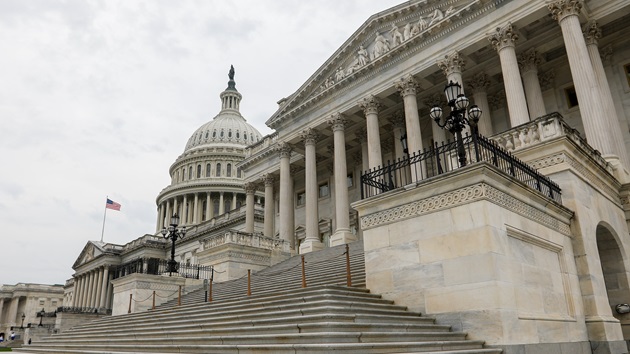
The United States Capitol building is seen in Washington D.C., United States, on September 24, 2025. Yasin Ozturk/Anadolu via Getty Images
(WASHINGTON) — Federal courts may be forced to quickly curtail operations — potentially delaying trials and other hearings — if congressional funding is not extended beyond Sept. 30, a spokesperson for the Administrative Office of U.S. Courts told ABC News.
While in previous government shutdowns the courts have found ways to use court fees and other financial tools to sustain full functionality and schedules — at least for several weeks — years of tighter budgets and rising costs have created a much more difficult situation in today’s landscape.
A government shutdown could begin at 12:01 a.m. Wednesday, Oct. 1, if there is a lapse is federal government funding.
“Judiciary operations would continue using court fees and other available balances through Friday, October 3,” the spokesperson, Jaculine Koszczuk, said in a statement.
After that, while the judiciary will not formally shut down, some operations may begin being put on hold.
“We will continue to assess available fees and balances after FY 2025 closes to determine if operations can be sustained beyond that date,” Koszczuk said. “Should fees and balances be exhausted before Congress enacts a continuing resolution or full-year funding, the Judiciary would then operate under the terms of the Anti-Deficiency Act. Federal courts would continue operating, but would be limited to activities needed to support the exercise of the Judiciary’s constitutional functions and to address emergency circumstances.”
Reuters was first to report that Judge Robert Conrad, director of the Administrative Office, issued a warning this week to judges and other court officials about the looming financial crisis — calling this year’s situation a “very sharp change” from the past.
The U.S. Supreme Court — which was established by the Constitution, not Congress — would be largely unaffected.
“In the event of a lapse of appropriations, the Court will continue to conduct its normal operations,” Supreme Court spokeswoman Patricia McCabe told ABC. “The Court will rely on permanent funds not subject to annual approval, as it has in the past, to maintain operations through the duration of short-term lapses of annual appropriations.”
Justices and federal judges would continue to be paid during a shutdown because federal law prohibits cuts to their pay once appointed for life. Many of the 33,000 other employees of the federal judiciary could face furloughs without pay.
The last time the judiciary experienced staff furloughs during a shutdown was 1995, when appropriations lapsed for three weeks until Congress reached a deal to end the standoff.
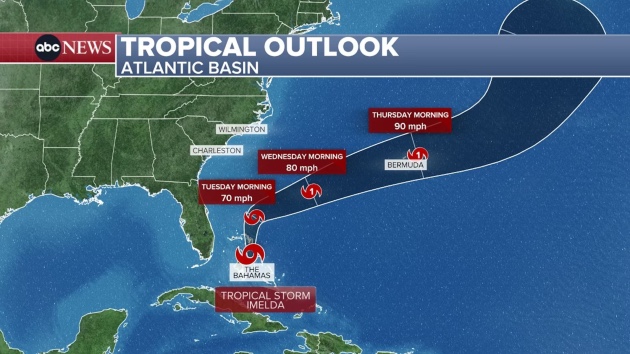
(NEW YORK) — Tropical Storm Imelda won’t make landfall in the United States, but it will skirt close to the Southeast coast, bringing rain, strong winds, high surf, rip currents and isolated flash flooding or coastal flooding.
Here’s what you need to know:
As Imelda moves north, the storm will bring rain to the Carolinas on Monday and then stretch from the Carolinas to Virginia by Tuesday.
Imelda is forecast to bring 1 to 2 inches of rain to the South Carolina/North Carolina border on Monday and Tuesday. The Myrtle Beach, South Carolina, and Wilmington, North Carolina, areas may see 2 to 4 inches.
Dangerous ocean conditions are also forecast from Florida to North Carolina. Rip currents are expected for much of the East Coast and high surf alerts are in place.
Georgia, South Carolina and North Carolina could see waves reaching 5 to 10 feet from Monday evening through Thursday morning. On Monday and Tuesday, waves could hit 11 feet in northern Florida and southern Georgia.
A wind advisory is also in place on Monday for the Central Florida coast. Winds could hit 40 mph in Melbourne, Palm Bay and Port St. Lucie.
Imelda will move north on Monday, and then when it’s positioned east of Central Florida on Tuesday morning, it’ll take a steep turn northeast and head toward Bermuda. Imelda may hit Bermuda as a hurricane on Thursday morning.
Meanwhile, Humberto, a Category 4 hurricane, will bring heavy rain to Bermuda on Tuesday. Humberto will then continue to move northeast out into the Atlantic.
(WASHINGTON) — Secretary of State Marco Rubio announced in a statement Sunday the release of U.S. citizen Amir Amiry, who had been considered wrongfully detained in Afghanistan.
This is the fifth release of an American citizen from detention in Afghanistan this year. Amiry’s case was not previously known to the public.
In his statement, Rubio thanked and credited President Donald Trump for his leadership and commitment, and he also gave credit to Qatar for helping to secure Amiry’s release.
“Today, thanks to President Trump’s leadership and commitment to the American people, the United States welcomes home U.S. citizen Amir Amiry who was wrongfully detained in Afghanistan. We express our sincere gratitude to Qatar, whose strong partnership and tireless diplomatic efforts were vital to securing his release,” Rubio said in his statement.
Rubio said there are still other Americans “unjustly detained” in Afghanistan and Trump “won’t rest” until they are returned home.
Officials at the State Department have said they hope an executive order signed by Trump earlier this year will deter nations from wrongfully detaining American citizens and that it will help to secure the release of wrongfully detained Americans abroad. The EO enhances efforts to protect U.S. nationals from wrongful detention abroad by authorizing robust responses against foreign governments engaging in such practices.
Special envoy for hostage response Adam Boehler traveled to Kabul to personally oversee Amiry’s release and to make sure all went according to plan, according to an administration official.
The official notes that Amiry was an American citizen and had received a special immigrant visa (SIV), which is a U.S. immigration program for Iraqis and Afghans who worked for the U.S. government or military to become permanent residents. Examples of SIV holders include translators and interpreters. Details of Amiry’s employment were not provided.
The diplomatic talks and negotiations leading to Amiry’s release was a joint U.S.-Qatari effort. This was not a prisoner exchange and the U.S. did not give anything to the Taliban in exchange for Amiry’s safe return, a U.S. official said.
Amiry’s release and Boehler’s visit to the region comes one week after Trump urged the Taliban to give back control of Bagram Air Base to the United States, threatening “bad things” would happen to Afghanistan if it does not.
(WASHINGTON) — President Donald Trump praised the U.S. Supreme Court in June for a “monumental victory” when it rolled back nationwide injunctions against his executive order attempting to end birthright citizenship.
Three months later, after two federal courts universally blocked the order again on different grounds, Trump is asking the justices for a definitive judgment on his reinterpretation of more than a century of settled legal precedent.
In filings, reviewed by ABC News Sunday but not yet on the Supreme Court’s public docket, Solicitor General John Sauer urges the justices to give expedited consideration to Trump’s appeal and a decision by next summer.
“The government has a compelling interest in ensuring that American citizenship—the privilege that allows us to choose our political leaders—is granted only to those who are lawfully entitled to it,” Sauer wrote in a petition for writ of certiorari.
“The lower court’s decisions invalidated a policy of prime importance to the President and his Administration in a manner that undermines our border security,” he wrote. “Those decisions confer, without lawful justification, the privilege of American citizenship on hundreds of thousands of unqualified people.”
Courts and the government have long interpreted the 14th Amendment’s citizenship clause to apply to anyone born in the U.S., regardless of the immigration status of a child’s parents.
The Amendment, ratified after the Civil War, states that all “persons born or naturalized in the United States, and subject to the jurisdiction thereof, are citizens of the United States and of the state wherein they reside.”
On his first day in office, Trump signed an executive order unilaterally declaring that only newborns whose parents have permanent legal status are “subject to the jurisdiction” of the U.S. and therefore eligible to be citizens.
An estimated 255,000 children are born on U.S. soil each year to one or more parents without American citizenship or permanent legal status, according to the Penn State Social Science Research Institute.
The administration is not seeking to begin enforcing the executive order until the Supreme Court decides whether or not to take up the case and ultimately render judgment — a decision likely months away.
“This executive order is illegal, full stop, and no amount of maneuvering from the administration is going to change that,” said Cody Wofsy, deputy director of the ACLU’s Immigrants’ Rights Project, in a statement. “We will continue to ensure that no one baby’s citizenship is ever stripped away by this cruel and senseless order.”
A federal judge in New Hampshire in July ruled that Trump’s order plainly appears to violate the Constitution and blocked enforcement of it in a class-action suit that covers all children who would be affected.
A separate ruling by a federal appeals court, also in July, blocked enforcement of the order nationwide, saying that a group of state plaintiffs could only be protected from the citizenship restrictions if they were put universally on hold.
The administration told the Supreme Court it seeks to appeal both cases.
The plaintiffs in each case — the ACLU and Washington State attorney general — provided ABC News with copies of the government’s filings.
In 1898, the Supreme Court previously addressed the question of citizenship for children born to non-citizens on U.S. soil, ruling in the landmark case U.S. v Wong Kim Ark that they are Americans under the law.
“The [14th] Amendment, in clear words and in manifest intent, includes the children born, within the territory of the United States, of all other persons, of whatever race or color, domiciled within the United States,” wrote Justice Horace Gray for the 6-2 majority. “Every citizen or subject of another country, while domiciled here, is within the allegiance and the protection, and consequently subject to the jurisdiction, of the United States.”
The Trump administration is attempting to argue that there is wiggle room in that precedent to still exclude from citizenship children born to temporary visitors and illegal aliens.
“The reliance interest for all of the people who are already here in the United States to whom birthright citizenship is a cherished right, and for the nation prospectively – this would be an earthquake if the Supreme Court were to rule in Trump’s favor,” said Hofstra Law professor, constitutional scholar, and ABC News legal contributor James Sample.
“I don’t see that happening,” Sample said. “On a political level, however, Trump likely sees this as favorable ground in the sense that even if he loses on the law, even if he loses in the Supreme Court, many of his political allies would see this as the kind of red meat political fight that they relish, and he would love to run against a loss.”
(GRAND BLANC, Mich.) — The man suspected of opening fire on a Michigan LDS church on Sunday was a 40-year-old veteran of the Iraq War, according to officials.
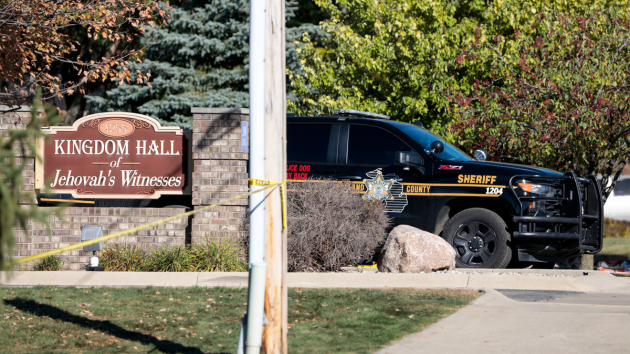
Police said the suspect, Thomas Jacob Sanford, drove his truck into The Church of Jesus Christ of Latter-day Saints in Grand Blanc, Michigan, before firing shots and setting the building on fire.
Sanford was killed in a shootout with police, officials said. At least four churchgoers were killed, and eight others were injured in the attack.
In the wake of the deadly rampage, Sanford’s military record has come into focus. The truck that he drove into the church bears an Iraq War veteran license plate, according to officials.
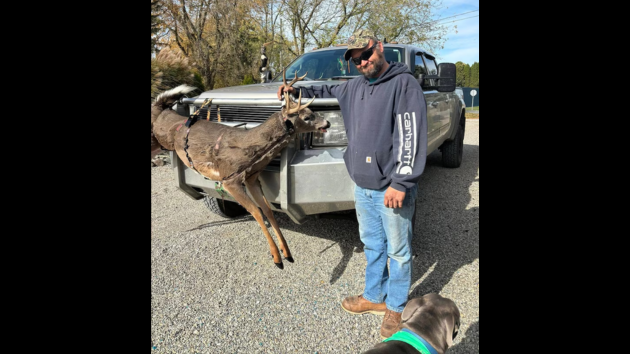
A photo posted to Sanford’s mother’s Facebook account appears to show him standing in front of the truck allegedly used in Sunday’s attack
ABC News has confirmed with the United States Marine Corps that Sanford served four years in the Marines from June 2004 to June 2008. He ultimately rose to the rank of sergeant, officials said.
He had one combat tour to Iraq that ended three months before he left the Marines, being deployed in Operation Iraqi Freedom in August 2007.
While serving, Sanford specialized in handling military vehicle equipment. Both as a technician responsible for inspecting, servicing and repairing motor transport equipment like tactical vehicles and as a vehicle recovery operator, responsible for bringing back armored vehicles in support of troop missions.
He left the military in March of 2008, after working in combat logistics at Camp Lejeune in North Carolina.
Sanford’s record provided by the Marine Corps indicates that he was given typical recognition at the time of his service for those of his rank.
Sanford was also a father of a son who grappled with serious health obstacles after he was born, according to posts online from the family and the hospital.
No motive has yet been identified in the deadly shooting and fire on Sunday.
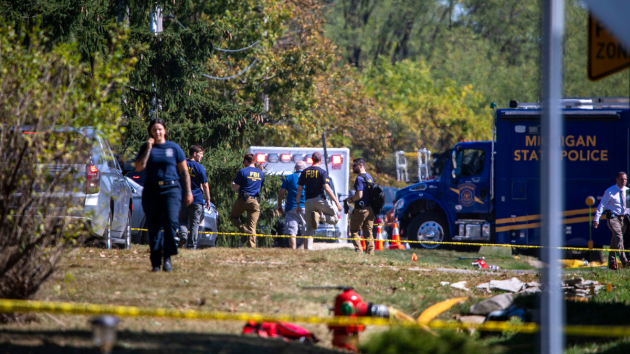
(GRAND BLANC, Mich.) — The search for more potential victims of a mass shooting at a Michigan church continued into Monday, after a gunman killed at least four people while hundreds were worshiping on Sunday morning.
Gunman Thomas Jacob Sanford, 40, drove his truck into The Church of Jesus Christ of Latter-day Saints in Grand Blanc, Michigan, on Sunday morning, before shooting congregants and setting the building on fire, according to officials.
At least four people were killed and eight others were injured in the shooting and fire, according to police. The gunman was then killed in a shootout with responding police, law enforcement said.
The FBI is leading the investigation, calling the attack an “act of targeted violence.”
Officials confirmed that of those shot, one victim died at the scene, another later died at the hospital and two more individuals were found dead at the scene due to the fire. Eight others remain hospitalized, seven are in stable condition and one is in critical condition.
Grand Blanc Township Police Chief William Renye told reporters Sunday, “We do believe we will find additional victims once we have that scene secured.”
Officials said that the chapel is a “total loss” as investigators work to comb through the rubble.
A source briefed on the investigation told ABC News that detectives are urgently working to determine the motive behind the shooting.
Investigators are working to learn whether the church had been the target of threats in recent months and looking to see whether the timing could be connected to the death on Saturday of Russell M. Nelson, president of The Church of Jesus Christ of Latter-day Saints. He was 101 years old.
Renye said during Sunday’s news conference that the FBI had assigned more than 100 agents to help in the investigation.
Renye said the gunman “ran the vehicle through the front door, exited and started firing shots,” adding that it remains unclear what connection, if any, the suspect had to the church.
Sanford was a veteran of the Iraq War, according to officials. ABC News confirmed with the United States Marine Corps that Sanford served four years in the Marines from June 2004 to June 2008. He ultimately rose to the rank of sergeant, officials said, serving one combat tour to Iraq.
President Donald Trump said had been briefed on the shooting and fire, writing Sunday on social media, “This appears to be yet another targeted attack on Christians in the United States of America.”
“The Trump Administration will keep the Public posted, as we always do. In the meantime, PRAY for the victims, and their families. THIS EPIDEMIC OF VIOLENCE IN OUR COUNTRY MUST END, IMMEDIATELY!” Trump said.
Trump also wrote that the FBI is leading the investigation efforts. Trump said that while the suspect is dead, there is “still a lot to learn.”
Vice President JD Vance posted his own statement on social media, calling the shooting and fire at an LDS church “awful.” He said the “entire” Trump administration is monitoring the incident.
Michigan Gov. Gretchen Whitmer said her “heart is breaking for the Grand Blanc community” in a statement on X.
“Violence anywhere, especially in a place of worship, is unacceptable,” she said. “I am grateful to the first responders who took action quickly. We will continue to monitor this situation and hold the Church of Jesus Christ of Latter-Day Saints in the Grand Blanc close.”
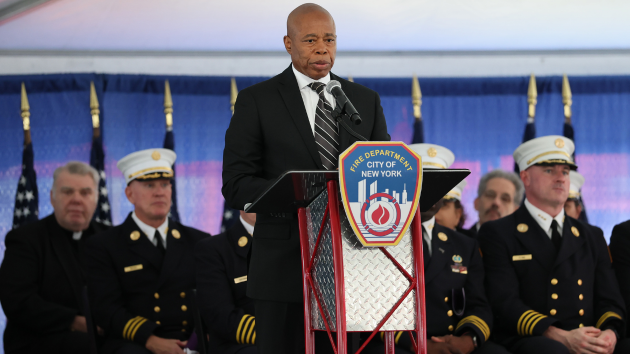
(NEW YORK) — New York City Mayor Eric Adams announced Sunday he is suspending his campaign for mayor, just weeks away from the closely watched election.
Adams announced his decision in a video on X.
The mayor, running as an independent, resisted calls to drop out previously from opponents of Democratic nominee Zohran Mamdani, who were concerned he and independent candidate former Gov. Andrew Cuomo, who lost the Democratic primary and is running as an independent, would split the vote.
Adams has been polling behind Mamdani, Cuomo and Republican nominee Curtis Sliwa.
ABC News previously reported that it is too late for Adams’s name to be removed from the ballot. His name will remain, as will fellow long shot candidate Jim Walden, who also suspended his campaign and last week endorsed Cuomo.
Adams’ decision follows an order Friday from the Manhattan federal judge who oversaw Adams’ criminal case.
Judge Dale Ho agreed to add the city’s Campaign Finance Board as an interested party in the now-dismissed corruption matter. The CFB asked to be added so it could review the case before deciding whether to award matching funds to the Adams campaign.
The judge’s order granting the request made clear to the mayor and his campaign advisers that it would be unlikely they would receive public money to match the nearly $4 million Adams has raised.
Adams was indicted in September 2024 on five counts in an alleged long-standing conspiracy connected to what prosecutors said were improper benefits, illegal campaign contributions and an attempted coverup.
The charges against the mayor — including counts of wire fraud, conspiracy, bribery and solicitation of a contribution from a foreign entity — were dropped against him in April by the U.S. Justice Department in what his critics claimed was a quid pro quo with the Trump administration.
Adams and the Justice Department denied there was a quid pro quo involved in the dropping of the charges.
Advisers for President Donald Trump had been in contact with Adams to persuade him to drop out of the race and offered him positions in the administration, including an ambassador post in Saudi Arabia, sources told ABC News.
Trump and Adams both denied reports of those meetings. However, Trump has been vocal that candidates should drop out to limit the number of challengers against Mamdani.
Adams said in his announcement he could not continue his bid because of what he said was media speculation and funds withheld by the CFB “have undermined my ability to raise the funds needed for a serious campaign.”
“When I was elected to serve as your mayor, I said these words: This campaign was never about me. It was about the people of this city — from every neighborhood and background — who had been left behind and believed they would never catch up. This campaign was for the underserved, the marginalized, the abandoned and betrayed by government,” Adams said in the video.
“Since then, it has been my honor to be your mayor. And I am proud to say that we took that victory four years ago and turned it into action — making this city better for those who had been failed by government.”
Adams also indicated he will serve out the rest of his term in office.
“Although this is the end of my reelection campaign, it is not the end of my public service. I will continue to fight for this city — as I have for 40 years, since the day I joined the NYPD to make our streets safer and our systems fairer,” he said.
Adams did not endorse any candidate for mayor in his announcement.
Mamdani wrote in a statement reacting to Adams’ withdrawal, “Donald Trump and his billionaire donors might be able to determine Eric Adams and Andrew Cuomo’s actions but they will not dictate the results of this election. New York deserves better than trading in one disgraced, corrupt politician for another. On November 4th, we are going to turn the page on the politics of big money and small ideas and deliver a government every New Yorker can be proud of.”
Cuomo said in a statement Sunday that Adams’s choice to drop out “was not an easy one, but I believe he is sincere in putting the well-being of New York City ahead of personal ambition.”
“We face destructive extremist forces that would devastate our city through incompetence or ignorance, but it is not too late to stop them,” Cuomo wrote.
The former governor added, “Mayor Adams has much to be proud of in his accomplishments. Only in New York can a child raised in a tenement in Bushwick, who once worked as a squeegee boy and a mailroom clerk, rise to become mayor. Whatever differences we may have, Eric Adams’ story is undeniably one of resilience — a testament to the spirit of this city.”
A spokesperson for Sliwa wrote, “Curtis Sliwa is the only candidate who can defeat Mamdani. Our team, our resources, and our funding are unmatched. Most importantly, we have the best solutions to help working people afford to stay in New York City and feel safe.”
City Hall staff members were informed of the mayor’s decision just a few moments before the campaign released Adams’ statement. Adams gave no indication that he has a job lined up after he leaves office. A source close to the mayor was unaware of a job being offered.
(NEW YORK) — Multiple people were shot Sunday during a packed service at The Church of Jesus Christ of Latter-day Saints in Grand Blanc, Michigan, police said.
At least 10 parishioners were shot, including one who was killed, Grand Blanc Police Chief William Renye said at a news conference. Renye said two other victims were in critical condition and that the gunman, a 40-year-old man, was killed in a gunfight with police.
The church was deliberately set on fire by the suspect, whose name was not immediately released, Renye said.
“We do believe we will find additional victims once we have that scene secured,” Renye said.
The attack unfolded at 10:25 a.m. and more than 100 people were attending the service, according to Renye.
“He ran the vehicle through the front door, exited and started firing shots,” Renye said of the suspect.
The Bureau of Alcohol, Tobacco, Firearms and Explosives (ATF) and FBI responded to the incident.
Fire set in the aftermath of the shooting grew to a five-alarm blaze that caused a partial collapse of the structure, according to law enforcement officials. Just before 1 p.m., authorities said the fire had been extinguished.
An ABC News source briefed on the investigation said detectives are urgently working to determine the motive behind the shooting. Investigators are working to learn whether the church had been the target of threats in recent months and looking to see whether the timing could be connected to the death on Saturday of Russell M. Nelson, president of The Church of Jesus Christ of Latter-day Saints. He was 101 years old.
Nelson died at his home in Salt Lake City, church spokesperson Candice Madsen said in a statement.
President Donald Trump said he’s been briefed on the shooting and fire, writing Sunday on social media, “This appears to be yet another targeted attack on Christians in the United States of America.”
“The Trump Administration will keep the Public posted, as we always do. In the meantime, PRAY for the victims, and their families. THIS EPIDEMIC OF VIOLENCE IN OUR COUNTRY MUST END, IMMEDIATELY!” Trump said.
Trump also wrote that the FBI is leading the investigation efforts. Trump said that while the suspect is dead, there is “still a lot to learn.”
Vice President JD Vance posted his own statement on social media, calling the shooting and fire at an LDS church “awful.” He said the “entire” Trump administration is monitoring the incident.
“Just an awful situation in Michigan. FBI is on the scene and the entire administration is monitoring things. Say a prayer for the victims and first responders,” Vance wrote.
Shortly after the shooting, Attorney General Pam Bondi said in a post on X, “I am receiving briefings about what appears to be a horrific shooting and fire at an LDS church in Grand Blanc, Michigan. @FBI and @ATFHQ agents are en route to the scene now. Such violence at a place of worship is heartbreaking and chilling. Please join me in praying for the victims of this terrible tragedy.”
Michigan Gov. Gretchen Whitmer said her “heart is breaking for the Grand Blanc community” in a statement on X.
“Violence anywhere, especially in a place of worship, is unacceptable,” she said. “I am grateful to the first responders who took action quickly. We will continue to monitor this situation and hold the Church of Jesus Christ of Latter-Day Saints in the Grand Blanc close.”
Renye said during Sunday’s news conference that the FBI has assigned more than 100 agents to help in the investigation.
“Violence in a place of worship is a cowardly and criminal act. Our prayers are with the victims and their families during this terrible tragedy,” FBI Director Kash Patel said in a social media post.
Church of Jesus Christ of Latter-day Saints spokesperson Doug Anderson issued a statement confirming that the gunman opened fire on the congregation during Sunday worship services.
“The Church is in communication with local law enforcement as the investigation continues and as we receive updates on the condition of those affected,” Anderson said. “We offer thanks to the emergency responders who are assisting victims and families. We are deeply grateful for the outpouring of prayers and concern from so many people around the world. In moments of sorrow and uncertainty, we find strength and comfort through our faith in Jesus Christ. Places of worship are meant to be sanctuaries of peacemaking, prayer and connection. We pray for peace and healing for all involved.”
For years, law enforcement and homeland security experts have been warning that religious institutions across the board are being targeted for acts of violence.
“We can all agree that our houses of worship should be safe places for people to exercise their freedom of religion but right now we are increasingly seeing them being targets for violence — and not just attacks any one faith,” Michael Masters, who oversees security operations for the main U.S. network of Jewish schools and synagogues, told ABC News. “Attacks against religious institutions are attacks against our democracy as a whole.”
Masters said there has been an increase in targeted attacks across the faith-based community over the past several years.
“This is something we’ve been working to prepare for in the Jewish community for many years. In the current threat environment, the offenders are often not distinguishing. There’s the Jewish community, the Sikh community, the Annunciation church and now the LDS church in Michigan,” he said.
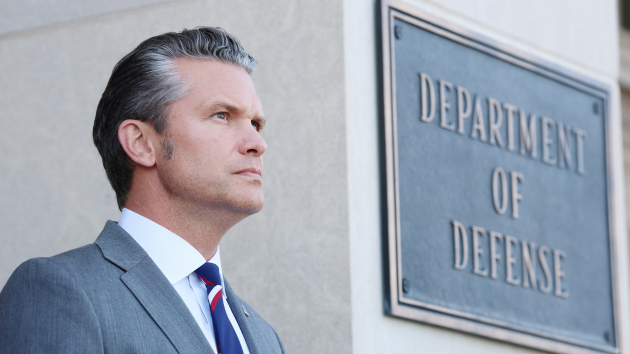
(WASHINGTON) — At next week’s unusual gathering of several hundred senior U.S. generals and admirals, Defense Secretary Pete Hegseth will deliver his message of restoring the “warrior ethos” to the U.S. military and present new standards toward that goal, according to five U.S. officials.
Many of the senior military officers will come to the Marine base at Quantico, Virginia, from all over the United States and from around the world to hear Hegseth in an event that could last just 30 minutes, according to two officials.
ABC News has previously reported that only officers in command positions and not staff positions are being summoned to the gathering and that they will also be joined by the senior enlisted adviser in that unit.
Five U.S. officials told ABC News that the rare gathering will allow Hegseth to personally tell the officers about the warrior ethos he envisions for the U.S. military and the path forward.
That will also include a discussion of new standards associated with how to achieve that goal and how the U.S. military will conduct itself.
President Donald Trump plans to speak to the generals and admirals at the meeting, White House officials told ABC News on Sunday.
Pentagon Press Secretary Kingsley Wilson declined to comment to ABC News about what Hegseth planned to discuss at Tuesday’s meeting.
Restoring the warrior ethos to the U.S. military is a message that Hegseth delivers regularly during his speaking engagements in the U.S. and abroad.
While it is common for Hegseth and previous defense secretaries to meet with generals and admirals during their travels or at the Pentagon, it is unusually rare for so many high-ranking officers to be gathered at one location to hear from the defense secretary.
Overall, there are 838 total general officers and admirals on active duty — 446 of them are from the higher two-star, three-star and four-star ranks — according to the Pentagon’s latest statistics from June, though it is difficult to ascertain a breakdown of how many officers are in command positions versus staff positions.
Several questions have been raised about the increased security requirements that will be needed at the large Marine base located 35 miles south of Washington, D.C.
Questions have also been raised about the significant travel and lodging costs that would be associated with transporting so many senior military officers and their senior enlisted advisers to Quantico, said two U.S. officials.
Video of Tuesday’s meeting will be recorded by the Pentagon for future public distribution, according to officials.
The invitations that went out to officers in command positions earlier this week did not disclose a reason or topic as to why they were being summoned to the gathering in Quantico.
Because of that, speculation among military officials had been rampant about the topic for the meeting and whether it was related to his earlier announcement this year of a 20% reduction in the number of officers of four-star rank.
Concerns had also been raised about his previous removal of 15 senior military officers from their posts, including Gen. Charles “CQ” Brown, Jr. the then-chairman of the Joint Chiefs of Staff, and Adm. Lisa Franchetti, the Navy’s top admiral.
(GLOBE, Ariz.) — At least four people have been confirmed dead and two remain unaccounted for amid intense flooding in parts of Arizona, local officials said Saturday.
The flooding caused about 1,000 propane tanks to wash away from a distribution facility, creating a serious hazmat concern in the area of downtown Globe, Arizona, according to Gila County Emergency Management.
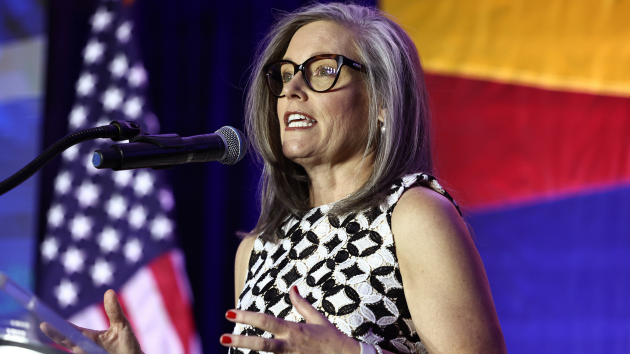
On Saturday, Arizona Gov. Katie Hobbs declared a state of emergency to speed resources to the area.
“The flooding in Gila County has caused heartbreaking loss and serious damage,” she said in a statement.
A search and rescue effort was underway for more potential victims, officials said.
Two of the victims confirmed dead were found in a vehicle having drowned, officials said, and a third victim was found outside a vehicle in downtown Globe. An official could not confirm to ABC News if the victims were adults or any relation between them.
A fourth man who went missing during the storm overnight was found dead Saturday morning outside his vehicle, according to the Scottsdale Police Department.
Police said they discovered Ander Polanco’s body outside his car as floodwaters receded. A death investigation is underway and the cause of death hasn’t been released.
The propane tanks that washed away have created a serious concern due to their ability to explode, officials warned.
“Historic Downtown Globe is currently unsafe, with compromised buildings as well as hazardous chemicals and debris, including propane tanks,” the city of Globe said in a post on Facebook.
“For your safety, please stay out of the area until further notice. We also ask everyone to stay out of the creek. Search and rescue operations are underway, and any traffic in the area can interfere with rescue teams and throw off the scent work of trained dogs,” the city said.
Gila County Emergency Management is advising residents to shelter in place due to possible hazardous materials in the floodwaters.
All available agencies in the region are responding to assist with SAR and hazmat assessment and clean up, a county emergency management official told ABC News.
“Crews continued work throughout the night. We want to thank them for their diligent work. This includes Globe FD, Globe PD, Globe Public Works, Gila County, Gila County Emergency Services and DPS,” the city of Globe said.
The city has added over 100 additional resources that include Maricopa Search and Rescue, Tonto Rim Search and Rescue, Pima County Search and Rescue, and 2-20 person work crews from the State Land Department. “We are waiting on many other crews from throughout the state,” the city said.