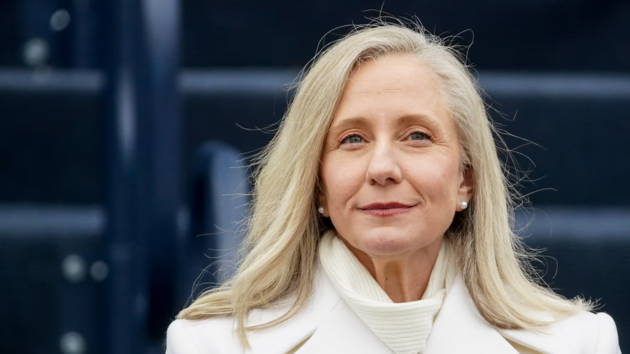
Abigail Spanberger, governor of Virginia, during an inauguration ceremony at Capitol Square in Richmond, Va., Jan. 17, 2026. (Al Drago/Bloomberg via Getty Images)
(WASHINGTON) — Virginia Gov. Abigail Spanberger, a rising star in the Democratic Party who captured the governor’s office last year by a large margin, will deliver the Democrats’ response Tuesday night to President Donald Trump’s State of the Union address, focusing on affordability and the chaos she believes the Trump administration has caused at home and abroad, her team told reporters.
Spanberger, who was inaugurated in January after serving three terms in the House of Representatives, will discuss lowering the persistently high costs of housing, health care, energy and groceries despite the administration’s insistence that some of these costs have come down.
The daughter of a law enforcement officer and a nurse, Spanberger focused relentlessly on affordability throughout her 2025 gubernatorial campaign. Despite the economy being the top issue Trump ran on in the 2024 election, it’s been one of the issues he’s struggled with the most during his second term, as Americans still haven’t felt the “Trump boom” they were promised.
In an ABC News/Washington Post/Ipsos poll, 57% of Americans disapprove of how Trump’s handling the economy, and 64% disapproved of how he’s handling tariffs on imported goods.
Spanberger, a former CIA officer, will also address how the Trump administration is contributing to greater worldwide uncertainty.
Trump and his team have spent a large portion of his second term so far focusing on foreign policy, including Trump going head-to-head with some U.S. allies and becoming more aggressive on the world stage. A former federal law enforcement officer who worked on narcotics and money-laundering cases for the U.S. Postal Inspection Service, Spanberger will also address what critics call the chaos caused by the Trump administration, which continues its immigration enforcement efforts that Americans are seeing in their communities.
She is also expected to challenge Republicans in Congress for not standing up to Trump.
Several Democrats have invited survivors of late sex offender Jeffrey Epstein to attend Trump’s address, while others plan to skip the event altogether in protest.
The governor will give her speech live from Colonial Williamsburg, the restored 18th century capital where Virginian representatives voted for its delegation to Congress to propose independence for all 13 colonies from Great Britain, and later adopted the Virginia Declaration of Rights — which influenced the Declaration of Independence and Bill of Rights.
There are at least two major counter events that several Democrats plan to attend, including MoveOn’s People’s State of the Union, which is promoting the participation of more than 20 members of Congress; and the “State of the Swamp” event by Defiance.org that features a handful of celebrities appearing by video or in person, such as Robert De Niro.
Spanberger prepared for her remarks by watching speeches other Democrats have delivered in response to Trump’s previous addresses to Congress.
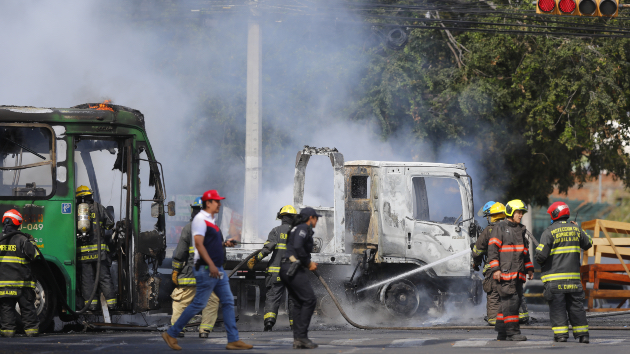
A view of the site where Mexican Army troops killed Nemesio Oseguera Cervantes, known as ‘El Mencho,’ leader of the Cartel Jalisco Nueva Generacion (Jalisco New Generation), during a federal operation in Guadalajara, Jalisco, Mexico on February 22, 2026. (Stringer/Anadolu via Getty Images)
(NEW YORK) — Airport operations are gradually returning to normal in Mexico after violence ignited in the country following the killing of the drug lord known as “El Mencho,” President Claudia Sheinbaum said at a press conference Tuesday.
Sheinbaum said there were “seven roadblocks” in Mexico Tuesday morning, but “all of them” have now been cleared. Flights have resumed at Guadalajara Airport, and operations are “gradually returning” at Puerto Vallarta airport, she added.
School was suspended in Jalisco and Michoacan on Tuesday, but “activities are expected to return to normal tomorrow,” Sheinbaum added.
Nemesio Oseguera Cervantes, the leader of the Jalisco New Generation Cartel, was killed in an operation led by Mexican authorities on Sunday in Jalisco, Mexican officials said.
Widespread cartel-organized violence erupted following his death, with vehicles set on fire, hundreds of road blockages and attacks on gas stations and businesses, according to Mexican authorities.
Mexico’s security strategy “has not changed,” after the operation, emphasizing that law enforcement were attempting to arrested an individual with an outstanding warrant, Sheinbaum said Tuesday.
“Members of the Army were attacked and responded. He later died while being transferred. But we will never act outside the law. That is very important. Here, the objective was never to kill anyone,” Sheinbaum said.
“Yes, this was a very significant member of organized crime, but the strategy has not changed. The strategy remains the same and is grounded in our laws and our Constitution,” she added.
Sheinbaum said that as of Monday morning, there are no longer any blockades and “normal activity has largely been restored.”
Oseguera Cervantes was one of the most wanted criminals in both Mexico and the United States. He was one of the top traffickers of fentanyl into the U.S., and last year President Donald Trump designated the Jalisco New Generation Cartel as a Foreign Terrorist Organization, the White House said.
When Mexican forces moved in to arrest him on Sunday, “El Mencho’s security detail opened fire,” Mexico’s Secretary of National Defense Ricardo Trevilla Trejo said Monday.
El Mencho “fled the location, leaving behind a group heavily armed,” Trevilla said. “The attack by organized crime members was extremely violent.”
Mexican special forces members continued to pursue El Mencho and eventually were able to injure him and two of the bodyguards with him, according to Trevilla.
El Mencho and the two bodyguards died during the helicopter evacuation flight that was heading towards a medical facility in Jalisco, Trevilla added.
Ultimately, 25 members of the Mexican National Guard and 30 cartel members were killed in Jalisco, Mexican officials said. Four cartel members were also killed in Michoacan, officials said.
Among those killed was a “principal confidant” of El Mencho in Jalisco who was “coordinating road blockades, vehicle burnings, and attacks on military and government facilities,” Trevilla said.
Seventy cartel members have been detained across seven states, Mexican officials said Monday.
The U.S. Embassy in Mexico on Monday continued to urge Americans in locations throughout Mexico to shelter in place due to “ongoing security operations and related road blockages and criminal activity.”
“While no airports have been closed, roadblocks have impacted airline operations, with most domestic and international flights cancelled in both Guadalajara and Puerto Vallarta,” the U.S. Embassy said in a security alert. “All ride shares are suspended in Puerto Vallarta. Some businesses have suspended operations.”
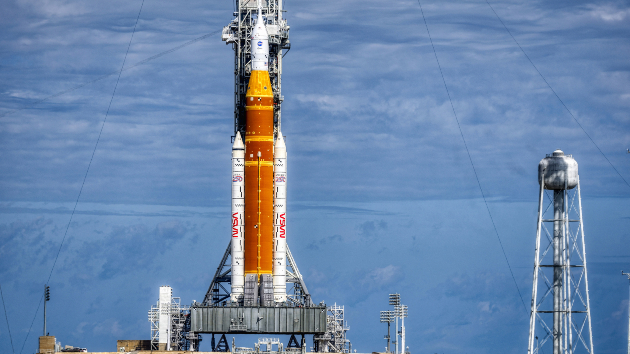
Artemis II: the Space Launch System rocket and Orion spacecraft at Launch Pad 39B, on Friday, Jan. 30, 2026. (Ricardo Ramirez Buxeda/Orlando Sentinel/Tribune News Service via Getty Images)
(MERRITT ISLAND, Fla.) — Weather conditions have again delayed operations leading to the launch of the Artemis II rocket mission to the moon.
The rollback of the Artemis II rocket and spacecraft at the Kennedy Space Center in Florida was originally scheduled for Tuesday afternoon. Due to high winds in the area, NASA said its plans to move the rocket and Orion spacecraft for Artemis II off the launch pad and back to the vehicle assembly building were pushed to Wednesday morning.
The 4-mile trek is expected to take 12 hours, the space agency said.
The move was deemed necessary after crews detected an interrupted flow of helium to the Artemis II rocket’s upper stage on Saturday. Helium did not flow properly during normal operations and reconfigurations that followed the wet dress rehearsal that concluded on Thursday.
The upper stage uses helium to maintain the proper environmental conditions for its engine and to pressurize liquid hydrogen and liquid oxygen propellant tanks, according to NASA. Essentially, helium is a critical element that ensures the proper flow of fuel into the rocket.
Once back in the vehicle assembly building, teams will install platforms to access the helium flow issue, NASA said. Teams will review potential causes of the issue as well as data from the 2022 Artemis I mission, in which teams had to troubleshoot helium-related pressurization of the upper stage before launch.
The Artemis II mission is a test flight that will send four astronauts on a more than 600,000-mile journey around the moon to test critical spacecraft systems, according to NASA. The crew will fly over the far side of the moon — passing between 4,000 and 6,000 miles above it — and spend a day observing and photographing the region.
After the lunar flyby, the astronauts will circle the moon for a return to Earth, in which the Earth-moon gravity field will help pull the spacecraft back to Earth over the course of its three-day return trip.
The Orion will then splashdown off the coast of San Diego after re-entering the Earth’s atmosphere, and the U.S. Navy will recover the astronauts from the Pacific Ocean.
The journey is expected to take 10 days total.
The mission sets the stage for the future Artemis III, which aims to someday land astronauts near the moon’s South Pole. The region has never been explored by humans before.
Artemis II will mark the first time humans have traveled beyond low Earth orbit since Apollo 17 in 1972.
In January, NASA delayed the Artemis moonshot due to near-freezing temperatures at the launch site.
Heaters were deployed to keep the Orion capsule on top of the rocket warm, while rocket-purging systems were adapted to the cold.
The rollback of Artemis II means it will not launch during the March launch window, NASA said.
The quick preparations will potentially preserve the April launch window, pending the outcome of data findings and repair efforts, according to the agency.
ABC News’ Briana Alvarado and Matthew Glasser contributed to this report.
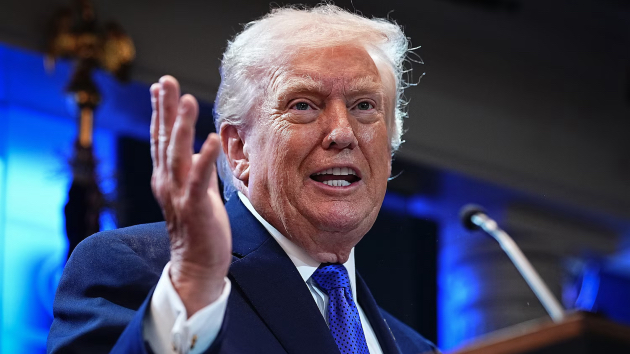
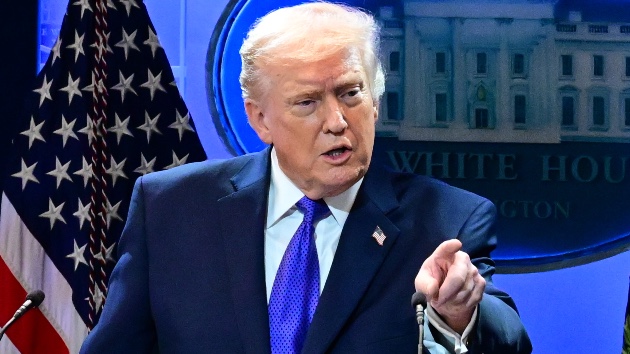
President Donald Trump speaks during a press conference in the Brady Press Briefing Room of the White House in Washington, February 20, 2026. (Aaron Schwartz/Getty Images)
(NEW YORK) — A 10% global tariff took effect on Tuesday, marking the first duty enacted by President Donald Trump after a recent Supreme Court decision invalidated most of his levies.
Within hours of the high court’s ruling on Friday, Trump signed an executive order imposing a 10% tariff on nearly all imports for up to 150 days. The directive called for enforcement of the duty to begin at 12:01 a.m. ET on Tuesday, Feb. 24.
Soon after signing the order, Trump vowed to hike the global tariff to 15%. As of Tuesday, however, the president had not issued an executive order formalizing that increase.
Stocks ticked higher Tuesday morning, recovering some of the losses suffered a day earlier in the first trading session since Trump announced the tariff increase.
Trump enacted the 10% tariff under Section 122 of the Trade Act of 1974, which allows the White House to address “large and serious” balance-of-payments deficits, or disparities between a country’s total payments in transactions with other nations and its total earnings.
Under the measure, the president can also impose levies to “prevent an imminent and significant depreciation of the dollar.”
The Section 122 tariffs will result in price increases amounting to $800 in additional costs for an average U.S. household over the next 150 days, the Yale Budget Lab projected. In order to extend the across-the-board 15% tariff beyond that time window, Trump would need to secure Congressional approval.
Senate Minority Leader Chuck Schumer, D-N.Y., said Monday that Democrats would oppose an extension of Section 122 tariffs, which could deny Trump the 60 votes necessary to overcome a potential Senate filibuster.
In a social media post on Monday, Trump affirmed what he said was his authority to issue tariffs, saying he does not need to consult Congress before erecting new trade levies.
Trump also reiterated his commitment to his policy approach, warning other countries that they may face a “much higher Tariff, and worse.”
The high court ruled in their February 20 decision that the International Emergency Economic Powers Act (IEPPA) does not authorize Trump to impose levies, nullifying a major swathe of tariffs issued by the president on April 2 of last year, which he dubbed “Liberation Day,” and a host of other measures.
If the Supreme Court had opted to uphold tariffs issued under IEPPA, the nation’s effective tariff rate would have remained at 16%, the Yale Budget Lab said. Taking into account the Section 122 tariffs, the effective tariff rate now stands at 13.7%, the group said.
American Tourist Yoni Pizer speaks of getting caught in the violence that erupted in Puerto Vallarta, Mexico, February 22, 2026, after the Mexican government killed the cartel leader Nemesio Oseguera Cervantes, also known as El Mencho. (ABC News)
(NEW YORK) — In harrowing detail, an American tourist described the violence that he, his husband and two friends were caught in on Sunday in the vacation mecca of Puerto Vallarta, Mexico, when armed criminals responded to the killing of a notorious cartel boss.
Yoni Pizer of Chicago told ABC News that he and his husband, who own a vacation condo in Puerto Vallarta, were driving their friends to a whale-watching expedition around 8:30 a.m. local time on Sunday when chaos suddenly erupted.
Pizer said they were just west of Puerto Vallarta, approaching an intersection, when they first noticed trouble and soon realized their lives were in jeopardy.
“We suddenly noticed a man running at us with a gun in his hand and one of my friends who was in the backseat shouted, ‘He’s got a gun! He’s got a gun!'” Pizer said.
He said the man was part of the group of armed assailants who were stopping cars and pulling the occupants out.
Pizer said the man banged on his car window and pointed the gun at his head. He said at first he thought it was just a carjacking, but later noticed other armed assailants stopping cars and pulling the occupants out.
He said the armed man ordered him and the others with him to get out of the car.
“At that point, he got into the car and drove it just a few yards into the intersection, and then threw an incendiary device in it, which exploded, and the car was quickly engulfed in flames,” Pizer said.
Widespread cartel-organized violence erupted following a Mexican Special Forces operation on Sunday that killed Nemesio Oseguera Cervantes, the leader of the Jalisco New Generation Cartel, who is also known as “El Mencho.”
Oseguera Cervantes was one of the most wanted criminals in both Mexico and the United States. He was one of the top traffickers of fentanyl into the U.S. Last year President Donald Trump designated the Jalisco New Generation Cartel as a Foreign Terrorist Organization.
When Mexican forces moved in to arrest him on Sunday in another part of the state of Jalisco, “El Mencho’s security detail opened fire,” Mexico’s Secretary of National Defense Ricardo Trevilla Trejo said Monday. More than 30 cartel members were killed in the firefight, which also left 25 members of the Mexican National Guard dead, Mexican officials said.
Oseguera Cervantes initially got away, but government forces tracked him down in the town of Tapalpa, about 180 miles southeast of Puerto Vallarta, where he and his two bodyguards were gravely wounded in a gun battle, Mexican authorities said.
El Mencho and his bodyguards died during an evacuation flight to a medical facility, Trevilla Trejo said.
In response, cartel members fanned out across the country, setting fire to vehicles and buildings, authorities said.
Among the other cartel members killed was a “principal confidant” of El Mencho in Jalisco who was “coordinating road blockades, vehicle burnings, and attacks on military and government facilities,” Trevilla said.
“Their goal was clearly to block all main roads in Puerto Vallarta. And, clearly, it wasn’t to kill people, because they easily could have killed all of us,” Pizer said.
He said that after his car was taken and set on fire, he and his party ran for their lives as they heard gunshots and saw numerous vehicles being torched.
“Then a city bus came up and they went onto the bus and started shooting their guns to make sure people understood that they meant business,” Pizer said, adding that the assailants blocked a road with the bus and set it on fire.
Pizer said at one point during their escape, he was separated from his husband and one of their friends, who both ended up sheltering in a church orphanage for more than eight hours.
Pizer said that a good Samaritan stopped and gave him and his other guest a ride back into Puerto Vallarta.
“We ran to the beach and turned around and saw black columns of smoke throughout the city,” Pizer said.
The U.S. State Department is advising American tourists to continue sheltering in place until tensions subside.
Mexican President Claudia Sheinbaum said there is a “greater calm” in Mexico as government forces worked to quell the violence.
Pizer said he fears the attack will wreck Puerto Vallarta’s top industry — tourism — at least for the short term.
“This all makes me very, very sad,” Pizer said. “Puerto Vallarta is such a wonderful, special place. Obviously, that’s why so many people come here.”
Louvre Museum Director Laurence Des Cars attends a press conference at the Louvre Museum on April 23, 2024 in Paris, France. Thierry Chesnot/Getty Images
(PARIS) — The director of the Louvre Museum in France has resigned, months after $102 million in jewels were stolen, according to the office of the French president.
Laurence des Cars’ tenure has been under intense scrutiny since the heist and she has faced calls for resignation.
French President Emmanuel Macron praised the resignation “as an act of responsibility at a time when the world’s largest museum needs both stability and a strong new impetus to successfully complete major security and modernization projects,” the Élysée said in a statement Tuesday.
“The President thanked her for her work and commitment over the past few years and, recognizing her undeniable scientific expertise, entrusted her with a mission within the framework of the French G7 presidency, focusing on cooperation between the major museums of the participating countries,” according to the statement.
At least seven suspects have been arrested in connection with the October robbery but the jewels have not been recovered.
Empress Eugénie’s crown was the only item the thieves did not escape with during the robbery. The thieves dropped it on the street outside the Louvre during the roughly five-minute long heist.
The crown “was crushed and significantly deformed” during the heist, the Louvre said in a statement earlier this month. However, “it remained largely intact,” meaning museum officials believe it can be fully restored.
In light of the robbery, security lapses at the museum have been exposed, including that the password to the world-famous museum’s video surveillance system was “Louvre,” according to a museum employee with knowledge of the system.
During testimony before a French Senate committee after the robbery, des Cars said the only camera installed outside the Apollo Gallery, where the stolen jewels were displayed, was facing west and did not cover the window where the thieves used power tools to break in and exit.
Des Cars said all of the museum’s alarms and video cameras work, but said there was a “weakness” in the museum’s perimeter security “due to underinvestment.”
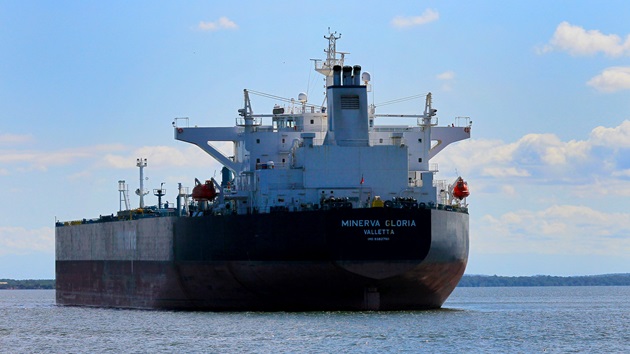
An oil tanker is seen anchored in Lake Maracaibo after loading crude oil at the Bajo Grande Refinery port. Jose Bula Urrutia/UCG/Universal Images Group via Getty Images
(WASHINGTON) — The Pentagon announced the third seizure in the Indian Ocean of an oil tanker allegedly linked to Venezuela’s illicit oil operation that had fled the Caribbean.
“Three boats ran and now all three have been captured,” said a post from the Department of Defense on X announcing the seizure. “The vessel was operating in defiance of President Trump’s established quarantine of sanctioned vessels in the Caribbean and attempted to evade. From the Caribbean to the Indian Ocean, we tracked it and stopped it. No other nation has the global reach, endurance, or will to enforce sanctions at this distance.”
The department added it would continue to “deny illicit actors and their proxies freedom of maneuver in the maritime domain.”
After the capture of Venezuelan President Nicolas Maduro in early January, Secretary of State Marco Rubio said the United States would continue enforcing a legal “quarantine” of illicit oil tankers transiting to and from Venezuela.
President Donald Trump said that his administration will work with private U.S. companies and the government in Caracas to expand Venezuelan oil production and exports — with the U.S. controlling the revenue of oil sales.
Venezuela’s interim president Delcy Rodriguez announced earlier this month that the country’s first shipment of liquefied petroleum gas had been exported to the U.S.
This is a developing story. Check back for updates.
US President Donald Trump speaks during a press conference at the White House, Washington, D.C., US on February 20, 2026. (Photo by Kyle Mazza/Anadolu via Getty Images)
(WASHINGTON) — President Donald Trump has pushed back against news reports that his top military adviser, Joint Chiefs Chairman Gen. Dan Caine, privately cautioned that if Trump ordered a U.S. military strike on Iran, a lack of critical munitions and support from allies could pose risks to American troops.
“General Caine, like all of us, would like not to see War but, if a decision is made on going against Iran at a Military level, it is his opinion that it will be something easily won,” Trump posted Monday on his social media platform.
That statement came as Trump was said to be considering military options as he puts pressure on Iran to end its nuclear program or face “bad” consequences.
According to a U.S. official, Tehran was expected to offer a new nuclear proposal by Tuesday ahead of another round of negotiations in Geneva led by special envoy Steve Witkoff on Thursday.
The meeting would be the second round of indirect talks between the U.S. and Iran, with Omanis and Qataris passing notes between the delegations.
In a statement, a Joint Staff spokesman emphasized that Caine’s role is to provide “a range of military options, as well as secondary considerations and associated impacts and risks, to the civilian leaders who make America’s security decisions.”
The president added that he will make the final call regarding military action, and repeated that he wants a deal with Iran, but warned that if there is not a deal “it will be a very bad day for that Country.”
“I am the one that makes the decision, I would rather have a Deal than not but, if we don’t make a Deal, it will be a very bad day for that Country and, very sadly, its people, because they are great and wonderful, and something like this should never have happened to them,” Trump said.
Trump also doubled down on his previous claims that Iran’s nuclear supply has been “obliterated” after last summer’s Operation Midnight Hammer, saying that it was “blown to smithereens.”
“He knows Iran well,” he said, referring to Caine, “in that he was in charge of Midnight Hammer, the attack on the Iranian Nuclear Development. It is a Development no longer, but rather, was blown to smithereens by our Great B-2 Bombers.” Trump said.
Israeli Prime Minister Benjamin Netanyahu threatened Iran during a speech to the Knesset on Monday, warning the Iranian ayatollah if Iran strikes Israel, “we will respond with a force they cannot even imagine,” according to remarks of his speech google translated from Hebrew to English.
“No one knows what the day will bring. We are vigilant, we are prepared for any scenario,” Netanyahu said.
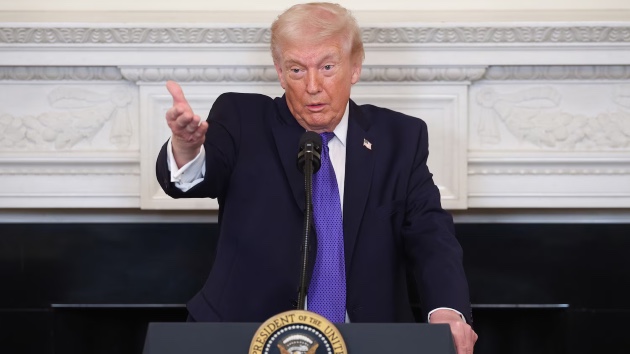
Donald Trump delivers remarks during a working breakfast with governors in the State Dining Room at the White House on February 20, 2026 in Washington, DC. (Kevin Dietsch/Getty Images)
(WASHINGTON) — When President Donald Trump delivers the first State of the Union address of his second term Tuesday night — it will be a chance to make the case for his sweeping policy goals directly to millions of Americans — ahead of November’s midterm elections where control of Congress is at stake.
One year ago, Trump proclaimed “America is back” as he addressed a joint session of Congress shortly after taking office, laying out novel plans to make good on issues he campaigned on, including lowering prices while imposing worldwide tariffs, the mass deportations of immigrants in the country illegally, and a promise to keep America out of foreign wars.
Since then, he has taken unprecedented, often highly controversial, steps to reshape the federal government and achieve those goals, testing the limits of presidential power on both the domestic and foreign policy fronts. But he’s done so at a political cost – with polls showing a growing number of Americans displeased or opposed.
White House press secretary Karoline Leavitt told reporters Tuesday morning that the president will contend that he and Republicans are the best choice to “continue tackling the affordability crisis” and that he’ll feature a Pennsylvania waitress who benefitted from his “no tax on tips” policy.
Earlier, she posted on X that “In one year, President Trump has turned our country around from the brink of disaster, and he will rightly declare the State of Our Union is strong, prosperous and respected.”
He could also use his speech to shore up support from lawmakers and the American people on two major, immediate issues: the current showdown with Iran that could end up with Trump ordering the U.S. military into war — and his tariff policy — much of which was struck down as illegal last week by the Supreme Court.
At least some of the justices are expected to attend, possibly including the conservatives ones he picked and who joined in that ruling. By tradition, they will be seated just in front of him, and the presence of justices he has railed against, even personally attacked, could bring fireworks to the House chamber.
The economy and tariffs
After months of blaming former President Joe Biden for leaving what he repeatedly called an economic “mess,” Trump has now taken full responsibility for the economy, even declaring last week that he “won affordability.” While he is sure to tout the relative taming of inflation in recent months – down to 2.4% now from 3% when he took office – that hasn’t translated into lower prices across the board for many Americans.
Prices for some key household goods such as eggs and gas are down, but his tariffs and other factors have increased the prices of many household goods such as produce, beef and coffee.
The ABC News/Washington Post/Ipsos poll shows that almost half of Americans, 48%, say the economy has gotten worse since Trump took office — although that number is down slightly from 52%, who said the same in October.
Given that, he faces an uphill battle to persuade Americans they are better off. According to that recent ABC/Post/Ipsos poll, 65% of Americans disapprove of how Trump is handling inflation and 57% disapprove of how he’s handling the economy overall.
“We have the greatest economy we’ve ever had,” Trump said Monday. “We have the most activity we’ve ever had. I’m making a speech tomorrow night, and you’ll be hearing me say that. I mean it’s — it’s going to be a long speech because we have so much to talk about.”
As Democrats make the rising cost of health care a major message for their candidates to run on in this fall – after many Americans saw their premiums skyrocket when Affordable Care Act subsidies expired at the start of the year – Trump will likely need to counter that by citing what he says he’s done to make health care more affordable.
He will surely point to his Most Favored Nation policy that lowered the cost of some pharmaceuticals and the TrumpRx platform aimed at making those lower prices for some medications more transparent.
Foreign policy
Trump will also have the chance to make the case for some of the ambitious foreign policy moves he’s made during his first year in office. His reshaping of America’s role in the global order comes as even some Republicans have criticized Trump for focusing too much on foreign policy rather than on domestic issues.
At his orders, the U.S. has amassed a major military force near Iran as negotiations over Iran’s nuclear program between American and Iranian officials are likely to continue on Thursday. Even so, critics say Trump and his administration have not made publicly clear exactly what objectives they are seeking in Iran.
At the same time, he has made clear the possibility of military action — either limited or more prolonged — is not out of the question, even as polls show Americans are hesitant about the U.S. getting involved in another war to make changes in another country.
More than half of Americans, 54%, oppose Trump using the U.S. military to force changes in other countries, while only 20% support it (and 26% say they have no opinion or did not respond to the question), according to the ABC/Post/Ipsos poll.
Trump will also have the chance to lay out his view that America has supremacy over the Western Hemisphere, what he has coined the “Don-roe Doctrine.”
That view was evident in the military operation that put American boots on the ground in Venezuela to capture then-President Nicolas Maduro and the ongoing strikes he’s authorized on boats allegedly carrying drugs in the Caribbean and Pacific that have killed more than 150 people.
That ideology was also a cornerstone in his repeated calls for the U.S. to “own” Greenland, something that alarmed many of America’s closest European allies. The president said that a deal with Denmark was in the works for ownership of the territory during his trip to Switzerland in January, but since then no other information has come from the White House about the status of those talks.
Immigration
The president will also likely tout success on the border and immigration, even as some public opinion has turned on the tactics used by Immigration and Customs Enforcement (ICE) in the immigration crackdown he’s ordered.
The Department of Homeland Security said in December that 2.5 million undocumented migrants were removed from the U.S. and the president has celebrated the reduction in crossings as the southern border, both of which were major campaign promises.
However, as ICE operations have ramped up, public opinion has started turning against them in the wake of the killings of Renee Nicole Good and Alex Pretti in Minnesota by federal law enforcement.
The ABC/Post/Ipsos poll found that the president’s approval ratings on immigration are also at a low for his second term — with 58% disapproving of his handling of immigration and 40% approving.
ABC News’ Fritz Farrow contributed to this report.
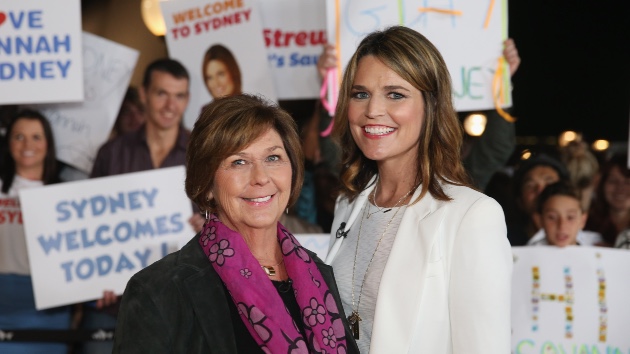
Australian-born presenter, Savannah Guthrie poses alongside her mother Nancy Guthrie during a production break whilst hosting NBC’s “Today Show” live from Australia at Sydney Opera House on May 4, 2015 in Sydney, Australia. (Photo by Don Arnold/WireImage)
(NEW YORK) — “Today” show host Savannah Guthrie announced on Tuesday a new $1 million reward for the recovery of her mom, Nancy Guthrie, who has been missing since Feb. 1.
The combined reward between the family and law enforcement now stands at $1.2 million.
Sources familiar with the family’s decision told ABC News the family was prepared to fund the reward from the start but waited until now because they were initially advised against it.
Separately, the Guthrie family is donating $500,000 to the Center for Missing and Exploited Children to shine a light on other missing persons cases.
Nancy Guthrie, 84, was abducted from her Tucson, Arizona, home by an unknown suspect in the early hours of Sunday, Feb. 1.
“Every hour and minute and second and every long night has been agony,” Savannah Guthrie said in her Tuesday morning Instagram post.
“We still believe in a miracle,” Savannah Guthrie said. “We also know she may be lost. She may be gone.”
Savannah Guthrie said in the video that her mom may be “dancing in heaven,” and “If this is what is to be, then we will accept it. But we need to know where she is.”
“Somebody knows,” Savannah Guthrie said. “And we are begging you to come forward now.”
Savannah Guthrie wrote in the caption that anyone with information can anonymously call the FBI or “reach out to me.”
The FBI has released photos and videos of the unknown armed suspect in front of Nancy Guthrie’s home, appearing to tamper with a security camera.
The FBI in Phoenix said in a statement on Tuesday, “If you have firsthand knowledge of Nancy’s whereabouts or any information about where she may be located, please contact the FBI tip line at 1-800-CALL-FBI (1-800-225-5324).”
“To help keep the tip line available for actionable investigative law enforcement leads, please submit only serious and detailed fact-based information – no well-wishes or case theories,” the FBI added. “The tip line is not for personal messages to the Guthrie family.”
Anyone with information is urged to call 911, the FBI at 1-800-CALL-FBI, or the Pima County Sheriff’s Department at 520-351-4900.