(CHIPPEWA FALLS, Wis.) — From the deck his father built by hand, Eric Halfen watches strangers comb through the artifacts of his life. The auctioneer’s chant ricochets across the yard, where everything from board games and mugs to the family’s home itself is being sold.
Eric grew up in this home in Chippewa Falls, Wisconsin. His father, Terry Halfen, poured the cement for the foundation and laid the bricks one by one. When Terry was diagnosed with cancer in late 2023, Eric moved back home to care for him.
Terry was being treated at the nearby hospital, Sacred Heart in Eau Claire, Wisconsin, but it shut down with little notice last year, terminating almost 1400 employees. The city demanded the state open an investigation and called the closure “abrupt and devastating.” But the state never opened one.
“It caused doctors to leave the area,” Eric said. “They didn’t have the proper doctor to do the procedures.”
So every day, Eric drove hours to a hospital farther away — sometimes six hours in a day for multiple trips — to sit by his father’s bedside. This past June, the family finally brought Terry back home. Just 48 hours later, he was gone.
Eric said that had Sacred Heart stayed open, “it would’ve been a lot less traumatic on him.”
While Eric can’t say for certain that it would have helped his father live longer, doctors and paramedics tell ABC News they’ve already seen conditions worsen in irreversible ways — even deaths — because of the region’s shuttered hospitals.
On the same day Sacred Heart closed its doors in Eau Claire, another hospital — St. Joseph’s in Chippewa Falls — also shuttered in neighboring Chippewa Falls because of financial difficulties.
There were only four major hospitals in the region. Now half are gone, sending shockwaves through the community and the rural areas they served.
A nationwide crisis
What’s happened to this part of western Wisconsin is part of a much larger crisis. Across the country, hospitals are vanishing, and a new wave of Medicaid cuts could accelerate the collapse.
President Donald Trump’s Big Beautiful Bill slashes nearly $1 trillion in Medicaid funding over the next decade. The administration says this cuts wasteful spending and will create a $50 billion fund for rural hospitals. But many health experts say that’s not nearly enough.
Already, nearly 100 rural hospitals have closed or eliminated inpatient services in the last decade, threatening health care access to some of the more than 16 million people living in rural communities who rely on Medicaid.
While the full impact of Medicaid cuts could take years to unfold, doctors say the system is already buckling. Many rural hospitals are already operating on razor-thin or negative margins, and they see these looming Medicaid changes could push them over the edge.
A representative for Hospital Sisters Health System, the owner of those two shuttered hospitals in Eau Claire and Chippewa Falls, said in a statement to ABC News that closing them down “was one of the most difficult and heartbreaking decisions.”
“These hospitals served their communities for more than a century and we recognize the personal impact this has had on the patients, colleagues and families who relied on us for care,” the statement continued, citing challenges including shrinking margins, workforce shortages, a growing number of patients without commercial insurance coverage, declining population and the fallout from the COVID-19 pandemic.
“Closures that are occurring across the country should be a wake-up call about the crisis rural health care providers are facing,” the representative said.
Impacted care
Dr. Brady Didion, a family physician who used to practice at St. Joseph’s, remembers the cascading fallout after the hospitals closed.
“People missing out on care, people having delayed care, diagnoses weren’t made. Appropriate imaging lab and surgical services weren’t made,” he said. “A lot of people and families suffered.”
Didion later left the area and now practices at a rural hospital 50 miles away, where he still feels the impact. The closure of Sacred Heart and St. Joseph’s means fewer places to transfer critical patients, with the remaining hospitals past capacity.
“I know that we have had delays in care such that it resulted in someone getting irreversible progression in their disease state or even dying,” Didion said. “I’ve literally been up all night on the phone trying to call to get someone care who needed it in our small hospital because these places were full.”
Day to day, that means keeping sicker patients longer, leveling with families about wait times and planning transfers that can take hours instead of minutes.
“It’s not just inconvenience — it is really loss of time, which in a critical disease state is super important and it can be a loss of life,” he said.
Toll on patients and staff
When a hospital closes, the rest of the community is left to pick up the pieces — including emergency services.
Chippewa Falls Fire Station Chief Jason Thom told ABC News his crews no longer have the option of stabilizing critical patients at St. Joseph’s Hospital, which once sat just down the street.
Now, he says, transport times often stretch an hour, or they rely on helicopters, but those aren’t always available.
The longer rides, Thom adds, take a toll on both patients and staff.
“It could be detrimental to the patient because we can do a lot of things; however, we can’t do everything. If they require a surgical procedure or in the event of somebody having a heart attack… we can maintain and get them there as quickly as we can. At that point, hope for the best that those patients are going to survive,” Thom said.
Inside the remaining hospitals, the spillover is visible.
“One of the local hospitals — the ambulance garage, it has two bays in it, which used to be for the ambulances to pull in and unload patients — is now set up basically as a triage area with beds in it for the overflow,” Thom says. “Waiting rooms are typically full. Patient rooms are full.”
The paramedics at the station say they are seeing patients wait longer to call 911 — and by the time they do, they’re often much sicker. The longer drives, combined with overwhelmed emergency departments, compound the delay.
Many residents can’t get regular doctor appointments now, and some hesitate to seek help because they can’t afford a ride home from a hospital that’s farther away.
“They’re more sick when we see them,” Brooke Sommerfeld, a paramedic at the station, told ABC News. “And so you’re kind of watching them… decompose almost in the back of the ambulance when you have them,” she said.
“It’s overwhelming,” she adds. “We know what we’re doing; we are trained in our skills, but at the same time, when you know… ultimately what they need is somewhere an hour away… it makes us feel almost helpless.”
(CHIPPEWA FALLS, Wis.) — From the deck his father built by hand, Eric Halfen watches strangers comb through the artifacts of his life. The auctioneer’s chant ricochets across the yard, where everything from board games and mugs to the family’s home itself is being sold.
Eric grew up in this home in Chippewa Falls, Wisconsin. His father, Terry Halfen, poured the cement for the foundation and laid the bricks one by one. When Terry was diagnosed with cancer in late 2023, Eric moved back home to care for him.
Terry was being treated at the nearby hospital, Sacred Heart in Eau Claire, Wisconsin, but it shut down with little notice last year, terminating almost 1400 employees. The city demanded the state open an investigation and called the closure “abrupt and devastating.” But the state never opened one.
“It caused doctors to leave the area,” Eric said. “They didn’t have the proper doctor to do the procedures.”
So every day, Eric drove hours to a hospital farther away — sometimes six hours in a day for multiple trips — to sit by his father’s bedside. This past June, the family finally brought Terry back home. Just 48 hours later, he was gone.
Eric said that had Sacred Heart stayed open, “it would’ve been a lot less traumatic on him.”
While Eric can’t say for certain that it would have helped his father live longer, doctors and paramedics tell ABC News they’ve already seen conditions worsen in irreversible ways — even deaths — because of the region’s shuttered hospitals.
On the same day Sacred Heart closed its doors in Eau Claire, another hospital — St. Joseph’s in Chippewa Falls — also shuttered in neighboring Chippewa Falls because of financial difficulties.
There were only four major hospitals in the region. Now half are gone, sending shockwaves through the community and the rural areas they served.
A nationwide crisis
What’s happened to this part of western Wisconsin is part of a much larger crisis. Across the country, hospitals are vanishing, and a new wave of Medicaid cuts could accelerate the collapse.
President Donald Trump’s Big Beautiful Bill slashes nearly $1 trillion in Medicaid funding over the next decade. The administration says this cuts wasteful spending and will create a $50 billion fund for rural hospitals. But many health experts say that’s not nearly enough.
Already, nearly 100 rural hospitals have closed or eliminated inpatient services in the last decade, threatening health care access to some of the more than 16 million people living in rural communities who rely on Medicaid.
While the full impact of Medicaid cuts could take years to unfold, doctors say the system is already buckling. Many rural hospitals are already operating on razor-thin or negative margins, and they see these looming Medicaid changes could push them over the edge.
A representative for Hospital Sisters Health System, the owner of those two shuttered hospitals in Eau Claire and Chippewa Falls, said in a statement to ABC News that closing them down “was one of the most difficult and heartbreaking decisions.”
“These hospitals served their communities for more than a century and we recognize the personal impact this has had on the patients, colleagues and families who relied on us for care,” the statement continued, citing challenges including shrinking margins, workforce shortages, a growing number of patients without commercial insurance coverage, declining population and the fallout from the COVID-19 pandemic.
“Closures that are occurring across the country should be a wake-up call about the crisis rural health care providers are facing,” the representative said.
Impacted care
Dr. Brady Didion, a family physician who used to practice at St. Joseph’s, remembers the cascading fallout after the hospitals closed.
“People missing out on care, people having delayed care, diagnoses weren’t made. Appropriate imaging lab and surgical services weren’t made,” he said. “A lot of people and families suffered.”
Didion later left the area and now practices at a rural hospital 50 miles away, where he still feels the impact. The closure of Sacred Heart and St. Joseph’s means fewer places to transfer critical patients, with the remaining hospitals past capacity.
“I know that we have had delays in care such that it resulted in someone getting irreversible progression in their disease state or even dying,” Didion said. “I’ve literally been up all night on the phone trying to call to get someone care who needed it in our small hospital because these places were full.”
Day to day, that means keeping sicker patients longer, leveling with families about wait times and planning transfers that can take hours instead of minutes.
“It’s not just inconvenience — it is really loss of time, which in a critical disease state is super important and it can be a loss of life,” he said.
Toll on patients and staff
When a hospital closes, the rest of the community is left to pick up the pieces — including emergency services.
Chippewa Falls Fire Station Chief Jason Thom told ABC News his crews no longer have the option of stabilizing critical patients at St. Joseph’s Hospital, which once sat just down the street.
Now, he says, transport times often stretch an hour, or they rely on helicopters, but those aren’t always available.
The longer rides, Thom adds, take a toll on both patients and staff.
“It could be detrimental to the patient because we can do a lot of things; however, we can’t do everything. If they require a surgical procedure or in the event of somebody having a heart attack… we can maintain and get them there as quickly as we can. At that point, hope for the best that those patients are going to survive,” Thom said.
Inside the remaining hospitals, the spillover is visible.
“One of the local hospitals — the ambulance garage, it has two bays in it, which used to be for the ambulances to pull in and unload patients — is now set up basically as a triage area with beds in it for the overflow,” Thom says. “Waiting rooms are typically full. Patient rooms are full.”
The paramedics at the station say they are seeing patients wait longer to call 911 — and by the time they do, they’re often much sicker. The longer drives, combined with overwhelmed emergency departments, compound the delay.
Many residents can’t get regular doctor appointments now, and some hesitate to seek help because they can’t afford a ride home from a hospital that’s farther away.
“They’re more sick when we see them,” Brooke Sommerfeld, a paramedic at the station, told ABC News. “And so you’re kind of watching them… decompose almost in the back of the ambulance when you have them,” she said.
“It’s overwhelming,” she adds. “We know what we’re doing; we are trained in our skills, but at the same time, when you know… ultimately what they need is somewhere an hour away… it makes us feel almost helpless.”
(BROWN COUNTY, Ind.) — A K-9 unit with the Brown County Sheriff’s Office in Indiana located two missing 11-year-old kids who became separated from their mother and were lost in the woods, police said.
First responders were dispatched to the area of Sundance Lake in Hoosier National Forest at approximately 5:48 p.m. on Sunday afternoon after they received a report that two 11-year-old children “became separated from their mother and were lost in the thick woods,” according to a statement from the Brown County Sheriff’s Office.
“Our department, along with the Department of Natural Resources – Law Enforcement, Nashville Police Department, Harrison Township Fire Department, and Southern Brown Volunteer Fire Department all began searching the area,” police said.
The initial search turned up nothing but when Deputy Cody Loncaric arrived in the scene with his K-9 partner named Knox, the dog immediately began his first track in a field close to where the juveniles went missing, officials said.
“Knox began his first track in the field which was approximately 550 yards in length,” authorities said. “K-9 Knox pointed first responders in the right direction and helped to successfully locate the two missing juveniles.”
Police did not say who long the two children had been missing for or how long but took the opportunity to credit the search team who were able to find the kids deep within the thick forest.
“We are beyond thankful for the great teamwork put together by all involved,” officials said.
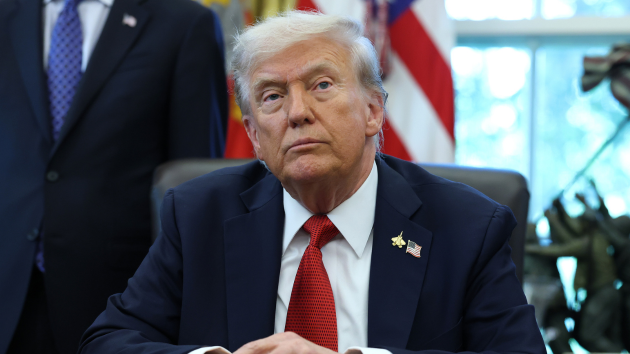
President Donald Trump speaks in the Oval Office at the White House on October 06, 2025 in Washington, DC. Trump and other cabinet secretaries spoke on an executive order that will increase the development and production of Alaska’s natural resources. (Photo by Anna Moneymaker/Getty Images) President Trump Speaks In The Oval Office
(WASHINGTON) — President Donald Trump says he’d consider declaring an “insurrection” inside the United States, accusing Democratic governors and mayors of preventing the federal government from enforcing immigration laws and turning their cities in “war zones.”
“Chicago’s a great city where there’s a lot of crime,” Trump told reporters on Tuesday. “And if the governor can’t do the job, we’ll do the job. It’s all very simple.”
Invoking the Insurrection Act would unfurl extraordinary presidential powers to use military force in American cities in a manner not used since the Civil Rights Movement.
It also would potentially pit troops from a southern Republican-run state against northern Democratic-run cities and states.
Some 200 National Guard troops from Texas were preparing to deploy to Chicago this week, administration officials told a federal judge this week who agreed not to block the deployments for now.
“That escalates the situation quite a bit,” Katherine Kuzminski, director of studies at the Center for a New American Security, said of the deployment of Texas troops to Chicago.
“It creates a tinderbox,” she said.
Under the law, the president can use military troops to protect federal buildings and federal employees. But they can only conduct domestic law enforcement if they remain under control of the state’s governors.
A major exception to those constraints is the Insurrection Act, which Trump said he’d be open to invoking if people were getting killed and if Democrats running states like Illinois and Oregon “were holding us up.”
Signed into law in 1807 by President Thomas Jefferson, that law allows the president to deploy military troops inside the U.S. to act as law enforcement and quell an “insurrection” that threatens a state or its residents.
“If I had to enact it, I do,” Trump said. “If people were being killed, and courts were holding us up, or governors or mayors were holding us up, sure I’d do that.”
In an interview on Newsmax, Trump said he wouldn’t invoke the law if he didn’t have to. At the same time, he told the outlet what is happening is “pure insurrection.”
Illinois Democratic Gov. JB Pritzker has called allegations of civil unrest in his state “complete bs” and pushed back on the arrival of Texan troops as an “unconstitutional invasion of Illinois by the federal government.”
If Trump declares an insurrection in Illinois, it would mark the first time a president has invoked the law without a governor’s consent since Lyndon Johnson did so to protect civil rights activists in 1965 in Alabama.
Since then, the law has been invoked at a governor’s behest, including in 1992 during riots in California following the acquittal of police officers accused of beating motorist Rodney King.
On Monday, both Texas GOP Gov. Greg Abbott and senior Trump aide Stephen Miller echoed Trump’s accusations that Chicago was a “war zone” and blamed Democratic politicians as refusing to enforce federal laws.
“We have local states refusing to enforce the law, and we have chaos,” Abbott said in an interview on Fox News with host Sean Hannity.
Miller, who has led Trump’s push for mass deportations inside the United States, directly accused local officials of trying to undermine the federal government.
“There is an effort to delegitimize the core function of the federal government of enforcing our immigration laws and our sovereignty,” he said in an interview on CNN on Monday.
“It is domestic terrorism. It is insurrection,” Miller added.
Kuzminski with the Center for a New American Security said the president has broad authority to invoke the Insurrection Act. But after Democratic-led states inevitably sue in court, a judge would likely press Trump to provide evidence that an insurrection has occurred.
In the case of Illinois, it’s possible the Trump administration would point to the “rebellion” as coming from Pritzker and other Democratic politicians themselves.
Pritzker said at a news conference on Monday that he believes invoking the Insurrection Act is part of Trump’s plan.
“The Trump administration is following a playbook — cause chaos, create fear and confusion, make it seem like peaceful protesters are a mob by firing gas pellets and tear gas canisters at night,” Pritzker told reporters.
“Why? To create the pretext for invoking the Insurrection Act so that he can send military troops to our city,” he added.
Kuzminski said there’s a reason why a federal government should move cautiously when thinking about unleashing military might in American cities.
“We are proud of the fact that we train the world’s most lethal fighting force,” Kuzminski said. “And that’s why we have such firm boundaries on their use in law enforcement.”
ABC News’ Katherine Faulders and Peter Charalambous contributed to this report.
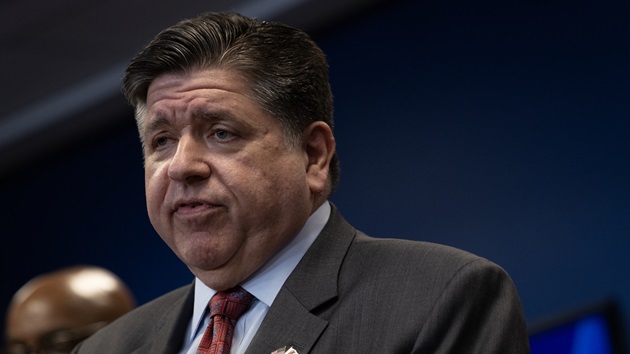
Illinois Gov. JB Pritzker speaks at a news conference October 06, 2025 in Chicago, Illinois. Scott Olson/Getty Images
(CHICAGO) — Members of the Texas National Guard have arrived in Illinois, according to sources familiar with their whereabouts and video taken of them at an Army Reserve training facility in a Chicago suburb.
The Texas National Guard boarded a military plane on Monday afternoon in Texas, as state and city leaders in Illinois were holding a news conference asking them to stay away from Chicago.
Texas Gov. Greg Abbott on Monday shared a photo on social media showing what he called the state’s “elite” National Guard boarding a plane, but he did not say where they were headed.
“Illinois will not let the Trump administration continue on their authoritarian march without resisting,” Illinois Gov. JB Pritzker said. “We will use every lever at our disposal to stop this power grab because military troops should not be used against American communities.”
Pritzker said at a news conference on Monday that over the weekend, he called on Abbott “to immediately withdraw his support of this decision” to send the Texas National Guard members to Chicago.
Earlier Tuesday, Abbott had replied to Pritzker on social media, saying, “I fully authorized the President to call up 400 members of the Texas National Guard to ensure safety for federal officials.”
During a news conference on Tuesday morning, Chicago Mayor Brandon Johnson said he had not received no advance information on the whereabouts of the Texas National Guard troops.
“We have not heard directly, of course, from the president or his administration and my expectation is that, regardless of what this administration is doing, I’m going to remain firm and committed to protecting the rights and the civility of our nation and will start right here in Chicago,” Johnson said.
“We do know that much like what we’ve seen in other parts of the country, there is a process that the National Guard goes through before they’re actually released into the streets of Chicago or anywhere,” Johnson added.
Johnson said that what he does know is that the deployment of National Guard troops in Chicago is “illegal, unconstitutional, it’s dangerous, it’s wrong.”
The state of Illinois and city of Chicago filed a lawsuit on Monday seeking to block the federalization and deployment of the National Guard.
The foundational principle separating the military from domestic affairs is “in peril” as Trump seeks to deploy the National Guard to cities across the country, lawyers for Illinois and Chicago wrote in the lawsuit.
“Let me be clear, Donald Trump is using our service members as political props and as pawns in his illegal effort to militarize our nation’s cities,” Pritzker said during a news conference.
To support his point, Pritzker played a video of an ICE raid conducted last week on an apartment complex in the South Shore neighborhood of Chicago, which he claimed was filmed by federal authorities with high-definition cameras for social media purposes. He said it was the same video that Secretary of the U.S. Department of Homeland Security Kristi Noem posted on social media on Saturday.
“They brought Black Hawk military helicopters and more than 100 agents in full tactical gear,” Pritzker said.
He added, “In the dead of night and seemingly for the cameras, armed federal agents emerged from the Black Hawk helicopters, rappelling onto the roof of that apartment building.”
The governor alleged the Trump administration is following a playbook to “cause chaos, create fear and confusion, make it seem like peaceful protesters are a mob by firing gas pellets and tear gas canisters at them. Why? To create the pretext for invoking the Insurrection Act so that he can send military troops to our city,” Pritzker said.
Speaking to reporters in the Oval Office on Monday afternoon, Trump said he did not yet see the need to use the Insurrection Act, but “if I had to enact it, I’d do it, if people were being killed and courts were holding us up, or governors or mayors were holding us up.”
(NEW YORK) — A week into the government shutdown, air traffic controller sick calls are beginning to cause delays and cancellations as a number of airport towers and control facilities don’t have enough staff to properly handle all flights.
Controllers are considered essential workers and are exempt from being furloughed during a shutdown. An estimated 13,294 controllers will continue to work without pay during the shutdown, according to the Department of Transportation’s shutdown plan.
California’s Burbank Airport was hit hardest Monday and was forced to close its tower from 4:15 p.m. through 10 p.m. PDT because it had no air traffic controllers, according to FAA documents.
The airport remained open but flights were delayed on average more than 2.5 hours. Controllers from a San Diego facility handled traffic into and out of Burbank during the tower closure.
“Clearance is closed. Ground’s closed. Local’s closed. The tower is closed due to staffing. You just contact SoCal on the 1-800 number in the green book for your clearance,” a controller can be heard informing pilots on air traffic control recordings, referring to a published listing of airport information.
Several other ATC facilities also experienced staffing issues on Monday. The Philadelphia TRACON (Terminal Radar Approach Control), Denver Center, Detroit TRACON, Indianapolis Center, Phoenix Airport, and the Phoenix TRACON also had staffing advisories from the Federal Aviation Administration. More than 600 flights Monday were delayed in and out of the Denver Airport and over 200 at Phoenix Airport.
“There have been increased staffing shortages across the system. When that happens, the FAA slows traffic into some airports to ensure safe operations,” the agency said in a statement to ABC News.
The National Air Traffic Controllers Association (NATCA), the union representing controllers nationwide, said it’s working with the FAA to mitigate any disruptions in the national airspace.
“It is normal for a few air traffic controllers to call in sick on any given day, and this is the latest example of how fragile our aviation system is in the midst of a national shortage of these critical safety professionals,” NATCA said in a statement to ABC News.
While ATC staffing is at critical levels across the country, it’s rare for it to have impacts on flights due to staffing shortages in places like Arizona or California, according to FAA documents reviewed by ABC News.
Transportation Secretary Sean Duffy said at a press conference on Monday that sick calls from controllers have been spread out across the region and not from one specific airport or ATC facility, but acknowledged that staffing levels at certain facilities are down as much as 50 percent.
“We don’t have one facility that has had long-term issues with the sick leave. But that is concerning to me. And if someone has to take sick leave, to drive Uber to make the difference, those are decisions they’re going to make themselves. But of course, that’s concerning for us,” Duffy said.
“These are high-skilled, high-performing, safety-driven professionals that I don’t want them driving for work,” Duffy added. “I don’t want them finding a second job to pay the bills. I want them to get paid for the work they’re doing today, keeping our planes in the air and our skies safe.”
Duffy met with controllers handling Newark’s airspace Monday and said they expressed concerns over the added financial stress of the shutdown in an already demanding job.
“The consistent message from these controllers was they’re not just now thinking about the airspace and the jobs they have to do in these towers or TRACON centers across the country. They’re thinking about, ‘am I going to get a paycheck?’” Duffy said. “So now what they think about as they’re controlling our airspace is, ‘how am I going to pay my mortgage? How do I make my car payment? I have a couple kids at home, how do I put food in the table? I’m working six days a week — do I have to take a second job and drive Uber when I’m already exhausted from doing a job that’s already stressful to think about.’”
Air traffic controllers will receive a partial paycheck on October 14 but will not be paid on October 28 if the shutdown continues, according to NATCA. Under the Government Employee Fair Treatment Act of 2019 (GEFTA), controllers will receive back pay after the shutdown ends.
The staffing crisis also led to some heated political exchanges on social media. California Governor Newsom posted on X, saying, “Thanks, @realDonaldTrump! Burbank Airport has ZERO air traffic controllers from 4:15pm to 10pm today because of YOUR government shutdown.”
Transportation Secretary Sean Duffy fired back at Newsom, posting, “News Flash! Your Democrat friends shut down the government because they want to make Americans pay the health care for illegals. And no state has more illegals than California! You care more about illegals than our hard-working American air traffic controllers. If you’re looking for someone to blame, look in the mirror – we all know it’s your favorite thing to do.”
Another aspect of air travel impacted by the shutdown, which is on the verge of running out of funding, is the Essential Air Service (EAS) program. Duffy said the EAS program, which provides airlines with subsidies to fly to rural areas that otherwise wouldn’t have air service because the route wouldn’t be profitable, will run out of funding on Sunday, Oct. 12.
“Air carriers that continue to operate EAS flights beyond October 12, 2025, would do so at their own risk as the Department may not be able to pay the contracted subsidy,” the DOT said in a notice. The notice also says that if carriers continue to operate during the funding lapse, they could be reimbursed on a “pro rata basis,” meaning they might not receive the full amount owed.
The biggest impacts would be felt in Alaska, where air travel is the primary mode of transportation. Alaska Senator Lisa Murkowski posted on X, saying, “The critical assistance these routes provide makes a disruption on any scale detrimental to these communities, and the local air carriers serving them.”
Murkowski said she is working with the administration to find a solution.
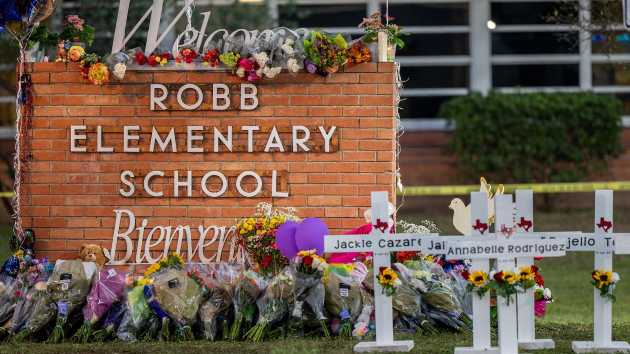
A memorial is seen surrounding the Robb Elementary School sign following the mass shooting at Robb Elementary School on May 26, 2022 in Uvalde, Texas. (Brandon Bell/Getty Images)
(UVALDE, Texas) — One of the two senior police officers charged in connection with the failures on the day of the Uvalde, Texas, elementary school mass shooting will go on trial Jan. 5, the judge overseeing the case told ABC News.
Judge Sid Harle said there has been an agreement to move the case of former school officer Adrian Gonzales from Uvalde to Corpus Christi for trial on 29 counts of abandoning and endangering a child.
A pretrial hearing in the case, scheduled for Oct. 14, has been canceled now that trial arrangements are under way.
Nineteen children and two teachers were killed in the May 2022 rampage at Robb Elementary School. Law enforcement waited some 77 minutes at the scene before breaching a classroom and killing the gunman.
Also charged is former Uvalde school police chief Pete Arredondo, who was the on-site commander on the day of the shooting. Arredondo faces 10 counts of child endangerment and abandonment on behalf of the injured and surviving children in classroom 112.
The judge said Arredondo’s case remains on hold pending the outcome of ongoing litigation between the Uvalde District Attorney’s Office and U.S. Customs and Border Protection, which has refused to allow its personnel to cooperate with the investigation into the shooting, according to the litigation.
Maine Secretary of State Shenna Bellows (Shawn Patrick Ouellette/Portland Press Herald via Getty Images)
(ELLSWORTH, Maine) — The Maine secretary of state’s office is investigating after 250 blank election ballots were found in a resident’s Amazon order last week, saying misconduct has not been ruled out, while maintaining the safety of the state’s election process.
The same day that an unnamed resident reported the bizarre delivery, the town of Ellsworth — 40 miles away — reported 250 missing absentee ballots, according to officials.
During a press conference this week, Maine Secretary of State Shenna Bellows, who is running for governor, said her office has partnered with the FBI, the U.S. Postal Service and other state agencies to lead the probe.
“This year, it seems that there may have been attempts to interrupt the distribution of ballots and ballot materials, but we are stronger and better than anyone who tries to do our elections harm. Time and time again, election officials and law enforcement rise to meet the challenges we face,” Bellows said.
“I have full confidence that law enforcement will determine who is responsible, and any bad actor will be held accountable. We will not stop until we have answers,” Bellows added.
Early in-person voting began in Maine on Monday for the Nov. 4 election, where constituents will decide on a referendum that could tighten restrictions on absentee voting in the state.
Bellows maintained the safety of this election at the press conference.
“Even if the most enterprising criminal were able to fabricate Maine ballots or Maine absentee ballot envelopes or if that chain of custody were broken, our elections would remain free, safe and secure because of the checks and balances in absentee voting itself,” Bellows said at the news conference.
Amazon told ABC News in a statement that the company is cooperating with relevant investigators on the situation.
“We’re cooperating with the law enforcement agencies investigating this incident. Based on our initial findings, it appears that this package was tampered with outside of our fulfillment and delivery network, and not by an Amazon employee or partner,” an Amazon spokesperson said.
Amazon’s initial findings match the description shared by the woman who received the blank ballots originally. She told officials that the package appeared to have been previously opened and retaped before she received it and handed it over to the Newburgh town office.
Bellows and Maine’s elections previously garnered national attention when she called for the removal of now-President Donald Trump from the state’s presidential primary ballot in 2024, which was later overturned by the U.S. Supreme Court.
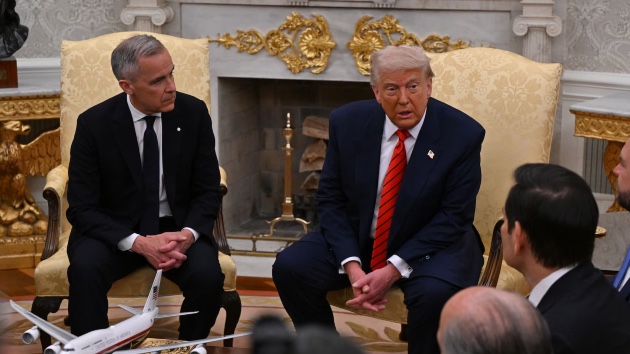
U.S. President Donald Trump participates in a bilateral meeting with Prime Minister of Canada Mark Carney at The White House on May 6, 2025 in Washington, D.C. (Photo by Ricky Carioti/The Washington Post via Getty Images)
(WASHINGTON) — President Donald Trump on Tuesday signaled optimism about a potential U.S.-Canada trade deal, saying the two sides had “come a long way” in negotiations.
Speaking in the Oval Office alongside Canadian Prime Minister Mark Carney, Trump appeared to dial back trade tensions, striking a friendly tone toward one of the largest U.S. trading partners.
“I love Canada and the people of Canada, and Mark feels the same way,” Trump said.
Trump acknowledged that competition between U.S. and Canadian firms would make any potential accord a “complicated agreement.”
“It’s a natural business conflict,” Trump added. “There’s nothing wrong with it.”
In July, Trump issued a 35% tariff on most goods and raw materials from Canada.
Canada originally issued retaliatory tariffs. However, in August, Carney announced exemptions for goods covered under the United States-Mexico-Canada trade pact.
During their last meeting in May, Carney pushed back against Trump’s controversial proposal to make Canada the 51st state.
“As you know from real estate, there are some places that are not for sale. And Canada is not for sale, it will never be for sale,” Carney told Trump.
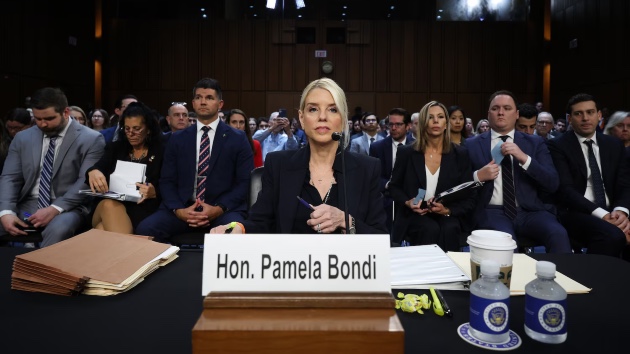
Attorney General Pam Bondi arrives to testify before the Senate Judiciary Committee on Capitol Hill, October 7, 2025 in Washington. (Win McNamee/Getty Images)
(WASHINGTON) — President Donald Trump’s tightening grip over the Justice Department to target his political opponents and lawmakers’ increasing calls for the release of more files from federal investigations into deceased sex offender Jeffrey Epstein took center stage at a contentious Senate hearing Tuesday for Attorney General Pam Bondi.
The hearing before the Senate Judiciary Committee is the first time since July that Bondi has faced questions from lawmakers and follows a tumultuous summer for the department that included deployments of federal law enforcement to Democratic-run cities, a growing number of investigations announced into Trump’s political foes and the controversial indictment of former FBI Director James Comey.
Democratic, Republican leaders differ on hearing focus
Senate Judiciary Chairman Chuck Grassley kicked off the hearing with extensive remarks seeking to highlight instances of what Republicans have labeled “weaponization” of the Justice Department under the Biden Administration, citing selective disclosures by FBI Director Kash Patel of the investigation into President Trump’s attempt to overturn his 2020 election loss.
“These are indefensible acts,” Grassley said. “This was a political phishing expedition to get Trump at all costs.”
Specifically, Grassley singled out a timely disclosure by the FBI on Monday that showed former Special Counsel Jack Smith’s investigators at one point sought limited phone toll records of several Republican senators around the time of the Jan. 6 attack on the U.S. Capitol.
As part of his investigation, Smith extensively investigated Trump and his allies’ pressure campaign on lawmakers to block the certification of former President Joe Biden’s election win — including calls that were made to senators after the Capitol was breached by the pro-Trump mob.
There’s no indication that Republican senators were a target of Smith’s investigation, and the toll records sought by investigators would not include any information about the content of conversations they may have had.
“We’re pointing this all out because we can’t have this repeated in the United States,” Grassley said. “We want to end it right now, whether we have Republican or Democrat administrations.”
Grassley made no mention of recent directives from Trump to have the Justice Department act “now” to carry out prosecutions of his political foes, or other instances of alleged politicization during Bondi’s tenure that have led to scores of departures of longtime career officials who have sounded alarm about the department being used as a tool to enact political retribution.
Ranking Democratic member Dick Durbin said in his opening statement assailed the Trump administration for the conduct in Chicago, a city in which Durbin represents.
“As President Trump turns the full force of the federal government on Chicago and other American cities, the assault on the city I am proud to represent is just one example of how President Trump and Attorney General Bondi shut down justice at the Department of Justice, even before the president’s party controlling the white House, Senate and House of Representatives shut down the government,” Durbin said.
“The attorney general has systematically weaponized our nation’s leading law enforcement agency to protect President Trump and his allies and attack his opponents. And sadly, the American people. You have purged hundreds of senior career officials since you first appeared before us,” he added.
Durbin listed off the greatest hits for critics of Bondi’s Justice Department, the closed investigation into Border Czar Tom Homan, the Eric Adams case being dropped, the hiring of a Jan. 6 defendant who attacked MPD officers, the handling of the Jeffrey Epstein files, and the case against James Comey.
“What has taken place since Jan. 20, 2025, would make even President Nixon recoil. This is your legacy,” Durbin said.
Senators grill Bondi on closed Homan investigation
Sen. Mazie Hirono, D-Hawaii, also pressed Bondi on Tuesday over whether Bondi personally approved closing the investigation into Trump’s border czar Tom Homan.
“Miss Bondi, did you approve closing the Homan investigation? Bribery investigation?” Hirono said.
“Senator Hirono, as I stated earlier, the Department of Justice and the FBI conducted a thorough review, and they found no credible evidence of any wrongdoing,” Bondi responded.
Hirono then pressed Bondi over the department’s removal of dozens of prosecutors who worked on investigations involving President Trump and the Jan. 6 attack on the Capitol.
Bondi shot back, “I’m not going to discuss personnel matters with you.”
Hirono concluded her questioning by accusing Bondi of deliberately politicizing the department, turning it from the Department of Justice into the “Department of revenge and corruption.”
In another heated exchanges at the hearing, Bondi reacted with outrage as she accused Sen. Peter Welch, D-Vt., of suggesting she was lying as she evaded questions about the investigation into Homan.
“First of all, is there a tape that has audio and video of the transfer the $50,000?” Welch asked.
“You would have to talk to Director Patel about that,” Bondi replied.
“No, I’m talking to you,” Welch said.
“I don’t know the answer –” Bondi said before Welch interjected, “You do know the answer.”
“Don’t call me a liar!” Bondi shot back. “I didn’t call you a liar,” Welch responded.
Bondi pushes back against Democrats
Bondi pushed back against her critics and Democrats during the hearing. In her opening statement, she framed her tenure as the “end” of weaponization of law enforcement, while reinforcing her extensive efforts to enact President Trump’s agenda.
“We will work to earn that back every single day. We are returning to our core mission of fighting real crime. While there is more work to do, I believe in eight short months we have made tremendous progress towards those ends,” she said.
She also railed against judges who have ruled against the administration in the months since Trump took office, while highlighting the Justice Department’s string of victories at the Supreme Court.
“My attorneys have done incredible work advancing President Trump’s agenda and protecting the Executive Branch from judicial overreach,” she said.
Bondi continued to hit back at Durbin, who questioned her about the federal deployment to Illinois.
The attorney general taunted the senator about Chicago’s crime rate. Bondi said that Patel and Deputy Attorney General Todd Blanche were on their way to the city.
“Chairman, as you shut down the government, you voted to shut down the government and you’re sitting here as law enforcement officers aren’t being paid. They’re out there working to protect you. I wish you love Chicago as much as you hate President Trump,” she said.
Durbin was taken aback by Bondi’s responses.
“Madam attorney general, it’s my job to grill you. Investigation of your agency is part of my responsibility. And this – this committee, you mean. I’d like the experience, but others have weathered the storm and answered questions in a respectful manner,” he said.
Bondi in the hot seat over Epstein files
Bondi faced heavy scrutiny over conflicting statements out of the administration on the Epstein files, after the Justice Department and FBI said in a July letter that no further releases were warranted and that there was no evidence suggesting others participated or enabled Epstein’s abuse of minor girls.
Democrats have accused the administration of seeking to cover up any mentions of Trump or high-profile appointees who had past associations with Epstein, which the administration has denied.
Trump and Epstein, who died by suicide in 2019 while awaiting trial on charges of trafficking young girls and women, were friends in the 1990s but the president said the relationship soured after Epstein poached some employees from Trump’s Florida club after he explicitly warned him not to do so.
When asked on Fox News about the alleged Epstein client list, the attorney general told Fox News in February, “It’s sitting on my desk right now to review.”
She refused to elaborate about those past comments or the growing calls for the Epstein files while testifying.
Bondi responded to individual Democrats who sought more details by surfacing donations they allegedly may have received from Reid Hoffman — an entrepreneur and founder of LinkedIn who is known to have past associations with Epstein.
She again surfaced Hoffman’s alleged donations in an exchange with Sen. Sheldon Whitehouse, in which she again refused to answer his direct questions about the Epstein files.
Political targeting questioned
Trump has recently ordered the department to ramp up investigations into so-called “radical left” organizations that he and other senior White House officials have alleged, without providing evidence, as helping to fund perpetrators who have attacked federal law enforcement officials dispatched around the country.
Just days after Trump’s comments, a senior official in the Justice Department ordered several U.S. Attorney’s offices around the country to prepare to open sweeping criminal investigations in to the Open Society Foundations founded by billionaire George Soros, naming criminal statutes ranging from robbery, material support for terrorism and racketeering, ABC News previously confirmed.
In a statement, the Open Society Foundations called the accusations “politically motivated attacks on civil society, meant to silence speech the administration disagrees with and undermine the First Amendment right to free speech.”
Bondi sought to brush off pointed questions from Democrats by repeatedly deflecting to crimes committed by undocumented immigrants in their states and districts that were among the briefing materials she brought with her to the hearings.
She has also dismissed any characterization of the Justice Department appearing to work in lockstep with the White House as “politicization” of law enforcement. Bondi and other senior DOJ officials have instead argued that the two federal cases brought against Trump by a special counsel under the Biden Administration represented a far more egregious example of weaponization, echoing grievances leveled at the department by Trump.
DOJ under scrutiny amid growing controversies
As ABC News first reported, the move to seek Comey’s indictment came over the objections of career prosecutors and followed Trump’s removal of his appointee to lead the U.S. Attorney’s Office for the Eastern District of Virginia, Erik Siebert, who expressed reservations about pursuing charges against Comey and New York Attorney General Letitia James, sources told ABC News.
Trump eventually installed a White House aide and former personal attorney Lindsey Halligan to lead the office and move forward with the case against Comey, and a grand jury narrowly voted to indict him on two counts of making false statements to Congress and obstructing a congressional investigation — while declining to indict on a third false statements charge. Comey has denied wrongdoing and is set to appear Thursday in federal court for his arraignment.
While sources told ABC News that leadership at the DOJ expressed reservations about pursuing the case, Bondi and FBI Director Kash Patel went on to publicly cheer news of Comey’s indictment in news interviews and social media posts.
The next week, the administration moved to fire a top national security prosecutor in the office, Michael Ben’Ary, over a misleading social media post that falsely suggested he was among the prosecutors who resisted charging Comey.
Ben’Ary was leading a major case against one of the alleged plotters of the Abbey Gate bombing during the U.S. withdrawal from Afghanistan. In a scathing departure letter, Ben’Ary set his sights squarely on the Justice Department’s leadership and labeled his removal as just one in a series of recent moves taken to root out career officials for political reasons at the expense of the nation’s security.
“This example highlights the most troubling aspect of the current operations of the Department of Justice: the leadership is more concerned with punishing the President’s perceived enemies than they are with protecting our national security,” Ben’Ary wrote. “Justice for Americans killed and injured by our enemies should not be contingent on what someone in the Department of Justice sees in their social media feed that day.”
The DOJ declined to comment when asked about Ben’Ary’s letter.
Sen. Richard Blumenthal pressed Bondi repeatedly on Tuesday over instances of pressure on the department by Trump and what conversations she may have had with him in the days leading up to the indictment of Comey.
“I’d like to know from you what conversations you had with President Trump about the indictment of James Comey,” Blumenthal said.
“Senator, I am not going to discuss any conversations I have or have not had with the President of the United States. You’re an attorney, you have a law degree, and you know that I’m not going to do that,” Bondi said on Tuesday.
Those actions have caused unprecedented turmoil at the Eastern District, which oversees some of the nation’s most sensitive national security, terrorism and espionage investigations.
Current and former officials say that turmoil has reverberated further across the Justice Department’s workforce around the country, with attorneys concerned they’ll face professional repercussions if they resist taking part in politicized investigations or prosecutions.
On Monday, nearly 300 DOJ employees who left the department since Trump’s inauguration released a letter on the eve of Bondi’s hearing describing her leadership as “appalling” in its treatment of the career workforce and the elimination of longstanding norms of independence from the White House.
“We call on Congress to exercise its oversight responsibilities far more vigorously,” the former employees said. “Members in both chambers and on both sides of the aisle must provide a meaningful check on the abuses we’re witnessing. And we call on all Americans — whose safety, prosperity, and rights depend on a strong DOJ — to speak out against its destruction.”