Sarah Ferguson speaks out on Duchess Meghan and why she would marry Prince Andrew ‘all over again’

Maggie Rulli and Taylor Behrendt-Rhodes, ABC News

(LONDON) — Sarah Ferguson, the Duchess of York, has spent most of her adult life in the public spotlight, first as the wife of Prince Andrew and then as a favorite target of the British tabloid media.

Several decades later, another new royal bride, Meghan, the Duchess of Sussex, became the target of the tabloid media when she wed Ferguson’s nephew, Prince Harry, in 2018.

“I believe that everybody has a right to their own voice and there should be no judgment on race, creed, color or any other denomination,” Ferguson told Good Morning America about the press’ treatment of Meghan, who joined Harry in stepping down from their senior royal roles last year and moving to California.

“I personally would never be able to judge another, so I just am not like that,” she said. “I wish Harry and Meghan so much happiness and I know that [the late Princess] Diana would be so proud of her sons and their wives.”

Ferguson — whose latest chapter in life is as author of a new novel, Her Heart for a Compass — was a close friend of Princess Diana’s, her sister-in-law in Britain’s royal family. Though the two were pitted against each other in the British press, she calls Diana her best friend.

Diana, the mother of Princes William and Harry, died in 1997 after a car crash in Paris, but Ferguson said she keeps her friend’s memory alive to this day.

“She’s in my heart,” Ferguson said of the late princess, whom she calls her “laughing friend.”

“I always say it doesn’t matter whether you get the love back or you don’t get love back or she’s here or she’s not here, you can love anyway and keep the kindness,” she said

“I loved Diana and I will always love her even if she isn’t here in person. It’s a really lovely thing to have,” she said.

Ferguson, now 61 and a grandmother of one with another on the way, said she also imagines what life would be like now with Diana, whose two sons have five children between them.

“If she was here, we’d be racing to the bouncy castle with our grandchildren,” said Ferguson. “The funny thing is we’d be with our grandchildren running in the egg and spoon race. She was always a better, faster runner than me.”

Finding her voice through writing

Ferguson drew on her own journey in the spotlight to write her first novel, which is set in the Victorian era and is based on her distant relative, Lady Margaret.

“Lady Margaret is an extremely wonderful, strong, very resilient redhead who fights for her heart … against extraordinary confines of what is seen as noble and duty,” she said. “I think I couldn’t write that and I couldn’t explain it if I hadn’t had a hint of fighting my own journey through my own compass of my own heart.”

“She didn’t have a voice,” Ferguson added. “So it’s about literacy, empowerment, empowerment of a woman’s voice that has been shut away.”

Ferguson said she is just now learning in her own life to speak up and not be a self-described “people pleaser,” saying, “I don’t believe I’ve really spoken out until now, properly.”

In the novel, Margaret is portrayed as having a complicated but honest relationship with her mother, a relationship Ferguson said she never got to have with her own mom.

“When she left me, I was so young,” said Ferguson. “And then my sister went to Australia, so I became the head of the house around 13, 14 years old, and I think that that’s possibly why I still have the rebel in me.”

Ferguson spoke with GMA while doing one of her favorite activities, horseback riding, which she said she relied on as a child for stability in her life.

“My ponies really helped me so much when my mother went to live in Argentina because they were my friends,” she said, describing them as “consistent” and “steadfast.” “They don’t go anywhere and they didn’t answer back. They are just so special.”

Taking life ‘one step at a time’

Though she had a complicated time as a member of Britain’s royal family, Ferguson remains an ardent supporter of the monarchy.

“I am a number one fan of the monarchy,” she said. “And I stand very strongly for the extraordinary steadfastness of the queen.”

She also speaks fondly of Prince Andrew, whom she married in 1986 and divorced a decade later, though the two remain very close.

“He is a great man and [our wedding day] was the best day of my life,” she said. “I would do it all over again because he was a very good-looking sailor, but I fell in love with him and I think love conquers all.”

Andrew, who shares two daughters with Ferguson, Princesses Beatrice and Eugenie, has faced intense scrutiny over his relationship with convicted sex offender Jeffrey Epstein, who died in prison in 2019.

Andrew, the third child of Queen Elizabeth, spoke out in a 2019 BBC interview and categorically denied allegations he had sex on multiple occasions with an American teenager who’s claimed she was trafficked to the prince at the direction of Epstein. Shortly after the interview, Andrew announced that he would step back from public duties, “for the foreseeable future” amid heavy criticism.

When asked how she has found resilience in the face of personal drama and tabloid scandal, Ferguson said she has learned to “take one step at a time.”

“You just look at it. What do I need to learn from this? How do I feel? [You] apologize profusely to yourself, to others, mostly to yourself for letting yourself down, perhaps, and you move forward and you get on and you take one step at a time,” she said. “I have destroyed myself many times, but the most important thing is to get up and get going.”

Ferguson also gives credit to the American public for helping her regain her footing after she and Andrew divorced. She credits Americans with welcoming her and supporting her through different ventures, including working with WW, formerly Weight Watchers.

“That’s why I want to say thanks to the American people, because they have given me a life,” she said. “And they’ve given me a chance to be able to have a platform to talk and to be able to say, ‘Be yourself.'”

Speaking of her ability to continually evolve both personally and professionally, Ferguson added, “I’m 61. I’m just starting my life. “

Copyright © 2021, ABC Audio. All rights reserved.

Front-line workers in Florida say current COVID-19 surge ‘feels like it’s an impending storm’

tuachanwatthana/iStock

(TAMPA, Fla.) — A jarring reality check is taking place in intensive care units across the country as thousands of COVID-19 positive patients, nearly all of them unvaccinated, are streaming into hospitals in need of care.

This is particularly true in Florida, where virus-related hospitalizations have skyrocketed in recent weeks. The situation has escalated rapidly, now nearing peak levels, with nearly 7,900 patients hospitalized with the virus across the state, up by more than 320% in the last month, according to data from the Centers for Disease Control and Prevention.

“It feels like it’s an impending storm … there’s no off ramp to this getting worse,” Dr. David Wein, an emergency room physician at Tampa General Hospital in Florida, told ABC News on Wednesday.

On Tuesday this week, more than 1,450 patients with COVID-19 were admitted to hospitals across the state, marking the highest number of patients seeking care within a 24-hour period in Florida since the onset of the pandemic.

“Right now, at Tampa General Hospital, we are really feeling the crush of this increase incidence of COVID-19, and so the delta area has really brought many patients to our emergency room, requiring treatment and admission,” Peggy Dugan, the executive vice president and chief medical officer at the hospital, told ABC News in an exclusive interview.

It was just six weeks ago that some of the team thought they may be out of the woods, with metrics steadily trending down across the country.

“It felt like we were ready to move in the right direction and start seeing it plateau. And it was a surprise to see it trend up like it did,” said Erika Mergl, nurse manager for the Tampa General Hospital’s Global Emerging Diseases Institute.

However, virus-related hospitalization levels are now nearing peak levels.

“We’re getting to numbers that were as high as last summer. In early July, we were down to 12 COVID-19 patients in the hospital, and today we have 80. So we’re really just seeing an escalation over a short span of time,” Duggan said.

The situation in Tampa is not an anomaly. Nearly every state in the country is now experiencing case, and COVID-19 hospitalization increases. Virus-related hospitalizations levels are now at their highest point since April, with nearly 33,700 patients receiving care — about 10,000 more patients than a week ago.

Many of the patients at Tampa General are younger, Dugan said, some as young as 22 or 23 years old, and “almost” all of them have been unvaccinated, the hospital said.

One of the hospital’s unvaccinated patients is 64-year-old patient Gerard Considine, who spent nine days intubated after he tested positive for the virus.

“I’m not used to being scared of anything, but this scared the hell out of me,” Considine told ABC News.

Considine said he didn’t get the COVID-19 vaccine because he had experienced adverse reactions to other vaccines, but despite his ordeal, he does not think he will choose to be vaccinated, believing that he has developed some antibodies, at this point.

However, said Duggan, “we’re seeing people who are recovering now very regretful that they didn’t get the vaccination in the first place.”

Many of the patients coming to the hospital are already quite ill when they arrive, said Wein.

“Unfortunately, we’re seeing people who are coming in days, or several days, into their disease and sicker, with difficulty breathing, needing to be admitted to the hospital. So it feels more like that winter surge that we had,” Wein said, adding that a number of these patients end up on ventilators.

“This is heartbreaking because all this could have been avoided, this is unnecessary human suffering that we are witnessing right now,” Dr. Seetha Lakshmi, the medical director of the Global Emerging Diseases Institute at Tampa General Hospital, told ABC News.

Several front-line workers at Tampa General Hospital expressed to ABC News their deep concern and fear about the next several weeks for their teams, given the state’s and the hospital’s exponential increase in infections and virus-related hospitalizations, stressing that their message to Americans is that vaccinations are key to controlling the pandemic and ending the suffering.

The difference in getting vaccinated, or not getting vaccinated is ultimately akin to “the difference between having a cold and dying,” said Wein. “If a vaccinated patient gets this, they’re most likely going to be just fine, and not going to end up in the hospital. Unfortunately, the unvaccinated person has a really high likelihood that he will end up hospitalized on a ventilator.”

Copyright © 2021, ABC Audio. All rights reserved.

New evidence has doctors worried about long-term damage from COVID ‘brain fog’

xavierarnau/iStock

(NEW YORK) — A flurry of new scientific findings is prompting renewed concern among doctors about the long-term cognitive impacts of COVID-19 in some patients.

Several new studies presented at the Alzheimer’s Association International Conference, being held this week in Denver, have found that many COVID-19 patients experience “brain fog” and other cognitive impairments months after recovery. This adds to a growing body of research on COVID-19’s apparent long-haul symptoms, which can include confusion, forgetfulness and other worrying signs of memory loss.

“This research features the first data from an international consortium, which includes the Alzheimer’s Association, investigating the long-term consequences of COVID-19 on the brain,” Heather Snyder, the vice president of medical and scientific relations for the Alzheimer’s Association said in prepared remarks.

Not enough time has passed for researchers to know if these worrying symptoms eventually clear up. However, they’re pointing to these studies as renewed evidence that everyone — especially older people who are already vulnerable to cognitive decline — should get vaccinated.

“While we work together to further understand the lasting impacts of COVID-19 on the brain, the take home message is simple: don’t get COVID-19. And the best way to do that is by getting vaccinated,” Maria Carrillo, chief science officer for the Alzheimer’s Association, said in prepared remarks.

Researchers at the University of Texas Health Science Center studied the cognition and olfactory senses of 300 older adult Amerindians from Argentina who contracted COVID and found that 50% had persistent problems with forgetfulness and 25% had additional problems with language and executive dysfunction.

“A large portion of our patients in the COVID Recovery Program exhibit cognitive signs and symptoms long after the inflammatory phase of COVID has passed. We typically see many patients with naso-pharyngeal predominant illness come back to us with more neurocognitive deficits,” Dr. Thomas Gut, director of the Post-COVID Recovery Center at Staten Island University Hospital, told ABC News. Gut was not involved in any of the studies presented at the conference.

Researchers at the New York University Grossman School of Medicine studied blood samples of 310 patients admitted to NYU Langone Health with COVID for the presence of biomarkers that would indicate brain inflammation and damage. High levels of certain biomarkers were strongly associated with inflammation in the brain. Damage to the blood-brain barrier caused by inflammation can result in the brain’s inability to send messages from the brain to other parts of the body.

“So far, our efforts offering supportive therapies have shown improvement, but the recovery time is still measured in months. Finding a cause and mechanism for these inflammatory changes in the brain would be the first place to start in addressing how to reverse or prevent these inflammatory changes,” said Gut.

Researchers from the University of Thessaly reviewed the cognitive function and overall health of 32 patients with mild to moderate COVID infection two months post-hospitalization and found that more than 50% experienced cognitive decline, particularly with short-term memory. They also found that poorer memory and thinking scores were associated with lower level of oxygen saturation during a short walk test.

“Many of the cognitive changes that we see mirror in many ways Alzheimer’s disease or PTSD,” said Gut. “What is becoming clearer, is that the severity of acute infection does not directly predict neurocognitive changes after the acute phase has passed. We have many patients that had mild infection or illness struggle severely with memory or behavior changes.”

Copyright © 2021, ABC Audio. All rights reserved.

States with surging COVID-19 rates also tend to have higher rates of uninsured

Lubo Ivanko/iStock

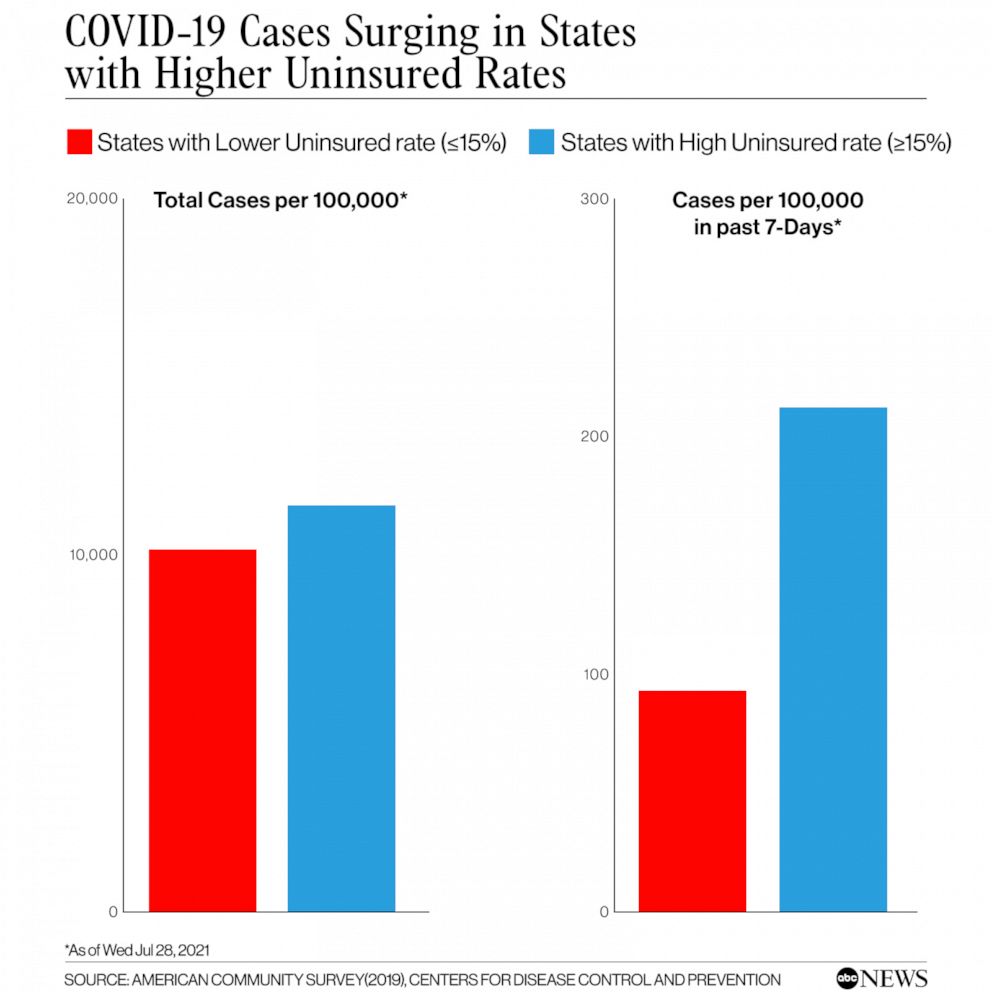
(NEW YORK) — As COVID-19 cases surge across much of the United States and many vaccinated people return to indoor masking, a pattern appears to be emerging — the same states that are seeing the biggest increases in COVID-19 infections also have high rates of residents who don’t have health insurance.

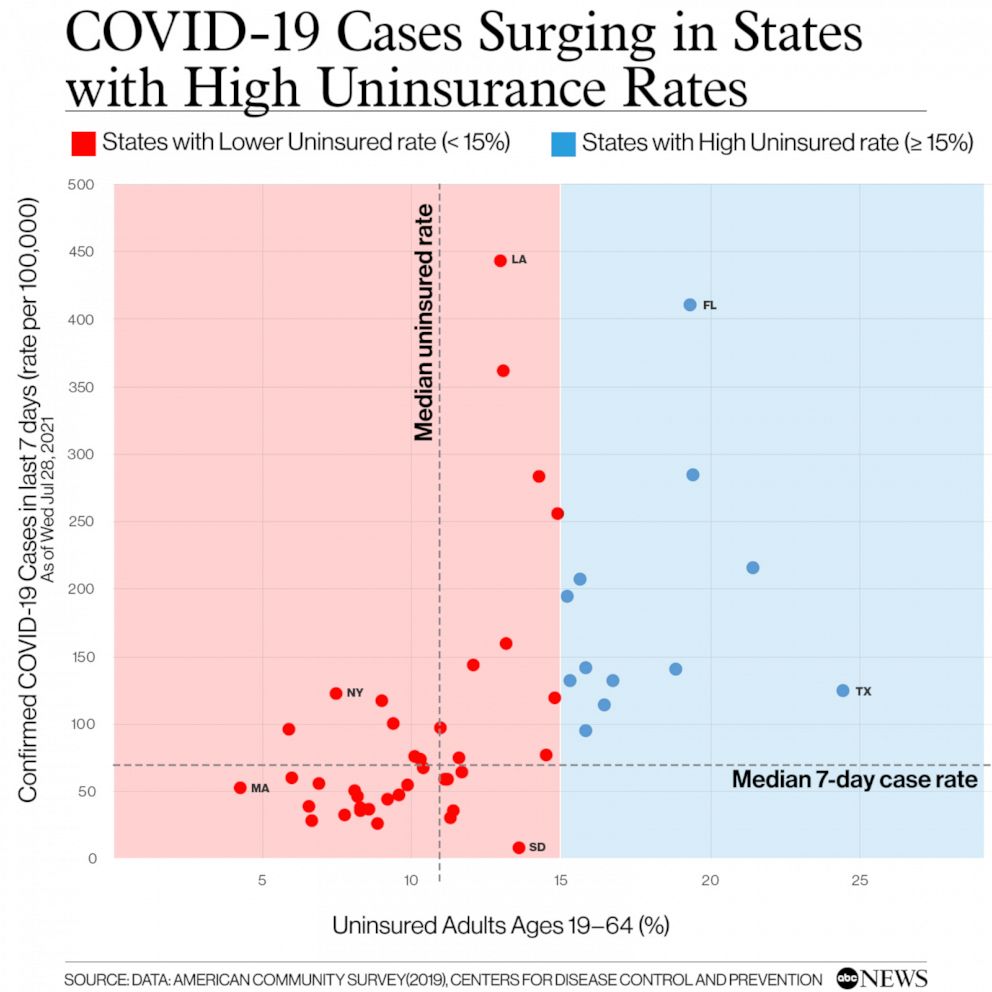
While COVID-19 data changes daily, as of Wednesday, the 12 states with the highest seven-day new case rates also had higher than average uninsured rates, according to data from the American Community Survey and the Centers for Disease Control and Prevention.

“​​It lines up with everything we’ve seen during the pandemic,” said John Brownstein, Ph.D., the chief innovation officer at Boston Children’s Hospital and an ABC News contributor. “Uninsured communities have less access to testing, less access to vaccines and less access to care. So of course, you’re going to have increased overall risk among those populations,” he added.

“It’s playing out as we would have anticipated in a pandemic.”

COVID-19 Cases Surging in States with Higher Uninsured Rates

Florida, where Gov. Ron DeSantis has mocked the use of masks and issued an executive order to block government entities from requiring COVID-19 vaccines, has emerged as a cautionary tale. Along with Louisiana, Florida now has the country’s highest COVID-19 case rate, with more than 400 new cases per 100,000 residents as of Wednesday, according to CDC data.

“Florida is in the worst spot right now,” said David Radley, a senior scientist for The Commonwealth Fund, a New York City-based foundation that promotes better access to quality health care. “It has the highest emerging case rate and it has a high level of uninsured.”

Florida might hold the dubious distinction of having among the highest new COVID-19 case rates coupled with a 19% uninsurance rate, but a number of other states are struggling with increasing COVID burdens and a health system that’s not set up to easily handle — or pay for them.

Any state in the upper right quadrant of the graph is “in a tough spot,” Radley said.

Importantly, a correlation between high uninsurance rates and an increasing COVID-19 burden does not mean below-average insurance coverage is driving infections. Instead, a complex constellation of overlapping factors, including politics, might be at play.

“When we think about the policy choices states have made, which would leave a state in a place to have high uninsured rate — things like not expanding Medicare and Medicaid programs and having more restrictive Medicaid programs in the first place — are political choices that tend to align on the right side of the political spectrum,” Radley said.

“I think there are a lot of undercurrents that are driving high uninsured rates and the high case rate,” Radley added.

The reality of being uninsured during a pandemic

Having a high rate of uninsured residents is bad enough during normal times, experts say, but it’s especially harrowing during a pandemic.

Hospitals providing intense levels of COVID-19 care to uninsured patients won’t be reimbursed at the same rate that they would be for patients with insurance. Assuming they survive, those uninsured patients will likely face medical bills for their hospital stays, whether they can afford them or not, Radley explained.

There’s also a circular phenomenon in which people without insurance, or who are underinsured, may be less likely to seek timely care or get tested in the first place.

“I can see a scenario where it would create a spiral,” Radley said.

Compounding that delayed care is the fact that people who don’t have health insurance are more likely to be in high-risk groups, Brownstein explained. He pointed to a preprint study he worked on, which has not yet been published in a peer-reviewed journal, which found that “vaccine deserts have more residents with self-reported COVID-19 exposures and pre-existing conditions as well as more individuals who lack health insurance.”

“If you have increased risk in those populations, it’s not just about increased cases, it’s increased hospitalizations and deaths,” Brownstein said.

The most current data available on insurance rates from the American Community Survey data is from 2019, meaning it doesn’t include the pandemic. But while experts feared that job loss during the pandemic would lead to higher uninsurance rates, Radley said that based on informal surveys, it doesn’t appear that those fears have come to pass. He expects 2020 rates to reinforce similar patterns to the 2019 rates.

“I would bet you that these are vast underestimates, because those that are uninsured are unlikely to get testing — either have access or be able to get testing covered,” Brownstein said. “The patterns that you’re witnessing might be even stronger if testing was equitable.”

“If we’re not taking care of fundamental issues of access to care at the most basic levels, and then you have worse outcomes among those patients because they didn’t have that care or access to testing, and they end up in hospitals,” Brownstein said. The end result: overflowing hospitals, which impact patients of all socioeconomic groups.

“Everyone suffers when you don’t do the right thing in terms of equitable access to care.”

Copyright © 2021, ABC Audio. All rights reserved.

Why some states are pushing back on masks amid delta variant surge

martin-dm/iStock

(NEW YORK) — It’s a simple device that can save lives and keep people out of emergency rooms.

But masks are once again a flashpoint after the Centers for Disease Control and Prevention (CDC) recommended this week that everyone in areas with substantial or high levels of transmission, regardless of their vaccination status, return to wearing a mask in public, indoor settings and in schools, amid a concerning rise in the delta variant.

Despite a rise in cases and hospitalizations, several states are pushing back against the CDC’s new guidelines — which have changed dramatically over the past few weeks. Some governors have balked at what they’ve criticized as a whiplash reversion to overly draconian measures, vowing no mask mandate would succeed in their state.

The CDC’s reversal comes just two months after it announced it would no longer recommend masking for vaccinated Americans, and just as the nation was breathing a collective sigh of relief at the precipitous fall of cases and hospitalizations due to the rollout of mass vaccinations.

Here are some of the states battling back against the changing guidance, and why.

No ‘one size fits all’

“The time for government mask mandates is over,” Texas Gov. Greg Abbott tweeted after the CDC’s announcement on Tuesday, adding that “now is the time for personal responsibility.”

Texas’ COVID-19 cases and hospitalizations have seen a dramatic rise, with daily case averages roughly doubling in recent weeks. COVID-19 deaths in the state are also ticking up.

On Thursday, Abbott criticized President Joe Biden for the length of time it’s taking the Food and Drug Administration to upgrade the vaccines to a permanent authorization from their current emergency authorization — a concern often cited by those who are hesitant to get the shot.

For states like Texas and Iowa that have either passed laws or issued executive orders banning mask mandates, the latest CDC guidance is “counterproductive to vaccination efforts,” said Iowa Gov. Kim Reynolds.

Reynolds called the CDC’s recommendation “not grounded in reality or common sense,” and praised herself for leading one of several states that have passed laws restricting mask mandates

“I’m concerned that this new guidance will be used as a vehicle to mandate masks in states and schools across the country, something I do not support,” Reynolds tweeted.

In Arizona, another state where mask mandates are banned by law, Gov. Doug Ducey used the CDC’s recommendations to criticize Biden, saying that the new mask guidance is an example of the Biden administration’s “inability to effectively control the COVID-19 pandemic.”

Alabama officials also said they would not be following the CDC’s updated guidance. A spokesperson for Gov. Kay Ivey said the current circumstances do not warrant a “blanket one-size-fits-all” approach.

“The state of emergency has ended, and Alabama is moving forward,” the spokesperson told ABC News.

‘The vaccine works’

Following the CDC’s announcement this week, Biden said the decision was not a relapse but “another step on our journey to defeating the virus.”

“Unlike 2020, we have both the scientific knowledge and the tools to prevent the spread of this disease,” Biden said. “We are not going back to that.”

But some states’ leaders are pointing to the vaccines’ efficacy as a reason not to re-enforce masking.

“The vaccine works,” said Gov. Henry McMaster of South Carolina, where a state law prohibits school administrators from requiring students to wear a mask.

Health officials stress that while the vaccines are indeed safe and effective, many states still have a substantial number of residents who are unvaccinated — and with the exponential spread of the highly transmissible delta variant, a mask is meant to protect both wearer and bystander.

In Maryland, a health department spokesperson told ABC News that the state isn’t affected by the new CDC guidance because it’s not among the areas showing “high or substantial community transmission.” The spokesperson said that Maryland is one of the most vaccinated states in the country, and that “blunts the impact of the delta variant.”

For health experts like University of Washington professor of global health Ali Mokdad, who believes the CDC was late in reversing its guidance, the political debate over masks is “hurting our ability to contain COVID-19.”

“I do not understand how masks and vaccines could be a political statement,” Mokdad said. “Look at the new admissions in Florida for COVID-19 confirmed patients — if this will not make governors pause and take this virus seriously, what will?”

Some states, like California, New Mexico and New Jersey, have welcomed the latest mask guidance.

“It’s clear that the nation is at a critical moment in this COVID crisis,” said Illinois Gov. J.B. Pritzker, lauding the CDC for “a hard look at where we are.”

“Illinois will follow this guidance, as we always have,” he said.

Left vs. right

Like other coronavirus issues, the updated mask guidance has divided parts of the country along largely political lines — even within states.

The attorney general of Missouri, where coronavirus cases and hospitalizations continue to rage, has announced that the state government is suing St. Louis city and county for bringing back mask mandates. But that didn’t stop Kansas City, on the other side of the state, from announcing Wednesday that it was also reinstating an indoor mask mandate.

Missouri Gov. Mike Parson, a Republican, called the new CDC guidance “disappointing” and “concerning” Wednesday, adding that “it only serves to disrupt” the state’s slow uptick in vaccination.

In Atlanta, Mayor Keisha Lance Bottoms, a Democrat, on Wednesday issued an executive order requiring masks in public indoor spaces — despite Gov. Brian Kemp’s longstanding opposition to any mask mandate.

“We don’t need mandates,” Kemp, a Republican, told ABC affiliate WSB-TV this week. “We need to continue to share the data and the facts.”

Georgia’s cases and hospitalizations are both at more than 10% and rising.

In Florida, a spokesperson for Gov. Ron DeSantis, a Republican, told ABC News that imposing mask mandates would discourage people from getting vaccinated.

But Miami-Dade, the state’s most populous county, is pushing back against the governor’s ban on masks after reporting 11,000 new coronavirus infections in one day.

“When the health care system is overwhelmed, that is extremely dangerous for all of us, so we must do our part to keep people out of the hospital,” Miami-Dade Mayor Daniella Levine Cava. a Democrat, said Wednesday.

Dr. Rich Besser, former acting CDC director and president of the Robert Wood Johnson Foundation, told ABC News that the pandemic is far from over and that “we do need to do more.”

“We’re in a very fluid situation,” Besser said. “You know, there are many who wanted to declare victory over this pandemic several months ago, but it’s far from over.”

“We will see the end of this pandemic,” said Besser, who supports a “layered approach” out of the crisis. “But until that time, we are all at risk.”

Copyright © 2021, ABC Audio. All rights reserved.

COVID-19 live updates: New CDC brief says vaccines may be less effective against delta variant

hapabapa/iStock

(NEW YORK) — The United States is facing a COVID-19 surge this summer as the more contagious delta variant spreads.

More than 612,000 Americans have died from COVID-19 and over 4.1 million people have died worldwide, according to real-time data compiled by the Center for Systems Science and Engineering at Johns Hopkins University.

Just 57.7% of Americans ages 12 and up are fully vaccinated against COVID-19, according to data from the Centers for Disease Control and Prevention.

The CDC on Tuesday, citing new science on the transmissibility of the delta variant, changed its mask guidance to now recommend everyone in areas with substantial or high levels of transmission — vaccinated or not — wear a face covering in public, indoor settings.

Here’s how the news is developing Friday. All times Eastern:

Jul 30, 5:29 am
New Yorkers getting 1st dose to receive $100 incentive

Starting Friday, New Yorkers who receive their first dose of the COVID-19 vaccine at any city-run site will get a $100 incentive.

New York Mayor Bill de Blasio made the announcement during a press briefing Wednesday.

“We will say thank you. We’ll say we’re really glad that you got vaccinated for yourself, for your family, for your community,” de Blasio said. “And here’s $100 to thank you for doing the right thing and to encourage people.”

The mayor said that New Yorkers getting vaccinated will not only get the cash, they’ll also be able to do “everything else that’s wonderful in this city, including the amazing concerts coming up. You can’t go to those concerts unless you’re vaccinated.”

Jul 30, 4:53 am
Japan to extend coronavirus state of emergency covering 3 of Tokyo’s neighboring prefectures

Japan’s government will put in place a coronavirus state of emergency covering three of Tokyo’s neighboring prefectures and Osaka on Monday, according to public broadcaster NHK.

Tokyo and Okinawa’s declarations will remain in place.

The news comes as case numbers in Japan continue to rise amid the Olympics.

As of Friday, there are 3,300 new positive cases in Tokyo, according to the Tokyo government’s COVID-19 information website. Of those 3,300 cases, 88 are severe and two have turned fatal.

Jul 30, 4:22 am
New CDC brief says vaccines may be less effective against delta variant

An internal Centers for Disease Control and Prevention brief published by the Washington Post Thursday reveals more details about why the delta variant is different to and more concerning than other strains of the coronavirus.

The CDC said the main differences between the delta variant and previous strains is that delta is highly contagious and likely more severe. Plus, breakthrough infections caused by delta may be as transmissible as unvaccinated cases.

“This is an incredibly, incredibly contagious version of virus, it’s almost like a whole different virus,” Dr. Ashish Jha said. “And CDC is estimating that it is probably also more deadly.”

Vaccines prevent more than 90% of severe diseases, but may be less effective at preventing infection or transmission of the delta variant, the CDC said. Therefore, there could be more breakthrough infections and more community spread despite people’s vaccination status.

“Current vaccines continue to provide strong protection against severe illness and death, but the delta variant is likely responsible for increased numbers of breakthrough infections — breakthroughs that could be as infectious as unvaccinated cases,” Dr. John Brownstein, an ABC News contributor, said. “This internal document highlights the challenge we all now face in combating the most transmissible variant of COVID so far.”

Jul 30, 3:38 am
Number of positive cases at Tokyo Olympics reaches 225

There are now 225 positive COVID-19 cases at the Tokyo Olympics, according to a tally kept by Olympics organizers.

That is an increase of 27 cases since Thursday.

Of those cases, three of them are athletes. Two were in the Olympic Village at the time of their positive case, and one was not.

Copyright © 2021, ABC Audio. All rights reserved.

Husband surprises wife with long-lost wedding video on 14-year anniversary

webphotographeer/ iStock

(EUGENE, Ore) — Drew and Kayla Gottfried were heartbroken after they were told that their wedding video had been erased after they tied the knot in 2007.

In a fortunate twist this past spring, Drew Gottfried received a call from their church saying that an old VHS tape had been found in the basement. Astonishingly, it was their wedding video.

For two months, Gottfried kept the secret until July 27, the couple’s 14th anniversary.

On that night, the couple went out to dinner and a movie at a local theater in downtown Eugene, Oregon, where Gottfried surprised his wife with a private viewing of the recovered video.

Kayla Gottfried’s emotional response was caught on camera and has since been viewed 6.1 million times on TikTok.

“How do you have video of this?” Kayla Gottfried said when she was surprised with the video. She told “World News Tonight” that she was happy to have that memory back.

“Break out those old family videos and relive those special moment with your loved ones often,” she said.

Although he’s also happy to have the video back, Gottfried shared a message that the present is just as important as the past.

“Enjoy your life, the moment you’re in, with your families. Whatever they are — birthdays, anniversaries, celebrations, get-togethers,” said Gottfried. “Just enjoy your time with your family. Be present and be there.”

Copyright © 2021, ABC Audio. All rights reserved.

COVID-19 live updates: US approaching same case numbers as 1 year ago

hapabapa/iStock

(NEW YORK) — The United States is facing a COVID-19 surge this summer as the more contagious delta variant spreads.

More than 611,000 Americans have died from COVID-19 and over 4.1 million people have died worldwide, according to real-time data compiled by the Center for Systems Science and Engineering at Johns Hopkins University.

Just 57.6% of Americans ages 12 and up are fully vaccinated against COVID-19, according to data from the Centers for Disease Control and Prevention.

The CDC on Tuesday, citing new science on the transmissibility of the delta variant, changed its mask guidance to now recommend everyone in areas with substantial or high levels of transmission — vaccinated or not — wear a face covering in public, indoor settings.

Here’s how the news is developing Thursday. All times Eastern:

Jul 29, 4:00 pm

Biden calls on states to offer $100 to those who get vaccinated

President Joe Biden is urging local governments to offer $100 to those who get vaccinated with funding from the American Rescue Plan.

Biden will also announce Thursday that all federal government employees and outside contractors will be asked to “attest to their vaccination status,” and those who aren’t vaccinated must social distance, get tested once or twice a week and wear a mask at work no matter where they live. This includes members of the Armed Forces and National Guard.

Biden’s also set to announce that small and medium businesses will be reimbursed for giving employees paid leave to get their family members vaccinated.

-ABC News’ Molly Nagle

Jul 29, 2:54 pm

US approaching same case, hospitalization levels as 1 year ago

One year ago, the U.S. was beginning to see a downturn in COVID-19 cases following a summer surge. On July 27, 2020, the U.S. was averaging about 63,400 new COVID-19 cases per day.

Now, one year later, the U.S. case average is trending in the wrong direction, averaging nearly 62,000 new cases a day.

The new infection average is up by 64.1% in the last week and 440% since mid-June.

Hospitalization levels are also nearing last summer’s numbers. More than 33,000 COVID-19 patients are now receiving care, close to the 37,000 patients hospitalized on Aug. 1, 2020.

Daily deaths, however, are significantly lower now than they were last summer.

-ABC News’ Arielle Mitropoulos

Jul 29, 2:42 pm

Florida hospital at capacity

Baptist Health in Jacksonville, Florida, warned Thursday that its hospitals and emergency rooms are at maximum capacity.

Hospital president and CEO Michael Mayo said earlier this week that the hospital had over 400 COVID-19 patients, an all-time high, and that unvaccinated people accounted for at least 97% of the patients. “It’s never been as bad as it is now,” Mayo said in a statement.

-ABC News’ Will Gretsky

Jul 29, 2:06 pm

Vaccinations up in Louisiana, Kentucky

Louisiana reported more than 10,000 vaccine doses per day over the last week, the first time the state’s daily numbers climbed above 10,000 since April, according to state data.

Kentucky is seeing a “little bit of an uptick” in vaccinations, Gov. Andy Beshear said, as cases skyrocket in the state.

When asked if he was considering a mask mandate, Beshear said, “I am not currently considering reinstating the mask mandate, but it’s still on the table if needed.”

Kentucky Health Commissioner Dr. Steven Stack said 95% of all cases involve unvaccinated individuals.

-ABC News’ Will Gretsky and Jason Volack

Jul 29, 1:16 pm

Israel to give 3rd vaccine dose to those 60 and over

In Israel, a third vaccine dose can be administered to people 60 and older beginning Aug. 1, Prime Minister Naftali Bennett said.

The third shot will be given to those who received a second dose at least five months ago.

-ABC News’ Bruno Nota

Jul 29, 12:34 pm

University of Missouri requiring masks in classrooms

The University of Missouri is requiring masks in classrooms, including for those who are vaccinated as of Aug. 2, the school said.

COVID-19 cases are surging in Missouri. The state’s positivity rate stands at 14.7%.

The university said the temporary mask requirement will be reviewed by Sept. 15.

-ABC News’ Will Gretsky

Jul 29, 9:46 am
Masks required in all federal buildings in areas of high or substantial transmission

Masks are now required for everyone — including vaccinated people — in all federal buildings that are in areas of high or substantial transmission, according to an Office of Management and Budget official. That includes federal offices in Washington, D.C., which is currently in substantial transmission status.

Jul 29, 8:12 am
US now administering over 600,000 shots per day on average

Over 754,000 doses of COVID-19 vaccines went into the arms of people across the United States on Wednesday, according to White House COVID-19 data director Cyrus Shahpar.

That figure includes 498,000 newly vaccinated individuals, Shahpar said, which is the highest daily amount reported since July 1.

The U.S. is now averaging more than 600,000 total shots administered per day, an increase of about 18% compared with last week, according to data from the Centers for Disease Control and Prevention.

Jul 29, 7:21 am
Daily case count hits record high in Tokyo amid Olympics

As the 2020 Summer Olympics plays out in Tokyo, the host city saw a record-breaking number of newly confirmed cases of COVID-19 for the third straight day.

A new all-time high of 3,865 cases were reported on Thursday, up from 3,177 on Wednesday and double the daily count a week ago, according to data from Tokyo’s metropolitan government. The Games, which were postponed for a year due to the coronavirus pandemic, are being held under a regional state of emergency and stringent restrictions.

Although Japan has managed to keep its COVID-19 cases and death toll lower than many other countries, its numbers have been on the rise in recent weeks with infections soaring not just in the capital city but across the nation.

“We have never experienced the expansion of the infections of this magnitude,” Japanese chief cabinet secretary Katsunobu Kato told reporters Tuesday.

At least 198 confirmed cases have been associated with the Tokyo Olympics. Of those, 24 were reported on Thursday and include three athletes who are staying at the Olympic Village, according to data from the Tokyo 2020 organizing committee.

Jul 29, 5:41 am
Dozens of cases across US linked to Christian summer camp

At least 75 confirmed cases of COVID-19 across 17 U.S. states have been linked to a Christian summer camp in North Carolina, officials said.

The outbreak is associated with campers and staff who attended The Wilds camp near Rosman in North Carolina’s Transylvania County between June 28 and July 17, according to a statement from the local public health department.

The camp, nestled on 1,000 acres in the Blue Ridge Mountains, offers sessions for children, adults and families.

Last week, a spokesperson for the camp told Ashevile ABC affiliate WLOS that they had cancelled sessions that week to work on enhancing COVID-19 protocols. Although there was no plan to cancel further sessions, the spokesperson said the camp was working to limit the number of attendees and started asking campers to get tested for COVID-19 before their sessions.

“We’ve been checking our staff, we’ve been doing screenings for everyone who comes onto the campsite and anticipating they’re coming to our campsite healthy,” the spokesperson told WLOS during a telephone interview last week. “And the anticipation is that they would leave healthy as well.”

Jul 29, 1:20 am
FDA approves shelf life extension for J&J vaccine

The Food and Drug Administration has approved another extension to the shelf life of Johnson & Johnson’s single-shot COVID-19 vaccine, from four-and-a-half months to six months, J&J said in a statement late Wednesday.

“The decision is based on data from ongoing stability assessment studies, which have demonstrated the vaccine is stable at six months when refrigerated at temperatures of 36 – 46 degrees Fahrenheit,” J&J said.

Jul 29, 12:38 am
CDC changes testing guidance for vaccinated people

On Tuesday, the Centers for Disease Control and Prevention quietly updated its guidance on testing for vaccinated people on its website.

While the CDC had previously said vaccinated people did not have to get tested for COVID-19 after being exposed to someone with the virus, unless they had symptoms, that is no longer the case.

The government agency now recommends: “If you’ve been around someone who has COVID-19, you should get tested 3-5 days after your exposure, even if you don’t have symptoms.”

“You should also wear a mask indoors in public for 14 days following exposure or until your test result is negative. You should isolate for 10 days if your test result is positive,” the updated guidance states.

Jul 28, 10:20 pm
Disney World brings back indoor mask requirement for all guests

Masks once again will be required while indoors at Disney World, regardless of vaccination status, the company announced Wednesday, as Florida has quickly become a COVID-19 hotspot.

Starting Friday, face coverings will be required for all guests ages 2 and up while indoors, including upon entering and throughout all attractions.

They are also required while riding Disney transportation.

Masks are still optional in outdoor common areas, the company said.

The theme park had initially dropped its mask requirement for vaccinated guests last month.

The updated rule will also go into effect Friday at Disneyland in California.

Disney is the parent company of ABC News.

Copyright © 2021, ABC Audio. All rights reserved.

Biden encourages vaccine incentives, announce requirements for federal workers

Inside Creative House/iStock

(WASHINGTON) — President Joe Biden is stepping up efforts to get shots in people’s arms, including calling on states, territories and local governments to do more to incentivize vaccination by offering $100 to those who get vaccinated and reimbursing small- and medium-sized businesses for offering their employees paid leave to get their family members vaccinated.

He also announced that every federal government employee and onsite contractor will be asked to “attest to their vaccination status,” and will require anyone not fully vaccinated to wear a mask at work regardless of where they live, social distance and get tested once or twice a week. Employees can also face restrictions on official travel.

Biden was also directing the Department of Defense to look into how and when they will add COVID-19 vaccination to the list of required vaccinations for members of the military, according to a fact sheet that was released to reporters.

Ahead of the president’s announcement, some groups representing large numbers of federal workers — including law enforcement and postal workers — raised some early objections.

“As an association representing those men and women charged with protecting the Constitutional rights of all Americans, including the right to privacy and choice, we are concerned by any move that would mandate the COVID-19 vaccine among federal employees,” Larry Cosme, president of the Federal Law Enforcement Officers Association, said in a statement.

The statement also asked that the administration work collaboratively with the association and other federal employee groups to incentivize workers to be vaccinated.

Chad Hooper, the executive director of the Professional Managers Association — formed in 1981 by IRS managers — implored all of its members, their staff and eligible Americans to get vaccinated as soon as possible, but highlighted that any mandate imposed on the entire workforce would be the first of its kind.

“Consistent with vaccines for other illnesses, such as measles or influenza, PMA believes that agency leadership should have the discretion to determine whether any, some, or all of their staff must be vaccinated against COVID-19,” Hooper said in a statement.

“At this time, no COVID-19 vaccine has received full approval from the FDA, and this may be contributing to vaccine hesitancy across our country. We must ask the administration to craft any such mandate with care and consideration of our members’ individual contraindications as well as their closely held personal and religious beliefs,” the statement continued.

Pfizer, Moderna and the Johnson and Johnson vaccines were granted an Emergency Use Authorization (EUA), but the FDA is facing pressure to issue full authorization of the vaccines, which could open the door to mandates in schools, and the military.

“The FDA recognizes that vaccines are key to ending the COVID-19 pandemic and is working as quickly as possible to review applications for full approval,” FDA spokesperson Alison Hunt said in a statement.

ABC News’ Jordyn Phelps and Lauren King contributed to this report.

Copyright © 2021, ABC Audio. All rights reserved.
Congress passes emergency security funding for Capitol Police, National Guard

krblokhin/iStock

(WASHINGTON) — The Senate swiftly passed the $2.1B emergency security supplemental bill Thursday with a rare unanimous vote in the Senate and only 11 House members voting against it.

The bill now heads to the president for his signature.

The move staves off critical funding cuts that both the U.S. Capitol Police and National Guard were expected to enact following weeks of congressional inaction. Both forces were crushed by the emergency needs in the wake of the Jan. 6 insurrection, each relying on Congress to reimburse them in the months after the attack.

The bill provides $521 million to reimburse the National Guard for the cost of deployment to Capitol Hill and roughly $70 million to the Capitol Police to cover expenses incurred in response to the attack, according to the bill’s summary.

An additional $300 million will be used to bolster safeguards for the Capitol complex, including funds for window and door upgrades and the installation of new security cameras.

But some Republican lawmakers argued that after spending trillions to battle the pandemic, it would be irresponsible to spend billions more without enacting spending cuts to cover the expenses.

The emergency supplemental bill also has $1.125 billion to cover the Afghanistan Special Immigrant Visa program — a little less than what the White House requested — to provide asylum to allies there who aided the U.S. mission and now face retribution from a resurgent Taliban.

The bill makes specific changes to the visa program, including increasing the number of authorized visas by 8,000 and lowering an employment eligibility requirement from two years to one.

Sen Mike Braun, R-Ind., said, “We need to protect our National Guard — and we will. And we need to protect our allies who kept our troops safe, and we will. Emergencies arise and the biggest threat to dealing with them in my opinion is fiscal irresponsibility in D.C. We could have easily paid for the major parts of this legislation with offsets within the DOD.”

This is a developing news story. Please check back for updates.

Copyright © 2021, ABC Audio. All rights reserved.