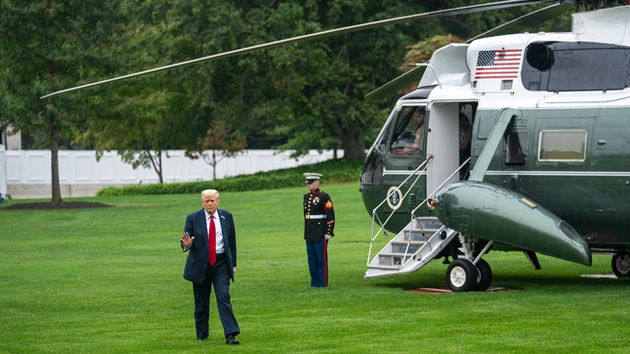
U.S. President Donald Trump waves from the roof of the West Wing of the White House as he takes a tour on August 05, 2025 in Washington, DC. (Photo by Win McNamee/Getty Images)
(WASHINGTON) — President Donald Trump on Thursday demanded work begin on a new census as redistricting battles are spreading across the country.
In a social media post, Trump announced he directed the Commerce Department to “immediately begin work on a new and highly accurate CENSUS based on modern day facts and figures and, importantly, using the results and information gained from the Presidential Election of 2024.”
“People who are in our Country illegally WILL NOT BE COUNTED IN THE CENSUS,” Trump added.
The U.S. Census Bureau says it “collects data from all foreign born who participate in its censuses and surveys, regardless of legal status” and has done so for its 235-year history. The data determines how the 435 House seats are divided among the 50 states every 10 years.
Trump’s announcement on Thursday comes amid a showdown in Texas over a proposed congressional map that, if enacted, could net Republicans between three and five U.S. House seats in next year’s midterm elections.
Texas Democrats fled the state in protest, denying Republicans the necessary quorum to vote on the changes. Republican Gov. Greg Abbott is now exploring legal consequences for those lawmakers, ordering Texas Department of Public Safety to find and arrest lawmakers who left the state and asking the Texas Supreme Court to remove a top Texas House Democrat from office.
With control of the U.S. House potentially at stake, blue-state Democrats are vowing to respond in kind should Texas Republicans succeed in changing their map.
New York Gov. Kathy Hochul and California Gov. Gavin Newsom said they will explore ways to gerrymander their maps. Both states currently use independent commissions to draw their maps following constitutional amendments.
More Republican governors, too, are exploring possibly redrawing congressional maps ahead of the 2026 elections given the GOP’s razor-thin margins in the House. Democrats would need to only net three seats next November to win back the House.
Vice President JD Vance is visiting Indiana on Thursday to discuss redistricting and other topics with Republican leaders.
Trump in his first term attempted to change the U.S. census to exclude noncitizens. In 2019, the Supreme Court ruled that Commerce Department’s attempt to add a citizenship question to the 2020 census violated federal law.
Israeli Prime Minister Benjamin Netanyahu talks with reporters before a bipartisan meeting with senate leaders in the U.S. Capitol on Wednesday, July 9, 2025. (Tom Williams/CQ-Roll Call, Inc via Getty Images)
(LONDON and TEL AVIV) — Israeli Prime Minister Benjamin Netanyahu is expected to meet with his security cabinet on Thursday, an Israeli official said, as he considers plans to occupy the Gaza Strip despite international condemnation of the deteriorating humanitarian situation there.
Netanyahu is expected to ask the cabinet to approve plans for the Isreal Defense Forces to gradually seize Gaza City, the largest city in the territory, the Israeli official told ABC News.
The cabinet is expected to meet at about 6 p.m. local time, or 11 a.m. ET, the source said.
Two sources familiar with the matter told ABC News earlier this week that Netanyahu had decided to propose that the IDF move forward with a plan to fully conquer and occupy the Palestinian territory.
Netanyahu held a three-hour limited security cabinet meeting on Tuesday where the matter was discussed, according to a readout from the prime minister’s office.
“The IDF is prepared to implement any decision made by the Political-Security Cabinet,” the readout said.
On Sunday, an Israeli official told ABC News that Netanyahu was pushing to expand the military operation in Gaza on the grounds that he felt Hamas is not interested in reaching a new deal under which surviving hostages could be released.
When asked about the possible expansion of the campaign in Gaza, U.S. State Department spokesperson Tammy Bruce said Tuesday, “Reporting is one thing. Real plans might be another. We are not in the business of interpreting statements from foreign governments when and if they’re made.”
“We do remain focused on freeing the hostages, including the remains of two Americans, and ensuring that Hamas never rules Gaza again,” Bruce said.
ABC News’ Joe Simonetti contributed to this report.
A United Airlines plane takeoff from San Francisco International Airport (SFO) in San Francisco, California, United States on August 6, 2025 as United Airlines flights grounded nationwide because of computer problems. (Photo by Tayfun Coskun/Anadolu via Getty Images)
(NEW YORK) — A tech outage led United Airlines to ground flights nationwide Wednesday night, and even with the issue now resolved, over 1,000 flights were delayed and dozens were canceled.
“We are working with customers to get them to their destinations after a technology disruption on Wednesday evening,” the airline said in a statement.
The outage stemmed from an issue with the airline’s weight and balance computer system, United said.
“The underlying technology issue has been resolved, and, while we expect residual delays, our team is working to restore our normal operations,” the airline said.
The airline said the outage began shortly after 6 p.m. ET and was resolved after a few hours.
“Due to a technology issue, we are holding United mainline flights at their departure airports,” the airline said in a statement. “We expect additional flight delays this evening as we work through this issue. Safety is our top priority, and we’ll work with our customers to get them to their destinations.”
Overall, more than 1,000 flights were delayed and more than 40 were canceled, according to FlightAware, a site that tracks air traffic. United said it’s covering meals and hotels for impacted customers.
The Federal Aviation Administration said in a statement it was aware the airline “experienced a technology issue disrupting their operations.”
U.S. Transportation Secretary Sean Duffy said the issue was specific to United’s operations “and is unrelated to the broader air traffic control system.”
The airline confirmed in a statement to ABC News that the issue was not related to a cyberattack.
The ground stop did not affect United Express flights, and any flight that was already in the air will continue to its destination, according to the airline.
Multiple FAA notices stated that the airline requested ground stops at major hubs, including Newark, San Francisco, Chicago, Denver and Houston.
This is a developing story. Please check back for updates.
Members of the U.S. Army drive a M1A2 Abrams Main Battle tank in the 250th birthday parade on June 14, 2025 in Washington, DC. (Photo by Samuel Corum/Getty Images)
(NEW YORK) — An active duty soldier with the U.S. Army was arrested Wednesday and charged with attempting to share sensitive information about U.S. military tank capabilities with Russia, the Justice Department announced.
Taylor Lee, 22, a soldier stationed at Fort Bliss, is alleged to have transmitted the information to an individual he believed was affiliated with Russia’s government in exchange for Russian citizenship, federal prosecutors said.
Lee was arrested on charges of attempted transmission of national defense information to a foreign adversary and attempted export of controlled technical data without a license, according to the DOJ.
Prosecutors said Lee, who has a top secret security clearance, sent technical information on the M1A2 Abrams tank and offered his assistance to the Russian Federation in an exchange online in May. In that exchange, prosecutors said Lee stated “the USA is not happy with me for trying to expose their weaknesses,” before adding, “at this point I’d even volunteer to assist the Russian federation when I’m there in any way.”
In July, at an in-person meeting between Lee and the person he apparently believed was a representative of the Russian government, prosecutors said Lee passed an SD memory card to the person, “including documents and information on the M1A2 Abrams, another armored fighting vehicle used by the U.S. military, and combat operations,” according to a DOJ press release. “Several of these documents contained controlled technical data that Lee did not have the authorization to provide.”
In another instance detailed in charging documents, Lee allegedly delivered hardware from inside an M1A2 Abram’s tank to a storage unit located in El Paso, Texas, and then texted the individual he believed was a Russian agent, “Mission accomplished.”
Lee has not yet entered a plea to any of the charges.
“This arrest is an alarming reminder of the serious threat facing our U.S. Army,” said Brig. Gen. Sean F. Stinchon, the commanding general of Army Counterintelligence Command. “Thanks to the hard work of Army Counterintelligence Command Special Agents and our FBI partners, Soldiers who violate their oath and become insider threats will absolutely be caught and brought to justice, and we will continue to protect Army personnel and safeguard equipment.”
Rep. Cory Mills, R-Fla., talks with reporters on the House steps of the U.S. Capitol on Thursday, June 27, 2024. (Tom Williams/CQ-Roll Call, Inc via Getty Images)
(WASHINGTON) — Florida Republican Congressman Cory Mills is facing allegations from an ex-girlfriend that he threatened to release sexually explicit images and videos of her following the end of their relationship, according to a police report obtained by ABC News.
Lindsey Langston, a Republican state committee member and 2024 Miss United States winner, filed a police report on July 14 alleging that Mills threatened to release the videos of her after their breakup earlier this year and that Mills threatened to harm any future partners, according to the report obtained from the Columbia County Sheriff’s Office in Florida.
In response, Mills said in a statement to ABC News, “These claims are false and misrepresent the nature of my interactions,” and accused a former Florida primary opponent of “weaponizing the legal system to launch a political attack against the man who beat him.”
According to the police report, Langston stated the relationship lasted from November 2021 to February 2025 and ended after she saw media reports regarding Mills being allegedly involved in an unrelated alleged assault in Washington that reportedly involved another woman, an incident which Mills has denied and was never charged. The woman has retracted her allegations.
“Lindsey confronted Cory about the woman, to which Cory told her he was not in a romantic relationship with her and the press fabricated the story. Lindsey then found a social media account for the other woman and saw posted photos of her with Cory,” the police report reads.
After Langston moved out of Mills’ residence, “Cory has contacted Lindsey numerous times on numerous different accounts threatening to release nude images and videos of her, to include recorded videos of her and Cory engaging in sexual acts,” according to the police report.
The police report, which was first reported on by Drop Site News, also states that Langston provided police with text messages and Instagram messages between her and Mills, “which consisted of Cory threatening to harm any men Lindsey intended to date in the future.”
Langston also told police Mills misled her by claiming he was separated from his wife, though he remains married.
After Columbia County’s initial involvement with the police report, the matter was referred to the Florida Department of Law Enforcement, according to the sheriff’s office.
“Anthony Sabatini is weaponizing the legal system to launch a political attack against the man who beat him in the primary, using his corporate legal office to push a narrative built on lies and flawed legal arguments – all to score political headlines. We have not been made aware of any report or allegations from law enforcement or the alleged complainant.” Mills said in his statement.
“These claims are false and misrepresent the nature of my interactions. I have always conducted myself with integrity, both personally and in service to Florida’s 7th District. Out of respect for the legal process, I won’t comment further at this time. My team and I will fully cooperate to ensure the truth is made clear. I remain focused on serving my constituents and advancing America First policies.”
Sabatini, an attorney who serves as a County Commissioner for District 1, briefly represented Langston but no longer does. Previously, he lost a Republican primary for the seat Mills now represents. He also served as a member of the Florida House of Representatives from 2018-2022.
Earlier this year, Mills, who represents Florida’s 7th congressional district, voted in favor of the “Take It Down Act,” a bipartisan law championed by first lady Melania Trump that the president signed into law in May.
The “Take it Down Act” was a bipartisan bill aimed at cracking down on the nonconsensual sharing of sexually explicit videos and photos, including deepfakes generated by artificial intelligence.
(WASHINGTON) — President Donald Trump’s sweeping new tariffs finally took effect on Thursday, slapping levies on dozens of countries and risking price increases for a host of everyday goods.
Tariffs between 10% and 41% were applied to nearly 70 countries beginning at 12:01 a.m. Thursday, significantly expanding the reach of Trump’s confrontational trade policy.
“IT’S MIDNIGHT!!! BILLIONS OF DOLLARS IN TARIFFS ARE NOW FLOWING INTO THE UNITED STATES OF AMERICA!” President Donald Trump posted shortly before midnight on his social media platform.
The tariffs arrived roughly a week after Trump delayed so-called reciprocal tariffs, opting to modify some levies.
Canada, a top U.S. trade partner, faces a 35% tariff. While Brazil, a key source of coffee, receives a 40% tariff which, when added on top of the 10% baseline tariff in the new order, means a 50% rate on the country’s imports to the U.S.
The countries facing the highest rates in the executive order are Laos and Myanmar at 40% and Syria at 41%.
India is hit with a 25% tariff in the order but that is expected to climb to 50% on Aug. 27. Trump on Wednesday said he was imposing the additional 25% levy as punishment for India’s decision to continue purchasing Russian oil throughout the Russia-Ukraine war.
There is an extended rollout for goods shipped into the country by vessel. As long as they are shipped by Aug. 7 and enter the U.S. by Oct. 5, they will not be subject to the new tariff rates.
The White House has said the rates were determined largely based on the trade deficit the U.S. has with those trading partners.
The new tariff rates resemble levies that were placed on more than 90 countries on April 2, though there are some differences.
Trump rolled out those so-called reciprocal tariffs in April, then delayed them, vowing to strike roughly 90 trade deals in 90 days. In early July, Trump delayed the tariffs again, setting a deadline of Aug. 1. A day before that deadline, he delayed them once again.
The new levies appear to add 15% tariffs on goods from several countries not initially included in the president’s “Liberation Day” executive order on April 2 — including Bolivia, Ecuador, Ghana and Iceland.
After the ‘Liberation Day” tariffs were unveiled and then delayed, Trump sent letters to leaders of roughly two dozen countries outlining the tariff levels that would take effect if no deal were struck. The Trump administration raced to strike trade agreements over the days preceding the deadline in an effort to win concessions from targeted countries in exchange for reduced tariff rates.
So far, the White House says it has reached trade agreements with the United Kingdom, Vietnam and Indonesia, as well as a preliminary accord with China.
“The president and his trade team want to cut the best deals for the American people and the American worker,” White House press secretary Karoline Leavitt said last month when she announced the Aug. 1 deadline.
Tariffs put forward so far by Trump are expected to cost an average household an additional $2,400 this year, the Yale Budget Lab found last week.
Importers typically pass along a share of the tariff-related tax burden onto consumers in the form of price hikes.
Speaking to reporters last week, a Trump administration official hailed the new tariffs as part of a “new system of trade” that aims to prioritize “fair and balanced trade” over efficiency at all costs.
ABC News’ Michelle Stoddart, and Meghan Mistry contributed to this report.
(WASHINGTON) — A bilateral meeting between President Donald Trump and Russian President Vladimir Putin could happen as soon as next week, according to a White House official.
White House special envoy Steve Witkoff returned from Moscow on Wednesday and relayed to President Trump that Putin would like to meet with him, the official said.
In response, Trump indicated he is open to that if Putin also meets with Ukrainian President Volodymyr Zelenskyy, the official added.
Witkoff met with Putin for several hours on Wednesday ahead of the Friday deadline imposed by Trump for Russia to agree to a ceasefire with Ukraine or face sanctions.
According to a senior administration official, the meeting “went well” but secondary sanctions are still expected to be deployed against Moscow this week.
Trump has expressed increasing frustration with Putin over the conflict, shortening the deadline for a ceasefire from 50 to 10 days as he said he was “disappointed” in the Russian leader.
Trump, in a social media post on Wednesday, called the meeting between Witkoff and Putin “highly productive.”
“Great progress was made! Afterwards, I updated some of our European Allies. Everyone agrees this War must come to a close, and we will work towards that in the days and weeks to come,” Trump wrote.
This is a developing story. Please check back for updates.
Smoke from the Rosa Fire rises in Riverside County, California, Aug. 4, 2025. Cal Fire
(SOLVANG, Calif.) — The Gifford Fire, a wildfire burning in Central California that has destroyed over 83,000 acres in six days, continues to rage and is now the largest blaze in the state this year, according to Cal Fire.
Since it started on Friday afternoon, the Gifford Fire — which is situated within the Los Padres National Forest in Solvang, California — has burned 83,933 acres and has only reached 9% containment, prompting evacuation orders for those in the Santa Barbara and San Luis Obispo counties, officials said.
While the flames have been centered around thick brush and rugged terrain, officials said over 1,000 structures are threatened by this wildfire.
Nearly 2,000 personnel have been dispatched to help fight the flames, with “great progress made on the west, north and east flanks of the fire” on Monday, according to Los Padres National Forest officials. Winds could potentially reach 20 mph on Tuesday, which could “test lines already constructed,” officials said.
On Wednesday, officials sad they would focus on improving “contingency and constructed containment fire lines.”
Warmer weather on Thursday and Friday could increase the “fire behavior” and pose a threat to the already raging flames, officials said.
On Tuesday, officials said they will deploy helicopters to “deliver very significant water drops” and will establish two new base camps to allow personnel to “more efficiently access the fire perimeter.”
An air quality alert in Cuyama, California, and an air quality watch for the rest of Santa Barbara County continues to remain in place “until conditions improve,” according to the Santa Barbara County Air Pollution Control District.
The fire is also impacting those outside of California, with smoke from the flames filtering into the Las Vegas Valley, “reducing visibility and air quality,” according to the National Weather Service Las Vegas.
Officials expect smoky conditions in the Las Vegas area “for at least another couple of days.”
Along with the Gifford Fire, firefighters are now also battling two additional flames in Central California that began on Monday — the Rosa Fire and the Gold Fire, according to Cal Fire.
The Rosa Fire, which is situated within Riverside County, has prompted evacuation orders and has destroyed 1,658 acres as of Wednesday, according to Cal Fire. The Gold Fire, which is located in San Bernardino County, is centered around “steep, rugged terrain in the northern area of the Mountaintop Ranger District” and has burned 991 acres, Cal Fire said.
As of Wednesday, the Rosa Fire is 18% contained and the Gold Fire is 5% contained, officials said.
The cause of all three fires remains under investigation, officials said.
(FORT STEWART, Ga.) — A U.S. Army sergeant allegedly shot and wounded five other soldiers at Fort Stewart in Georgia, using his personal handgun, officials said.
The shooting at the 2nd Armored Brigade Combat Team area was reported at 10:56 a.m and the suspect, automated logistics Sgt. Quornelius Radford, was apprehended at 11:35 a.m., Fort Stewart said. All lockdown measures have since been lifted, Brig. Gen. John Lubas, the 3rd Infantry Division and Fort Stewart-Hunter Army Airfield commander, said at a news conference.
A motive is not clear, Lubas said, but the shooting involved the 28-year-old Radford’s co-workers and was at Radford’s “place of work.” He used a personal handgun, but it’s not clear how he brought it to his workplace, Lubas added.
Lubas praised the “brave soldiers” who he said “immediately intervened” and tackled the suspect. He said they, “without a doubt, prevented further casualties.”
All five victims are in stable condition and are expected to recover, Lubas said. Hospital officials said two of the victims were rushed to Memorial Health University Medical Center in Savannah, which is a Level 1 trauma center about 40 miles from Fort Stewart.
Radford has been interviewed by Army investigators and is in pretrial confinement, Lubas said.
Radford, who is from Jacksonville, Florida, has not previously deployed to combat, Lubas said. He had been arrested locally for a DUI, Lubas said, noting the arrest was “unknown to his chain of command until the [shooting] occurred and we started looking into the law enforcement databases.”
Lubas emphasized that although it is still early in the investigation, he said they are not aware of the suspect having any prior behavioral or disciplinary issues.
Lubas also said he remains “very confident in the security” of Fort Stewart.
Georgia Gov. Brian Kemp said on social media, “We are keeping the victims, their families, and all those who answer the call to serve in our hearts and prayers.”
President Donald Trump has been briefed on the shooting, according to White House press secretary Karoline Leavitt.
The full circumstances surrounding the shooting were not immediately clear.
Access to combat firearms on a U.S. military personnel on base is highly restricted, with guns kept stored in an armory on the base. Firearm use is limited to only when soldiers are participating in field training, and the guns are returned to the armory at the conclusion of that training.
Military personnel are allowed to have legally registered personal guns, but there are restrictions on how they can be brought onto a base.
The entrance to the state-managed immigration detention center dubbed Alligator Alcatraz/Joe Raedle/Getty Images
(NEW YORK) — Known for the eponymous reptiles that inhabit the nearby swamps, the migrant detention center dubbed “Alligator Alcatraz” faces the possibility of being shut down over concerns about some of the area’s lesser-known inhabitants — the Everglades’ bats, panthers, and storks.
At a hearing in federal court Wednesday, environmental groups have so far called two witnesses as part of their effort to prove that facility was built without the federally required impact studies.
Attorneys representing Florida officials have argued that the facility was initially funded by, constructed, and managed by the state and is therefore exempt from the National Environmental Policy Act – the main law being used to challenge the facility.
To counter that, the environmental groups called Florida state Rep. Anna Eskamani, who testified that she understood that the Department of Homeland Security was the driving force behind the facility.
During a guided tour she took of the facility last month, Florida Division of Emergency Management Executive Kevin Guthrie allegedly told Eskamani and other lawmakers that Alligator Alcatraz was built at the direct request of the Department of Homeland Security and in compliance with Immigration and Customs Enforcement.
“DHS made the request for a facility to be established, and this was the product of that facility,” she testified. “They kept asserting to us that they were following all federal and state guidelines, and ICE inspects our facility.”
Alligator Alcatraz has so far operated in what immigration advocates have described as a jurisdictional gray zone — with the facility funded by the federal government but run by the state of Florida — that they allege allows officials to skirt some legal requirements.
Florida Gov. Ron DeSantis has previously argued that the state of Florida is “implementing” the federal government’s immigration policy with the expectation that the state would be fully reimbursed for the costs of Alligator Alcatraz, but local and federal officials have so far been unable to tell the federal courts who is actually in charge of the facility.
The hearing — at which federal, state, and tribal officials are testifying — comes amid heightened scrutiny of the facility, which was once touted as a “one-stop shop to carry out President Trump’s mass deportation agenda.”
Located 50 miles west of Miami in the heart of the Florida Everglades, “Alligator Alcatraz” was quickly constructed over a matter of weeks, utilizing hundreds of tents, trailers, and other temporary facilities to potentially house more than 3,000 detainees.
The facility was built on the grounds of the Dade-Collier Training and Transition Airport, a sparsely used piece of tarmac owned by Miami-Dade County.
Alligator Alcatraz also neighbors land leased to the Miccosukee Indian Tribe, including villages, a school, traditional hunting areas, and sacred sites. The Miccosukee Tribe joined the lawsuit last month, arguing that the facility threatens to damage nearby tribal villages.
The environmental groups and the tribe that brought the case allege that the sprawling facility was built without the federal or state government conducting an environmental impact statement, which is required under the National Environmental Policy Act (NEPA), so the public and lawmakers can understand the impact of a project. They also argue that the government failed to get public input on the project.
The Department of Justice has also argued that the environmental groups cannot prove irreparable harm and that NEPA does not give a court the power to block the use of the facility.
Attorneys representing the Florida officials tried to cast doubt on Eskamani’s testimony by arguing she has publicly opposed the policy, including saying at one point that the facility was a “half-billion-dollar anti-immigrant grift.”
“I can definitely see myself saying that on social media,” she told the court about the comments.
Eskamani also testified about the environmental impacts of the facility, which she said was described to her by state officials as an “active construction site.” Miles of barbed wire, tons of freshly laid asphalt, and hundreds of high-power lights peppered the facility.
Eve Samples, the executive director of the nonprofit Friends of the Everglades, which brought the lawsuit, testified before Eskamani on Wednesday and argued that the environmental impact has already been felt at the site. The construction of the facility brought increased traffic to the sensitive area, and high-power lights have made the facility visible at night from miles away.
The facility sits next to the Big Cypress National Preserve and the Big Cypress Area, ecologically sensitive and protected areas that house threatened species, including the Everglade snail kite, Florida panther, wood stork, and Florida bonneted bat.
Jesse Michael Panuccio, a lawyer representing Florida, tried to blunt her testimony by highlighting that the facility was built on a preexisting airport, where hundreds of planes take off and land daily.
While Wednesday’s hearing is limited to environmental issues — including impacts on the nearby Big Cypress National Preserve — the testimony is expected to shine a light on the operations of the facility and could result in a federal judge ordering the facility to be shut down until the required environmental impact studies are conducted.
Immigrant advocates have alleged that detainees have endured inhumane conditions, including flooded facilities, spoiled food, and sweltering heat — and that they have limited access to their attorneys and are effectively housed in a jurisdictional “black hole.”