
NYC, California turn to COVID testing mandate to boost vaccination numbers — will it be enough?

Ergin Yalcin/iStock

(NEW YORK) — As contentious debates over vaccine mandates continue with new coronavirus cases on the rise among the unvaccinated, elected officials are starting to fine-tune the idea of a new incentive by requiring public employees to get a coronavirus test until they get their shots.

Barun Mathema, an assistant professor of epidemiology at Columbia University’s Mailman School of Public Health, told ABC News that the plan is a very effective incentive on paper, and it will have a bigger impact outside of the public sector when it comes to confidence in the vaccines.

“This is saying the government, unambiguously, supports vaccination. One can try things like lotteries to entice individuals, but to me, this is a serious and thoughtful approach,” he told ABC News.

New York City Mayor Bill de Blasio announced last week that employees of the city’s public hospital system, which included medical centers like Elmhurst Hospital, the epicenter of the first wave of hospitalizations in 2020, would have to show proof of vaccination or submit a weekly test until they got their shot. Exemptions are allowed for religious medical reasons.

De Blasio expanded that order on Monday to all city public employees, which included police officers, firefighters and teachers. Even though 59% of the city’s entire population and 70% of its adult population has at least one dose of the vaccine as of Tuesday, the numbers were lagging among the ranks of some New York agencies, city data showed.

The NYPD had a 43% vaccination rate, the Department of Correction had a 42% vaccination rate, the FDNY had a 55% vaccination rate, and public school employees and city hospital employees each had a 60% vaccination rate, according to data from city officials. Nationally, 56% of all residents and 69% of all adults have at least one shot, according to the U.S. Centers for Disease Control and Prevention.

The testing mandate will go into effect for unvaccinated public hospital workers next week, and goes into effect on Sept. 13, the first day of schools in New York, for other public employees.

De Blasio stressed that the delta variant is causing cases to rise in unvaccinated neighborhoods in the city and he wanted to ensure New Yorkers that their public employees were vaccinated or proven safe.

“We’re going to keep climbing this ladder and adding additional measures as needed mandates and strong measures, whenever needed to fight the delta variant,” the mayor said during a news conference Monday.

A few hours later, California Gov. Gavin Newsom announced that he would place a similar testing mandate for any state employee who can’t provide proof of vaccination. The mandate affects 249,000 employees and also provides exemptions for religious or medical reasons.

“California has committed to vaccination verification and or testing on a weekly basis,” Newsom said at a news conference.

California’s policy will take effect on Aug. 9.

Mathema said the policy will be most effective at swaying unvaccinated employees who were on the fence about getting the shot and needed an incentive to do so.

In this case, time spent on taking a COVID-19 test, submitting the paperwork to a boss and getting their OK week after week would take its toll, Mathema said.

“There will certainly be some people who find the constant testing inconvenient,” he said.

Dr. John Brownstein, an epidemiologist at Boston Children’s Hospital and an ABC News contributor, said the testing requirement will put extra pressure on an unvaccinated employee to get their shot.

“They’ll have to quarantine and put themselves out of two weeks of work,” he said.

Brownstein predicted that more states will follow New York City and California’s lead and there appears to be momentum at the federal level. President Joe Biden is expected to announce Thursday that all federal employees show proof of vaccination or submit to regular testing, ABC News has learned.

Brownstein added that some businesses have begun to implement rules that provide more benefits for customers. Some cruise ships, he noted, restrict their non-vaccinated passengers from the more popular dining areas and attractions.

“It’s a hybrid carrot and stick situation. You’re giving benefits to people who are vaccinated and punishing people who aren’t,” he said.

Mathema warned that there are likely to be a number of public employees who will submit to the weekly testing rather than get their shots. He reiterated that elected officials and businesses that implement a testing mandate for the unvaccinated needed to supplement their policy with a focused educational plan.

“I do believe this needs to be met with outreach, strong outreach and consistent outreach,” Mathema said. “We do need to be tactful, show empathy and address real issues that are out there: people’s concerns over the vaccine.”

Anyone who needs help scheduling a free vaccine appointment can log onto vaccines.gov.

Copyright © 2021, ABC Audio. All rights reserved.

NASA’s new mission studies how intense thunderstorms may influence climate change

iStock/LaserLens

(SALINA, Kan.) — NASA recently began new research to investigate how extreme summer weather may be affecting the upper layers of earth’s atmosphere.

Kenneth Bowman, Ph.D., the principal investigator for the Dynamics and Chemistry of the Summer Stratosphere (DCOTSS) research project, spoke to reporters about the project during a press briefing on Tuesday. He said their goal is to understand how intense summer thunderstorms over the U.S. affect the stratosphere — the second layer of earth’s atmosphere as you move toward space — especially as climate change causes severe thunderstorms to occur more often.

“Most thunderstorms occur in the lower layer of the atmosphere, which we call the troposphere. But when we get particularly intense thunderstorms, the updrafts — the rising air in the storm — can actually overshoot into the layer above, which is the stratosphere,” Bowman said.

He said that when this happens, the air in the troposphere can rise up to the stratosphere in as little as 20 to 30 minutes. Those updrafts can transport pollutants and water that might not normally reach this level of the atmosphere in such a short amount of time.

The stratosphere is usually dry, according to the project’s website, and the water and pollutants may “have a significant impact on radiative and chemical processes” in the atmospheric layer.

David Wilmouth, Ph.D., a scientist at Harvard University who is working on the project, said the updrafts could potentially “change the chemical composition of the stratosphere, a process that would not otherwise happen.” Their work will determine if that’s the case.

Bowman explained that the stratosphere is important because it contains the Earth’s ozone layer, which protects us from harmful ultraviolet radiation that comes from the sun. About 90% of the world’s ozone layer exists within the stratosphere, according to Wilmouth.

Wilmouth said the ozone layer is “critical” for protecting life on earth. If its protective shield was to weaken, humans would be more susceptible to skin cancer, cataracts disease and an impaired immune system, according to NASA.

Dan Csziczo, Ph.D., a professor and head of the Department of Earth, Atmospheric and Planetary Sciences at Purdue University, said during the briefing that their goal is specifically to understand the composition and size of the particles that make their way up to the stratosphere, and how they might influence the earth’s climate. Csziczo said the research would also help scientists understand the process of cloud formation and subsequent precipitation.

Understanding the relationship between climate change and particulate matter in the air is critical because, ultimately, each of them might exacerbate the impact of the other on humans’ health and way of life.

For the project, NASA is working with several universities across the country, as well as the National Center for Atmospheric Research and the National Oceanic and Atmospheric Administration.

The mission consists of three eight-week-long deployments over the course of the 2021 and 2022 summer seasons. The DCOTSS will be using NASA’s ER-2 high-altitude research aircraft for the mission.

DCOTSS will be operated out of Salina, Kansas, a site chosen by the researchers due to its central location within the U.S. It’s also a region of the country that’s particularly prone to severe and intense thunderstorms during the summer.

The ER-2 aircraft is equipped with fully robotic, pre-programmed instruments that can measure the gases and particles that come out of the overshooting tops of the thunderstorms, as well as meteorological information, such as water vapor, Wilmouth said.

The aircraft can only transport its pilot, who must wear a pressurized suit to withstand the high altitudes, which can go as high as 70,000 feet — about twice the altitude of typical commercial airlines, according to the project’s website.

Copyright © 2021, ABC Audio. All rights reserved.

How students fared during first full school year of COVID-19 pandemic

iStock/skynesher

(PORTLAND, Ore.) — After a full school year during the COVID-19 pandemic, elementary and middle school students are heading into the fall with lower rates of achievement gains in reading and math than they would have during a typical school year, new research shows.

The researchers say the results were worse in high-poverty areas and could have been even worse overall had thousands of students “missing” from school systems been counted. Separately, they say that it would take “unprecedented” levels of growth to make up for the past school year.

NWEA, a Portland-Oregon-based education research organization that develops pre-K-12 assessments, expedited research on test scores from the 2020-21 school year to help spotlight student needs ahead of the fall.

Researchers compared gains in student achievement in grades 3-8 across the school year to pre-pandemic levels — specifically, the 2018-19 school year — based on the average results of its MAP Growth assessments in reading and math.

They found that, looking at the results of 5.5 million test-takers, students did make modest progress overall over the course of the school year — but not as much as during a typical year. Compared to 2018-19, average achievement gains declined 3 to 6 percentile points in reading depending on the grade level. There was an even steeper decline in math, between 8 and 12 percentile points.

Unexpectedly, the gains in math and reading decelerated between winter and spring relative to a typical school year, researchers found.

“I think many of us expected to maybe start to see some signs of hope closer to the spring, when more kids were returning to the classroom,” Karyn Lewis, a senior research scientist with NWEA, told ABC News. “So that that’s when learning really stalled more was surprising to me.”

Lewis pointed to “pandemic fatigue” as possibly being behind the unanticipated results.

“When I think back and reflect on my own experiences in the winter, that’s I think when pandemic fatigue really started to set in,” she said. “I think that it’s starting to show in these data that kids were also affected.”

When they dug deeper into the data, researchers found that there were even greater declines in math and reading progress for disadvantaged students. Those attending high-poverty schools showed more than double the declines of students attending low-poverty schools for many grades. This was especially pronounced at the elementary level: Third graders in high-poverty schools showed 11-percentile-point declines in reading and 17 percentile-point-declines in math, the report found.

“We know that the pandemic was not an even crisis across families in our country, and families in high-poverty situations were impacted in different ways,” Lewis said. “Parents were less likely to be able to stay home and support virtual learning opportunities because of the way their jobs were structured. These homes may have had less reliable internet access or less reliable access to a dedicated computer. … It’s just layer upon layer of different factors that I think are probably attributing to this.”

The recent findings don’t show the complete picture, Lewis said, due to a higher attrition rate than normal — and so-called “missing” students likely adding to the lower achievers. The overall attrition rate for the 2020-21 school year was about 20%, researchers said — meaning 1 in 5 students who tested the prior year did not test this year. For 2018-19, the overall attrition rate was 13%.

“The kids that went missing are not the random sample of students but are more likely to be in schools that serve a high proportion of kids in poverty, that were lower achieving in prior years and that were from communities of color,” Lewis said. “This may actually be kind of the best-case scenario because we are missing the voices of many of the students in these groups that were most impacted.”

Researchers also emphasized that their work didn’t specifically address the impact of remote learning on performance.

“This national data is fantastic for giving us the lay of the broad landscape, but we really need as districts and schools come back to lean into the local context and look at our own data and see how that compares with the trends that we’re seeing nationally,” Brooke Mabry, strategic content design manager for NWEA’s Professional Learning Design team, told ABC News.

With students going into the fall with, on average, lower gains in math and reading, there would need to be “unprecedented” levels of growth to catch up, Lewis said. The delta variant may also throw a “big curveball” for schools this fall, as COVID-19 cases rise across the country. But there are signs of hope, researchers said.

“We do know that what we learned from what happened with kids over the summer months, when they are out of school altogether, the kids that seem to lose the most across the summer period are also those that tend to rebound the quickest when they’re back in the classroom,” Lewis said. 

Copyright © 2021, ABC Audio. All rights reserved.

With vaccination rates down, officials try new approach

iStock/Hector Pertuz

(NEW YORK) — Vaccine lotteries and other incentives designed to encourage COVID-19 vaccination after the rate steeply declined didn’t consistently raise numbers as many public health officials had hoped.

Now, officials are turning to community partnerships and other means of engagement to drive vaccinations — and the personal approach appears promising.

Vaccinations peaked at over 4 million per day in early April before dropping down to an average of about 429,000 per day by early July. Despite at least 30 states and territories implementing vaccine incentives such as cash lotteries, free food and free entrance to local attractions, the weekly moving average still hovers close to 470,000.

Experts caution not to say that vaccine incentives didn’t work. States such as Ohio and Missouri saw a temporary but meaningful bump in vaccinations in the week after the lotteries were announced.

“I think vaccine incentives have worked better than we think,” said Dr. Stacy Wood, professor of marketing at North Carolina State University. “When any given incentive didn’t work, it was because it didn’t match the hurdle that a particular person was facing for vaccination. … There’s no one-size-fits-all incentive.”

But for some, the vaccine incentives themselves are a turn off. “It actually makes me a little more leery,” said Camille Holmes, a school-based speech therapist from Westchester County, New York.

Holmes said she routinely gets vaccines for herself and her family but right now is “indifferent” about the COVID-19 vaccine.

“I think as time progressed, my answer went from ‘absolutely not,’ to ‘I don’t know,’ to ‘I’m not ready,’ to ‘I probably am going to get it when I’m forced to do so.'”

So what is the key to encouraging vaccinations? For some, it might be a mandate from their employer. For others, it might be about renewed fear as the more contagious delta variant spreads. Now that cases are rising due to the delta variant, there has been a gradual increase in vaccinations, up 14% last week, according to the White House.

But for many, it’s about meeting people where they are — literally. According to research by Wood, “small incentives combined with that immediacy” tailored to a specific population works well.

This might be especially true for younger people, who aren’t necessarily opposed to getting a vaccine but don’t feel as deeply concerned they’ll become very sick or die without it.

St. Louis County, Missouri, recently announced a new initiative called Sleeves Up STL that will enlist local barbershops and beauty salons to provide information to their customers about getting the vaccine.

Randy Barnes, the owner of R & R Style Shop in Florissant, Missouri, plans to participate in this initiative because COVID-19 has been rising in his community.

“I’m thinking because of the barber and the beauty shops, people trust us. If the information is there, if the education is there, people maybe would be more apt to [get vaccinated],” Barnes said. “Those that were skeptical, given the right information, maybe would go ahead and get themselves vaccinated and even convince other people.”

There is already evidence that getting information from trusted friends, family members and community leaders spurs vaccination. Since Arkansas Gov. Asa Hutchinson began traveling the state and having community conversations, the rate of vaccinations in the state has increased 40%, he told NPR.

Research has shown, and Barnes and Wood believe, that hearing from those who’ve had COVID-19 or lost someone due to the disease would be helpful. Barnes lost his brother to COVID-19 last April.

In addition to discussing vaccination with people, having vaccines immediately available at places where people commonly go, such as subway stations or museums can be helpful.

Whether it’s a lottery ticket, free meal, a conversation with a survivor or a trusted person or convenience, Barnes said he hopes one of these measures motivates people.

Adjoa Smalls-Mantey, M.D., D.Phil., trained in immunology and a psychiatrist in New York City, is a contributor to the ABC News Medical Unit.

Copyright © 2021, ABC Audio. All rights reserved.

Culture wars threaten to overtake war on COVID

iStock/ninjaMonkeyStudio

(WASHINGTON) — The TAKE with Rick Klein

It takes less than ever to find partisan grooves these days — and the fact that they’ve been etched deeper out of the fallout from Jan. 6 serves as a case in point.

That’s the reality that confronts President Joe Biden with this next uncertain phase of combatting the pandemic. New federal guidance on mask mandates and the consideration of a vaccine requirement for federal workers run into longstanding political arguments about individual liberties and personal accountability.

The push for vaccinations has become less partisan of late, with prominent Republicans adding new emphasis — and giving special credit to the previous administration — to make the case.

Yet mask-wearing and vaccine requirements have long since taken on cultural as well as political significance, and the fallout of Biden’s latest comments offer just a taste. Former President Donald Trump is offering strong pushback to mandates, and consider as well how readily some Republicans are using Dr. Anthony Fauci as a foil — raising money off the mention of his name, and even threatening legal action against him.

Biden indicated that he will outline next steps in the push to vaccinate the country on Thursday, as some statistics showing rates going up of late. The president on Tuesday also served up a reminder that as a candidate he “promised to be straight with you about COVID — good news or bad.”

Another reminder: 11 months ago, Biden said he wouldn’t hesitate to order another shutdown if that’s what his advisers recommended.

“I would shut it down; I would listen to the scientists,” he told ABC “World News Tonight” Anchor David Muir last August.

The campaign was quick to clarify that comment at the time. Biden’s statement Tuesday about masks and vaccines framed them as a way “to avoid the kind of lockdowns, shutdowns, school closures and disruptions we faced in 2020.”

“We are not going back to that,” the president said.

The RUNDOWN with Averi Harper

The testimony of Capitol Police officer Harry Dunn underscored the additional layer of trauma Black law enforcement officers experienced on Jan. 6.

Dunn’s heartbreaking testimony chronicled the racial slurs he endured as he tried to defend the seat of our nation’s democracy.

Among the insurrectionists were attackers who carried Confederate flags, donned shirts with anti-Semitic messages and freely hurled the n-word at Black officers.

“No one had ever, ever called me a n***** while wearing the uniform of a Capitol Police officer,” said Dunn.

He also brought with him the stories of other Black officers, later adding, “Another Black officer later told me he had been confronted by insurrectionists in the Capitol who told him, put your gun down and we’ll show you what kind of n***** you really are.”

For many, listening to Dunn recount the epithets stung as they were broadcast uncensored. The attack at the Capitol is often referred to as one of our nation’s darkest days, it’s particularly poignant that racism crept its way into the ugliness of it all, too.

It’s a vile reminder that racism in America, even in its most blatant forms, still exists.

The TIP with Alisa Wiersema

Republicans in Washington have one more representative joining their ranks — but the victory serves as an upset to Trump, despite his looming influence over the Republican Party on a national scale.

Nearly three months after the May 1 special election, State Rep. Jake Ellzey came out on top in Tuesday’s runoff election for Texas’ 6th Congressional District. Ellzey faced off with fellow Republican, Susan Wright, who had Trump’s backing going into the contest due to the political legacy of her late husband, Rep. Ron Wright, who died in February from COVID and complications with cancer.

The conclusion of the race is the latest indicator of the former president’s looming influence over his party in a state that is increasingly becoming ground zero for intra-party battles.

On Monday, Trump waded into another high-profile Texan battle by endorsing incumbent Attorney General Ken Paxton for another term. The move served a devastating — and complicated — blow to Land Commissioner George P. Bush, who was the only member of his storied political family to publicly back Trump, despite the former president launching repeated attacks against his father, Jeb Bush.

Copyright © 2021, ABC Audio. All rights reserved.

DOJ declines to back Rep. Mo Brooks in lawsuit brought by Rep. Swalwell over Jan. 6 incitement

iStock/Michał Chodyra

(WASHINGTON) — The Justice Department declined a request from Rep. Mo Brooks, R-Ala., Tuesday night to intervene for him in a lawsuit brought by a Democratic lawmaker suing him for his role in allegedly inciting the Jan. 6 attack on the U.S. Capitol.

In a new filing, the DOJ said it has determined it does not believe Brooks was acting within the scope of the duties of his office when he spoke in front of a pro-Trump rally just before rioters stormed the building, telling the crowd, “today is the day American patriots start taking down names and kicking a**.”

Brooks had asked for the Justice Department to replace him as a defendant in a lawsuit brought by Rep. Eric Swalwell, D-Calif., providing him legal immunity under a law known as the Westfall Act that former President Donald Trump similarly has sought to use to shield him from an effort by columnist E. Jean Carroll to sue him for defamation over his denial of her rape allegation.

“We appreciate the thoughtful analysis by the Committee on House Administration and the Department of Justice and could not agree more with their conclusion,” Rep. Swalwell’s attorney Philip Andonian said in a statement Tuesday night. “This conduct manifestly is outside the scope of Brooks’s employment as a member of Congress and the House and DOJ made the right call in requiring him to answer directly for his actions. This is a great step toward justice.”

Attorney General Merrick Garland faced a barrage of criticism last month when the department said it would continue to seek to substitute itself for Trump in the lawsuit, arguing that the law did apply to Trump even if they believed his statements were “crude” and “disrespectful.”

“The essence of the rule of law is that like cases be treated alike,” Garland said in defense of the move in testimony before a Senate panel. “That there not be one rule for Democrats and another for Republicans. That there not be one rule for friends and another for foes.”

Brooks similarly argued that by speaking to the rally and repeating Trump’s false claims of a stolen election that he was performing an official act of his office by representing the interests of his constituents.

Brooks has not responded to ABC News’ request for comment following the DOJ’s decision Tuesday.

But the chair of the House Administration Committee, Rep. Zoe Lofgren, D-Calif., disputed that assertion in a July 23 letter to the Justice Department, saying that Brooks’ conduct was “in furtherance of political campaigns” and thus should be deemed outside the scope of his office.

“Essentially, in deflecting the allegation that his speech was an incitement to violence, Representative Brooks has sworn under oath to the court that his conduct was instead in furtherance of political campaigns,” Lofgren wrote. “As noted, standards of conduct that apply to Members and precedents of the House are clear that campaign activity is outside the scope of official duties and not a permissible use of official resources.”

The Justice Department in its late filing Tuesday night largely backed Lofgren’s position, saying, “Brooks’s appearance at the Jan. 6 rally was campaign activity, and it is no part of the business of the United States to pick sides among candidates in federal elections. … Indeed, although the scope of employment related to the duties of a Member of Congress is undoubtedly broad and there are some activities that cannot be neatly cleaved into official and personal categories, Brooks’s request for certification and substitution of the United States for campaign-related conduct appears to be unprecedented.”

“Members of Congress are subject to a host of restrictions that carefully distinguish between their official functions, on the one hand, and campaign functions, on the other,” the department said. “The conduct at issue here thus is not the kind a Member of Congress holds office to perform, or substantially within the authorized time and space limits, as required by governing law,” the DOJ wrote.

The DOJ also notes that “if proven” the conduct Brooks is alleged by Swalwell to have engaged in “would plainly fall outside the scope of employment for an officer or employee of the United States.” “… conspiring to prevent the lawful certification of the 2020 election and to injure Members of Congress and inciting the riot at the Capitol.”

“Alleged action to attack Congress and disrupt its official functions is not conduct a Member of Congress is employed to perform and is not “actuated . . . by a purpose to serve” the employer, as required by District of Columbia law to fall within the scope of employment,” the department wrote in its filing.

Legal experts have been closely watching what the DOJ would ultimately decide in Brooks’ case, believing it could have a significant impact on other cases brought against allies of former President Trump being sued for encouraging or inciting the pro-Trump mob that stormed the Capitol on Jan. 6.

It is still unclear, however, whether the judge overseeing the case will decide to grant Brooks’ request to substitute the DOJ for himself despite DOJ’s stated opposition Tuesday evening.

Copyright © 2021, ABC Audio. All rights reserved.

Ben Crump files lawsuit against Johnson & Johnson on behalf of Black women

Chinnapong/iStock

(NEW YORK) — Prominent civil rights attorney Ben Crump has filed a lawsuit against Johnson & Johnson, alleging the pharmaceutical giant marketed talcum-based baby powder specifically to Black women despite links to ovarian cancers.

Johnson & Johnson has denied the allegations, saying its marketing campaigns are “multicultural and inclusive.” The company also denies that its products cause cancer, despite a Missouri appellate court last year ruling in favor of ovarian cancer victims suing the company as part of a separate lawsuit, claiming their condition was caused by asbestos in its baby powder and other talc products.

Crump, perhaps best known for representing the family of George Floyd after his murder by Derek Chauvin, filed the suit Tuesday in New Jersey with his legal partner Paul Napoli on behalf of members of the National Council of Negro Women (NCNW). The council, founded in 1935, is a nonprofit that advocates for and empowers women of African descent and their families.

“I would be remiss if I did not say exactly what this lawsuit is about. It is about the lives of our grandmothers, our mothers, our sisters, our daughters, our nieces, and our wives, and how they were sinisterly targeted by Johnson and Johnson,” Crump said at a news conference Tuesday announcing the suit. “This multi-billion-dollar corporation, their corporate executives know about the link between talcum powder and ovarian cancer.”

“Black women have always been the backbone of this country, standing up for everyone, but receiving the least amount of respect,” he added. “Well, it is time that we stand up for Black women.”

At the news conference, victims who lost family members to ovarian cancer tearfully spoke out about the impact these deaths have had on their lives.

Lydia Huston said her mother died of ovarian cancer in 2014. She remembers the mother of two and grandmother of eight as a “phenomenal cook” who “loved to take care of the people that she loved.”

“We had a routine and it involves hygiene, a very clean home and a very clean body,” she said. “And just like deodorant, soap, lotion, and toothpaste, talcum powder was a part of the daily routine that she had for over 35 years.”

“I miss her dearly, and I want justice for her,” Huston said.

Janice Mathis, the executive director of the NCNW, added in a separate statement that “generations of Black women” used Johnson & Johnson products as part of their daily routines.

“This company, through its words and images, told Black women that we were offensive in our natural state and needed to use their products to stay fresh,” she said. “Generations of Black women believed them and made it our daily practice to use their products in ways that put us at risk of cancer — and we taught our daughters to do the same.”

Johnson & Johnson has denied that its baby powder products cause cancer, but has previously said that it is facing more than 20,000 lawsuits over its talcum products. Despite assurances it is safe, the company stopped selling talc-based baby powder in 2020 in the U.S., citing reduced demand due to misinformation and litigation advertising.

In June 2020, an appellate court in Missouri upheld more than $2 billion in damages against Johnson & Johnson, saying the company knew there was asbestos in its baby powder. In June of this year, the Supreme Court declined to hear the company’s appeal of the Missouri verdict.

The company told ABC News in a statement that independent scientific testing has proved its products do not cause cancer. A Journal of the American Medical Association report released last year found “no statistically significant link” between use of powder in the genital area and risk of ovarian cancer.

“We empathize with anyone suffering from cancer and understand that people are looking for answers. We believe those answers can be better understood through science — and decades of independent scientific testing by medical experts around the world has confirmed that our products are safe, do not contain asbestos, and do not cause cancer,” Johnson & Johnson told ABC News in a statement Tuesday.

“The accusations being made against our company are false, and the idea that our Company would purposefully and systematically target a community with bad intentions is unreasonable and absurd,” the statement added. “Johnson’s Baby Powder is safe, and our campaigns are multicultural and inclusive.”

“We firmly stand behind the safety of our product and the ways in which we communicate with our customers,” the company said, noting that more information can be found at www.FactsAboutTalc.com.

Copyright © 2021, ABC Audio. All rights reserved.

Iowa judge to decide if Mollie Tibbetts’ convicted killer will get new trial

kuzma/iStock

(POWESHIEK COUNTY, Iowa) — The lead agent who investigated the disappearance and murder of University of Iowa student Mollie Tibbetts testified Tuesday that there was no doubt in his mind who killed her.

“Cristhian Rivera murdered Mollie Tibbetts,” special agent Trent Vileta said in court.

Vileta rejected a theory by Cristhian Bahena Rivera’s attorneys that he was framed for Tibbetts’ kidnapping and murder as part of a sex trafficking ring. The attorneys claim the alleged sex trafficking ring was investigated and that resulting evidence was withheld from them by law enforcement authorities.

“I don’t remember any tips that she (Tibbetts) was the victim of sex trafficking, but I didn’t see all of them either,” Vileta said.

A jury convicted 27-year-old Bahena Rivera in May of first-degree murder, but his sentencing was postponed after his attorneys requested a new trial in order to be allowed to review evidence in any ongoing investigations into sex trafficking in and around Poweshiek County, Iowa, where Tibbetts went missing in July 2018. Her body was discovered in an Iowa cornfield about a month after she vanished.

During Tuesday’s hearing, which lasted more than four hours, Bahena Rivera’s attorneys called Arne Maki to testify about a conversation he said he had in July 2020 with a 21-year-old inmate while they were both being held at the jail in Keokuk County, Iowa.

Maki, 46, who is now serving a prison sentence for domestic violence, claimed the inmate who he befriended told him that he and another man killed Tibbetts on the orders of a sex trafficker after she was kidnapped and brought to a sex trafficking “trap house.”

“He’s like, ‘yeah, I killed her,'” Maki testified about the inmate who defense attorneys named in court documents and during the hearing. “I’m like, ‘I don’t believe you.'”

Maki claimed the man then mentioned Bahena Rivera, a Mexican national who was in the country illegally and working at a dairy in Poweshiek County when he was arrested and charged with Tibbetts’ killing.

“He’s like, ‘We set him up.’ He’s like, ‘It’s a sex trafficking case gone wrong, and I stabbed her to death and put her in a tarp, me and my Black friend that don’t speak English good.'”

Maki testified that he doubted the inmate’s story until he saw TV news reports on Bahena Rivera’s testimony during his trial.

Bahena Rivera claimed he was kidnapped at his home near Brooklyn, Iowa, by two armed masked men, who ordered him to drive to where Tibbetts was expected to be jogging. He claimed that when they found Tibbetts, one of the men stabbed her to death, put her body in the trunk of Bahena Rivera’s car and made him drive to a cornfield, where the young woman’s badly decomposed remains were discovered a month after she went missing.

Bahena Rivera said that while he placed Tibbetts’ body in the cornfield, he did not kill her.

“Right there my conscience told me that I should say something, even if it’s not true,” Maki said, explaining why he told authorities about the inmate’s purported confession.

But under cross-examination from prosecutor Bart Klaver, Maki said he did not know that the inmate who confessed to him was in a rehab facility under court supervision at the time Tibbetts disappeared.

Judge Joel Yates, who presided over Bahena Rivera’s trial, told the attorneys he will make a written decision as soon possible on the defense motion for a new trial.

Earlier this month, Yates rejected the motion to allow Bahena Rivera’s attorneys an opportunity to review evidence in ongoing sex trafficking investigations in Poweshiek County and in the case of a missing 11-year-old boy, Xavior Harrelson, who vanished in May from his home in Poweshiek County. The defense attorneys suggested that the man who they allege operated the sex trafficking “trap house” once had been the boyfriend of Harrelson’s mother.

Copyright © 2021, ABC Audio. All rights reserved.

Key takeaways from Jan. 6 hearing: Powerful testimony counters revisionist history

uschools/iStock

(WASHINGTON) — The House select committee tasked with investigating the Jan. 6 attack on the Capitol held its first hearing Tuesday in which lawmakers heard dramatic, emotional accounts from law enforcement officers who defended the building against a pro-Trump mob.

“We’re going to revisit some of those moments today, and it won’t be easy,” Chairman Bennie Thompson, D-Miss., said to open the hearing, while praising the officers for holding the line. “But history will remember your names and your actions.”

Here are key takeaways from the first hearing:

All witnesses feared for their lives during attack

The four officers testifying — Capitol Police officers Aquilino Gonell and Harry Dunn and Metropolitan Police Department officers Michael Fanone and Daniel Hodges — flatly rejected any attempts to rewrite history on Jan. 6 and downplay the attack as one that shouldn’t be investigated further, telling lawmakers they all feared for their lives on Jan. 6.

When Rep. Liz Cheney, R-Wyo., asked Gonell to respond to former President Donald Trump’s calling the crowd “loving.” Gonell placed responsibility on him for sending his supporters to the Capitol.

“It’s a pathetic excuse for his behavior for something that he himself helped to create — this monstrosity,” Gonell said. “I’m still recovering from those ‘hugs and kisses’ that day.”

Hodges, who referred to the rioters as “terrorists,” detailed the weapons used against officers that day including police shields, batons, hammers, a sledgehammer, flag poles, tasers, pepper spray, bear and wasp spray, copper pipes, rocks, table legs broken down, guardrails, cones and “any items they can get their hands on.”

“There were over 9,000 of the terrorists out there with an unknown number of firearms and a couple hundred of us, maybe. So we could not — if that turned into a firefight, we would have lost,” he said. “And this was a fight we couldn’t afford to lose.”

Hodges, who was crushed in a doorway that day, recalled how he had to wrestle with one rioter who tried to take his baton and how another shouted at him, “‘You will die on your knees.'”

Gonell also described the day as a scene “from a medieval battlefield.”

“I could feel myself losing oxygen and recall thinking to myself, ‘this is how I’m going to die, trampled defending this entrance,'” he said.

But the officers said they didn’t think twice about defending the Capitol and democracy, as traumatic as the experience was for them, their colleagues and families.

“Us four officers, we would do Jan. 6 all over again,” Dunn said. “We wouldn’t stay home because we knew what was going to happen. We would show up. That’s courageous. That’s heroic. So what I ask from you all, is to get to the bottom of what happened.”

The lawmakers choked up at times during the officers’ testimony including Rep. Adam Kinzinger, R-Ill., who told them, “You guys may like individually feel a little broken … but you guys won.”

“Democracies are not defined by our bad days. We’re defined by how we come back from bad days,” he said.

Racial slurs heard at riot haunt hearing room: ‘I guess it is America’

Racial slurs haunted the hearing room as officers recounted chants made by the mob, moving some officers to tears and prompting some lawmakers to hang their heads.

Dunn recounted the racist verbal abuse he endured from rioters in emotional testimony and said it was the first time he had been called the n-word in uniform.

“I’m a law enforcement officer and I do my best to keep politics out of my job, but in this circumstance I responded, ‘Well, I voted for Joe Biden, does my vote not count? Am I nobody?'” he said he told rioters who falsely shouted at him the election was stolen.

“That prompted a torrent of racial epithets,” Dunn said. “One woman in a pink MAGA shirt yelled “You hear that guys, this n***** voted for Joe Biden.”

Dunn, who also witnessed a Confederate flag carried through the Capitol, said that other Black officers shared similar stories of racial abuse from the day.

“I sat down on the bench in the Rotunda with a friend of mine, who is also a Black Capitol Police officer and told him about the racial slurs I endured. I became very emotional and began yelling, ‘How the blank could something like this happen? Is this America?'” he said. “I began sobbing.”

When Rep. Adam Schiff, D-Calif., posed the same question to Dunn later, the officer said, “I guess it is America. It shouldn’t be.”

Committee looking to subpoena Trump, lawmakers

Cheney, in her opening statement, made clear the committee is open to subpoenaing the former president, White House aides and members of Congress as they create a timeline of the day.

“We must also know what happened every minute of that day in the White House. Every phone call, every conversation, every meeting, leading up to, during, and after the attack. Honorable men and women have an obligation to step forward,” she said.

Adding to that pressure, all four witnesses told lawmakers they wanted an investigation into those in power who may have aided and abetted rioters.

Dunn used an analogy with a hitman to describe his expectations, in an apparent nod to the former president, after the witnesses spent three and a half hours recounting chants of “Trump sent us,” among others.

“If a hitman is hired and he kills somebody, the hitman goes to jail, but not only does the hitman go to jail but the person who hired them does. There was an attack carried out on Jan. 6 and a hitman sent them,” he said. “I want you to get to the bottom of that.”

Thompson said at a press conference after the hearing that the committee could be brought back for another hearing during the House’s August recess, which starts Friday. The panel said its work is just beginning.

The Department of Justice said in letters to former Trump officials, and provided to congressional committees, that they can participate in the investigations into the Jan. 6 attack, according to sources and letters reviewed by ABC News earlier Tuesday.

Cheney and Kinzinger poke holes in GOP arguments against committee

The two Republicans on the panel spent their questioning time pushing back on some of the most prominent Republican talking points after Jan. 6 — including that the rioters were not violent and that whatever took place at the Capitol paled in comparison to violence perpetrated by antifa during racial justice protests.

“I condemn those riots and the destruction of property that resulted — but not once did I ever feel that the future of self-governance was threatened like I did on Jan. 6,” Kinzinger said. “There was a difference between breaking the law and rejecting the rule of law, between a crime, even grave crimes and a coup.”

Kinzinger also defended his choice to serve on the committee, saying it’s “not in spite of my membership in the Republican Party, but because of it, not to win a political fight, but to learn the facts and defend our democracy.”

Cheney reminded in her opening statement that she and other lawmakers preferred to establish an independent commission to investigate the attack, but that effort was “defeated by Republicans in the Senate.”

“That leaves us where we are today. We cannot leave the violence of Jan. 6 and its causes uninvestigated,” she said. “If those responsible are not held accountable, and if Congress does not act responsibly, this will remain a cancer on our constitutional republic.”

The former No. 3 House Republican also reminded that her GOP colleagues had “recognized the events that day for what they actually were” in the days after the attack, even if members downplay it now.

Ahead of Tuesday’s hearing, Republicans who boycotted the select panel said the hearing should focus on the fact that Capitol Police were unprepared for Jan. 6. But because they gave up their ability to participate in the hearing, they couldn’t lead the discussion in their preferred direction — or challenge Democrats’ lines of inquiry the way Cheney and Kinzinger picked apart some of their claims.

Officers, while praised for heroism, blast lawmakers for partisan politics

While the officers were praised throughout the hearing for holding the line on Jan. 6, with lawmakers on the panel thanking them for their protection, the officers didn’t hold back when describing their disapproval in how partisan politics has muddied the search for the truth.

Fanone, the Metropolitan Police Department officer who was dragged down the Capitol steps, beaten with a flagpole, tased repeatedly and taunted with chants of “kill him with his own gun,” called out lawmakers on Tuesday who have blocked efforts for an investigation.

“The indifference shown to my colleagues is disgraceful,” he said, slamming his fist on the witness table. “I feel like I went to hell and back to protect them and the people in this room, but too many are now telling me that hell doesn’t exist or that hell actually wasn’t that bad.”

“Nothing — truly nothing — has prepared me to address those elected members of our government who continue to deny the events of that day, and in doing so betray their oath of office,” he added.

Gonell said of the former president downplaying the day, “It’s insulting, it’s demoralizing because everything that we did was to prevent everyone in the Capitol from getting hurt.”

Dunn said that the investigation is innately political because of the landscape surrounding the attack, but that it shouldn’t stop lawmakers from seeking the truth.

“It’s not a secret that it was political. They literally were there to stop the steal. So when people say it shouldn’t be political, it is. It was and it is. There’s no getting around that,” he said.

“Liz Cheney and Adam Kinzinger are being lauded as courageous heroes and while I agree with that notion, why? Because they told the truth? Why is telling the truth hard?” he asked. “I guess in this America, it is.”

Copyright © 2021, ABC Audio. All rights reserved.
Biden: Requirement for all federal employees to get vaccine ‘under consideration’

Alex Edelman/CNP/Bloomberg via Getty Images

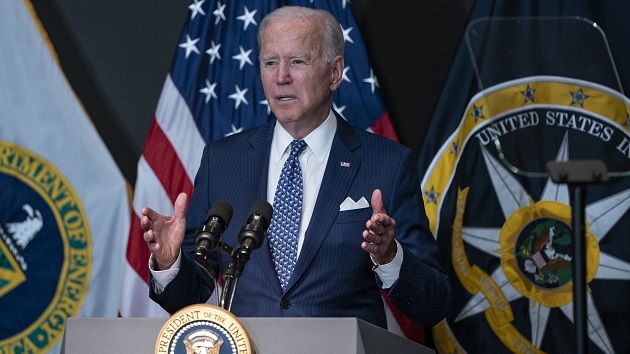
(WASHINGTON) — President Joe Biden said Tuesday afternoon that a mandate to require all federal employees to be vaccinated is now “under consideration.”

He said this one day after the Department of Veterans Affairs moved to require all health workers get a COVID-19 vaccine and shortly after the Centers for Disease Control and Prevention cited new science on the transmissibility of the delta variant and reversed its mask guidance.

“It’s under consideration right now,” Biden said when asked by ABC News if the federal government would expand the vaccine mandate. “But if you’re not vaccinated, you’re not nearly as smart as I thought you were.”
 

As he wrapped a visit to the Office of the Director of National Intelligence, ABC News also asked the president about Tuesday’s new guidance from the CDC, recommending masks for vaccinated Americans in public, and whether it would cause confusion, but Biden continued to focus on those who remain unvaccinated.

“We have a pandemic because the unvaccinated — and they’re sowing enormous confusion,” he said. “The more we learned — the more we learn about this virus and the delta variation, the more we have to be worried, concerned.”

“And the only one thing we know for sure, if those other 100 million people got vaccinated we’d be in a very different world. So get vaccinated. If you aren’t, you’re not nearly as smart as I thought you were,” Biden continued.

Following his remarks, Biden released a statement saying the CDC decision is “another step on our journey to defeating the virus” and that he’d have more to say on Thursday when he will “lay out the next steps” to get more Americans vaccinated.

Regarding the CDC recommendation for students, Biden said it’s “inconvenient,” but gives them a chance to learn “with their classmates with the best available protection.”

He also acknowledged concerns that as cases rise and mask guidance is reversed that the U.S. could be heading back to restrictions and closures but said in the statement, “We are not going back to that.”

“In the meantime, more vaccinations and mask wearing in the areas most impacted by the delta variant will enable us to avoid the kind of lockdowns, shutdowns, school closures and disruptions we faced in 2020. Unlike 2020, we have both the scientific knowledge and the tools to prevent the spread of this disease,” he said.

Earlier Tuesday, the CDC cited new science on the transmissibility of the delta variant and reversed its mask guidance to recommend that everyone in areas with high levels of COVID, vaccinated or not, wear a mask, as the virus continues to spread rapidly across the U.S.

“This new science is worrisome and unfortunately warrants an update to our recommendation,” CDC Director Rochelle Walensky told reporters during a briefing on Tuesday afternoon.

Throughout Washington there was a quick return to mask wearing for many who had grown accustomed to being without.

Vice President Kamala Harris, meeting with Interior Secretary Deb Haaland and Native American voting rights advocates Tuesday afternoon, wore a mask indoors for the first time since May 13.

Asked about the development, Harris gave a little shrug.

“None of us like wearing masks,” she said bluntly.

She noted that most people dying at this point are not vaccinated.

“People need to get vaccinated. That’s the only way we’re going to cut this thing off. No one likes wearing a mask. Get vaccinated. That’s it,” she said, then hitting her hand on the table for emphasis.

ABC News’ Cheyenne Haslett and Anne Flaherty contributed to this report.

Copyright © 2021, ABC Audio. All rights reserved.