(NEW YORK) — Soviet-born businessman Lev Parnas, a former associate of Rudy Giuliani, was found guilty Friday of making unlawful campaign donations totaling more than $350,000 to two pro-Trump super PACs and a GOP congressman in 2018, acting as a straw donor for a wealthy Russian who wanted to enter the burgeoning marijuana market in the United States.
Co-defendant Andrey Kukushkin was also convicted in the case, which was tried in a Manhattan federal court.
The illegal donations overlapped with Giuliani’s quest in Ukraine to unearth information that could damage then-presidential candidate Joe Biden, an effort in which Parnas allegedly positioned himself as a middleman.
“In order to gain influence with American politicians and candidates, they illegally funneled foreign money into the 2018 midterm elections with an eye toward making huge profits in the cannabis business,” U.S. Attorney Damian Williams said of Parnas and Kukushkin. “Campaign finance laws are designed to protect the integrity of our free and fair elections — unencumbered by foreign interests or influence — and safeguarding those laws is essential to preserving the freedoms that Americans hold sacred.”
As he left court, Parnas was heard saying “I’m upset, but i want to get back to my wife and my kids. We put up an incredible fight.”
Parnas was also convicted of using a shell company, as well as money belonging to his associate Igor Fruman, to funnel hundreds of thousands of dollars into Republican and pro-Trump political action committees. Fruman previously pleaded guilty in that case.
The defense portrayed Parnas as “in over his head” but not someone who willfully violated any laws.
Parnas was arrested two years ago at Dulles Airport holding a one-way ticket to Vienna. He now faces up to 45 years in prison.
(LONDON) — A suspected poacher found dead in a South African national park is believed to have been killed by an elephant, park officials said.
Rangers in Kruger National Park discovered the body on Thursday after following tracks in the Stolznek section of the giant game reserve, a spokesperson for the park said in a statement on Twitter.
“Initial investigations suspect that the deceased was killed by an elephant and left behind by his accomplices,” the statement said.
The identity of the deceased individual was not released.
The Rangers did not find any animals killed in the immediate area, the spokesperson said.
Park officials took the opportunity to warn that it is “dangerous to hunt illegally” in the park.
“Criminals stand to lose their lives and freedom,” the statement said.
Kruger National Park is South Africa’s largest wildlife sanctuary, encompassing nearly 5 million acres. The game reserve is also one of the hardest-hit regions in the country for rhino poaching. The park’s rhino population has decreased by 60% since 2013. In the first half of 2020, 166 rhinos were poached in South Africa, with 88 in Kruger National Park.
There are 3,529 white rhinos and 268 black rhinos left in Kruger National Park, according to South African National Parks.
To help combat rhino poaching, in recent months Kruger National Park has deployed more patrols in addition to using dogs and detection technologies to track suspects.
Between July and September, there was a nearly 30% increase in the number of poachers arrested in the park compared with the same period last year, according to South African National Parks.
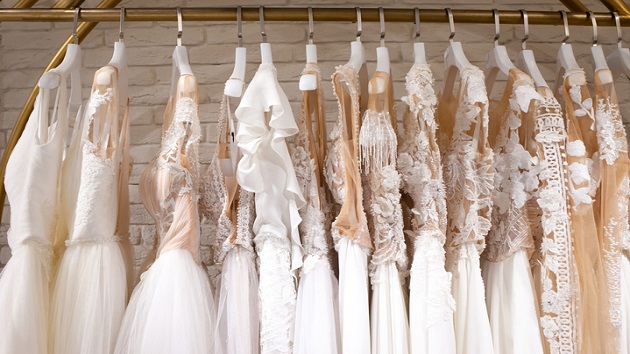
(NEW YORK) — As global supply chain issues continue to escalate, wedding dress delays could spoil the special days for many brides-to-be.
Many couples held off on weddings and rescheduled due to the pandemic, but now some brides are faced with their wedding gowns or bridal party dresses being delayed as well.
Upscale bridal shop L’Fay Bridal is advising brides to prepare for increased lead times for gowns ordered through their company.
“Gowns used to take about six to eight months to arrive, without rush fees,” L’Fay Bridal NYC shop manager McKenzie Custin told “GMA.” “Now brides can expect to wait a full nine to 10 months.”
Rush fees have also become more prevalent for brides looking to receive their gowns in less than eight months, she said.
Custin said brides should also include time for at least a monthlong alteration process when confirming their wedding dates. For example, if the wedding is planned eight months out, that only leaves seven months for a dress to actually arrive.
“The ideal timeline is nine to 10 months for your gown to arrive and one and a half to two months for alterations,” she added. “Brides should be ordering their gowns a full year or a little over year in advance to avoid any stress, worry or rush fees.”
It’s estimated that there will be 2.5 million weddings in 2022, the most the U.S. has had since 1984, according to The Wedding Report.
Coupled with global supply chain issues, several retailers don’t foresee wedding dress delays slowing down anytime soon.
“The increased timeline is unfortunately here to stay with the sudden boom,” said Custin. “Many designers are operating understaffed due to COVID-19 — this means that rush fees are required more often and the minimum turn around time for a gown has increased.”
In addition to wedding gowns, supply chain disruptions have also effected the arrival of bridesmaid dresses.
New York City-based pediatric nurse practitioner Allyson Tauber, who is scheduled to get married on March 12, 2022, found her wedding dress rather quickly. Once ordered, it arrived in six months as promised and now she is awaiting to begin alterations within the next few months.
But she hasn’t had the same luck when it comes to her bridesmaid dresses. She allowed them to pick their dresses from Bella Bridesmaids, and had all participants submit orders ahead of time.
However, in September, she received an email titled “Urgent Production Change for Dressy Fabrics.” “I was told that effective immediately, a few fabrics are majorly delayed due to COVID,” Tauber told “GMA.” “As it turns out, all of the dresses I had chosen were in the affected fabrics.”
Tauber was given the option to have everyone come in for a fitting and order their dresses within eight days and they would arrive the week before the wedding or they could change fabrics, colors or designers to accommodate what was available.
“I have finally decided to move forward with a third option — to cancel my order from Bella Bridesmaid and find my bridesmaid dresses elsewhere,” she said.
Tauber said she’s switched to Anthropologie’s bridal service instead.
“Anthropologie’s BHLDN has been amazing to work with,” she said. “I am very excited to have found a place where my bridesmaids can order dresses to try on at home and return them if they want to try another style or size.”
“GMA” has reached out to Bella Bridesmaids for comment.
While a great deal of the bridal industry has been impacted by ongoing global chain supplies, some stores, such as New York City’s Kleinfeld Bridal, said it has not been intensely affected.
“We are truly not seeing any issues or hearing of any,” said a Kleinfeld spokesperson. “The Kleinfeld merchandising and production teams are in daily constant contact with each of our designers and have not had any delivery issues nor do we foresee this effecting our brides.”
MORE: Supply chain questions answered, plus tips and solutions for smart shopping
The brand also highlighted that the store always has sample dresses available to buy straight off the rack.
Mass bridal retailers, such as David’s Bridal, have also reported seeing a 45% increase for in-store purchases versus online likely due to condensed planning and supply chain issues. The company owns its own supply chain, and carries over 300,000 gowns in stock and ready to go in a variety of styles.
With continual major delays globally, experts also suggest shopping through small businesses that carry products made in America.
(NEW YORK) — Truth Social, the social media app announced Wednesday by former President Donald Trump, could provide the former president with a substantial infusion of cash — but critics also warn that it could create a new platform for the spread of misinformation.
The app will be the first product of Trump’s new company, Trump Media and Technology Group, which is merging with the Nasdaq-listed Digital World Acquisition Group to form a publicly traded company, the former president announced.
The announcement comes at a time of turmoil for Trump’s family business, with multiple branches of the Trump Organization currently under criminal investigation, sources previously told ABC News. On Wednesday, it was reported that the Westchester, New York, district attorney’s office has had an ongoing criminal investigation into the Trump Organization’s Westchester golf course; in July, the Manhattan DA charged the Trump Organization and its longtime CFO, Allen Weisselberg, with tax fraud; and New York Attorney General Letitia James has been conducting a parallel probe into Trump’s business dealings.
Trump has denied all wrongdoing in the investigations, calling James’ investigation and the investigation into his Westchester golf course a “witch hunt.”
Trump also has millions in loans coming due early next year from one of his biggest creditors, Deutsche Bank. As of last year, Trump’s company owed the Frankfurt-based bank an estimated $340 million, according to filings to the U.S. Office of Government Ethics in July of 2020.
The Trump Organization is also reportedly in “advanced talks” to sell the Trump International Hotel in Washington, D.C, which lost $71 million while Trump was in office, according to newly released federal documents.
Digital World Acquisition Group is a SPAC, or special acquisition company, also referred to as a blank-check company, which is usually a company established by a group of investors with a large sum of cash on hand seeking an investment opportunity. They are essentially shell companies that are created to facilitate a merger with companies that want to go public on stock exchanges like the Nasdaq.
If the newly announced merger is completed, Trump’s company would have access to the nearly $300 million in cash raised by Digital World Acquisition. On Friday, Digital World Acquisition jumped more than 180% in Nasdaq trading before being halted due to volatility as shares surged for a second straight day. Previously, the stock surged more than 350% after the merger with Trump Media and Technology Group was announced.
The chairman and CEO of Digital World Acquisition, Patrick F. Orlando, is a Wall Street veteran who previously worked at numerous investment banks, including Deutsche Bank, until 2003. Orlando, who formed his own investment bank, Benessere Capital, is also CEO of Yunhong International, which is itself a blank-check company incorporated in the Cayman Islands with headquarters in Wuhan, China, according to Bloomberg.
Digital World Acquisition, which was incorporated in Miami in December 2020 shortly after Trump lost the 2020 election, also has ties to Brazil, as its chief financial officer, Luis Orleans-Braganza, is a current member of Brazil’s National Congress and supporter of the country’s far right president, Jair Bolsonaro.
Trump is no stranger to leveraging his celebrity name in the business world, with business offerings ranging from the hit TV show “The Apprentice” to now-defunct ventures like Trump University, Trump Steaks, and Trump Vodka.
“He is a marketer, he is always looking for ways to monetize,” said David Richard, a social media expert and professor at Emerson College. “He can monetize his followers and I think that’s exactly what he is doing.”
Trump has remained banned from most major social media platforms, including Twitter and Facebook, since the aftermath of the Jan. 6 attack on the U.S. Capitol, with companies citing fears that he could incite further violence. Trump has long credited Twitter and social media for helping fuel his 2016 presidential victory, and in launching his own social platform the former president is hoping to regain his enormous social media following as he looks toward the 2022 midterm elections and a possible run for the White House in 2024.
With Truth Social, Trump will enter an already-crowded market of right-wing social media alternatives that promise users a space for “free speech,” including Parler, Gab, and even Gettr, which was launched by the former president’s longtime aide Jason Miller just a few months ago.
Trump, in his announcement Wednesday, said he created Truth Social “to stand up to the tyranny of Big Tech.” But the former president, who used social media to spread falsehoods about the 2020 election, is drawing criticism from some social media experts who say Truth Social will likely become a “magnet for disinformation,” spreading only “Trump’s truth.”
“Donald Trump’s campaign and his brand has always been about creating a truth that benefits him,” said Richard. “If it’s the Trump algorithm, the opposition and dissenting voices are not going to pop up in the feed. Trump will always come first. It doesn’t matter what information you want, you will always get what Trump says at the top of the feed.”
A representative for Trump Media and Technology Group did not respond to ABC News’ request for comment about the new platform, and former President Trump’s office declined to comment.
Alexander Reid Ross, a fellow with the Centre for Analysis of the Radical Right, told ABC News that while he believes Truth Social won’t grow enough to replace top social media platforms like Twitter, it will probably become a gathering place for extremists who could “turn it into something more focused and deliberately violent.”
“I think the thing about a lot of these sites is that since they’re built solely on voicing frustrations and anger, the engagement is pretty limited,” Ross said. “Obviously, calling it Truth Social sort of lays out a path of hard-core trolling, gaslighting, and assorted reactionary tactics that we’re used to seeing from the Trump camp.”
“Trump’s political existence is fueled by impulsive emotional responses to easy narratives that don’t match the complexities of modern life,” added Ross. “So there is absolutely no reason to believe that a social media site built around his personality will involve modest inquiry based on scientific curiosity using rigorous research.”
Experts also told ABC News that Truth Social could end up having a similar outcome to Trump’s previous online venture.
Earlier this year, Trump shut down “From the Desk of Donald J. Trump,” a website where the former president posted statements after he was banned from Facebook and Twitter, after only about a month of operation.
“Trump does not have a great track record of launching online platforms in his post-presidency,” said Vivian Schiller, executive director of Aspen Digital at the nonprofit Aspen Institute for Humanistic Studies. “His last attempt, which he called a platform but was in fact a blog, petered out after a matter of weeks.”
On the other hand, said Richard, “Trump knows how to create controversy and he knows how to say things that rile people up,” which Richard said will make it easier for the platform to attract subscribers.
Schiller told ABC News that “the bar is nearly insurmountable” for the site to become an alternative to Facebook or Twitter because the site will likely appeal to mostly Trump supporters who “may grow bored if there’s no one to spar with.”
“That said — and this is important — Trump has defied expectations before, so we shall see,” Schiller said.
(DAVIS COUNTY, UT) — The Davis School District in Utah intentionally ignored widespread racial harassment, according to a scathing new report from the U.S. Department of Justice.
School officials have been accused of failing to respond to hundreds of reports from Black students who said they’ve been called racial slurs, including the N-word, been threatened or even been physically assaulted. Asian American students also were subject to widespread harassment in the district, according to the DOJ.
“White and other non-Black students routinely called Black students the N-word and other racial epithets, called them monkeys or apes and said that their skin was dirty or looked like feces,” the DOJ said students reported to them.
“Peers taunted Black students by making monkey noises at them, touching and pulling their hair without permission, repeatedly referencing slavery and lynching, and telling Black students, ‘Go pick cotton’ and ‘You are my slave,'” the report said students told the DOJ.
The Justice Department said the school district deliberately showed indifference to race-based student harassment, violated Black students’ equal protection rights and violated the equal protection clause when it refused to allow Black students to form student groups.
The two-year-long investigation also found students frequently were harassed and abused verbally and physically, and that even when such behavior was witnessed by faculty or staff, nothing was done to halt it.
Investigators also found that some staff members directly targeted students with racially abusive remarks.
Black students said the harassment was pervasive and consistent, and many students said they’d concluded faculty and staff effectively condoned the behavior because reporting it felt useless. Several students told investigators they “disliked attending school and at times missed school because of racial harassment.”
Other students said they feared retaliation for reporting the racial harrasment.
Davis School District has signed a settlement agreement with the Justice Department in connection with the district’s alleged mistreatment of students of color.
The agreement outlines steps required of the district to strengthen its procedures, training and practices in investigating and resolving allegations of racial harassment and discrimination, district representatives told ABC News in a statement. A consultant will be hired to review and help revise potential policies for the district, which serves tens of thousands of students across 91 schools, the district said.
District officials said they’ll work to correct its issues over the next few years and that they’ll soon share plans for doing so with students, parents and staff.
“During the investigation, the district was made aware of serious incidents of racial harassment and discrimination and instances where those incidents were not handled appropriately,” the statement continued. “The district takes these findings very seriously. They do not reflect the values of this community and the expectations of the district. The district pledges to correct these practices.”
(WASHINGTON) — The Supreme Court will take up the Texas abortion law on the merits next month in a rare highly-expedited case that could definitively resolve the fate of its six-week ban and unprecedented enforcement mechanism.
SB8 will remain in effect for the near future until the Court issues its decision, which wouldn’t typically be expected for weeks to months after a case is argued.
The justices granted the request of Texas abortion providers and civil rights groups to hear the case before lower courts ruled on the law.
They also said they would also examine the question of whether the U.S. government, in the separate case, could even seek an injunction against a state law like Texas’.
Oral arguments are set for Nov. 1 — one month before the court is already set to hear a milestone abortion rights case out of Mississippi.
The court said it deferred a decision on the Justice Department’s emergency request for the court to put SB8 back on hold and that it would wait for oral arguments before taking action. Justice Sonia Sotomayor dissented.
This is a developing story. Please check back for updates.
(WASHINGTON) — For reporters in Washington, it’s a frequent refrain from President Joe Biden on the status of negotiations with lawmakers on his domestic agenda: “I won’t negotiate in the press.”
But Thursday evening marked a shift from the strategy of playing his cards close to his chest. The president was unusually candid at a CNN town hall, laying his cards out publicly, and unafraid to call out moderate Sens. Joe Manchin and Kyrsten Sinema on the roadblocks they’ve created in the talks.
The decision was perhaps a calculated one, as the White House counts down the days before Biden departs for a major climate summit in Europe, at which the president hopes to have real domestic progress in hand to encourage other nations to adopt similar measures.
Early Friday morning, Biden hosted House Speaker Nancy Pelosi at the White House for breakfast, with Senate Majority Leader Chuck Schumer joining remotely, the three leaders already back at the bargaining table.
Pelosi later told reporters Friday that Democrats are nearing a deal on their two major agenda packages.
“We have a couple of outstanding issues that just need a decision,” she said, describing a deal as within reach. “I think it’s very possible,” she added.
Biden’s town hall capped off what has been the most momentous week of negotiation in months, with the president acquiescing to losing some key programs from his initial $3.5 trillion wish list, in order to meet those moderates calling for less government spending. The acknowledgement of the concessions could send a signal to Democrats that a deal on the package, which has been whittled from Biden’s $3.5 trillion wish list to just under $2 trillion, is imminent.
“I do think I’ll get a deal,” Biden said, in summary of the movement in recent days.
That deal has not been easy in coming. Biden admitted some painful cuts to his programs at the town hall, but the lifelong politician, who campaigned on his ability to reach bipartisan deals, said some losses were inevitable.
“Hey look, it’s all about compromise. You know, it’s – ‘compromise’ has become a dirty word. But it’s bipartisanship and compromise still has to be possible,” Biden said Thursday.
One of those compromises – losing the corporate tax rate hike Biden has long pushed for.
“I don’t think we’re going to be able to get the vote,” Biden said. He was blunt in pinning the blame on a lone hold-out in his caucus.
“Senator Sinema is opposed to any tax rate hikes for corporations and for high earners,” Biden said, offering an unusual amount of insight into his talks with the moderate Democrat.
Later Thursday, a White House official clarified that Biden meant it would be challenging to get enough votes to raise the corporate tax rate, but that other proposals, such as a tax increase on stock buybacks, or instituting a tax on billionaires’ stock holdings, could make up the difference, ensuring the package, which will likely to top out just under $2 trillion, would not add to the federal deficit.
Biden also wasn’t shy in pulling back the curtain on his conversations with moderate Manchin. Admitting that the plan to expand Medicare to cover dental, hearing and vision “a reach” at this point in the talks, Biden revealed Manchin’s thinking, and said he could settle for $800 vouchers to cover dental work.
“He says he doesn’t want to further burden Medicare so that — because it will run out of its ability to maintain itself in the next number of years. There’s ways to fix that, but he’s not interested in that part, either. But, look, Joe — Joe’s not a bad guy. I mean, he’s a friend. And he’s always, at the end of the day, come around and voted for it,” Biden said.
Biden also for the first time admitted that his proposal to guarantee 12 weeks of paid family leave will be cut significantly.
“It is down to 4 weeks,” Biden said, in a frank assessment. “And the reason it’s down to 4 weeks is because I can’t get 12 weeks.”
Biden also confirmed that two years of free community college is falling victim to the downsizing. He offered an increase to Pell grants instead, and vowed to continue to fight for the program.
“I promise you, I guarantee you, we’re going to get free community college in the next several years, across the board,” he said, adding jokingly that his first lady Jill Biden, a community college professor, would insist on it.
ABC News’ Benjamin Siegel contributed to this report.
(NEW YORK) — Climate change is not only warming the planet, it’s negatively affecting human health in myriad ways, with researchers reporting surges in heat-related illnesses, infectious diseases, poor sleep and an increase in suicides, according to a major report by The Lancet Countdown that’s been cosigned by health experts from more than 70 institutions worldwide.
“There is no safe temperature rise from a health standpoint,” Dr. Renee Salas, an author of the report and an assistant professor of emergency medicine at Harvard, said at a press briefing on Tuesday. “The take-home message of this year’s brief is clear: Climate change is first and foremost a health crisis.”
Additionally, the report shows how decades of racial inequity has deepened divides when it comes to health outcomes, especially in the U.S. over the last few decades, as researchers have observed an increase in the intensity, duration and frequency of heat waves, wildfires and droughts.
We could be investing in a healthier future. This is a pivotal moment in history.
More than a third of urban heat-related deaths in the 1990s and early 2000s can be attributed to climate change, and extensive research also has shown that exposure to heat waves poses a range of health risks, from heat rashes to heat exhaustion to heatstroke.
“During the last heat wave, I saw paramedics with burns on their knees from kneeling down on the sidewalk to take care of patients with heatstrokes,” said Dr. Jeremy Hess, a co-author of the report and a professor of environmental and occupational health services at the University of Washington. “I have seen patients die of heatstroke this year. These are preventable problems.”
Warmer temperatures also contribute to people sleeping less and observable increases in suicide and crime.
“Patients tend to complain more about sleep disturbances during heat waves, which generally go away once the weather passes,” said Dr. Shehram Majid, a New York City-based psychiatrist. “I have seen a rise in patients struggling with mood and anxiety disorders during periods of extreme weather in NYC.”
One study estimates that in the U.S., suicide rates rise 0.7% for every 1 degree Celsius increase in average temperature.
Climate change also creates and exacerbates droughts, which can lead to more wildfires that burn for much longer, which means more dust and smoke that destroys air quality. Agriculture suffers. Pollen levels can increase, affecting those with allergies.
And poor air quality can be felt thousands of miles away from fires. In July 2021, smoke from California’s Dixie Fire reached the Eastern Seaboard, contributing to the worst air quality in New York City in 15 years.
“September 2020, we saw the max wildfires to date, with about 80,000 wildfires in the U.S., which is eight times greater than 2001,” Salas added.
Emerging evidence, cited in the report, also shows that wildfire smoke may be more harmful than many other types of smoke, especially for children. Exposure has been linked to an increased risk of heart and pulmonary disease, premature death, worsened mental health and greater risk of preterm birth.
More flooding can create conditions that lead to increased mosquito breeding, which means diseases such as Dengue fever, a dangerous viral infection, can spreader wider more quickly via the insects.
“New Dengue transmission potential is five times higher than 1950,” Salas added.
Longer warm seasons also means more ticks are spreading Lyme disease.
“We spent many years talking about the pandemic, yet we were not prepared. We are bound to make the same mistake again with climate change. We have not invested in the mitigation and adaptation necessary,” said Dr. Georges Benjamin, executive director of the American Public Health Association. “The health sector is already stressed, and when you add these natural disasters it pushes things to the breaking point.”
Policymakers need to get serious about taxing carbon and reaching zero-emission targets, said Benjamin, adding: “This is an opportunity to invest differently in a green recovery that isn’t fueled by fossil fuels. We could be investing in a healthier future. This is a pivotal moment in history.”
Yalda Safai, M.D., M.P.H., a psychiatry resident in New York City, is a contributor to ABC News Medical Unit.
(NEW YORK) — Robert Durst has been charged in Westchester County with the murder of his former wife, Kathie, who disappeared in 1982, according to the district attorney’s office.
A criminal complaint was filed Tuesday of this week.
“The Westchester County District Attorney’s Office can confirm that a complaint charging Robert Durst with the murder of Kathleen Durst was filed in Lewisboro Town Court on Oct. 19, 2021. We have no further comment at this time,” a statement from a spokeswoman for Westchester DA Mimi Rocah said.
This is a developing story. Please check back for updates.
(ATLANTA) — A infant who was born at 25 weeks, after his mom was stabbed while walking on a trail in Atlanta, went home this month after spending nearly five months in the neonatal intensive care unit (NICU).
The baby, Theodore Jude, was released from the Children’s Hospital of Atlanta at Egleston on Oct. 8 with a farewell parade from nurses, who lined the halls with rattles to say goodbye.
“We’re obviously super grateful and praising that he’s alive and with us,” said Theodore’s mom, Valerie Kasper. “It’s been a long journey and it’s already been exhausting and like a rollercoaster, and now that he is home, this is the start of a new thing.”
Kasper, 34, was walking near her car with her 3-year-old son, Benjamin, on June 5, when she was stabbed multiple times by a homeless man who later admitted to the stabbing, according to the Associated Press. Police said they believe “mental illness played a role” in the case.
While Benjamin sustained no physical injuries in the attack, Kasper was transported to a local hospital, where she underwent an emergency C-section.
“The trauma of the attack was pretty intense obviously and the moment of going into surgery was just as scary,” said Kasper. “When I went into surgery I was crying, saying, ‘Save my baby and save my uterus,’ because I thought if he didn’t make it, I would want to have another baby.”
Theodore weighed just two pounds when he was born, and was immediately whisked away to the NICU, according to Kasper.
While they were performing the C-section, doctors also repaired Kasper’s colon and liver, which she said were both damaged in the attack.
She was not able to see her newborn son until 24 hours after giving birth, when she went in a wheelchair to visit him in the NICU.
“I was in so much pain that I couldn’t handle sitting in the wheelchair and I almost passed out in the NICU,” recalled Kasper, who was also not able to hold her son because he was still so fragile. “It was really hard.”
Kasper spent the next week in the hospital recovering from her injuries and from giving birth. Shortly after she was discharged on June 12, Kasper received a call from the NICU that Theodore was not doing well and would have to be transferred to another hospital for surgery.
“That was devastating,” she said. “I was thinking, ‘This is it. This is the life of the NICU. How am I ever going to fall asleep waiting for these phone calls?'”
Theodore survived what would be the first of four surgeries following his birth.
Kasper and her partner, Steven Barkdoll, both teachers, spent the next several months traveling back and forth between the NICU and their home, where they stayed with Benjamin.
Kasper was only able to hold Theodore for the first time during a visit to the NICU on June 28, three weeks after his birth.
“It took like three people to help me into the chair, to help the baby in my arms, and he was still intubated so it was just extremely fragile moving him,” she said. “I was sitting there kind of in pain, wanting to enjoy the moment but also having to be aware of my own limitations.”
After several more months of treatment, doctors discharged Theodore from the NICU on Oct. 8.
It was then that he met his older brother, Benjamin, for the first time.
“Benjamin just like ran over to the stroller, so excited to see his brother,” Kasper said of the meeting, five months in the making. “That was a big day.”
Though the family is now home under one roof for the first time in months, the recovery continues for both Theodore and Kasper, who still has limited mobility and pain from her wounds.
Theodore remains on oxygen and a feeding tube, as well as a heart monitor, according to Kasper. He also takes several medications and has frequent appointments with doctors and specialists.
“It’s like bringing home a newborn baby that needs lots of attention, and he needs a little even more attention,” said Kasper. “He’s a cutie pie and we love all the snuggles, but it’s still a stressful situation to be in.”
“We’re just monitoring him as he grows and supporting him the best we can to try to get him off all the machines and let him be a big boy,” she said of Theodore, who now weighs 11 pounds.
Kasper said she and her family have been touched by the outpouring of support they have received, from a GoFundMe account that has raised over $100,000 to friends and family offering support and the nurses and doctors who helped she and Theodore recover.
“It’s definitely a big motivator and relief, in a way, to know that evil can happen, or bad things can happen, and the love shines through,” she said. “I just get overwhelmed by that.”
“I feel that once we’re back on our feet, we’re going to have to be giving back for sure,” Kasper added.