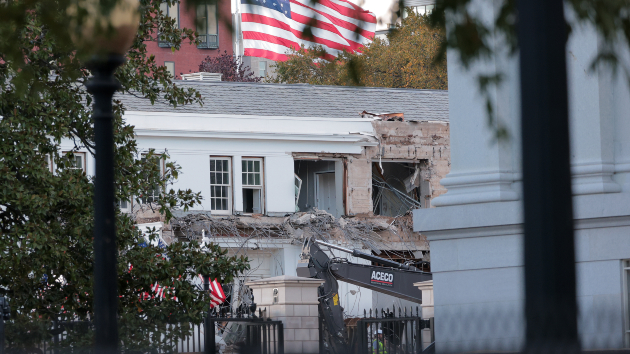
(WASHINGTON) — New images appear to show the entire White House East Wing has been demolished to make way for President Donald Trump’s $300 million ballroom.
White House press secretary Karoline Leavitt defended the demolition as she faced questions from reporters at a briefing on Thursday.
President Trump initially said in July that the project would not interfere with the existing White House structure. Then this week, as crews began to raze the East Wing, the administration said the entire wing would need to be “modernized” to make way for the massive 90,000 square foot ballroom.
By Thursday, satellite images from Planet Labs PBC showed the East Wing reduced to rubble.
“This is the People’s House. Why not inform the public of that change and when it was decided that the East Wing would have to be demolished?” ABC News Chief White House Correspondent Mary Bruce asked Leavitt.
“With any construction project changes come. And we have informed all of you, we’ve been keeping you apprised of this project. We’ve shown you the renderings,” Leavitt said.
“The plans changed when the president heard counsel from the architects and the construction companies who said that in order for this East Wing to be modern and beautiful for many, many years to come, for it to be a truly strong and stable structure, this phase one that we’re now in was necessary,” Leavitt added.
This is a developing story. Please check back for updates.
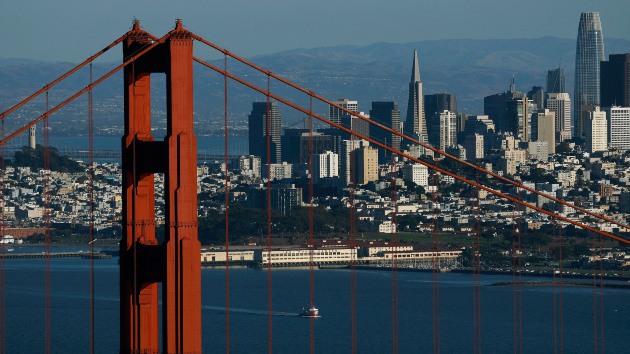
(WASHINGTON) — President Donald Trump said Thursday that he’s pulling back on his decision to send troops to clean up crime in San Francisco this weekend.
Trump claimed on social media that he spoke with the city’s mayor, Daniel Lurie, Wednesday night, who asked the president to “give him a chance” to turn things around.
“The Federal Government was preparing to ‘surge’ San Francisco, California, on Saturday, but friends of mine who live in the area called last night to ask me not to go forward with the surge in that the Mayor, Daniel Lurie, was making substantial progress. I spoke to Mayor Lurie last night and he asked, very nicely, that I give him a chance to see if he can turn it around,” Trump wrote on his social media platform.
Trump said the move could be a mistake, that he could fix things “much faster,” but ultimately said, “Let’s see how you do.”
“Therefore, we will not surge San Francisco on Saturday,” Trump concluded.
This is a developing story. Check back for updates.
(KITTITAS COUNTY, Wash.) — Rescuers in Washington trekked through 5 miles of snow to save two stranded hikers who had “no shelter but a blue plastic tarp,” with officials urging those who go on outdoor adventures to prepare accordingly.
The two hikers had lost their way in “unexpected snow” in the Alpine Lakes Wilderness area in the Cascade Mountains shortly before 11 a.m. on Sunday when they called the Kittitas County Sheriff’s Department for help.
The hikers used text-to-911 to say they were “lost, wet and cold, with no shelter but a blue plastic tarp” and that they were “unable to make their way off the snowy mountainside where they were perched,” the sheriff’s department said.
After hiking 5 miles through the snowy conditions, rescuers found the hikers, who were “wet and cold but uninjured,” officials said. The hikers were assisted off the slope they were perched on and out of the wilderness, officials said.
The sheriff’s department emphasized that as the seasons change, mountain conditions can change fast.
Officials said any outdoor enthusiast should pack “10 essentials” for any hiking or camping excursion: navigation, sun protection, insulation, illumination, first-aid supplies, fire starters, nutrition, hydration, emergency shelter and a repair kit and tools.
In the wake of several costly rescues over the summer, one official in Washington is proposing an ordinance that would fine an individual “if they are found to be reckless or negligent in their actions where search and rescue is requested to respond.”
“I need to find a creative way to deter the current behavior we are witnessing while attempting to recoup the financial burden placed on our county for an unfunded state mandate,” Skamania County Sheriff Summer Scheyer announced in June after the county experienced a 400% increase in search and rescue missions.
In June, Scheyer said the ordinance was “still in the planning phase,” but believed it would serve as an “added deterrent for those who take exceptional risks and expect the services we are required to provide as a result of their own actions.”
It is unclear whether the ordinance has passed in Skamania County. The Skamania County Sheriff’s Office did not immediately respond to ABC News’ request for comment.
Cris Hazzard, a professional hiking guide and author, known as “The Hiking Guy,” previously told ABC News that several minutes of “homework” before embarking on an outdoor excursion — including checking the website of the trail or park or downloading an app like AllTrails — can help hikers avoid challenging conditions or become aware of specific closures.
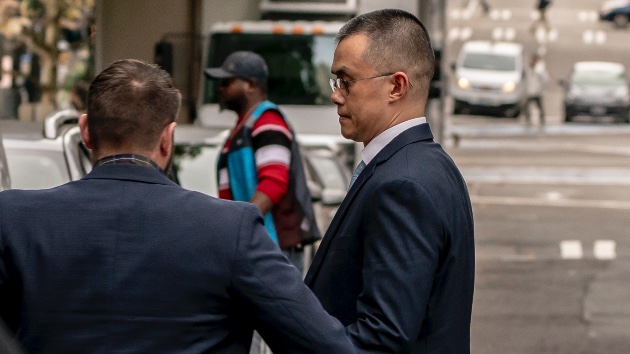
Binance CEO Changpeng Zhao leaves the U.S. District Court on November 21, 2023 in Seattle, Washington. Zhao pleaded guilty to a money-laundering charge. (Photo by David Ryder/Getty Images)
(WASHINGTON) — President Donald Trump has pardoned Binance co-founder Changpeng Zhao, White House press secretary Karoline Leavitt confirmed to ABC News on Thursday.
Zhao pleaded guilty in 2023 to a money laundering charge.
The pardon comes as Zhao made recent moves to boost World Liberty Financial, a cryptocurrency company that Trump’s sons, Eric and Donald Jr., launched earlier this year.
Leavitt said in a statement that Trump “exercised his constitutional authority by issuing a pardon for Mr. Zhao, who was prosecuted by the Biden Administration in their war on cryptocurrency.”
“In their desire to punish the cryptocurrency industry, the Biden Administration pursued Mr. Zhao despite no allegations of fraud or identifiable victims. The Biden Administration sought to imprison Mr. Zhao for three years, a sentence so outside Sentencing Guidelines that the even the Judge said he had never heard of this in his 30-year career,” Leavitt said in the statement. “These actions by the Biden Administration severely damaged the United States’ reputation as a global leader in technology and innovation. The Biden Administration’s war on crypto is over.”
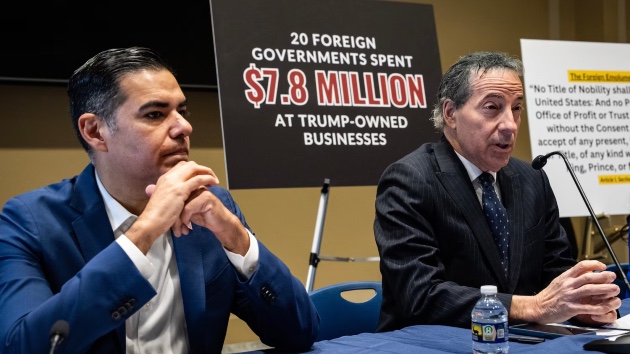
In this Jan. 4, 2024, file photo, Rep. Robert Garcia looks on as Ranking member of the House Oversight Committee Rep. Jamie Raskin speaks during a media briefing on Capitol Hill in Washington, D.C. Drew (Angerer/Getty Images)
(WASHINGTON) — Top House Democrats asked President Donald Trump on Thursday to provide documents — including correspondence between his lawyers and his Justice Department — as they investigate his demand for the DOJ to pay roughly $230 million as a settlement for investigations he faced during the Biden administration and in his first term in office.
Reps. Jamie Raskin and Robert Garcia, the ranking members on the House Judiciary and Oversight committees, respectively, sent a letter directly to Trump requesting that he provide documents and information to their committees.
“In remarks to the press this week, you described a blatantly illegal and unconstitutional effort to steal $230 million from the American people,”Raskin and Garcia wrote in their letter. “Your plan to have your obedient underlings at the Department of Justice (DOJ) instruct the U.S. Treasury to pay you, personally, hundreds of millions of dollars–especially at a time when most Americans are struggling to pay rent, put food on the table, and afford health care–is an outrageous and shocking attempt to shake down the American people.”
The committees want Trump to provide “all administrative claims filed by you on your legal representation under Federal Torts Claims Act” as well as “all correspondence between you or your legal representatives and any DOJ official.”
The Democrats also want “all DOJ memoranda, legal analyses, or recommendations shared with you and your legal representative, or any White House official.”
The settlement negotiations with DOJ stem from two separate administrative claims attorneys for Trump submitted while he was out of office in 2023 and 2024. One sought damages over the investigation he and some in his orbit faced surrounding ties between his 2016 campaign and the Russian government.
The second claim related to accusations that he was prosecuted maliciously by then-special counsel Jack Smith and that his privacy rights were violated when the FBI searched his Mar-a-Lago estate for classified documents in August of 2022.
Those claims would likely first need sign-off from top officials in the DOJ who previously served as Trump’s defense attorneys or otherwise represented his allies.
Trump, asked Tuesday by reporters in the Oval Office about the New York Times’ story that first reported Trump’s demand, said the decision would “go across my desk.”
“It’s interesting, because I’m the one that makes a decision, right?” Trump said. “And you know that decision would have to go across my desk, and it’s awfully strange to make a decision where I’m paying myself.”
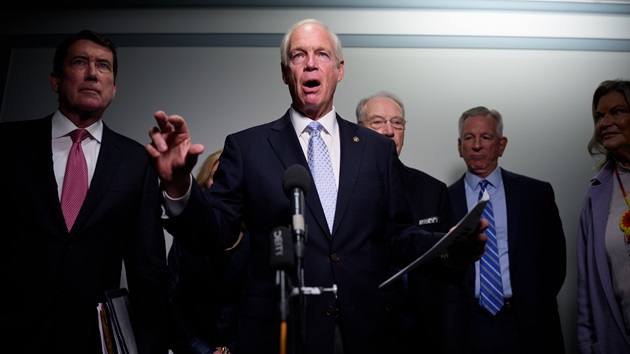
Sen. Ron Johnson (R-WI) speaks to reporters on Capitol Hill on October 6, 2025 in Washington, DC. Andrew Harnik/Getty Images
(WASHINGTON) — There’s going to be a different sort of government funding vote on Thursday as the ongoing shutdown reaches in 23rd day.
The Senate on Thursday will vote on a bill put forward by Republican Sen. Ron Johnson called the “Shutdown Fairness Act.” While the bill would not end the shutdown, it would allow some federal employees to get paid.
Johnson’s bill would provide appropriations to pay the troops and “excepted employees” of federal agencies being affected by the shutdown. That includes employees determined by the Office of Personnel Management to be performing emergency work, or for contractors who provide support to those employees.
Meanwhile Democratic Sen. Chris Van Hollen said he’d offer an alternative bill to Johnson’s that would pay all federal employees.
Johnson urged his colleagues to support the bill and slammed Democrats ahead of Wednesday night’s note to fund the government — which failed to advance for the 12th time.
“If Democrats vote for a 12th time to keep the government shut down, they should at least vote to pay those who are still working,” Johnson wrote on X. “It’s common sense and common courtesy — there’s no excuse to oppose the Shutdown Fairness Act.”
The bill would need 60 votes to pass and it’s unclear if it will get the support it needs to pass.
The vote on this bill comes as federal workers will miss their first full paycheck on Friday.
The legislation puts Democrats in an interesting spot, as Republicans will work to brand votes against this bill as votes against paying federal workers.
Over the last few days, several Democrats have said that they support paying federal employees — but some have added that they oppose the bill because it gives too broad of discretion to the White House and Office of Management and Budget to determine who is considered essential enough to be paid.
Meanwhile, some Republicans say there’s a simpler way for Democrats to ensure all federal employees get paid: funding the government.
“Ron Johnson’s bill would essentially weaponize the government shutdown to allow President Trump to decide who works and gets paid and who doesn’t work and doesn’t get paid,” Van Hollen said. “Our belief is that no federal employee, no one should bear the burden or be punished for a shutdown they have nothing to do with. So our view is that we want to make sure everybody gets paid at the end of the day.”
When pressed on why he would not, therefore, support the clean bill Republican’s have put forward 11 times, Van Hollen said it’s important to both pay Americans and protect health care.
“Of course, we want to open the government. That’s the best way to address this issue. We also need to address these other big issues,” Van Hollen said.
Van Hollen said he will likely offer his counter proposal on the floor and seek unanimous consent for its passage. It will almost certainly be blocked.
If Johnson’s bill passes, the House would have to return from recess to take it up in order for it to pass.
No vote is expected for Thursday on the clean short-term funding bill. With senators leaving town for the weekend, this shutdown will drag on to Monday.
(MIAMI) — Portland Trail Blazers head coach Chauncey Billups has been charged in an illegal poker operation tied to the Mafia, while Miami Heat guard Terry Rozier is among several people charged in a separate but related illegal gambling case, authorities announced on Thursday.
Billups, in his fifth season as head coach, was arrested in Oregon, where he is expected to make an initial court appearance on Thursday, sources said.
The poker games were allegedly rigged in favor of those running the games, using advanced technology, such as rigged shuffling machines and even X-ray technology to read cards facing down on the table, U.S. Attorney Joseph Nocella Jr. said.
Christopher Raia, assistant director in charge of the FBI’s New York Field Office, called it a “massive, nationwide takedown” of 34 defendants in connection with two separate sports betting and illegal poker schemes.
Among the defendants are current and former NBA coaches and players as well as 13 Mafia members and associates, Raia said.
Billups coached the Trail Blazers in their season opener on Wednesday night, a loss to the Minnesota Timberwolves.
Billups was also a star player, mostly for the Detroit Pistons, before retiring in 2014. He was a five-time All-Star in his 17 years in the NBA and led the Pistons to the NBA title in 2004, being named Finals MVP.
He was the No. 3 overall pick in 1997 and finished his career with 15.2 points and 5.4 assists per game.
Rozier and former Cleveland Cavaliers player and assistant coach Damon Jones were charged in a separate case, authorities announced.
They allegedly passed inside information to four co-defendants, who are accused of passing the information to a network of sports bettors, sources said. Those bettors allegedly placed wagers with online sports books or retail betting outlets, which prohibit betting based on nonpublic information.
The indictment included an example from March 23, 2023, when Rozier — then playing for the Charlotte Hornets — allegedly tipped off a co-defendant that he planned to leave the game early with a purported injury, sources said. He left the game nine minutes in. A co-defendant and others allegedly placed $200,000 in wagers, betting Rozier would underperform his statistics.
FBI Director Kash Patel announced the charges at a news conference Thursday, saying over 30 people were arrested in the “historic” and ongoing cases.
Rozier is in his 11th year in the league. He’s appeared in 665 games and has averaged 13.9 points per game over 665 games played. He was a key contributor for the Boston Celtics on playoff runs in 2016-19 before joining the Hornets.
His team opened the 2025 season Wednesday night in Orlando, but Rozier did not play as he deals with a hamstring injury.
Last year, former Toronto Raptors forward Jontay Porter pleaded guilty to wire fraud and received a lifetime NBA ban after he bet on his team to lose, pretended to be hurt for gambling purposes and shared confidential information with gamblers.
This is a developing story. Please check back for updates.
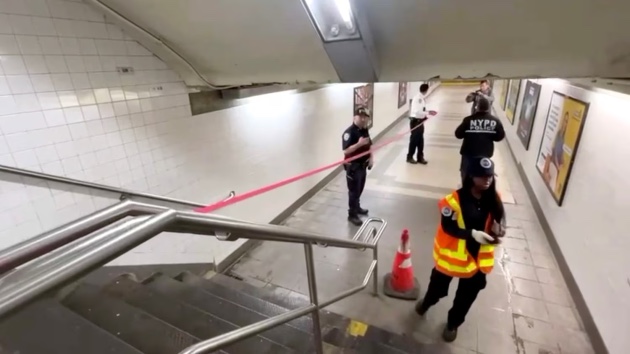
A baby was found on a subway platform in Manhattan, New York, on Oct. 20, 2025. (WABC)
(NEW YORK) — The woman charged with abandoning her newborn at a Midtown Manhattan subway station told investigators she gave birth just hours before she left the baby at the bottom of a staircase, according to court documents.
The baby girl was found wrapped in a blanket at the southbound 1 train platform at 34th Street-Penn Station during the Monday morning rush hour, the New York Police Department said. The umbilical cord was still attached, indicating she had likely been born within a few hours, according to the criminal complaint.
The baby was taken to the hospital in stable condition, police said, with New York City Transit President Demetrius Crichlow calling it “the miracle on 34th Street.”
Police said the mother, 30-year-old Assa Diawara, was caught on surveillance footage carrying a bundle in her arms through the turnstiles at the subway station. More footage showed her leaving the station empty-handed, the complaint said.
Diawara allegedly admitted she was the woman in the videos and said she gave birth late Sunday night into early Monday morning, the complaint said.
Diawara was taken into custody early Wednesday on charges of abandonment of a child and endangering the welfare of a child, police said.
Detectives identified her by following a trail of surveillance camera footage, an NYPD official said. Video showed Diawara taking a car service to Jamaica, Queens, and then investigators canvassed the area where she was dropped off and found a neighbor who recognized her from the surveillance footage, the official said.
Diawara has made her first court appearance and was granted supervised release. She is due to return to court in December.
New York’s Abandoned Infant Protection Act permits a parent to leave a newborn in a safe place — like a hospital, police station or fire station — up to 30 days after the baby’s birth. The parent would not be prosecuted and can remain anonymous as long as the baby is left in a safe place and the appropriate person is notified.
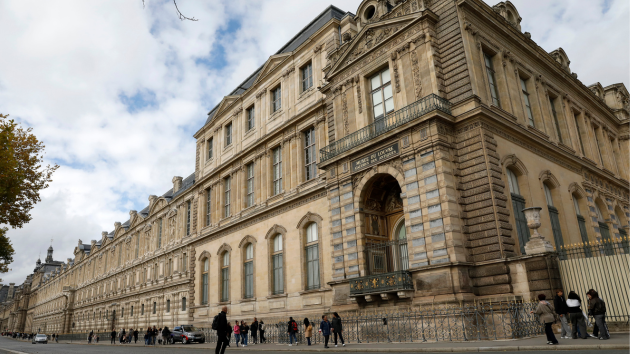
(LONDON) — Two traces of DNA were found in one of the helmets and one of the gloves suspects left behind after a jewelry heist at the Louvre on Sunday, French police told ABC News.
In what could be the first major break in the investigation of the $102 million jewel heist at the Louvre Museum, investigators are now analyzing the lates clues in hopes it would lead to identifying the brazen thieves involved in the heist.
The latest development comes as the director of the Louvre took the hot seat on Wednesday, telling lawmakers she submitted her resignation following Sunday’s daylight robbery from the museum’s ornate Apollo Gallery.
Appearing in front of France’s Senate Culture Committee for two hours, Laurence des Cars, the president and director of the Louvre, said her resignation was rejected.
“This tragedy deeply shocked museum staff, fellow citizens, and admirers of the Louvre around the world,” said des Cars, reading an opening statement. “This is an immense wound that has been inflicted on us.”
Des Cars said all of the museum’s alarms worked, as did its video cameras, but noted a “weakness” in security.
“The weakness of the Louvre is its perimeter security, which has been a problem for a long time … certainly due to underinvestment,” des Cars told the lawmakers.
She said a “Grand Louvre renovation project” began 40 years ago “and has only affected half of the museum.”
She said the only camera installed outside the Apollo Gallery was facing west and did not cover the window where the thieves used power tools to break in.
“The security system, as installed in the Apollo Gallery, worked perfectly,” des Cars said. “The question that arises is how to adapt this system to a new type of attack and modus operandi that we could not have foreseen.”Despite touting the security system within the Louvre as working properly, des Cars added, “Today we are witnessing a terrible failure at the Louvre. The security of the Louvre is one of my top priorities during my term of office, and I repeat that I was appalled by the museum’s security situation when I arrived in 2021.”
Des Cars said the 232-year-old museum’s “aging infrastructure” has hindered “the instalation of modern equipment.”
Officials said earlier this week that evidence collected so far points to “organized crime,” but added that investigators have not ruled out that the heist could have been an inside job.
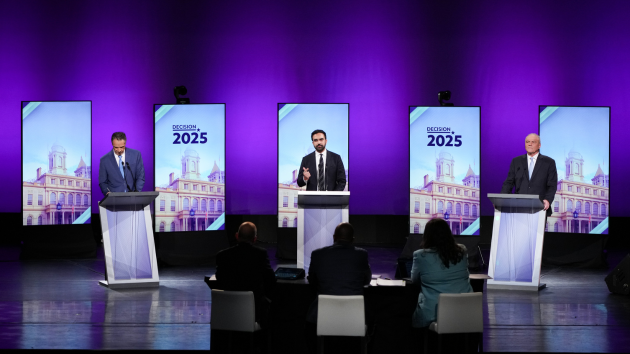
(NEW YORK) — The knives came out during Wednesday night’s second and final New York City mayoral debate.
While answering questions on policy issues such as housing and education, the candidates onstage — Democratic candidate and state assemblyman Zohran Mamdani, Republican candidate and “Guardian Angels” founder Curtis Sliwa, and independent candidate and former Gov. Andrew Cuomo — relentlessly attacked each other over what they said were each others’ shortcomings.
Some of the most acrimonious moments came during what were ostensibly meant to be discussions on policy.
Cuomo said that the number of homeless people in New York City had “more than doubled” since he stepped down as governor, criticizing what he claimed was Mamdani’s lack of action on the issue as an assemblyman.
Cuomo, who resigned the governorship in 2021 amid allegations of sexual harassment that he has long denied, used the phrase “since I left,” to refer to the end of his tenure — which Sliwa quickly jumped on.
“Andrew, you didn’t leave. You fled! From being impeached by the Democrats in the state legislature — you fled!” Sliwa cried out.
A question to Mamdani about his position on schools turned into a free-for-all between him and Cuomo.
“I did things — you have never had a job,” Cuomo said to Mamdani at one point. “You’ve never accomplished anything. There’s no reason to believe you have any merit or qualification for 8 and 1/2 million lives … Shame on you. Shame on you.”
Mamdani countered, “Always a pleasure to hear Andrew Cuomo create his own facts at every debate stage. We just had a former governor say in his own words that this city has been getting screwed by the state. Who was leading the state? It was you!”
“Governor Hochul, Governor Hochul,” Cuomo countered, referring to current Gov. Kathy Hochul. “You were the legislator–“
They both continued to talk over each other until a moderator intervened.
Sliwa seized on the fighting to get in a shot.
“I heard the both of them again, fighting like kids in the schoolyard,” Sliwa said. “Zohran, your resume could fit on a cocktail napkin, and Andrew, your failures could fill a public school library in New York City.”
Overall, on the issue of dealing with President Donad Trump, the candidates were asked what combination of “defiance, diplomacy and cooperation” they’d use if the Trump administration attempts to interfere in the running of the city or threatens to cut funding.
Sliwa, who has a frosty relationship with Trump — and has not courted his endorsement — criticized the other two candidates as too confrontational.
“My adversaries have decided to bump chests with President Trump to prove who’s more macho,” Sliwa said. “You can’t beat Trump. He holds most of the cards … So if you’re all of a sudden going to get adversarial, you’re going to lose and who gets hurt? The people of New York City. With Trump, it’s always the art of the deal.”
Cuomo, meanwhile, said the mayor has to both confront and work with the president — and then painted a mayoral victory by Mamdani as an invitation for Trump to wreak havoc.
“He has said he’ll take over New York if Mamdani wins, and he will, because he has no respect for him,” Cuomo said. “He thinks he’s a kid, and he’s going to knock him on his tuchus” — using the Yiddish slang term for someone’s rear end. He added that the mayor both has to combat and work with the president at different points
“We first just heard from the Republican candidate for mayor, and then we heard from Donald Trump’s puppet himself, Andrew Cuomo,” Mamdani retorted. “You could turn on TV any day of the week, and you will hear Donald Trump share that his pick for mayor is Andrew Cuomo, and he wants Andrew Cuomo to be the mayor, not because it will be good for New Yorkers, but because it will be good for him.”
In terms of the running of the city, the debate moderators asked Mamdani about recent reports that he would ask New York Police Commissioner Jessica Tisch to remain in her position if elected, which he said he would.
“Commissioner Tisch broke the status quo, started to deliver accountability, rooting out corruption and reducing crime across the five boroughs. I have said time and again that my litmus test for that position will be excellence, and the alignment will be of that position,” he said.
Cuomo said he would ask Tisch to stay on and said he didn’t believe Mamdani’s pledge.
Sliwa said he, too, also would ask Tisch to stay on the job “for stability” but said he didn’t think she would serve in a Cuomo or Mamdani administration.
As for the support of incumbent Democratic Mayor Eric Adams — both Mamdani and Sliwa said they would not accept an endorsement from Adams, who suspended his reelection campaign late last month.
Cuomo said he would and posted a photo of himself online sitting courtside with Adams at a New York Knicks game after the debate.