All pregnant people should get COVID-19 vaccine amid delta variant surge, leading health organizations say

MarsBars/iStock

(NEW YORK) — The nation’s two leading health organizations focused on the care of pregnant people have issued new guidelines calling on all pregnant people to get vaccinated against COVID-19.

The new joint recommendation from the American College of Obstetricians and Gynecologists (ACOG) and the Society for Maternal-Fetal Medicine (SMFM) comes as the United States faces both a low vaccination rate and a summer surge of COVID-19 cases as the more contagious delta variant spreads.

Just 16% of pregnant people in the U.S. had received more than one dose of a COVID-19 vaccine as of May, compared to the nearly 58% of Americans ages 12 and up who are fully vaccinated against COVID-19, according to data from the Centers for Disease Control and Prevention (CDC).

“ACOG is recommending vaccination of pregnant individuals because we have evidence of the safe and effective use of the vaccine during pregnancy from many tens of thousands of reporting individuals, because we know that COVID-19 infection puts pregnant people at increased risk of severe complications, and because it is clear from the current vaccination rates that people need to feel confident in the safety and protective value of the COVID-19 vaccines,” ACOG president Dr. J. Martin Tucker said in a statement. “Pregnant individuals should feel confident that choosing COVID-19 vaccination not only protects them but also protects their families and communities.”

Both ACOG, a national membership organization for more than 60,000 OBGYNs, and SMFM, a global organization with more than more than 5,000 physicians, scientists and women’s health professionals, previously recommended that pregnant people have access to vaccines and should “engage in shared decision-making” about the vaccine with their doctors.

“COVID-19 vaccination is the best method to reduce maternal and fetal complications of COVID-19 infection among pregnant people,” Dr. William Grobman, president of SMFM, said in a statement announcing the new recommendation, also noting the vaccines are safe before, during and after pregnancy.

Here is what pregnant and breastfeeding people may want to know about the COVID-19 vaccines to help them make informed decisions.

1. When can pregnant people get a COVID-19 vaccine?

Everyone 12 years of age and older, including pregnant people, is now eligible to get a COVID-19 vaccination, according to the U.S. Centers for Disease Control and Prevention (CDC).

Pregnant people can get the COVID-19 vaccine at any point in their pregnancy, and the vaccine does not need to be spaced from other vaccines, like the flu shot or Tdap booster.

2. What is the science behind the COVID-19 vaccine?

Both the Pfizer and Moderna vaccines use mRNA technology, which does not enter the nucleus of the cells and doesn’t alter the human DNA. Instead, it sends a genetic instruction manual that prompts cells to create proteins that look like the virus a way for the body to learn and develop defenses against future infection.

They are the first mRNA vaccines, which are theoretically safe during pregnancy, because they do not contain a live virus.

The Johnson & Johnson vaccine uses an inactivated adenovirus vector, Ad26, that cannot replicate. The Ad26 vector carries a piece of DNA with instructions to make the SARS-CoV-2 spike protein that triggers an immune response.

This same type of vaccine has been authorized for Ebola, and has been studied extensively for other illnesses — and for how it affects women who are pregnant or breastfeeding.

The CDC has concluded that pregnant people can receive the Johnson & Johnson one-shot vaccine after reviewing more than 200 pages of data provided by the company and the U.S. Food and Drug Administration (FDA).

Vaccine experts interviewed by ABC News said although pregnant women are advised against getting live-attenuated virus vaccines, such as the one for measles, mumps and rubella, because they can pose a theoretical risk of infection to the fetus, the Johnson & Johnson vaccine doesn’t contain live virus and should be safe.

3. Are there studies on pregnant women and the COVID-19 vaccine?

Two recent studies found Pfizer and Moderna’s COVID-19 vaccines appear to be “completely safe” and effective for pregnant people, according to Dr. Francis Collins, director of the National Institutes of Health (NIH).

Collins wrote in a blog post that the Pfizer and Moderna vaccines, which both use mRNA technology, were found to provide in pregnant people the levels of antibodies and immune cells needed to protect them against COVID-19.

The vaccines were also found to likely offer protection as well to infants born to a vaccinated person, according to Collins.

“Overall, both studies show that COVID-19 mRNA vaccines are safe and effective in pregnancy, with the potential to benefit both mother and baby,” he wrote, later adding, “While pregnant women are urged to consult with their obstetrician about vaccination, growing evidence suggests that the best way for women during pregnancy or while breastfeeding to protect themselves and their families against COVID-19 is to roll up their sleeves and get either one of the mRNA vaccines now authorized for emergency use.”

One study cited by Collins in his blog post was led by researchers at Northwestern University studying people who had been fully vaccinated during pregnancy.

The study, published May 11 in the journal Obstetrics & Gynecology, is believed to be the first to examine the impact of the COVID-19 vaccines on the placenta, according to the university. Researchers found the vaccine had no impact on pregnancy and no impact on fertility, menstruation and puberty.

The second study cited by Collins, led by researchers at Beth Israel Deaconess Medical Center and Harvard Medical School, looked at more than 100 women who chose to get either the Pfizer or Moderna vaccines. Researchers found that the women’s antibodies against COVID-19 after being fully vaccinated were also present in infant cord blood and breast milk, “suggesting that they were passed on to afford some protection to infants early in life,” according to Collins.

An earlier study, a study published in the American Journal of Obstetrics & Gynecology in March found the Pfizer and Moderna vaccines are safe and effective in pregnant and lactating people and those people are able to pass protective antibodies to their newborns.

Researchers studied a group of 131 reproductive-age women who received the Pfizer or Moderna vaccine, including 84 pregnant, 31 lactating and 16 non-pregnant women and found antibody levels were similar in all three groups. No significant difference in vaccine side effects were found between pregnant and non-pregnant study participants.

The study had some limitations. It was small and participants were primarily white health care workers from a single city. On the other hand, it’s the largest study of a group that was left out of initial vaccine trials.

4. What are health groups saying about the COVID-19 vaccine?

In addition to ACOG and SMFM, other health organizations have also said COVID-19 vaccines are safe for pregnant people.

The World Health Organization (WHO) says pregnant people at high risk of exposure to COVID-19 and those at risk of severe disease should be vaccinated.

“While pregnancy puts women at higher risk of severe COVID-19, very little data are available to assess vaccine safety in pregnancy,” WHO said in a statement. “Nevertheless, based on what we know about this kind of vaccine, we don’t have any specific reason to believe there will be specific risks that would outweigh the benefits of vaccination for pregnant women. For this reason, those pregnant women at high risk of exposure to SARS-CoV-2 (e.g. health workers) or who have comorbidities which add to their risk of severe disease, may be vaccinated in consultation with their health care provider.”

The CDC says people who are pregnant and breastfeeding “may choose to be vaccinated” and should talk with their health care provider, noting that breastfeeding is an important consideration but “is rarely a safety concern with vaccines.”

“Getting a COVID-19 vaccine during pregnancy can protect you from severe illness from COVID-19,” the CDC states on its website. “If you have questions about getting vaccinated, a conversation with your healthcare provider might help, but is not required for vaccination.”

5. What will clinical trials be like for pregnant people?

Pfizer’s phase 2/3 trial will enroll approximately 4,000 women within weeks 24-34 of their pregnancy, the company announced in a press release.

Half will get the vaccine, and half will get a placebo.

The study will include healthy, pregnant woman age 18 and older in the U.S., Canada, Argentina, Brazil, Chile, Mozambique, South Africa, the United Kingdom and Spain.

Participants in the vaccine group will receive two doses at 21 days apart — and each woman will be followed for at least 7-10 months in order to continuously assess for safety in both participants and their infants.

Infants will also be assessed, up until 6 months of age, for transfer of protective antibodies from their vaccinated mother.

Women enrolled in the trial will be made aware of their vaccine status shortly after giving birth to allow those women who originally received placebo to be vaccinated while staying in the study.

6. Why weren’t pregnant people included in early clinical trials?

Not recruiting parents-to-be in clinical trials and medical research is nothing new, according to Dr. Ruth Faden, the founder of the Johns Hopkins Berman Institute of Bioethics and a bioethicist who studies the ethics of pregnancy and vaccines.

“For a very long time, pregnant women were not included in biomedical research evaluation efforts or clinical trials, both for concerns about fetal development and what would be the implications of giving a pregnant women an experimental drug or vaccine and also for legal liability worries from manufacturers and pharmaceutical companies,” Faden told “GMA” last month. “There’s a huge gap between what we know about the safety and effectiveness of a new drug or a new vaccine for the rest of the population and what we know about it specific to pregnancy.”

In the case of the COVID-19 vaccines, health experts have only one of the three sources of evidence that are used to evaluate safety and efficacy during pregnancy: the data on non-pregnant people who were enrolled in the clinical trials, according to Faden.

From that, Faden said, health experts can try to glean what side effects may happen to people who are pregnant, but it is not an exact science.

However, it’s considered typical — and many argue ethically appropriate — to study an unknown substance first in healthy adults and then progressively in broader and broader populations. Pregnant people and children are often tested later down the line because of concerns about potential long-term harm.

Some of the volunteers in prior COVID-19 vaccine trials that didn’t include pregnant women directly may still become pregnant during the trial. This will also give researchers some insights about the vaccine’s safety among this group.

7. What risk factors should pregnant people consider?

At this time, the CDC recommends that pregnant women be prioritized for vaccinations and encourages them to speak to their doctors about the risks and benefits of a vaccination.

The question of whether an expecting parent should receive a COVID-19 vaccine will eventually come down to a number of factors, including everything from the trimester, risk factors for COVID-19, ability to remain socially distanced in their lifestyle and occupation, guidance from federal and state officials and recommendations from a person’s own physicians, experts say.

Similar to the flu vaccine, which was not tested on pregnant people in clinical trials, health experts will need to rely on continuously incoming data to make decisions around how safe the COVID-19 vaccines are during pregnancy.

Officials are doing the same for the general population, considering the speed at which the COVID-19 vaccines were developed, according to Faden, who noted that people who are pregnant should not be “unnecessarily alarmed.”

The COVID-19 vaccines can be taken during any trimester. Since other vaccines are recommended during pregnancy, the CDC currently recommends spacing out vaccine appointments a few weeks apart, if possible.

8. Is COVID-19 more dangerous for pregnant people?

Even now, more than one year into the coronavirus pandemic in the U.S., some questions remain about how pregnant people are impacted by COVID-19.

The CDC has shared data showing that pregnant people infected with COVID-19 are at an increased risk for “intensive care unit admission, invasive ventilation, extracorporeal membrane oxygenation, and death,” compared to nonpregnant people.

Health experts say that with or without the vaccine, pregnant people need to continue to remain on high alert when it comes to COVID-19 by following safety protocols, including face mask wearing, social distancing and hand washing.

ABC News’ Sony Salzman and Eric Strauss contributed to this report.

Copyright © 2021, ABC Audio. All rights reserved.

COVID-19 live updates: Delta leaves vaccinated, unvaccinated with similarly high viral loads, CDC says

hapabapa/iStock

(NEW YORK) — The United States is facing a COVID-19 surge this summer as the more contagious delta variant spreads.

More than 612,000 Americans have died from COVID-19 and over 4.1 million people have died worldwide, according to real-time data compiled by the Center for Systems Science and Engineering at Johns Hopkins University.

Just 57.7% of Americans ages 12 and up are fully vaccinated against COVID-19, according to data from the Centers for Disease Control and Prevention.

The CDC on Tuesday, citing new science on the transmissibility of the delta variant, changed its mask guidance to now recommend everyone in areas with substantial or high levels of transmission — vaccinated or not — wear a face covering in public, indoor settings.

Here’s how the news is developing Friday. All times Eastern:

Jul 30, 1:00 pm
Delta variant leaves vaccinated, unvaccinated with similarly high viral loads: CDC

Data shows that the delta variant leaves vaccinated and unvaccinated people with similarly high viral loads, CDC Director Dr. Rochelle Walensky said in a statement Friday.

“High viral loads suggest an increased risk of transmission and raised concern that, unlike with other variants, vaccinated people infected with Delta can transmit the virus,” Walensky said.

“This finding is concerning and was a pivotal discovery leading to CDC’s updated mask recommendation” this week, Walensky said.

-ABC News’ Sony Salzman

Jul 30, 10:45 am
6 passengers test positive on cruise ship

Six passengers on Royal Caribbean’s Adventure of the Seas ship have tested positive for COVID-19 during routine testing, the cruise line said Friday.

Four of the passengers — who were not traveling together — are vaccinated. The other two are unvaccinated minors who were traveling together, the cruise line said.

One person has mild symptoms. The other five have no symptoms, the cruise line said.

“The guests were immediately quarantined, and their immediate travel party and all close contacts were traced and all tested negative,” Royal Caribbean said. “Each guest and their immediate travel parties disembarked in Freeport, The Bahamas, and separately traveled home via private transportation.”

This cruise started in the Bahamas on July 25. Everyone over 16 must be fully vaccinated and test negative before boarding, the cruise line said.

-ABC News’ Sam Sweeney

Jul 30, 10:30 am
Broadway audiences must be vaccinated

As Broadway gears up for its return in September, the Broadway League announced Friday that everyone attending a show must be vaccinated and wear a mask.

Guests will need to show proof of vaccination when they enter the theater.

This rule applies through October 2021 and may change in November.

All performers, staff and backstage crew also must be vaccinated.

Jul 30, 5:29 am
New Yorkers getting 1st dose to receive $100 incentive

Starting Friday, New Yorkers who receive their first dose of the COVID-19 vaccine at any city-run site will get a $100 incentive.

New York Mayor Bill de Blasio made the announcement during a press briefing Wednesday.

“We will say thank you. We’ll say we’re really glad that you got vaccinated for yourself, for your family, for your community,” de Blasio said. “And here’s $100 to thank you for doing the right thing and to encourage people.”

The mayor said that New Yorkers getting vaccinated will not only get the cash, they’ll also be able to do “everything else that’s wonderful in this city, including the amazing concerts coming up. You can’t go to those concerts unless you’re vaccinated.”

Jul 30, 4:53 am
Japan to extend coronavirus state of emergency covering 3 of Tokyo’s neighboring prefectures

Japan’s government will put in place a coronavirus state of emergency covering three of Tokyo’s neighboring prefectures and Osaka on Monday, according to public broadcaster NHK.

Tokyo and Okinawa’s declarations will remain in place.

The news comes as case numbers in Japan continue to rise amid the Olympics.

As of Friday, there are 3,300 new positive cases in Tokyo, according to the Tokyo government’s COVID-19 information website. Of those 3,300 cases, 88 are severe and two have turned fatal.

Jul 30, 4:22 am
New CDC brief says vaccines may be less effective against delta variant

An internal Centers for Disease Control and Prevention brief published by the Washington Post Thursday reveals more details about why the delta variant is different to and more concerning than other strains of the coronavirus.

The CDC said the main differences between the delta variant and previous strains is that delta is highly contagious and likely more severe. Plus, breakthrough infections caused by delta may be as transmissible as unvaccinated cases.

“This is an incredibly, incredibly contagious version of virus, it’s almost like a whole different virus,” Dr. Ashish Jha said. “And CDC is estimating that it is probably also more deadly.”

Vaccines prevent more than 90% of severe diseases, but may be less effective at preventing infection or transmission of the delta variant, the CDC said. Therefore, there could be more breakthrough infections and more community spread despite people’s vaccination status.

“Current vaccines continue to provide strong protection against severe illness and death, but the delta variant is likely responsible for increased numbers of breakthrough infections — breakthroughs that could be as infectious as unvaccinated cases,” Dr. John Brownstein, an ABC News contributor, said. “This internal document highlights the challenge we all now face in combating the most transmissible variant of COVID so far.”

Jul 30, 3:38 am
Number of positive cases at Tokyo Olympics reaches 225

There are now 225 positive COVID-19 cases at the Tokyo Olympics, according to a tally kept by Olympics organizers.

That is an increase of 27 cases since Thursday.

Of those cases, three of them are athletes. Two were in the Olympic Village at the time of their positive case, and one was not.

Copyright © 2021, ABC Audio. All rights reserved.

New details on CDC’s Provincetown investigation portray delta variant as serious threat

Narvikk/iStock

(WASHINGTON) — Adding more insight into the CDC’s updated mask guidance, newly published details of the Provincetown outbreak raise concern that the now-dominant delta variant may be able to spread among fully vaccinated people.

Following multiple large gatherings in Provincetown, Mass., from July 3-17, investigators identified 469 COVID-19 cases, two-thirds of which were in fully vaccinated people. The delta variant was responsible for 90% of those cases. The breakthrough infections were among people vaccinated with Pfizer, Moderna and Johnson & Johnson. None of the vaccinated people died, but most had some symptoms.

During the outbreak investigation, researchers learned that the amount of virus in the noses of vaccinated people experiencing a breakthrough infection was the same as in an unvaccinated person — a worrying sign vaccinated people can spread the virus.

“This finding is concerning and was a pivotal discovery leading to CDC’s updated mask recommendation,” said CDC Director Rochelle Walensky in a statement.

“This is a very concerning outbreak — pretty much a ‘super spreader event,'” said Dr. Carlos Del Rio, executive associate dean and global health expert at the Emory School of Medicine.

Experts caution that more studies are needed to understand if what happened in Provincetown holds up in subsequent outbreak investigations. The CDC report noted the social gatherings were “densely packed.” And breakthrough infections are still relatively uncommon, with the majority of cases driven by spread among unvaccinated people. Meanwhile, an internal CDC briefing first published by the Washington Post and confirmed by ABC News outlined additional new data suggesting that the delta variant is different from prior variants in other ways. Chiefly, this variant appears to be extraordinarily contagious — possibly more so than Ebola, Spanish flu, chickenpox and the common cold. It’s also possible delta leads to more severe illness, but for now this is only a possibility and not firmly established.

Taken collectively, these new revelations prompted the CDC to update its mask guidance Tuesday to recommend that vaccinated people once again don masks indoors, especially in high-transmission areas. And that includes schools this fall.

“The rules have changed,” said Dr. Dan Barouch, director of the Center for Virology and Vaccine Research at Beth Israel Deaconess Medical Center. “We have a different epidemic now that we did in May.”

Throughout the spring and summer, the CDC based its guidance on scientific studies of prior COVID-19 variants, including the then-dominant alpha variant, which was first identified in the U.K. and swept the United States during the 2020-2021 winter surge.

But the delta variant — which only just surpassed alpha as the dominant variant on July 6 — is different. It hit the U.S. so fast that only in the past few weeks has sufficient data emerged to show scientists just how significant those differences were.

That means that throughout the summer, the nation’s public health guidance may have been based on alpha variant rules while the nation was living in a delta variant world.

It’s a game of catch-up that’s all-too-familiar to doctors and scientists who have dedicated their lives to preventing infectious disease.

“This is what I always say in a pandemic: I wish I knew today what I’m going to learn tomorrow,” Del Rio said.

“When we released our school guidance on July 9, we had less delta variant in the country, we had fewer cases in the country,” said Walensky, speaking at a Tuesday press conference. “And importantly, we were really hopeful that we would have more people vaccinated, especially in the demographic between 12 to 17 years old,” she said.

Now, Del Rio said, new data is telling us “that the virus has changed — it’s a lot more transmissible, and it has been able to adapt.”

Although it now seems that vaccinated people can pass the virus, “the great majority of transmissions is still coming from vaccinated people,” Del Rio said. “That’s why you’re seeing mandates come left and right. People are saying, enough is enough.”

Experts say this is still a pandemic largely of the unvaccinated, with a majority of cases among unvaccinated people, meaning it’s more important than ever for anyone who is not vaccinated to get vaccinated.

Crucially, current vaccines appear to work just as well against delta to dramatically reduce the risk of severe illness and death. But they may not work as well at preventing mild infections.

“Current vaccines continue to provide strong protection against severe illness and death, but the delta variant is likely responsible for increased numbers of breakthrough infections — breakthroughs that could be as infectious as unvaccinated cases,” said John Brownstein, Ph.D., the chief innovation officer at Boston Children’s Hospital and an ABC News contributor.

The CDC brief said one of the agency’s biggest challenges moving forward is countering the public perception that vaccines don’t work. But the fact that roughly half the nation is already vaccinated likely saved the United States from an even deadlier summer surge, experts agreed.

“If it were not for the vaccines, there likely would have been a massive overwhelming surge in this county,” Barouch said.

Even still, large portions of the country — including children — remain unvaccinated. And what scientists are learning about the delta variant’s capacity to transmit between vaccinated people might mean we need to mask up again — especially in those high transmission areas.

“We have to get the unvaccinated vaccinated. And in the meantime, masking is useful, but not sufficient so we have to also add testing to the mix of mitigation strategies,” Del Rio said.

For now, the future remains uncertain. Many scientists worry about a winter surge, while others feel encouraged that the delta variant might fade away as suddenly as it arrived.

“There is some evidence — first from India and now from the U.K. — that the delta variant surges and then begins to dissolve,” Barouch said. “We don’t fully understand why the sparks catch fire, and we don’t fully understand why the flames go out.”

ABC News’ Sasha Pezenik, Anne Flaherty, Arielle Mitropoulos and Eric Strauss contributed to this report.

Copyright © 2021, ABC Audio. All rights reserved.

Data suggests Russia’s COVID-19 death toll is far higher than reported

Macky_CH/iStock

(ST. PETERSBURG, Russia) — At the start of June, St. Petersburg’s local administration stopped publishing information about how many COVID-19 patients had been hospitalized in the Russian city.

The sudden disappearance of the previously daily reported figures happened to coincide with the opening of one the city‘s most prestigious annual events, the St. Petersburg International Economic Forum.

The forum, a gathering of Russia’s elite and a showcase for its biggest companies, has become a flagship event under President Vladimir Putin. Over five days, 13,000 people were expected to attend the event, where Putin told the audience that life was “gradually returning to its normal routine” after the pandemic.

But the forum was opening just as St. Petersburg was seeing a terrifying surge in COVID-19 cases, as a third wave fueled in part by the delta variant bore down on the country. The last bulletin before the numbers vanished had shown St. Petersburg hospitalizing 500 people a day — a record number and one that meant the city would run out of hospital beds within days.

Journalists and critics of the government quickly started asking if the disappearance of the COVID-19 statistics was connected to holding the forum. St. Petersburg’s administration refused to comment and the latest figures weren’t published again until nearly three weeks later. They were no longer updated daily, either.

“They need to create the impression that everything is OK,” said Boris Vishnevsky, an opposition lawmaker from St. Petersburg’s city assembly, who also opposed holding the forum. “They don’t care about people’s lives and health.”

Throughout the pandemic, Russian authorities have been accused of massaging statistics to hide the real scale of the country’s COVID-19 impact. The Kremlin has repeatedly suggested that although it has been difficult, Russia has fared better than most other countries, even as it has neglected to impose tough lockdown measures.

But publicly available mortality statistics, as well as other data, show an ever growing, yawning gap between Russia’s official COVID-19 figures and what are likely the far larger real numbers. The data suggest the true death toll may already be over a half-million people. Far from doing better than most, the data suggests that, in reality, Russia has suffered one of the deadliest COVID-19 epidemics in the world.

The toll is growing even steeper now as Russia endures a deadly third wave that has remained largely unchecked amid few restrictions and poor vaccination uptake — the latter caused in part by some of the highest levels of vaccine scepticism in the world.

Russia’s official COVID-19 death toll, published by the government’s coronavirus task force, currently stands at around 155,000. In total numbers, that still places Russia fourth in the world, behind only Brazil, India and the United States. But, given the size of the country’s 144 million population and the number of cases it has had, that number appears puzzlingly low.

There is a consensus among experts internationally that the best method to assess the true toll of the pandemic in Russia is by counting so-called “excess deaths.” That is, comparing the total number of deaths from any cause in a country during the pandemic periods with the total number of deaths in an average year.

Almost every country hit by the pandemic has seen a steep increase in total deaths compared to the average. Although some of those extra deaths can be attributed to other causes, such as disruption to health systems, most experts believe the vast majority are COVID-19 deaths.

Russia’s official death toll doesn’t take into account excess deaths, but its national statistics service, Rosstat, has quietly continued to release total mortality data for each month, publishing it in spreadsheets on its website. That has allowed independent demographers and journalists to calculate excess deaths for Russia during the pandemic.

The mortality data so far released by Rosstat shows that in 2020, Russia suffered 340,000 more deaths than in 2019. For the first five months of 2021, there were 133,000 more excess deaths.

That means Russia has sustained at least 473,000 more deaths during the pandemic than usual, already three times higher than its officially reported toll. That does not yet include June and July, the deadliest months of the current third wave.

“I think that by the end of September, the overall excess mortality will be at least 700,000 people,” said Alexey Raksha, an independent demographer who previously worked at Rosstat. “It is a huge number.”

By proportion of the population, the current figures give Russia the highest death toll of any major country in the world and place it in the top five of any country in the world, behind only Peru, Bulgaria, North Macedonia and Serbia, according to a ranking by The Economist tracking excess deaths globally.

“In November and December of last year, the number of deaths have been record. The biggest in history, in post-war history in Russia,” said Raksha.

Raksha was fired from his job as a demographer at Rosstat last year after he publicly pointed out the discrepancies in the official COVID-19 statistics. He has accused Russian authorities of crudely manipulating the numbers, which he says is visible in the unnatural anomalies in the data released by the country’s coronavirus task force.

He points to line graphs showing monthly deaths for Moscow, where steep curves indicating increasing deaths at certain times suddenly flatline and hold steady for several days.

“It’s in contradiction with all statistical, epidemiological, demographical law,” Raksha said. “It’s just impossible.”

He said the sudden plateaus are nicknamed the “Soybanin’s Shelf,” referring to Moscow’s Mayor Sergey Sobyanin. He said they were the result of city officials simply putting a limit on the number of deaths that could be published that day.

“At some point, Sobyanin just ordered not to show more than 75 deaths daily in Moscow. That’s it,” Raksha said.

Russian health officials have previously said they take a more conservative approach to assessing COVID-19 deaths. But that does not explain the vast difference and, at times, officials have acknowledged the real death toll is substantially higher.

In December, Deputy Prime Minister Tatiana Golikova, who oversees the COVID-19 response, acknowledged that around 81% of all excess deaths in Russia were caused by COVID-19. The federal statistics service in June also published an estimate suggesting there had been over 270,000 COVID-19 deaths.

But Russia’s primary official death toll, which is most often used internationally and in state media, has not been updated to match those statements.

A recent investigation by three independent Russian investigative news sites also found evidence that internal government records show it is also concealing the scale of COVID-19 cases in the country by as much as five times.

The sites, Meduza, Kholod and Mediazona, reported that an oversight by Russia’s health ministry in issuing certificates confirming recent COVID-19 patients had inadvertently revealed the ministry has a database containing 29 million recorded COVID-19 cases. The official public count currently only shows six million.

The government has denied the reports, but issued conflicting responses, saying the database was not accurate and that it also contained vaccination numbers.

Critics have said the efforts to make Russia’s bout with the pandemic appear less deadly are making it worse by discouraging people from taking the virus seriously, which they say also hampers its push to vaccinate. Although Russia’s Sputnik V vaccine has been found to be effective, authorities are struggling to persuade Russians to get it.

With few restrictions in place and still less than 20% of the population fully vaccinated, doctors in the city told ABC News they feared a fourth wave in the autumn was already inevitable.

“Doctors will answer for it, not the government,” said a paramedic in St. Petersburg, who requested anonymity over concerns she could face retaliation.

In St. Petersburg last week, Alexander Yablokov, a 68-year-old soccer manager, said he did not believe the official death toll after he spent three weeks in a COVID-19 hospital. While there, he said he was in a small ward where all but one of seven patients with him died within a week. He said he had pulled his blanket over his head whenever he heard the sound of a gurney coming down the corridor, knowing another of his neighbors had passed.

“I thought I had found myself in a morgue. Not a hospital but a morgue,” he said

Copyright © 2021, ABC Audio. All rights reserved.

Sarah Ferguson speaks out on Duchess Meghan and why she would marry Prince Andrew ‘all over again’

Maggie Rulli and Taylor Behrendt-Rhodes, ABC News

(LONDON) — Sarah Ferguson, the Duchess of York, has spent most of her adult life in the public spotlight, first as the wife of Prince Andrew and then as a favorite target of the British tabloid media.

Several decades later, another new royal bride, Meghan, the Duchess of Sussex, became the target of the tabloid media when she wed Ferguson’s nephew, Prince Harry, in 2018.

“I believe that everybody has a right to their own voice and there should be no judgment on race, creed, color or any other denomination,” Ferguson told Good Morning America about the press’ treatment of Meghan, who joined Harry in stepping down from their senior royal roles last year and moving to California.

“I personally would never be able to judge another, so I just am not like that,” she said. “I wish Harry and Meghan so much happiness and I know that [the late Princess] Diana would be so proud of her sons and their wives.”

Ferguson — whose latest chapter in life is as author of a new novel, Her Heart for a Compass — was a close friend of Princess Diana’s, her sister-in-law in Britain’s royal family. Though the two were pitted against each other in the British press, she calls Diana her best friend.

Diana, the mother of Princes William and Harry, died in 1997 after a car crash in Paris, but Ferguson said she keeps her friend’s memory alive to this day.

“She’s in my heart,” Ferguson said of the late princess, whom she calls her “laughing friend.”

“I always say it doesn’t matter whether you get the love back or you don’t get love back or she’s here or she’s not here, you can love anyway and keep the kindness,” she said

“I loved Diana and I will always love her even if she isn’t here in person. It’s a really lovely thing to have,” she said.

Ferguson, now 61 and a grandmother of one with another on the way, said she also imagines what life would be like now with Diana, whose two sons have five children between them.

“If she was here, we’d be racing to the bouncy castle with our grandchildren,” said Ferguson. “The funny thing is we’d be with our grandchildren running in the egg and spoon race. She was always a better, faster runner than me.”

Finding her voice through writing

Ferguson drew on her own journey in the spotlight to write her first novel, which is set in the Victorian era and is based on her distant relative, Lady Margaret.

“Lady Margaret is an extremely wonderful, strong, very resilient redhead who fights for her heart … against extraordinary confines of what is seen as noble and duty,” she said. “I think I couldn’t write that and I couldn’t explain it if I hadn’t had a hint of fighting my own journey through my own compass of my own heart.”

“She didn’t have a voice,” Ferguson added. “So it’s about literacy, empowerment, empowerment of a woman’s voice that has been shut away.”

Ferguson said she is just now learning in her own life to speak up and not be a self-described “people pleaser,” saying, “I don’t believe I’ve really spoken out until now, properly.”

In the novel, Margaret is portrayed as having a complicated but honest relationship with her mother, a relationship Ferguson said she never got to have with her own mom.

“When she left me, I was so young,” said Ferguson. “And then my sister went to Australia, so I became the head of the house around 13, 14 years old, and I think that that’s possibly why I still have the rebel in me.”

Ferguson spoke with GMA while doing one of her favorite activities, horseback riding, which she said she relied on as a child for stability in her life.

“My ponies really helped me so much when my mother went to live in Argentina because they were my friends,” she said, describing them as “consistent” and “steadfast.” “They don’t go anywhere and they didn’t answer back. They are just so special.”

Taking life ‘one step at a time’

Though she had a complicated time as a member of Britain’s royal family, Ferguson remains an ardent supporter of the monarchy.

“I am a number one fan of the monarchy,” she said. “And I stand very strongly for the extraordinary steadfastness of the queen.”

She also speaks fondly of Prince Andrew, whom she married in 1986 and divorced a decade later, though the two remain very close.

“He is a great man and [our wedding day] was the best day of my life,” she said. “I would do it all over again because he was a very good-looking sailor, but I fell in love with him and I think love conquers all.”

Andrew, who shares two daughters with Ferguson, Princesses Beatrice and Eugenie, has faced intense scrutiny over his relationship with convicted sex offender Jeffrey Epstein, who died in prison in 2019.

Andrew, the third child of Queen Elizabeth, spoke out in a 2019 BBC interview and categorically denied allegations he had sex on multiple occasions with an American teenager who’s claimed she was trafficked to the prince at the direction of Epstein. Shortly after the interview, Andrew announced that he would step back from public duties, “for the foreseeable future” amid heavy criticism.

When asked how she has found resilience in the face of personal drama and tabloid scandal, Ferguson said she has learned to “take one step at a time.”

“You just look at it. What do I need to learn from this? How do I feel? [You] apologize profusely to yourself, to others, mostly to yourself for letting yourself down, perhaps, and you move forward and you get on and you take one step at a time,” she said. “I have destroyed myself many times, but the most important thing is to get up and get going.”

Ferguson also gives credit to the American public for helping her regain her footing after she and Andrew divorced. She credits Americans with welcoming her and supporting her through different ventures, including working with WW, formerly Weight Watchers.

“That’s why I want to say thanks to the American people, because they have given me a life,” she said. “And they’ve given me a chance to be able to have a platform to talk and to be able to say, ‘Be yourself.'”

Speaking of her ability to continually evolve both personally and professionally, Ferguson added, “I’m 61. I’m just starting my life. “

Copyright © 2021, ABC Audio. All rights reserved.

Front-line workers in Florida say current COVID-19 surge ‘feels like it’s an impending storm’

tuachanwatthana/iStock

(TAMPA, Fla.) — A jarring reality check is taking place in intensive care units across the country as thousands of COVID-19 positive patients, nearly all of them unvaccinated, are streaming into hospitals in need of care.

This is particularly true in Florida, where virus-related hospitalizations have skyrocketed in recent weeks. The situation has escalated rapidly, now nearing peak levels, with nearly 7,900 patients hospitalized with the virus across the state, up by more than 320% in the last month, according to data from the Centers for Disease Control and Prevention.

“It feels like it’s an impending storm … there’s no off ramp to this getting worse,” Dr. David Wein, an emergency room physician at Tampa General Hospital in Florida, told ABC News on Wednesday.

On Tuesday this week, more than 1,450 patients with COVID-19 were admitted to hospitals across the state, marking the highest number of patients seeking care within a 24-hour period in Florida since the onset of the pandemic.

“Right now, at Tampa General Hospital, we are really feeling the crush of this increase incidence of COVID-19, and so the delta area has really brought many patients to our emergency room, requiring treatment and admission,” Peggy Dugan, the executive vice president and chief medical officer at the hospital, told ABC News in an exclusive interview.

It was just six weeks ago that some of the team thought they may be out of the woods, with metrics steadily trending down across the country.

“It felt like we were ready to move in the right direction and start seeing it plateau. And it was a surprise to see it trend up like it did,” said Erika Mergl, nurse manager for the Tampa General Hospital’s Global Emerging Diseases Institute.

However, virus-related hospitalization levels are now nearing peak levels.

“We’re getting to numbers that were as high as last summer. In early July, we were down to 12 COVID-19 patients in the hospital, and today we have 80. So we’re really just seeing an escalation over a short span of time,” Duggan said.

The situation in Tampa is not an anomaly. Nearly every state in the country is now experiencing case, and COVID-19 hospitalization increases. Virus-related hospitalizations levels are now at their highest point since April, with nearly 33,700 patients receiving care — about 10,000 more patients than a week ago.

Many of the patients at Tampa General are younger, Dugan said, some as young as 22 or 23 years old, and “almost” all of them have been unvaccinated, the hospital said.

One of the hospital’s unvaccinated patients is 64-year-old patient Gerard Considine, who spent nine days intubated after he tested positive for the virus.

“I’m not used to being scared of anything, but this scared the hell out of me,” Considine told ABC News.

Considine said he didn’t get the COVID-19 vaccine because he had experienced adverse reactions to other vaccines, but despite his ordeal, he does not think he will choose to be vaccinated, believing that he has developed some antibodies, at this point.

However, said Duggan, “we’re seeing people who are recovering now very regretful that they didn’t get the vaccination in the first place.”

Many of the patients coming to the hospital are already quite ill when they arrive, said Wein.

“Unfortunately, we’re seeing people who are coming in days, or several days, into their disease and sicker, with difficulty breathing, needing to be admitted to the hospital. So it feels more like that winter surge that we had,” Wein said, adding that a number of these patients end up on ventilators.

“This is heartbreaking because all this could have been avoided, this is unnecessary human suffering that we are witnessing right now,” Dr. Seetha Lakshmi, the medical director of the Global Emerging Diseases Institute at Tampa General Hospital, told ABC News.

Several front-line workers at Tampa General Hospital expressed to ABC News their deep concern and fear about the next several weeks for their teams, given the state’s and the hospital’s exponential increase in infections and virus-related hospitalizations, stressing that their message to Americans is that vaccinations are key to controlling the pandemic and ending the suffering.

The difference in getting vaccinated, or not getting vaccinated is ultimately akin to “the difference between having a cold and dying,” said Wein. “If a vaccinated patient gets this, they’re most likely going to be just fine, and not going to end up in the hospital. Unfortunately, the unvaccinated person has a really high likelihood that he will end up hospitalized on a ventilator.”

Copyright © 2021, ABC Audio. All rights reserved.

New evidence has doctors worried about long-term damage from COVID ‘brain fog’

xavierarnau/iStock

(NEW YORK) — A flurry of new scientific findings is prompting renewed concern among doctors about the long-term cognitive impacts of COVID-19 in some patients.

Several new studies presented at the Alzheimer’s Association International Conference, being held this week in Denver, have found that many COVID-19 patients experience “brain fog” and other cognitive impairments months after recovery. This adds to a growing body of research on COVID-19’s apparent long-haul symptoms, which can include confusion, forgetfulness and other worrying signs of memory loss.

“This research features the first data from an international consortium, which includes the Alzheimer’s Association, investigating the long-term consequences of COVID-19 on the brain,” Heather Snyder, the vice president of medical and scientific relations for the Alzheimer’s Association said in prepared remarks.

Not enough time has passed for researchers to know if these worrying symptoms eventually clear up. However, they’re pointing to these studies as renewed evidence that everyone — especially older people who are already vulnerable to cognitive decline — should get vaccinated.

“While we work together to further understand the lasting impacts of COVID-19 on the brain, the take home message is simple: don’t get COVID-19. And the best way to do that is by getting vaccinated,” Maria Carrillo, chief science officer for the Alzheimer’s Association, said in prepared remarks.

Researchers at the University of Texas Health Science Center studied the cognition and olfactory senses of 300 older adult Amerindians from Argentina who contracted COVID and found that 50% had persistent problems with forgetfulness and 25% had additional problems with language and executive dysfunction.

“A large portion of our patients in the COVID Recovery Program exhibit cognitive signs and symptoms long after the inflammatory phase of COVID has passed. We typically see many patients with naso-pharyngeal predominant illness come back to us with more neurocognitive deficits,” Dr. Thomas Gut, director of the Post-COVID Recovery Center at Staten Island University Hospital, told ABC News. Gut was not involved in any of the studies presented at the conference.

Researchers at the New York University Grossman School of Medicine studied blood samples of 310 patients admitted to NYU Langone Health with COVID for the presence of biomarkers that would indicate brain inflammation and damage. High levels of certain biomarkers were strongly associated with inflammation in the brain. Damage to the blood-brain barrier caused by inflammation can result in the brain’s inability to send messages from the brain to other parts of the body.

“So far, our efforts offering supportive therapies have shown improvement, but the recovery time is still measured in months. Finding a cause and mechanism for these inflammatory changes in the brain would be the first place to start in addressing how to reverse or prevent these inflammatory changes,” said Gut.

Researchers from the University of Thessaly reviewed the cognitive function and overall health of 32 patients with mild to moderate COVID infection two months post-hospitalization and found that more than 50% experienced cognitive decline, particularly with short-term memory. They also found that poorer memory and thinking scores were associated with lower level of oxygen saturation during a short walk test.

“Many of the cognitive changes that we see mirror in many ways Alzheimer’s disease or PTSD,” said Gut. “What is becoming clearer, is that the severity of acute infection does not directly predict neurocognitive changes after the acute phase has passed. We have many patients that had mild infection or illness struggle severely with memory or behavior changes.”

Copyright © 2021, ABC Audio. All rights reserved.

States with surging COVID-19 rates also tend to have higher rates of uninsured

Lubo Ivanko/iStock

(NEW YORK) — As COVID-19 cases surge across much of the United States and many vaccinated people return to indoor masking, a pattern appears to be emerging — the same states that are seeing the biggest increases in COVID-19 infections also have high rates of residents who don’t have health insurance.

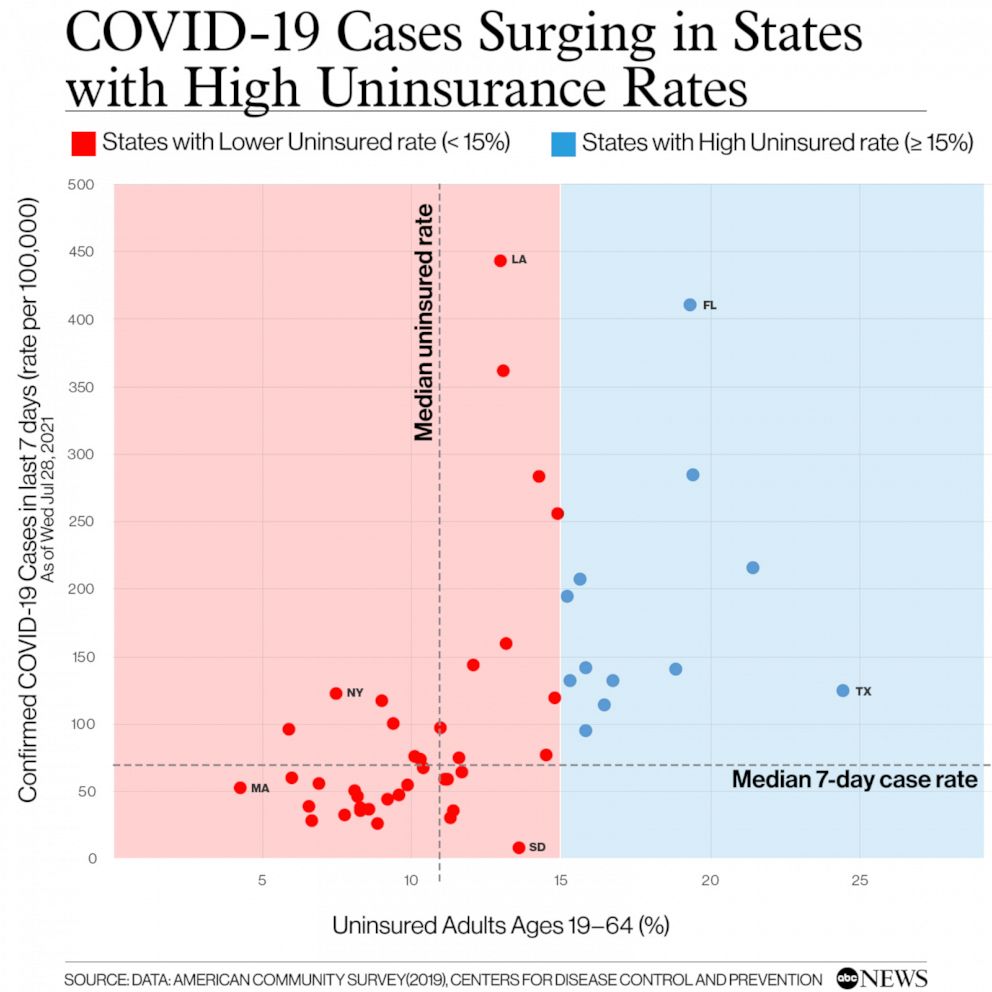
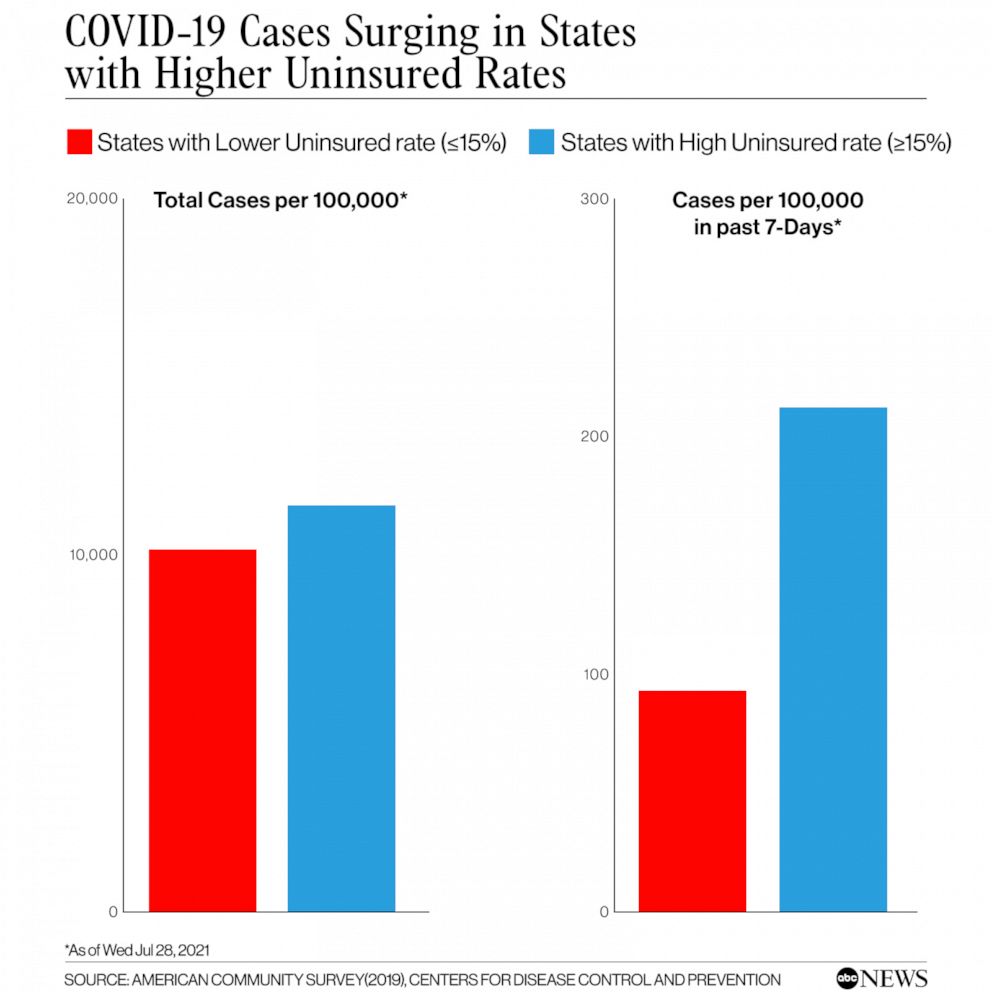
While COVID-19 data changes daily, as of Wednesday, the 12 states with the highest seven-day new case rates also had higher than average uninsured rates, according to data from the American Community Survey and the Centers for Disease Control and Prevention.

“​​It lines up with everything we’ve seen during the pandemic,” said John Brownstein, Ph.D., the chief innovation officer at Boston Children’s Hospital and an ABC News contributor. “Uninsured communities have less access to testing, less access to vaccines and less access to care. So of course, you’re going to have increased overall risk among those populations,” he added.

“It’s playing out as we would have anticipated in a pandemic.”

COVID-19 Cases Surging in States with Higher Uninsured Rates

Florida, where Gov. Ron DeSantis has mocked the use of masks and issued an executive order to block government entities from requiring COVID-19 vaccines, has emerged as a cautionary tale. Along with Louisiana, Florida now has the country’s highest COVID-19 case rate, with more than 400 new cases per 100,000 residents as of Wednesday, according to CDC data.

“Florida is in the worst spot right now,” said David Radley, a senior scientist for The Commonwealth Fund, a New York City-based foundation that promotes better access to quality health care. “It has the highest emerging case rate and it has a high level of uninsured.”

Florida might hold the dubious distinction of having among the highest new COVID-19 case rates coupled with a 19% uninsurance rate, but a number of other states are struggling with increasing COVID burdens and a health system that’s not set up to easily handle — or pay for them.

Any state in the upper right quadrant of the graph is “in a tough spot,” Radley said.

Importantly, a correlation between high uninsurance rates and an increasing COVID-19 burden does not mean below-average insurance coverage is driving infections. Instead, a complex constellation of overlapping factors, including politics, might be at play.

“When we think about the policy choices states have made, which would leave a state in a place to have high uninsured rate — things like not expanding Medicare and Medicaid programs and having more restrictive Medicaid programs in the first place — are political choices that tend to align on the right side of the political spectrum,” Radley said.

“I think there are a lot of undercurrents that are driving high uninsured rates and the high case rate,” Radley added.

The reality of being uninsured during a pandemic

Having a high rate of uninsured residents is bad enough during normal times, experts say, but it’s especially harrowing during a pandemic.

Hospitals providing intense levels of COVID-19 care to uninsured patients won’t be reimbursed at the same rate that they would be for patients with insurance. Assuming they survive, those uninsured patients will likely face medical bills for their hospital stays, whether they can afford them or not, Radley explained.

There’s also a circular phenomenon in which people without insurance, or who are underinsured, may be less likely to seek timely care or get tested in the first place.

“I can see a scenario where it would create a spiral,” Radley said.

Compounding that delayed care is the fact that people who don’t have health insurance are more likely to be in high-risk groups, Brownstein explained. He pointed to a preprint study he worked on, which has not yet been published in a peer-reviewed journal, which found that “vaccine deserts have more residents with self-reported COVID-19 exposures and pre-existing conditions as well as more individuals who lack health insurance.”

“If you have increased risk in those populations, it’s not just about increased cases, it’s increased hospitalizations and deaths,” Brownstein said.

The most current data available on insurance rates from the American Community Survey data is from 2019, meaning it doesn’t include the pandemic. But while experts feared that job loss during the pandemic would lead to higher uninsurance rates, Radley said that based on informal surveys, it doesn’t appear that those fears have come to pass. He expects 2020 rates to reinforce similar patterns to the 2019 rates.

“I would bet you that these are vast underestimates, because those that are uninsured are unlikely to get testing — either have access or be able to get testing covered,” Brownstein said. “The patterns that you’re witnessing might be even stronger if testing was equitable.”

“If we’re not taking care of fundamental issues of access to care at the most basic levels, and then you have worse outcomes among those patients because they didn’t have that care or access to testing, and they end up in hospitals,” Brownstein said. The end result: overflowing hospitals, which impact patients of all socioeconomic groups.

“Everyone suffers when you don’t do the right thing in terms of equitable access to care.”

Copyright © 2021, ABC Audio. All rights reserved.

Why some states are pushing back on masks amid delta variant surge

martin-dm/iStock

(NEW YORK) — It’s a simple device that can save lives and keep people out of emergency rooms.

But masks are once again a flashpoint after the Centers for Disease Control and Prevention (CDC) recommended this week that everyone in areas with substantial or high levels of transmission, regardless of their vaccination status, return to wearing a mask in public, indoor settings and in schools, amid a concerning rise in the delta variant.

Despite a rise in cases and hospitalizations, several states are pushing back against the CDC’s new guidelines — which have changed dramatically over the past few weeks. Some governors have balked at what they’ve criticized as a whiplash reversion to overly draconian measures, vowing no mask mandate would succeed in their state.

The CDC’s reversal comes just two months after it announced it would no longer recommend masking for vaccinated Americans, and just as the nation was breathing a collective sigh of relief at the precipitous fall of cases and hospitalizations due to the rollout of mass vaccinations.

Here are some of the states battling back against the changing guidance, and why.

No ‘one size fits all’

“The time for government mask mandates is over,” Texas Gov. Greg Abbott tweeted after the CDC’s announcement on Tuesday, adding that “now is the time for personal responsibility.”

Texas’ COVID-19 cases and hospitalizations have seen a dramatic rise, with daily case averages roughly doubling in recent weeks. COVID-19 deaths in the state are also ticking up.

On Thursday, Abbott criticized President Joe Biden for the length of time it’s taking the Food and Drug Administration to upgrade the vaccines to a permanent authorization from their current emergency authorization — a concern often cited by those who are hesitant to get the shot.

For states like Texas and Iowa that have either passed laws or issued executive orders banning mask mandates, the latest CDC guidance is “counterproductive to vaccination efforts,” said Iowa Gov. Kim Reynolds.

Reynolds called the CDC’s recommendation “not grounded in reality or common sense,” and praised herself for leading one of several states that have passed laws restricting mask mandates

“I’m concerned that this new guidance will be used as a vehicle to mandate masks in states and schools across the country, something I do not support,” Reynolds tweeted.

In Arizona, another state where mask mandates are banned by law, Gov. Doug Ducey used the CDC’s recommendations to criticize Biden, saying that the new mask guidance is an example of the Biden administration’s “inability to effectively control the COVID-19 pandemic.”

Alabama officials also said they would not be following the CDC’s updated guidance. A spokesperson for Gov. Kay Ivey said the current circumstances do not warrant a “blanket one-size-fits-all” approach.

“The state of emergency has ended, and Alabama is moving forward,” the spokesperson told ABC News.

‘The vaccine works’

Following the CDC’s announcement this week, Biden said the decision was not a relapse but “another step on our journey to defeating the virus.”

“Unlike 2020, we have both the scientific knowledge and the tools to prevent the spread of this disease,” Biden said. “We are not going back to that.”

But some states’ leaders are pointing to the vaccines’ efficacy as a reason not to re-enforce masking.

“The vaccine works,” said Gov. Henry McMaster of South Carolina, where a state law prohibits school administrators from requiring students to wear a mask.

Health officials stress that while the vaccines are indeed safe and effective, many states still have a substantial number of residents who are unvaccinated — and with the exponential spread of the highly transmissible delta variant, a mask is meant to protect both wearer and bystander.

In Maryland, a health department spokesperson told ABC News that the state isn’t affected by the new CDC guidance because it’s not among the areas showing “high or substantial community transmission.” The spokesperson said that Maryland is one of the most vaccinated states in the country, and that “blunts the impact of the delta variant.”

For health experts like University of Washington professor of global health Ali Mokdad, who believes the CDC was late in reversing its guidance, the political debate over masks is “hurting our ability to contain COVID-19.”

“I do not understand how masks and vaccines could be a political statement,” Mokdad said. “Look at the new admissions in Florida for COVID-19 confirmed patients — if this will not make governors pause and take this virus seriously, what will?”

Some states, like California, New Mexico and New Jersey, have welcomed the latest mask guidance.

“It’s clear that the nation is at a critical moment in this COVID crisis,” said Illinois Gov. J.B. Pritzker, lauding the CDC for “a hard look at where we are.”

“Illinois will follow this guidance, as we always have,” he said.

Left vs. right

Like other coronavirus issues, the updated mask guidance has divided parts of the country along largely political lines — even within states.

The attorney general of Missouri, where coronavirus cases and hospitalizations continue to rage, has announced that the state government is suing St. Louis city and county for bringing back mask mandates. But that didn’t stop Kansas City, on the other side of the state, from announcing Wednesday that it was also reinstating an indoor mask mandate.

Missouri Gov. Mike Parson, a Republican, called the new CDC guidance “disappointing” and “concerning” Wednesday, adding that “it only serves to disrupt” the state’s slow uptick in vaccination.

In Atlanta, Mayor Keisha Lance Bottoms, a Democrat, on Wednesday issued an executive order requiring masks in public indoor spaces — despite Gov. Brian Kemp’s longstanding opposition to any mask mandate.

“We don’t need mandates,” Kemp, a Republican, told ABC affiliate WSB-TV this week. “We need to continue to share the data and the facts.”

Georgia’s cases and hospitalizations are both at more than 10% and rising.

In Florida, a spokesperson for Gov. Ron DeSantis, a Republican, told ABC News that imposing mask mandates would discourage people from getting vaccinated.

But Miami-Dade, the state’s most populous county, is pushing back against the governor’s ban on masks after reporting 11,000 new coronavirus infections in one day.

“When the health care system is overwhelmed, that is extremely dangerous for all of us, so we must do our part to keep people out of the hospital,” Miami-Dade Mayor Daniella Levine Cava. a Democrat, said Wednesday.

Dr. Rich Besser, former acting CDC director and president of the Robert Wood Johnson Foundation, told ABC News that the pandemic is far from over and that “we do need to do more.”

“We’re in a very fluid situation,” Besser said. “You know, there are many who wanted to declare victory over this pandemic several months ago, but it’s far from over.”

“We will see the end of this pandemic,” said Besser, who supports a “layered approach” out of the crisis. “But until that time, we are all at risk.”

Copyright © 2021, ABC Audio. All rights reserved.
COVID-19 live updates: New CDC brief says vaccines may be less effective against delta variant

hapabapa/iStock

(NEW YORK) — The United States is facing a COVID-19 surge this summer as the more contagious delta variant spreads.

More than 612,000 Americans have died from COVID-19 and over 4.1 million people have died worldwide, according to real-time data compiled by the Center for Systems Science and Engineering at Johns Hopkins University.

Just 57.7% of Americans ages 12 and up are fully vaccinated against COVID-19, according to data from the Centers for Disease Control and Prevention.

The CDC on Tuesday, citing new science on the transmissibility of the delta variant, changed its mask guidance to now recommend everyone in areas with substantial or high levels of transmission — vaccinated or not — wear a face covering in public, indoor settings.

Here’s how the news is developing Friday. All times Eastern:

Jul 30, 5:29 am
New Yorkers getting 1st dose to receive $100 incentive

Starting Friday, New Yorkers who receive their first dose of the COVID-19 vaccine at any city-run site will get a $100 incentive.

New York Mayor Bill de Blasio made the announcement during a press briefing Wednesday.

“We will say thank you. We’ll say we’re really glad that you got vaccinated for yourself, for your family, for your community,” de Blasio said. “And here’s $100 to thank you for doing the right thing and to encourage people.”

The mayor said that New Yorkers getting vaccinated will not only get the cash, they’ll also be able to do “everything else that’s wonderful in this city, including the amazing concerts coming up. You can’t go to those concerts unless you’re vaccinated.”

Jul 30, 4:53 am
Japan to extend coronavirus state of emergency covering 3 of Tokyo’s neighboring prefectures

Japan’s government will put in place a coronavirus state of emergency covering three of Tokyo’s neighboring prefectures and Osaka on Monday, according to public broadcaster NHK.

Tokyo and Okinawa’s declarations will remain in place.

The news comes as case numbers in Japan continue to rise amid the Olympics.

As of Friday, there are 3,300 new positive cases in Tokyo, according to the Tokyo government’s COVID-19 information website. Of those 3,300 cases, 88 are severe and two have turned fatal.

Jul 30, 4:22 am
New CDC brief says vaccines may be less effective against delta variant

An internal Centers for Disease Control and Prevention brief published by the Washington Post Thursday reveals more details about why the delta variant is different to and more concerning than other strains of the coronavirus.

The CDC said the main differences between the delta variant and previous strains is that delta is highly contagious and likely more severe. Plus, breakthrough infections caused by delta may be as transmissible as unvaccinated cases.

“This is an incredibly, incredibly contagious version of virus, it’s almost like a whole different virus,” Dr. Ashish Jha said. “And CDC is estimating that it is probably also more deadly.”

Vaccines prevent more than 90% of severe diseases, but may be less effective at preventing infection or transmission of the delta variant, the CDC said. Therefore, there could be more breakthrough infections and more community spread despite people’s vaccination status.

“Current vaccines continue to provide strong protection against severe illness and death, but the delta variant is likely responsible for increased numbers of breakthrough infections — breakthroughs that could be as infectious as unvaccinated cases,” Dr. John Brownstein, an ABC News contributor, said. “This internal document highlights the challenge we all now face in combating the most transmissible variant of COVID so far.”

Jul 30, 3:38 am
Number of positive cases at Tokyo Olympics reaches 225

There are now 225 positive COVID-19 cases at the Tokyo Olympics, according to a tally kept by Olympics organizers.

That is an increase of 27 cases since Thursday.

Of those cases, three of them are athletes. Two were in the Olympic Village at the time of their positive case, and one was not.

Copyright © 2021, ABC Audio. All rights reserved.