An undated photo of Sheridan Gorman who was shot and killed in Chicago on March, 19, 2026. (Courtesy of the Gorman Family)
(CHICAGO) — An undocumented immigrant from Venezuela has been arrested in the killing of a Loyola University Chicago student, the Department of Homeland Security said.
Sheridan Gorman, 18, was walking with friends near Tobey Prinz Beach Park, less than a mile from the university’s Lake Shore campus, in the early hours of March 19 when a man walked up to the group and shot Gorman, according to Chicago police.
“She had her entire life ahead of her — her education, her future, her family, the countless lives she would have touched,” Gorman’s family said in a statement. “All of that was taken in a moment.”
The suspect, Jose Medina, was arrested on Friday on charges including first-degree murder and is due at a detention hearing on Monday, police said.
DHS said it’s lodged an arrest detainer as the agency pushes for Medina to be kept behind bars.
DHS said Medina has been apprehended and released twice. He was first apprehended by U.S. Border Patrol and released in May 2023, and the next month, he was arrested for shoplifting in Chicago and released, DHS said. The Chicago Police Department said it doesn’t provide criminal histories.
Gorman “was failed by open border policies and sanctuary politicians,” DHS Acting Assistant Secretary Lauren Bis said in a statement. “We are calling on Governor J.B. Pritzker and Chicago’s sanctuary politicians to commit to not releasing this criminal illegal alien from jail back into American neighborhoods.”
Gorman’s family also commented on the immigration policies, saying, “We are gravely disappointed by the policies and failures that allowed this individual to remain in a position to commit this crime. When systems fail — whether through release decisions, lack of coordination, or unwillingness to act — the consequences are not abstract. They are real. And in our case, they are permanent.”
“Accountability must be complete,” the family said.
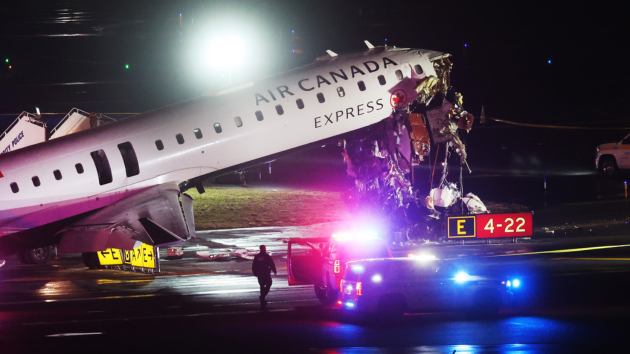
An Air Canada Express plane sits on the tarmac after it collided with a fire truck on the tarmac at LaGuardia Airport on March 23, 2026 in New York City. (Photo by Spencer Platt/Getty Images)
(NEW YORK) — A regional Air Canada jet collided into a Port Authority airport vehicle at LaGuardia Airport in New York City, an on-the-ground crash that demolished the front of the airplane, killed two pilots, injured dozens of passengers and prompted the airport to shut down, law enforcement and aviation officials said.
At least 41 people were transferred to local hospitals Sunday night after the plane, which was operated by Jazz Aviation, struck a rescue-and-firefighting vehicle that had been “responding to a separate incident” at 11:47 p.m., a Port Authority spokesperson said.
The pilot and the co-pilot of the plane were killed in the crash, officials said. Two of the injured were Port Authority officers and the other 39 were passengers, officials said.
LaGuardia is closed until at least 2 p.m. Monday, the Port Authority said.
The collision happened shortly after the plane, Air Canada Flight 8646, which was carrying four crew members and 72 passengers, touched down from Montreal, according to Port Authority Executive Director Kathryn Garcia.
The ground vehicle — a Port Authority Aircraft Rescue and Firefighting — had requested permission and had been cleared by the air traffic controller to cross Runway 4 at taxiway Delta, according to audio recordings. Shortly after that permission was granted, an air traffic controller was heard telling the vehicle to stop several times right before the collision, according to the recordings.
Preliminary data shows the Air Canada plane was traveling between 93 and 105 mph when it impacted the fire truck, FlightRadar24 told ABC News.
All passengers have been accounted for, Garcia said, and an unaccompanied minor on the plane was reunited with their family.
Thirty-two of those who had been transferred were later released, Garcia said, adding that several others had serious injuries. Two Port Authority police officers who were injured — a sergeant and an officer — were in stable condition at the hospital, she said.
National Transportation Safety Board investigators have responded to the scene.
Teams from Air Canada and Jazz Aviation are also headed to LaGuardia. Canadian authorities will be involved as a party to the investigation as the plane was operated by a Canadian carrier, but the NTSB will be leading the investigation since the collision occurred in the U.S.
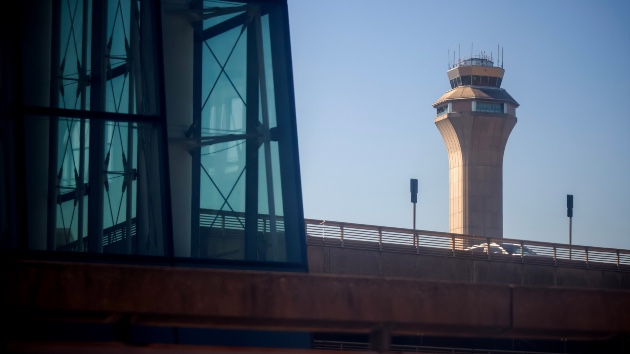
The FAA Air Traffic Control tower at Newark Liberty International Airport (EWR) in Newark, New Jersey, US, (Photographer: Michael Nagle/Bloomberg via Getty Images)
(NEWARK, N.J.) — Ground stop briefly in place, control tower evacuated at Newark Airport after reports of smoke
A ground stop was briefly in place on Monday morning at Newark Liberty International Airport, where an air traffic control tower was being evacuated due to reports of smoke, according to the Federal Aviation Administration.
An FAA spokesperson said there was no fire and the controllers evacuated the tower due to a burning smell from an elevator.
“Arrivals and departures are temporarily paused at Newark Liberty International Airport in New Jersey after air traffic controllers evacuated the tower because of a burning smell coming from an elevator,” the FAA said in a statement. “It happened around 7:30 a.m. local time on Monday, March 23.”
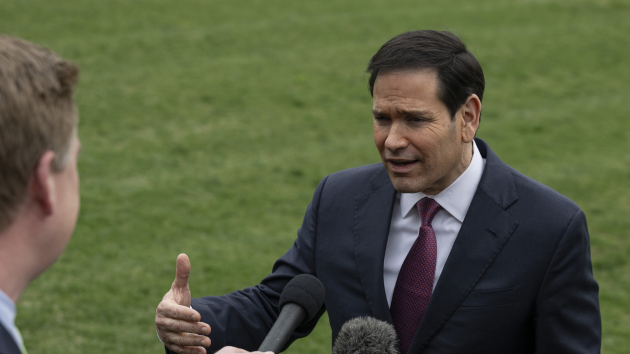
The United States Secretary of State Marco Rubio speaks to the press. (Photo by Celal Gunes/Anadolu via Getty Images)
(WASHINGTON) — The State Department has formally launched a new entity charged with anticipating and responding to dangers posed by Iran and other U.S. adversaries’ weaponization of advanced technology, including artificial intelligence, officials familiar with the matter tell ABC News.
The department’s Bureau of Emerging Threats has been tasked with safeguarding American national security against cyberattacks, the weaponization of space and similar malicious efforts, they said.
In addition to Iran, the officials identified novel threats from China, Russia, North Korea and foreign terrorist organizations as particular areas of focus.
Secretary of State Marco Rubio announced the creation of the Bureau of Emerging Threats when he revealed his sweeping reorganization plan for the department nearly a year ago, but few specifics about its purpose have been revealed before now.
“The bureau will address not only the current threats we face today in cyberspace, outer space, critical infrastructure, and through the misuse of disruptive technology like AI and quantum, but those we will face in the decades ahead,” State Department principal deputy spokesperson Tommy Pigott said.
Anny Vu, the senior official leading the bureau who also recently served as the Trump administration’s chargé d’affaires to China, said her team of experts will be “dedicated to leveraging foreign policy and all tools of national power” to protect U.S. interests.
Officials say the Bureau of Emerging Threats will include five divisions: the Office of Cybersecurity, the Office of Critical Infrastructure Security, the Office of Disruptive Technology, the Office of Space Security and the Office of Threat Assessment.
The Iranian regime and its affiliates have a long history of using cyberattacks to target U.S. interests, and the American cybersecurity firm CrowdStrike says it identified an uptick in activity from pro-Iranian actors after the U.S. and Israel initiated military action against the country in late February.
The Cybersecurity and Infrastructure Security Agency is investigating at least one major attack believed to have been carried out by pro-Iran hackers since the conflict began–a breach of the American medical technologies company, Stryker.
The State Department formally notified Congress about the creation of the Bureau of Emerging Threats on Friday, the same day the White House released its national policy framework for artificial intelligence.
The four-page blueprint calls on Congress to pass “minimally burdensome” laws governing the use of AI to override more restrictive state legislation. It also says lawmakers shouldn’t not seek to create any new federal agencies aimed at regulating AI.
Firefighters at the scene in Highfield Road, Golders Green, London, after an apparent arson attack on four ambulances belonging to the Jewish Community Ambulance service in London. (Photo by Jonathan Brady/PA Images via Getty Images)
(LONDON) — The Metropolitan Police in London is investigating an apparent arson attack on four ambulances belonging to the Jewish community ambulance service, Hatzalah, in the early hours of Monday morning.
Officials said the arson attack is being treated as an antisemitic hate crime.
No injuries were reported and the fires have been put out, police said. Nearby houses were evacuated as a precaution.
“This is a deeply shocking antisemitic arson attack,” Prime Minister Keir Starmer said on social media. “My thoughts are with the Jewish community who are waking up this morning to this horrific news. Antisemitism has no place in our society.”
Police Superintendent Sarah Jackson said in a statement that no arrests have been made, but they believe there are three suspects involved.
“We know this incident will cause a great deal of community concern and officers remain on scene to carry out urgent enquiries,” Jackson said. “We are in the process of examining CCTV and are aware of online footage. We believe we are looking for three suspects at this early stage.”
Police said there were reports of explosions in the fire, which they said is believed to be linked to gas canisters on the ambulances.
An Air Canada Express plane sits on the tarmac after it collided with a fire truck on the tarmac at LaGuardia Airport on March 23, 2026 in New York City. (Photo by Spencer Platt/Getty Images)
(NEW YORK) — A regional Air Canada jet crashed late on Sunday into a Port Authority airport vehicle at LaGuardia Airport in New York, a collision that demolished the front of the airplane, killed two pilots, injured dozens of others and prompted the airport to shut down on Monday morning, law enforcement and aviation officials said.
At least 41 people were transferred to local hospitals after the plane, which was operated by Jazz Aviation, struck a rescue-and-firefighting vehicle that had been “responding to a separate incident,” a Port Authority spokesperson said in a statement. Two of the injured were Port Authority officers and the other 39 were passengers, officials said.
“The airport will remain closed until at least 2 p.m. Monday to allow for a thorough investigation,” the authority said.
The collision happened shortly after the plane, Air Canada Flight 8646, which was carrying four crew members and 72 passengers, touched down, according to Port Authority Executive Director Kathryn Garcia.
Jazz Aviation, which is based in Halifax, Nova Scotia, issued a statement confirming the incident, saying it happened at 11:47 p.m. Air Canada said on social media that it was “aware of an incident” and that Jazz Aviation would issue updates as needed.
All passengers have been accounted for, Garcia told reporters at a pre-dawn press conference at the airport. An unaccompanied minor on the plane was reunited with their family, she said.
Thirty-two of those who had been transferred to the airport were later released, Garcia said, adding that several others had serious injuries. Two Port Authority police officers who were injured — a sergeant and an officers — were in stable condition at the hospital, she said.
The regional jet involved in the collision had traveled from Montreal to New York, according to Flightradar24, a flight information tracker. The cause of the crash was not immediately clear. Preliminary information appeared to show that the flight had landed on Runway 4 and was rolling down the runway when the collision occurred.
The National Transportation Safety Board said it was sending a team to investigate the crash. Chair Jennifer Homendy will serve as the on-scene spokesperson, accompanied by member John DeLeeuw, according to the NTSB. Those investigators were on site by the time Garcia spoke at about 4:30 a.m. ET, according to the Port Authority.
New York City Emergency Management said in a statement that its first responders were present at the airport, adding that the initial response from the Fire Department had ended.
“Units will remain on scene with a watch line that includes one engine, one ladder, and one battalion chief,” the NYCEM’s statement said. “The NTSB is on scene leading the investigation.”
The pilot and the co-pilot of the plane were killed in the crash, multiple officials briefed on the situation said earlier. The New York City Chief Medical Examiner’s Office was on-scene early on Monday, and officials were awaiting confirmation of the identities of those who were killed. Next of kin were to be notified before their names were released, officials said.
The ground vehicle — a Port Authority Aircraft Rescue and Firefighting — had requested permission and had been cleared by the air traffic controller to cross Runway 4 at taxiway Delta, according to audio recordings. Shortly after that permission was granted, an air traffic controller was heard telling the vehicle to stop several times right before the collision, according to the recordings.
At least 18 flights have been diverted from LGA following the airport’s closure, with most being sent to New York’s John F. Kennedy International Airport or to New Jersey’s Newark Liberty International Airport.
A union official had earlier told ABC News that there were two individuals who had been injured in the crash, saying they were Port Authority police officers assigned to firefighter duty at LaGuardia Airport.
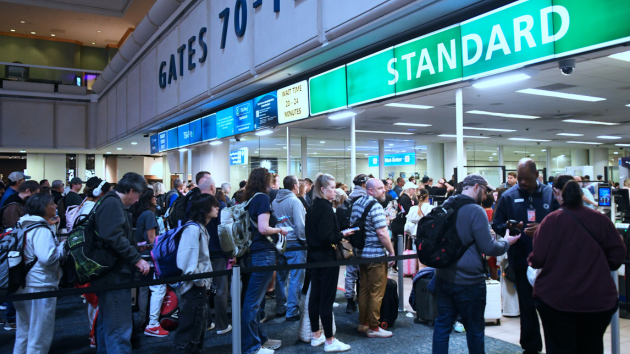
Travelers wait in a TSA screening line at Orlando International Airport on March 22, 2026 in Orlando, Florida. (Photo by Paul Hennessy/Anadolu via Getty Images)
(ORLANDO, Fla.) — President Donald Trump said Sunday that he’s sending Immigration and Customs Enforcement (ICE) agents to U.S. airports to assist Transportation Security Administration (TSA) officers amid the ongoing Department of Homeland Security (DHS) shutdown.
“On Monday, ICE will be going to airports to help our wonderful TSA Agents who have stayed on the job despite the fact that the Radical Left Democrats, who are only focused on protecting hard line criminals who have entered our Country illegally, are endangering the USA by holding back the money that was long ago agreed to with signed and sealed contracts, and all,” Trump said in a post on his social media platform.
On Saturday, the president said he was ready to deploy ICE agents if Democrats didn’t “immediately sign an agreement” to end the shutdown.
Trump said that operations would include immigration enforcement. It’s not currently clear what security roles, exactly, ICE agents will take on in airports.
The White House referred ABC News back to the president’s post when asked what capacity Americans can expect to see ICE operating in at airports.
Tom Homan, Trump’s border czar, said Sunday that he was working with acting ICE Administrator Todd Lyons on plans that would “free up TSA agents for specialized tasks, like passenger and bag screening” and hopes to have final details together by the end of the day.
“We’re simply there to help TSA do their job in areas that don’t need their specialized expertise, such as, you know, screening through the x-ray machine, not trained on that, we won’t do that,” Homan told CNN’s “State of the Union.” “But there are roles we can play to release TSA officers from the non significant role, such as guarding an exit, so they can get back to the scanning machines and move people quicker.”
Trump’s statements come after Democrats on Friday blocked legislation to reopen DHS for the fifth time since the partial shutdown began in mid-February.
Democrats have demanded changes to policy surrounding ICE and Customs and Border Protection in exchange for votes to fund all of the department. Republicans, meanwhile, have rejected Democratic efforts to fund other agencies in DHS like the Coast Guard, Transportation Security Administration (TSA) and Federal Emergency Management Agency (FEMA).
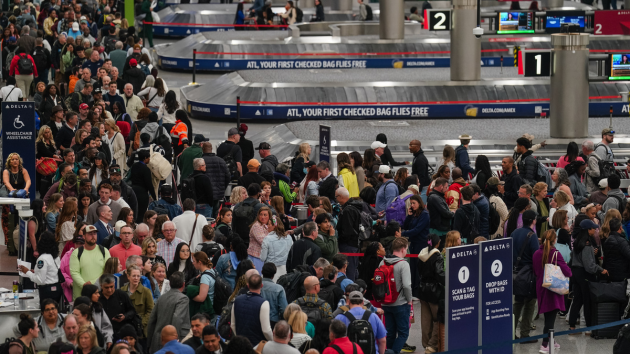
Thousands of TSA employees have now missed their first full paychecks, and travelers are facing long lines at airports around the country.
House Minority Leader Hakeem Jeffries blasted the plan to send ICE agents to airports.
“The last thing that the American people need are for untrained ICE agents to be deployed at airports all across the country, potentially to brutalize or, in some instances, kill them,” Jeffries told CNN’s “State of the Union.” “We’ve already seen how ICE conducts itself. These are untrained individuals when it comes to doing the current job that they have for the most part, let alone deploying them in close exposure in highly sensitive situations at airports across the country.”
Transportation Secretary Sean Duffy on Sunday appeared to suggest that ICE agents would do more than Homan outlined, saying that ICE could be used to support airport screening.
“They run those same type of security machines at the southern border, right? Packages come through or people come through. They run similar assets,” Duffy said on ABC News’ “This Week,” adding that “even administratively they’ll be helpful.”
“But again, we have ICE agents who are trained and can provide assistance to agents,” Duffy said.
On Saturday, Senate Majority Leader John Thune, R-S.D., also urged Democrats to agree to a funding deal.
“At some point, the Democrats are going to have to take yes for an answer. I know they think this is politically good for them. It is not,” Thune said.
A bipartisan group of lawmakers has met behind closed doors with Homan throughout the week. The latest meeting concluded late Friday night.
Senate Minority Leader Chuck Schumer, in speech on the Senate floor on Saturday, urged Republicans to support a Democratic effort to fund TSA while other negotiations continue.
“It is unacceptable for workers and travelers and entire airports to get taken hostage in political games, but that’s what the Republicans are doing,” Schumer, D-N.Y., said.
“It is unacceptable to say we will only pay TSA workers if it is attached to a bill that funds ICE with no reforms, but that’s what the Republicans have been doing. Democrats want to pay TSA workers ASAP, with no strings attached,” Schumer added.
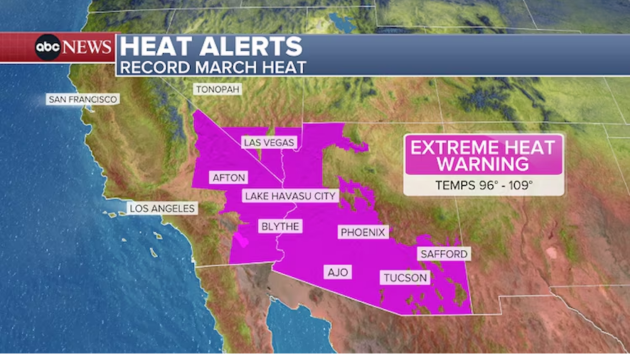
Record March heat continues in the West. (ABC News)
(PHOENIX) — Record-shattering temperatures are expected to continue on Sunday as a rare and strong early-season heat dome has resulted in triple-digit highs in some parts of the Western U.S.
As the temperatures soared to 105 degrees on Saturday in Phoenix, Ariz., the third-straight day the weather has topped the 100-degree mark, more than 400 people attending an airshow in nearby Glendale were treated for heat-related illnesses, authorities said.
At least 25 people attending the Luke Days Airshow at Luke Air Force Base were overcome by the sweltering weather and had to be hospitalized for various heat-related illnesses, U.S. Air Force Brig. Gen. David Berkland said at a news conference on Saturday, according to ABC affiliate station KNXV in Phoenix.
Berkland said the majority of the people treated were under the age of 12 or over the age of 60, and many also had “pre-existing medical conditions like heart disease, diabetes or pregnancy.”
Dozens of locations across the West have broken high-temperature records since Thursday, and some areas in the Plains have also seen records fall.
The temperature in Phoenix reached 105 degrees for the third straight day on Saturday, tying a record for March. In Tucson, temperatures soared to 102 on Saturday. Las Vegas, Nev., hit 96 on Saturday, the second-highest temperature there for March behind the 97-degree record set on Friday.
Elsewhere in the West, Salt Lake City, Utah, and Denver, Colo., set new highs for March when they hit 84 and 86 degrees, respectively, on Saturday,
Hot weather also stretched across the Midwest and Great Plains. Omaha, Neb., recorded 96 degrees on Saturday, while Wichita, Kan., and Kansas City, Mo., each reached 93.
Extreme heat warnings remain in effect for parts of southern California, Nevada and Arizona on Sunday, including Las Vegas, Phoenix, Tucson and Lake Havasu, Ariz.
Phoenix is likely to surpass the 100-degree mark again on Sunday, the fourth-straight day the city is expected to surpass that temperature. Las Vegas and Salt Lake City could also see additional daily records heading into Monday.
Hot weather is forecast to continue to move into the South and the Ohio Valley, where dozens of daily records could be broken from interior California to Texas and the Carolinas, including the cities of Sacramento, Las Vegas, Albuquerque, Dallas, Oklahoma City, Memphis, New Orleans, Cincinnati and Raleigh.
Severe weather in store for southern Indiana and Pennsylvania Some severe storms are possible for southern Indiana and most of Pennsylvania later Sunday and into Sunday night and could include damaging winds and large hail. Isolated tornadoes are also possible for a sliver of Ohio, the northern panhandle of West Virginia and southwest Pennsylvania.
By late Sunday night, a line of scattered storms will likely stretch from Evansville, Ind., to Columbus, Ohio, and into State College, Pa.
New York City could also see a couple of thunderstorms, some strong enough to produce gusty winds and possibly small hail.
Critical fire weather threat in the Plains
Millions of people across the Plains are under red flag fire warnings on Sunday due to low humidity, warm temperatures, gusty winds and dry vegetation. The fire danger is expected to continue Sunday before improving a bit into Monday.
Meanwhile, several wildfires are still burning further north in Nebraska and South Dakota.
Fire crews in Nebraska have made significant progress in battling the Morrill Fire, largest wildfire in state history. The blaze, which has burned more than 640,000 acres across multiple counties in western Nebraska, was 98% contained as of Saturday night, according to the Nebraska Emergency Management Agency.
Another large Nebraska wildfire, the Cottonwood Fire in the south-central part of the state, has burned nearly 130,000 acres and was 94% contained on Saturday night, according to the Nebraska Emergency Management Agency.
More damaging floods in Hawaii
After a damaging flood event more than one week ago during which parts of Hawaii recorded rainfall by feet, more rain has brought damaging and impactful flooding across parts of the island.
A flash-flood warning was in effect Saturday for potentially life-threatening flooding on Oahu and the potential for the Wahiawa Dam to fail. There were several reports of damage, water rescues and road closures due to flooding.
The threat of the Wahiawa Dam failing has subsided as water levels gradually subside, but any heavy pockets of rain could cause rapid water rises and reinvigorate the threat.
The heaviest rain has shifted eastward, with the island of Molokai under a flash-flood warning on Sunday.
All Hawaiian islands except Kauai remain under a flood watch through Sunday for more heavy rain. The heaviest rain is expected mostly on the Big Island and the island of Maui, but the other islands will see some rain showers and perhaps some isolated heavy pockets of rain.
Thunderstorms will be possible at times, which may include damaging winds.
Travelers wait in line at a TSA checkpoint at Hartsfield-Jackson Atlanta International Airport in Atlanta, Georgia, US. (Elijah Nouvelage/Bloomberg via Getty Images)
(NEW YORK) — Saturday saw the highest call-out rate of TSA officers at airports since the partial Department of Homeland Security shutdown began, according to exclusive data from the Transportation Safety Administration first obtained by ABC News.
Over 3,250 officers called out Saturday, March 21, according to TSA data, accounting for 11.51% of the scheduled workforce.
Airport security lines are growing nationwide as TSA officers, who haven’t received a paycheck for over three weeks, call out of work. Over the weekend, President Donald Trump posted on his social media platform that he will deploy Immigration and Customs Enforcement (ICE) agents to airports beginning Monday unless Democrats agree to a funding package to end the DHS shutdown.
Democrats are demanding reforms to ICE and Customs and Border Protection policies before they will vote to fund the DHS.
Transportation Secretary Sean Duffy said Sunday on ABC’s “This Week” that ICE agents are trained and can assist with airport security. ICE has remained funded through appropriations from the Trump’s tax and spending bill passed last summer, while key DHS agencies like TSA, the Federal Emergency Management Agency and the Coast Guard are left unfunded.
Duffy said that ICE does have proper security training, but could also help by just managing lines. It is unclear how many ICE agents would be sent to airports or which airports they will be sent to.
“We’re simply there to help TSA do their job in areas that don’t need their specialized expertise, such as, you know, screening through the x-ray machine, not trained on that, we won’t do that,” White House Border Czar Tom Homan said Sunday on CNN’s “State of the Union.” “But there are roles we can play to release TSA officers from the non significant role, such as guarding an exit, so they can get back to the scanning machines and move people quicker.”
There was a nearly four-hour wait Sunday during the 11 a.m. hour to pass through TSA checkpoints at New York’s LaGuardia Airport, according to the TSA.
Saturday, the airports with the highest TSA personnel call-out rates were William P. Hobby Airport in Houston, with 47.4%; George Bush Intercontinental Airport in Houston, with 42.4%; Louis Armstrong New Orleans International Airport, with 34.1%, Hartsfield-Jackson Atlanta International Airport, with 33.6%; and John F. Kennedy International Airport in New York, with 33.4%.
The president of the union that represents TSA workers issued a statement Sunday blasting what he called the Trump administration’s “threat” to send ICE to airports.
“ICE agents are not trained or certified in aviation security,” American Federation of Government Employees National President Everett Kelley in the statement. “TSA officers spend months learning to detect explosives, weapons, and threats specifically designed to evade detection at checkpoints – skills that require specialized instruction, hands-on practice, and ongoing recertification. You cannot improvise that. Putting untrained personnel at security checkpoints does not fill a gap. It creates one.”
“Our members at TSA have been showing up every day, without a paycheck, because they believe in the mission of keeping the flying public safe,” Kelley said. “They deserve to be paid, not replaced by untrained, armed agents who have shown how dangerous they can be.”
Other airports with call-out numbers over 20% Saturday included Baltimore/Washington International Thurgood Marshall Airport, Chicago Midway International Airport, Charlotte Douglas International Airport, Phoenix Sky Harbor International Airport, Long Beach Airport, Pittsburgh International Airport, and Luis Munoz Marin International Airport in San Juan, Puerto Rico.
Airports with high wait times Saturday included Luis Munoz Marin International Airport, with wait times of roughly two-and-a-half hours in the standard TSA line; George Bush Intercontinental Airport in Houston, with wait times of over two hours; LaGuardia, with wait times of one hour and 40 minutes, and Hartsfield Jackson Atlanta International Airport, with wait times of an hour-and-a-half.
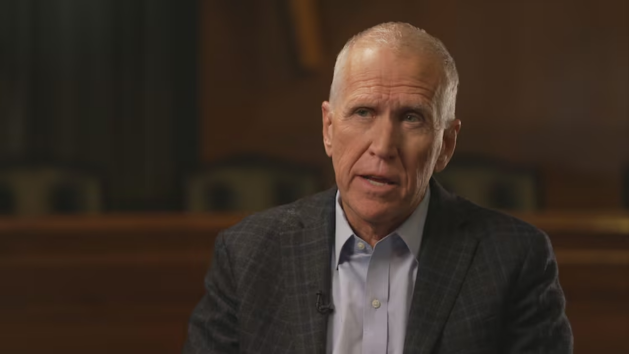
Sen. Thom Tillis, R-N.C., appears on ABC News’ “This Week” on March 22, 2026. (ABC News)
(WASHINGTON) — As the war with Iran enters its fourth week, Republican Sen. Thom Tillis said the Trump administration must make its objectives of the operation clearer before Congress approves additional funding.
“What is the objective, the primary objective?” ABC News’ “This Week” co-anchor Jonathan Karl asked Tillis in an interview that aired Sunday.
“I don’t know, and I think it’s a real problem,” the North Carolina senator said.
Praising last summer’s “Operation Midnight Hammer” when the U.S. military struck Iran’s nuclear facilities, Tillis said he “could see why we needed to finish some of the work and go back in,” but the weeks-long operation now is “ambiguous.”
“I don’t know what our long-term strategic goals are, but we’re going to need to know that,” Tillis said. “I generally support what the president’s doing in Iran, but if we’re going to get anything close to the $200 billion supplemental request, we got to get 60 votes, and we’re going to have to figure out how to accomplish that.”
The Pentagon is seeking $200 billion in funding, according to a senior administration official. While he said the topline number could move, Secretary of Defense Pete Hegseth confirmed Thursday that the department will request additional funding for the war, saying, “It takes money to kill bad guys.”
As the war rages on, Iran continues to block the critical Strait of Hormuz. A significant share of the world’s oil passes through the strait each day, and the blockage has surged global oil prices. Gas prices in the U.S. are up $1 per gallon on average since the war began Feb. 28, according to GasBuddy.
“Can’t all of a sudden walk away” President Donald Trump has mused about “winding down” the war soon and last week he suggested in a social media post that he may pull out of Iran before the Strait of Hormuz issues are resolved.
“I wonder what would happen if we ‘finished off’ what’s left of the Iranian Terror State, and let the Countries that use it, we don’t, be responsible for the so called ‘Strait?’ That would get some of our non-responsive ‘Allies’ in gear, and fast!!!” Trump posted Wednesday.
Tillis was critical of that option, arguing leaving the strait as it is harms U.S. allies in the region.
“We have a number of partners and allies in the region whose economic fortunes rests on the Strait of Hormuz being open,” Tillis said. “We’ve decided that we’re going to project power and try and produce good outcomes in the Middle East. You can’t all of a sudden walk away after you’ve kind of created the event and expect other people to pick it up and leave — and leave a good taste in their mouth.”
After Trump lashed out U.S. allies in the North Atlantic Treaty Organization (NATO) for not assisting the U.S. with opening the Strait of Hormuz, labeling them “cowards,” Tillis — the co-chair of the Senate NATO Observer Group — defended those allies’ decisions.
“I don’t think that they’re cowards. I think they’re people that weren’t consulted on a major military operation, and I’d have the same reaction if I was the head of state,” Tillis said.
“These folks love the United States,” he added. “But they don’t appreciate the way they’re being treated right now. And I can, I can absolutely understand that.”
“American lives will be lost” without NATO The North Carolina Republican also pushed back on Trump’s recent suggestion that he could leave NATO without consulting Congress.
“Well, that’s factually not true. The president of the United States cannot withdraw from NATO,” Tillis said. “American lives have been saved by the NATO alliance, and American lives will be lost without it.”
In June, Tillis announced he would not seek reelection this year. No longer concerned with having to run a campaign, the self-described “plain-spoken” senator has become even more so.
He didn’t vote for the Republicans’ tax overhaul and spending cuts bill. He’s not planning to vote for the “SAVE America Act,” a Trump priority. He called out Trump’s Justice Department for seeking indictments against Democrats Trump accused of seditious behavior for posting a video telling service members not to follow illegal orders, and he’s threatening to hold up any nominee to the Federal Reserve until the DOJ ends its probe of Chair Jerome Powell.
But no members of Trump’s administration have received more criticism from Tillis than Stephen Miller, the deputy chief of staff to the president and one of his top advisers on immigration, and outgoing Homeland Security Secretary Kristi Noem. Tillis has called the pair “sycophants” and called for Trump to fire Noem, which he ultimately did.
The president has praised Miller over the years. In October, he said he was “doing an unbelievable job” and told him, “The people of this country love you.”
But Tillis said he doesn’t think Miller is “particularly loyal” to the president.
“If the president thinks that Stephen Miller is worried about [Trump’s] legacy, he’s fooling himself. Stephen Miller is worried about his own legacy,” Tillis said.
A “healthy” relationship with Trump Still, Tillis told Karl he believes he has a “healthy relationship” with the president.
“There are aspects about this president that I admire and will always admire, but I do not admire bad advice, and I hate bad execution, and when I see it and I think it’s undermining the president of the United States’ agenda, then I’m going to call them out,” he said.
Tillis said his motivation for criticizing the administration and some of its policies are to help Republicans perform well in this year’s midterm elections.
“I’m not trying to undermine Republicans. I’m trying to undermine efforts that are going to make it very difficult for Republicans to get elected in November,” he said.
Asked by Karl why he feels liberated to speak out since announcing his retirement, Tillis had a simple answer.
“When people have said, ‘You seem a little bit more liberated.’ I said, ‘No, s—, Sherlock,'” Tillis said. “I no longer have to view things through a political lens.”