(NEW YORK) — Saturday marks 20 years since the 9/11 terrorist attacks.
Hijackers crashed two commercial airliners into the World Trade Center, striking the north tower at 8:46 a.m. followed by the south tower at 9:03 a.m. At 9:37 a.m., a third hijacked airline crashed into the Pentagon.
Twenty-two minutes later, the World Trade Center’s south tower collapsed. A fourth hijacked plane crashed into a field in rural Shanksville, Pennsylvania, at 10:03 a.m. after passengers fought with and overcame the hijackers.
At 10:28 a.m. the World trade Center’s North Tower collapsed.
In total, 2,977 people were killed, including many New York City first responders.
The anniversary will be marked by several events across the country, including the annual commemoration at the World Trade Center Memorial in downtown Manhattan.
Here are the latest updates from the day. All times are Eastern.
Here’s how the news was developing. All times Eastern.
Sep 11, 8:21 am
Crowds begin to gather at World Trade Center
Families of World Trade Center victims, survivors, first responders and dignitaries have begun gathering at the National September 11th Memorial & Museum for this year’s memorial services.
The event begins at 8:30 a.m. and is expected to conclude at approximately 1:00 p.m.
The ceremony will include moments of silence at the times the four planes crashed and the times both towers collapsed.
Family members will read the names throughout the morning of all of the people lost that day as well as the victims of the 1993 World Trade Center bombing.
Sep 11, 8:01 am
Obama reflects on 20th anniversary
Former President Barack Obama released a statement Saturday morning reflecting on the 20th anniversary of the Sept. 11 attacks.
He urged all Americans to remember the courage and selflessness of those lost in the attacks.
“We reaffirm our commitment to keep a sacred trust with their families — including the children who lost parents, and who have demonstrated such extraordinary resilience. But this anniversary is also about reflecting on what we’ve learned in the 20 years since that awful morning,” Obama wrote.
“That list of lessons is long and growing. But one thing that became clear on 9/11 – and has been clear ever since – is that America has always been home to heroes who run towards danger in order to do what is right.”
In his statement the former president pointed to examples of heroic actions from the last two decades, such as the service members, first responders and medical personnel.
“They represent what is best in America, and what can and should bring us together,” Obama said. “9/11 reminded us how so many Americans give of themselves in extraordinary ways – not just in moments of great crisis, but every single day. Let’s never forget that, and let’s never take them for granted.”
-ABC News’ Molly Nagle
Sep 11, 8:20 am
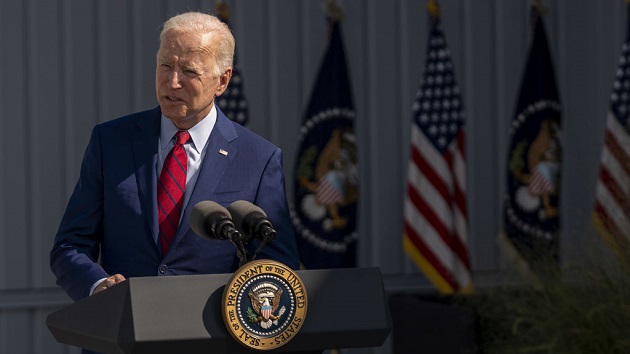
President Biden to attend services at World Trade Center, Shanksville, Pentagon
President Joe Biden and first lady Jill Biden will attend three 9-11 memorial services throughout the day
They will begin at the National September 11th Memorial & Museum in lower Manhattan at 8:30 a.m. and fly out to Shanksville, Pennsylvania. The president and first lady will attend a wreath-laying ceremony at the Flight 93 National Memorial at 12:30 p.m.
They will be joined by Vice President Kamala Harris and the second gentleman Doug Emhoff at the Pentagon at 4:30 p.m. where they will take part in the wreath-laying ceremony to honor the lives lost at the location.
Biden released a video speech on social media Friday evening marking the 20th anniversary.
“As we saw in the days that followed, unity is our greatest strength. It’s what makes us who we are — and we can’t forget that,” he tweeted.
(WASHINGTON) — The House select committee investigating the Jan. 6 Capitol attack is in the process of reviewing thousands of pages of documents obtained in response to requests made of federal government agencies and 35 social media and communication companies in recent weeks.
A spokesperson for the committee said that documents have come in from “nearly all Executive Branch agencies.” Last month, the committee sent records requests to eight government agencies, seeking records from the Trump White House and administration related to the riot and efforts to overturn the 2020 election results.
It was not immediately clear what documents the committee has in their possession, but sources familiar with what has been obtained so far say the records came from both social media companies and government agencies.
The panel sent requests to the National Archives — which maintains and preserves Trump White House records — the Department of Defense, Department of Homeland Security, Department of Justice, Department of the Interior, the FBI and several intelligence community agencies.
The committee has not yet received documents from the National Archives, which is in the process of reviewing the request.
“The Select Committee is also aware that the National Archives has undertaken the process required by law for identifying records and notifying relevant parties,” a committee spokesperson said.
In the 12-page letter to the National Archives, the committee requested records pertaining to more than 30 White House aides, lawyers, Trump family members and outside advisers, along with West Wing communications, records and visitors logs on and around the day of the Capitol riot.
In a statement following the request, former President Donald Trump slammed the investigation as a “partisan exercise” that is “being performed at the expense of long-standing legal principles of privilege.”
“Executive privilege will be defended,” Trump said.
It’s not clear what conversations the Biden White House is engaged in related to executive privilege. Biden has said his administration wants to help the investigation, but sources say there could be reluctance within the West Wing and Department of Justice to set new precedents regarding executive privilege and what presidential records Congress can access and obtain.
(WASHINGTON) — What’s black and white and roaming the greater Washington, D.C., area?
Zebras.
“As if 2021 can’t get even more crazier, a pack of zebras were spotted in a Maryland county,” the National Park Service of Chesapeake Bay tweeted out earlier this week.
The group of five zebras, referred to as a dazzle, have been on the loose in Maryland for over a week now. The zebras escaped from a farm near Upper Marlboro, Maryland, late last month, Chief Rodney Taylor with Prince George’s County Animal Services Division told Washington ABC affiliate WJLA.
The farm has had exotic animals on and off for 15 years, Taylor told WJLA. Animal Services has received multiple calls that the quadrupeds were spotted roaming and grazing on the majestic plains of rural Maryland. The farm is working to lure the zebras back with feeding stations, where they hope they will be able to corral the zebras without spooking them.
The zebras are not dangerous unless you approach them, according to Taylor.
Congresswoman Eleanor Holmes Norton, D-Washington, D.C., inserted herself into the bizarre story by releasing a statement Friday denying responsibility for letting the zebras loose. Her office later clarified it was a joke. Holmes Norton said in jest that she had a “solid alibi” proving she did not release the zebras.
She is known locally as an advocate for consent of being governed — as she continues fighting for D.C. statehood — and joked in the statement that she opposes unnecessary fences.
“Local news has reported that the zebras were let loose on Saturday or Sunday of last weekend, a period of time during which I was enjoying quiet time at home with family,” Norton said. “My alibi is solid, but given my career of fighting for statehood for the District, which includes years of explaining the importance of having consent of the governed, and given my recent opposition to fences, I can understand why the charge was made. I hope the owners find the zebras and that all involved live long, full lives.”
The country requests that anyone with information about the whereabouts of the zebras contact Prince George’s County Animal Control Services at 301-780-7200.
(NEW YORK) — He was 39 years old, but those who knew Carl Asaro remember him as “a big kid.” He was a man who loved music, his wife, six children and his job as a firefighter.
“He would still have like a lot of energy and come play with all of the neighborhood kids,” his daughter Rebecca said. “He was big on riding his bike, throwing the football around and playing his guitar. If he wasn’t with us, that’s all he did. He was a huge Grateful Dead fan. He was either humming the songs or playing on the guitar.”
Asaro worked at Engine 54, only four miles from the World Trade Center.
On Sept. 11, 2001, he was one of the first responders who answered the call to help. Of the 15 people who left from Engine 54, Ladder 4 that day, none returned home.
Now, 20 years later, 65 children of New York firefighters who died have picked up their own helmets, inspired by their loved ones’ ultimate sacrifice.
“I think during this time it’s kind of expected to feel those old feelings and feel them resurge, but the days in between, when you don’t expect it — when a song comes on the radio and you see something that reminds you of him, those are the days that hit you a little bit harder,” Asaro’s son Carl Jr. said.
Four of the six Asaro children went on to continue his legacy as firefighters — Carl Jr., Matt, Rebecca and Mark, who were 13, 12, 9, and 7 on 9/11.
Rebecca remembers it was her mom’s turn to carpool that morning.
“I saw my dad that morning. That night before I asked him for tic tacs. I remember I was begging him, so before he went to work he dropped ‘em off and he kissed us goodbye,” she said.
“In school they kept calling us one by one. My mom when she picked me up… she was just so frantic… I remember my mom was back and forth on the phone,” she said. “I was 9 and didn’t really understand much of what was going on… I thought my dad pulled up one day and it was the chief to tell my mom what was going on. My mom didn’t understand so then it finally hit her days later that he wasn’t coming home.”
Matt took the bus home that day, knowing his dad was at ground zero.
“I was proud but I didn’t know what happened. I didn’t know the severity of it,” he said. “We didn’t have no cell phones back then, and I remember just calling him and beeping and no answer, no answer. That’s how life got to be without him. Coming down here and just waiting — people getting found everyday- alive, dead. They didn’t find nothing, not a bone, not a hair, not a memento. It just kind of sucked.”
Asaro’s body was never found, so his family opted to bury a guitar instead, filled with notes from loved ones — a symbol of his love of music.
Rebecca was eventually inspired to follow her dad’s footsteps as a firefighter by seeing his impact.
“It’s like the department’s small and my dad had such a big heart,” she said. “Through the years after 9/11 we talked to people.. He impacted so many.”
For Matt, he said the bond formed at the firehouse “is like no other.”
“We grew up here,” Carl Jr. said. “I think for us to give back and live a life of service is one way to really feel connected with my dad and for us to feel whole in a way.”
The siblings agreed that being a part of the FDNY helped them cope with the incredible loss.
“They’re a big part of our lives — has been and always will be,” Matt said, joking that his dad might have pointed out he wanted them to become doctors instead.
For five years, his namesake Carl Jr. didn’t visit ground zero. Now, he finds it peaceful, saying that because it was the last place his father was, he considers it his father’s final resting place.
On the eve of the anniversary of one of the darkest days in American history, Carl Jr. reflects on a discussion he had with his sister.
“We were talking about how you’re only truly dead when your name is mentioned for the last time, and I thought that was powerful,” he said. “If that’s the case my father and these men that were killed that day and sacrificed their life, they’re going to live forever through their legacy and their actions.”
(WASHINGTON) — President Joe Biden paid tribute to the victims of the Sep. 11 terror attacks Friday, commemorating their lives and the losses of their families in a somber six-and-a-half-minute video.
Biden, in prerecorded remarks to the nation on the eve of the 20th anniversary, hailed the shared sense of national purpose that Americans felt after 9/11, and called unity the “greatest strength” of the country.
“Unity is what makes us who we are, America at its best. To me that’s the central lesson of Sept. 11,” he said. “Unity doesn’t mean we have to believe the same thing. But we must have a fundamental respect and faith in each other and in this nation.”
Biden will travel to New York City Friday evening and will attend 9/11 memorials in New York City; Shanksville, Pennsylvania; and at the Pentagon in Arlington, Virginia, on Saturday.
“No matter how much times has passed, these commemorations bring everything back,” Biden said in the video, addressing the families of the victims. “Jill and I hold you close, and send you our love.”
“There are people around the world who you will never know who are suffering their own losses, who see you,” he continued. “Your courage … gives them courage that they too can get up and keep going.”
Biden said the 9/11 attacks also exposed the “darker forces of human nature,” acknowledging the wave of Islamophobia that followed the attacks as “fear and anger, resentment and violence against Muslim Americans, true and faithful followers of a peaceful religion.”
“We saw a national unity bend and we saw that unity is the one thing that must never break,” he said.
Biden recalled speaking to a family friend in the days after 9/11 on the way to a meeting with students at the University of Delaware. The friend, Davis, had lost his eldest son at the World Trade Center, and his youngest son in a boating accident three years earlier.
“He told me to tell people, ‘Don’t be afraid. Tell them don’t be afraid.’ The absolute courage it took after two unimaginable losses is extraordinary, yet the most ordinary of American things. To know that life can be unfair and uncertain … but even in the darkness, to still be the light,” Biden recalled.
He invoked his friend’s words at the end of his remarks.
“We find strength in the broken places, as [Ernest] Hemingway wrote. We find light in the darkness,” he continued. “We find purpose to repair, renew and rebuild. And as my friend told me that September, 20 years ago, we must not be afraid.”
(BOWLING GREEN, Ky.) — With millions of Americans still unvaccinated, hospitals across the country are once again facing the overwhelming pressure of caring for thousands of COVID-19 patients — with more than 100,000 people in beds as of Friday.
While hospitalization rates in states like Florida and Mississippi, hit hard early in the delta surge, are beginning to decline, other southern states, including Kentucky, are showing no signs of infection and hospitalization rates slowing down.
“We walk into the hospital and it feels like the world is on fire,” Dr. Karan Singh, a pulmonologist at Med Center Health in Bowling Green, Kentucky, told ABC News.
Statewide, there are more than 2,600 patients hospitalized with COVID-19 — the highest on record, and currently, just 7% of intensive care beds remain available. At the state’s previous peak last December, there were 1,000 fewer patients hospitalized.
Last week, Kentucky reported more than 30,000 new cases, according to Gov. Andy Beshear, a weekly record since the onset of the pandemic.
“Our hospital situation has never been more dire in my lifetime than it is right now,” Beshear said. “We cannot handle more sick individuals.”
More than 400 members of the Kentucky National Guard, as well as strike teams from the Federal Emergency Management Agency’s emergency medical services, have now been deployed to help struggling hospitals across the state.
“I would honestly say it’s at least three times worse than what it was the first time,” nurse Kerri Eklund, from Baptist Health Hardin, in Elizabethtown, told ABC News. “We’re seeing a lot of people getting really sick. There are patients that will come in and they’ll be doing okay for a few days and then, in the blink of an eye, they go downhill.”
The current wave of infections caught many health care workers by surprise, added Heather Brock, another nurse at Baptist Health Hardin. Earlier this year, with vaccinations available, there was a sense that things would return to normal. However, nearly nine months into the country’s vaccination rollout, and less than 50% of Kentucky’s total population has been fully vaccinated.
“I wasn’t expecting this much of a surge again. In my opinion, it’s worse than the previous ones,” Brock said.
Front-line health workers said that the situation escalated quickly, after a short period of relief earlier this summer, and nearly all patients have been unvaccinated.
Across Kentucky, state data shows that 91.6% of COVID-19 related hospitalizations between March 1, and Aug. 31, have been among partially or unvaccinated residents.
“The patients who are vaccinated are doing a lot better,” said Eklund. In fact, “patients who are vaccinated, most of the time don’t even need oxygen, and they’re just here because they have a few of the other complications and they’re monitored. Most of the patients who end up going downhill, unfortunately, have not been vaccinated.”
Many patients the teams are treating remain in the intensive care unit for weeks at a time, said Baptist Health Hardin nurse Clara Robertson, while “suffering and struggling for breath, that entire time. And then a lot of times, unfortunately, losing that battle, and dying.”
The state’s most recent wave has been a difficult reality to face, added Eklund, as well as emotionally crushing for the medical staff to watch so many patients suffer.
The patients, “have been doing all they can and trying their hardest, and then they just get to the point that their body can’t handle it anymore. And I think their minds start to break, because they’ve been giving it all and they’re still not getting any better.”
Medical professionals, whether doctors, nurse practitioners, physician assistants or respiratory therapists — all are stretched so thin that many are experiencing exhaustion, compassion fatigue and burnout.
“We’re being tasked with daunting assignments, and everyone is emotionally, physically and mentally exhausted,” noted Brian Deweese, a respiratory therapist at Med Center Health. The fatigue is such, he said, that “we are seeing highly experienced and exceptional health care workers walk away from their profession altogether, because of the stress and anxiety they’re having to deal with.”
Outside the walls of the hospital, Singh said many community members do not fully realize the severity of the COVID-19 crisis across the state.
“When we leave, and we go to the grocery store, or we talk to people not in medicine, it’s like the world is just unaware of what is happening,” Singh said.
And front-line workers say they worry this surge will only further deteriorate, as they prepare for fall and winter.
“I’m really worried that it’s just going to keep getting worse, and I hope that we’re able to find a way to protect everyone, and have what we need, because we all know that winter is the worst time for health issues all together,” said Eklund. “I’m really hoping that we’re not going to have to see a lot of lives lost.
(NEW YORK) — Hours before the 20th anniversary of the 9/11 terrorist attacks, pretrial proceedings in the case against the five accused orchestrators started and ended on Friday with none of them present in the courtroom for the final public session of the week – while multiple defense teams raised formal objections against the judge continuing to preside over the military commission.
Khalid Sheikh Mohammed, the self-proclaimed mastermind of the attacks, had been present during public sessions of the proceedings on Tuesday and Wednesday this week, even taking the rare moment out of his detention cell to wave at reporters in the public gallery in the courtroom. But he and his co-defendants surprised reporters Friday by skipping the final public portion of the commission before the world recognizes the solemn commemoration on Saturday.
An assistant staff judge advocate, identified only by a pseudonym “Pa,” testified to their absence and provided signatures acknowledging their “voluntary” decision not to attend. James Connell, defense counsel for Ali Abdul Aziz Ali, aka Ammar al-Baluchi, attempted to have the military witness identify himself, but the government objected, insisting the testimony should proceed anonymously and was within the regulations of the military commission and not a violation of the Sixth Amendment.
Connell’s complaint was less about identifying this particular witness on the record, and more about expressing his continuing objection to the government’s use of unnamed witnesses. The interaction illustrated not only the tedious nature of the pretrial proceedings where nearly every action warrants deliberation, but it also revealed another unusual aspect of this case: the defense does not have access to their own clients — even when the court is in session – unless the accused actually attend the hearings.
The assistant staff judge advocate testified that one 9/11 defendant, Ammar al-Baluchi was sleepy and chose to nap rather than attend Friday’s public session. No explanation was given for the absence of the other four defendants, though Connell was able to extract details that the condition worsened of another Gitmo detainee, Abdul Hadi al-Iraqi – who is charged in another case but shares communal living quarters with some of the 9/11 defendants.
Al-Iraqi now claims that he is paralyzed and has lost the function of his legs, so al-Baluchi apparently aided him throughout the past several nights after the detainees rejected the assistance of a female corpsman. (His lawyers say that her initial offer was an invasive exam as the reason al-Iraqi waved off care.) The assistant staff judge advocate rejected the claim that Al-Iraqi is paralyzed.
Col. Matt McCall, presiding over the proceedings, offered to make a change to the schedule to allow the defendants more time to sleep Friday morning and attend today’s proceedings in the afternoon, but the defense counsel ultimately refused the accommodation – rather than face the prospect that the codefendants would be dragged out of their cells and forced to attend in person.
After discussing the judge’s qualifications at length this week, Mohammed’s lawyer Gary Sowards surprised many in the courtroom by announcing he would seek to disqualify McCall from sitting on the bench, saying there is a reasonable question about the judge’s impartiality, given the “extra-judicial” nature of McCall’s removal from the case after he was initially assigned. (Sowards argues the decision was made without appropriate litigation and at the behest of the Pentagon.)
A second chief counsel argued not for McCall’s removal from the case, but that he needed more time to read in on the case at hand and capital law.
“You’re not familiar with the record,” defense counsel Cheryl T. Bormann told the judge. “You are not familiar with the law as it applies to capital cases. Being a judge in a trial courtroom requires you to rule spontaneously on objections.”
A third lead attorney echoed both Sowards and Bormann. Connell declared he had no objections with McCall and would not seek to disqualify him. The final team deferred for now.
McCall said he would consider the arguments and render a decision on his own position.
The teams then moved into arguing over discovery, one of the most contentious issues in this case. The defense teams argued in favor of a motion demanding the government turn over more detailed evidence from the CIA black sites where KSM and the other detainees were held. After pointing out that the government provided limited assessments of more than 800 interrogation sessions, the defense further pressed the government’s secrecy.
In step with this line of questioning, Connell also revealed to reporters after the session that he could now share that the prosecution had withheld evidence linking an FBI interrogator that was part of the so-called “clean team” that questioning the detainees after they arrived at Guantanamo and the CIA black site program, providing fresh scrutiny surrounding the 2008 testimony from the detainees that the government is expect to build much of its case upon.
This slow drip of information and lack of transparency creates a significant hurdle for each defense team, they argue. “We don’t know what we don’t know,” Corey Krzan, one of Ramzi bin al-Shibh’s lawyers, said before the judge.
After about three and a half hours of public session, the court recessed for lunch and a classified session. The public portion of the proceedings will resume on Monday.
(OSHKOSH, Wisc.) — Anissa Weier, one of the two 12-year-old girls who said they attacked a friend to please the fictional character “Slender Man,” will be released from a mental health institution on Monday. Weier is now 19.
In 2014, Weier and Morgan Geyser lured Payton Leutner, also 12, to the woods in Waukesha, Wisconsin, where Geyser stabbed Leutner 19 times while Weier watched. Leutner was rushed to the hospital with life-threatening injuries but survived.
Judge Michael Bohren on Friday approved the conditions of Weier’s release from Winnebago Mental Health Institute. The full report on those conditions hasn’t been released to the public.
In 2017 Weier was sentenced to up to 25 years in a mental institution.
At a March court hearing, Bohren reviewed several medical reports and a letter written by Weier. “I have exhausted all the resources available to me at the Winnebago Mental Health Institute. If I am to become a productive member of society, I need to be a part of society,” Weier wrote.
Weier said she’s taken the responsibility that comes with “living with a mental illness, by communicating with total transparency to my treatment team members, participating wholeheartedly in all aspects of my treatment, and maintaining 100% medication adherence.”
“I am sorry and deeply regretful for the agony, pain, and fear I have caused,” Weier wrote, adding, “I take full responsibility for my actions.”
“I vowed after my crime that I would never become a weapon again, and I intend to keep that vow,” she said.
Geyser and Weier were charged in adult court with first-degree attempted intentional homicide. Weier pleaded guilty to a lesser charge and was found by a jury to be not guilty by mental disease or defect. Geyser pleaded guilty to the first-degree charges, and in 2018, as a part of her plea agreement, Geyser was convicted but found not guilty by reason of mental disease or defect.
Geyser was sentenced to up to 40 years in a mental institution. Last year a state appeals court upheld her sentence.
Geyser and Weier said they had intended to kill Leutner to appease the fictional character “Slender Man” — often depicted online as a horror figure who stalks children — and prove that he was real.
After Geyser stabbed Leutner, she and Weier left Leutner alone in the woods. Injured and bleeding, Leutner pulled herself out of the woods and into the open where someone could find her.
“If the knife had gone the width of a human hair further, she wouldn’t have lived,” Dr. John Kelemen, who operated on Leutner that day, told ABC News in 2014.
In a 2019 interview, Leutner told ABC News she was doing well and that her hope was to “put everything behind me and live my life normally.”
ABC News’ Jason Volack, Allie Yang and Sean Dooley contributed to this report.
(NEW YORK) — Taking his toughest tone yet against those Americans still unvaccinated, President Joe Biden has triggered vows of legal challenges from GOP governors representing some of the very states where he’s trying to use mandates to get more people inoculated.
At least 19 Republican governors have lashed back at Biden’s promise to use OSHA to pressure employers with more than 100 employees to mandate COVID-19 vaccines or have workers submit to weekly testing. The Republican governors called the mandate an overreach that will force Americans to choose between their job and the vaccine.
While Biden said on Friday morning, during a visit to local middle school, that all scientists would agree with his new strategy — that using protecting public health as a justification for mandates makes “considerable sense,” his taking a combative tone may come with new political and public health risks and further polarize Americans, fueling the already bitter political divide around the pandemic.
South Dakota GOP Gov. Kristi Noem, a potential 2024 presidential candidate, tweeted to Biden, “see you in court,” while Mississippi GOP Gov. Tate Reeves compared him to a “tyrant,” and South Carolina GOP Gov. Henry McMaster said he’ll “fight them to the gates of hell” to stop the move. House Minority Leader Kevin McCarthy called Biden’s approach “flat-out un-American.”
When ABC News Congressional Correspondent Rachel Scott asked Biden on Friday what his message was to Republicans threatening to challenge his move in court, he responded, “Have at it.”
He continued, “Look, I am so disappointed that particularly some Republican governors have been so cavalier with the health of these kids, so cavalier with the health of their communities. We’re playing for real here — this isn’t a game.”
While Biden has previously said he wouldn’t impose vaccine mandates, he said Friday that vaccine requirements are “nothing new.” However, past vaccines requirements for measles, mumps and rubella, for instance, have historically been implemented at a state and local level — and at times when the country wasn’t already so divided politically
In his address to the nation on Thursday introducing his new six-part approach, a frustrated Biden went after the unvaccinated and elected officials for standing in the way of public health measures and, he said, causing people to die.
“These pandemic politics, as I refer to it, are making people sick, causing unvaccinated people to die. We cannot allow these actions to stand in the way of the large majority of Americans who have done their part and want to get back to life as normal,” Biden said.
“My message to unvaccinated Americans is this: What more is there to wait for? What more do you need to see?” he said. “We’ve been patient, but our patience is wearing thin. And your refusal has cost all of us.”
He called out the governors, many of whom are now criticizing his approach, saying, “if these governors won’t help us beat the pandemic, I’ll use my power as president to get them out of the way.”
He added, “Let me be blunt. My plan also takes on elected officials in states that are undermining you and these life-saving actions. Right now, local school officials are trying to keep children safe in a pandemic while their governor picks a fight with them and even threatens their salaries or their jobs,” he said. He promised his administration would to pay back salaries withheld from those opposing mask bans.
White House press secretary Jen Psaki was asked on Friday what caused Biden and the rest of the administration to change its tune on blaming the unvaccinated for the pandemic — after Psaki said in June that she didn’t want to place blame.
She said Biden on Thursday was “channeling the frustration” of millions who are vaccinated as the pandemic rages, while pointing a finger at Republicans.
“We didn’t anticipate, I will say, that when there was a vaccine approved under a Republican president, that the Republican president took, that there would be such hesitation, opposition vehement opposition in some cases from so many people of his own party in this country,” she said.
While 75% of adults have gotten a shot, per data from the Centers for Disease Control and Prevention, vaccinations have stalled in recent months despite widespread availability as the hospitals across the country face another surge of the virus timed with the start of a new school year.
Biden’s new approach to getting more shots into arms comes as his approval for handling the pandemic has dropped sharply from 62% in June to 52% now.
The latest ABC News/Washington Post poll found also that vaccine hesitancy has subsided in the face of the delta surge, with the share of Americans who are disinclined to get a coronavirus shot now just half what it was last January. Among those unvaccinated adults, about 7 in 10 are skeptical of the vaccines’ safety and effectiveness, 9 in 10 see vaccination as a personal choice rather than a broader responsibility and just 16% have been encouraged by someone close to them to get a shot.
It’s unclear if Biden will break through to that group.
A White House spokesman declined to say whether public polling on why certain people remain unvaccinated informed the decision to institute these new requirements, or otherwise explain how Americans’ attitudes toward COVID-19 vaccines impacted the president’s decision.
The spokesman said the decision to enact the new requirements was “not rooted in any political focus, rather on what’s going to work.”
As some GOP governors say they’re preparing lawsuits, White House COVID-19 Response Coordinator Jeff Zients in defending the mandates on Friday argued that COVID-19 is a “public health issue, not a political issue.”
“We know that vaccination requirements work,” Zients said, pointing to “significant increases in vaccination rates at companies, health care systems, universities, that implement vaccine requirements.”
As Biden did on Thursday, Zients pointed specifically to companies like Fox News — which has provided a platform for vaccine misinformation and has repeatedly railed against Biden’s COVID-19 response — but which is also participating in a version of a vaccination reporting requirement itself.
“The president’s actions will accelerate that number of companies across the board for employers over a hundred, and that includes Fox News, which already has that vaccination requirement in place to keep its own employees safe.”
ABC News’ Ben Gittleson and Sasha Peznik contributed to this report.
(NEW YORK) — The sky was clear and blue. The gray towers stood, both guarding and welcoming, at the gateway to the nation. Out of nowhere came the impact, the blaze, the smoke — and then the towers were gone. When the dust and flames finally cleared, a new world had emerged.
The death and destruction defined that late summer day and remain seared in the minds of those who lived through Sept. 11, 2001. From the ashes and wreckage rose a new America: a society redefined by its scars and marked by a new wartime reality — a shadow darkened even more in recent days by the resurgence of fundamentalist Islamist rule in the far-off land that hatched the attacks.
Twenty years later — with more than 70 million Americans born since the crucible of the attacks — the legacy of 9/11 remains. From airport security to civilian policing to the most casual parts of daily life, it would be nearly impossible to identify something that remains untouched and unaffected by those terrifying hours in 2001.
This week, ABC News revisits the 9/11 attacks and unwinds their aftermath, taking a deep look at the America born in the wake of destruction. “9/11 Twenty Years Later: The Longest Shadow” is a five-part documentary series narrated by George Stephanopoulos. Episodes will air on ABC News Live each night leading up to the 20th anniversary of the attacks, from Sept. 6-10. The series will be rebroadcast in full following the commemoration ceremonies on Saturday, Sept. 11.
Part 5: A shadow so long, it covers all
The blue light may have been the strangest part.
On the streets of Baltimore, where crime proliferates in the poorest neighborhoods and economic desperation can run thick, the blue cast made it feel like one of those science-fiction movies set in a dark future of robots in control.
“I found it extremely oppressive and dystopian,” said Joanne Cavanaugh Simpson, a contributor to Baltimore magazine and a Pulitzer Center grantee.
The blue lights are meant to be seen. They are security cameras, and police want them to both solve crimes and deter them. In the city famed as the birthplace of America’s national anthem, the lights announce that the people are being watched.
Critics say these neighborhoods coated in blue also represent something else: the failures of an overzealous surveillance state, militarized and armed to the hilt in the years since terrorists attacked the nation on Sept. 11, 2001.
Despite the city’s high-tech efforts to curb crime, Baltimore still suffers from some of the highest homicide rates in the country. The city’s public image — shaped for many by the HBO crime drama “The Wire” — remains tethered to the fraught relationship between the police and the community.
For Baltimore and other major metropolitan areas, ubiquitous surveillance and a tragic cycle of police-involved killings continue to animate the debate over U.S. law enforcement. Many of the most controversial policing practices date to 9/11, when local governments were flooded with a surge of money, technology and new crime-fighting strategies — on top of a new mindset that assigned local cops to the front lines of the Global War on Terror. It was a time when many police departments re-fashioned themselves as paramilitary organizations, as their core mission was recalibrated from performing the traditional role of “protect and serve” to preventing the feared “second wave” of attacks for a terrorized and traumatized nation.
Police departments across the country, eager to avoid the failures that led to 9/11, scrambled to equip officers with the latest in military equipment and technology — much of it made available by a federal government that would spend almost 20 years at war in Afghanistan and Iraq. And the police forces — always eager to hire military veterans — were being staffed by people trained to police populations under occupation, not communities on the home front who get to decide how they want to be governed. Critics charged that racial profiling proliferated in cities like Baltimore, where the blinking blue lights became a symbol of life under a surveillance state.
“Over-policing, the racial tension — it just exponentially grew for local policing,” said Chris Burbank, a former police chief in Salt Lake City, who’s now a vice president at the Center for Policing Equity.
From aerial surveillance in Baltimore to national terrorist watch lists, local police departments experimented with novel approaches to securing their streets in the years following 9/11. A scarred nation largely acquiesced.
Over time, critics of these methods say that the trauma suffered by heavily policed communities — and the toll on residents’ civil liberties — have done more harm than good. As protests erupted across the country in the wake of George Floyd’s death in 2020, the gap between police departments and the citizens they are sworn to protect had never seemed wider.
“This separation between policing and community, I think you have to view 9/11 as gasoline that was poured on that fire,” said Lawrence Grandpre, a Baltimore-based community activist and author.
In the immediate aftermath of 9/11, a wariness of Muslims swept the country. Hate crimes against Muslims skyrocketed. Mosques became inundated with threats.
“Anything that showed that you were an Arab or a Muslim caused everyone to be suspicious of you,” said Sahar Aziz, director of the Center for Security, Race and Rights at Rutgers University Law School.
In response to the terror attacks, police departments in some major cities compiled vast databases of alleged potential terrorists and undertook ambitious surveillance missions targeting Muslim communities.
“You had massive surveillance programs by the NYPD, and the LAPD, and the FBI,” said Aziz. “Muslim student organizations at universities, Muslim-owned businesses, mosques, anywhere where Muslims congregated was systematically surveilled … we were sitting ducks.”
At the time of the attacks, the conversation around law enforcement was trending toward stricter guidelines for equitable policing — including halting some of the most invasive tactics like stop-and-frisk. Years of advocacy and lobbying in Washington culminated in the End Racial Profiling Act — a bill incoming President George W. Bush supported on the campaign trail in 2000.
“And then 2001, 9/11 happened, and it was completely off the table,” Aziz said. “It was a nonstarter.”
Before the 2001 terror attacks, John Farmer was the New Jersey attorney general who led the push to reform a state police culture that had itself acknowledged racial profiling and had vowed to eliminate it. After the attacks, as Farmer served as senior counsel to the 9/11 Commission, he said he had to watch as 9/11 “had the effect of deferring the debate on racial profiling.”
“Suddenly,” Farmer said, “no one wanted to talk about it anymore.”
Over the next decade, as American military forces engaged terrorists abroad, veterans of war returned home to continue their service as police officers. Together, with the influx of weapons of war, police throughout the U.S. began to look more and more like they were deployed on a forward operating military base.
“Police departments all over the country have acquired a pretty significant amount of military-grade weapons and equipment since 9/11,” said Loren Crowe, an Army officer who served two deployments overseas. “My local police department would be well-equipped to go fight in the mountains in Afghanistan.”
It all amounted to a post-9/11 “over-policing” that has had debilitating effects on police-community relations, according to many who have spent their careers in law enforcement.
“At that time there was so much fear in communities because of 9/11,” said Baltimore Police Commissioner Michael Harrison, who experienced the changes as he worked his way up through the ranks in the New Orleans Police Department. “And it became a concept of more police — and do more with more police.”
In Baltimore, where the death of Freddie Gray in 2016 ignited nationwide protests and added new urgency to the debate over post-9/11 policing, the local police department led the charge in advancing novel and controversial police tactics.
Blue-light cameras flooded crime-prone streets. Facial recognition software and phone data collection were employed to fight crime.
Perhaps the most jarring to residents were the so-called “spy planes” deployed to surveil large swaths of the city. Launched in 2016, the nation’s first-ever aerial surveillance experiment was meant to be secret. The manned airplanes’ immense capabilities allowed them to record the outdoor movements of an entire city. An independent audit later found that nearly all of the spy planes’ flights tracked over majority Black communities.
The police department has since suspended the program, and Harrison, the new commissioner, is focused on mending the strained relationship between the police and the community.
“Let’s try to tamper down the militaristic look and mindset, and move away from the warrior model into the guardian model, where we’re guardians of our community, not necessarily warriors of the community,” says Harrison.
Still, wounds run deep.
“Baltimore is one of the cities that is a pioneer in surveilling its own citizens,” said Simpson, who has reported on the city’s surveillance programs for Baltimore magazine. “There’s a lot of desperation to get a handle on the crime … so Baltimore has become a destination for police surveillance technology companies, to try out their wares.”
Grandpre, the community organizer, said this experimentation with electronic surveillance “just exacerbates the notion of a divide between the police force and the community.”
“After 9/11 and with Baltimore’s high crime rate, there’s a notion that anything is acceptable,” Grandpre said.
Now, two decades on, Americans are finally returning to pre-9/11 conversations about policing and what it really means for a nation to govern itself.
“Absolutely there’s bias. Absolutely there’s racism. And we can start to talk about some of these things,” said Burbank.
Supporters of these police programs stress the need to try something new and different. “What we’ve been doing has not been working,” said Joyous Jones, a retired nurse and proponent of police surveillance in Baltimore, who decided to start working for the surveillance company running the planes after the program became public.
“The [American Civil Liberties Union] and all those people that really complain about their civil liberties — I don’t have that because when I walk outside, I have to look and dodge bullets,” Jones said.
Jones is not alone in her support for the programs. “There was public support for it,” Commissioner Harrison said. “There were community surveys that were in high percentage in favor of it … and we looked at all of that.”
But after a year of high-profile police-involved killings and a spike in violent crime in many cities, reformers continue to ask: Are these police practices even working?
“People talk about the dichotomy: Do we want security, or do we want liberty? But some of the experts I spoke with say that’s sort of a false dichotomy,” Simpson said. “Are you getting more security with this technology? Is the crime rate in Baltimore getting better? No.”
“All these technologies have been added, a lot of them since 9/11,” Simpson said. “And what are you losing by deploying all this?”
ABC News’ Sarah Kate Caliguire, Alexandra Myers, Abigail Roberts and Tom Sampson contributed to this report.