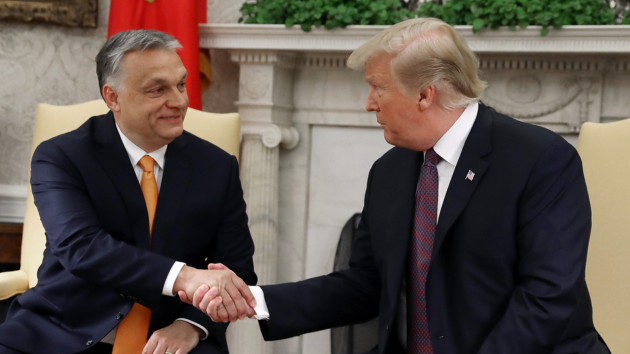
(WASHINGTON) President Donald Trump and Hungary’s autocratic leader Viktor Orban, whom Trump has repeatedly praised as a “strongman,” will meet at the White House on Friday.
Expected to be part of the talks is Russia’s war in Ukraine, specifically new U.S. sanctions targeting two of Moscow’s largest oil companies and their subsidiaries that are set to go into effect on Nov. 21.
Last week, Trump said Orban wanted an exemption from the sanctions.
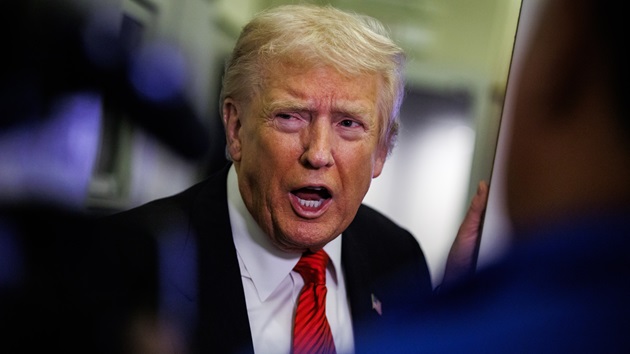
“He has asked for an exemption. We haven’t granted one, but he has asked. He’s a friend of mine. He’s asked for an exemption,” Trump told reporters on Air Force One.
Orban was recently going to play host to a summit between President Trump and Russian President Vladimir Putin, before Trump called the proposed meeting off amid frustration with the lack of progress in peace talks.
Trump said they had picked Budapest, Hungary as the location because both he and Putin liked Orban.
“He’s been a very good leader in the sense of running his country,” Trump said of Orban.
Ahead of Friday’s meeting, Orban posted on X that he hoped to “open a new chapter in Hungarian–American relations with President Trump.”
“Our goal is to establish a strategic partnership that includes energy cooperation, investments, defence collaboration, and discussions on the post-war landscape following the Russia–Ukraine conflict. We are working on an agreement based on mutual benefits, one that serves the interests of every Hungarian citizen,” Orban wrote.
Trump also welcomed Orban to the White House during his first term, in 2019, breaking from his predecessors who had shunned Hungary’s prime minister from Washington.
The two men met several times when Trump was out of office at his Florida estate, including during the summer of the 2024 campaign and after Trump became president-elect.
Orban has been embraced by many prominent American conservatives over his positions on immigration and LGBTQ issues, and has spoken several times at the Conservative Political Action Conference. Orban hosted a CPAC event in Hungary earlier this year.
Trump praised Orban during the ABC News September 2024 presidential debate with then-Vice President Kamala Harris, after Harris claimed Trump was not respected on the world stage.
“Let me just tell you about world leaders. Viktor Orban, one of the most respected men — they call him a strong man. He’s a tough person. Smart. Prime Minister of Hungary. They said why is the whole world blowing up? Three years ago it wasn’t. Why is it blowing up? He said because you need Trump back as president,” Trump said during the debate.
(WASHINGTON) — The Trump administration has asked the 1st U.S. Circuit Court of Appeals to issue an emergency stay of a judge’s ruling Thursday ordering the administration to fully fund the Supplemental Nutrition Assistance Program by today.
Lawyers for the Department of Justice argue that the district court ruling makes a “mockery of the separation of powers.”
“This unprecedented injunction makes a mockery of the separation of powers. Courts hold neither the power to appropriate nor the power to spend. Courts are charged with enforcing the law, but the law is explicit that SNAP benefits are subject to available appropriations,” the DOJ said in its filing.
U.S. District Judge John McConnell, in his ruling Thursday, ordered the Trump administration to fully fund SNAP for the month of November by Friday.
Last week McConnell ordered the government to use emergency funds to pay for SNAP in time for the Nov. 1 payments to be made — but the administration committed to only partially funding the program, saying they had to save the additional funds for child nutrition programs.
McConnell, in his Thursday ruling ordering SNAP to be fully funded, said the government’s argument that it did not want to tap into emergency funds in order to protect child nutrition programs was implausible, and accused the Trump administration of “erroneously and intentionally” conflating the funding.
“People have gone without for too long, not making payments to them for even another day is simply unacceptable,” the judge said.
The government has asked the circuit court to allow U.S. Department of Agriculture, which operates SNAP, to continue with the partial payment of SNAP and to “not compel the agency to transfer billions of dollars from another safety net program with no certainty of their replenishment.”
McConnell hemself denied a request from the government to stay his own decision, saying, “The request for a stay of this decision, either a stay or an administration stay, is denied. People have gone without for too long. Not making payments to them for even another day is simply unacceptable.”
The judge, in his order Thursday, directly rebuked President Donald Trump for stating “his intent to defy” a court order when Trump said earlier this week that SNAP will not be funded until the government reopens from the ongoing government shutdown.
U.S. Border Patrol Chief Greg Bovino leads his troop as they confront demonstrators outside of an immigrant processing center on September 27, 2025 in Broadview, Illinois. Scott Olson/Getty Images
(CHICAGO) — The Border Patrol official tasked with leading the Trump administration’s immigration enforcement crackdown in Chicago admitted to lying about a rock-throwing incident used to justify deploying tear gas against protesters, U.S. District Judge Sara Ellis said Thursday before issuing a preliminary injunction limiting the use of force during immigration arrests and protests.
The Oct. 23 incident involving Border Patrol Commander Greg Bovino, has been a key part of the court proceedings challenging the tactics of immigration agents during the Trump administration’s “Operation Midway Blitz,” which began in September.
Video of the incident showed Bovino throwing a gas canister at demonstrators in Chicago’s Little Village neighborhood without giving a verbal warning — a violation of the judge’s earlier temporary restraining order limiting the use of force, the judge said.
“Mr. Bovino and the Department of Homeland Security claimed that he had been hit by a rock in the head before throwing the tear gas, but video evidence disproves this. And he ultimately admitted he was not hit until after he threw the tear gas,” Ellis said Thursday.
At the time of the incident, DHS defended Bovino’s actions saying that a Border Patrol transport van transporting undocumented immigrants was attacked by demonstrators.
“The mob of rioters grew more hostile and violent, advancing toward agents and began throwing rocks and other objects at agents, including one that struck Chief Greg Bovino in the head,” Assistant Secretary Tricia McLaughlin said in a statement after the incident.
She said in the statement that Border Patrol agents repeated multiple warnings.
“Agents properly used their training. The use of chemical munitions was conducted in full accordance with CBP policy and was necessary to ensure the safety of both law enforcement and the public,” McLaughlin said in the statement.
ABC News has reached out to DHS; about the discrepancy between its account of what happened and the judge’s ruling. A spokesperson responded with a statement criticizing the judge’s decision to grant a preliminary injunction.
“This injunction is an extreme act by an activist judge that risks the lives and livelihoods of law enforcement officers,” the spokesperson said in a statement Thursday. “Rioters, gangbangers, and terrorists have opened fire on our federal law enforcement officers, thrown rocks, bottles, and fireworks at them, slashed the tires of their vehicles, rammed them, ambushed them, and they have destroyed multiple law enforcement vehicles. Despite these real dangers, our law enforcement shows incredible restraint in exhausting all options before force is escalated.”
The spokesperson said DHS would appeal the judge’s order.
During Thursday’s hearing, the judge listed several other instances that she said proved federal agents disregarded the First Amendment rights of journalists, demonstrators and religious practitioners.
She referenced a Sept. 19 video of an incident involving protesters at the Broadview immigration facility.
“The protesters were standing far away. Agents immediately began lobbying … flash-bang grenades and tear gas with no warning whatsoever,” Ellis said.
The judge said she saw little reason for the use of force that federal agents used.
“Overall, this calls into question everything that defendants say they are doing in their characterization of what is happening either at the Broadview facility or out in the streets of the Chicagoland area during law enforcement activities,” she said.
In a deposition, played in court earlier this week, Bovino defended his own conduct and that of other immigration agents, saying he believed “all uses of force have been more than exemplary” during the operation in the Chicago region.
U.S. Rep. Elise Stefanik (R-NY) speaks during a hearing before the House Education and Workforce Committee at the Rayburn House Office Building on May 7, 2025 in Washington, DC. Alex Wong/Getty Images
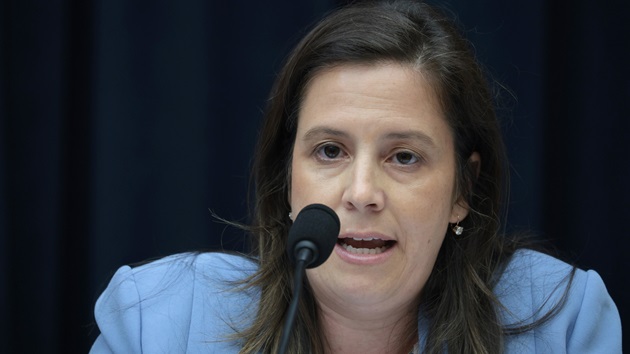
(NEW YORK) — New York Republican Rep. Elise Stefanik, a top ally of President Donald Trump on Capitol Hill, officially launched a campaign for governor in 2026 against Democratic Gov. Kathy Hochul on Friday after months of hinting at the move.
She has been a vocal critic of Hochul and doubled down on attacks against her after the upstate moderate governor endorsed New York City Mayor-elect Zohran Mamdani following his Democratic primary victory.
In a statement Friday through her campaign, Stefanik slammed Hochul, her likely opponent in the election if both Stefanik and Hochul win their respective party primaries.
“Kathy Hochul is the Worst Governor in America. Under Kathy Hochul’s failed leadership, New York is the most unaffordable state in the nation with the highest taxes, highest energy, utilities, rent, and grocery prices crushing hardworking families,” Stefanik wrote.
“I am running for Governor to bring a new generation of leadership to Albany to make New York affordable and safe for families all across our great state,” Stefanik wrote. “Our campaign will unify Republicans, Democrats, and Independents to Fire Kathy Hochul once and for all to Save New York.”
An announcement video Stefanik posted on Friday focused on a similar message, with the video’s narrator largely pinning affordability issues and other key concerns on Hochul.
The video does not mention President Donald Trump.
But Hochul and the New York State Democratic Party are pointing to her close relationship with Trump as a detriment. And New York went blue in the 2024 presidential election — with Trump receiving 43% of the vote in New York state, trailing Vice President Kamala Harris by around 13 percentage points.
“Elise Stefanik is running to deliver New York for Donald Trump and raise your costs,” Hochul said in a post on X on Friday. “Not on my watch. My message to Trump’s ‘top ally’ — bring it on.”
After Tuesday’s election victories for Democrats, a spokesperson for the New York State Democratic Party said New Yorkers will reject Stefanik, who was briefly nominated for a position as United Nations ambassador by Trump earlier this year.
“Voters in New York and across the country rejected Trump and his enablers earlier this week, and Stefanik will face the same fate when she launches her campaign to put Trump ahead of New Yorkers,” Addison Dick wrote in a statement.
Press releases from Stefanik’s campaign on Friday released after the announcement said that Stefanik has already netted endorsements from more than half of New York’s Republican county chairs and from the chair of the New York Republican Party.
“There will not be a Republican primary and a year from now, Elise will lead our team to victory over Kathy Hochul, end one-party Democrat rule, and make New York affordable again,” New York GOP Chairman Ed Cox wrote in a statement.
The upstate New York congresswoman, a onetime staffer for Mitt Romney’s 2012 presidential campaign who helped former House Speaker Paul Ryan prepare for his vice presidential debate, gained prominence in the MAGA movement during the first Trump administration as a vocal defender of the president on the House Intelligence Committee during Democrats’ first impeachment inquiry in 2019.
New York last elected a Republican governor in 2002 when George Pataki won a third term in office.
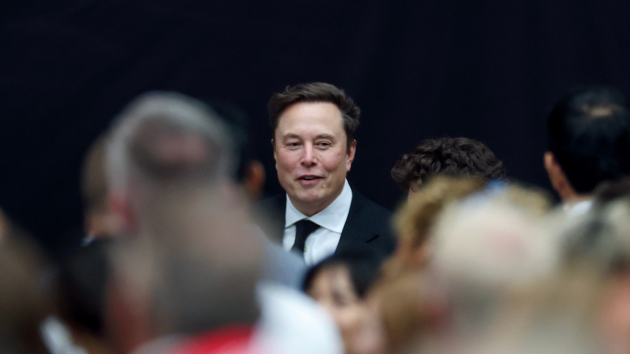
Tesla shareholders awarded CEO Elon Musk a pay package on Thursday that could grant the tech entrepreneur nearly $1 trillion in compensation over the next decade.
The pay package would make Musk the best-compensated CEO ever recorded. According to a securities filing in September, Musk would rake in roughly $900 billion over the duration of the agreement.
The full compensation would only be delivered if Musk vaults the company from its present value of $1.1 trillion to $8.5 trillion, a figure that exceeds the current combined market values of Meta, Microsoft and Google-parent Alphabet, the filing says.
The compensation package also includes a set of production goals, including one million Robotaxis in commercial operation and the delivery of one million humanoid robots over the next 10 years, according to the securities filing.
Before Tesla released the results of the shareholder vote, some major shareholders said they had voted down the proposal. Norway’s $2 trillion sovereign wealth fund said Tuesday that it had voted against the pay package, raising concerns about its scale and potential risks.
“While we appreciate the significant value created under Mr. Musk’s visionary role, we are concerned about the total size of the award, dilution, and lack of mitigation of key person risk consistent with our views on executive compensation,” Norges Bank Investment Management, the manager of the fund, said in a statement.
(NEW YORK) — Musk, considered the world’s richest person, currently boasts a net worth of about $504 billion, according to Forbes. If he were to receive the full pay package, Musk would become the world’s first-ever trillionaire.
The pay package could also increase Musk’s ownership stake in Tesla to as much as 29%. Musk has long pursued a larger ownership stake.
“We are at a pivotal juncture in Tesla’s history, and the proposals the Special Committee has carefully designed and the Board has put forward will help determine Tesla’s future,” the company’s website said earlier this week. “If you believe, like us, that Elon is the CEO that can make our ambitious vision a reality, vote NOW.”
Online voting among shareholders closed at 11:59 a.m. ET on Wednesday.
The company’s new compensation package arrives as Musk’s previous payment plan remains in legal limbo.
Last year, a Delaware judge twice struck down a $50 billion pay package for Musk put forward by the company in 2018.
Chancellor Kathaleen McCormick of the Court of Chancery, which litigates corporate governance litigation for companies incorporated in Delaware, initially declared that the negotiations surrounding the package had been inappropriate, due to a lack of independence among board members and problematic influence by Musk over those negotiations.
In a second ruling, McCormick decided that an additional shareholder vote on the compensation package — even if made with full knowledge of the initial problems surrounding the negotiation of the agreement — could not undo those problems. Musk has appealed the ruling.
Tesla announced a 12% jump in revenue over the third quarter in October, snapping a streak of two consecutive quarters of falling sales.
Still, earnings fell short of analysts’ expectations, causing a drop in the stock price. Overall, shares of Tesla have climbed about 16% this year, putting them roughly in line with a jump in the S&P 500 over that period.
Musk’s work as a “special government employee” with the Trump administration, which ended in May, set off demonstrations at Tesla dealerships worldwide in protest of his effort to slash government spending as leader of the Department of Government Efficiency.
On an earnings call in June, Musk fielded a question about his control of the company, which a Morgan Stanley analyst said was 13%.
“As I mentioned before, I think my control of Tesla should be enough to ensure that it goes in a good direction, but not so much control that I can’t be thrown out if I go crazy,” Musk said in jest.
Tasos Katopodis/Getty Images for Fair Share America
(WASHINGTON) — As tributes pour in for former Speaker of the House Nancy Pelosi after she announced Thursday that she would leave Congress in January 2027 at the end of her current term, it’s an open question who will replace her.
According to filings with the Federal Election Commission as of Thursday morning, six Democratic candidates besides Pelosi and two Republicans have registered campaign committees for the June 2026 primary for California’s 11th Congressional District, the San Francisco-based congressional seat Pelosi represents.
California uses a “top-two” primary system where the two candidates with the most votes, regardless of party, advance to the general election.
The filing period for California’s congressional primary does not open until February 9, 2026, and closes on March 6, so there is still plenty of time for other challengers to enter the ring.
Two of those candidates had already been gaining attention and some prominence.
Both are decades younger than Pelosi, and now could be among the continued wave of generational change within the Democratic Party — similar to how U.S. Rep. Jerry Nadler, D-N.Y., announced his retirement in September and is likely to be succeeded by one of the numerous younger candidates who have launched bids.
California state Sen. Scott Wiener announced in October, weeks before Pelosi’s announcement, that he would run for the seat. Weiner had previously indicated he would wait for her to announce her plans.
Wiener, 55, was first elected to the California state Senate in 2016 and previously worked in San Francisco city government and as a lawyer.
In his announcement video launching his congressional bid, he said he was running “to defend San Francisco, our values, our people, and the constitution of the United States with everything we have … Trump and his MAGA extremists don’t scare me.” According to federal campaign finance filings, his campaign had nearly $870,000 on hand as of the end of September.
Wiener, in a statement on Thursday, called Pelosi “an icon of American politics,” and praised her work on health care, the economy, climate policy, and “fighting for the marginalized … At the height of the AIDS crisis, when so many others wanted to push LGBTQ people under the rug, Nancy Pelosi fought proudly for us to be treated with dignity.”
Speaking about his own experience coming out as gay around the time Pelosi came to Congress and said she was there to fight AIDS, Wiener added, “It was a terrifying time to come of age as a gay man, and Nancy Pelosi stepped up and used her voice and platform to fight for people like me.”
Asked on Thursday by ABC station KGO-TV how more challengers might enter the race now and how that impact his campaign, Wiener said he didn’t want to speculate on who else might enter.
“Today, this is really just about honoring Nancy Pelosi, her leadership, how much she delivered for our city and our country. And then we will certainly have plenty of time to talk about the campaign,” he said.
Separately, former Silicon Valley tech entrepreneur Saikat Chakrabarti had well beforehand launched a primary campaign to Pelosi, with a progressive platform that includes tuition-free public college and universal health care.
Chakrabarti, 39, a founding engineer of the online payment platform Stripe, was New York Rep. Alexandria Ocasio-Cortez’s campaign manager during her 2018 primary upset against incumbent Joe Crowley, which kicked off Ocasio-Cortez’s meteoric rise.
He also worked as her chief of staff in Congress for the beginning of her first term and got his start in politics working on Bernie Sanders’ 2016 presidential campaign.
In a statement on Thursday, Chakrabarti thanked Pelosi “for your decades of service that defined a generation of politics and for doing something truly rare in Washington: making room for the next one. Our campaign is ready to build on that legacy by fighting to create a San Francisco and an America that works for everyone.”
Speaking with ABC News on Thursday, Chakrabarti said that challengers in the race and Pelosi’s decision to retire “doesn’t change what my campaign’s about, because I still believe we need to change the Democratic Party. I’m still calling for people to run all across the country to build this new movement.”
Asked if he’d want Pelosi’s endorsement, Chakrabarti said he would if she’s willing to endorse him but that it’s her decision to make.
Gabrielle Lurie/San Francisco Chronicle via Getty Images
(WASHINGTON) — President Donald Trump on Thursday called former House Speaker Nancy Pelosi an “evil woman” when asked to comment on her retirement announcement.
“I’m glad she’s retiring,” Trump said as he took reporter questions in the Oval Office during a news conference on reducing the cost of weight loss drugs for Americans.
“I think she did the country a great service by retiring,” Trump continued. “I think she was a tremendous liability for the country. I thought she was an evil woman who did a poor job, who cost the country a lot in damages and in reputation. I thought she was terrible.”
Pelosi became one of Trump’s fiercest critics, and their tensions were well-documented as she led the House in the final years of his first term.
She presided over both of Trump’s impeachments, the first in 2019 over allegations of abuse of power and the second in 2021 after a pro-Trump mob stormed the U.S. Capitol on Jan. 6.
In 2020, she went viral for ripping up a copy of Trump’s State of the Union speech as she stood behind him.
Pelosi did not attend Trump’s inauguration this past January.
More recently, she called Trump a “vile creature” in an interview with CNN.
“The worst thing on the face of the Earth, but anyway,” Pelosi said. When asked to explain why she described him that way, Pelosi said he “does not honor the Constitution.”
Trump, too, has spared no criticism of Pelosi over the years. He regularly targeted her in his 2024 campaign speeches and rallies, calling her a “crooked person,” “evil” and “sick.”
Pelosi, 85, announced early Thursday morning in a video message that she was retiring at the end of her current term in 2027 representing San Francisco in Congress.
The first woman elected speaker of the U.S. House of Representatives and the first woman to lead a major political party in either chamber of Congress, Pelosi will leave Washington after nearly 40 years as one of the most powerful elected women in history.
“I say to my colleagues in the House all the time, no matter what title they have bestowed upon me, speaker, leader, whip, there has been no greater honor for me than to stand on the House floor and say, I speak for the people of San Francisco. I have truly loved serving as your voice,” Pelosi said in her announcement on Thursday.
(NEW YORK) — Exercise equipment company Peloton is voluntarily recalling approximately 833,000 exercise bikes due to a potential issue specific to the bike’s seat post, the company announced Thursday.
According to the company announcement, the recall affects “certain Original Series Bike+ models manufactured from December 2019 through July 2022 for sale in the U.S. and Canada.”
“The Original Series Bike+ seat post can break during use, posing a potential fall and injury risk to consumers,” the company stated.
Peloton said it has so far received three reports of Original Series Bike+ seat posts breaking “out of approximately 833,000 units sold in the U.S.”
“Peloton has received no reports of a seat post breaking, out of 44,800 units sold in Canada,” it added.
According to a recall announcement on the U.S. Consumer Product Safety Commission website, the affected bikes were sold at Peloton and Dick’s Sporting Goods stores nationwide, as well as online at Peloton, Dick’s, Amazon and eBay from January 2020 to April 2025. The bikes retailed for approximately $2,495, according to the agency.
The CPSC also stated that of the three broken seat post reports Peloton received, two included “reports of injuries due to a fall.”
Peloton said Thursday that impacted users should stop using the recalled bikes and contact Peloton for a replacement seat post.
The replacement seat post is a CPSC-approved solution, a Peloton spokesperson told ABC News.
Both the company and the CPSC noted the new seat posts can be self-installed.
The affected bikes bear the model number PL02 and serial numbers beginning with the letter “T,” according to Peloton. The serial number can be found “inside the front fork, behind the front fork, or behind the flywheel,” the company said.
In a statement to ABC News, the Peloton spokesperson said, “The integrity of our products and our Members’ well-being are our top priorities. We are taking this opportunity to make replacement seat posts available to all affected Bike+ users and we encourage them to contact us to receive the redesigned seat post as soon as possible.”
Peloton previously voluntarily recalled over 2 million bikes, Bike Model PL01, in 2023, warning that the bike seat post assembly could break and cause users to fall.
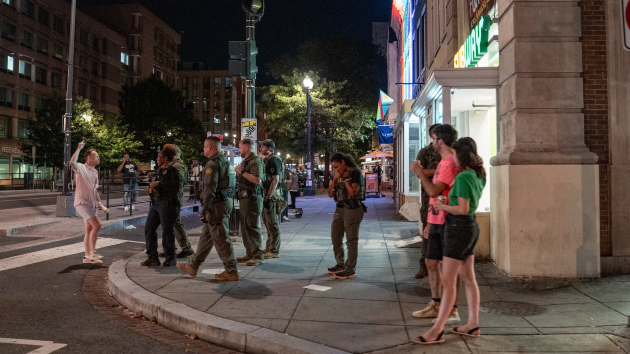
FBI and Border Patrol officers speak with Sean Charles Dunn, after he allegedly assaulted law enforcement with a sandwich, along the U Street corridor during a federal law enforcement deployment to the nation’s capital on Aug. 10, 2025, in Washington, D.C. (Andrew Leyden/Getty Images)
(WASHINGTON) — A jury found Sean Charles Dunn, the man accused of throwing a sandwich at a Customs and Border Protection agent in Washington, D.C., not guilty after three days of testimony and dozens of exhibits.
Dunn, a former Department of Justice staffer, had been hit with a misdemeanor assault charge after a grand jury failed to indict him on a felony assault charge for allegedly throwing a sandwich at the agent during the federal law enforcement surge in August. Video of the encounter went viral after Dunn’s arrest.
According to the earlier felony criminal complaint, Dunn allegedly approached the officer while shouting “f— you! You f—— fascists! Why are you here? I don’t want you in my city!”
After several minutes of confrontation, Dunn allegedly threw the sandwich, striking the officer in the chest, the complaint says.
Defense attorney Sabrina Shroff signaled her strategy immediately in her closing arguments on Wednesday, saying, “This case, ladies and gentlemen, is about a sandwich,” she said. “A sandwich that landed intact, still in its Subway wrapping.”
Assistant U.S. Attorney Michael DiLorenzo opened the government’s closing argument by urging jurors to find Dunn, better known online as “Sandwich Guy,” guilty of misdemeanor assault.
“This case is not about strong opinions,” DiLorenzo said. “It’s not about immigration.” Instead, he argued, Dunn crossed a line the night he threw the sandwich at a CBP agent.
The government said Dunn caused a “seven-minute disturbance” designed to pull attention away from CBP and the Metropolitan Police Department during a “high-visibility” operation. “Distract the officers, move them from their post,” DiLorenzo told jurors.
Prosecutors then played a video of Dunn admitting to officers, “I did it. I threw a sandwich. I did it to draw them away from where they were. I succeeded.”
The government argued that intent, not the menu item, is what matters. “Even with a sandwich, you don’t have the right to touch another person,” DiLorenzo said.
At several points, U.S. District Judge Carl J. Nichols reminded jurors that their verdict must rest on the evidence presented.
When Shroff continued her argument, she turned the government’s framing on its head, not by disputing the sandwich, but by arguing its legal meaning.
She showed photos of the sandwich on the ground after it hit the CBP agent and then pointed to something the government had not, the agent’s own mementos from the incident. The agent, she said, later received a fake Subway sandwich and a “felony footlong” badge from co-workers, both of which he displayed at work.
“If someone assaulted you, if someone offended you, would you keep a memento of that assault?” Shroff asked. “Would you stick it on your lunchbox and carry it every day? Of course not.”
Shroff argued the sandwich caused no injury, was not a foreseeable weapon, and that Dunn was engaged in protected political speech. She compared the incident to “a kid throwing a stuffed toy in the middle of a bedtime temper tantrum.”
Earlier, Dunn waived his right to testify in court ahead of closing arguments.
After nearly two hours of deliberation, the jury did not reach a verdict. Proceedings will resume at 9 a.m. Thursday.
-ABC News’ Alex Mallin contributed to this report.
(CHICAGO) — Supervisory Border Patrol Agent Charles Exum testified Wednesday that he had no role in the decision to release his government-issued vehicle after it was involved in a collision that led to him shooting a woman on Chicago’s southwest side last month.
“I was told to pick it up, [so] I picked it up,” Exum said, adding that he believed the vehicle had no remaining evidentiary value after it was processed and released by the FBI.
An attorney for the woman disputed Exum’s account, arguing that releasing the vehicle before defense lawyers could inspect it may have led to the destruction of potentially favorable evidence. The lawyer also confronted the agent with text messages Exum sent to friends and family in the days after the incident in which he appeared to boast about his shooting skills.
“I fired 5 rounds and she had 7 holes. Put that in your book, boys,” one of those messages said.
U.S. District Judge Georgia Alexakis ordered the testimony Wednesday in the criminal case against Marimar Martinez, who was shot by the Border Patrol agent — identified for the first time as Exum — on Oct. 4 in the Brighton Park neighborhood. The incident led to chaotic street protests and the deployment of tear gas by federal agents.
Martinez and another man, Anthony Ian Santos Ruiz, are charged with assault with a deadly weapon, accused of following the agents’ vehicles and initiating the collision with Exum’s SUV that led to the shooting. Federal prosecutors contend Exum fired five rounds defensively after Martinez allegedly drove toward him when he exited his vehicle after the crash, according to court filings.
“Moments after exiting the CBP Vehicle, the Martinez Vehicle drove northbound ” at the agent and he “proceeded to fire approximately five shots from his service weapon at the driver of the Martinez Vehicle,” prosecutors wrote in a criminal complaint last month.
Both Martinez and Ruiz have entered not guilty pleas. Martinez’s attorneys contend in court filings that it was the agents’ vehicle that initiated the collision. The government disputes that.
Wednesday’s hearing focused on a defense motion alleging that the federal government may have spoiled or altered evidence when it allowed the damaged vehicle Exum was driving to be released to him and driven back to his home base in Maine, where a Customs and Border Protection mechanic later wiped off black scuff marks after the FBI had processed the SUV in Chicago.
Exum said that after the collision, his government-issued Chevrolet Tahoe had scratches and dents on the driver’s side and black marks on the driver’s door and above the fuel tank. He said the FBI took photographs of his vehicle before it was taken from the scene to an FBI office for further evidence processing.
Prosecutors said in court filings that the FBI took additional photographs of the vehicle at an FBI facility in Chicago. The FBI also took paint chip samples from the Tahoe and downloaded data from the vehicle’s on-board computer before releasing the vehicle to Exum, according to court records.
Exum said he was contacted several hours after the shooting and told that his vehicle was ready to be picked up from an FBI office in downtown Chicago. He testified that a supervisor told him the vehicle had been processed for evidence and cleared for release. When he retrieved it, he said, the SUV appeared to be in the same condition as when it was removed from the scene.
A 23-year Border Patrol veteran stationed in Maine, Exum was on a temporary duty assignment for “Operation Midway Blitz” in Chicago. His assignment began in early September and was scheduled to end in October. He said he stayed an extra day after the incident to be interviewed by the FBI and a prosecutor.
Exum testified that he drove the vehicle back to Maine over three days, arriving at his home duty station on Oct. 10 and parking it in the facility’s garage. He said he did not see the vehicle again until about six days later, when he noticed it had been moved and that the black scuff marks from the collision had been cleaned off. He said he had no prior knowledge of the work and later learned that a supervisor had authorized a mechanic to perform it.
Prosecutors submitted to the court an email from that supervisor to Exum explaining that he had authorized the work on the vehicle to begin “because I though all the necessary pictures and evidence was [sic] taken in Chicago during the initial investigation.”
Exum said all work on the vehicle was stopped after the FBI informed him it would need to be returned to Chicago under a court order. The vehicle was transported to Chicago on a flatbed truck on Oct 23 and inspected by attorneys for Martinez a week later.
Defense attorney Chris Parente suggested during cross-examination that it was Exum, not his supervisor, who initiated the request for repairs. Parente cited an FBI interview report from Oct. 20 in which the agent wrote that Exum said he had sought approval for the work.
Exum denied that account.
“I did not say that, and I did not get approval for anything,” he testified. “He must have written it down incorrectly or misunderstood.”
Parente also confronted Exum with a series of text messages he sent in the days after the shooting — to his wife, his brother, and a group of fellow agents in a Signal chat. Prosecutors turned over screenshots of the messages to the defense earlier this week.
In one screenshot displayed in court — which included a link to a news article about the shooting — Exum wrote in a group chat: “Read it. Five shots, seven holes.” The message appeared to refer to the number of times Exum shot Martinez.
“So the ‘five shots, seven holes’ is a reference to my argument at the detention hearing that you shot Ms. Martinez five times and there were seven holes. Is that true?” Parente asked.
“I believe that is true,” Exum replied, adding: “I am a firearms instructor, and I take pride in my shooting skills.”
“So you’re bragging that you shot her five times and got seven holes? Are you literally bragging about this?” Parente asked.
“I’m just saying five shots, seven holes,” Exum answered.
In another partially redacted message to the same group, Exum wrote: “I have a MOF amendment to add to my story. I fired 5 rounds and she had 7 holes. Put that in your book, boys.” Exum said “MOF” referred to a nickname used by the group — “Miserable Old F—s.”
Exum testified that the texts to the group were sent as a way of “relieving stress.”
A separate redacted message from Oct. 5, the day after the shooting, read: “Cool. I’m up for another round of ‘f— around and find out.’”
“That means illegal actions have legal consequences,” Exum replied.
Parente pressed Exum on whether such messages were appropriate for a federal officer.
“You’re supposed to protect the lives of U.S. citizens, right?” Parente asked.
“Protect anyone’s life,” Exum replied.
“You know Ms. Martinez is a U.S. citizen, right?”
“I do know,” Exum said.
“And yet this seems like you’re in a support group bragging about the shooting,” Parente said.
“I did what I had to do to save my life,” Exum replied.
Following Exum’s testimony — which did not delve into the specific circumstances of the shooting — Judge Alexakis approved a defense request to hear from the FBI agent in Maine who took Exum’s statement, as well as the FBI agent and federal prosecutor who approved the release of his vehicle just hours after the incident.
“I want to know why an [assistant U.S. attorney] would authorize the release of a vehicle at the center of a media storm in an agent-involved shooting,” Parente said. “It doesn’t comport with my experience, so I think they both have relevant testimony.”
A date for that hearing has not yet been set.
Martinez has been indicted on charges of assaulting a federal officer with a deadly weapon. Prosecutors allege she and Ruiz followed the agents’ SUV for miles and rammed it while Exum and two others were inside.
A DHS statement on the incident emphasized that Martinez “was armed with a semi-automatic weapon and had a history of doxxing federal agents.” The government alleged that the law enforcement officers were “ambushed by domestic terrorists.” The charges against Martinez, however, made no mention of a weapon, and prosecutors have acknowledged in court that the gun was not displayed or possessed by Martinez during the confrontation. It was discovered in her purse when agents searched her vehicle later. Martinez has a license for the gun and a concealed carry permit, according to court records.