(NEW YORK) — A new generation of politicians is emerging just in time for the midterms.
This election cycle marks the first time members of Generation Z, those born after 1996, are eligible to run for seats in the House of Representatives, where legislators must be 25 years old by the time they’re sworn in.
Karoline Leavitt, a Republican from New Hampshire, and Maxwell Frost, a Democrat from Florida, are the two main viable Generation Z candidates running for Congress in the 2022 midterms.
Leavitt turns 25 just a few weeks before the New Hampshire primary in August, and Frost turned 25 earlier this year.
Both candidates have some political experience.
Leavitt worked in the Trump administration as an assistant press secretary. Following that, she served as communication director for the No. 3 Republican in the House, Rep. Elise Stefanik, R-N.Y.
She was raised in New Hampshire and is running in the GOP primary to represent its 1st District, hoping for the chance to go head-to-head against the Democratic incumbent, Rep. Chris Pappas.
“I’m honored to be considered a contender in this primary race to represent my home district and defeat the Democrat, who I obviously feel is not doing a good enough job,” said Leavitt, who has been outspoken about her false belief that Trump won the 2020 election.
Some of Leavitt’s campaign promises include strengthening the Second Amendment, fighting for energy independence, tackling the opioid crisis and advocating for legislation that supports the anti-abortion movement.
“We need young, fresh leadership in Washington on both sides of the aisle,” said Leavitt. “There are politicians that have been [in Washington] literally three times as long as I’ve been alive. This is a serious problem for our country and my generation, [which particularly] lacks young conservative voices.”
Another Gen Z candidate is also running in that crowded race. Tim Baxter, who shares a pro-Trump platform, is struggling to gain traction, however, and had to take out a loan for over $100,000 to continue funding his campaign.
Frost — the Gen Zer running in the Democratic primary for Florida’s 10th Congressional District — was a national organizer for the ACLU and then became the national organizing director of March for Our Lives, a youth-led organization dedicated to ending gun violence.
He’s hoping to fill the open seat of Rep. Val Demmings, who is running for a Senate seat.
Frost said one particular moment cemented his decision to run: being reconnected with his biological mother and having a conversation with her about his birth.
She told him she had him at one of the most vulnerable points in her life, he said, which is when Frost decided to see the world through the eyes of its most vulnerable people.
“I hung up the phone and said, I need to run for Congress, not just for myself, but for people like my biological family, my family, friends, and people who live in central Florida.”
Both Leavitt and Frost agree it’s time to elect young people to Congress to represent issues younger voters care about and to give them more of a say in decisions being made now, which will impact young Americans down the line.
The median age of a senator in Congress is 64, while it’s 58 for members of the House. Nearly two-thirds of Congress is over 55, according to Pew Research.
Leavitt believes it’s crucial for the Republican Party to “encourage young conservative leaders when they come along” while Frost said Generation Z faces unique challenges and the country “needs a diversity of opinions, thoughts, experiences and age” in Congress.
When people tell Leavitt to wait her turn, she said her response is, “for who?”
Frost said he’s had similar experiences with people questioning his age and experience. But he tells them something he picked up from a voter, that he’s “just on time” for a congressional bid.
(NEW YORK) — A 26-year-old woman arrested this week in the fatal shoving attack of an 87-year-old woman earlier this month on a New York City street has made bail, her attorney said Friday.
Lauren Pazienza, of Port Jefferson, New York, was charged Tuesday with manslaughter in connection to the March 10 incident, police said.
Pazienza turned herself in to the 10th Precinct in Manhattan’s Chelsea neighborhood, ABC station WABC reported. She was seen being escorted out of the 10th Precinct with her hair covering her face and did not respond to any questions from reporters about the charge.
Pazienza was arraigned Tuesday in New York Criminal Court on manslaughter and assault charges. A judge set her bail at $500,000 cash or $1 million bond.
Her parents have since posted bail and her attorney, Arthur Aidala, expects her to be released from Rikers Island at some point Friday, he told reporters.
Pazienza’s return court appearance, initially scheduled for Friday, was adjourned until April 25 pending the arraignment on her expected indictment.
“We look forward to getting the evidence and the discovery material from the attorney’s office so my client will now be able to come to our office and discuss the case with her partners and I to determine what the next steps are,” Aidala said.
The attorney called the victim’s death a “tragedy.”
“We’re just going to get to the bottom of what really happened that day after we have all the evidence that’s in possession of the prosecutors because we don’t have any evidence,” Aidala said.
The victim was walking in Chelsea on the night of March 10 when the assailant approached her from behind and pushed her, “causing her to fall and hit her head,” the New York City Police Department said following the incident. She was transported to an area hospital in critical condition. She had suffered a traumatic head injury, her family said.
The victim, who officials identified as Barbara Maier Gustern, died from her injuries on March 15, police said.
The NYPD released surveillance video of the suspect walking along a sidewalk as it called on the public for help in solving what police said appeared to be an unprovoked attack.
“We’re asking the public’s help in solving this disgusting, disgraceful offense committed against a vulnerable, elderly female who was doing nothing but walking down the streets of New York City,” NYPD Chief of Detectives James Essig said during a briefing last week.
A motive in the attack remains unclear.
Gustern was a well-known and beloved member of the city’s cabaret scene and a vocal coach. Condolences from the theater community have poured in in the wake of her sudden passing.
“We are waiting for the legal process to run its course and look forward to a resolution of the matter,” her grandson, AJ Gustern, said in a statement to ABC News. “While we appreciate the outpouring of affection for my grandmother, the family is still grieving. We ask for respect for our privacy during this difficult time.”
ABC News’ Aaron Katersky contributed to this report.
(NEW YORK ) — Lev Parnas, a former associate of Rudy Giuliani who was previously convicted on campaign finance charges, pleaded guilty Friday to a wire fraud conspiracy charge that resulted from his work at a startup insurance company he co-founded.
Federal prosecutors accused 50-year-old Parnas of duping investors in Fraud Guarantee, a company he established in Florida with a co-defendant, David Correia, who previously pleaded guilty.
Parnas appeared by video in front of U.S. District Judge Paul Oetken in Manhattan and said “between approximately 2012 and 2019 I agreed with another person to give false information” to potential investors.
“I’m extremely sorry for my actions, your honor,” Parnas said.
Parnas and Correia tried to lure potential investors to Fraud Guarantee by hiring Giuliani as a pitchman, according to federal prosecutors. Giuliani has said he was paid $500,000.
Parnas briefly became a figure in the first congressional impeachment inquiry against former President Donald Trump in connection with his role in assisting Giuliani in his effort in Ukraine to find disparaging information about President Joe Biden and his family, as well to call for the ouster of then-U.S. Ambassador to Ukraine Marie Yovanovitch.
At least seven victims invested a total of more than $2 million in Fraud Guarantee because Parnas and Correia misled them about the financial arrangements. The majority of investor funds were withdrawn as cash and were spent on personal expenditures such as Parnas’ rent, prosecutors said.
“Various representations he made to investors were material to obtaining funds,” Assistant U.S. Attorney Nicholas Roos said.
Parnas was previously convicted of six other counts. On the wire fraud conspiracy, he faces at least five years in prison when he’s sentenced June 29.
“Certainly the government will seek restitution and forfeiture,” Roos said.
(NEW YORK) — Vanessa Bryant has partnered with Nike to honor the life and legacy of her late husband, basketball star Kobe Bryant.
The athletic apparel company announced Thursday that in collaboration with the Bryant family there will be a focus on championing a new generation of fans and encouraging youth participation in sports.
To kick off the partnership, the first shoe, the Kobe 6 Protro “Mambacita Sweet 16,” will be a tribute to Vanessa and Kobe’s daughter, Gianna “Gigi” Bryant.
Kobe, 41, and Gigi, 13, died in a tragic helicopter crash along with seven others in January 2020.
The news of the company’s new partnership comes a year after it was initially announced that Kobe Bryant’s long-held partnership with Nike had come to an end as well as Vanessa previously slamming the brand over unauthorized sneakers honoring Gigi.
“I am happy to announce that we will continue my husband’s legacy with Nike and look forward to expanding his and Gigi’s global impact by sharing the Mamba Mentality with youth athletes for generations to come,” Vanessa said in a statement.
In addition to the new partnership, Nike and Vanessa will also work together to create a youth basketball center in Southern California, as well as continue to outfit the NBA and WNBA athletes who carry the legacy of the Mamba Mentality.
“Kobe Bryant means so much to so many of us, not just NBA fans but globally beyond the game,” John Donahoe, the president and CEO of Nike, said in a statement. “His impact in growing the sport, particularly encouraging women and young people to pick it up, endures as one of his deepest, lasting legacies. Together with Vanessa, we hope to honor Kobe and Gigi by championing a new generation for many years to come.”
(WASHINGTON) — President Joe Biden touched down Friday in Poland, what’s become the epicenter for millions fleeing their home country, to meet with U.S. service members and refugees as his presence in Europe sends a powerful message that NATO is united against Russia’s violent invasion.
At a briefing in Rzeszów on the humanitarian response to the ongoing crisis, Biden, again, called Russian President Vladimir Putin a “war criminal,” after the State Department announced this week its formal assessment that Russian forces have committed war crimes in Ukraine.
“The single most important thing that we can do from the outset is to keep the democracies united in our opposition and our effort to curtail the devastation that is occurring at the hands of a man who I quite frankly think is a war criminal,” Biden said, flanked by Poland’s President Andrzej Duda and USAID Administrator Samantha Powers. “I think it will meet the legal definition of that as well.”
Biden’s schedule was slightly delayed Friday after the plane flying Poland’s president turned back en route to Rzeszow to make an emergency landing in Warsaw.
Earlier, Biden and Secretary of Defense Lloyd Austin greeted members of the 82nd Airborne division in Rzeszów to thank them for their service — and ended up staying for a slice of pizza.
“Thank you very, very much for all you do. And it’s not hyperbole to suggest you’re the finest fighting force, not in the world — in the world. That’s not hyperbole,” Biden told the room.
But the president also raised eyebrows when he appeared to tell the group that American troops will be going into Ukraine, though he has repeatedly said that he will not send troops there.
“You know, with the Ukrainian people, Ukrainian people have a lot of backbone, they have a lot of guts and I’m sure you’re observing it,” Biden said. “And you’re gonna see when you’re there, and some of you have been there. You’re gonna see, you’re gonna see women, young people standing, standing in the middle, in front of a damn tank, just saying I’m not leaving. I’m holding my ground. They’re incredible. But they take a lot of inspiration from us.”
Asked to clarify Biden’s comment, a White spokesperson told ABC News, “the President has been clear we are not sending U.S. troops to Ukraine and there is no change in that position.”
Biden also told the room that what they are engaged in is “much more than just whether or not you can alleviate the pain and suffering of the people of Ukraine.”
“What’s at stake, and not just in what we’re doing here in Ukraine to try to help the Ukrainian people and keep the massacre from continuing, but beyond that, what’s at stake is…what are your kids and grandkids gonna look like in terms of their, their, their freedom,” the president said.
Raising his familiar line of the current fight between autocracies and democracies, Biden told these troops what they are doing is “really consequential” and goes beyond just helping Ukrainians from this invasion.
“The fact of the matter is that you are the finest — this is not hyperbole. You’re the finest fighting force in the history of the world. Let me say it again, the finest fighting force in the history of the world. Part of the reason is you’ve had to fight so much for the last 20 years. For real,” he said.
He also brought up his late son, Beau, saying, “Proudest thing he ever did was put that uniform on. Like many of you, he didn’t have to go either,” Biden said.
National Security Advisor Jake Sullivan confirmed earlier Friday that the president will meet with refugees Saturday when he is in Warsaw and deliver a “major address” ahead of his departure.
“He will also have the opportunity to meet with Ukrainian refugees, and with American humanitarians who are they’re trying to help feed and respond to the material needs of the refugee population in Warsaw,” Sullivan told reporters on Air Force One.
“And he will give a major address tomorrow that will speak to the stakes of this moment, the urgency of the challenge that lies ahead, what the conflict in Ukraine means for the world, and why it is so important that the free world sustain unity and resolve in the face of Russian aggression,” Sullivan added.
In neighboring Ukraine, the war continues.
In one of the worst attacks yet, the city council of the besieged Ukrainian city of Mariupol has said 300 people were killed in a devastating bombing of its drama theater, where hundreds of people were sheltering. The building was marked with the words “Children” written in giant Russian letters on the ground to either side.
Biden and the leaders of the other 29 NATO member countries came together in Brussels Thursday in a powerful show of solidarity against Russia’s invasion.
Biden announced new sanctions against Russia, targeting a majority of the Duma, the lower level of parliament, over 40 Russian defense companies and yet more Russian oligarchs. He also announced the U.S. will provide $1 billion in humanitarian aid to support people within Ukraine and those impacted by Russia’s war against Ukraine. That funding will go to food, shelter, clean water, medical supplies and other assistance.
Pushed on what the U.S. and NATO would do if Russia used chemical weapons in Ukraine, Biden would not get specific or confirm intelligence that Vladimir Putin is moving chemical weapons into Ukraine but said they “would respond” and that “the nature of the response would depend on the nature of the use.”
(NEW YORK) — Russian forces are continuing their attempted push through Ukraine from multiple directions, while Ukrainians, led by President Volodymyr Zelenskyy, are putting up “stiff resistance,” according to U.S. officials.
The attack began Feb. 24, when Russian President Vladimir Putin announced a “special military operation.”
Russian forces moving from neighboring Belarus toward Ukraine’s capital, Kyiv, have advanced closer to the city center in recent days despite the resistance. Heavy shelling and missile attacks, many on civilian buildings, continue in Kyiv, as well as major cities like Kharkiv and Mariupol. Russia also bombed western cities for the first time last week, targeting Lviv and a military base near the Poland border.
Russia has been met by sanctions from the United States, Canada and countries throughout Europe, targeting the Russian economy as well as Putin himself.
Here’s how the news is developing. All times Eastern:
Mar 25, 12:50 pm
Biden says he’s in Poland to see humanitarian crisis firsthand
President Joe Biden, flanked by Poland’s President Andrzej Duda and Samantha Powers of the U.S. Agency for International Development, spoke at a briefing on humanitarian efforts Friday, again calling Russian President Vladimir Putin a “war criminal.”
“The single-most important thing that we can do on the outset, is keep the democracies united in our opposition, and our effort to curtail the devastation that is occurring at the hands of a man, who quite frankly, I think is a war criminal. And I think we’ll meet the legal definition of that, as well,” Biden said.
Biden said he’s in Poland to see the “humanitarian crisis” “firsthand,” but said he’s disappointed he “can’t see it firsthand like I have in other places.”
“They will not let me … cross the border and take a look at what’s going on in Ukraine,” Biden said. “But, you know, I’m eager to hear from you, the humanitarian community, about what you see, what you’re doing, and where you think we go from here.”
Since the invasion began on Feb. 24, over 3.6 million people have fled Ukraine, with more than 2.2 million of those refugees going to Poland, according to the United Nations High Commissioner for Refugees.
“Whether it’s food, or a blanket, or cash, or the care for medical teams that we send in, or child welfare specialists, they need it now. They need it as rapidly as we can get it there,” Biden said.
Mar 25, 12:12 pm
Biden tells troops ‘what’s at stake’ is beyond Ukraine
President Joe Biden spoke to members of the 82nd Airborne Division in Jasionka, Poland, Friday, telling them, “What you’re doing is consequential — really consequential.”
“What’s at stake” is beyond Ukraine, Biden said.
“What are your kids and grandkids gonna look like in terms of their freedom?” Biden said. “The last 10 years there have been fewer democracies that have been formed than we’ve lost in the world.”
“What you’re engaged in is much more than just whether or not you can alleviate the pain and suffering of the people of Ukraine,” Biden said.
Biden commended the troops, saying “the rest of the world looks to us, because, you know, we not only lead by the example of our power, but by the power of our example. And your generation combines both. The rest of the world looks at you and sees who you are. They see you are a multiethnic group of Americans that are in fact together and united in one resolve, to defend your country, and to help those who need help.”
Mar 25, 11:12 am
Biden thanks troops in Poland
In Jasionka, Poland, on Friday, President Joe Biden and Secretary of Defense Lloyd Austin visited American troops, thanking them for working alongside Polish allies.
Biden and Austin first greeted members of the 82nd Airborne Division in a makeshift barbershop.
Biden and Austin then stopped by a mess hall and ended up staying for a slice of pizza.
Biden also shared a story about searching for his son, Beau, in a mess hall in Baghdad, only to find him using his mother’s maiden name — Hunter — on his fatigues.
“I said, ‘Beau, what the hell’s going on?’ His name was Beau Biden, and he was a colonel, I mean, a major, excuse me,” Biden said.
“And I said, ‘What happened?’ And he said, ‘Dad, with the name Biden, everybody thinks something’s going on. So I’m Hunter.’ That was his mother’s maiden name,” Biden said.
Mar 25, 10:29 am
Ukrainian troops have retaken towns, UK intelligence says
Ukrainian troops have been able to retake towns and defensive positions up to 35 kilometers (about 22 miles) east of Kyiv due to counter-attacks and Russian forces falling back on overextended supply lines, the U.K. Ministry of Defense said Friday in an intelligence update on the situation.
Ukrainian troops are likely to continue to attempt to push Russian forces back along the northwestern axis from the Ukrainian capital toward Antonov Airport in Hostomel, a suburb of Kyiv, according to the U.K. Ministry of Defense.
In southern Ukraine, Russian forces are still attempting to circumvent the densely populated city of Mykolaiv as they look to drive west toward Odesa, with their progress being slowed by logistic issues and Ukrainian resistance, the U.K. Ministry of Defense said.
Mar 25, 10:25 am
Biden arrives in Poland
U.S. President Joe Biden arrived at Poland’s Rzeszow-Jasionka Airport Friday afternoon, where he will get a firsthand look at the international efforts to help some of the millions of people fleeing Ukraine.
Biden was greeted on the tarmac by four U.S. commanding generals. While in Rzeszow on Friday, Biden will receive a briefing on the humanitarian situation and meet with humanitarian aid groups as well as service members of the U.S. Army’s 82nd Airborne Division.
He will later travel to Warsaw, where he will meet with Polish President Andrzej Duda as well as refugees from Ukraine on Saturday.
Mar 25, 10:07 am
US says Russian attacks have capacity to put NATO at risk
U.S. President Joe Biden’s support of NATO battle groups on the eastern flank stems from the belief that Russia’s attacks in Ukraine have the capacity to put the alliance’s territories at risk, according to White House national security adviser Jake Sullivan.
“We do believe Russian aggression in Ukraine shows a willingness by the Russians to disregard international borders and to disregard the basic rules of the road of the international community that have been built in sustained over the course of seven decades,” Sullivan told reporters aboard Air Force One on Friday.
“It is important in this moment to send a clear message to Russia that the United States and NATO will defend every inch of NATO territory and to deter any thinking that Putin might have about further Russian aggression into NATO,” he said.
Sullivan noted that Belarus’ willingness to station Russian troops on its soil, in particular, has a “significant impact particularly on our NATO allies in the Baltics and Poland.”
Sullivan said Biden has made clear that any diplomatic agreement reached is one that Ukraine will have to determine for itself, meaning Washington is not going to push or pressure Kyiv into any outcome.
Currently, Washington’s priority is to ensure Ukraine has the capabilities to defend itself as Russian forces continue pushing forward, Sullivan told reporters.
Mar 25, 10:02 am
Pope Francis to consecrate Russia, Ukraine
Pope Francis will consecrate Russia and Ukraine to the Immaculate Heart of Mary on Friday, inviting people around the world to join him in the prayer.
“This Act of Consecration is meant to be a gesture of the universal Church, which in this dramatic moment lifts up to God, through His Mother and ours, the cry of pain of all those who suffer and implore an end to the violence, and to entrust the future of our human family to the Queen of Peace,” Francis said in a statement.
He also called for an end to the violence.
Consecration is an act of surrender in which the pope recognizes both Russians and Ukrainians as children of god, and entrusts them to Mary’s care, Father Alexandre Mello, the secretary of the Vatican’s Dicastery for the Laity, Family, and Life, told Crux.
Mello also said consecration aims to build bridges as the prayer’s goal is to have a healing effect and remind Russians and Ukrainians of their shared roots and identities as children of the same God.
The ceremony is tied to the Marian apparitions in Fatima, Portugal in 1917, in which many Catholics believe the Virgin Mary appeared to three children, asking that the pope consecrate Russia to her immaculate heart.
The Act of Consecration to the Immaculate Heart of Mary will be prayed during the Lenten penitential service in St. Peter’s Basilica in Rome which begins at 5 p.m. local time. The pope will start the prayer at around 6:30 p.m. local time and has asked all Catholic Bishops and priests to join him spiritually.
U.S. bishops, including Cardinal Wilton Gregory, the archbishop of Washington, D.C., and Cardinal Blase Cupich, the archbishop of Chicago, announced they will be holding consecration ceremonies on Friday.
Pope Emeritus Benedict XVI said he will join in the prayer from his converted monastery in Vatican City, where he has lived since he resigned.
Mar 25, 9:27 am
Biden to meet with Polish president, refugees from Ukraine in Warsaw
U.S. President Joe Biden will meet with Polish President Andrzej Duda as well as refugees from Ukraine in Warsaw on Saturday, according to White House national security adviser Jake Sullivan.
Speaking to reporters aboard Air Force One en route to Poland on Friday, Sullivan noted that Biden will also deliver a “major address” before departing Saturday.
“He will give a major address tomorrow that will speak to the stakes of this moment, the urgency of the challenge that lies ahead, what the conflict in Ukraine means for the world, and why it is so important that the free world sustain unity and resolve in the face of Russian aggression,” Sullivan said. “He’ll also talk about the context and history of this conflict and where he sees it going from here.”
Upon arrival in Rzeszow, Poland, on Friday, Biden will meet with humanitarian aid groups as well as service members of the U.S. Army’s 82nd Airborne Division, according to Sullivan.
“He will be able to talk through with a range of different humanitarian leaders and experts, both from the region and from the international community as well as the US government experts who are playing a key role in this, on how the efforts are going so far and what further steps need to be taken to make sure that we’re investing those dollars as wisely as possible,” Sullivan said. “He will also have the chance to visit with troops from the 82nd Airborne Division, who have been deployed to Poland to reassure our NATO ally and to deter further aggression on the eastern flank. And he will also get a briefing from the commanders of those units who will have the chance to lay out for him the various tasks and missions that the American troops stationed at the airfield here have been undertaking and continue to undertake.”
-ABC News’ Molly Nagle
Mar 25, 8:03 am
Ukrainian rescuers work to remove unexploded devices from homes
Video has emerged showing Ukrainian rescuers working to remove unexploded devices from civilian homes amid the Russian invasion.
The video, released Friday by the State Emergency Service of Ukraine and verified by ABC News, shows pyrotechnic units in the northern city of Chernihiv using special equipment to carefully search for and remove unexploded shells, missiles and mines that landed in houses.
The State Emergency Service of Ukraine said it was called in to seize ammunition 18 times over the past day. The agency warned people not to approach the objects because they could explode “at any time” and to immediately report such findings to rescuers or police.
-ABC News’ Victoria Beaule
Mar 25, 7:34 am
Biden departs Brussels for Poland
U.S. President Joe Biden departed Belgium on Friday morning and was en route to Poland for the final leg of his four-day trip aimed at maintaining unity among allies and supporting Ukraine’s defense against Russia.
Biden was seen boarding Air Force One in the European Union’s de facto capital, Brussels, at 6:42 a.m. ET. He is expected to land in Rzeszow, Poland, at around 9:15 a.m. ET, where he will receive a briefing on the humanitarian response to the millions of people fleeing Ukraine in the wake of Russia’s invasion. He will also meet with service members from the U.S. Army’s 82nd Airborne Division.
-ABC News’ Molly Nagle
Mar 25, 6:36 am
300 dead in airstrike on Mariupol theater, officials say
About 300 people were killed last week in a Russian airstrike on a drama theater-turned-bomb shelter in the besieged Ukrainian city of Mariupol, the city’s government said Friday, citing eyewitnesses.
“We didn’t want to believe in this horror,” the Mariupol City Council. said in a statement. “But the words of those who were inside the building at the moment of this terrorist act say the opposite.”
As many as 1,500 civilians had been taking refuge in the grand, columned Donetsk Regional Theatre of Drama in central Mariupol when it was struck on March 16, according to the Ukrainian government. Satellite images showed huge white letters on the pavement in front of and behind the building spelling out “CHILDREN” in Russian — “DETI” — to alert warplanes to those inside.
Video circulating online and verified by ABC News shows the immediate aftermath of the strike on the theater. People covered in dust are seen trying to make their way out of the theater, walking down from the first floor staircase in an area of the building that was still standing at the time.
Since invading Ukraine on Feb. 24, Russian forces have been relentlessly bombarding Mariupol, destroying homes and leaving thousands of residents trapped. Ukraine has defied Russia’s ultimatum for its troops to lay down arms and surrender the strategic southeastern port city of 430,000.
-ABC News Patrick Reevell
Mar 25, 5:20 am
Russia claims to have seized 5 more localities in Ukraine
Russia claimed Friday that its forces had captured five more localities in Ukraine.
“The grouping of troops of the Russian Armed Forces advanced another 4 kilometers overnight and captured Batmanka, Mikhailovka, Krasny Partizan, Stavki and Troitskoe,” the Russian Ministry of Defense said in a statement.
Ukraine did not immediately comment on the claim.
Mar 25, 5:10 am
US, EU announce plan to reduce Europe’s reliance on Russian gas
U.S. President Joe Biden and European Commission President Ursula von der Leyen announced Friday a joint task force to “reduce Europe’s dependence on Russian fossil fuels and strengthen European energy security,” amid Russia’s invasion of Ukraine.
Named the “Task Force for energy security,” the group will be chaired by one representative from the White House and one representative from the European Commission. They will work to ensure energy security for Ukraine and the European Union ahead of the next two winters by focusing on two main goals — diversifying liquefied natural gas supplies and reducing demand for natural gas, according to a fact sheet from the White House.
As part of the agreement, the United States will work with international partners to put more liquefied natural gas on the EU market, pledging to make at least 15 billion cubic meters available in 2022, with increases expected going forward.
The White House stressed that the task force would also work with an eye towards clean energy, looking to reduce greenhouse gas intensity of all new liquefied natural gas infrastructure as well as demand for liquefied natural gas by “accelerating market deployment of clean energy measures.” Those measures include expediting planning of clean energy projects, like wind and solar power, and using smart thermostats and heat pumps in homes.
-ABC News’ Molly Nagle
Mar 24, 5:44 pm
Biden meets with European Council
U.S. President Joe Biden’s final meeting in Brussels on Thursday was with the European Council.
“They reviewed their ongoing efforts to impose economic costs on Russia and Belarus, as well as their readiness to adopt additional measures and to stop any attempts to circumvent sanctions,” the White House said in a statement.
The leaders said they willl continue “providing humanitarian assistance, including to neighboring countries hosting refugees, and underscored the need for Russia to guarantee humanitarian access to those affected by or fleeing the violence,” according to the White House.
They also “discussed EU-U.S. cooperation to reduce dependence on Russian fossil fuels, accelerate the transition to clean energy, as well as the need to respond to evolving food security needs worldwide,” the White House said.
(SALT LAKE CITY) — An anti-transgender sports bill that would ban transgender participation in sports was vetoed by Utah Gov. Spencer Cox Tuesday. However, if the state legislature chooses to override his veto in a Friday vote from at least two-thirds of members, the bill could still be passed into law.
Cox wrote a letter to state Senate President Sen. J. Stuart Adams and state House Speaker Rep. Brad R. Wilson listing the “fundamental flaws” he considered when vetoing the bill.
He wrote that he chose to veto it “because the bill was substantially changed in the final hours of the legislative session with no public input and in a way that will likely bankrupt the Utah High School Athletic Association and result in millions of dollars in legal fees for local school districts.”
Adams responded by vowing to override the veto.
“Doing nothing is taking a step backward for women. Finding a solution to this complicated issue is necessary to maintain fair competition now and in the future,” Adams said in a March 22 online statement.
HB11 initially allowed trans participation in girls’ sports and proposed that a commission decide if there is a threat to safety or fairness against cisgender girls in competitions.
However, on the last day of the legislative session, a substitute of the bill was introduced to implement an all-out ban on transgender women’s participation in sports, and the commission would only come into play if a court prohibited the ban.
“It is important to note that a complete ban was never discussed, never contemplated, never debated and never received any public input prior to the Legislature passing the bill on the 45th and final night of the session,” Cox wrote.
Cox warned that school districts will also be liable for any lawsuits to come from this ban.
He states that only four trans students are playing sports in the state, with only one athlete in girls’ sports, and they are not unfairly dominating. He said the high rates of mental health challenges transgender youth face due to discrimination also influenced his decision.
“Four kids who are just trying to find some friends and feel like they are a part of something. Four kids trying to get through each day,” Cox said.
He added, “Rarely has so much fear and anger been directed at so few. I don’t understand what they are going through or why they feel the way they do. But I want them to live.”
Cox warned legislators that he also plans on calling a special session to change the section of the bill in order to avoid bankrupting the athletic association and local schools if they override his veto.
Indiana Gov. Eric Holcomb has also vetoed a transgender sports bill this week and is also facing attempts from the legislature to override his decision.
At least 11 other states have implemented bans against transgender athletes.
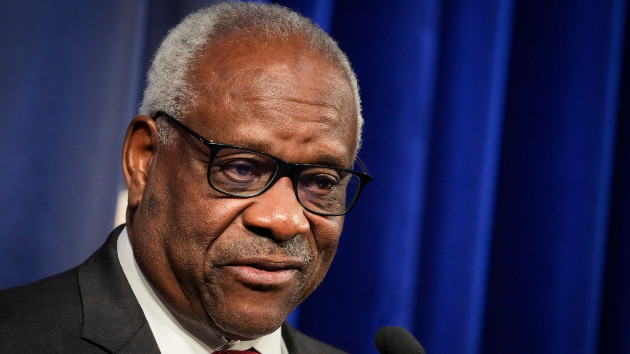
(WASHINGTON) — Justice Clarence Thomas was discharged from Sibley Memorial Hospital in Washington on Friday, one week after being admitted for treatment of an infection, a Supreme Court spokeswoman said.
No further information has been provided on his diagnosis, treatment, or prognosis.
Thomas’ chambers has also not responded to requests for comment about the new revelations surrounding his wife’s political activities in the aftermath of the 2020 election and direct contact with the White House.
In the fall of 2020, after Joe Biden defeated Donald Trump in the presidential election, Virginia “Ginni” Thomas, repeatedly urged White House chief of staff Mark Meadows to attempt to overturn the election results, according to text messages obtained by congressional investigators.
On Sunday, Supreme Court spokeswoman Patricia McCabe said in a statement, “Justice Clarence Thomas was admitted to Sibley Memorial Hospital in Washington, D.C., on Friday evening after experiencing flu-like symptoms. He underwent tests, was diagnosed with an infection, and is being treated with intravenous antibiotics. His symptoms are abating, he is resting comfortably, and he expects to be released from the hospital in a day or two.”
The court will reconvene on Monday for another week of oral arguments. It’s not clear whether Thomas will appear on the bench, though the court has said he continues to actively participate in cases through the use of briefs, argument transcripts and other communications with his colleagues.
(NEW YORK) — When it comes to the NCAA March Madness basketball tournament, brackets are either busted or booming. So one brand came up with a way to sweeten the experience for everyone.
Krispy Kreme announced on Thursday that through Sunday, March 27 all guests who bring in their bracket — whether it’s on paper or an app — will receive a free Original Glazed doughnut each day they do so.
You always win with team #KrispyKreme🙌 TODAY 3/24 – 3/27, you can visit any US shop to show us your booming or busted bracket & we’ll give you one FREE Original Glazed #doughnut! Yes…we’re serious! 🍩 See full offer details & participating US shops at https://t.co/Ks0SA31BkDpic.twitter.com/x4pPcfClsR
Customers who join the confectioner’s rewards program can also get a dozen Original Glazed doughnuts for just $1 with the purchase of any regularly priced dozen through Monday, April 4.
The offer is valid in shop, drive thru and online with the Krispy Kreme app.
(NEW YORK) — Pale pastel colors and fresh fruit are just a couple of indicators that we’ve left winter behind and moved on to sunnier spring days ahead.
Dairy Queen has embraced both the flavors and colors for spring with a dose of nostalgia for its latest limited-time menu addition.
The light purple hued fruity blast dipped cone is made with DQ world-famous soft serve in a cone that’s dipped into a fruity cereal flavored shell.