(LOS ANGELES) — Wildfires wreaking havoc in several West Coast regions are expected to burn throughout the night as dangerous conditions may further increase their spread.
The Alisal Fire in Southern California had exploded to about 13,400 acres Tuesday evening after sparking near the Alisal Reservoir on Monday around 2:30 p.m. It remains just 5% contained and 50 mph gusts were expected in the region overnight, according to the National Weather Service.
Strong northwest winds pushed the fire south of the summit, crossing Highway 101 to Tajiguas Beach, according to fire officials. The origin of the blaze is not yet known.
The fire prompted evacuations in Santa Barbara County and the closure of Highway 101 from Las Cruces to Goleta. Closures of the 101, the only major highway in the region, have caused congestion on the nearby State Road 154 and Interstate 5, according to the California Highway Patrol.
Videos posted to social media show thick plumes of smoke hanging over roadways in Gaviota, California, and near Refugio State Beach in Santa Barbara County.
While winds died down Tuesday, red flag warnings remained in effect in Northern California, where wildfires have destroyed dozens of trailers at mobile home parks in Sacramento County and San Joaquin County.
The region remains a tinderbox following decades of drought, exacerbated by climate change.
(MEMPHIS, Tenn.) — Two U.S. Postal Service employees are dead after a shooting at a Memphis postal facility, authorities said.
The suspected shooter, who was also a USPS employee, died of an apparent self-inflicted gunshot wound, FBI Memphis spokesperson Lisa-Anne Culp said during a press briefing Tuesday.
The shooting occurred Tuesday afternoon at the East Lamar Carrier Annex, a location that does not have retail customers. Around 2:50 p.m. local time, the Memphis Police Department said it had secured the scene and there was no active threat.
A witness told Memphis ABC affiliate WATN she saw people running away saying shots had been fired.
USPS is working with the FBI, Memphis Police Department and the Bureau of Alcohol, Tobacco, Firearms and Explosives on the investigation, Postal Inspector Susan Link told reporters.
The USPS and FBI spokespeople did not share any additional information on the shooting, including the identifies of the victims or suspect.
“The Postal Service is saddened at the events that took place today in Memphis,” the USPS said in a statement. “Our thoughts are with the family members, friends and coworkers of the individuals involved. The Postal Service will be providing resources to all employees at the East Lamar Carrier Annex in the coming days and weeks.”
This is the second high-profile workplace shooting in the Memphis area in recent weeks. Last month, one person was killed and 14 others were injured in a shooting at a Kroger grocery store in Collierville. The suspected gunman, a third-party vendor for Kroger, died of an apparent self-inflicted gunshot wound, police said.
(NEW YORK) — Scientists have discovered another way modern-day farming techniques are killing off bee populations.
While pesticides have long been blamed for the decline in pollinators, a study published in Proceedings of the Royal Society B on Tuesday has found that the mass-flowering of single plant species is increasing the prevalence of bee populations infected with parasites.
Monoculture farming — which involves growing only one type of crop at a time on a specific field — is a common agricultural practice, especially in the U.S., which has about 440 million acres being cultivated for monoculture. But one of the consequences of the practice is that landscapes without much natural habitat can suddenly experience mass-bloom events and have negative impacts on bees, according to the study.
Researchers at the University of Oregon surveyed 1,509 bees in sunflower fields and non-crop flowering habitats in California’s Central Valley, finding that when the crops flowered for a short period of time across a large space, the events can aggregate pollinator species together, which then results in increased rates of bees becoming infected with parasites as they come in contact with each other.
The degraded landscapes are attractive to bees because of the massive amounts of pollen and nectar that bloom at the same time, the researchers said. The mass events have the potential to provide immune and nutritional benefits to the bees, but when the mass blooms peaked is when the bees had higher rates of parasitism, Hamutahl Cohen, a researcher of the at the University of Oregon’s Institute of Ecology and Evolution and one of the authors of the study, told ABC News.
“We have an incredible amount of biodiversity on this earth,” Cohen said. “And we’re seeing that wildlife is declining, and one of the primary drivers of decline is disease.”
While in many ways the modification of landscapes is necessary to feed a growing population, Cohen described the mass-flowering crops as the “doorknobs of the bee world” as bees go from flower to flower to collect food amid their daily work.
“It’s just the same thing as a human touching a doorknob,” she said. “We all know this, because of the pandemic … if you have a cold and you touch a doorknob, and someone else comes and touches that doorknob, they can get sick.”
Scientists are suggesting that farmers stop the practice of monoculture farming, which are often in “highly degraded areas” such as California’s Central Valley, which has seen an “incredible amount” of habitat loss in the past 100 years, Cohen said.
However, the fate of bees is not doomed, Cohen said. On fields where farmers who heeded the call to implement strips of perennial plants, bee aggregation was less likely to be associated with parasitism due to the increased diversity of flowers.
While Cohen was not surprised to see the enhanced rates of parasitism in bees and monoculture farming systems, she was surprised to find just how effective planting non-crop flowers were for conservation efforts.
“It didn’t just dampen the effect of aggregating these,” she said. “It actually reversed the effects.”
The perennial plants are often selected for characteristics like drought tolerance and suitability for pollinators, Cohen said, adding that there can be “economic hurdles” to changing the landscape to implementing conservation practices.
(WASHINGTON) — The House voted Tuesday to temporarily raise the debt ceiling by $480 billion after the Senate approved the stopgap measure late last week, putting off the risk of default until early December.
House Speaker Nancy Pelosi called the lower chamber back to Washington from a two-week recess to pass the measure. The bill passed along party lines Tuesday evening in a 219-206 vote. It now heads to President Joe Biden’s desk for signature.
“A default would send shockwaves to global financial markets, and would likely cause credit markets worldwide to freeze up and stock markets to plunge. Employers around the world would likely have to begin laying off workers,” Pelosi told reporters during a press conference on Capitol Hill Tuesday.
The debt ceiling bill was packaged as part of a rule for floor debate of several other bills, meaning there was not a stand-alone vote on the debt limit measure. The bill was considered “deemed and passed” once the rule was adopted.
Pelosi staved off defections amid razor-thin margins in the House. She could have only afforded to lose three votes.
Republicans for months have said that Democrats would need to act on their own to raise the debt limit because they have total control of Washington and are planning to pass a multi-trillion social and economic package with zero input from Republicans.
Senate Minority Leader Mitch McConnell has said repeatedly that Democrats should have to hike the debt limit because of the high cost of Biden’s proposed agenda.
Democrats have argued that raising the debt limit is a bipartisan responsibility, in part because it covers spending that already took place under the Trump administration.
The House’s return Tuesday follows a chilling warning from Treasury Secretary Janet Yellen that if the House fails to act this week the U.S. is at risk of defaulting and will be unable to pay its bills.
Yellen warned on ABC’s “This Week” that McConnell and Republicans are playing with “catastrophe” over a pending fight to raise the debt ceiling.
“Fifty million Americans wouldn’t receive Social Security payments. Our troops won’t know when or if they would be paid. The 30 million families that receive a child tax credit, those payments would be in jeopardy,” Yellen said.
She said such a scenario “could result in catastrophe.”
President Joe Biden has said he will sign the bill into law once the House approves the measure Tuesday, but lawmakers will once again be at odds and at risk of fiscal calamity come December.
The new deadline will coincide with the end of the stop-gap deal to fund the federal government.
Pelosi indicated an off-ramp on the debt ceiling drama is in the works. She told reporters that the Treasury Department should be able to lift the debt ceiling unilaterally, while Congress would maintain the power to overrule an increase to the debt limit.
“I’m optimistic that these decisions have to be made,” Pelosi said.
“We are not a rubber stamp or a lockstep party — we have a discussion, and other family values that all members have brought to the table,” Pelosi said.
The idea to give the Treasury the authority to lift the debt limit “seems to have some appeal on both sides of the aisle because of the consequences of not lifting it.”
Pelosi said she thinks the idea has “merit.”
“We’re just hoping that we can do this in a bipartisan way,” she added.
The speaker said she does not support raising the debt limit through the process of reconciliation, which would allow Democrats to pass any bill with just a simple majority. The process is time-consuming and Democrats have firmly said they oppose using the process.
In a letter to Biden, McConnell warned that come December he would be willing to allow the nation to default on its national debt rather than work with Democrats on a resolution.
“Your lieutenants on Capitol Hill now have the time they claimed they lacked to address the debt ceiling through standalone reconciliation, and all the tools to do it,” McConnell said in the letter. “They cannot invent another crisis and ask for my help.”
ABC News’ Allison Pecorin contributed to this report.
(BOGOTA, Colombia) — A “few” U.S. personnel at the embassy in Bogotá, Colombia, have reported symptoms consistent with “Havana syndrome,” a source familiar with the cases confirmed to ABC News.
Colombia is now the latest country where American officials have reported incidents of the mysterious neurological affliction that has confounded the U.S. government for years now, but the reports are particularly notable because Secretary of State Antony Blinken is heading to Bogotá this month, the Colombian Foreign Ministry announced last week.
In a similar episode in August, Vice President Kamala Harris’s trip to Vietnam was delayed for a few hours after an unconfirmed case of “Havana syndrome” was reported by a staffer at the U.S. mission there.
American diplomats, spies and other officials have reported strange experiences and debilitating symptoms in several countries now, starting with Cuba in late 2016 and expanding to China, Russia, Uzbekistan, Germany, Austria and elsewhere.
Symptoms include headaches, dizziness, cognitive difficulties, tinnitus, vertigo and trouble with seeing, hearing or balancing. Many officials have suffered symptoms years after reporting an incident, while some have been diagnosed with traumatic brain injuries.
It’s unclear how many U.S. officials have confirmed medical symptoms.
Leadership at the U.S. embassy in Bogotá informed staff of the reported incidents, saying they are investigating the cases and addressing them “seriously, with objectivity and with sensitivity,” according to an email from Ambassador Philip Goldberg obtained by the Wall Street Journal, which first reported the news. The source confirmed to ABC News that Goldberg has been in communication with staff, but declined to share the emails.
State Department spokesperson Ned Price declined to comment on the report Tuesday during a department briefing, saying instead the agency is working to ensure all affected personnel get “the prompt care they need in whatever form that takes” and to protect its work force around the world.
Pressed on why the administration wasn’t being more forthcoming, Price said officials had to respect personnel privacy, adding, “It’s certainly not the case that we are ignoring this. We are just not speaking to the press — we’re speaking to our workforce.”
Price also declined to confirm that Blinken is traveling to Colombia. Colombia’s Foreign Ministry announced he would visit for a high-level dialogue on Oct. 20 with Foreign Minister and First Vice President Marta Lucía Ramírez after the two met last week in Paris on the sidelines of the summit of Organization for Economic Cooperation and Development countries.
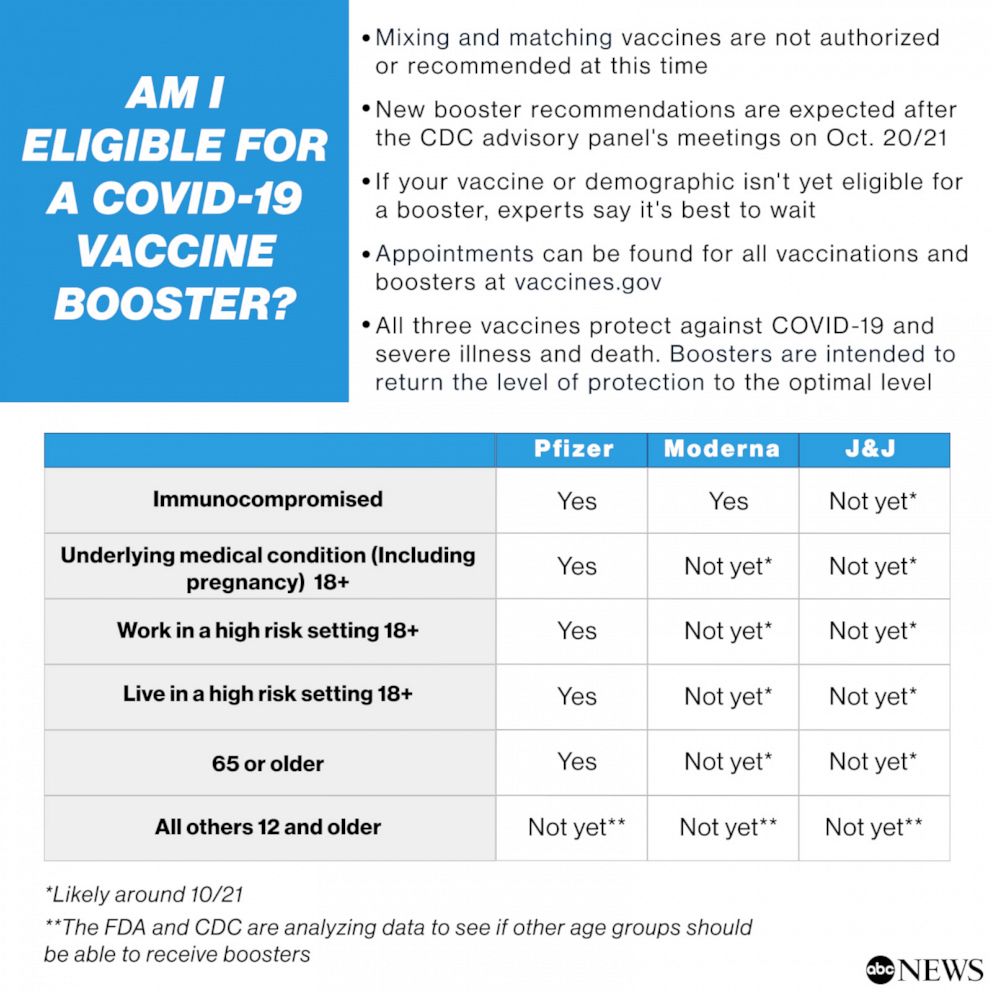
(WASHINGTON) — If it’s been six months or more since your second COVID-19 vaccine shot, you may be wondering whether you qualify for a booster.
In September, the Centers for Disease Control and Prevention endorsed an independent panel’s recommendation that older adults, along with those as young as 18 who have an underlying medical condition, receive a Pfizer booster shot.
CDC Director Rochelle Walensky also added a recommendation for a third dose for those in high-risk jobs or settings, such as nursing and teaching. Immunocompromised Americans, like those undergoing cancer treatment, have been able to get a third dose of the Moderna or Pfizer mRNA vaccines since mid-August.
But there has been a lot of public debate and there are different rules for Moderna, Johnson & Johnson, and Pfizer boosters, all of which can add to confusion. So, when is it your turn?
ABC News answers a wide variety of scenarios in the table below to let you know whether you qualify — and if you don’t today, when you might.
New booster recommendations are expected after the CDC advisory panel’s meetings on Oct. 20 and 21.
Boosters are intended to return the level of protection to the vaccine’s optimal level. Mixing and matching vaccines are not authorized or recommended at this time, but may be in the near future, and if your vaccine or demographic isn’t yet eligible for a booster, experts say it’s best to wait.
Appointments for all vaccines and boosters can be found at vaccines.gov.
(WASHINGTON) — In a private phone call Tuesday with the nation’s governors, the White House said states should prepare to begin vaccinating elementary-aged kids against COVID-19 in early November and that it would work with local health officials in the coming days to identify which sites will receive the first doses.
In audio obtained by ABC News, White House officials told the governors it had enough pediatric doses on hand for the 28 million children ages 5 through 11 expected to become eligible once federal regulators give the green light.
Once that happens, the pediatric Pfizer vaccine will be distributed in 100-dose packs. The doses, which are about a third of what is given to adults, will be sent to thousands of sites, including pediatricians, family doctors, hospitals, health clinics and pharmacies enrolled in a federal program that guarantees the shots are provided for free.
Some states are planning to provide the vaccine through schools as well.
“We’ve secured plenty of supply, and we’ll be putting in place an allocation, ordering and distribution system similar to what we’ve used for the other vaccines,” said President Joe Biden’s White House COVID coordinator, Jeff Zients, on the phone call to governors.
Zients said states should expect an initial rush for shots and ensure parents can easily schedule appointments.
“It’s important that all of us recognize that parents have been waiting for a pediatric vaccine for a long time so they will understandably be very eager to get their kids vaccinated or kids vaccinated right away,” he said.
Pfizer’s study on elementary-aged kids included 4,500 volunteers from the U.S., Finland, Poland and Spain. Precise details on the effectiveness of the vaccines in clinical trials involving kids has not been publicly released, although Pfizer says the study showed the smaller dosage was safe and effective.
Separate vaccine trials are under way for toddlers and preschoolers, with results expected by the end of the year. A Pfizer vaccine for kids under 5 is expected to become available in early 2022.
Both the U.S. Food and Drug Administration and the Centers for Disease Control and Prevention must agree the pediatric COVID vaccines are safe and effective before any shots are given to kids.
Key meetings with independent advisers to those agencies are scheduled for later this month and the first week of November.
In anticipation of the FDA and CDC authorizing the vaccine for kids, the federal government purchased 65 million pediatric two-shot doses from Pfizer. According to the Department of Health and Human Services, 70% of providers who administer vaccines to kids are enrolled to offer COVID shots.
Whether parents will embrace the vaccines for their kids is still a question and could depend upon details released in coming weeks on the clinical trial. In a September poll, the Kaiser Family Foundation found that about a third of parents with kids ages 5-11 were willing to vaccinate their kids right away, while another third wanted to “wait and see.” The figures represented a slight uptick in vaccine acceptance among parents of elementary-aged kids since July.
Overall, children are still considered significantly less likely than adults to experience bad outcomes from COVID-19. According to an estimate by the American Academy of Pediatrics and the Children’s Hospital Association, less than 2% of all child COVID-19 cases resulted in hospitalization.
Still, health officials warned that the sudden spike in COVID cases this summer and fall resulted in an alarming number of hospitalizations among kids. Since late August, the U.S. reported more than 1.1 million pediatric cases.
ABC News’ Cheyenne Haslett contributed to this report.
(NEW YORK) — Infants born to mothers with COVID-19 are significantly more likely to experience health problems, such as difficulty breathing, compared to infants born to mothers without COVID-19, according to a new study published Monday.
The study, published in the Journal Of Maternal-Fetal And Neonatal Medicine, adds a new layer onto the growing body of research showing the potential complications COVID-19 can cause for both pregnant people and babies.
As COVID-19 continues to affect more expectant people in the United States, especially those who are unvaccinated, here are seven questions answered about pregnancy and the coronavirus.
1. Are pregnant people at higher risk?
Yes, pregnant people are at higher risk for complications from COVID-19.
Since the onset of the pandemic, more than 127,000 pregnant people have tested positive for COVID-19, 22,000 pregnant people have been hospitalized nationwide and at least 171 pregnant people have died as result of COVID-19, according to federal data.
COVID-19 causes a two-fold risk of admission into intensive care and a 70% increased risk of death for pregnant people, according to the Centers for Disease Control and Prevention (CDC).
Research published last month in the American Journal of Obstetrics and Gynecology, a medical journal, also found that pregnant people infected with the delta variant are more likely to have severe COVID-19 cases, and the variant leads to even worse outcomes for unvaccinated pregnant people.
2. What risks does COVID-19 bring to the fetus?
Pregnant people with COVID-19 are more likely to experience preterm birth, or delivering the baby earlier than 37 weeks, according to the CDC.
Poor pregnancy outcomes, such as pregnancy loss, have also been reported. There have been at least 266 pregnancy losses in the U.S. since the onset of the pandemic, according to federal data.
infants with COVID-positive mothers had two times greater odds of developing any type of adverse health complication during the birth process compared to infants with COVID-negative mothers, according to the research published in Journal Of Maternal-Fetal And Neonatal Medicine.
3. Is the COVID-19 vaccine safe for pregnant people?
Yes, the vaccines are safe for people who are pregnant, breastfeeding, trying to get pregnant or might become pregnant in the future, according to data compiled over the past nearly one year.
Both the Pfizer and Moderna vaccines use mRNA technology, which does not enter the nucleus of the cells and doesn’t alter the human DNA. Instead, it sends a genetic instruction manual that prompts cells to create proteins that look like the virus a way for the body to learn and develop defenses against future infection.
They are the first mRNA vaccines, which are theoretically safe during pregnancy, because they do not contain a live virus.
Messenger RNA vaccines for COVID-19, such as those produced by Moderna and Pfizer, showed no obvious safety concerns for pregnant women, according to a preliminary report published in April in the New England Journal of Medicine.
Messenger RNA, or mRNA, technology does not enter the nucleus of the cells and doesn’t alter the human DNA. Instead, it sends a genetic instruction manual that prompts cells to create proteins that look like the virus a way for the body to learn and develop defenses against future infection.
The Johnson & Johnson vaccine uses an inactivated adenovirus vector, Ad26, that cannot replicate. The Ad26 vector carries a piece of DNA with instructions to make the SARS-CoV-2 spike protein that triggers an immune response.
This same type of vaccine has been authorized for Ebola, and has been studied extensively for other illnesses — and for how it affects women who are pregnant or breastfeeding.
The CDC as well as the nation’s two leading health organizations focused on the care of pregnant people — American College of Obstetricians and Gynecologists (ACOG) and the Society for Maternal-Fetal Medicine (SMFM) — have all issued guidelines calling on all pregnant people to get vaccinated against COVID-19, citing the safety and efficacy of the vaccines.
The COVID-19 vaccines can be taken during any trimester.
Just 25% of pregnant people in the U.S. between the ages of 18 and 49 are currently vaccinated with at least one dose, according to the CDC.
4. What precautions should pregnant people take?
The most important thing pregnant people can do to protect themselves is to get vaccinated, and to make sure their loved ones are vaccinated too, medical experts say.
Pregnant people who are fully vaccinated should wear a face mask indoors when in public in areas of substantial or high transmission, avoid crowds and poorly ventilated indoor spaces and wash hands often with soap and water, according to the CDC.
Unvaccinated pregnant people should get vaccinated and continue masking until fully vaccinated, while also following safety guidelines like avoiding crowds and poorly ventilated indoor spaces, washing hands often with soap and water and staying six feet apart from people not in their households, according to the CDC.
5. Should pregnant people travel?
There is no guidance that pregnant people should not travel, so it’s ultimately a personal decision.
Pregnant people should consult with their doctors first. Factors to consider include where you’re considering traveling, how far along in your pregnancy you are and what your backup plan would be.
When traveling, pregnant people should wear a face mask that covers their nose and mouth.
In addition to considering whether the country in question has seen a significant influx of COVID-19 cases, think about the situation on ground. Has travel within the country been disrupted? How would you feel about potentially being quarantined upon returning to the United States? Is there a risk you could be grounded due to canceled flights or quarantines and not be able to travel home? Would you have access to medical care at your destination?
The U.S. State Department provides travel advisories that include up-to-date recommendations about which countries have reported cases of COVID-19 and how widespread infections have been. The situation is fluid and rapidly evolving, so you should check back often and use that information to inform what’s essentially a personal decision.
6. Can coronavirus be transferred to the fetus?
There is still more research to be done to determine whether a pregnant person could pass the virus to her fetus before, during or after delivery.
One small study in Italy last year found that a pregnant person infected with the coronavirus might be able to spread it to her fetus, but the study’s leader said it was still “too early to make guidelines” or to change care.
According to the CDC, some newborns have tested positive for COVID-19 shortly after birth but it is not known if the newborns got the virus before, during, or after birth.
7. Is it safe for a person with COVID-19 to breastfeed?
It is safe, in general, to breastfeed when you have COVID-19, according to both the CDC and the American College of Obstetricians and Gynecologists (ACOG).
The CDC recommends that people with COVID-19 wash their hands before breastfeeding and wear a mask when breastfeeding and whenever they are within six feet of the baby.
It is not likely that COVID-19 can pass through breast milk.
Recent studies have shown though that people who are vaccinated against COVID-19 may be able to pass along protection from the virus to their infant through breastfeeding.
(NEW YORK) — Former President Donald Trump and Rudy Giuliani face no criminal charges but their names will figure into the trial that starts Tuesday in Manhattan of Soviet-born and Florida-based businessman Lev Parnas, who has been associated with Giuliani and now stands accused of making unlawful campaign donations.
Before they hear any evidence, prospective jurors are being asked about the former president and his personal attorney since federal prosecutors have said Parnas allegedly shared photos of himself with Trump and Giuliani to raise his profile.
When asked about the extent to which their names were going to come up by Judge Paul Oetken during a recent court hearing, assistant U.S. attorney Hagan Scotten replied, “They will come up really only peripherally.”
Parnas, 49, allegedly made unlawful donations totaling more than $350,000 to two pro-Trump super PACs and former Texas Congressman Pete Sessions in 2018. Another part of the case involves Parnas and co-defendant Andrey Kukushkin being charged with acting as straw donors for a wealthy Russian who wanted to enter the burgeoning marijuana market in the United States.
Parnas and Kukushkin have each pleaded not guilty to all charges. Prosecutors have said the recipients of the donations did not know the source of those donations to be the wealthy Russian.
The alleged illicit donations overlapped with Giuliani’s quest in Ukraine to unearth information that could damage then-presidential candidate Joe Biden, an effort in which Parnas allegedly positioned himself as a middleman.
During Trump’s first impeachment, a defense attorney for Parnas cast him as someone who could shed light on the ousting of ex-ambassador to Ukraine Marie Yovanovitch. Prosecutors have since eliminated allegations involving Yovanovitch’s firing to “streamline” the case, as they put it to the judge.
In recent weeks, Parnas has claimed he can no longer afford to travel to New York. The U.S. Marshals were ordered to send a plane to bring him Florida and taxpayers will pay his hotel bill for the duration of the trial.
(NEW YORK) — A Wyoming coroner on Tuesday said Gabby Petito, the 22-year-old travel blogger whose remains were recovered in September in a national park, died by strangulation.
Petito’s boyfriend and cross-country traveling companion, Brian Laundrie, has been named by investigators as a person of interest in her death and is the subject of a massive nationwide search being directed by the FBI.
Teton County Coroner Dr. Brent Blue told reporters Petito’s manner of death was homicide.
Her body was discovered on Sept. 19 in the Bridger-Teton National Forest near Jackson.
Blue’s announcement comes amidst a nationwide search the FBI is leading for Laundrie, who drew suspicion after returning to his parents’ North Port, Florida, home on Sept. 1 without Petito but driving her van, authorities said.
Laundrie’s parents told police they last saw their son on Sept. 13, two days after Petito’s parents, who live in Long Island, New York, reported her missing. Laundrie’s parents told investigators their son may have been headed to the Carlton Reserve, a 25,000-acre wildlife preserve near their home.