
5 persons of interest in HBCU bomb threat investigation: Source

5 persons of interest in HBCU bomb threat investigation: Source
Drew Angerer/Getty Images

(WASHINGTON) — The persons of interest were connected to spoofed calls – emanating from a fake telephone number, the FBI official said, according to the source familiar with the contents of a call between FBI and DHS officials and state and local law enforcement on Tuesday.

No bombs have been found.

During the call, the federal officials went into more detail about the nature of the bomb threats, which started in early January, and the most recent, which occurred Monday against HBCUs and other universities, according to the source.

In the past few days, the FBI reported over 20 bomb threats to HBCU’s and other institutions — from Howard University in Washington, D.C. to Jackson State University in Jackson, Mississippi.

Several of the schools canceled classes amid concerns about the threats.

The FBI on Wednesday said it is investigating the bomb threats to predominantly HBCUs as hate crimes, according to a statement released by the Bureau.

“Although at this time no explosive devices have been found at any of the locations, the FBI takes all threats with the utmost seriousness and we are committed to thoroughly and aggressively investigating these threats,” the statement says.

They FBI says investigation is being coordinated with 20 FBI field offices and is the “highest priority” for the Bureau.

The first threat against the HBCUs came against Xavier University of Louisiana on Jan. 4, and according to the FBI official briefing state and local law enforcement, it was racially motivated.

Following that threat in early January, two Black churches were also targeted with bomb threats – none came to fruition.

There were also three bomb threats against Jewish facilities on the last day in January, but officials aren’t clear if those are connected, according to a source briefed on the contents of the law enforcement call.

Copyright © 2022, ABC Audio. All rights reserved.

Suspect in deadly Bridgewater College shooting was former student: Court records

Suspect in deadly Bridgewater College shooting was former student: Court records
WCAV-TV

(BRIDGEWATER, Va.) — The suspect in a shooting on a Virginia college campus that left two officers dead was a former student at the institution, according to court documents.

Andrew Wyatt Campbell, 27, faces multiple felony charges, including two counts of capital murder, in connection with Tuesday’s shooting at Bridgewater College.

A campus police officer and a campus safety officer were fatally shot after responding to a call of a “suspicious male individual” on the grounds of the college’s Memorial Hall, Virginia State Police spokesperson Corinne Geller told reporters Tuesday.

Geller did not elaborate on any connections between the alleged shooter and the small, private liberal arts college. However, in court records obtained by Harrisonburg, Virginia, ABC affiliate WHSV, authorities noted that Campbell had dropped out of Bridgewater College.

Bridgewater College confirmed with WHSV that Campbell, of Ashland, Virginia, was once a member of the college’s track and field and cross country teams. He attended the school from 2013 to 2017, a school spokesperson told The Associated Press.

In 2017, Campbell was charged with trespassing for entering the campus’ Kline Campus Center, the school’s main dining hall, “after being banned,” an arrest warrant at the time stated.

Several college employees called 911 Tuesday after seeing the suspect in and around the college’s Memorial Hall. “He was not supposed to be in this particular location,” Geller told reporters.

Campbell was charged with two felony counts of capital murder, one felony count of first-degree murder, one felony count of use of a firearm in the commission of a felony and aggravated felony murder of more than one person within three years in connection with the shooting, court records show. He is being held without bond at the Rockingham County Jail.

The suspect made his first court appearance Wednesday via video conference for an arraignment in Harrisonburg/Rockingham General District Court. His attorney requested that Campbell undergo a mental health evaluation, WHSV reported. His next court appearance is scheduled for Feb. 16 at 1 p.m.

Police are investigating a motive in the shooting, which killed Bridgewater College Campus Police Officer John Painter, 55, and Campus Safety Officer Vashon “JJ” Jefferson, 48.

Painter joined the department in May 2019 after retiring as chief of the Grottoes Police Department in Virginia, and Jefferson joined in August 2018.

The two were close friends and known to many as the “dynamic duo,” according to Bridgewater College President David Bushman.

Virginia Gov. Glenn Youngkin ordered that flags in the state be flown at half-staff Wednesday “in respect and memory of the officers lost.”

In the wake of the tragedy, Bridgewater canceled classes for the remainder of the week and gathered to sing the school’s alma mater Wednesday.

Bushman told ABC News’ Pierre Thomas in an interview Wednesday that the tight-knit campus community is suffering an “unspeakable” loss.

“We’ve navigated a pandemic together and it’s almost like you’re getting back to normal. And then it’s just, it’s unimaginable,” Bushman said.

“In so many ways this hurts so deeply because we are a tight community, but that’s also our greatest strength,” he said. “And that’s why I know we know we will grieve together and will heal.”

The officers were “always together” and on a first-name basis with students, the president said.

Bridgewater College sophomore Jack Cataneo, 20, told ABC News the incident feels “like a bad dream.”

“It really makes you think because it could happen to anybody,” he said.

ABC News’ Quinn Owen, Sarah Shales and Ben Stein contributed to this report.

Copyright © 2022, ABC Audio. All rights reserved.

Texas hospital fighting COVID-19 surge in community with high comorbidity rates

Texas hospital fighting COVID-19 surge in community with high comorbidity rates
ABC News

(MCALLEN, Texas) — When 21-year-old, first-time mother Samantha Reyna arrived in labor at DHR Health Women’s Hospital in McAllen, Texas, she was stunned to learn that she was positive for COVID-19.

“I was actually completely shocked,” Reyna, who gave birth Sunday, told ABC News. “I didn’t think I was going to be positive while going into labor.”

Although Reyna has had minor symptoms, out of precaution, she and her husband made the difficult decision to keep her 1-day-old son, Santos, in the nursery, in an effort to keep him from catching COVID-19.

“It’s been a little sad, because I don’t have him here with me. I’m not able to be there for him in case he cries or anything,” Reyna said.

Although there are encouraging declines in COVID-19 cases and hospitalizations across much of the country, many U.S. hospitals, including DHR Health, continue to struggle with significant numbers of COVID-19 patients in need of care. Many of these patients suffer from obesity and other comorbidities, such as diabetes and hypertension, which put them at increased risk from severe disease due to COVID-19, according to health care workers.

“Our population is a sick population. We have one of the worst levels of diabetes and obesity in the nation,” Dr. Federico Vallejo, a pulmonary critical care physician at DHR Health, told ABC News. “And as you know this, this can be really difficult for any population. So that’s why we saw incredible cases of sick patients, because our population has increased risk because of these comorbidities.”

A number of pregnant people, who are at increased risk for severe illness from COVID-19 because of their pregnancy, are also coming in positive, hospital officials said, with between 10% to 15% of patients who are delivering testing positive.

Over the last two years, nearly 167,000 pregnant people tested positive for COVID-19, and at least 267 pregnant people died, according to federal data.

Throughout the pandemic, the emotional toll of testing positive has had a significant impact on expectant mothers.

“You could see the fear in their eyes, thinking they and their baby were going to die. Initially there was a lot of misinformation and fear from moms about ‘What do I do now that I am positive? Is my baby going to get it now that I’m positive, because I’m pregnant?'” Dr. Flor A. Limas, an obstetrician and gynecologist at DHR Health, told ABC News.

Available intensive care units in Texas are still running low, with 8% of beds currently available across the state.

“Omicron is supposed to be mild, but it’s not mild for the health care system,” Dr. Juan Sarmiento, a critical care intensivist at DHR Health, said.

Dr. Juan Marcos Chavez Paz, a critical care physician at DHR Health, added that though virus-related hospitalization numbers are slowly beginning to abate, his team is still not out of the woods yet.

“I think that we passed the tsunami, but we’re still having waves, some big ones coming, and I’m sure there will be more coming in the future,” he told ABC News.

According to Vallejo, a small fraction of the population in need of care are immunocompromised patients who have fallen ill despite being previously vaccinated.

“We’re seeing the poor souls that are collateral damage, those that did everything right, they got their vaccinations, but unfortunately they’re immunosuppressed because of different circumstances — organ transplants, cancer with chemotherapy — and those sadly get sick, despite the vaccine, but this is more of a fraction of them,” Vallejo said.

The physicians stressed that the vaccines have been a “game-changer,” explaining that the majority of their patients who are becoming severely ill are unvaccinated.

Reyna, who is unvaccinated, has now been reunited with her baby, and said she wants to get vaccinated, and is now considering the shot for her son, too.

“Without vaccines right now, we’d be in hell,” Sarmiento said.

Copyright © 2022, ABC Audio. All rights reserved.
Trump-endorsed challengers lag behind incumbent Republicans in fundraising

Trump-endorsed challengers lag behind incumbent Republicans in fundraising
Brandon Bell/Getty Images

(WASHINGTON) — Three of the 10 House Republicans who voted to impeach former President Donald Trump have tapped out early to announce they are not seeking reelection in 2022 — but the remaining seven appear to be running strong races, judging by fundraising numbers disclosed in the latest campaign finance filings.

As 2022 candidates were gearing up for the upcoming midterm election none of the Trump-endorsed challengers vying to unseat those seven House Republicans managed to outraise the sitting lawmakers in the last quarter of 2021, filings released this week show.

It’s not uncommon for incumbents to have a big cash advantage over their challengers, but the large fundraising gaps hint at the long way Trump-backed challengers have to go to — despite the former president’s support.

Most notably, Rep. Liz Cheney — with backing from both establishment Republicans and moderate Democrats — has broken her own fundraising records, despite being the most high-profile Republican on Trump’s 2022 hit list.

The Wyoming Republican reported raising more than $2 million in just the final three months of last year, bringing her 2021 fundraising total to $7.2 million. Her Trump-endorsed primary challenger, Harriet Hageman, raised less than half of Cheney’s fourth-quarter haul during the same period, reporting just over $745,000.

As the 2022 election year ramps up, Hageman’s cash on hand is just $381,000 compared to Cheney’s $4.7 million war chest, according to filings.

Cheney, one of two Republicans on the nine-member House committee investigating the Jan. 6 attack on the U.S. Capitol, has also received support from some major liberal donors who typically give only to Democrats, including investor and billionaire John Pritzker of the Pritzker family, who maxed out on his contribution to Cheney by giving $10,800 to her joint fundraising committee earlier last year.

Also among those rallying behind Cheney are Trump critics within the Republican Party, including former Rep. Francis Rooney, R-Fla., who is among several Republican lawmakers who announced their retirement after clashing with pro-Trump GOP forces.

“My wife and I maxed out for Liz and then we held a fundraiser for her because we wanted to speak up,” Rooney, who gave Cheney’s joint fundraising committee $10,800 back in May, told ABC News.

Rooney, who had previously given upwards of $1 million to various GOP candidates groups over the years, told ABC News that he’s no longer giving to the RNC and Republicans except for Cheney and a handful of others, because he’s tired of Trump-dominated narratives within the Republican Party.

Among Cheney’s other donors in the final months of last year was former President George W. Bush, who maxed out on his donation to her campaign by giving $5,800 in October.

Bush also gave $2,800 to Sen. Lisa Murkowski, R-Alaska, who has been targeted by Trump for being one of seven Senate Republicans who voted to convict him in his impeachment trial last year, and the only one of them up for reelection this year. Similar to Cheney, Murkowski outraised her Trump-endorsed challenger, Kelly Tshibaka, by more than double in the final three months of 2021, and entered the 2022 election year with $4.3 million on hand.

Reps. Fred Upton and Peter Meijer, both representing Michigan, also boasted major fundraising advantages over their respective Trump-endorsed challengers, Steve Carra and John Gibbs, both bringing in five times the amount their challengers took in last quarter.

In Washington’s 3rd District, Rep. Jaime Herrera Beutler held a narrower fundraising gap over Trump-backed challenger Joe Kent, but still entered 2022 with a much larger war chest than his rival.

South Carolina Republican Russell Fry, who Trump endorsed just this week, managed to raise close to the amount raised by incumbent Rep. Tom Rice, but still faces Rice’s big war chest of nearly $2 million.

Former Trump aide Max Miller, who’s running to fill retiring GOP Rep. Anthony Gonzalez’s seat in Ohio, continued to report the strongest fundraising figures among contenders vying for Gonzalez’s open seat. Although his fundraising showed signs of slowing down in the final quarter of 2021, with contributions of $181,000 compared to the nearly $700,000 he raised in the previous quarter, he nonetheless entered 2022 with nearly $1 million in cash on hand.

Miller was one of several big-name Trump-aligned GOP candidates who failed to maintain their massive fundraising momentum from the earlier part of 2021.

Rep. Marjorie Taylor Greene, who had boasted $3.5 million in donations in the first quarter of 2021, reported a relatively small $1.2 million haul in the final quarter, while Reps. Matt Gaetz and Lauren Boebert’s fundraising both gradually slowed down throughout the year.

In Senate races, Sen. Tim Scott, who is endorsed by Trump and is also considered a possible 2024 presidential election contender, continued to bring in large sums, raising $7 million in the fourth quarter.

Rep. Mo Brooks, who is running for a Senate seat, was significantly outraised in the fourth quarter by his GOP primary challenger Katie Britt, who raised $1.2 million compared to Brooks’ $385,000 — a huge drop from what he raised in the previous quarter.

In North Carolina, no GOP Senate candidate raised more than a million dollars in the final quarter amid a competitive primary. Trump-endorsed Senate candidate Ted Budd brought in $968,360 while former North Carolina Republican Gov. Patrick McCory raised $748,072 and Rep. Mark Walker brought in only $146,053. The split among Republican donors could make Trump’s endorsement all the more important for Budd, the current leading fundraiser.

In Pennsylvania, the Senate primary field was upended when the Trump-endorsed candidate dropped out in November, leading two relative newcomers to emerge on the campaign trail. TV doctor Mehmet Oz and former hedge fund CEO Dave McCormick are reportedly dropping millions in advertising, but it remains to be seen whether they’re getting any return on their investment. Trump has yet to make an endorsement in the race.

The candidate who appears to have raised the most money of any GOP challenger is Georgia Senate candidate and former football star Herschel Walker, who raised $5.4 million in the fourth quarter to lift his fundraising total to $10 million since the start of his campaign — signaling what could be an expensive general election race between him and Democratic incumbent Raphael Warnock, who has nearly $23 million in cash on hand.

“This massive fundraising haul, likely the largest in the country for a non-incumbent, shows that Georgia Republicans are clearly united behind Herschel Walker and are ready to take on Senator Warnock,” Scott Paradise, campaign manager for Team Herschel, said in a press release last week.

On the Democratic side, Arizona Sen. Mark Kelly joins Warnock as the party’s top two fundraisers, with Kelly holding $19 million in cash on hand as both men seek reelection.

In what could be a tight Senate primary race in Pennsylvania, Lt. Gov. John Fetterman held a strong lead in fundraising over the course of last year, but fellow Western Pennsylvanian Rep. Conor Lamb appears to be gaining traction, bringing in $1.35 million in the fourth quarter of 2021.

In North Carolina, leading Senate candidate Cheri Beasley took in $2.1 million in the final quarter of 2021, with 90% of her donations being $100 or less, according to her campaign. Beasley’s campaign manager, Travis Brimm, said in a press release that they are “committed to building a strong, grassroots campaign that touches every corner of the state and helps lead to victory in November.”

And nationally, the Democratic Party and Republican Party fared about even with their national party committees’ fundraising in 2021.

In total, the RNC outraised the DNC by $8 million, but the DNC entered the election year with a bigger war chest, reporting $67 million in cash on hand compared to $56 million for the RNC.

The Senate and House arms of the Republican Party also slightly outraised their Democratic counterparts, and entered the year with a slightly bigger war chest of $111 million compared to the Democratic committees’ $106 million.

Copyright © 2022, ABC Audio. All rights reserved.

Congressional bill seeks to end legacy admissions at colleges

Congressional bill seeks to end legacy admissions at colleges
Michael Godek/Getty Images

(WASHINGTON) — A bill introduced in Congress Wednesday by Democratic lawmakers seeks to end legacy admissions at many U.S. colleges and universities.

The so-called Fair College Admissions for Students Act would amend the Higher Education Act of 1965 to bar institutions of higher education that participate in federal student aid programs from giving admissions preference to applicants with legacy or donor status, a common practice at elite institutions.

The bill was introduced by Rep. Jamaal Bowman (D-NY) and Sen. Jeff Merkley (D-Oregon) in an attempt to address what they said is an unfair and inequitable admissions process that disproportionately benefits wealthy, white and connected students.

“All students deserve an equitable opportunity to gain admission to institutions of higher education, but students whose parents didn’t attend or donate to a university are often overlooked in the admissions process due to the historically classist and racist legacy and donor admissions practices at many schools across the country,” Bowman said in a statement.

Merkley said the bill would seek to level the playing field for minority and first-generation students especially.

“Children of donors and alumni may be excellent students and well-qualified, but the last people who need extra help in the complicated and competitive college admissions process are those who start with the advantages of family education and money,” he said in a statement.

The bill would allow the education secretary to waive the legacy preference ban for institutions like historically Black colleges and universities, tribal colleges and minority-serving institutions, which admit high levels of underrepresented students already.

Legacy preferences are common among selective colleges; according to the progressive think tank The Century Foundation, three-quarters of the nation’s top 100 national universities in U.S. News & World Report employ them, and nearly all the 100 liberal arts colleges do.

The legacy preference is worth an extra 160 points for children of alumni, researchers from Princeton University found.

Supporters of legacy preferences argue that legacies can help boost an institution’s ability to award financial assistance to low-income students.

Several institutions, including Johns Hopkins University and Amherst College, have ended their practice of legacy admissions in recent years.

Last year, Colorado became the first state to enact a law banning legacy admissions at public colleges and universities. In the wake of the “Varsity Blues” scandal, California didn’t ban legacy admissions but did require institutions whose students receive state financial aid to disclose how many applicants are accepted through the practice.

The Fair College Admissions for Students Act is introduced as the Supreme Court is poised to hear challenges to affirmative action, which also could have implications for many colleges and universities’ admissions policies.

Copyright © 2022, ABC Audio. All rights reserved.

Biden relaunches cancer ‘moonshot’ initiative to help cut death rate

Biden relaunches cancer ‘moonshot’ initiative to help cut death rate
Leigh Vogel/UPI/Bloomberg via Getty Images

(WASHINGTON) — President Joe Biden on Wednesday relaunched the federal government’s cancer “moonshot” initiative, with the goal of cutting the death rate from cancer in half over the next quarter-century.

“We can end cancer as we know it,” Biden said during an event at the White House.

The initiative is personal for Biden, who lost his son Beau to brain cancer in 2015 and who first launched the initiative as vice president.

“I committed to this fight when I was vice president,” Biden said Wednesday. “It’s one of the reasons why quite frankly why I ran for president. Let there be no doubt, now that I am president, this is a presidential, White House priority. Period.”

After the Obama presidency, Biden and wife — and now first lady — Jill Biden founded a nonprofit foundation dedicated to finding a cure for cancer.

In 2016, Congress authorized $1.8 billion in funding for the government’s moonshot initiative over seven years. There’s $410 million left for the next two fiscal years.

In addition to cutting today’s age-adjusted death rate from cancer by at least 50% over the next 25 years — after it has fallen by about 25% over the past 20 years — the initiative will aim to “improve the experience of people and their families living with and surviving cancer,” the White House said.

“It’s bold,” Biden said. “It’s ambitious. But it’s completely doable. Just as we harnessed the size to develop cutting edge COVID-19 vaccines and treatments, we’ll bring a fierce sense of urgency to the fight against cancer.”

On Wednesday, Biden said he was “announcing a call to action for cancer screening and early detection.”

More than 9.5 million cancer screenings were missed in the U.S. because of the COVID-19 pandemic, the White House said.

“We have to get cancer screenings back on track,” Biden said. “And make sure they’re accessible to all Americans.”

But the pandemic has also led Biden to set “very ambitious goals,” a senior Biden administration official told reporters Tuesday.

“The scientific advances that we saw from the COVID-19 pandemic, from the response to it, also points to things that are possible today,” the official said.

One example, according to the White House, is that the relaunched initiative will aim to “study and evaluate multi-cancer detection tests, like we did for COVID-19.”

The cancer “moonshot” initiative will have a coordinator in the White House, and the White House will form a “cancer cabinet” of officials from across the federal government. The initiative will involve the private sector, foundations, academic institutions and others, too.

Other goals, according to the White House, include increasing equitable access to screening and prevention — with at-home screening, mobile screening, and community health networks, as well as “accelerating efforts to nearly eliminate cervical cancer through screening and HPV vaccination, with a particular focus on reaching people who are most at risk.”

There will be a White House cancer “moonshot” summit, as well as a White House roundtable conversation series, they said.

The president also called on Congress to approve funding for a research project he has proposed to be housed at the National Institutes of Health, called “Advanced Research Projects Agency for Health (ARPA-H),” which would try to develop breakthroughs for several diseases.

Biden was joined Wednesday in the White House’s East Room by about 100 members of the cancer community, including patients, survivors, researchers, advocates, caregivers, members of Congress and others, according to senior Biden administration officials.

During his remarks, the president drew on his own family’s experience navigating a cancer diagnosis, articulating many of the challenges people around the country face after hearing they have cancer.

“Despite all the progress,” Biden said, “there’s still a sense of powerlessness, guilt that maybe you’re not doing enough because you don’t know enough.”

The first lady and Vice President Kamala Harris. whose mother was a breast cancer researcher, also spoke.

ABC News’ Molly Nagle contributed reporting.

Copyright © 2022, ABC Audio. All rights reserved.

CNN president Jeff Zucker resigns, says he failed to disclose consensual relationship with colleague

CNN president Jeff Zucker resigns, says he failed to disclose consensual relationship with colleague
Mike Coppola/Getty Images for WarnerMedia

(NEW YORK) — CNN president Jeff Zucker announced Wednesday that he’s resigning for not disclosing a consensual relationship with a colleague.

Zucker said in a note to employees, “As part of the investigation into Chris Cuomo’s tenure at CNN, I was asked about a consensual relationship with my closest colleague, someone I have worked with for more than 20 years. I acknowledged the relationship evolved in recent years. I was required to disclose it when it began but I didn’t. I was wrong.”

The colleague, who is not leaving the company, said in a statement, “Jeff and I have been close friends and professional partners for over 20 years. Recently, our relationship changed during COVID. I regret that we didn’t disclose it at the right time. I’m incredibly proud of my time at CNN and look forward to continuing the great work we do everyday.”

WarnerMedia CEO Jason Kilar said in a companywide memo that he accepted Zucker’s resignation and that he’ll announce an interim leadership plan soon.

“We thank Jeff for his contributions over the past 9 years,” Kilar said.

This is a developing story. Please check back for updates.

Copyright © 2022, ABC Audio. All rights reserved.

Biden orders US troop deployments to reassure NATO allies amid Russia standoff

Biden orders US troop deployments to reassure NATO allies amid Russia standoff
Michael Reynolds/EPA/Bloomberg via Getty Image

(WASHINGTON) — President Joe Biden has ordered U.S. troop deployments to reassure NATO allies amid the standoff with Russia over Ukraine.

Pentagon press secretary John Kirby announced the imminent arrival of several thousand U.S. troops — some already in Europe and some from the U.S. — to NATO allies in eastern Europe at a Pentagon briefing Wednesday — the first major movement of U.S. forces in response to concerns Russia will invade Ukraine.

“President Biden has been clear that the United States will respond to the growing threat to Europe’s security and stability. Our commitment to NATO Article 5 and collective defense remains ironclad. As part of this commitment and to be prepared for a range of contingencies, the United States will soon move additional forces to Romania, Poland, and Germany,” Kirby said.

All of the troops would be under U.S. command.

“I want to be very clear about something. These are not permanent moves. They are moved designed to respond to the current security environment. Moreover, these forces are not going to fight in Ukraine. They are going to ensure the robust defense of our NATO allies,” he added.

A senior defense official had earlier confirmed to ABC News that about 3,000 U.S. troops will be given orders to deploy to Europe or, if they’re already in Europe, to head to countries in eastern Europe.

One of the units moving into eastern Europe from Germany is an armored Stryker unit.

“It’s important that we send a strong signal to Mr. Putin and frankly, to the world that NATO matters to the United States. It matters to our allies, and we have ironclad Article 5 commitments attack on one is an attack on all,” Kirby said.

The troop movements are separate from the 8,500 U.S. troops put on “heightened alert” to reinforce NATO’s Response Force if needed — and none would go to Ukraine.

Pressed on what signal it sends that the U.S. is not waiting for a NATO vote to deploy an alliance force, Kirby said “the signal that sends — that we’re that we’re moving additional U.S. forces into allied territory, at the request and with the invitation of those countries — is that we take our NATO commitments very, very seriously.”

Kirby said 1,000 soldiers based in Germany will arrive in Romania in “the coming days” at the request of the country, augmenting the roughly 900 U.S. troops already in Romania. Another 2,000 troops from Fort Bragg in North Carolina will deploy to Poland and Germany, most to Poland.

“The 82nd Airborne Division is deploying components of an Infantry Brigade Combat Team and key enablers to Poland. And the 18th Airborne Corps is moving a joint task force capable headquarters to Germany. Both of them as you know are based in Fort Bragg, North Carolina,” Kirby said.

The announcement comes after Biden told reporters on Friday that he would be moving American forces “in the near term.”

Russian President Vladimir Putin blamed the escalating tensions on the U.S. and the West for having “ignored” Russia’s key demand that NATO bar Ukraine from joining the organization. The U.S. and NATO allies argue Russia is the aggressor, having already invaded Crimea and massing troops at the border.

This a developing story. Please check back for updates.

Copyright © 2022, ABC Audio. All rights reserved.

Major winter storm strikes from Denver to Chicago before heading to Northeast

Major winter storm strikes from Denver to Chicago before heading to Northeast
ABC News

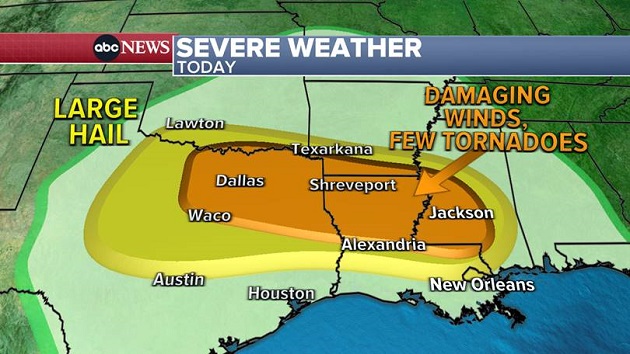
(NEW YORK) — A major winter storm is moving across the Heartland Wednesday, bringing snow from Denver to Chicago and ice as far south as Texas.

More than 1 foot of snow is expected from northern Missouri into Illinois, Indiana, Ohio and Michigan.

A winter storm warning has been issued in Chicago where 5 to 10 inches of snow is expected.

A winter storm warning was also issued in Denver where up to 6 inches of additional snow is forecast.

Denver schools are closed Wednesday due to the storm.

As of Tuesday night, 1,212 flights were already canceled for Wednesday due to the storm, with St. Louis, Chicago, Denver, Detroit and Kansas City seeing the biggest impacts.

In Missouri, Gov. Mike Parson has issued a state of emergency.

Further south, an ice storm warning has been issued from Memphis to Louisville, where the ice could be as thick as half an inch, sending trees toppling onto power lines.

A winter storm warning was also issued for Dallas where ice could make roads very dangerous.

The storm will then move into the Northeast Thursday night into Friday morning, bringing snow, sleet and freezing rain.

Over 1 foot of snow is possible in western Pennsylvania, upstate New York and parts of New England.

A winter storm watch has been issued for Boston, where residents are still digging out from last weekend’s massive snowstorm.

Dangerous ice accumulation is possible from Washington, D.C., to Philadelphia to New York City to Boston.

New York City will see rain on Thursday which will then change to freezing rain and some sleet on Friday morning. The National Weather Service warns that New York City Tristate region should be prepared for dangerous travel conditions on Friday.

Copyright © 2022, ABC Audio. All rights reserved.

Houthi missile intercepted by UAE during historic Israeli visit raises tensions

Houthi missile intercepted by UAE during historic Israeli visit raises tensions
Israel’s President Isaac Herzog speaks at al-Wasl Dome at Expo 2020 Dubai during Israel’s expo National Day in the gulf emirate on January 31, 2022. – KARIM SAHIB/AFP via Getty Images

(JERUSALEM)– While Israeli’s president Isaac Herzog was in Abu Dhabi on a historic visit on Monday, United Arab Emirates officials announced that a ballistic missile fired by Yemen’s Houthi rebels had been intercepted, the third such attack in three weeks.

Tensions between the two countries have escalated as the Iran-backed Houthis claimed responsibility for a Jan. 15 drone-and-missile attack on the Abu Dhabi National Oil Co. fuel depot, killing three people and wounding six. It was the first deadly attack since 2018, when the UAE-backed forces were fighting the Houthis for control of the Red Sea port city of Hodeidah.

“The operation led to a large number of death and wounded, including Emiratis,” Yahya Sare’e, spokesman of the Houthis, tweeted on Tuesday.

A Saudi-led coalition retaliated the day after with an airstrike on Yemen, killing about 80 people.

In 2020, the UAE and Bahrain signed U.S.-brokered normalization agreements with Israel, known as the “Abraham Accords.” Iran and its regional allies, including the Houthis, were among their shared security concerns. Iran, meanwhile, denounced any normalization of relations with Israel.

“The Islamic republic of Iran not only condemns what some countries are doing aiming at normalization, but also believes that those countries should listen to awakening calls by their own people and stop sowing discord in the Muslim and Arab world. This will be much better for the region’s future,” spokesman of Iran’s foreign ministry Saeed Khatibzadeh said on Monday, according to the Tasnim News Agency.

Yemeni minister of information Dhaif Allah Al-Shami, also made clear his country’s similar stance.

“Every country has its own way of welcoming the leaders of the Zionist entity [Israel], and we in Yemen have only done our duty,” he said on Twitter.

Zakaria Al-Qaq, an expert in national security and war studies, told ABC News the Houthi attack on the UAE coinciding with the Israeli president’s visit had a clear message: “To stop the UAE intervention in Yemen.”

“Second, it’s not only a rejection to the Israel Emirates relation but also a threat to Yemeni National Security, because [of] the security coordination between the two countries,” he added.

Houthis have declared they would continue to fire rockets into the UAE.

“The armed forces affirm that the state of the Emirati enemy will be an unsafe as long as the tools of the Israeli enemy in Abu Dhabi and Dubai continue to launch aggression against our people and our country,” Sare’e wrote in another tweet.

The Houthi spokesman has also repeated threats, telling citizens, residents and companies in the UAE “to stay away from vital headquarters and facilities, as they are vulnerable to targeting during the coming period.”

People in the already war-worn Yemen have been going through a difficult humanitarian situation over the past years. The World Food Programme has warned that more than five million people are on the verge of famine, with 50,000 others now living in famine-like conditions.

The spate of recent attacks have helped raise crude oil prices above $90 per barrel, another worry for a global economy already struggling through the pandemic.

Copyright © 2022, ABC Audio. All rights reserved.