
Idaho abortion ban temporarily blocked weeks before set to take effect

Idaho abortion ban temporarily blocked weeks before set to take effect
Darin Oswald/Idaho Statesman/Tribune News Service via Getty Images

(BOISE, Idaho) — The Idaho Supreme Court has temporarily blocked a new law that bans nearly all abortions in the state while a legal challenge plays out in court.

The court issued a stay on implementation of the bill, set to go into effect on April 22, in a ruling on Friday, more than a week after Planned Parenthood filed a lawsuit seeking to reverse the restrictive abortion law.

The state has until April 28 to respond to the court.

The law bans abortions once cardiac activity in a fetus is detected, which happens at approximately six weeks of pregnancy. Many women are unaware at six weeks that they are pregnant.

The suit was filed on March 30 in Idaho’s Supreme Court on behalf of Planned Parenthood Great Northwest, Hawai’i, Alaska, Indiana, Kentucky and Dr. Caitlin Gustafson, a health care provider who performs abortions at Planned Parenthood clinics, according to court documents.

The bill was signed by Gov. Brad Little on March 23, making Idaho the first state to model legislation after Texas’ abortion ban.

“It should be clear to everyone that the Idaho state legislature intentionally abandoned the ordinary rule of law when they passed this six-week abortion ban. Then the governor joined their effort to deny his constituents their constitutional rights when he signed the abortion ban into law — despite his own acknowledgement that it was wrong,” Alexis McGill Johnson, president and CEO of Planned Parenthood Federation of America, said in a press release announcing the legal challenge.

The law would also allow the father, grandparents, siblings, uncles or aunts of the fetus to sue a medical provider that performs the procedure and collect a reward of at least $20,000 for a successful claim filed within four years of an abortion, according to Planned Parenthood.

The law’s “enforcement mechanism and substance are blatantly unconstitutional, so much so that Idaho’s Attorney General’s Office released an opinion to this effect, and the Governor emphasized similar concerns upon signing,” the lawsuit states.

In a letter to Janice McGeachin, the lieutenant governor and president of the state’s senate, Little criticized the bill, saying, “I stand in solidarity with all Idahoans who seek to protect the lives of preborn babies.”

He then added, “While I support the pro-life policy in this legislation, I fear the novel civil enforcement mechanism will in short order be proven both unconstitutional and unwise.”

In its lawsuit, Planned Parenthood asked the court to rule that the bill is “unlawful and unenforceable” and forbid Idaho courts from implementing civil cases as the bill allows.

Without intervention from the court, the law would go into effect, “wreaking havoc on this State’s constitutional norms and the lives of its citizens,” according to the lawsuit.

“The abortion ban blatantly undermines patients’ right to privacy. It also improperly and illegally delegates law enforcement to private citizens, violating the separation of powers and allowing plaintiffs without injury to sue, in violation of the Idaho Constitution,” Planned Parenthood said.

Added Rebecca Gibron, the interim CEO of Planned Parenthood Great Northwest, Hawai’i, Alaska, Indiana, Kentucky: “This law is a cruel overreach by politicians so intent on controlling the lives of their constituents that they’re willing to compromise our constitutional rights and compromise our health and safety, all in order to ban abortion.”

The lawsuit requests emergency relief by April 21 to prevent the implementation of the abortion ban before it becomes law.

“Unless this abortion ban is stopped, Idahoans will watch in real time as their government strips them of the very rights they were sworn to protect. Everyone deserves to make their own decisions about their bodies, families, and lives — and we’re going to keep fighting to make sure that is a reality,” McGill Johnson said.

Copyright © 2022, ABC Audio. All rights reserved.

New York AG asks judge to force Cushman & Wakefield to comply with subpoenas in Trump civil case

New York AG asks judge to force Cushman & Wakefield to comply with subpoenas in Trump civil case
Michael M. Santiago/Getty Images

(NEW YORK) — The New York Attorney General’s Office asked a judge Friday to force Cushman & Wakefield to comply with subpoenas issued in connection with the civil investigation of former President Donald Trump.

The motion to compel followed two subpoenas, one issued this past February and another in September of last year, that sought documents and records associated with several Trump properties: 40 Wall Street, a skyscraper in Manhattan; Seven Springs, an estate in Westchester, New York; and Trump National Golf Club in Los Angeles.

Cushman & Wakefield handled the appraisals of those properties, which have come under civil investigation by the attorney general’s office over possible manipulation as the Trump Organization sought tax breaks and favorable lending terms.

Trump and The Trump Organization have denied any wrongdoing. ABC News has reached out to both for comment on the attorney general’s new request.

Cushman & Wakefield, which has not been accused of any wrongdoing, complied with a subpoena issued early in the investigation, but said the two more recent ones were overly broad and amounted to harassment of the company.

“Cushman & Wakefield’s work for the Trump Organization is significant to our ongoing investigation into Donald J. Trump and the Trump Organization’s financial practices,” Attorney General Letitia James said in a statement. “There should be no doubt that information about Cushman’s appraisal work for the Trump Organization is relevant to our efforts and that Cushman — like any other party — cannot defy a lawful subpoena because no one is above the law.”

ABC News has reached out for comment from Cushman & Wakefield.

The commercial brokerage, which also handled office leasing at several Trump properties, cut ties with Trump after the Jan. 6 riot at the U.S. Capitol, saying in a statement at the time, “Cushman & Wakefield has made the decision to no longer do business with The Trump Organization.”

The Trump Organization purchased Seven Springs, the 212-acre property in Mount Kisco, New York, in 1995, hoping to develop a golf course and, when that was rejected, luxury homes.

In 2004, the Trump Organization valued the property at $80 million; in 2007 they valued it at $200 million; and by 2012, they valued it at $291 million, based on the contention the property was zoned for nine homes worth a supposed $161 million of profit, the attorney general’s office said.

Two separate professional appraisers valued the lots that were supposedly going to be developed at fractions of the prices used in the Trump Statement of Financial Condition, the attorney general’s office said.

The attorney general’s office has also raised questions about the true value of the Trump leasehold interest in 40 Wall Street. Outside appraisals conducted by Cushman & Wakefield in 2010-2012 for Capital One, which held a $160 million mortgage on the building, valued the Trump Organization’s interest in the property between $200 million and $220 million.

During the same period, according to the attorney general’s office, Trump’s financial statements represented that 40 Wall Street had a valuation of $601.8 million in 2010, $524.7 million in 2011, $527.2 million in 2012 and $530.7 million in 2013. Those values were between two and three times as much as recorded in the three consecutive appraisals.

Copyright © 2022, ABC Audio. All rights reserved.

Men who posed as federal agents are national security risk: Federal prosecutors

Men who posed as federal agents are national security risk: Federal prosecutors
Photo by Drew Angerer/Getty Images

(WASHINGTON) — The two men accused of impersonating federal law enforcement agents are a risk to national security, government prosecutors said in a court document, pushing to keep the men in custody Friday.

“In compromising at least four members of the USSS, they caused a risk to national security and the functioning of an essential government agency protecting the nation’s leadership,” Assistant U.S. Attorney Josh Rothstein wrote in the document. “Because of the nature and circumstances of the Defendants’ conduct, this factor points in favor of detention.”

The judge did not make a ruling on their detention Friday. The parties will be back in court Monday.

Arian Taherzadeh and Haider Ali stand accused of impersonating federal law enforcement agents as well as giving lavish gifts to U.S. Secret Service agents and their families. The pair was arrested on Wednesday.

“They are not law enforcement agents, and they are not involved in sanctioned covert activities,” prosecutors wrote in the detention memo. “Neither Defendant is even employed by the United States government. But their impersonation scheme was sufficiently realistic to convince other government employees, including law enforcement agents, of their false identities.”

The federal government also alleges that after Taherzadeh was arrested, he was interviewed and admitted to posing as a law enforcement officer and providing free rent to U.S. Secret Service agents. He also allegedly provided a “doomsday bag,” generator, flat-screen television, two iPhones, a drone, a gun locker, a Pelican gun case and a mattress to agents and officers of the Secret Service.

Lawyers for the government were grilled by Judge Michael Harvey on the source of the funding of the men, saying they could have put all of the charges on credit, and asking whether any gifts were exchanged between U.S. Secret Service agents and the two men.

“Who is funding the scheme? If it is Mr. Ali buying that day’s lunch at Chick-fil-A, it’s far less important,” Harvey said.

Both of those answers, the government acknowledged, they do not know.

“The scale of the comprised situation that they created is quite large and it’s causing us to have to send agents out to interview many, many people. These aren’t people just dressing up for Halloween. This is very serious,” Rothstein said.

In an interview with agents, Taherzadeh said his co-conspirator Ali “funded most of their day to day operation,” but he did not know the source of the money.

The assistant U.S. attorney said Ali has “some sort of citizenship status in Pakistan,” citing an ID card from the country. The government said they will do more digging over the weekend. Ali, Rothstein said, was born in Pakistan. The identification card is “relevantly new”

Rothstein also revealed the men had immigration documents of certain people who are in the building and the government is trying to figure out if those documents are real.

The government also revealed Taherzadeh was a special police officer, which, according to Rothstein, is a contracted company that stands in building lobbies, and the suspect was working in this capacity at “some time.”

“I don’t want to spend time with additional amorphous representation,” Harvey told the prosecutors, asking for more details for the entirety of the case.

Charging documents unsealed Wednesday show the men attempted to gift members of the Secret Service not only rent worth up to $40,000 but also weapons, including offering to purchase a $2,000 assault rifle for a member of first lady Jill Biden’s detail.

Prosecutors said in the court filing they “compromised” U.S. Secret Service “personnel involved in protective details and with access to the White House complex by lavishing gifts upon them, including rent-free living.”

The government added, “They procured, stored, and used all the tools of law enforcement and covert tradecraft: weaponry, including firearms, scopes, and brass knuckles; surveillance equipment, including a drone, antennae, hard drives, and hard drive copying equipment; tools to manufacture identities, including a machine to create Personal Identification Verification (PIV) cards and passport photographs; and tactical gear, including vests, gas masks, breach equipment, police lights, and various law enforcement insignia.”

An assistant U.S. Attorney representing the government said at a previous court hearing on Thursday that Ali has “claimed to witnesses to have connections to the ISI, which is the Pakistani Intelligence Service,” and the government found three Pakistani visas as well as two Iranian visas “from July 31 2018 through December 28 2019 and December 28 2019 through January 25 2020. And we know that because the conduct in the complaint starts in February 2020.”

Prosecutors have also alleged the men kept binders full of residents who lived in the luxury Washington, D.C., Navy Yard building. Several residents who spoke to ABC News were disturbed by the details outlined in the government’s allegations, including that the accused had a list of residents in the complex.

“It was pretty crazy, I just got home from work and I just saw a bunch of FBI agents in the lobby,” building resident Thomas Lee told ABC News. “It’s scary. It’s my place of living. … I just came home and then there’s just FBI agents. I’m like … what’s going on?”

Copyright © 2022, ABC Audio. All rights reserved.

Alabama governor signs ‘Don’t Say Gay,’ trans care and bathroom ban bills

Alabama governor signs ‘Don’t Say Gay,’ trans care and bathroom ban bills
Julie Bennett/Getty Images

(MONTGOMERY, Ala.) — In the latest salvo of legislation targeting LGBTQ youth, Alabama Gov. Kay Ivey has signed into law two bills banning transgender health care for minors and teaching about gender identity and sexual orientation in kindergarten through fifth grade.

The Alabama legislature passed the two bills focusing on transgender youth a day prior. SB 184 bans gender-affirming care, while HB 322 bans trans students from using bathrooms and locker rooms that align with their gender identity. HB 322 also limits LGBTQ content in classrooms due to a last-minute amendment.

SB 184, the Vulnerable Child Protection Act, states that anyone who provides gender-affirming care — including puberty blockers, hormone therapy or physical gender-affirming surgeries — to anyone under 18 could be convicted of a felony and face up to 10 years in prison and a $15,000 fine.

Several Alabama physicians has said the legislation is riddled with misinformation about how gender-affirming care actually affects children.

“When lawmakers attempt to practice medicine with a life without a license, they realize quickly that there was a lot more they didn’t understand than what they thought they did,” Morissa Ladinsky, an associate professor of pediatrics at the University of Alabama at Birmingham, previously told ABC News.

For instance, the bill would ban minors from receiving gender-affirming “surgical procedures,” but in Alabama, such surgeries aren’t allowed until a patient reaches the age of legal majority for medical decisions, which is 19.

The legislation also makes the claim that puberty blockers can cause infertility or other health risks. According to Ladinsky, these potential side effects only present real risks after puberty and are not a risk to youth taking puberty blockers.

“I believe very strongly that if the Good Lord made you a boy, you are a boy, and if he made you a girl, you are a girl,” Ivey said in a statement after signing the bill into law. “We should especially protect our children from these radical, life-altering drugs and surgeries when they are at such a vulnerable stage in life. Instead, let us all focus on helping them to properly develop into the adults God intended them to be.”

The bill’s sponsor, Republican Sen. Shay Shelnutt, has called gender-affirming health care “child abuse.”

“We don’t want parents to be abusing their children. We don’t want to make that an option, because that’s what it is; it’s child abuse. This is just to protect children,” Shelnutt said Feb. 23 on the state Senate floor.

Courtney Roark, the Alabama policy & movement building director for the youth-led reproductive rights nonprofit URGE, slammed the bill’s passage as an attack on bodily autonomy for trans youth and their families.

“In yet another attack on our bodies, our autonomy, and our desire to live happy and healthy lives, Alabama politicians have passed and signed into law a bill that would criminalize doctors, principals, teachers, school counselors and nurses for providing gender-affirming care and support to trans and non-binary youth,” Roark said. “Trans and non-binary youth in our state and across the country already face extraordinary barriers to accessing the liberated and joyous lives they deserve.”

HB 322 would require students in public K-12 schools to only use bathrooms and locker rooms that correspond with their assigned sex at birth.

Alabama state Rep. Scott Stadthagen, the sponsor of the bill, said the bill does not target transgender students.

“Almost every school district in this state is dealing with this issue with opposite genders wanting to use opposite bathrooms,” Stadthagen has said in debate. “I find this to be a safety issue. It is for protection of our students.”

“Here in Alabama, men use the men’s room, and ladies use the ladies’ room — it’s really a no brainer,” Ivey said in a statement. “This bill will also ensure our elementary school classrooms remain free from any kind of sex talk.”

An amendment to this bill would also prohibit classroom instruction or discussion on sexual orientation or gender identity for students in kindergarten through the fifth grade in public K-12 schools. The language mirrors the controversial so-called “Don’t Say Gay” bills popping up across the country.

Ivey took issue with that characterization, saying in a statement, “Let me be clear to the media and opponents who like to incorrectly dub this the ‘Don’t Say Gay’ amendment: That is misleading, false and just plain wrong. We don’t need to be teaching young children about sex. We are talking about five-year-olds for crying out loud. We need to focus on what matters – core instruction like reading and math.”

LGBTQ suicide awareness group The Trevor Project condemned the passage of such bills.

“On likely the last day of Alabama’s legislative session, lawmakers have added last-minute votes to push the most extreme anti-transgender agenda we’ve seen to date — all within a matter of hours,” said Sam Ames, director of advocacy and government affairs for The Trevor Project.

“These policies are not only cruel and unnecessary, they are unpopular among a majority of Americans,” they continued. “Criminalizing doctors, isolating trans youth from their support systems and stigmatizing conversations around LGBTQ identity will only fuel more bullying, anxiety and suicide risk among these youth.”

Copyright © 2022, ABC Audio. All rights reserved.

Questions over White House COVID protocols amid uptick in cases

Questions over White House COVID protocols amid uptick in cases
Chip Somodevilla/Getty Images

(WASHINGTON) — The White House is charging ahead with President Joe Biden’s schedule despite an uptick of COVID-19 cases among Washington politicians and staff members, including some in the president’s inner circle and others who have come near him at White House events.

White House officials have repeatedly said they follow advice from the president’s doctor, adhere to Centers for Disease Control and Prevention guidance and, in some cases, “go beyond it” to protect the president.

But recent close calls are putting a spotlight on how those prevention practices are being applied and where questionable exceptions are being made.

Even as administration officials say they’ll continue to adhere to strict protocols, the White House changed its tone Friday about the risk of Biden catching COVID.

In a shift in tone, White House communications director Kate Bedingfield told CNN Friday morning it’s now “certainly possible” the president could still test positive for COVID at some point.

Noting that the president is vaccinated and double-boosted, press secretary Jen Psaki tried to clarify those comments during Friday’s White House press briefing.

“[I]t is also the case that despite all of the precautions we take and even with the president being double-boosted, he could still test positive for COVID,” she said, “just as people — many people in the White House have — many people in the press corps have. That is a possibility and we want to be transparent with the American public about that.”

In recent days, two White House staffers and at least 19 members of Congress have tested positive for COVID-19. On Thursday, House Speaker Nancy Pelosi tested positive after being near the president on two different occasions earlier in the week — at one point they shared a kiss on the cheek.

On Thursday, White House press secretary Jen Psaki told reporters the president was not considered a “close contact” of Pelosi, as defined by Center for Disease Control and Prevention guidelines because they had not been within six feet of each other for 15 minutes.

The president tested negative for COVID-19 on Friday morning, according to a White House official.

This week, when Vice President Kamala Harris presided over the Senate confirmation of Judge Ketanji Brown Jackson to the Supreme Court, she was not wearing a mask much of the time despite being deemed a close contact of her communications director, who tested positive two days before the vote.

According to CDC guidance, someone who is deemed a close contact should wear a “well-fitting mask for 10 full days” when around other people at home or in public.

A White House official later told ABC News Harris had gotten a doctor’s okay before going maskless while sitting on the dais during the Senate vote.

“After consulting with a White House physician and reviewing CDC guidance, which we do for all engagements, the vice president presided over the Senate while practicing social distancing — with limited and brief interactions from her chair. In addition, the vice president tested negative today, and will continue to maintain strong protocols and follow the CDC’s guidance,” the official said.

Despite the increasing number of new cases in people coming close to Biden, the White House said it does not plan to step up testing for Biden or enforce a stricter mask mandate around the president.

“That would be a decision made by his doctor. But that is not deemed to be necessary at this point,” Psaki told ABC Senior White House Correspondent Mary Bruce.

While masks are now optional at the White House campus, meetings with the president are often socially-distanced, officials said.

The White House says it has a strict testing protocol for any staffer or administration official who comes near the president as well as for Biden himself. When pressed on whether those same requirements apply to others who meet with the president, such as guests, Psaki said the White House would assess each situation on a “case-by-case” basis.

ABC News’ Mariam Khan contributed to this report.

Copyright © 2022, ABC Audio. All rights reserved.

U.S. sends Patriot battery to Slovakia so Ukraine can get its S-300 anti-aircraft system: Pentagon update Day 44

U.S. sends Patriot battery to Slovakia so Ukraine can get its S-300 anti-aircraft system: Pentagon update Day 44
Andrew Harrer/Bloomberg via Getty Images

(WASHINGON) — The Pentagon has been providing daily updates on the U.S. assessment of the Russian invasion of Ukraine and Ukraine’s efforts to resist.

Here are highlights of what a senior U.S. defense official told reporters Friday on Day 44:

U.S. sending Patriot system to backfill Slovakia

After repeated pleas from Ukraine for help defending itself against Russian air strikes, Slovakia is sending its sole S-300 surface-to-air missile system to Ukraine, it announced Friday, and at the same time, the U.S. announced it is moving one of its Patriot missile batteries to Slovakia to replace it.

“At my direction, and at the invitation of Slovakia, U.S. European Command will reposition one Patriot missile system, manned by U.S. service members, to Slovakia,” Defense Secretary Lloyd Austin said in a statement Friday. “Their deployment length has not yet been fixed, as we continue to consult with the Slovakian government about more permanent air defense solutions.”

There has been talk of such an arrangement since last month when Slovakian defense minister Jaroslav Nad’ said his country was ready to deliver its Soviet-era S-300 to Ukraine on condition Slovakia’s air-defense capability be immediately backfilled.

“Should there be situation that we have a proper replacement or that we have a capability guaranteed for a certain period of time, then we will be willing to discuss the future of S-300 system,” Slovakia’s Prime Minister Eduard Heger said in a joint press conference with Austin on March 17.

A U.S. military Patriot battery based in Germany was pre-positioned in Poland for this purpose, and that system will soon be moving to from Poland to Slovakia to replace its S-300, according to a senior U.S. defense official.

The Slovak military has previously said it had about 45 missiles for its S-300 system.

U.S. ‘not buying’ Russia’s denial of hitting railway station

The Pentagon is “not buying” Russia’s denial of responsibility, a senior U.S. defense official said.

“They originally claimed a successful strike and then only retracted it when there were reports of civilian casualties,” the official said. “It’s our full expectation that this was a Russian strike — we believe they used a short range ballistic missile, an SS-21.”

Why might the Russians have targeted it?

The official said the station is a major rail hub in a “very strategic location,” just south of the key city of Izyum.

“And we’ve been talking now for days and days about how Izyum was so important to them because it lies almost in the middle of the Donbas,” the official said.

Russian units ‘eradicated’

Some of the Russian battalion tactical groups (BTGs) that have withdrawn back across the Belarusian and Russian borders have been essentially gutted from hard fighting in Ukraine, according to the senior defense official.

“We’ve seen indications of some units that are literally, for all intents and purposes, eradicated. There’s just nothing left of the BTG except a handful of troops and maybe a small number of vehicles,” the official said.

In terms of total losses — counting troops, tanks, aircraft and missile inventory – Russia has lost between 15-20% of the combat power it originally had arrayed against Ukraine since the beginning of the invasion, according to the official.

Russia hoping to recruit 60,000 new troops

Some of the Russian forces withdrawn from around Kyiv and elsewhere are now heading to the Russian cities of Belgorod and Valuyki, to the northwest of Donbas. But there are “no indications” that fresh troops are waiting there to join them.

For now, degraded Russian BTGs, usually made up of roughly 800-1,000 troops, are “exploring the option of” consolidating, banding together remaining forces and supplies to form new units.

“It’s really going to depend on the unit and how ready they are to get back into the fight, but we don’t believe that in general this is going to be a speedy process for them given the kinds of casualties they’ve taken and the kind of damage that they’ve sustained to their to their units’ readiness,” the official said.

Russia is also aiming to recruit upwards of 60,000 new troops, according to the official.

“They hope to get reinforced by new conscripts — there’s a whole new conscription schedule coming up here in May,” the official said, adding that Russian conscripts serve for one year.

“It remains to be seen how successful they’ll be on this, and where those reinforcements would go, how much training they would get,” the official said.

Additionally, the U.S. sees indications Russia has begun mobilizing reservists.

After Russian BTGs rebuild, “the most likely course of action would be for them to move immediately south right into the Donbas,” the official said.

The Pentagon estimates more than 40 Russian BTGs are already positioned in or near the Donbas region. The estimate was “more than 30” on Wednesday, meaning up to 10,000 more troops have arrived in recent days.

ABC News’ Luis Martinez contributed to this report.

Copyright © 2022, ABC Audio. All rights reserved.

At Jackson confirmation, Harris asks Black senators to write letters to Black girls

At Jackson confirmation, Harris asks Black senators to write letters to Black girls
Alex Wong/Getty Images

(WASHINGTON) — As she presided over Thursday’s historic confirmation vote for Ketanji Brown Jackson to become the first Black woman to sit on the Supreme Court, Vice President Kamala Harris gave an assignment to Sens. Raphael Warnock and Cory Booker — the only two Black Democrats in the Senate: Write a letter, using the vice president’s official stationery, to a young Black girl in their lives.

Before the vote, Warnock, speaking on the Senate floor, had spoken of the historic aspect of Judge Jackson’s confirmation by talking about his own daughter.

“Yes I’m a Senator, I’m a pastor, beyond all of that I am a father of young Black girl. I know how much it means for Judge Jackson to have navigated the double jeopardy of racism and sexism to now stand in the glory of this moment, in all of her excellence,” Warnock said.

“For my five-year-old daughter and for so many young women in our country, but really if we’re thinking about it right for all of us, seeing Judge Jackson ascend to the Supreme Court reflect the promise of progress on which on democracy rests. So, what a great day it is in America,” he said.

Later, Warnock shared on Twitter “Dear Chloé, Today, we confirmed Ketanji Brown Jackson to the United States Supreme Court,” he wrote. “In our nation’s history, she is the first Supreme Court Justice who looks like you – with hair like yours.”

Booker said he has not yet decided who will get his letter.

After the vote, Harris said, “There is so much about what’s happening in the world now that is presenting the worst of … human behavior,” Harris said. “And then we have a moment like this that I think reminds us that there is so much left to accomplish.”

ABC News’ Rachel Scott contributed to this report.

Copyright © 2022, ABC Audio. All rights reserved.

COVID-19 cases rise in Los Angeles County due to BA.2 variant

COVID-19 cases rise in Los Angeles County due to BA.2 variant
yorkfoto/Getty Images

(LOS ANGELES) — COVID-19 cases are rising in Los Angeles County as the BA.2 variant continues to spread throughout the United States.

Data from the L.A. County Department of Public Health shows 1,088 new cases of the virus were recorded Thursday with a seven-day rolling average of 841 new cases per day.

That average is a 40% increase from the average of 601 cases per day recorded two weeks earlier, according to the data.

Additionally, the seven-day average of positive tests rose to 1.0% from 0.7% over the same period.

However, officials believe the number of positive cases is an “undercount” because many people who test positive use rapid at-home tests and don’t report their results.

During a press conference Thursday, L.A. County Public Health Director Dr. Barbara Ferrer said there were 14 new outbreaks in schools for the week ending Tuesday compared to four outbreaks the prior week.

One of the active outbreaks, which occurred at a high school, started with 26 cases and has since grown to 60 cases.

Health experts said the surge of cases is, in part, due to BA.2, a subvariant of the original omicron variant.

Ferrer revealed during the press conference that the highly infectious subvariant accounted for 46.5% of samples that underwent genomic sequencing, up from 31.8% the week prior.

Because the most recent date for which subvariant-specific data is available in Los Angeles is March 19, Ferrer said she expects BA.2 may now make up more than half of all COVID-19 infections in the county.

This is in line with data from Centers for Disease Control and Prevention, showing BA.2 makes up 75% of all cases in the Western region, which includes California, Arizona and Nevada.

“Given that BA.2 is more transmissible than the earlier strains of omicron, it’s very likely BA.2 is now the predominant subvariant in L.A. County,” Ferrer said.

The Los Angeles County Department of Public Health did not return ABC News’ request for comment.

The spread of the variant mirrors what’s been seen in several countries in Europe, including England, which hit a record-high 1 in 13 people being infected with the virus last week, according to the U.K.’s Office for National Statistics.

However, experts said the rise in cases can also be attributed to the relaxing of public health measures.

“People are letting down their guard in terms of distancing, masking and attending crowded events,” Dr. Otto Yang, associate chief of infectious diseases and a professor of medicine at the David Geffen School of Medicine at the University of California, Los Angeles, told ABC News. “It’s not rocket science. We know how the virus spreads. We know if we relax the measures, it will spread more.”

Ferrer said the relaxing of indoor masking is also one of the reasons behind school outbreaks.

However, hospitalizations and deaths due to the virus in L.A. County continue to remain low.

In the last two weeks, daily hospitalizations have dropped from 373 to 273, according to county data.

Meanwhile, the daily number of deaths currently sits at 15, down from 16 the week before, the data shows.

Yang said the low numbers are due to several factors including high vaccination rates, effective treatments and some prior immunity from infection during the previous omicron wave.

But he warned that these figures could rise in the next few weeks.

“These indicators lag so it takes time [during a surge] before people become seriously ill and die,” Yang said.

Yang also encouraged residents to get their booster shots if they haven’t already and to consider wearing masks around family members or friends at high risk of severe illness.

“If you are at risk of giving it to someone who would have a severe case, consider wearing a mask and avoiding indoors crowded events,” he said. “The same measures will still work. Even if your personal risk isn’t high, think about the people around you.”

Copyright © 2022, ABC Audio. All rights reserved.
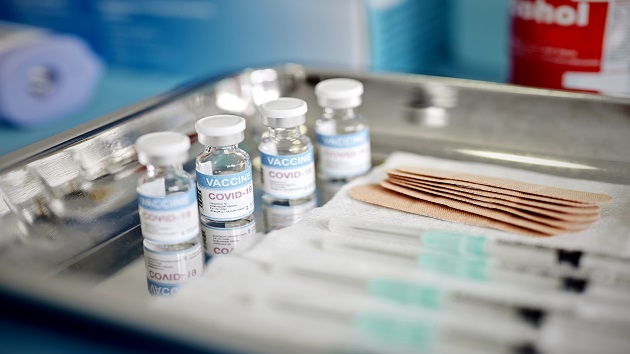
COVID-19 vaccine campaign prevented millions of deaths, hospitalizations in U.S., study finds

COVID-19 vaccine campaign prevented millions of deaths, hospitalizations in U.S., study finds
Morsa Images/Getty Images

(NEW YORK) — Despite a recent increase in COVID-19 breakthrough infections, an updated report illustrates the significant impact the nation’s vaccine campaign has had in preventing millions of virus-related deaths, hospitalizations and infections.

The U.S. COVID-19 vaccine program is now estimated to have prevented 2.2 million deaths, 17 million hospitalizations and 66.1 million additional infections through March 2022, according to updated modeling from the Commonwealth Fund, an organization advocating for improved healthcare for marginalized communities.

In the analysis of recent trends, researchers estimated that the daily peak of deaths pre-omicron, and without vaccination, would have exceeded 24,000 per day, far surpassing the actual peak of 4,300 per day, experienced by the country during the winter of 2021.

Without the vaccines, the omicron wave could have been substantially larger, the study suggested.

In addition, the researchers estimate that without vaccines, there would have been nearly $900 billion in associated health care costs.

The model accounts for waning immunity and changes in population behavior over time, as schools and businesses have reopened and travel has increased. As immunity wanes, researchers stressed that “redoubling efforts to increase vaccine uptake, especially among the elderly and other vulnerable groups, will be critical to avert outbreaks as pandemic restrictions are lifted,” particularly as the omicron subvariant, BA.2, spreads.

“Our findings point to the tremendous power of vaccination to reduce disease burden from COVID-19. This may be even more important if newer variants arise or population immunity ebbs. Without continued funding, the lifesaving impact of vaccinations are at risk,” researchers said.

Former President Donald Trump and President Joe Biden have both taken credit for the development and implementation of the COVID-19 vaccine.

Following the release of the study, the White House said in a statement that the loss prevented by the vaccine is the “the result of the Biden Administration’s efforts to use every tool to make vaccinations easy and convenient for every American, Congress providing us the vital resources we needed, and the American people stepping up and doing their part.”

“Together, we’ve spared millions of families the immeasurable loss that too many others have suffered, and turned unthinkable pain into extraordinary purpose and progress,” the statement said.

Trump has also touted his administration’s leadership in the nation’s vaccine rollout, asserting that the vaccines would not have been developed at such a fast pace without his pressure on drug companies.

“There are some people that say my greatest achievement was getting the vaccine, because the vaccine was said to take three to five years, and most people said it wasn’t going to happen,” Trump said during a panel interview at Princeton University in July 2021. “We made maybe one of the best bets in history because we bought billions and billions of dollars worth of the vaccine by saving time long prior to knowing whether or not it was going to work.”

Despite Trump’s support of the COVID-19 vaccine, last month, an ABC News analysis of federal data found that on average, the death rates in states that voted for Trump were more than 38% higher than in states that voted for Biden, following the widespread availability of vaccines.

“The irony of course, is that the Trump administration was responsible for fighting for this pandemic funding, in fast-tracking the vaccine process that has really saved a lot of lives,” Peter Jacobson, professor emeritus of health law and policy at the University of Michigan School of Public Health, told ABC News.

In order to protect more Americans moving forward, the Biden administration and its top health officials, including Dr. Anthony Fauci, chief medical adviser to the White House, and Dr. Rochelle Walensky, director of the Centers for Disease Control and Prevention, have continued to push for COVID-19 funding.

“COVID-19 is not over. And we have an obligation to protect our country, the American people and make sure we’re taking steps to prepare,” White House press secretary Jen Psaki said during a press conference this week.

The White House asserted inaction on funding for Covid-19 relief will leave the nation vulnerable to the emergence of future surges and variants. Weekly allocations of many COVID therapies have already been scaled down with the funding stalled in Congress.

“This is deeply disappointing – and it should be unacceptable to every American. We’ve worked too hard and come too far to leave ourselves and our economy vulnerable to an unpredictable virus,” the White House statement said.

Copyright © 2022, ABC Audio. All rights reserved.

Power still out for around 850,000 customers in Puerto Rico amid massive outage

Power still out for around 850,000 customers in Puerto Rico amid massive outage
Pawel Gaul/Getty Images

(NEW YORK) — Power is still out for around 850,000 customers in Puerto Rico on Friday, after a massive outage left 1.5 million customers without power, according to LUMA Energy, the company that took over transmission and distribution from the island’s power authority.

As of 12 p.m. on Friday, power was restored for around 660,000 customers. LUMA said most of the island should have power by Friday night and it expects to restore power to “more than 1 million customers during tonight.”

The power outage came after a fire erupted at one of the island’s four main power plants. The exact cause of the interruption of service is under investigation, LUMA said.

“The extent of the outage has impacted each generating facility in Puerto Rico and a significant effort to restore service is underway,” LUMA said in a statement.

Given how widespread the outage is, the government and the energy company said there is no timetable for full restoration.

“We are continuing to make progress in restoration but due to extensive damage at Costa Sur substation, we are not in position to provide an estimate of full restoration at this time,” LUMA said.

Public schools were closed to students on Thursday and Friday due to the outage, according to the island’s governor, Pedro Pierluisi.

Around 100,000 customers were also without water on Thursday due to the power outage, according to president of the Aqueduct and Sewer Authority, Doriel Pagán Crespo.

The outage also affected some traffic intersections by shutting off traffic lights, officials warned.

Only essential personnel are being summoned to central government agencies on Friday, Pierluisi said, in another tweet.

Addressing the upcoming hurricane season, Josue Colon, the executive director of the power company, said the electrical grid still needs to be reconstructed and that it would not be responsible for them to say that the island’s grid could withstand a hurricane like 2017’s category 5 Maria.

Copyright © 2022, ABC Audio. All rights reserved.