(NEW YORK) — A popular Easter candy was recalled weeks before the holiday.
Earlier this month, Ferrero announced through the Food Standards Agency it would take “the precautionary action of recalling selected batches of Kinder Surprise because it might be contaminated with Salmonella. Only Kinder Surprise products manufactured in Belgium are affected.”
Now, the U.S. Food and Drug Administration cited the international press release and warned Americans of the additional potentially at-risk products.
“Ferrero U.S.A., Inc. of Parsippany, New Jersey is voluntarily recalling its Kinder Happy Moments Chocolate Assortment and Kinder Mix Chocolate Treats basket, because the product may be contaminated with Salmonella Typhimurium,” the FDA wrote on Tuesday.
The Centers for Disease Control and Prevention alerted consumers of the Kinder Happy Moments Milk Chocolate and Crispy Wafers Assortment Kinder Mix Chocolate Treats Basket recall on Twitter.
KINDER CHOCOLATE RECALL: Do not eat or give away recalled Kinder chocolate. It may be contaminated with Salmonella.
•Kinder Happy Moments Chocolate Assortment
•Kinder Mix Chocolate Treats Basket
As of time of publication, according to Food Safety News, the Salmonella outbreak linked to the chocolate products has sickened nearly 100 people total across multiple countries throughout the U.K., Ireland, Germany, Sweden and the Netherlands.
The affected product pack sizes listed by the FSA are 20g and 20g x 3 with best before dates between July 11, 2002 and Oct. 7, 2022.
Click here for more information on the recall, refunds and contact information for the Ferrero consumer care team.
(ALEXANDRIA, Va.) — A Virginia federal jury began deliberations on Wednesday in the case of a confessed ISIS fighter accused of being one of the infamous “Beatles,” the British terrorists who tortured and murdered more than six victims among a group of 26 westerners held hostage in Syria.
El Shafee Elsheikh doesn’t deny fighting for ISIS but rested his defense in U.S. District Court for the Eastern District of Virginia on his claim that this was a case of mistaken identity about holding the westerners captive. He faces a life sentence if convicted of holding hostages and causing the deaths of journalists and humanitarian aid workers, including four Americans and two Britons.
In closing arguments Wednesday, federal prosecutors said Elsheikh was one of the men who brutalized American journalists James Foley and Steven Sotloff, as well as aid workers Peter Kassig and Kayla Mueller. The men were shown in ISIS videos in 2014-15 being beheaded by a black-clad and masked ISIS executioner nicknamed “Jihadi John” because hostages had dubbed the men the “Beatles” to discuss them while in captivity.
The videos shocked the world as the executioner — later named as Mohammed Emwazi — demanded the U.S. cease military strikes against ISIS.
Mueller, 26, of Prescott, Arizona, was reportedly killed by an airstrike by ISIS in February 2015. It was later revealed that she had been taken by ISIS leader Abu Bakr al-Baghdadi and repeatedly abused and raped.
“Elsheikh, without a shadow of a doubt, is an ISIS Beatle,” prosecutor Raj Parekh told the jury.
But defense lawyer Nina Ginsberg countered that the U.S. never presented any hard evidence that the defendant was anything other than a foot soldier in ISIS battling the Syrian Army.
Despite evidence from a parade of former hostages and FBI agents who testified during the trial about what she described as “loathsome, brutal acts,” Ginsberg said the government failed to prove Elsheikh was a captor, and that he was “never identified at this trial by any of the former hostages.”
The U.S. instead relied primarily on Elsheikh’s own statements after his 2018 capture by Syrian Democratic Forces with fellow admitted ISIS Beatle Alexanda Kotey, who has pleaded guilty. They told several journalists, primarily British filmmaker Sean Langan, on video that they held the westerners captive, got family members’ email addresses from hostages such as Mueller, and beat others such as Danish photojournalist Daniel Rye.
Rye testified on Tuesday, revealing agonizing details of how the British ISIS members had stuck him in the ribs 25 times on his 25th birthday, hanged him by his hands and jammed the barrel of an MP5 submachine gun in his mouth.
He described the loyalty of Foley, who once had an opportunity to escape captivity but refused to abandon his comrade, the British journalist John Cantlie, whose whereabouts and survival remain unknown. Notably, Cantlie’s photo was shown to jurors alongside six other hostages known to have been killed.
The captors forced them to sing a version of “Hotel California,” emphasizing the line, “You can never leave” — but that was hardly the worst of their suffering.
Sotloff tried to leave letters for Mueller in a communal toilet, but they were caught and he, Cantlie and Foley were punished severely, he recalled. When he learned after 13 months he had been ransomed and set for release, Rye said Cantlie came to him.
“He wanted me to bring out a message. ‘If you cannot get us released, drop a bomb on this place – kill us,’” Rye said, as family members of hostages in the courtroom held each other.
By the time he and another hostage were told they were being released as the last two Europeans, Rye said the Americans and British hostages knew they were going to be executed. The U.S. began bombing ISIS in August 2014.
The Americans retreated silently to one corner of the small room, the British men in another corner. As he left the room, “I took one last look at my friends, and thought it was the last time I would see them alive,” Rye told the jury.
Prosecutors said all of the hostages who were brutalized and those ultimately murdered showed superhuman courage. They described a year or more of broken ribs, severe blows to the thighs called “dead legs,” stress positions, water deprivation, mock executions — and finally beheadings which, at least, ended their suffering.
“All these people wanted was to do the right thing,” Assistant U.S. Attorney Dennis Fitzpatrick said.
Sotloff’s father, Art, told ABC News that justice has been served.
“I feel like all of them are looking down on us, pattin’ us on the back for doing the right thing,” he said.
(NEW YORK) — Russian President Vladimir Putin’s “special military operation” into neighboring Ukraine began on Feb. 24, with Russian troops invading from Belarus, to the north, and Russia, to the east. Russian forces have since been met with “stiff resistance” from Ukrainians, according to U.S. officials.
In recent days, Russian forces have retreated from northern Ukraine, leaving behind a trail of death and destruction. After graphic images emerged of civilians lying dead in the streets of Bucha, a town northwest of Kyiv, the United States and European countries accused Russia of committing war crimes.
Here’s how the news is developing. All times Eastern:
Apr 13, 8:11 pm
Blinken authorizes Pentagon to supply $800M of weapons to Ukraine
U.S. Secretary of State Antony Blinken has authorized the Pentagon to provide $800 million in new military aid to Ukraine that the White House announced earlier Wednesday.
Blinken said that though Ukrainian forces are “regaining ground,” the war is “far from over,” with Russia repositioning itself for renewed attacks in eastern and southern Ukraine.
“The United States, its Allies and partners must take action now to surge additional military assistance as Ukraine prepares for the next phase in the fight for its freedom and its very future,” Blinken said in a statement.
The new package includes increased capabilities, such as sea drones, armored vehicles and long-range artillery, he said.
-ABC News’ Conor Finnegan
Apr 13, 6:15 pm
US moving ‘as quickly as possible’ on latest Ukrainian military aid
The U.S. will be moving “as quickly as possible” to get the latest military aid announced Wednesday into Ukraine, Pentagon spokesman John Kirby said.
“We will literally start right away,” Kirby told reporters during a briefing Wednesday.
“We’re aware of the clock. And we know time is not our friend,” he continued.
The weapons systems, which include 155 mm howitzer artillery, are intended to help Ukraine fight against Russia in the eastern Donbas region and met requests that came from the Ukrainians, Kirby said.
“We tailored this list specifically to meet the needs that they have asked for, with respect to what’s going on in eastern Ukraine,” said Kirby. “That’s what’s really driving this.”
-ABC News’ Luis Martinez
Apr 13, 5:46 pm
Biden updates Zelenskyy on US support
President Joe Biden on Wednesday updated Ukrainian President Volodymyr Zelenskyy on ongoing efforts the United States is making to provide Ukraine with additional military support, according to the White House.
Biden and Zelenskyy spoke by phone for nearly an hour.
The call comes as the White House is expected to announce as early as Wednesday afternoon an additional military assistance package to Ukraine that could be as much as $750 million and include a range of new military hardware.
During his latest national address, Zelenskyy said they spoke about the package, as well as “the prosecution of all Russian servicemen and commanders who committed war crimes” and international cooperation for such prosecution.
-ABC News’ Molly Nagle
Apr 13, 5:01 pm
Russia threatens to strike ‘decision-making centers’ in Kyiv
The Armed Forces of the Russian Federation is threatening strikes against Ukrainian “decision-making centers,” including those in the capital of Kyiv, if alleged Ukrainian attacks and sabotage on Russian territory do not stop.
“We see attempts of sabotage and strikes by Ukrainian forces against facilities on Russian Federation territory,” the Russian military said in its daily update of its “special military operation” in Ukraine. “If such cases continue, the Russian Armed Forces will strike at decision-making centers, including in Kyiv, from which the Russian army has so far refrained.”
In its statement, the Russian Armed Forces claimed to have destroyed 36 enemy assets on Wednesday, including two repair bases, two missile-artillery weapon depots and the command post for the 15th Separate Regiment of the Ukrainian National Guard.
Apr 13, 4:08 pm
Treasury Secretary Yellen presses China to get Russia to end war
U.S. Treasury Secretary Janet Yellen is pressuring China to convince Russia to end its war in Ukraine, citing the “special relationship” between the two countries.
“I fervently hope that China will make something positive of this relationship and help to end this war,” Yellen said Wednesday during remarks to the Atlantic Council.
Despite a virtual meeting between President Joe Biden and Chinese President Xi Jinping back in March to discuss the crisis in Ukraine, China has remained neutral during the Russian invasion and has refused to openly condemn Russian President Vladimir Putin. U.S. officials have said that it does not appear China has assisted with Moscow’s requests for military and economic help.
“Going forward, it will be increasingly difficult to separate economic issues from broader considerations of national interest, including national security,” Yellen said. “The world’s attitude towards China and its willingness to embrace further economic integration may well be affected by China’s reaction to our call for resolute action on Russia.”
Yellen noted that Beijing claims to respect sovereignty and territorial integrity and said now is the time for China to put some weight behind their commitments.
“China cannot expect the global community to respect its appeals to the principles of sovereignty and territorial integrity in the future if does not respect these principles now when it counts,” Yellen said.
China and India have continued to do business with Russia despite the international condemnation of Putin’s invasion and severe sanctions by the United States and its Western allies.
Yellen warned that any assistance to help Russia undermine or evade sanctions will not be taken lightly.
“Let me now say a few words to those countries who are currently sitting on the fence, perhaps seeing an opportunity to gain by preserving their relationship with Russia and backfilling the void left by others: Such motivations are short-sighted,” Yellen said. “The future of our international order, both for peaceful security and economic prosperity, is at stake. This is an order that benefits us all. And let’s be clear, the unified coalition of sanctioning countries will not be indifferent to actions that undermine the sanctions we’ve put in place.”
-ABC News’ Justin Gomez
Apr 13, 2:36 pm
Biden announces new $800 million in military aid to Ukraine
President Joe Biden officially announced Wednesday that his administration is “authorizing an additional $800 million in weapons, ammunition, and other security assistance to Ukraine.”
Biden made the announcement in a statement released by the White House after he updated Ukrainian President Zelenskyy on the support during a phone call Wednesday morning.
Noting that Russia is preparing to focus its fight in the Donbas region of eastern Ukraine, Biden said the United States would continue to “provide Ukraine with the capabilities to defend itself.”
“This new package of assistance will contain many of the highly effective weapons systems we have already provided and new capabilities tailored to the wider assault we expect Russia to launch in eastern Ukraine. These new capabilities include artillery systems, artillery rounds, and armored personnel carriers,” Biden said.
He added, “I have also approved the transfer of additional helicopters. In addition, we continue to facilitate the transfer of significant capabilities from our Allies and partners around the world.”
-ABC News’ Molly Nagle
Apr 13, 2:28 pm
Russia shows more signs of gearing up for new offensive
Russia is staging helicopters, artillery systems and troops in preparation for what is expected to be a renewed offensive in the Donbas region of eastern Ukraine, a senior U.S. defense official said Wednesday.
Russian forces have been using the cities of Belgorod and Valuyki in Russia near Ukraine’s northeast border as primary sites to stage equipment and resupply troops, the official said. The United States is now seeing a third Russian town, Rovenki, also near the Ukraine northeast border, being used for that purpose.
The official said there’s already signs that Russian forces are on the move south to the Donbas region.
“We continue to see units flowing into the northern Luhansk Oblast, that north part of the Donbas,” the official said. “They’re flowing in from Valuyki and from that town called Rovenki.”
The long Russian convoy is heading south and, at last check, was near the city of Izium in eastern Ukraine, according to the official.
Other Russian troops to the south of Izium appear to be working to improve their mobility and firepower in the region, the official said.
“We’ve seen them try to erect a temporary bridge over a local river,” the official said. “They’re increasing their artillery in the area.”
-ABC News’ Matt Seyler
Apr 13, 1:48 pm
Biden updates Zelenskyy on US support
President Joe Biden on Wednesday updated Ukrainian President Volodymyr Zelenskyy on ongoing efforts the United States is making to provide Ukraine with additional military support, according to the White House.
Biden and Zelenskyy spoke by phone for nearly an hour, but details of the conversation were not immediately released.
The call comes as the White House is expected to announce as early as Wednesday afternoon an additional military assistance package to Ukraine that could be as much as $750 million and include a range of new military hardware.
-ABC News’ Molly Nagle
Apr 13, 12:29 pm
Bright moment in grim war as puppy pulled from rubble alive
In a brief moment of joy amidst the brutality of war, rescuers in eastern Ukraine on Wednesday pulled a puppy alive from the rubble of a bombed building, authorities said.
The rescue unfolded in Mykhailivka in the Donetsk region, according to the Donetsk Regional Police.
Police released a video showing rescuers digging through the rubble with bare hands to reach the trapped pooch. Rescuers said they heard the puppy whining as they were picking through the rubble.
“Thanks to the boys for doing everything quickly and promptly here,” said the dog’s owner while holding the trembling puppy in his arms
Apr 13, 11:36 am
Finland, Sweden discuss possibility of joining NATO
Finland and Sweden — both traditionally militarily neutral countries — are considering a dramatic pivot in their security policy following Russia’s invasion of Ukraine.
Leaders of both countries publicly stated during a joint press conference Wednesday that they are considering taking steps to join the NATO alliance.
“The European security architecture has changed fundamentally after Russia’s invasion of Ukraine,” Finland’s Prime Minister Sanna Marin said. “The change in the security landscape makes it necessary to analyze how we best secure peace for Finland and in our region in the future.”
Swedish Prime Minister Magdalena Andersson added, “We have to really think through what is best for Sweden and our security and our peace in this new situation and, of course, what is happening and the discussion in Finland is important for us to follow. Therefore, we need to have a very close contact, but we have to have a process in Sweden to think this through.”
Last week, NATO Secretary-General Jens Stoltenberg said he’s had close contact with political leaders of both countries and has conveyed that it’s up to them whether to decide joining NATO.
“But if they apply, I expect that 30 allies will welcome them and that we will find ways to also address the concerns they may have about this interim period between (when) they have applied and until the last ratifications has taken place,” Stoltenberg said.
Kremlin spokesperson Dmitry Peskov warned that further expansion of NATO to include Finland and Sweden will not contribute to security in Europe.
“In itself, the alliance is rather a tool sharpened for confrontation, this is not an alliance that ensures peace and stability,” Peskov said, according to Russian state-run news agency TASS.
-ABC News’ Christine Theodorou
Apr 13, 11:19 am
Water crisis worsens in eastern Ukraine as war devastates infrastructure: UNICEF
About 1.4 million people have been left without clean running water in war-torn eastern Ukraine and an estimated 4.6 million people across the country are at risk of losing their supply, the United Nations Children’s Fund reported Wednesday.
UNICEF officials said heavy fighting in eastern Ukraine, including the widespread use of explosive weapons in populated areas, has decimated a large part of the region’s water systems. The agency tallied 20 separate incidents in which water infrastructure has been damaged or destroyed and warned of a “risk of complete collapse.”
Damaged electrical grids have shut down water pumps and explosion-related damage to pipelines are disrupting the flow of water, according to UNICEF.
“Water is essential for life and a right for everyone,” Osnat Lubrani, the U.N. resident coordinator in Ukraine, said in a statement. “The health risks, particularly for children and the elderly, caused by water stoppages are severe, as people are forced to use dirty water sources, resulting in diarrhoea and other deadly infectious diseases.”
Murat Sahin, a UNICEF Ukraine representative, added that, “Young children who live in conflict zones are 20 times more likely to die from diarrheal diseases linked to unsafe water than from direct violence, as a result of war.”
In hard-hit Mariupol, which has been under siege since the start of the Russian invasion on Feb. 24, thousands of residents trapped in the city are seeking any water they can find and resorting to dirty water sources, according to UNICEF. Major cities across the Donetsk and Luhansk regions are also cut off from water supplies.
The water systems in Sumy, Chernihiv and Kharkiv have also been seriously damaged, UNICEF said. An additional 340,000 people are at risk of losing their water supply from a reservoir in Horlivka in the Donetsk region that is inching closer to running dry, according to UNICEF.
Agency officials said that prior to the invasion, much of the water systems in eastern Ukraine were already ailing after eight years of a low-grade conflict in the region.
-ABC News’ Christine Theodorou
Apr 13, 6:17 am
Russia says 1,026 Ukrainians surrendered in Mariupol
Russia’s Defense Ministry claimed on Wednesday that more than a thousand Ukrainian soldiers had surrendered in besieged Mariupol, which is still held by Ukrainian forces.
“In Mariupol city, near the ‘Illich’ Steelworks, 1,026 Ukrainian servicemen of the 36th Marine Brigade have voluntarily laid down their arms and surrendered as a result of a successful offensive by the Russian Armed Forces and Donetsk People’s Republic militia units,” the ministry said in a statement.
Russia said the surrendering troops included 162 officers and 47 women.
“151 wounded Ukrainian servicemen of the 36th Marine Brigade received primary medical care immediately on the spot, after that they were all taken to the Mariupol city hospital for further treatment,” the ministry said.
(NEW YORK) — A college athlete who took time away from her sport to focus on her mental health is speaking out to urge coaches, schools, parents and fellow players to pay attention to the mental health of student-athletes.
“One of my favorite things to tell myself, if I’m not succeeding in the way I want to, I’ll put my hands on my heart now to say, ‘I love you and I’m listening,'” Cailin Bracken, a sophomore lacrosse player at Vanderbilt University, told ABC News’ Good Morning America. “And I want people to experience that from their coaches and administrators. I want there to be grace on all ends.”
Bracken said of the relationship between parents and kids, “I want for student-athletes and for parents to have an open communication.”
Bracken said that as a freshman at Vanderbilt, she struggled with depression after a mid-season concussion, which led her to stepping away from playing on the school’s lacrosse team.
“[If] I had a good day of practice, I was happy, and if I had a bad day of practice, I didn’t want to talk to anyone,” Bracken said. “I was investing so much of my worth in lacrosse.”
After taking time off from competing, Bracken reentered the sport and now is sharing her story to help others.
Earlier this month, Bracken opened up about her experience in an essay titled, “Dear College Sports,” for The Mental Matchup. In it, she describes how college sports can take a toll on student athletes, and how they are met with many expectations from coaches and administrators.
“Playing a sport in college, honestly, feels like playing fruit ninja with a butter knife,” Bracken wrote. “There are watermelons and cantaloupes being flung at you from all different directions, while you’re trying to defend yourself using one of those flimsy cafeteria knives that can’t even seem to spread room-temperature butter.”
“And beyond the chaos and overwhelm of it all, you’ve got coaches and parents and trainers and professors who expect you to come away from the experience unscathed, fruit salad in hand,” she added.
In her letter, Bracken mentions college athletes like Stanford University soccer star Katie Meyer and Duke University lacrosse player Morgan Rodgers, both of whom died by suicide at the age of 22.
Bracken wrote that when she hears stories like theirs, she feels fear, adding, “It scares me so much to wonder if it could’ve been my team; if it could’ve been me.”
On college campuses in the United States, around 30% of women and 25% of men who are student-athletes report having anxiety, according to data shared by the American College of Sports Medicine (ACSM).
Among athletes with known mental health conditions, only 10% seek care from a mental health professional, according to the ACSM.
The NCAA found that during the coronavirus pandemic, student-athletes’ mental health was even negatively affected, with students reporting stress due to academic concerns, lack of access to their sport, financial worries and COVID-19 health concerns.
Professional athletes like Michael Phelps, Simone Biles and Naomi Osaka have been public in recent years about the pressure, stress and burnout they’ve faced at the top of their sports, and those are struggles college athletes may feel too.
According to the ACSM, student-athletes face pressures from academics and competing, as well as other stressors like being away home home, traveling for games, feeling isolated from campus and other students due to their focus on sport and adapting to being in the public spotlight.
Bracken said that it is because of the support of her team and coaches that she was able to return to the field, writing, “I was able to navigate my way out of the darkness instead of letting it consume me.”
“I want other coaches to just say, ‘Hey, how can I be here for you?,’ because I never ever want a coach or a parent or teammate to see a situation like Katie Meyer [or] Morgan Rogers and say, ‘I wish I had done more,” she told GMA.
She added that she has been heartened by the response she’s received to opening up about her own mental health battle, saying, “I’m so grateful people are listening.”
“I had a father reach out to me and telling me that after reading the essay, he drove two-and-a-half hours to his daughter’s lacrosse practice and waited outside to give her a hug,” said Bracken. “And it was the most beautiful thing, because it’s exactly why I wrote it.”
If you or someone you know is in crisis, call the National Suicide Prevention Lifeline at 1-800-273-TALK (8255) or contact the Crisis Text Line by texting HOME to 741741. You can reach Trans Lifeline at 877-565-8860 (U.S.) or 877-330-6366 (Canada) and The Trevor Project at 866-488-7386.
(NEW YORK) — Russian President Vladimir Putin’s “special military operation” into neighboring Ukraine began on Feb. 24, with Russian troops invading from Belarus, to the north, and Russia, to the east. Russian forces have since been met with “stiff resistance” from Ukrainians, according to U.S. officials.
In recent days, Russian forces have retreated from northern Ukraine, leaving behind a trail of death and destruction. After graphic images emerged of civilians lying dead in the streets of Bucha, a town northwest of Kyiv, the United States and European countries accused Russia of committing war crimes.
Here’s how the news is developing. All times Eastern:
Apr 14, 4:51 am
197 children killed in invasion, Ukraine says
At least 197 children have been killed in Ukraine since the Russian invasion began, Ukraine’s Prosecutor General’s Office said on Thursday.
Another 351 children have been injured during the invasion, the office said. The actual number of casualties was assumed to be higher, because Ukraine’s official figures didn’t include “full consideration of places with active hostilities,” the office said.
Two children died after being hospitalized for injuries from a rocket attack on a train station in eastern Ukraine last Friday, according to Thursday’s update. Seven children have now died following that Russian attack, the update said.
Apr 13, 9:43 pm
Ukraine claims to have struck Russia’s Black Sea fleet flagship
Several Ukrainian government sources reported Wednesday that armed forces have struck Russia’s Black Sea Fleet flagship Moskva.
The governor of Odesa Maksym Marchenko claimed on Telegram that two anti-ship cruise missiles struck the cruiser in the Black Sea, causing “very serious damage.”
Ukrainian presidential adviser Oleksiy Arestovych and Anton Gerashchenko, an adviser to Ukraine’s Ministry of Internal Affairs, reported there was an explosion and that the cruiser is on fire.
Russia’s Ministry of Defense said a fire onboard the Moskva caused a subsequent broadside munitions explosion.
“The ship received serious damage, the crew was evacuated,” the ministry said, adding that an investigation is underway.
There was no mention of a missile strike in the ministry’s statement, which was carried by Russia’s state-run news agency TASS.
(LOS ANGELES) — A store owner has been arrested in the shooting of a 9-year-old girl police said was hit by an errant bullet at a Southern California mall when the merchant allegedly opened fire on a pair of shoplifters he was chasing.
Marqel Cockrell, 20, was being held on $1 million bail after he was arrested in Nevada and booked on suspicion of attempted murder, the Victorville Police Department announced Wednesday.
The shooting unfolded around 6:30 p.m. Tuesday at the Mall of Victor Valley in Victorville, police said.
The San Bernardino County Sheriff’s Department sent deputies to the mall after receiving multiple 911 calls reporting gunfire at the shopping center, authorities said. Multiple law enforcement agencies also responded to the scene as the mall was placed on lockdown and officers began to evacuate people and searched for the shooter, who apparently fled by the time officers arrived.
Deputies found the wounded girl and immediately began rendering medical aid, Victorville police said. She was taken to Loma Linda University Medical Center, where she was in stable condition.
The girl’s family members told ABC station KABC in Los Angeles that she suffered a gunshot wound to the arm.
Investigators believe the shooting occurred near a Barnes & Nobles outlet at the mall. Overnight, investigators worked to identify Cockrell as the suspect in the shooting.
Cockrell, who is the co-owner of a sneaker store at the mall called Sole Addicts, attempted to chase down two shoplifters out of his store according to police. In an attempt to stop the shoplifters, Cockrell fired multiple shots, missing the shoplifters and striking the young victim.
After fleeing the scene, Cockrell was arrested by the Nevada Highway Patrol in Clark County, Nevada, about 9 pm. Tuesday. He was booked at the Clark County Jail on suspicion of attempted murder and is awaiting extradition back to California.
This is the second shooting to occur at the Mall of Victor Valley within the last six months. In November 2021, a man was killed and two other people, including a juvenile, were wounded in a shooting outside the mall.
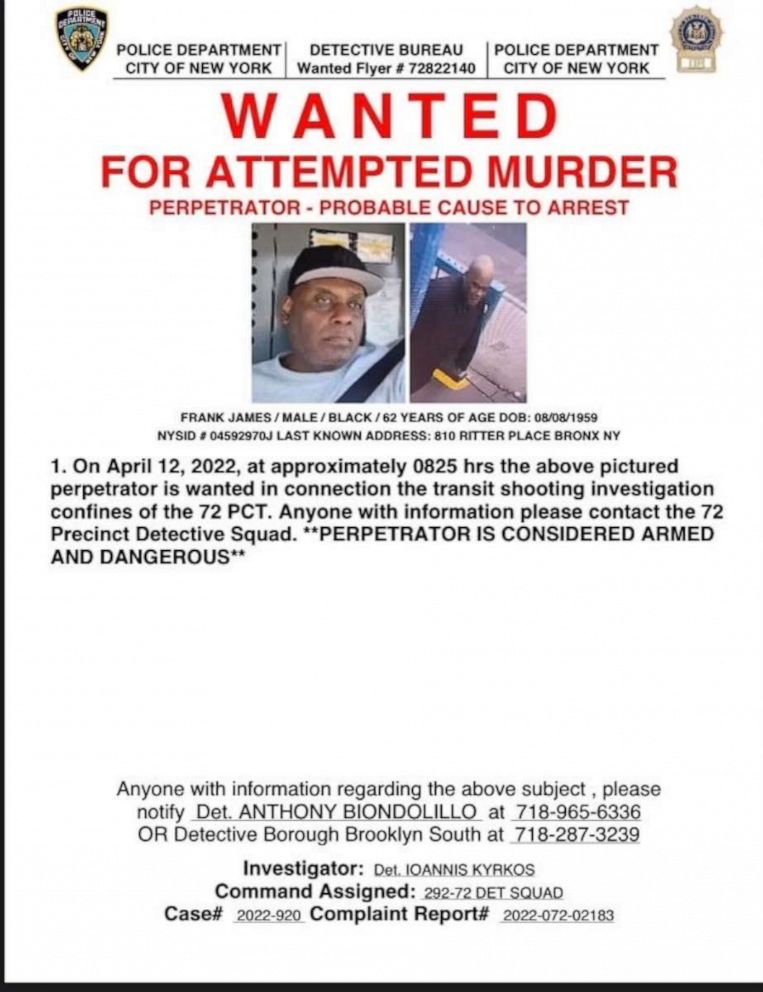
(NEW YORK) — Brooklyn subway shooter suspect Frank James, was arrested within 30 hours after the incident through a combination of on-the-ground detective work, technology and possibly a tip from the fugitive himself, investigators said.
“We were able to shrink his world, quickly. There was nowhere left for him to run,” New York Police Department Commissioner Keechant Sewell said at a press conference Wednesday afternoon.
Officers got their first lead soon after the incident at the crime scene, the 36th Street subway station in Sunset Park, Brooklyn, where several eyewitnesses filmed and photographed James.
Police said the suspect also left behind key pieces of evidence that helped them track his movements before and after the incident — a 9 mm Glock allegedly used in the shooting, his coat, a bag filled with fireworks and James’ credit card.
James used the credit card to rent U-Haul van that was discovered parked five miles southeast of the station, police said. Officers recovered the vehicle later in the evening.
James legally purchased the gun in Ohio in 2011, according to the NYPD. The Bureau of Alcohol, Tobacco, Firearms and Explosives is currently looking over data related to the gun, according to the agency.
Cameras were not working inside the 36th Street subway station, but he was filmed entering the subway station near where the van was found, according to investigators. He was also spotted at the 7th Avenue station in Park Slope, roughly three miles north of the crime scene, less than 30 minutes after the shooting, police said.
James fled the scene in a R train from the 36th Street station, police said.
While investigators continued to probe through clues, including James’ social media posts where he ranted against New York City Mayor Eric Adams, police released his photo to the public Tuesday night and named James as a “person of interest.”
“That was a critical effect on raising the kind of public awareness,” John Miller, the NYPD deputy commissioner for intelligence and counterterrorism, said at Tuesday’s news conference.
A cellphone alert with James’ description went out to New York City residents at 10:21 a.m. Wednesday, just hours after the police officially identified him as a suspect.
The NYPD said they received a Crime Stoppers tip a few hours later from some claiming James was inside a McDonald’s in Manhattan’s Lower East Side. The tipster may have been James himself, according to sources.
“I think you’re looking for me. I’m seeing my picture all over the news, and I’ll be around this McDonald’s,” one of the tipsters reportedly said, according to sources.
An NYPD official said police are reviewing the 911 call.
When officers responded to the McDonald’s, James was nowhere to be seen, so officers drove around the neighborhood, according to the NYPD.
Around 1:45 p.m. officers found James in the East Village neighborhood of Manhattan and arrested him without incident, according to police.
The FBI, ATF and other federal law enforcement agencies said they are still going through evidence and clues related to the shooting.
ABC News’ Aaron Katersky and Mark Crudele contributed to this report.
(WASHINGTON) — Following a call with Ukraine’s President Volodymyr Zelenskyy, President Joe Biden announced Wednesday his administration is authorizing an additional $800 million for weapons and ammunition for Ukraine, including artillery and armored personnel carriers, as it braces to defend itself from an expected new Russian offensive.
Pentagon press secretary John Kirby walked reporters through the aid package in an afternoon press briefing, saying it includes “new capabilities that we have not provided to Ukraine.”
“We committed from the very beginning even before the invasion, to helping Ukraine be able to defend itself. This is a piece of that. And this is representative of the kinds of capabilities that the Ukrainians themselves have asked for and said they need as this fighting now gets focused on the eastern part of the country,” he said.
“How that gets interpreted by the Russians. you can ask Mr. Putin and the Kremlin,” Kirby added.
Biden announced the $800 million package in an earlier written statement. He also noted that Russia is preparing to focus its invasion in the Donbas region in eastern Ukraine but affirmed the U.S. would continue to “provide Ukraine with the capabilities to defend itself.”
“This new package of assistance will contain many of the highly effective weapons systems we have already provided and new capabilities tailored to the wider assault we expect Russia to launch in eastern Ukraine. These new capabilities include artillery systems, artillery rounds, and armored personnel carriers,” Biden said.
“I have also approved the transfer of additional helicopters. In addition, we continue to facilitate the transfer of significant capabilities from our Allies and partners around the world,” Biden added.
According to the Pentagon, the list of new military hardware includes 155mm howitzer artillery — a specific request from Ukraine — 200 M-113 armored personnel carriers, 100 armored humvees, 300 Switchblade drones, and 11 MI-17 helicopters. The U.S. had given Ukraine five helicopters as part of an earlier shipment.
“And again, the Ukrainians have made it clear that in this fight that’s coming, artillery is a critical need — not just the artillery piece itself, but the rounds that go with it,” Kirby said following Biden’s announcement. “You can see, there’s 40,000 rounds that are going on with this — and we will be in an iterative conversation with them going forward and if they need additional artillery rounds, clearly the United States will do what we can to fill those needs.”
Reiterating the U.S. position not to send U.S. forces to fight in Ukraine, Kirby told reporters, “There will be no U.S. pilots flying the helicopters into Ukraine.”
“Unmanned coastal defense vessels” were also included on the lengthy list of equipment, some of which will require specific training.
The additional aid comes after Biden called Russia’s action’s in Ukraine “genocide” for the first time and as Zelenskyy warns Putin could use chemical weapons in Ukraine.
The U.S. has now given Ukraine more than $3 billion in security assistance.
(NEW YORK) — Frank James, the man wanted for allegedly opening fire on a rush-hour subway train in Brooklyn, shooting 10 people, was taken into custody in Manhattan on Wednesday afternoon, officials said, ending an over 24-hour-long search.
“We got him,” New York City Mayor Eric Adams announced at a Wednesday news conference.
The NYPD received a tip saying the suspect was in the East Village, in a McDonald’s at 6th Street and 1st Avenue, police said. Responding officers didn’t see him in the McDonald’s, but they drove around the area and spotted James near St. Marks Place and 1st Avenue, where he was taken into custody without incident around 1:45 p.m. ET, police said.
James, 62, may have called police on himself, according to sources. Among the calls to Crime Stoppers was reportedly someone who said: “I think you’re looking for me. I’m seeing my picture all over the news, and I’ll be around this McDonalds.”
An NYPD official said police are reviewing the 911 call.
Once taken into custody, James asked for a lawyer and didn’t speak to officers, according to law enforcement sources.
James has been charged by federal prosecutors in Brooklyn with terror-related offenses, officials said, and has been transferred to federal custody.
James, wanted for the attempted murder of 10 people, was the subject of an intense search by the U.S. Marshals Service and other federal and local agencies.
In the chaos after the Tuesday morning shooting at the 36th Street subway station, James eluded law enforcement by boarding an R train that pulled into the station and traveling one stop before exiting at the 25th Street station, according to NYPD Chief of Detectives James Essig. After that, James was seen again at a Park Slope subway stop at 9:15 a.m. before fading from view, Essig said.
The “active shooter” incident unfolded on a Manhattan-bound N subway just before 8:30 a.m. as the train approached the 36th Street station.
A man mumbling to himself on the train donned a gas mask and detonated a smoke canister before pulling out a handgun and firing 33 bullets, a police official told ABC News. Three teenagers were among the 10 people shot.
The gun jammed during the incident, which is believed to have saved lives, a law enforcement official told ABC News.
Smoke poured out of the subway car as the doors opened and screaming riders ran out onto the platform of the station. Bloodied people were seen lying on the floor of the train and the platform.
Twenty-nine people suffered various injuries, hospital officials said. As of Wednesday morning, just four of the wounded remained hospitalized, according to Adams.
“Based on the preliminary investigation, we believe he was alone,” Adams told ABC News in an interview Wednesday on “Good Morning America.”
“We still do not know the suspect’s motivation,” New York City Police Commissioner Keechant Sewell said at a press conference Tuesday evening. “Clearly this individual boarded the train and was intent on violence.”
The Glock 9 mm semi-automatic handgun James allegedly used was purchased legally in 2011 in Ohio, law enforcement sources told ABC News. The gun, and the purchase of a gas mask on eBay, are among the pieces of evidence that elevated James from person of interest to suspect, the sources said.
Senior law enforcement officials told ABC News that they also uncovered a number of social media posts and videos tied to James and are studying them closely to see if they are relevant to the subway attack.
Sewell said she increased security for the mayor after investigators found what she called “concerning posts,” though she declined to call them “threats.”
“There are some postings possibly connected to our person of interest where he mentions homelessness, he mentions New York and he does mention Mayor Adams,” Sewell told reporters Tuesday. “And as a result of that, in an abundance of caution, we’re going to tighten the mayor’s security detail.”
Authorities are also tracking James’ whereabouts leading up to the shooting.
On Monday night, according to federal prosecutors, James accessed a storage unit with gun parts and ammunition in Philadelphia, near where he was living. According to prosecutors, police found “an empty magazine for a Glock handgun, a taser, a high-capacity rifle magazine and a blue smoke canister” in the apartment.
Prosecutors allege James rented a U-Haul van in Philadelphia on Monday. On Tuesday morning, James drove from Pennsylvania to New Jersey and then entered New York, reaching Brooklyn at about 4:11 a.m., prosecutors said.
Security cameras showed James at 6:12 a.m. Tuesday, wearing a hard hat and orange vest, two blocks away from the 36th Street station, prosecutors said. Police showed witnesses that surveillance video to identify him, according to prosecutors.
Police said the U-Haul was found Tuesday afternoon, parked near a subway station on Kings Highway in Brooklyn’s Gravesend neighborhood, about 5 miles from the 36th Street station.
The key to the van and a credit card, which law enforcement sources told ABC News was used to rent a U-Haul, were among the gunman’s possessions recovered from the shooting scene. Other items discovered at the scene of the shooting include the gun used in the attack, three extended magazines, a hatchet, gasoline, four smoke grenades and a bag of consumer-grade fireworks.
Phantom Fireworks, a company in Wisconsin, confirmed that James bought fireworks products there last year that were believed to have been left behind in the subway station.
None of the surveillance cameras inside the 36th Street subway station were working at the time of Tuesday’s shooting, a police official told ABC News. The cameras, which are aimed at the turnstiles, didn’t transmit in real-time due to a glitch computer malfunction, a source said. The same glitch impacted cameras at the stops before and after 36th Street. Investigators said they are looking into how this malfunction happened.
However, the cameras at the Kings Highway subway station in Gravesend were transmitting live feeds in real-time. That’s where investigators believe James entered the subway Tuesday morning, just blocks from where the U-Haul van was parked and eight subway stops away from the 36th Street station.
Police were able to get an image of the suspect from a bystander’s cellphone video, a law enforcement official told ABC News.
“The fact that these cameras are not working is a large concern,” Brooklyn borough president Antonio Reynoso told ABC News Live on Wednesday. “There’s a lot of work to do in the city now to check every camera, make sure they’re all working, and also a deeper dive into what happened and what we can do in the future to ensure this doesn’t happen.”
Subway service at the 36th Street station resumed Wednesday morning.
The bloodshed came amid a surge in crime within New York City’s transit system. The mayor said he has already doubled the number of police officers patrolling the city’s subway stations and is also considering installing special metal detectors in the wake of Tuesday’s shooting.
But Reynoso said, “More cops is not necessarily going to solve for this problem.”
“I think there are root causes to this violence that exists, mostly mental health at this point, is what we’re seeing in New York City. And that’s where we should be spending resources and energy,” Reynoso said. “More cops to respond to a crime won’t necessarily stop the crime. In this case, this individual was inside a train car — unless you believe that you can put a police officer in every single train car in New York City, which is physically impossible … that’s not the way we’re going to solve that issue.”
New York Gov. Kathy Hochul said in a statement Wednesday, “The epidemic of gun violence that continues to terrorize communities across this country must end. My pledge to New Yorkers is this: I will fight every day to restore public safety, get guns off our streets, and prevent these horrific acts of violence.”
Anyone with information, videos or photos related to the shooting is urged to call NYPD Crime Stoppers at 1-800-577-TIPS.
ABC News’ Luke Barr, Mark Crudele, Alex Hosenball, Joshua Hoyos, Soo Rin Kim and Christopher Looft contributed to this report.
Law enforcement sources told ABC News that police had probable cause to arrest James, 62, for the attempted murder of 10 people — a determination made overnight after more than 18 hours of investigation that included video, cellphone data and interviews with witnesses. The U.S. Marshals Service joined the search for James — who was considered a dangerous and wanted fugitive — along with other federal and local agencies.
The “active shooter” incident unfolded on a Manhattan-bound N subway car during the Tuesday morning commute, just before 8:30 a.m. ET, as the train approached the 36th Street subway station in Brooklyn’s Sunset Park neighborhood, according to police.
A man mumbling to himself on the train donned a gas mask and detonated a smoke canister before pulling out a handgun and firing at least 33 bullets, a police official told ABC News. Three teenagers were among the 10 people shot. The gun jammed during the incident, which is believed to have saved lives, a law enforcement official told ABC News.
Smoke poured out of the subway car as the doors opened and screaming riders ran out onto the platform of the station. Bloodied people were seen lying on the floor of the train and the platform as others attempted to administer aid.
Twenty-nine people suffered various injuries, hospital officials said. As of Wednesday morning, just four of the wounded remained hospitalized, according to the mayor.
“At this time, based on the preliminary investigation, we believe he was alone,” New York City Mayor Eric Adams told ABC News in an interview Wednesday on Good Morning America.
“We still do not know the suspect’s motivation,” New York City Police Commissioner Keechant Sewell said at a press conference Tuesday evening. “Clearly this individual boarded the train and was intent on violence.”
The Glock 9 mm semi-automatic handgun James allegedly used was purchased legally in 2011 in Ohio, law enforcement sources told ABC News. The gun, and the purchase of a gas mask on eBay, are among the pieces of evidence that elevated James from person of interest to suspect, the sources said.
Authorities have at least one of James’ credit cards and are able to track his purchase history.
Phantom Fireworks, a company in Wisconsin, confirmed that James bought fireworks products there last year that were believed to have been left behind in the subway station.
Senior law enforcement officials told ABC News that they have uncovered a number of social media posts and videos tied to James and are studying them closely to see if they are relevant to the subway attack.
Sewell said she increased security for the mayor after investigators found what she called “concerning posts,” but declined to call them “threats.”
“There are some postings possibly connected to our person of interest where he mentions homelessness, he mentions New York and he does mention Mayor Adams,” Sewell told reporters Tuesday. “And as a result of that, in an abundance of caution, we’re going to tighten the mayor’s security detail.”
Police said James had rented a U-Haul van possibly connected to the violence. The key to the van and a credit card, which law enforcement sources told ABC News was used to rent a U-Haul, were among the gunman’s possessions recovered from the scene of the shooting. James had rented the same van in Philadelphia, according to police.
Police said the U-Haul van was found Tuesday afternoon, unoccupied and parked near a subway station on King’s Highway in Brooklyn’s Gravesend neighborhood, about 5 miles southeast of the 36th Street station. Nothing of investigative interest was discovered in the vehicle, apart from a pillow and other indications that James had been living inside, a law enforcement source told ABC News.
Other items discovered at the scene of the shooting include the gun used in the attack, three extended magazines, a hatchet, gasoline, four smoke grenades and a bag of consumer-grade fireworks.
None of the surveillance cameras inside the 36th Street subway station were working at the time of Tuesday’s shooting, a police official told ABC News. The cameras, which are aimed at the turnstiles, didn’t transmit in real-time due to a glitch computer malfunction, a source said. The same glitch impacted cameras at the stops before and after 36th Street. Investigators said they are looking into how this malfunction happened.
However, the cameras at the Kings Highway subway station in Gravesend were transmitting live feeds in real-time. That’s where investigators believe James entered the subway Tuesday morning, just blocks from where the U-Haul van was parked and eight subway stops away from the 36th Street station.
Police were able to get an image of the suspect from a bystander’s cellphone video, a law enforcement official told ABC News. Investigators are looking through video from other witnesses and surrounding businesses, hunting for any clues.
“The fact that these cameras are not working is a large concern,” Brooklyn borough president Antonio Reynoso told ABC News Live on Wednesday. “There’s a lot of work to do in the city now to check every camera, make sure they’re all working, and also a deeper dive into what happened and what we can do in the future to ensure this doesn’t happen.”
Subway service at the 36th Street station resumed Wednesday morning.
The bloodshed came amid a surge in crime within New York City’s transit system. The mayor said he has already doubled the number of police officers patrolling the city’s subway stations and is also considering installing special metal detectors in the wake of Tuesday’s shooting.
But Reynoso said, “More cops is not necessarily going to solve for this problem.”
“I think there are root causes to this violence that exists, mostly mental health at this point, is what we’re seeing in New York City. And that’s where we should be spending resources and energy,” Reynoso said. “More cops to respond to a crime won’t necessarily stop the crime. In this case, this individual was inside a train car — unless you believe that you can put a police officer in every single train car in New York City, which is physically impossible … that’s not the way we’re going to solve that issue.”
Anyone with information, videos or photos related to the shooting is urged to call NYPD Crime Stoppers at 1-800-577-TIPS.
ABC News’ Luke Barr, Mark Crudele, Alex Hosenball, Joshua Hoyos, Soo Rin Kim and Christopher Looft contributed to this report.