Benton Harbor, Michigan sees decreasing levels of lead in drinking water

Benton Harbor, Michigan sees decreasing levels of lead in drinking water
Matthew Hatcher/Bloomberg via Getty Images

(BENTON, Mich.) — After seeing elevated levels of lead in its drinking water for three years, the city of Benton Harbor, Michigan, a majority Black community, is finally seeing decreasing numbers, according to a recent report.

The six-month sample results released Wednesday showed that for the first time since 2018, Benton Harbor reports lead levels within federal limits.

“This is encouraging news, an indication that corrosion control treatment is taking hold and reducing the amount of lead getting into the water,” Eric Oswald, director of Michigan’s Drinking Water and Environmental Health Division,said in a release, adding that the news “does not lesson the urgency” to reduce lead exposure in the city.

Residents of Benton Harbor have been forced to use bottled water provided by the state for years due to lead contamination. The lead contamination issues in Benton Harbor echo similar water crises in poorer, majority nonwhite cities.

Environmental Protection Agency data shows that 1 in 6 majority nonwhite ZIP codes has at least one water district with excessive lead contamination, compared to 1 in 8 majority white ZIP codes, according to ABC News analysis of the data in October.

From the same data, 1 in 4 of America’s poorest ZIP codes, where median household income is less than $35,000, has at least one water district with excessive lead contamination.

Over 90% of residents in Benton Harbor are nonwhite and the median household income is only $21,916, according to 2019 Census data.

In early September, a coalition of environmental and community organizations demanded the removal of lead service lines in Benton Harbor. Soon after, Michigan Gov. Gretchen Whitmer announced a commitment to remove all of the lead service lines within 18 months, a project that will cost approximately $30 million.

Construction began in November to replace the city’s service lines that had been poisoning the water supply for years.

Despite decreased levels of lead, state and city officials emphasized that they are not changing guidance and urged residents to continue to use bottled water for cooking, drinking and brushing teeth.

ABC News’ Catherine Thorbecke, Briana Stewart and Will McDuffie contributed to this report.

Copyright © 2021, ABC Audio. All rights reserved.

Tapering, explained: Federal Reserve to reel back massive bond-buying program

Tapering, explained: Federal Reserve to reel back massive bond-buying program
Rudy Sulgan/Getty Images

(WASHINGTON) — It’s been hard for Americans to avoid headlines and statements about “tapering” in recent months, as economists and policymakers debate how to best support the economy while the pandemic ebbs in the U.S.

The Federal Reserve said in a policy statement Wednesday that it was greatly reducing its massive bond-buying program, a pandemic-era initiative that flushed cash into financial markets and aimed to buoy the economy during the health crisis.

In the context of current economic policies, this ongoing process of slowing down asset purchases by the Fed is referred to as “tapering.” Simplistically, it refers to the gradual slowdown of the economic stimulus policy that was initiated at the height of the pandemic, when businesses shuttered and unemployment skyrocketed.

“The Fed has been buying up bonds since March of 2020 — bonds and mortgage-backed securities — at a certain rate, and they’re going to slow the rate at which they’re buying up these assets until they’re not buying them anymore,” Megan Greene, global chief economist at the advisory firm Kroll Institute and a senior fellow at the Harvard Kennedy School, told ABC News.

On Wednesday, Federal Reserve Chair Jerome Powell said during his post Fed-meeting news conference, “We’re basically two meetings away now from from finishing the taper.”

The move to speed up tapering comes as inflation has thrown a new wrench in the Fed’s ability to use its tools to support the economy. Economists have attributed the rising inflation to pandemic-related imbalances as global supply chain snags and labor shortages hobble the ability of supply to keep up with surging demand, pushing up prices.

The Fed’s pandemic policies helped stimulate the economy and consumer demand during the height of the crisis, but the U.S. central bank does not have monetary tools to ease the supply constraints.

“We are phasing out our purchases more rapidly because with elevated inflation pressures and a rapidly strengthening labor market, the economy no longer needs increasing amounts of policy support,” Powell said Wednesday. “In addition, a quicker conclusion of our asset purchases will better position policy to address the full range of plausible economic outcomes.”

In addition to doubling the pace of its tapering, the Fed also signaled that it could hike interest rates up to three times in 2022.

Copyright © 2021, ABC Audio. All rights reserved.

Biden surveys tornado damage in Kentucky ahead of remarks on ‘extreme weather’

Biden surveys tornado damage in Kentucky ahead of remarks on ‘extreme weather’
Leigh Vogel/UPI/Bloomberg via Getty Images

(MAYFIELD, Ky.) — President Joe Biden on Wednesday surveyed storm damage and met with families in neighborhoods ravaged by the deadly tornadoes .

Biden viewed damage in Mayfield before heading to Dawson Springs and also make remarks on the federal response and “extreme weather,” according to the White House.

Shortly before noon, Marine One landed in Mayfield, and Biden was greeted on the tarmac in Fort Campbell by Kentucky Gov. Andy Beshear, stopping for a five-minute conversation.

Deputy principal press secretary Karine Jean-Pierre said Biden’s message on Wednesday “is that he and the federal government intend to do whatever it takes, for as long as it takes, by providing any support that is needed to aid recovery efforts and support the people of Kentucky — and of other impacted states as they rebuild.”

“It is going to be a very long, long road ahead. And so that’s the president’s focus right now is to talk, specifically to hear from the elected officials on the ground,” she told reporters earlier on Air Force One.

Before receiving a briefing from state and local officials in Kentucky, Biden vowed all the federal support he can provide to the area, both now and in the months to come.

“Immediately after a disaster is a time when people are really, really moving, and trying to help each other and trying to get things done. But after a month, after six weeks, after two months, people can get themselves to a point where they get fairly depressed about what’s going on, particularly young kids, particularly people who’ve lost somebody. And so I just want you to know, the help that we’re able to offer at the federal level, is not just now,” Biden said.

“I’ve instructed my team to make you all aware of everything that is available from a federal level,” Biden added later on. “And some of it has to do outside of FEMA, outside of Homeland Security, there’s other programs, including education, there’s a whole range of things, but I’m here to listen.”

The president seemed struck by the scale of the damage he saw on his aerial tour.

“As you fly over here, as I’ve done in the past, I’ve not seen this tornado, this much damage from a tornado. You know, you think, but for the grace of God, why was I not 100 yards outside that line? Which makes it so different,” he noted.

After a briefing in Mayfield by local leaders “on the impacts of the tornadoes and extreme weather,” according to the White House, Biden will then continue on to Dawson Springs and that tour will culminate in remarks at 4 p.m. EST.

White House press secretary Jen Psaki earlier this week said Biden will not be delivering a “major speech” there but rather will be “trying to be a source of comfort to people who have gone through a devastating couple of days in their communities.”

“I would expect while he’s there, he will receive an update from local authorities on what their needs are, see local elected officials and discuss in person with them and make sure they’re getting what they need from the federal government,” Psaki said.

“He also wants to hear directly from people, and he wants to offer his support directly to them,” Psaki added. “People who have gone through over the last couple of days, really incredible challenges losing their homes, losing loved ones, losing parts of their community that they’ve grown up with and I think he wants to offer his support directly to them as well.”

Biden was joined for the visit by Department of Homeland Security Secretary Alejandro Mayorkas and FEMA Administrator Deanne Criswell, who were on the ground there on Sunday.

Copyright © 2021, ABC Audio. All rights reserved.

Fed to more rapidly end pandemic-era policies amid inflation, sees 3 rate hikes in 2022

Fed to more rapidly end pandemic-era policies amid inflation, sees 3 rate hikes in 2022
Al Drago/Bloomberg via Getty Images

(WASHINGTON) — Federal Reserve officials announced Wednesday that they intend to more rapidly end pandemic-era monetary policies meant to support the economy as surging inflation casts a new shadow over the recovery.

The U.S. central bank announced it would accelerate the tapering of its bond-buying program that flushed financial markets with liquidity during the coronavirus-induced downturn. Fed officials voted to keep interest rates near-zero currently, but indicated that they anticipated as many as three interest rate hikes starting in 2022.

“The path of the economy continues to depend on the course of the virus,” the Fed officials said in a policy statement Wednesday. “Progress on vaccinations and an easing of supply constraints are expected to support continued gains in economic activity and employment as well as a reduction in inflation. Risks to the economic outlook remain, including from new variants of the virus.”

The policy shift comes on the heels of the Federal Reserve’s final meeting of the year, which ended Wednesday afternoon.

The committee decided during the meeting to “double the pace of reductions in its asset purchases,” Federal Reserve Chair Jerome Powell said in a post-meeting news conference, signaling the pandemic-era program could be halted completely by March.

“Beginning in mid-January, we will reduce the monthly pace of our net asset purchases by $20 billion for Treasury securities and $10 billion for agency mortgage-backed securities,” Powell said. “If the economy evolves broadly as expected, similar reductions in the pace of that asset purchases will likely be appropriate each month, implying that increases in our securities holdings would cease by mid-March, a few months sooner than we anticipated in early November.”

He added that they are phasing out purchases more rapidly because, “with elevated inflation pressures and a rapidly strengthening labor market, the economy no longer needs increasing amounts of policy support.”

Powell also said supply constraints and bottlenecks have limited how quickly production can respond to recent rises in demand, resulting in elevated levels of inflation.

“These problems have been larger and longer lasting than anticipated, exacerbated by waves of the virus,” Powell said. “While the drivers of higher inflation have been predominantly connected to the dislocations caused by the pandemic, price increases have now spread to a broader range of goods and services.”

While Powell didn’t use the words “temporary” or “transitory” to describe inflation levels — as he and the Fed have previously — he did say inflation is expected to continue falling, to levels closer to the longer-run goal of 2%, by “the end of next year.”

“I think the Fed is showing that they’re taking this threat of higher inflation seriously, more seriously than they seemed to be before, but they still think that inflation should abate next year,” said Megan Greene, global chief economist at the advisory firm Kroll Institute and a senior fellow at the Harvard Kennedy School.

Greene said open-ended questions about changing labor force participation patterns and evolving consumer habits in the wake of the pandemic ultimately will have a big impact on how policymakers can react to inflation.

“There are fewer people in the labor force now than there were before the pandemic, and there’s a big question about whether that’s just the big structural change, or whether people might still jump in off the sidelines and get jobs,” Greene told ABC News. “And we’ve never been through this before, so we just don’t know, but if the labor force participation rate is just lower now, then the labor market is pretty tight and that makes sustained inflation a bigger threat.”

Americans also are changing their spending habits, she said.

“It’s not just that as the economy reopened and there’s a surge in demand, there’s also been a change in what we have a demand for,” she said. “In the 1960s, two-thirds of what we bought were goods. Right before the pandemic, two-thirds of what we bought were services.”

The pandemic reversed that decades-long shift, but it’s unclear whether it’s structural or related to lingering worries over the virus, according to Greene.

“All the inflation pretty much is in goods, so there’s a question, Is this just a change in our consumption habits now? Or is it that people are worried that going to the gym will land them in the hospital, so they’re not paying for those kinds of services anymore?” Greene told ABC News.

She said while the “jury’s out” on how this trend will play out as the pandemic ebbs, it’s something the Fed will have to figure out to better address inflation.

While the Fed’s projections indicate the possibility of up to three rate hikes in 2022, Greene suggests Americans take this with a “grain of salt” for now, saying that the data released Wednesday only indicates what each member of the Federal Open Market Committee thinks will happen “based on their own assumptions about inflation and growth and unemployment.”

The Fed’s policy shifts comes, meanwhile, as data indicates inflation hit a 39-year high last month. The government’s consumer price index, which measures the prices consumers pay for a basket of everyday goods and services, soared 6.8% in the last 12 months — the largest such increase since 1982.

The latest indicators inflation is tightening its grip on the U.S. economy have thrown a wrench in the Fed’s original plans to boost the economy throughout the pandemic.

Economists have attributed the rapidly climbing consumer prices largely to supply-demand imbalances lingering from the pandemic shock to the economy. Global supply chain issues, and an apparent shortage of workers accepting low-wage jobs in the service industry, have been linked to supply not being able to keep up with the surging consumer demand for goods and services as the pandemic wanes in the U.S. As a result, prices have been rising at a rapid clip.

The risk of inflation snowballing out of control, such as what was seen in the U.S. in the 1970s, makes it more difficult for the Fed to continue its easy monetary policy that was initiated during the pandemic — such as keeping interest rates low and injecting liquidity into financial markets. While these policies can help stimulate consumer demand, economists have linked the rising prices to issues clobbering the supply-side of the equation, not the demand side.

“We understand that high inflation imposes significant hardship, especially on those least able to meet the higher costs of essentials like food, housing and transportation,” Powell said. “We are committed to our price stability goal. We will use our tools both to support the economy and a strong labor market and to prevent higher inflation from becoming entrenched.”

Copyright © 2021, ABC Audio. All rights reserved.

Fire briefly trapped scores of people in Hong Kong skyscraper, injuring 13, authorities say

Fire briefly trapped scores of people in Hong Kong skyscraper, injuring 13, authorities say
Chen Xuming/VCG via Getty Images

(HONG KONG) — Scores of people were trapped in a Hong Kong skyscraper on Wednesday after a major fire broke out, authorities said.

Flames ignited at the World Trade Centre in Hong Kong’s bustling Causeway Bay shopping district at around noon local time, setting scaffolding ablaze and forcing many people inside to flee to higher floors, where they awaited rescue, authorities said.

At least 13 people were injured, mostly due to smoke inhalation, during the incident. One of the people suffering from smoke inhalation was hospitalized in serious condition, according to authorities.

Authorities said they believe the blaze emerged from electrical cables on the first or second level of a shopping mall inside the 38-story complex, which is under renovation. The Hong Kong Fire Services Department had received a notice that the World Trade Centre’s fire safety system, including alarms and sprinklers, were shut off due to the construction, authorities said.

More than 150 firefighters were deployed to the scene, according to authorities. Thick smoke was seen billowing out from the building’s entrance as firefighters used a crane to rescue people trapped on the rooftop.

By 4:30 p.m. local time, firefighters had extinguished the flames and evacuated everyone from the building. Some 770 people were evacuated by rescuers, while 40 others evacuated from the building themselves, authorities said.

The World Trade Centre complex houses offices, restaurants and a mall, but the shops were all closed due to the ongoing renovations.

Copyright © 2021, ABC Audio. All rights reserved.

Five FBI officials solicited prostitutes overseas while on work trips: DOJ inspector general

Five FBI officials solicited prostitutes overseas while on work trips: DOJ inspector general
YURI GRIPAS/AFP via Getty Images

(WASHINGTON) — Five Federal Bureau of Investigation officials “solicited” prostitutes while on an overseas trip, the Department of Justice inspector general said in a two-page report.

Four of the officials “solicited, procured, and accepted commercial sex overseas.”

“The OIG investigation also found that four of those officials lacked candor about their interactions with prostitutes and other misconduct during OIG compelled interviews and compelled polygraph examinations, in violation of FBI policies, and that one of those officials made false statements in an OIG compelled interview and compelled polygraph examination in violation of federal law, when the official denied having engaged in sex acts with a prostitute,” Inspector General Michael Horowitz wrote.

Soliciting a prostitute overseas while working for the FBI is a violation of FBI and DOJ policy.

One FBI official “lacked candor” to the Inspector General “when the official denied observing or placing pills in a package to be delivered to a foreign law enforcement officer and that another of the officials failed to report having been provided such a package.”

The inspector general says there were about 100 white pills that were seen being given to a foreign official.

A sixth FBI official did not report the misconduct in violation of DOJ policy.

The inspector general said of the five who solicited prostitutes two resigned, two retired, and one was removed. The report said three of the individuals also failed to report their interactions with foreign nationals.

There are no details in the report about where the prostitution solicitation occurred or the names of the officials involved.

Copyright © 2021, ABC Audio. All rights reserved.

LA school board votes to delay student vaccine mandate as thousands remain non-compliant

LA school board votes to delay student vaccine mandate as thousands remain non-compliant
Allen J. Schaben / Los Angeles Times via Getty Images

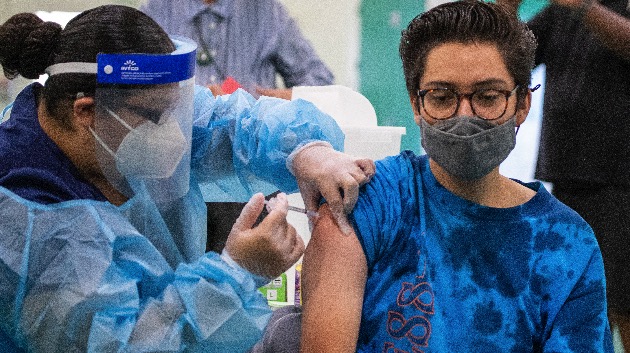
(LOS ANGELES) — The Los Angeles public school district’s board of education has approved delaying enforcement of its COVID-19 vaccine mandate to the fall, as thousands of students at the nation’s second-largest school district remain non-compliant.

Under the mandate, which the board passed in September, all students ages 12 and up were required to be fully vaccinated by Jan. 10, 2022, to be allowed on school campuses for the second semester, unless they had an approved exemption or deadline extension.

Currently, over 87% of eligible students are in compliance with the mandate, Los Angeles Unified Interim Superintendent Megan Reilly said during Tuesday’s board meeting, calling it a “major milestone.”

Some 27,000 students are not in compliance with the mandate, as it’s too late to complete the two-dose vaccine series to be fully vaccinated by the January deadline.

Under Reilly’s proposal, the transfer of non-compliant students to the remote program will be delayed until the beginning of the fall 2022 semester.

“It allows more time for families to get this vaccine,” Reilly said ahead of the board’s vote. “This effort remains a top priority for Los Angeles Unified. We will continue to engage students and families around the importance of vaccines and the deadlines to participate for in-person learning. We will improve vaccination rates for eligible students and we will continue to provide a consistent, stable learning environment and access to vital resources.”

Most board members said they were reluctant to vote in favor of delaying enforcement of the vaccine mandate, though did so to limit disruption to in-person learning in the middle of the school year.

“I will support this because it keeps our promise to the vaccinated students in our district that we would not disrupt their education needlessly,” board member Jackie Goldberg said. “To be clear, we are not moving one inch from the mandate. Not one inch, not a centimeter. We are simply saying you now have more time to do it because we want all of you to be vaccinated and safe. And also we do not want your not being vaccinated to disrupt the education of those who have complied.”

Board president Kelly Gonez said voting in favor of the delay “is not a decision I am happy to make.”

“But like my fellow board members, I am very enthusiastic about our vaccination progress,” she continued. “I believe that this board unequivocally made the right decision in September, and it has made our schools safer, it has made our communities as a whole safer and it has saved lives.”

The vote came a day after a Los Angeles Superior Court judge denied two parent groups’ bid for a preliminary injunction against the student vaccine mandate, according to the Los Angeles Daily News.

The school district had also mandated that staff get both doses of the COVID-19 vaccine by Nov. 15, barring exemptions due to disability or religious belief.

During its meeting Tuesday, board members also approved extending the district’s student and employee vaccination policy to all district-authorized charter schools to maintain a consistent vaccine policy.

The school district is one of the few nationwide that has implemented vaccine mandates. The policies came ahead of California Gov. Gavin Newsom’s announcement in October that the state will require COVID-19 vaccines for all school children ages 12-17 once the Federal Drug Administration grants full approval. The state policy includes personal exemptions, not just religious or medical.

“So there’s plenty of latitude for families to make decisions,” Newsom told Good Morning America last week. “LA is slightly different, and we’re going to obviously have to work through that with that district.”

“You have to work to accommodate, and I have all the confidence in the world the school board will work to accommodate,” he added.

Copyright © 2021, ABC Audio. All rights reserved.

Kroger ends COVID sick pay benefits for unvaccinated employees

Kroger ends COVID sick pay benefits for unvaccinated employees
Scott Olson/Getty Images

(NEW YORK) — Kroger, one of the largest employers in the U.S. with 500,000 workers, announced that it will pull paid emergency COVID leave for unvaccinated employees.

The grocery chain is also adding a $50 monthly insurance surcharge for salaried associates who are unvaccinated.

The new rules will take effect starting Jan. 1, 2022.

Kroger said this is a necessary step to protect its employees and customers.

“We have been navigating the COVID-19 pandemic for almost two years and in line with our values, the safety of our associates and customers has remained our top priority,” Kroger said in a statement about the policy shift.

The supermarket chain said employees who are fully vaccinated will still be entitled to paid leave and the new policy does not apply to workers with medical or religious accommodations.

Kroger will continue to pay $100 to workers who choose to get vaccinated.

Copyright © 2021, ABC Audio. All rights reserved.
Congressional Democrats raise debt limit by $2.5 trillion, averting financial calamity

(WASHINGTON) — Late Tuesday night, the House voted to raise the debt ceiling by $2.5 trillion — a move that should stave off the first-ever default.

All Democrats in both the Senate and House voted to raise the debt limit. One Republican, Rep. Adam Kinzinger, from Illinois, joined them.

The Senate cleared the vote earlier Tuesday with zero GOP support.

The bill now heads to President Joe Biden’s desk to be signed into law.

Once signed by the president, the legislation will have prevented a U.S. default that could have halted Social Security and veterans’ payments, hiked interest on mortgages and loans and disrupted the global economy.

The Treasury Department predicted that the U.S. would be unable to pay its bills come Wednesday.

Congressional action was the last step in a months-long process aimed at raising the federal borrowing limit.

In October, Republican and Democratic leadership locked horns over the spending cap. Though both parties acknowledged the necessity of raising the debt limit, Republicans argued that Democrats ought to raise the limit on their own — wrongly claiming they needed to offset the cost of Biden’s yet-to-be passed $1.75 trillion social spending bill.

Democrats, who helped raise the debt limit multiple times under the Trump administration, insisted it be a bipartisan effort since the debt limit had to be raised to cover past spending.

The October dispute ended in the GOP blinking, with Republicans giving Democrats the votes necessary for a short-term raise to the debt limit, but vowing they’d be less cooperative in the winter.

Last week, however, party leaders announced an agreement on a two-step process to raise the debt limit. Republicans ultimately provided 10 votes to permit a one-time rule change altering the number of votes necessary to pass the debt-limit hike and clearing a path for Democrats to pass the legislation without a single GOP backer.

The reached agreement required Democrats to name a specific amount they want to raise the debt limit by. They settled on $2.5 trillion — enough to prevent the government from defaulting through early 2023, Majority Leader Chuck Schumer said Tuesday.

Copyright © 2021, ABC Audio. All rights reserved.

COVID deaths for pregnant people spiked during delta: Data

(ATLANTA) — As the delta variant of COVID-19 spread across the United States this summer, the virus appeared to take a particular toll on unvaccinated pregnant people, with deaths dramatically increasing in the summer months.

The number of pregnant people who died of COVID-19 spiked sharply in August and September, with more than two dozen deaths recorded in each of those months, according to data released this week by the U.S. Centers for Disease Control and Prevention (CDC).

More than 40% of the 248 deaths among pregnant people since the start of the pandemic occurred since August, the data shows.

The number of pregnant people who contracted COVID-19 also increased sharply over the summer months, according to CDC data, reaching numbers of cases not seen since before the vaccine was made widely available earlier this year.

Now, as the omicron variant spreads across the U.S., with what is believed to be a high degree of transmissibility, the director of the CDC said she is “very concerned” about those who remain unvaccinated.

“I can tell you, when I hear about a pregnant woman in the community who is not vaccinated, I personally pick up the phone and talk to them,” CDC Director Dr. Rochelle Walensky told ABC News’ chief medical correspondent, Dr. Jennifer Ashton, in a Dec. 8 interview.

“It’s just shocking,” she said of the number of pregnant people who died specifically in August, one month after the delta variant became the predominant variant in the U.S.

Risks to unvaccinated people and the fetus

More than 25,000 pregnant people have been hospitalized since the start of the pandemic, and more than 150,000 cases of COVID-19 have been confirmed in pregnant people, according to the CDC.

Pregnancy is included in the CDC’s list of underlying medical conditions that make a person more likely to experience severe illness from COVID-19.

The virus causes a two-fold risk of admission into intensive care and a 70% increased risk of death for pregnant people, and increases the risk of a stillbirth or delivering preterm, or earlier than 37 weeks, according to the CDC.

COVID-19 is especially dangerous in pregnant people because their immune systems are already less active as they are supporting their growing fetus. For the same reason, their hearts and kidneys are working harder, Dr. Laura Vricella, a maternal fetal medicine physician at Mercy Hospital in St. Louis, told ABC News in August, as her hospital and others experienced a spike in pregnant patients with COVID-19.

Pregnant people must also keep their oxygen levels higher in general to support their fetus, which can be a herculean task to do when COVID-19 is in the body, according to Vricella.

And in addition to pregnant people with COVID-19 being more likely to deliver prematurely, Vricella said her hospital also saw more COVID-positive pregnant patients deliver stillbirths, even with mild COVID cases.

“COVID-19 begins as a respiratory illness, but can affect the entire body and also seems to increase the risk of thrombosis or blood clots,” she said. “We suspect that this decreased oxygen to the fetus may be responsible for the stillbirths that we are seeing, though we need further research.”

Vaccination rate remains low

In September, the CDC issued an “urgent health advisory” calling on pregnant people to prioritize getting vaccinated against the virus.

As of Dec. 4, the most recent data available, the vaccination rate among pregnant people remains below 40%, compared to nearly 61% of the general population, according to the CDC.

The vaccination rate for Black pregnant people, who already face disproportionate health risks in pregnancy and postpartum, is even lower, at just over 20%, CDC data shows.

“This is one where I feel like we have to do more,” Walensky said of the low vaccination rate overall among pregnant people. “We have to do better.”

“The vaccines are safe, they are effective and they are even more important in pregnant women,” she said.

In addition to the CDC, the nation’s two leading health organizations focused on the care of pregnant people — American College of Obstetricians and Gynecologists (ACOG) and the Society for Maternal-Fetal Medicine (SMFM) — have issued guidelines calling on all pregnant people to get vaccinated against COVID-19.

Vaccines shown to be safe

Though pregnant people were not recruited for the initial clinical trials of the COVID-19 vaccines, data over the past several months, since vaccines have been widely available, has shown them to be safe for pregnant people.

In its health advisory urging pregnant people to get vaccinated, the CDC pointed specifically to new data showing the vaccines did not increase the risk of miscarriage. The vaccines are also not believed to have any “significant impact” on fertility.

Both the Pfizer and Moderna vaccines use mRNA technology, which does not enter the nucleus of the cells and doesn’t alter the human DNA. Instead, it sends a genetic instruction manual that prompts cells to create proteins that look like the virus, as a way for the body to learn and develop defenses against future infection.

They are the first mRNA vaccines, which are theoretically safe during pregnancy because they do not contain a live virus.

Vaccine experts interviewed by ABC News said although pregnant women are advised against getting live-attenuated virus vaccines, such as the one for measles, mumps and rubella, because they can pose a theoretical risk of infection to the fetus, the Johnson & Johnson vaccine doesn’t contain live viruses and should be safe. Instead the Johnson and Johnson vaccine uses inactive viruses.

Health experts said that with or without the vaccine, pregnant people need to continue to remain on high alert when it comes to COVID-19 by following safety protocols, including mask wearing, social distancing and hand washing.

Copyright © 2021, ABC Audio. All rights reserved.