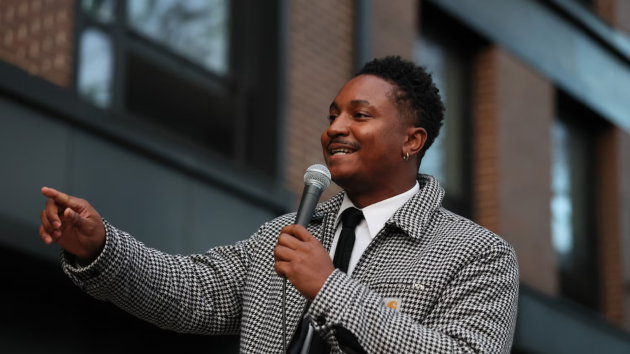
Councilmember Chi Osse speaks as Starbucks workers go on strike outside a Starbucks store, Nov. 13, 2025, in Brooklyn, New York. Michael M. Santiago/Getty Images
(NEW YORK) — New York City councilmember Chi Ossé appeared to confirm he would challenge House Democratic leader Rep. Hakeem Jeffries for his seat representing New York’s 8th congressional district in an X post on Monday.
Ossé responded to another post calling him out for saying last month that he was not going to run. This comes after Ossé’s name appeared on FEC filings launching a bid for NY-08 earlier Monday.
“How can Brooklyn voters take you at your word when just last month you said this? ‘It would take a very dire situation in order for me to even consider spending the rest of my 20s in DC. Just to be clear, I’m not running for Congress,'” a post said.
Ossé responded: “Seems like we’re in a dire situation.”
Ossé told Axios that he is “currently exploring” the challenge and that the filings are legitimate.
“The Democratic Party’s leadership is not only failing to effectively fight back against Donald Trump, they have also failed to deliver a vision that we can all believe in,” Ossé, who recently joined the Democratic Socialists of America, said in a statement to Axios.
“These failures are some of the many reasons why I am currently exploring a potential run for New York’s 8th Congressional District,” he told the outlet.
Ossé is floating a challenge without the complete and total blessing from progressives. New York City Mayor-elect Zohran Mamdani’s team has reportedly been attempting to discourage Ossé from running, and Adam Green, co-founder of the Progressive Change Campaign Committee, said in a statement that “it is not the right moment to launch a primary challenge to Hakeem Jeffries.”
Asked about Ossé’s FEC filings in a press conference on the Hill Monday afternoon, Jeffries appeared to welcome the challenge, saying, “Come on in, the water is warm.”
A spokesperson for Jeffries said in a statement to ABC News that they “welcome this primary challenge” from Ossé and “look forward to a rigorous debate.”
“Leader Jeffries is fighting hard to lower the high cost of living, address the Republican healthcare crisis, combat corruption and win back control of the House for the good of the country. We welcome this primary challenge and look forward to a rigorous debate about the type of serious leadership required to deliver for the people of Brooklyn and the nation,” said Justin Chermol, Jeffries’ spokesperson.
Ossé, 27, made waves as New York’s first Gen Z city councilmember when he was sworn into office in 2022 and led the charge on the FARE Act, which was passed last year and forces landlords to pay broker’s fees instead of tenants.
Ossé left the New York City chapter of the Democratic Socialists of America in 2020 “very shortly after signing up,” saying on X that he “wasn’t aligned with the organization itself.” He later rejoined NYC-DSA in 2025.
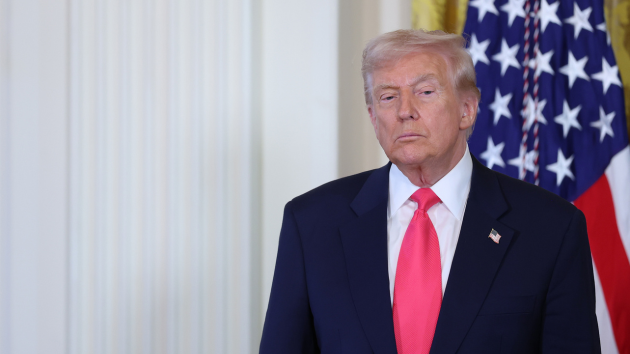
U.S. President Donald Trump listens as first lady Melania Trump speaks at a signing ceremony for the “Fostering the Future” executive order in the East Room of the White House on November 13, 2025, in Washington, DC. (Photo by Anna Moneymaker/Getty Images)
(WASHINGTON) — President Donald Trump on Monday said he would sign the bill to compel the Justice Department to release all files relating sex offender Jeffrey Epstein if it comes to his desk.
“I’m all for it,” he said as he took reporter questions during an event in the Oval Office, contending the controversy is deflecting from his administration successes.
Pressed again moments later if he would sign the bill that the House is set to take up Tuesday, Trump replied: “Sure I would.”
“Let the Senate look at it. Let anybody look at it. But don’t talk about it too much, because, honestly, I don’t want it to take away from us. It’s really a Democrat problem,” he said.
This is a developing story. Please check back for updates.
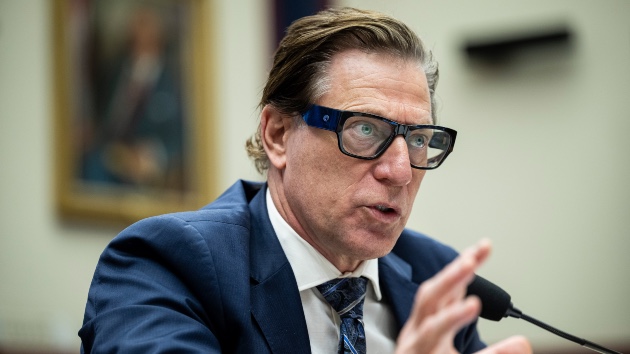
David Richardson, acting administrator of the Federal Emergency Management Agency (FEMA), during a House Transportation and Infrastructure Subcommittee hearing in Washington, DC, US, on Wednesday, July 23, 2025. (Photographer: Graeme Sloan/Bloomberg via Getty Images)
(WASHINGTON) —Acting Federal Emergency Management Agency David Richardson resigned on Monday after six months on the job.
Richardson, who was temporarily installed in May after former acting Administrator Cameron Hamilton was fired by Secretary of Homeland Security Kristi Noem a day after telling Congress the agency should not be disbanded, putting him at odds with President Donald Trump’s suggestions that FEMA be downsized or dissolved.
Richardson was also in charge of the department’s countering Weapons of Mass Destruction office.
In an exclusive statement to ABC News, Richardson said that he stepped up when others didn’t weeks before the start of hurricane season.
“I agreed to be the acting administrator through hurricane season when others wouldn’t. Hurricane season ends on 1 December. Since the danger has largely passed, I can now leave for other opportunities,” Richardson said. “Many were asked. One raised his hand and said, ‘I’ll do it.’ I knew hurricane season was three weeks away and time was of the essence. I didn’t hesitate. It was the same in the 2006 during the worst days of Iraq and the streets of Ramadi. Nobody wanted to train and fight alongside the Iraqis. I said, ‘I’ll do it.'”
The Department of Homeland Security confirmed that Richardson resigned as FEMA administrator and said that FEMA Chief of Staff Karen Evans will step into the role on Dec. 1.
“The Federal Emergency Management Agency (FEMA) and the Department of Homeland Security (DHS) extend their sincere appreciation to the Senior Official Performing the Duties of the Administrator, David Richardson, for his dedicated service and wish him continued success in his return to the private sector,” a DHS spokesperson said. “Mr. Richardson led FEMA through the 2025 hurricane season, delivering historic funding to North Carolina, Texas, Florida, New Mexico and Alaska, and overseeing a comprehensive review that identified and eliminated serious governmental waste and inefficiency, while refocusing the agency to deliver swift resources to Americans in crisis.”
Richardson has faced criticism during his tenure at the top of the agency.
In a House Transportation Committee hearing following the deadly flooding in Texas in July, Democrats panned Richardson’s and FEMA’s response.
“You’re the leader, but you did not lead, as you are required to by federal law. But worse, you seem uninterested to learn what went wrong and how to respond,” Rep. Greg Stanton, D-Ariz., said.
Richardson was on vacation with his two sons during the flooding but he testified that he immediately coordinated a response with Texas officials, the White House and others from his truck.
Sources close to Richardson contend that he was available during the disaster. A source said he was on the phone from the moment the floods struck while on vacation and drove back to Washington as soon as he could.
In June, shortly after hurricane season began at the beginning of the month, Richardson told staff in an all-hands that he was unaware it had started, according to sources familiar with the meeting.
It was unclear if Richardson was joking, but a Department of Homeland Security spokesperson argued he was.
When asked by reporters during a White House press briefing whether Trump was “still comfortable” with Richardson after his remarks, press secretary Karoline Leavitt dismissed concerns and said FEMA is taking hurricane season “seriously, contrary to some of the reporting we have seen based on jokes that were made and leaks from meetings.”
Richardson’s comments followed an internal review indicating FEMA was “not ready” for the 2025 hurricane season in mid-May.
The DHS spokesperson denied FEMA is unprepared, saying “Despite meanspirited attempts to falsely frame a joke as policy, there is no uncertainty about what FEMA will be doing this Hurricane Season.”
“FEMA is laser-focused on disaster response and protecting the American people,” the spokesperson added.
Senate Minority Leader Chuck Schumer, D-N.Y., slammed Richardson, posting on X that he is “unaware of why he hasn’t been fired yet.”
“Trump’s FEMA chief is incompetent,” Sen. Ed Markey, D-Mass., added. “People will die.”
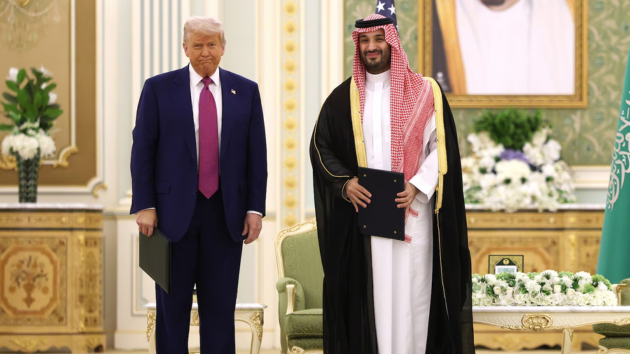
xPresident Donald Trump and Saudi Crown Prince Mohammed bin Salman attend a signing ceremony at the Saudi Royal Court, May 13, 2025, in Riyadh, Saudi Arabia. (Win Mcnamee/Getty Images)
(WASHINGTON) — Tuesday marks the first time His Royal Highness Prince Mohammed bin Salman, the crown prince and prime minister of Saudi Arabia, steps foot in the U.S. since 2018, following the death of Saudi critic Jamal Khashoggi by Saudi agents in Istanbul, which caused global outrage.
The crown prince denied ordering the operation but ultimately acknowledged responsibility as the kingdom’s de facto ruler.
Now more than seven years later, the Saudi leader has business on his mind as he seeks to deepen ties with the U.S. through cooperation on oil and security, while also expanding the regime’s global outreach in finance, artificial intelligence and technology. Saudi Arabia notably boasts the world’s largest economy and maintains its lead as the world’s top oil producer.
The crown prince will meet with President Donald Trump at the White House and he’ll be invited in with pomp and circumstance. Saudi flags were seen draped in front of the White House, next to American flags, ahead of his visit.
Trump is also hosting a dinner for the Saudi leader on Tuesday night.
A focus on defense and business
The prince’s trip to the U.S. is being billed as an “official working visit,” and is designed to follow up and advance on Trump’s May appearance in Riyadh — the first official visit of Trump’s second term in office.
“A lot of the financial and economic and artificial intelligence deals that they announced that were very ambiguous six months ago, I think we might start to see some teeth from them this time around and hopefully get a little bit more clarity on what those deals actually are,” said Elizabeth Dent, a senior fellow at the Washington Institute for Near East Policy and former director for the Gulf and Arabian Peninsula in the office of the Secretary of Defense at the Pentagon.
During that May visit, Trump announced a $142 billion arms package with the Saudis, which according to a White House fact sheet was the “the largest defense cooperation agreement” Washington has ever done.
The agreement covers deals with more than a dozen U.S. defense companies in areas including air and missile defense, air force and space advancement, maritime security and communications, the fact sheet said.
The kingdom in turn announced a $600 billion investment in the U.S. spanning multiple sectors, including energy security, defense, technology, global infrastructure and critical minerals.
Some of the other notable deals announced under the $600 billion pledge included investments in: U.S.-based artificial intelligence data centers and energy infrastructure; advanced technologies; Saudi infrastructure projects; U.S. energy equipment and commercial aircraft; the U.S. health care supply chain; and U.S. sports industries.
Trump confirmed on Monday during an event in the Oval Office that he plans to sell F-35s to Saudi Arabia as part of a weapons deal, which experts say would mark the first time those jets have been sold to an Arab military.
“There’s a whole host of issues that encompass this. Part of it is that Israel has to be able to maintain their congressionally-mandated qualitative military edge, which Congress does determine that,” Dent said. “And so, if the deal goes forward, I think we just have to see how they’re going to figure out the best way to ensure Israel can maintain that, as the only country in the Middle East that currently has F-35s.”
“I think the Israelis are probably pretty uncomfortable with these rumors swirling around without normalization in sight,” Dent added.
Saudis insist on ‘credible pathway’ to Palestinian statehood
The Saudi leader is seeking security guarantees from the U.S. amid turbulence in the Middle East. The security agreement with the U.S. has been in a development stage and has not yet been formalized, but the kingdom is seeking to deepen military and security ties between the two countries.
The security guarantees are viewed by some as part of a larger regional “megadeal” involving normalization with Israel, something Trump will surely push for, even as the Saudi kingdom has refused to do so under the current Israeli leadership.
Trump told reporters on Air Force One on Friday that he would discuss the issue with the crown prince.
“I hope that Saudi Arabia will be going into the Abraham Accords fairly shortly,” he said.
Earlier this year, Trump signed an unprecedented defense pact with Qatar via executive order that recognizes the “enduring alliance” between the U.S. and Qatar and provides Qatar an explicit security guarantee in the event of “external attack.”
Many analysts have said they believe the Saudis are looking for a similar defense pact with the U.S.
“I think it’ll be kind of similar to Qatar’s, where it basically just says it will consider any sort of threat or attack on Saudi Arabia to be an attack on the United States, and then the United States will respond appropriately, which could range from political to military options. So, I think that the administration will make sure to give themselves that decision space,” Dent said. “There’s a lot to work through here. Obviously, I think a lot of it will be about expectation management.”
The kingdom is notably invested in implementing the president’s 20-point Gaza peace plan. The kingdom has previously stated it wants to see the emergence of a credible path toward an independent and a free Palestine as a condition for supporting the demilitarization of Hamas and reconstruction of Gaza.
But Israel has put up a roadblock to Palestinian statehood, which will undoubtedly cause angst among Arab regional partners who are pushing for sustained peace in Gaza.
“Our opposition to a Palestinian state in any territory has not changed,” Israeli Prime Minister Benjamin Netanyahu said Sunday during his weekly cabinet meeting. “Gaza will be demilitarized and Hamas will be disarmed, the easy way or the hard way.”
Netanyahu has long opposed a Palestinian state, saying in recent months that its creation would only reward Hamas and endanger Israel’s security.
ABC News’ Christopher Boccia contributed to this report.
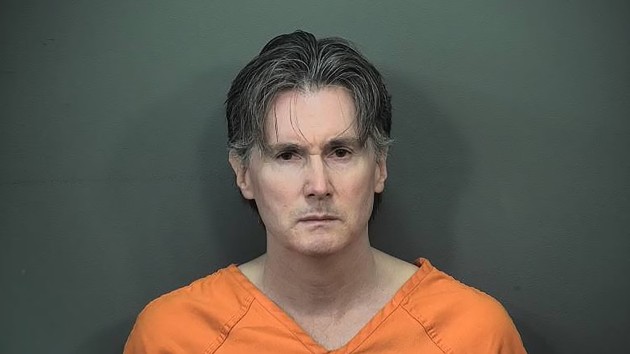
The booking photo for Curt Andersen. Boone County, Indiana Sheriff’s Office
(WHITESTOWN, Ind.) — An Indiana man has been charged with voluntary manslaughter for fatally shooting a cleaning woman who mistakenly went to the wrong home, prosecutors announced Monday, nearly two weeks after the mother of four was killed.
The suspect, Curt Andersen, has been booked into the Boone County jail on a no bond hold and will appear in court sometime this week, prosecutors said.
The Boone County prosecutor, Kent Eastwood, said the decision to file the charge follows a “comprehensive examination,” in which his office determined Andersen’s actions did not fall under the legal protections provided by the Indiana Stand Your Ground law.
“It’s our contention that the person did not have a reasonable belief that that type of force was necessary, given all the facts that he had at that time,” Eastwood said during a press briefing on Monday.
The shooting occurred the morning of Nov. 5 in a subdivision of Whitestown, located approximately 20 miles northwest of Indianapolis, police said.
Officers responding to a 911 call reporting a possible home invasion shortly before 7 a.m. found the woman dead on the front porch of the residence with a gunshot wound, Whitestown police said.
The gun had been fired from inside by a resident of the home, police said.
Police later determined the woman was part of a cleaning crew that had mistakenly arrived at the wrong address, and that “the facts gathered do not support” that a home invasion occurred.
The Boone County Coroner’s Office identified the shooting victim as 32-year-old Maria Florinda Rios Perez de Velasquez of Indianapolis. She died from a gunshot wound to the head, the coroner’s office said.
Eastwood said his office started a review of the case on Nov. 10 following a “thorough and professional” police investigation, which included taped witness statements and crime scene diagrams.
The prosecutor said he has received words of support from people who said they were praying for him “because we know you have a difficult decision to make.”
“Honestly, it wasn’t,” he said. “I hate to sound cavalier about this, but it wasn’t a hard decision.”
Velasquez’s husband told Indianapolis ABC affiliate WRTV that they had been cleaning homes for seven months and he was with her when she was shot.
“I never thought it was a shot, but I realized when my wife took two steps back, she looked like she’d been hit in the head,” her husband, Mauricio Velasquez, told WRTV in Spanish.
“She fell into my arms, and I saw the blood. It went everywhere,” he told the station.
They have four children, the youngest 11 months old, according to WRTV.
“This is a tragedy for everyone involved, and our hearts and prayers are with her family as they navigate this difficult time,” Eastwood said.
The prosecutor said this type of case is “very rare” in Boone County, and chastised what he called “false and misleading information” circulating since the shooting, including the claim the person who committed the crime was a police officer.
“This must stop immediately,” he said. “It does not help the process. It does not help this case. It undermines the integrity of the judicial process. It spreads confusion and it harms both the victim’s family and the accused’s right to a fair trial.”
Protesters gather at First Ward Park for the ‘No Border Patrol In Charlotte’ rally to raise their voices for the immigrant community and against ICE raids and Border Patrol activity in Charlotte, North Carolina, US on November 15, 2025. (Peter Zay/Anadolu via Getty Images)
(CHARLOTTE, N.C.) — Federal agents fanned out across North Carolina’s largest city over the weekend, detaining more than 130 people in the first 48 hours of its immigration crackdown that has prompted protests and resistance from local leaders.
Greg Bovino, commander-at-large spearheading the crackdown for the U.S. Customs and Border Protection (CBP), vowed in a social media post on Sunday that his agents would “hit Charlotte like a storm.”
On Monday, a Department of Homeland Security (DHS) spokesperson told ABC News that those arrested in Charlotte over the weekend by CBP and U.S. Immigration and Customs Enforcement (ICE) allegedly “have all broken the immigration laws of our country.”
“Criminal records of those arrested include known gang membership, aggravated assault, possession of a dangerous weapon, felony larceny, simple assault, hit and run, possession of stolen goods, shoplifting, DUI, DWI, and illegal re-entry after prior deportation, a felony,” a DHS spokesperson said. “We will not stop enforcing the laws of our nation until every criminal illegal alien is arrested and removed from our country.”
Of the more than 130 people taken into custody in Charlotte over the weekend, 81 people were arrested in the first five hours of operation “Charlotte’s Web” on Saturday, according to Bovino.
Charlotte is the latest city targeted in a nationwide Trump administration immigration enforcement blitz that has included Los Angeles and Chicago — which, like Charlotte, are Sanctuary Cities that are run by a Democratic mayors.
Federal agents are expected to stay in Charlotte until Friday, according to preliminary information from federal authorities. By the end of the week, about 200 agents are expected to be re-deployed to New Orleans to begin “Operation Catahoula Crunch” in the Big Easy, according to multiple law enforcement sources.
In a joint statement released on Saturday, Charlotte and Mecklenburg County elected officials, including Charlotte Mayor Vi Lyles, slammed the CBP operations, saying they are “causing unnecessary fear and uncertainty in our community.”
“It is critical for all residents to feel secure in our community and know they can live their lives without being fearful while walking down the street, going to school, work or the grocery store.”
In advance of the CBP arriving in Charlotte, North Carolina Gov. Josh Stein, a Democrat, released a statement, asking residents to report any “inappropriate behavior” they witness from federal agents.
“If you see any inappropriate behavior, use your phones to record and notify local law enforcement, who will continue to keep our communities safe after these federal agents leave,” Stein said.
In advance of the CBP arriving in Charlotte, North Carolina Gov. Josh Stein, a Democrat, released a statement, asking residents to report any “inappropriate behavior” they witness from federal agents.
“If you see any inappropriate behavior, use your phones to record and notify local law enforcement, who will continue to keep our communities safe after these federal agents leave,” Stein said.
Over the weekend, eyewitnesses filmed and photographed several incidents in which masked agents arrested residents in Charlotte. The footage captured CPB agents stopping and pulling people from vehicles, and rounding up others at stores and parking lots.
Even naturalized U.S. citizens like 46-year-old Willy Aceituno were not spared from getting snared in “Charlotte’s Web.”
Aceituno told ABC affiliate station WSOC in Charlotte that he was stopped twice within five minutes by federal agents on Saturday. He said the second time he was stopped, agents broke his window and forced him out of his vehicle. He said he told them he was a U.S. citizen.
“They asked me, ‘Hey, give me your papers.’ I say, ‘I’m scared because I give [them to] you five minutes ago’,” said Aceituno, adding that he was released after he showed agents documents proving his citizenship.
The Department of Homeland Security told ABC News that Aceituno was stopped because he was interfering with their operations, an allegation Aceituno denied.
A DHS spokesperson made no apologies for the federal crackdown in Charlotte.
“We are surging DHS law enforcement to Charlotte to ensure Americans are safe and public safety threats are removed,” the DHS spokesperson said in a statement. “There have been too many victims of criminal illegal aliens and President [Donald] Trump and Secretary [Kristi] Noem will step up to protect Americans when sanctuary politicians won’t.”
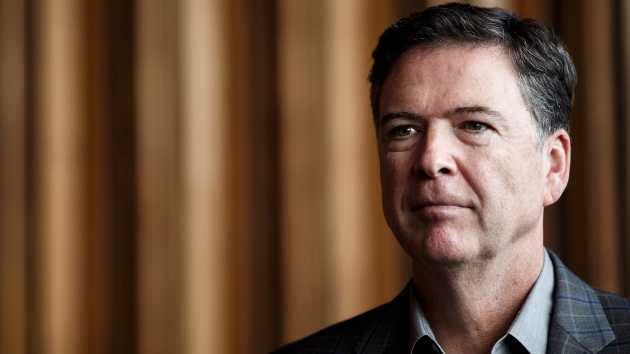
Former FBI Director James Comey talks backstage before a panel discussion about his book “A Higher Loyalty,” June 19, 2018, in Berlin. (Carsten Koall/Getty Images)
(NEW YORK) — A magistrate judge expressed alarm Monday at what he called “a disturbing pattern of profound investigative missteps” that may have irreversibly tainted the prosecution of James Comey and violated the former FBI director’s constitutional rights, in a scathing opinion granting Comey’s attorneys access to a vast trove of grand jury evidence.
Judge William Fitzpatrick ordered the Trump administration to turn over a full transcript and recording of the September grand jury presentation by Trump-appointed U.S. Attorney Lindsey Halligan, which he said included instances where she may have made “fundamental misstatements of the law that could compromise the integrity of the grand jury process.”
“The Court recognizes that the relief sought by the defense is rarely granted,” Fitzpatrick said in a ruling Monday. “However, the record points to a disturbing pattern of profound investigative missteps, missteps that led an FBI agent and a prosecutor to potentially undermine the integrity of the grand jury proceeding.”
Comey pleaded not guilty in October to one count of false statements and one count of obstruction of a congressional proceeding related to his testimony before the Senate Judiciary Committee in 2020, amid what critics call Trump’s campaign of retribution against his perceived political foes.
Halligan, Trump’s handpicked U.S. attorney for the Eastern District of Virginia, sought the indictment of Comey over the objections of career prosecutors after Trump forced out previous U.S. attorney Erik Siebert who sources said had resisted bringing cases against Comey and New York Attorney General Letitia James. Halligan, who had no experience as a prosecutor, sought the indictment after Trump, in a social media post, called on Attorney General Pam Bondi to act “NOW!!!” to prosecute Comey and New York Attorney General Letitia James.
Fitzpatrick, in Monday’s ruling, wrote, “Having been requested by the government to review the grand jury materials, the Court has identified two statements by the prosecutor to the grand jurors that on their face appear to be fundamental misstatements of the law that could compromise the integrity of the grand jury process.”
Separately, the judge raised concerns that based on materials handed over by the government, it appears the indictment that Halligan ultimately returned in open court may not have been presented or deliberated on by the grand jury, which initially rejected one of the three charges she had sought.
“If this procedure did not take place, then the Court is in uncharted legal territory in that the indictment returned in open court was not the same charging document presented to and deliberated upon by the grand jury,” Fitzpatrick said. “Either way, this unusual series of events, still not fully explained by the prosecutor’s declaration, calls into question the presumption of regularity generally associated with grand jury proceedings, and provides another genuine issue the defense may raise to challenge the manner in which the government obtained the indictment.”
Based on his outlined concerns about potential government misconduct, Fitzpatrick ordered the government to provide all of the grand jury materials to Comey’s attorneys by 5 p.m. ET Monday.
David Richardson, acting administrator of the Federal Emergency Management Agency (FEMA), during a House Transportation and Infrastructure Subcommittee hearing in Washington, DC, US, on Wednesday, July 23, 2025. (Photographer: Graeme Sloan/Bloomberg via Getty Images)
(WASHINGTON) — Acting FEMA Administrator David Richardson resigned on Monday, according to multiple sources familiar with the situation.
Richardson, who was temporarily installed in May after former Acting Administrator Cam Hamilton was essentially fired by Secretary of Homeland Security Kristi Noem.
Richardson was also in charge of the department’s countering Weapons of Mass Destruction office. It is unclear if he will still stay on in that role.
It is unclear who will lead the disaster management agency.
Richardson told staff in an all-hands meeting in June that he was unaware hurricane season had started, according to sources familiar with the meeting.
It was unclear if Richardson was joking, but a Department of Homeland Security spokesperson argued he was.
When asked by reporters during a White House press briefing whether President Donald Trump was “still comfortable” with Richardson after his remarks, press secretary Karoline Leavitt dismissed concerns and said FEMA is taking hurricane season “seriously, contrary to some of the reporting we have seen based on jokes that were made and leaks from meetings.”
Richardson’s comments followed an internal review indicating FEMA was “not ready” for the 2025 hurricane season in mid-May.
The DHS spokesperson denied FEMA is unprepared, saying “Despite meanspirited attempts to falsely frame a joke as policy, there is no uncertainty about what FEMA will be doing this Hurricane Season.”
“FEMA is laser-focused on disaster response and protecting the American people,” the spokesperson added.
Senate Minority Leader Chuck Schumer, D-N.Y., slammed Richardson, posting on X that he is “unaware of why he hasn’t been fired yet.”
“Trump’s FEMA chief is incompetent,” Sen. Ed Markey, D-Mass., added. “People will die.”
This is a developing story. Please check back for updates.
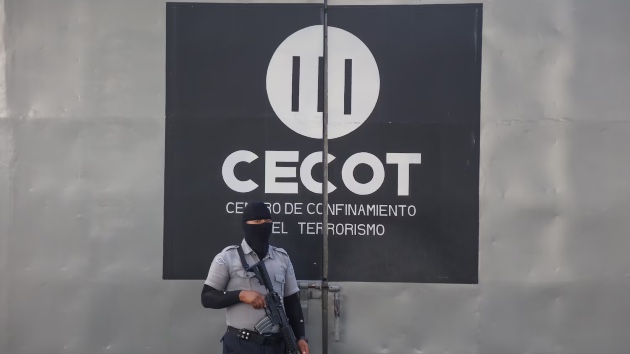
A prison officer patrols in front of a gate at the Terrorism Confinement Center (CECOT) in Tecoluca, in San Vicente, El Salvador, April 4, 2025. (Anadolu via Getty Images)
(WASHINGTON) — A federal appeals court on Friday denied a request to reconsider an earlier decision that prevented a federal judge from investigating whether Trump administration officials acted in contempt for allegedly violating a court order when it deported hundreds of alleged gang members to El Salvador under the Alien Enemies Act in March.
The decision will allow Judge James Boasberg to attempt to proceed with the early stages of the contempt proceedings, including requesting evidence from the Trump administration about the decision not to turn around a plane bound for El Salvador after he ordered it be returned.
In a statement authored by three judges in the majority, the court described Boasberg’s actions as “a measured and essential response to what it reasonably perceived as shocking Executive Branch conduct.”
“The district court has every ability to set a new deadline for production of the information it sought regarding the probable contempt it identified or to proceed otherwise within his sound discretion,” the ruling said. “For its part, the government will have the full opportunity at the appropriate time to raise any defenses it may have. If it is dissatisfied with any appealable order the district court may enter, it will have the opportunity to seek review through the ordinary process. That is how our system of justice is designed to work.”
On Monday, Boasberg said the parties will discuss at a hearing on Wednesday how to proceed with the court’s contempt inquiry.
In the time between Boasberg’s original order and Friday’s decision, a whistleblower came forward to allege the Trump administration deliberately planned to defy Boasberg’s order. That new context could inform how Boasberg proceeds with the case.
“The facts the district court recounted present grave rule-of-law concerns. Obedience to court orders is vital to the ability of the judiciary to fulfill its constitutionally appointed role. Judicial orders are not suggestions; they are binding commands that the Executive Branch, no less than any other party, must obey,” the ruling said.
Lee Gelernt, an attorney for the American Civil Liberties Union, told ABC News the ruling will allow the group to proceed before Boasberg.
“And now we have more evidence that the government deliberately violated the court’s order not to hand over the Venezuelan men to El Salvador,” Gelernt said.
The Trump administration in March invoked the Alien Enemies Act — an 18th-century wartime authority used to remove noncitizens with little-to-no due process — to deport two planeloads of alleged migrant gang members to the CECOT mega-prison in El Salvador by arguing that the Venezuelan gang Tren de Aragua is a “hybrid criminal state” that is invading the United States.
Boasberg issued a temporary restraining order and ordered that the planes be turned around, but Justice Department attorneys said his oral instructions directing the flight to be returned were defective, and the deportations proceeded as planned.
Boasberg subsequently sought contempt proceedings against the government for deliberately defying his order.
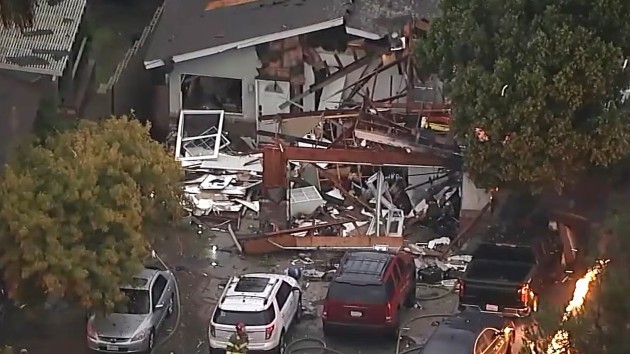
Chino Valley Fire responded to an apparent explosion on the 4200 block of Sierra Vista Dr., in Chino Hills, Calif., Nov. 16, 2025. KABC
(CHINO HILLS, Calif.) — A suspected gas leak caused a home in California to explode, injuring nine people, officials said. An investigation is underway.
The explosion also forced an evacuation of nearby homes in the Chino Hills neighborhood Sunday night, according to authorities.
Jenny Smith, a spokesperson for the San Bernardino County Sheriff’s Department, told ABC News that the explosion was caused by a possible gas leak.
“Deputies found a residence, in the 42000 block of Sierra Vista Drive, that had caught fire from a possible gas leak. There was damage to surrounding homes due to the incident. The fire department, SoCal Edison and SoCal Gas, were called and arrived on scene,” Smith said in a statement.
Smith added that none of the injuries sustained by the victims appear to be life threatening.
“The initial report was that nine people who were in the house were transported to a local hospital. No injuries appeared to be life threatening. The cause of the fire is still under investigation,” she added.
Members of the Chino Valley Fire District closed the impacted street and took multiple injured individuals to the hospital, according to a social media post.
“Firefighters found major damage to the reported house and minor damage to surrounding homes. Four patients were transported with varying injures to an area hospital,” the Facebook post read.
The Chino Valley Fire District also noted that the gas leak was contained by the end of the evening and evacuated residents could return to the their homes.
“Final Update 10:45 PM: The gas leak has been stopped. Crews will remain on scene to continue the overhaul and investigation. Residents will be allowed back into the unaffected homes at approximately 11:00 pm,” the post added.
“They were just screaming for help, saying, ‘Ow. It hurts! Help me!’ You know, barefooted in their pajamas. The little boy without a shirt, just in his sweatpants. It was hard,” a neighbor said.
“Their hair was burnt, they had blood on their faces,” the other neighbor said.
SoCal Edison and SoCal Gas did not immediately respond to ABC News’ request for comment.