New research suggests that India’s COVID-19 death toll during its first and second waves might have been significantly undercounted, with the actual number potentially 12 times higher than the official stats — over 6 million people.
That would be by far the highest COVID death toll in the world — greater than the U.S. at more than 811,000.
India was devastated by a crushing wave of the delta variant in April and May, with supply shortages, makeshift clinics and images of funeral pyres burning nonstop.
There was a sense at the time that the number of deaths was an undercount and a study in July indicated that deaths could be 10 times the official toll, although that research had limitations.
The new study, by researchers in the U.S. and India from the Center for Disease Dynamics, Economics & Policy, a public health research institute in Washington, D.C., indicates that the “reported COVID-19 deaths greatly underestimated pandemic-associated mortality” and was particularly acute among older and poorer people.
According to government statistics, India logged 478,007 COVID-19 deaths from the beginning of the pandemic, marked at Jan. 3, 2020 to Dec. 21, 2021, and nearly 35 million cases during that time.
The study — which is focused on the Chennai District on the country’s southeast coast — indicates the number is likely much higher, finding that that the death rate there was 5.2 per 1,000, “a 41% increase over typical mortality levels in the city.”
The study uses data on “all-cause mortality” within the district, i.e. the death rate from all causes of death for the population in the given time period are considered.
“On the nationwide figures, the 5.2 deaths per 1000 resident would indicate over 6 million deaths nationwide if the results could be extrapolated to the entire country,” Professor Ramanan Laxminarayan, an economist and epidemiologist and the study’s lead author, told ABC News. He is the founder of the University of Washington’s Center for Disease Dynamics, Economics and Policy in DC, which contributed to the project.
Deaths were substantially higher in older age groups.
Greater increases in mortality were observed in communities with lower socioeconomic status during the second wave of infections from March 1-June 30, 2021, but not during the first.
Laxminarayan said that there were limitations to the study — Chennai, as an urban area, might have been more affected than many parts of the country which were rural.
“But by the same token, Chennai has some of the best public health and healthcare facilities in the country and so the mortality rates in Chennai were likely lower than in other parts of the country,” he added.
The study notes that the true burden of disease is still “uncertain” due to restrictions in disease surveillance and a lack of official death records.
(NEW YORK) — As the COVID-19 pandemic has swept the globe, more than 5.3 million people have died from the disease worldwide, including over 810,000 Americans, according to real-time data compiled by Johns Hopkins University’s Center for Systems Science and Engineering.
About 61.6% of the population in the United States is fully vaccinated against COVID-19, according to data from the Centers for Disease Control and Prevention.
Here’s how the news is developing. All times Eastern:
The Critics Choice Awards, initially scheduled to be held in person in Los Angeles next month, will be postponed, the association behind the film and television awards show announced Wednesday.
“After thoughtful consideration and candid conversations with our partners at The CW and TBS, we have collectively come to the conclusion that the prudent and responsible decision at this point is to postpone the 27th Annual Critics Choice Awards,” the Critics Choice Association said in a statement.
Organizers are working to find a new date during the upcoming awards season to hold the gala in person “with everyone’s safety and health remaining our top priority,” it said.
The Critics Choice Awards would have been the first major televised awards show of the season.
The announcement comes as the Los Angeles County health department reported 6,500 new COVID-19 cases on Wednesday, double the number from the day before and one of the steepest rises the county has seen during the pandemic.
The daily average case rate for the county has also more than doubled since last week, to 29 cases per 100,000 people. Test positivity has jumped to 4.5%, up from 1.9% last Thursday.
Health officials said new cases could reach over 20,000 by the end of the year due to the highly transmissible omicron variant.
-ABC News’ Jason Nathanson and Nick Kerr
Dec 22, 7:36 pm
SCOTUS to decide fate of Biden vaccine mandates for large businesses, health care workers
The U.S. Supreme Court said Wednesday it will take up challenges to the Biden administration’s federal vaccine mandates for large businesses and health care workers, scheduling an expedited hearing for Jan. 7, 2022.
In a pair of orders accepting the cases, the high court put off immediate action on the mandates until after oral arguments next month.
Last week, a federal appeals court reinstated the emergency rule from the Labor Department’s Occupational Safety and Health Administration requiring private companies with 100 or more employees to mandate vaccinations or conduct weekly testing to ensure workplace safety. Multiple Republican state attorneys general, business organizations and other groups appealed the decision to the Supreme Court.
The Biden administration has since said masks among unvaccinated employees must be enforced starting Jan. 10 and proof of vaccination or testing compliance begins Feb. 9. The requirement remains in effect.
A separate rule by the Department of Health and Human Services requiring vaccinations of workers at facilities that receive funds to treat Medicare and Medicaid patients remains on hold. The Biden administration has asked the justices to reinstate it.
-ABC News’ Devin Dwyer
Dec 22, 7:07 pm
Biden on at-home testing: ‘Nothing’s been good enough’
In an exclusive interview with ABC “World News Tonight” anchor David Muir Wednesday, President Joe Biden said “nothing’s been good enough” when it comes to accessing rapid, at-home COVID-19 tests, and expressed some regret about not ordering them sooner.
“I wish I had thought about ordering” 500 million at-home tests “two months ago,” he told Muir.
The president did emphasize strides the country has made in vaccinations in the past year.
“We’re in a situation now where we have 200 million people fully vaccinated,” he said. “And we have more than that who have had one shot.”
Click here to read more from Muir’s interview with Biden.
Dec 22, 6:20 pm
Harris tests negative after COVID-19 exposure from staffer
Vice President Kamala Harris had close contact with a staff member who tested positive for COVID-19 Wednesday morning, her spokeswoman said.
The staffer was with Harris throughout the day on Tuesday after testing negative for COVID-19 on Tuesday, Monday “and every day last week,” but on Wednesday morning the staffer tested positive, Harris’ spokeswoman, Symone Sanders, said in a statement Wednesday evening.
Harris had a negative antigen test Wednesday morning and a negative PCR test after being notified of the staffer’s positive test, according to Sanders.
The vice president will be tested again Friday and Monday and will “continue with her daily schedule,” including departing for Los Angeles Wednesday evening for a stay through the new year, Sanders said.
President Joe Biden tested negative again Wednesday morning following exposure to a staff member who recently tested positive for COVID-19, the White House said.
Both are fully vaccinated and have received their booster doses.
-ABC News’ Ben Gittleson
Dec 22, 4:51 pm
New York state reports another record-breaking day
New York state hit another record high with more than 28,924 new daily cases, Gov. Kathy Hochul said Wednesday.
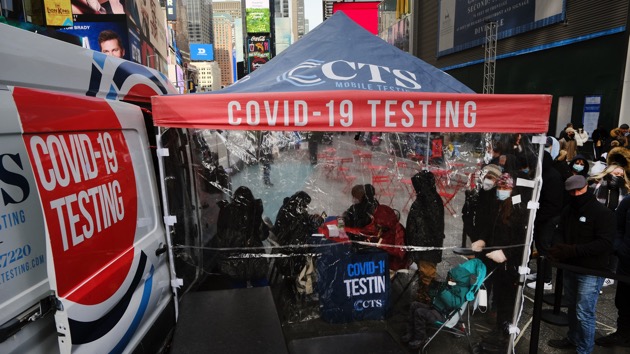
The record-high numbers come as the state sees an increase in testing, with New Yorkers waiting in lines to test ahead of seeing family for the holidays.
Hospitalizations are increasing, Hochul said.
New York has 4,500 COVID-19 patients currently in hospitals, which is nearly double the total number of patients from one month ago, according to state data.
Hochul added, “We’re not panicking. We have the resources we need. We have vaccines, we have boosters, we have masks.”
-ABC News’ Arielle Mitropoulos
Dec 22, 4:40 pm
US will have 265K doses of Pfizer pill in January: White House
Ten million treatment courses of Pfizer’s newly FDA-authorized COVID-19 pill have been purchased by the federal government, the White House announced.
The White House said 265,000 doses will be available in January and all 10 million will be delivered by late summer.
The White House said it also bought 3 million courses of Merck’s treatment, though that pill is not yet authorized.
-ABC News’ Cheyenne Haslett
Dec 22, 3:47 pm
Fauci says he’d ask unvaccinated relatives not to attend holiday gatherings
Dr. Anthony Fauci told MSNBC that he’d ask unvaccinated relatives not to attend a family holiday gathering this year due to the omicron surge.
Passengers are seen at Hartsfield-Jackson Atlanta International Airport in Atlanta, Dec. 20, 2021.
“I think we’re dealing with a serious enough situation right now that if there’s an unvaccinated person I would say, ‘I’m very sorry, but not this time. Maybe another time when this is all over,'” Fauci told MSNBC Tuesday night.
“It’s a problem when you’re dealing with [a variant] that’s spread so rapidly and you are unvaccinated. The virus is going to find you,” he said.
Ahead of the holidays, the best way to protect yourself and those around you is still to get vaccinated and boosted, Fauci said. Testing provides another layer of protection, though Fauci acknowledged that if people cannot get ahold of a test, given the increase in demand, they may need to make tough decisions, depending on their individual risk.
-ABC News’ Arielle Mitropoulos, Josh Hoyos
Dec 22, 3:36 pm
California requiring booster for health care workers
California is requiring health care workers to get the booster shot by Feb. 1, Gov. Gavin Newsom announced.
As of Wednesday, California has a 3.3% positivity rate, the lowest in the country, Newsom said. Newsom, however, warned that cases have nearly doubled in one week.
The governor also announced that the state bought 6 million rapid tests to be distributed to school children, so each student has about one or two tests. Students can test at home before returning to classrooms after the holidays, he said.
California is also working on expanding hours at test sites to provide more access, he said.
-ABC News’ Nicholas Kerr
Dec 22, 2:33 pm
Testing soon available at some NYC subway stops
For the first time, some New York City subway stations will offer walk-in PCR testing, New York Gov. Kathy Hochul announced Wednesday.
The initiative begins Dec. 27 at the Times Square-42nd St subway station from 8 a.m. to 2 p.m. and at Grand Central Terminal from 3 p.m. to 8 p.m. Testing will be seven days a week but not available on New Year’s Day.
Five other subway testing locations will open next week and will be announced when they’re finalized, the governor said.
New York also offers vaccinations at some subway stations. Boosters are now available at Times Square-42nd St and Jackson Heights-Roosevelt Av/74 St. Grand Central Terminal will offer boosters beginning Dec. 27, according to the governor’s office.
Dec 22, 1:58 pm
Omicron confirmed in all 50 states
Omicron cases have now been reported in all 50 states, according to an ABC News count.
The South Dakota Department of Health announced Wednesday that officials detected omicron in a young man in his 20s, making South Dakota the final state to confirm the highly transmissible variant.
The CDC on Monday said omicron was estimated to be the dominant variant in the U.S., representing more than 73% of new cases as of Dec. 18.
The CDC warned this week that models, which estimate the trajectory of coronavirus in the U.S., suggest that the number of new omicron infections will likely surge in the weeks to come and could exceed previous peaks.
-ABC News’ Arielle Mitropoulos, Darren Reynolds
Dec 22, 12:45 pm
Pfizer COVID treatment pill authorized by FDA
Pfizer’s at-home pill treatment for COVID-19 was authorized by the FDA on Wednesday.
When taken early, Pfizer’s pill was 89% effective at reducing the risk of severe illness and death from COVID-19, according to the company.
It’s also effective against omicron, Pfizer said.
-ABC News’ Cheyenne Haslett
Dec 22, 12:31 pm
Biden again tests negative after staff exposure
President Joe Biden received another PCR test Wednesday and again tested negative following exposure to a staff member who recently tested positive for COVID-19, the White House said.
Biden was near the staff member for about 30 minutes on Air Force One on Friday, during a trip to Philadelphia from South Carolina, according to White House press secretary Jen Psaki.
The staff member, who is fully vaccinated and boosted, tested negative Friday morning but tested positive Monday, according to the White House.
The president first received an antigen test Sunday and a PCR test Monday and both came back negative, Psaki said.
-ABC News’ Sarah Kolinovsky
Dec 22, 12:01 pm
Delta says omciron surge may ‘create significant disruptions,’ asks CDC to shorten isolation period for the fully vaccinated
Delta Air Lines said the omicron surge “may exacerbate shortages and create significant disruptions.”
Delta is urging the CDC to shorten the time fully vaccinated people must isolate following breakthrough infections, saying the current 10-day period “may significantly impact [its] workforce and operations.”
Delta proposed a five-day isolation from symptom onset for those who experience a breakthrough infection.
“Our employees represent an essential workforce to enable Americans who need to travel domestically and internationally,” Delta said in a letter.
Ninety percent of Delta’s workforce is fully vaccinated.
-ABC News’ Amanda Maile
Dec 22, 11:19 am
UK records over 100K daily cases for 1st time
The United Kingdom recorded 106,122 new cases in the last 24 hours, surpassing 100,000 daily cases for the first time, according to government data.
That brings the total of cases over the past seven days to 643,219 — a 58.9% jump from the previous week.
Deaths, however, are not rising. This week’s death toll is down 2.7% from the week before.
-ABC News’ Guy Davies
Dec 22, 10:26 am
New York City, DC, Vermont averaging more daily cases than any other point of pandemic
The U.S. is now averaging nearly 150,000 new COVID-19 cases every day, up about 72% in the last month. Over the last week alone, the nation has recorded more than 1 million new cases, according to federal data.
Every state in the country except for one — Montana — is currently experiencing high community transmission, according to federal data.
New York City, Vermont and Washington, D.C., are now averaging more daily cases than at any other point in the pandemic.
Florida is now reporting its highest number of new cases in about three months.
Since early December, Georgia’s daily case average has more than doubled, while Hawaii’s average has quadrupled, according to federal data.
-ABC News’ Arielle Mitropoulos
Dec 22, 9:33 am
Ohio hospitals take out an ad in local paper pleading for people to get vaccinated
Six hospitals in Ohio have taken out a full-page ad in the Cleveland Plain-Dealer in a desperate plea for people to get vaccinated as the state faces a renewed surge.
The ad, which appeared in Sunday’s paper, says in big letters: “Help.”
“We need your help. We now have more COVID-19 patients in our hospitals than ever before,” the ad says. “And the overwhelming majority are unvaccinated. This is preventable.”
Ohio Gov. Mike DeWine announced last week that he would deploy the state’s National Guard to help with hospital strain. Ohio is now averaging more than 9,100 new cases every day — up 67.5% in the last month. Statewide, more than 5,200 patients are hospitalized with COVID-19.
“The best way to avoid serious illness is the vaccine,” the ad said. “So, get vaccinated and get your booster … we need you to care as much as we do.”
-ABC News’ Arielle Mitropoulos
Dec 22, 8:48 am
Booster shots ‘will really help us’ with omicron: CDC director
About 73% of U.S. COVID-19 cases are now the omicron variant, but that number rises to 90% in areas like New York, CDC director Dr. Rochelle Walensky told “Good Morning America” Wednesday.
“Things are moving quickly,” she said. “The doubling times of this virus are very fast, around two days.”
But Walensky said the booster shot “will really help” with this variant.
“What we know about omicron is that it has a lot of mutations, and with more mutations we need more immune protection. And that’s really why this booster shot will really help us,” Walensky said.
Asked if President Joe Biden’s decision to mail 500 million free at-home rapid tests to Americans in January is too late to help the current surge, Walensky responded, “We have been ramping up testing.”
“We have much more testing now than we had just months ago,” she said. “And we were in the middle of a delta surge as omicron hit, so really right now there are so many things that we can do in addition to testing to keep safe — and that really does mean getting 40 million Americans who continue to be unvaccinated vaccinated and making sure that people get that booster shot.”
Dec 22, 3:46 am
Portugal bans outdoor drinking, large gatherings for New Year’s Eve
Portugal said it would limit outdoor gatherings to 10 people and prohibit outdoor drinking on New Year’s Eve.
The country, which has 52 confirmed omicron cases, will also require most people to work from home starting on Saturday, the president’s office told ABC News on Tuesday.
The new restrictions, which are set to expire Jan. 10, will require people to present negative COVID-19 tests as they enter sporting events, theaters, weddings and other large gatherings.
Bars, discos, and schools will close on Saturday, the president’s office said.
The country reported an uptick in COVID-19 cases between Dec. 16 and Dec. 19, but numbers were slightly down on Tuesday, with 2,752 newly diagnosed cases and 18 deaths, according to the World Health Organization’s COVID-19 dashboard. Portugal’s adult population is 87% fully vaccinated.
-ABC News’ Aicha El-Hammar Castano
Dec 21, 7:53 pm
California to require all health care workers to get booster
California Gov. Gavin Newsom tweeted Tuesday evening that he will require that all health care workers in the state to get their booster shot.
“With Omicron on the rise, we’re taking immediate actions to protect Californians and ensure our hospitals are prepared,” he tweeted.
More details about the order will be shared on Wednesday, according to Newsom.
Dec 21, 7:05 pm
Chicago to institute vaccine mandate for indoor events
Chicago Mayor Lori Lightfoot announced a vaccine mandate for most indoor events as the city grasps with a rise in COVID-19 cases.
Starting Jan. 3, anyone over the age of 5 will have to show proof that they are fully vaccinated to “to dine indoors, visit gyms, or enjoy entertainment venues where food or drink are being served,” the mayor’s office said in a statement.
Patrons 16 and older will also need to “provide identification that matches their vaccination record,” according to the statement.
Chicago is averaging more than 1,700 new COVID-19 cases a day — a 79% increase from one week ago, the mayor’s office said.
Dec 21, 4:36 pm
New Hampshire hospital seeing record-high number of patients
Elliot Hospital in New Hampshire is now seeing three to four times as many patients as it had at the beginning of the pandemic, Dr. Laura McPhee told ABC News.
She said their ICU is full with COVID-19 patients and staff is running thin.
“We’re tired. It’s been extremely hard on everybody,” McPhee said, stressing that “most of the patients that we’re seeing are unvaccinated.”
“Most days I’ve been angry and frustrated. … Because this is preventable. It doesn’t have to happen,” she said. “I’ve not ever seen a patient here in the ICU who has been fully vaccinated with a booster.”
(WASHINGTON) — President Joe Biden said Wednesday in an exclusive interview with ABC “World News Tonight” anchor David Muir that “accountability is necessary” for the Jan. 6 insurrection at the U.S. Capitol, “no matter where it goes.”
“I think accountability is necessary,” Biden told Muir during a sit-down interview at the White House.
“And that means if it goes right into the previous administration?” Muir pressed, referring to the administration of President Donald Trump, who was in office when his supporters launched a deadly attack on the Capitol.
“No matter where it goes,” Biden said. “Those responsible should be held accountable.”
You can watch more of David Muir’s interview with President Joe Biden on ABC “World News Tonight” and “Nightline” at 12:35 a.m. ET
A House select committee currently investigating the Jan. 6 insurrection has subpoenaed top Trump administration officials, including the former president’s chief of staff, Mark Meadows. The House later voted Meadows in criminal contempt for refusing to cooperate.
In October, a reporter asked the president what his message was to those who defy the committee’s subpoenas.”
“I hope that the committee goes after them and holds them accountable,” Biden said then.
Asked if the Justice Department should prosecute them, he replied, “I do, yes.”
Days later, Biden said during a CNN town hall he was wrong to appear as if he was directing the department to act a certain way, noting what he said “was not appropriate.”
“I should have chosen my words more wisely,” he added.
(WASHINGTON) — Democratic Rep. Mary Gay Scanlon was carjacked at gunpoint in broad daylight Wednesday afternoon in south Philadelphia’s largest park following a business meeting.
The congresswoman was left unharmed, according to a statement provided to ABC News by her spokesperson, Lauren Cox.
“Wednesday afternoon, at around 2:45 p.m., Congresswoman Scanlon was carjacked at gunpoint in FDR Park following a meeting at that location. The Congresswoman was physically unharmed,” Cox said in a statement.
“She thanks the Philadelphia Police Department for their swift response, and appreciates the efforts of both the Sergeant at Arms in D.C. and her local police department for coordinating with Philly PD to ensure her continued safety,” the statement said.
Scanlon, who was first elected to Congress in 2018, represents the 5th Congressional District in Pennsylvania, which includes parts of south Philadelphia.
Her spokesperson confirmed that Scanlon’s personal belongings, including her personal and government-issued phones and identification, were stolen by the perpetrators.
Philadelphia’s mayor, Jim Kenney, released a statement condemning the incident.
“I’m appalled to learn of this violent crime that was perpetrated against my friend and colleague, Congresswoman Mary Gay Scanlon. Everyone deserves to feel safe in our city, and sadly, as we know, that hasn’t always been the case this year. It’s disheartening, and quite frankly infuriating, that criminals feel emboldened to commit such a reckless crime in the middle of the day in what should be a place of tranquility and peace—one of Philadelphia’s beautiful parks,” he said in a statement.
“I’m thankful that she was not physically harmed during this incident, and my thoughts are with her during what I’m sure is a traumatic time. I’m also thankful that our police officers have been working hard to identify violent criminals and get them off our streets. PPD is actively investigating this incident. We simply cannot and will not tolerate any acts of violence. If anyone has any information about this incident—or any other crime—please call or text PPD’s anonymous tip line at 215-686-TIPS.”
The incident comes amid a violent year in Philadelphia, which saw a spike in both gunpoint robberies and auto thefts.
Philadelphia is seeing at least an 80% increase in carjackings in 2021, compared with the total number in 2020, Philadelphia Police have said.
(WASHINGTON) — The House select committee investigating the Jan. 6 Capitol attack sent a letter on Wednesday to GOP Rep. Jim Jordan of Ohio, requesting he appear for an interview with the panel about his communications with President Donald Trump on and before Jan. 6.
The request from Chairman Bennie Thompson, D-Miss., to the staunch Trump ally is the committee’s second such request to a GOP lawmaker.
On Monday night, the committee requested a meeting with Rep. Scott Perry, R-Pa., to discuss his communications with Trump Justice Department officials about false claims of election fraud and efforts to install Jeffrey Clark as the acting attorney general.
Jordan, who Rep. Liz Cheney, R-Wyo., has described as a potential “material witness” for the committee’s investigation, has said he spoke to Trump on Jan. 6 after the attack — after initially telling an Ohio news station he couldn’t remember when he communicated with Trump and Politico reported that they spoke twice.
Jordan, a leader and founding member of the Trump-aligned House Freedom Caucus, was among the GOP lawmakers who planned to challenge the election results on the House floor. He has said he had “nothing to do with” the attack on the Capitol.
After the election, the Ohio Republican focused most of his efforts challenging the legality of the pandemic-era voting changes in many states rather than some of the more outlandish and unproven theories of election fraud pushed by some Trump supporters.
The committee said it hoped to ask Jordan about his communications with Trump on Jan. 6 and any communications he may have had on Jan. 5 and Jan. 6 with Trump’s legal team, White House officials, or any of the rally organizers and activists based at the Willard Hotel.
“We would also like to ask you about any discussions involving the possibility of presidential pardons for individuals involved in any aspect of January 6th or the planning for January 6th,” the panel wrote.
The committee also noted that it has obtained “testimony indicating that the president was watching television coverage of the attack from his private dining room adjoining the Oval Office during this time period,” which has been publicly reported.
A spokesman for Jordan did not immediately return a message seeking comment.
The committee requested a meeting with Jordan in the first week of January but also said it would be “glad to explore travel arrangements” to meet with him at home in Ohio.
Jordan was among the House Republicans nominated to serve on the select committee by House GOP Leader Kevin McCarthy, R-Calif. But House Speaker Nancy Pelosi blocked him from being seated on the panel given his past false statements about the election results — which led McCarthy to withdraw all his selections to the committee.
Lindsey Nicholson/Education Images/Universal Images Group via Getty Images
(NEW YORK) — Urgent care chain CityMD announced it is temporarily closing more than a dozen of its 150 locations in New York and New Jersey amid a surge in COVID-19 cases and increased demands for testing.
The 19 shuttered clinics include 13 in New York City — impacting every borough except Staten Island — two on Long Island, one in Westchester County, and three in New Jersey.
“To preserve our ability to staff our sites, we are temporarily closing certain locations effective December 22,” a statement on CityMD’s website read. “It is our hope that closing sites now will best allow us to avoid future closures as this surge continues.”
It is not clear when the locations will reopen, with CityMD directing patients to visit nearby locations for testing in the meantime.
This is not the first time that CityMD has closed locations due to the pandemic.
During Thanksgiving last year, the urgent care chain announced all locations would close 90 minutes earlier, citing staff working longer hours than scheduled due to long COVID-19 testing lines
CityMD did not immediately respond to ABC News’ request for comment.
The closures come as states in the Northeast continue to report record-breaking numbers of COVID-19 cases.
On Wednesday, New York reported record-high infections for the fifth time over six days, with more than 28,000 people testing positive, state data showed.
Additionally, New York City has the country’s highest new case rate, with 1,019 cases per 100,000 people over the last seven days, according to data from the Centers for Disease Control and Prevention.
To meet the demand for testing, Mayor Bill de Blasio announced the city would be opening more than 20 testing locations this week.
Gov. Kathy Hochul also said the state intends to set up an online portal through which New Yorkers can order at-home rapid tests. The tests will mostly be sent to areas where vaccination rates are lagging and cases are rising.
New Jersey also reported a record number of COVID-19 cases on Wednesday, with 9,711 confirmed infections.
The state already has a program in place for residents to request a free COVID-19 test kit in the mail. The sample is then sent back to a laboratory with results available within 48 hours.
(RICHMOND, Va.) — A time capsule estimated to be more than 130 years old, unearthed from the base of a statue of Confederate Gen. Robert E. Lee, was being opened Wednesday in Richmond, Virginia, and the artifacts showed a snapshot of life in the Confederate South.
Virginia Gov. Ralph Northam attended the opening of capsule by historians. Historians used tools to painstakingly open the corroded box. After hours of working to unseal the box, the team — clad in blue latex gloves — pulled the first artifact: a medium-sized maroon book.
“It’s very wet,” Kate Ridgeway said, a conservator with the Virginia Department of Historic Resources said as she peered into the rusted time capsule.
“We are trying to preserve what we can of this book,” Ridgeway said, after conservators took a thin maroon book from the more than hundred year old container.
Other artifacts were slowly pulled from the corroded box, another book and what one historian said looked like the coin.
Conservators pulled a few items from the box: what appears to be a coin, at least three books of varying size and color, what appeared to be an envelope and papers, some of which were difficult to identify given their condition.
Teams quickly worked to “stabilize” the artifacts, Ridgeway told reporters in the room, so that they could be worked on. As for how long it takes to stabilize them, historians said it depends on how wet the items are.
The time capsule was found by construction crews in early December. Crews taking apart the removed statue’s base came across an area that looked “different,” according to a release from Northam’s office, and chiseled out a section of the 2,000-pound granite block to reveal it.
The capsule is estimated by experts to date back to 1887. According to the governor’s office, records show that, “37 Richmond residents, organizations, and businesses contributed about 60 objects to the capsule, many of which are believed to be related to the Confederacy.”
The pedestal stood beneath a bronze statue of Lee on horseback that was removed in September 2021, following nationwide racial justice protests after George Floyd was killed by police in Minneapolis.
The statue’s removal was slowed by lawsuits from some residents who opposed it being taken down, but the state’s Supreme Court okayed it.
As the capsule was opened, the state was making plans to create a new time capsule to reflect present-day Virginia.
“This monument and its time capsule reflected Virginia in 1890 — and it’s time to remove both, so that our public spaces better reflect who we are as a people in 2021,” Northam said in a September press release. “The past 18 months have seen historic change, from the pandemic to protests for racial justice that led to the removal of these monuments to a lost cause. It is fitting that we replace the old time capsule with a new one that tells that story.”
The state has selected 39 individuals to add artifacts to the 2021 time capsule, which are expected to include nods to the 2020 racial justice protests, as well as items, including face masks and vaccination cards, related to the COVID-19 pandemic.
(NEW YORK) — As the COVID-19 pandemic has swept the globe, more than 5.3 million people have died from the disease worldwide, including over 810,000 Americans, according to real-time data compiled by Johns Hopkins University’s Center for Systems Science and Engineering.
About 61.6% of the population in the United States is fully vaccinated against COVID-19, according to data from the Centers for Disease Control and Prevention.
Here’s how the news is developing. All times Eastern:
Dec 22, 3:47 pm
Fauci says he’d ask unvaccinated relatives not to attend holiday gatherings
Dr. Anthony Fauci told MSNBC that he’d ask unvaccinated relatives not to attend a family holiday gathering this year due to the omicron surge.
Passengers are seen at Hartsfield-Jackson Atlanta International Airport in Atlanta, Dec. 20, 2021.
“I think we’re dealing with a serious enough situation right now that if there’s an unvaccinated person I would say, ‘I’m very sorry, but not this time. Maybe another time when this is all over,'” Fauci told MSNBC Tuesday night.
“It’s a problem when you’re dealing with [a variant] that’s spread so rapidly and you are unvaccinated. The virus is going to find you,” he said.
Ahead of the holidays, the best way to protect yourself and those around you is still to get vaccinated and boosted, Fauci said. Testing provides another layer of protection, though Fauci acknowledged that if people cannot get ahold of a test, given the increase in demand, they may need to make tough decisions, depending on their individual risk.
-ABC News’ Arielle Mitropoulos, Josh Hoyos
Dec 22, 3:36 pm
California requiring booster for health care workers
California is requiring health care workers to get the booster shot by Feb. 1, Gov. Gavin Newsom announced.
As of Wednesday, California has a 3.3% positivity rate, the lowest in the country, Newsom said. Newsom, however, warned that cases have nearly doubled in one week.
The governor also announced that the state bought 6 million rapid tests to be distributed to school children, so each student has about one or two tests. Students can test at home before returning to classrooms after the holidays, he said.
California is also working on expanding hours at test sites to provide more access, he said.
-ABC News’ Nicholas Kerr
Dec 22, 2:33 pm
Testing soon available at some NYC subway stops
For the first time, some New York City subway stations will offer walk-in PCR testing, New York Gov. Kathy Hochul announced Wednesday.
The initiative begins Dec. 27 at the Times Square-42nd St subway station from 8 a.m. to 2 p.m. and at Grand Central Terminal from 3 p.m. to 8 p.m. Testing will be seven days a week but not available on New Year’s Day.
Five other subway testing locations will open next week and will be announced when they’re finalized, the governor said.
New York also offers vaccinations at some subway stations. Boosters are now available at Times Square-42nd St and Jackson Heights-Roosevelt Av/74 St. Grand Central Terminal will offer boosters beginning Dec. 27, according to the governor’s office.
Dec 22, 1:58 pm
Omicron confirmed in all 50 states
Omicron cases have now been reported in all 50 states, according to an ABC News count.
The South Dakota Department of Health announced Wednesday that officials detected omicron in a young man in his 20s, making South Dakota the final state to confirm the highly transmissible variant.
The CDC on Monday said omicron was estimated to be the dominant variant in the U.S., representing more than 73% of new cases as of Dec. 18.
The CDC warned this week that models, which estimate the trajectory of coronavirus in the U.S., suggest that the number of new omicron infections will likely surge in the weeks to come and could exceed previous peaks.
-ABC News’ Arielle Mitropoulos, Darren Reynolds
Dec 22, 12:45 pm
Pfizer COVID treatment pill authorized by FDA
Pfizer’s at-home pill treatment for COVID-19 was authorized by the FDA on Wednesday.
When taken early, Pfizer’s pill was 89% effective at reducing the risk of severe illness and death from COVID-19, according to the company.
It’s also effective against omicron, Pfizer said.
-ABC News’ Cheyenne Haslett
Dec 22, 12:31 pm
Biden again tests negative after staff exposure
President Joe Biden received another PCR test Wednesday and again tested negative following exposure to a staff member who recently tested positive for COVID-19, the White House said.
Biden was near the staff member for about 30 minutes on Air Force One on Friday, during a trip to Philadelphia from South Carolina, according to White House press secretary Jen Psaki.
The staff member, who is fully vaccinated and boosted, tested negative Friday morning but tested positive Monday, according to the White House.
The president first received an antigen test Sunday and a PCR test Monday and both came back negative, Psaki said.
-ABC News’ Sarah Kolinovsky
Dec 22, 12:01 pm
Delta says omciron surge may ‘create significant disruptions,’ asks CDC to shorten isolation period for the fully vaccinated
Delta Air Lines said the omicron surge “may exacerbate shortages and create significant disruptions.”
Delta is urging the CDC to shorten the time fully vaccinated people must isolate following breakthrough infections, saying the current 10-day period “may significantly impact [its] workforce and operations.”
Delta proposed a five-day isolation from symptom onset for those who experience a breakthrough infection.
“Our employees represent an essential workforce to enable Americans who need to travel domestically and internationally,” Delta said in a letter.
Ninety percent of Delta’s workforce is fully vaccinated.
-ABC News’ Amanda Maile
Dec 22, 11:19 am
UK records over 100K daily cases for 1st time
The United Kingdom recorded 106,122 new cases in the last 24 hours, surpassing 100,000 daily cases for the first time, according to government data.
That brings the total of cases over the past seven days to 643,219 — a 58.9% jump from the previous week.
Deaths, however, are not rising. This week’s death toll is down 2.7% from the week before.
-ABC News’ Guy Davies
Dec 22, 10:26 am
New York City, DC, Vermont averaging more daily cases than any other point of pandemic
The U.S. is now averaging nearly 150,000 new COVID-19 cases every day, up about 72% in the last month. Over the last week alone, the nation has recorded more than 1 million new cases, according to federal data.
Every state in the country except for one — Montana — is currently experiencing high community transmission, according to federal data.
New York City, Vermont and Washington, D.C., are now averaging more daily cases than at any other point in the pandemic.
Florida is now reporting its highest number of new cases in about three months.
Since early December, Georgia’s daily case average has more than doubled, while Hawaii’s average has quadrupled, according to federal data.
-ABC News’ Arielle Mitropoulos
Dec 22, 9:33 am
Ohio hospitals take out an ad in local paper pleading for people to get vaccinated
Six hospitals in Ohio have taken out a full-page ad in the Cleveland Plain-Dealer in a desperate plea for people to get vaccinated as the state faces a renewed surge.
The ad, which appeared in Sunday’s paper, says in big letters: “Help.”
“We need your help. We now have more COVID-19 patients in our hospitals than ever before,” the ad says. “And the overwhelming majority are unvaccinated. This is preventable.”
Ohio Gov. Mike DeWine announced last week that he would deploy the state’s National Guard to help with hospital strain. Ohio is now averaging more than 9,100 new cases every day — up 67.5% in the last month. Statewide, more than 5,200 patients are hospitalized with COVID-19.
“The best way to avoid serious illness is the vaccine,” the ad said. “So, get vaccinated and get your booster … we need you to care as much as we do.”
-ABC News’ Arielle Mitropoulos
Dec 22, 8:48 am
Booster shots ‘will really help us’ with omicron: CDC director
About 73% of U.S. COVID-19 cases are now the omicron variant, but that number rises to 90% in areas like New York, CDC director Dr. Rochelle Walensky told “Good Morning America” Wednesday.
“Things are moving quickly,” she said. “The doubling times of this virus are very fast, around two days.”
But Walensky said the booster shot “will really help” with this variant.
“What we know about omicron is that it has a lot of mutations, and with more mutations we need more immune protection. And that’s really why this booster shot will really help us,” Walensky said.
Asked if President Joe Biden’s decision to mail 500 million free at-home rapid tests to Americans in January is too late to help the current surge, Walensky responded, “We have been ramping up testing.”
“We have much more testing now than we had just months ago,” she said. “And we were in the middle of a delta surge as omicron hit, so really right now there are so many things that we can do in addition to testing to keep safe — and that really does mean getting 40 million Americans who continue to be unvaccinated vaccinated and making sure that people get that booster shot.”
Dec 22, 3:46 am
Portugal bans outdoor drinking, large gatherings for New Year’s Eve
Portugal said it would limit outdoor gatherings to 10 people and prohibit outdoor drinking on New Year’s Eve.
The country, which has 52 confirmed omicron cases, will also require most people to work from home starting on Saturday, the president’s office told ABC News on Tuesday.
The new restrictions, which are set to expire Jan. 10, will require people to present negative COVID-19 tests as they enter sporting events, theaters, weddings and other large gatherings.
Bars, discos, and schools will close on Saturday, the president’s office said.
The country reported an uptick in COVID-19 cases between Dec. 16 and Dec. 19, but numbers were slightly down on Tuesday, with 2,752 newly diagnosed cases and 18 deaths, according to the World Health Organization’s COVID-19 dashboard. Portugal’s adult population is 87% fully vaccinated.
-ABC News’ Aicha El-Hammar Castano
Dec 21, 7:53 pm
California to require all health care workers to get booster
California Gov. Gavin Newsom tweeted Tuesday evening that he will require that all health care workers in the state to get their booster shot.
“With Omicron on the rise, we’re taking immediate actions to protect Californians and ensure our hospitals are prepared,” he tweeted.
More details about the order will be shared on Wednesday, according to Newsom.
Dec 21, 7:05 pm
Chicago to institute vaccine mandate for indoor events
Chicago Mayor Lori Lightfoot announced a vaccine mandate for most indoor events as the city grasps with a rise in COVID-19 cases.
Starting Jan. 3, anyone over the age of 5 will have to show proof that they are fully vaccinated to “to dine indoors, visit gyms, or enjoy entertainment venues where food or drink are being served,” the mayor’s office said in a statement.
Patrons 16 and older will also need to “provide identification that matches their vaccination record,” according to the statement.
Chicago is averaging more than 1,700 new COVID-19 cases a day — a 79% increase from one week ago, the mayor’s office said.
Dec 21, 4:36 pm
New Hampshire hospital seeing record-high number of patients
Elliot Hospital in New Hampshire is now seeing three to four times as many patients as it had at the beginning of the pandemic, Dr. Laura McPhee told ABC News.
She said their ICU is full with COVID-19 patients and staff is running thin.
“We’re tired. It’s been extremely hard on everybody,” McPhee said, stressing that “most of the patients that we’re seeing are unvaccinated.”
“Most days I’ve been angry and frustrated. … Because this is preventable. It doesn’t have to happen,” she said. “I’ve not ever seen a patient here in the ICU who has been fully vaccinated with a booster.”
(AUSTIN, Texas) — The right-wing American Legislative Exchange Council, otherwise known as ALEC, is pushing a new piece of anti-fossil fuel divestment legislation after a version of the bill was passed in Texas.
Texas this year paved the way for the GOP on several fronts, from passing a new “fetal heartbeat” abortion law to a restrictive election law. The state also buoyed a bill that would require state entities to divest from companies that choose to no longer do business with fossil fuel companies. It was signed into law in June.
At least a dozen similar bills to the Texas law were filed in 2021 legislative sessions in a handful of states, according to the Texas Tribune, and experts anticipate the trend will grow in 2022.
“Oil and gas is the lifeblood of the Texas economy,” Texas state Rep. Phil King said during a floor discussion of the state’s bill in May, according to the Tribune. “In the world of capital, there’s a movement to deny funds to businesses that will not sign on to extreme anti-fossil fuel policy.”
ALEC, which drafts and streamlines legislative priorities for lawmakers in statehouses across the country, approved model legislation similar to the Texas law — called the Energy Discrimination Elimination Act — at its December meeting.
In an email obtained by the Center for Media and Democracy, a top executive for a state-level group that pushed the anti-divestment bill in Texas wrote that “at the ALEC Committee meetings you’ll have the opportunity to push back against woke financial institutions that are colluding against American energy producers.”
Modeled after anti-BDS legislation supported by ALEC that passed in Texas in 2019, the fossil fuel bill is touted as sending “a strong message that the states will fight back against woke capitalism,” the executive wrote in the email. The controversial Boycott, Divestment, Sanctions (BDS) movement uses financial pressure to “end international support for Israel’s oppression of Palestinians.”
ALEC’s Task Force on Energy, Environment and Agriculture voted unanimously in support of the fossil fuel bill language, according to news reports, but it appears to have been removed from ALEC’s website.
ALEC did not respond to a request for comment.
“It’s likely more political than anything else,” Hana Vizcarra, a senior attorney at EarthJustice, told ABC regarding ALEC’s efforts on the energy front. “I think that the financial sector is waking up to the reality of impacts of climate change on their investments, their lending, how they go about their business… these kinds of efforts appear to just be pushing against the tide of reality.”
Banks are starting to shift their investments as they assess the risks of climate change, Vizcarra said, and that doesn’t necessarily equate to a boycott. In 2020, Larry Fink, founder and chief executive of investment behemoth BlackRock, wrote to shareholders that the firm would make climate change “a defining factor” in its investment strategy.
“It’s largely pushing against the private sector and business community at the moment,” she said. “But they may find that they’re actually hindering their own business climate through these efforts.”
The public is getting on board with holding companies responsible for climate change.
In a September public opinion poll conducted by organizations at Yale and George Mason universities, 41% of Americans said that over the next 12 months, they intend to reward companies that are taking steps to reduce global warming more frequently than they do now.
Another 41% said they intend to punish companies that are opposing steps to reduce global warming more frequently than they do now. The poll found that at least half of Americans say industries should be doing “more” or “much more” to address global warming. And 70% say fossil fuel companies should be doing more.
Progressives, meanwhile, are introducing legislation that would require government entities to divest from fossil fuel companies.
And in response to reporting about the energy discrimination bill, 38 climate advocacy organizations wrote a letter to state treasurers and comptrollers urging them to push back against the legislation.
“Despite what ALEC and other politically-motivated organizations may claim, the global energy transition is underway,” the groups wrote. “This is a market reality, not a political opinion.”
(WASHINGTON) — D.C. Mayor Muriel Bowser announced Wednesday that certain establishments, including restaurants, bars, nightclubs, gyms, events and meeting spaces, will require proof of COVID-19 vaccination beginning in January.
Patrons above the age of 12 will be required to be partially vaccinated by Jan. 15 and fully vaccinated by Feb. 15.
“If you are a resident that is not yet vaccinated and you want to continue enjoying these activities, now is the time to get vaccinated,” Bowser said.
Citing new data from the Centers for Disease Control and Prevention reporting omicron as now the dominant strain in the U.S., D.C. Department of Health official Patrick Ashley said it was only “a matter of time” before that played out in the district, which currently has 25 confirmed cases of the new variant.
Ashley also pointed to huge spikes in the weekly and daily case rate in D.C. from a month ago, attributing them, in part, to the winter surge and the omicron variant.
A month ago, D.C. reported a daily case rate of 13.7 cases per 100,000 people. As of Wednesday, the rate had jumped nine times to 123.8 cases per 100,000 people.
Bowser noted that some exceptions to the new mandate will be made for patrons not staying long at a restaurant, for example, a patron picking up an order.
The move follows in the footsteps of other major U.S. cities like New York City, San Francisco and Los Angeles that have similar vaccine requirements.
Approved proof of vaccination includes vaccination cards or photos of vaccination cards, immunization records or verification apps like CLEAR and VaxYes.
Further guidelines on the requirements are still to come, Bowser said. Wednesday’s initial announcement of the new guidelines was made to give businesses enough time to prepare.
Bowser also announced that to meet the increased testing demand among residents, the district will order another five million rapid antigen tests, for a total of six million.
Students in D.C. schools will also have to be immunized beginning March 1, following regulations from the D.C. Council.
Bowser also encouraged residents to celebrate safe holidays and asked people to have small gatherings, wear masks and gather outdoors.