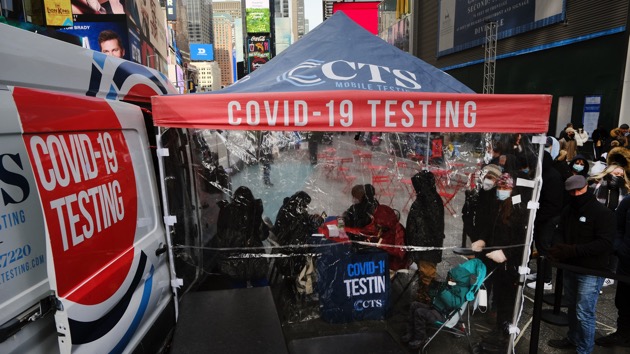
The Food and Drug Administration on Thursday authorized Merck’s COVID-19 pill for certain adults.
The authorization is limited to adults who have a high risk of severe illness and for whom alternative FDA-authorized treatment options are not accessible or medically appropriate.
This is the second COVID-19 treatment in pill form after Pfizer’s pills were authorized Wednesday.
This is a developing story. Please check back for updates.
ABC News’ Sony Salzman contributed to this report.
(MOSCOW) — Amid fears Russia might invade Ukraine, Russia’s president Vladimir Putin has again repeated demands for guarantees from Western countries that NATO will not expand in eastern Europe, but also expressed hope that negotiations with the Biden administration in January could allow the two sides to “move forward.”
Putin offered the mixed messages on Thursday during his marathon end-of-year press conference in Moscow, making menacing accusations against Ukraine but also sounding more hopeful notes around the possibility for negotiation.
Western countries are alarmed that Russia may be preparing a renewed invasion into Ukraine this winter, amid a build up of tens of thousands of Russian troops on its border. Putin has demanded the U.S. and NATO give legal guarantees the alliance will not expand further and withdraw NATO troop deployments from eastern Europe.
The Biden administration has called those demands non-starters but has agreed to hold talks with Russia over its concerns. Putin on Thursday said those talks would take place in Geneva in January and said Russia had seen a “positive reaction” from the U.S. to its demands to negotiate.
“I hope that the first positive reaction and the announced possible start of work in the near future, in the first days of January, will allow us to move forward,” Putin said.
Putin said Russia was forced to confront NATO and Ukraine now to prevent the country potentially becoming a base for NATO missiles in the future.
“And so we put the question directly: there must be no movement of NATO further to the east,” he said. “The ball is in their court. They must answer us something.”
The U.S. and NATO countries have rejected Russia’s demands for a veto on NATO expansion, seeing them as an attempt by the Kremlin to have formal recognition for a sphere of influence over Ukraine. Analysts and Western officials have been trying to understand whether the Russian build up is a negotiating tactic or signals a real readiness to invade.
Putin’s comments on Thursday did little to move the needle. He said Russia did not want conflict but alleged there Ukraine might be preparing a military operation to re-take the Russian-controlled separatist regions in its east, saying Kyiv had tried to do it twice before in the past.
“They keep telling us: war, war, war,” Putin said. “There is an impression that, maybe, they are preparing for the third military operation and are warning us in advance: do not intervene, do not protect these people. But if you do intervene and protect them, there will be new sanctions. Perhaps, we should prepare for that.”
Analysts fear Russia might use the accusation of a Ukrainian attack as pretext to launch its own invasion. There are no signs Ukraine’s government is preparing such an assault, which would risk an overwhelming Russian response.
Russia last week published two draft treaties listing its demands from the U.S. and NATO. The proposals would limit NATO troops and military infrastructure to the countries where they were based before 1997, when the key eastern European members joined.
The Biden administration immediately rejected Russia’s demands limiting which countries can join NATO. But it has said it is ready to hold talks with Moscow about some of the other proposals, which are linked to arms control for example.
Putin spoke at length and angrily about NATO’s expansion eastward since the end of the Cold War, a grievance he has long held.
Asked by a journalist from Britain’s Sky News on Thursday if he would guarantee Russia will not invade Ukraine, Putin said it was Russia that needed guarantees from Western countries over NATO.
“What guarantees must we give you? You must give us guarantees. Right here and right now!” Putin said.
(PHILADELPHIA) — Democratic Rep. Mary Gay Scanlon was carjacked at gunpoint in broad daylight Wednesday afternoon in south Philadelphia’s largest park following a business meeting.
The congresswoman was left unharmed, according to a statement provided to ABC News by her spokesperson, Lauren Cox.
“Wednesday afternoon, at around 2:45 p.m., Congresswoman Scanlon was carjacked at gunpoint in FDR Park following a meeting at that location. The Congresswoman was physically unharmed,” Cox said in a statement.
“She thanks the Philadelphia Police Department for their swift response, and appreciates the efforts of both the Sergeant at Arms in D.C. and her local police department for coordinating with Philly PD to ensure her continued safety,” the statement said.
Five suspects were taken into custody in Newark, Delaware, at about 9 p.m., when they were found inside Scanlon’s Acura MDX in a parking lot, Delaware State Police said. Their names were not released.
Scanlon, who was first elected to Congress in 2018, represents the 5th Congressional District in Pennsylvania, which includes parts of south Philadelphia.
Her spokesperson confirmed that Scanlon’s personal belongings, including her personal and government-issued phones and identification, were stolen by the perpetrators.
Philadelphia’s mayor, Jim Kenney, released a statement condemning the incident.
“I’m appalled to learn of this violent crime that was perpetrated against my friend and colleague, Congresswoman Mary Gay Scanlon. Everyone deserves to feel safe in our city, and sadly, as we know, that hasn’t always been the case this year. It’s disheartening, and quite frankly infuriating, that criminals feel emboldened to commit such a reckless crime in the middle of the day in what should be a place of tranquility and peace—one of Philadelphia’s beautiful parks,” he said in a statement.
“I’m thankful that she was not physically harmed during this incident, and my thoughts are with her during what I’m sure is a traumatic time. I’m also thankful that our police officers have been working hard to identify violent criminals and get them off our streets. PPD is actively investigating this incident. We simply cannot and will not tolerate any acts of violence. If anyone has any information about this incident—or any other crime—please call or text PPD’s anonymous tip line at 215-686-TIPS.”
The incident comes amid a violent year in Philadelphia, which saw a spike in both gunpoint robberies and auto thefts.
Philadelphia is seeing at least an 80% increase in carjackings in 2021, compared with the total number in 2020, Philadelphia Police have said.
As the COVID-19 pandemic has swept the globe, more than 5.3 million people have died from the disease worldwide, including over 812,000 Americans, according to real-time data compiled by Johns Hopkins University’s Center for Systems Science and Engineering.
About 61.7% of the population in the United States is fully vaccinated against COVID-19, according to data from the Centers for Disease Control and Prevention.
Dec 23, 5:44 am
Rep. Jan Schakowsky tests positive for COVID
Rep. Jan Schakowsky, D-Ill., has tested positive for COVID-19.
Schakowsky said her husband, Bob, had tested positive last week. After several negative tests, the lawmaker also tested positive on Tuesday night, she said on Twitter.
Both Schakowskys were vaccinated and received boosters. They’re now quarantining, she said.
“We got tested when we felt something was off, and now we can prevent exposure to our family and loved ones,” Schakowsky said. “I implore you to do the same before holiday gatherings this week and next. Get tested if you feel sick or have been around someone who tests positive.”
ABC News’s Ben Siegel
Dec 22, 10:58 pm
Rep. Jim Clyburn, majority whip, tests positive for COVID
Rep. Jim Clyburn, D-S.C., the No. 3 Democrat in the House, said Wednesday night that he had tested positive for COVID. The 81-year-old lawmaker said he’s vaccinated and currently asymptomatic.
“America is in a new phase of this pandemic. No one is immune,” he wrote. “I urge anyone who has not done so to protect themselves by getting vaccinated and boosted.”
He said he has been in quarantine since Sunday awaiting results and missed his granddaughter’s wedding because of testing positive.
Clyburn played a crucial role in getting President Joe Biden elected last year when he endorsed him ahead of the South Carolina primary. Biden won the contest and carried the momentum through to the presidency.
The congressman appeared on stage with Biden on Dec. 17 at South Carolina State University’s graduation ceremony. Biden gave the commencement address while Clyburn received his diploma after graduating in 1961 but missing the ceremony. Both were wearing masks on stage and Clyburn said he tested negative ahead of the ceremony.
Clyburn was the eighth member of Congress — six representatives and two senators — to publicly disclose they tested positive for COVID this week. Later on Wednesday, Rep. Jan Schakowsky, D-Ill., became the ninth member to confirm a positive test.
The Critics Choice Awards, initially scheduled to be held in person in Los Angeles next month, will be postponed, the association behind the film and television awards show announced Wednesday.
“After thoughtful consideration and candid conversations with our partners at The CW and TBS, we have collectively come to the conclusion that the prudent and responsible decision at this point is to postpone the 27th Annual Critics Choice Awards,” the Critics Choice Association said in a statement.
Organizers are working to find a new date during the upcoming awards season to hold the gala in person “with everyone’s safety and health remaining our top priority,” it said.
The Critics Choice Awards would have been the first major televised awards show of the season.
The announcement comes as the Los Angeles County health department reported 6,500 new COVID-19 cases on Wednesday, double the number from the day before and one of the steepest rises the county has seen during the pandemic.
The daily average case rate for the county has also more than doubled since last week, to 29 cases per 100,000 people. Test positivity has jumped to 4.5%, up from 1.9% last Thursday.
Health officials said new cases could reach over 20,000 by the end of the year due to the highly transmissible omicron variant.
ABC News’ Jason Nathanson and Nick Kerr
Dec 22, 7:36 pm
SCOTUS to decide fate of Biden vaccine mandates for large businesses, health care workers
The U.S. Supreme Court said Wednesday it will take up challenges to the Biden administration’s federal vaccine mandates for large businesses and health care workers, scheduling an expedited hearing for Jan. 7, 2022.
In a pair of orders accepting the cases, the high court put off immediate action on the mandates until after oral arguments next month.
Last week, a federal appeals court reinstated the emergency rule from the Labor Department’s Occupational Safety and Health Administration requiring private companies with 100 or more employees to mandate vaccinations or conduct weekly testing to ensure workplace safety. Multiple Republican state attorneys general, business organizations and other groups appealed the decision to the Supreme Court.
The Biden administration has since said masks among unvaccinated employees must be enforced starting Jan. 10 and proof of vaccination or testing compliance begins Feb. 9. The requirement remains in effect.
A separate rule by the Department of Health and Human Services requiring vaccinations of workers at facilities that receive funds to treat Medicare and Medicaid patients remains on hold. The Biden administration has asked the justices to reinstate it.
With omicron’s explosive spread threatening to outpace current COVID-19 treatments, the race is on to find new options that will stand up to the variant.
The first oral antiviral treatment for the virus was authorized by the Food and Drug Administration Wednesday. Pfizer’s Paxlovid has proved effective against severe illness and death from COVID, and is expected to hold up against omicron. The news lent a glimmer of hope amid the latest surge, but supply is expected to remain limited for months as production ramps up.
Meanwhile, omicron’s high transmission rate is squeezing what was already a finite arsenal of COVID treatments. Of the currently authorized monoclonal antibody therapies — which have become a primary treatment for COVID to help keep patients out of the hospital — two of the main ones bought in bulk by the U.S. government have not been successful against the omicron variant.
The third option, one so far expected to remain effective against omicron, is in scant supply with federal health officials moving quickly to stockpile the drug, called sotrovimab, from Vir Biotechnology and GlaxoSmithKline.
Dr. Anthony Fauci, the nation’s top infectious disease expert, said the low supply of sotrovimab is “something we need to worry about” in a private call this week between the White House COVID response team and the nation’s governors obtained by ABC News.
The Biden administration is aiming to double its sotrovimab supply to more than 1 million treatment courses, making 300,000 doses available in January.
So far about 55,000 doses of sotrovimab have been allocated to states, with federal health officials promising shipments would arrive as soon as this week. But as the omicron variant rapidly advances — nearly three-quarters of all COVID cases are now omicron — health officials are bracing for a winter surge while potentially lacking ample defense from treatments that hold up against the new variant.
Marcus Plescia, chief medical officer of the Association of State and Territorial Health Officials, told ABC News that state leaders gearing up for omicron face a multi-pronged challenge: what was a “compelling tool” against the virus is now compromised, and what now works is still in limited supply. In addition, with hospital staffing shortages, there are looming concerns that manpower to administer the treatment will also be scarce.
“We can’t just hope it’s delta and give the older therapies,” he said. “Even if all of these monoclonal treatments still worked against all the variants, and we had an abundant supply, I’d worry we would get to a place where we just didn’t have the capacity to administer them.”
Evusheld, the pre-exposure monoclonal treatment from AstraZeneca, authorized earlier this month and expected to hold up against omicron is another treatment that could help out health officials. It can be given to a small subset of people for preventative use against the virus, such as those where the vaccines are not effective because of compromised immune systems.
“We’re in a very tight situation now where the virus is increasing faster than our access to the drugs that can treat it,” said Dr. Andrew Pavia, a fellow with the Infectious Diseases Society of America and a treatment guidelines panel member with the National Institutes of Health, told ABC News. “Once we have an adequate supply of sotrovimab, of Evusheld and of Paxlovid, we’ll have some pretty good tools for fighting omicron. But the virus is going to wash over the country before we have an adequate supply. So I’m worried January is going to be ugly.”
A spokeswoman for GSK told ABC News the company is “working with urgency and exploring options to expand our supply capacity in 2022,” including securing additional batches of the ingredients they’ll need to amp up sotrovimab manufacturing, and pushing up their next year supply plans to make more available sooner.
“The challenge is that the supplies [of sotrovimab] are still very limited,” Pavia said. “It’s going to require some very careful prioritization of who needs the drug the most.”
It’s not the first time new variants have hindered mainstay COVID treatments: for several months earlier this year federal health officials paused distribution of Eli Lilly’s monoclonal antibody treatment when it was shown to be ineffective against the gamma and beta variants. The Food and Drug Administration recommended health care providers use alternative authorized antibodies — like Regeneron and GSK — which had shown to hold up against the main variants of concern.
The government spent billions of dollars purchasing Regeneron and Eli Lilly’s monoclonal antibody cocktail to ensure there would be enough supply; GSK’s had not been as widely purchased and distributed. When delta became the dominant variant of concern and all three antibody therapies were effective against it, Eli Lilly’s authorization was renewed.
Health officials have increasingly turned to these therapies as breakthrough cases have ticked up and vaccination rates have not ticked up enough. These antibodies are synthetic versions of the body’s natural line of defense, meant for COVID patients early on in their infections and who are at high risk of getting even sicker in order to help keep them out of the hospital.
The currently authorized COVID-19 vaccines and their booster doses have still shown to be highly effective at preventing severe illness and death.
But as omicron gains steam, some hospitals, like Mount Sinai in New York, have already put a pause on using Regeneron and Eli Lilly’s treatments, given they are not effective against the variant. Some jurisdictions, however, are still clamoring for more supply amid the new crush of cases.
Miami-Dade County exhausted its supply of Regeneron’s treatment this week, shutting down its infusion site for a day while more was secured, a spokesperson for the mayor’s office told ABC News. They now have enough to last until Monday.
“What’s emerging is a realization that this virus is going to be with us for a while, and it’s going to be challenging,” Plescia said. “We’re just going to have to get through this as best we can and find new tools to meet that challenge.”
ABC News’ Eric M. Strauss and Cheyenne Haslett contributed to this report.
Lingering health concerns about commercial air travel during the COVID-19 pandemic have fueled a boom in private jet travel, a trend that has led to fresh scrutiny of the industry’s taxpayer bailout — which some critics are calling a “handout to the wealthy.”
The multi-trillion-dollar federal rescue for businesses clobbered by the coronavirus included billions for airlines grounded by travel restrictions and safety concerns — and, according to one report, more than half a billion dollars for boutique aviation firms that deliver private jet travel to the super-rich.
“This was the rest of us paying to subsidize the luxury consumption of the very richest people in the country,” Dean Baker, cofounder of the progressive think tank Center for Economic and Policy Research, told ABC News.
During the summer of 2020, at the time of the first of three bailout programs set aside for aviation, industry experts said that private jet operators — just like the commercial airlines — would be confronting substantial drops in revenue. Executives at private aviation firms said they needed the government’s help to save the jobs of their employees.
But at the same time, many of those same executives said publicly that they saw signs of a coming boom, fueled by concerns about the pandemic.
That forecast is now coming to pass, making the once-niche industry an overnight sensation thanks to those who can afford to shell out up to $20,000 for a flight across the country. Industry analysts say private aviation has now exceeded pre-pandemic levels of popularity.
“Private aviation has bounced back faster than many industries, including the airlines,” said Travis Kuhn, vice president of market intelligence at the aviation consulting firm ARGUS International. “At this point in time, private air travel is about 15% larger today than it was two years ago — and it is almost all directly attributed to the pandemic.”
Furthermore, Kuhn said that after flocking to private aviation “for the perceived health advantages” of avoiding crowded airports and commercial planes, wealthy Americans “have since discovered the time-saving and productivity advantages” — a sign that the increased interest in private aviation may be here to stay.
In 2020, private aviation firms collected a total of up to $643 million in government funds from the Payroll Support Program, the Paycheck Protection Program, and the Economic Injury Disaster Loan program for small businesses, according to an analysis from Accountable.US, a government watchdog group. Subsequent iterations of the Payroll Support Program released even more funds to the private jet industry.
The overwhelming majority of funds delivered to private aviation firms came as grants that do not need to be repaid, as long as beneficiaries refrained from “conducting involuntary furloughs or terminations of employees” through September of 2021.
But some critics are calling on the firms that rebounded quickly to voluntarily return some of the money.
“These days, it seems many private jet companies are celebrating even greater fortune and opportunity regardless of government aid received,” said Kyle Herrig, the president of Accountable.US. “It’s time to pay taxpayers back.”
Among the biggest bailout recipients was OneSky Flight, an Ohio-based business aviation portfolio of brands like FlexJet, Sentient Jet, and PrivateFly, which received $81 million from a pot of money set aside in the Coronavirus Aid, Relief, and Economic Security (CARES) Act to help airlines. In a 2021 extension of the program, FlexJet, Sentient Jet and PrivateFly collected more than $50 million more in grants.
Executives at the OneSky companies have described the business as catering to a high-net-worth clientele, largely comprised of corporate clients and wealthy fliers. The companies’ social media feeds are peppered with endorsements from celebrity customers like astronaut Buzz Aldrin and golfer Bubba Watson, and references to their sponsorship of thoroughbred horse racing and an annual snow polo tournament in Aspen.
When OneSky reached out to the federal government for bailout dollars, company executives emphasized the needs of their pilots and flight controllers.
Directional Aviation, OneSky’s parent company, did not respond this week to a request for comment from ABC News.
Dan Hubbard, a spokesperson for the National Business Aviation Association, an industry trade group, told ABC News that “these businesses requested federal aid for the same reason countless other small businesses did: to keep employees on the job.”
“This crisis-moment investment worked — as it has in a host of industries — supporting employees and paving the way for their companies’ gradual recovery,” Hubbard said. “To have denied aviation businesses the same kind of lifeline offered to all other kinds of enterprises would have struck a blow to an entire segment of America’s aviation workforce.”
But critics have pushed back on that premise, arguing that private jet operators could have afforded to support their employees for a short stretch if they anticipated that business would rebound — which many industry executives said publicly at the time.
“It’s true that it does support jobs, but it would also support jobs if we agreed to pick up 25% of the tab for [Amazon CEO] Jeff Bezos’ personal servants,” Baker said of the bailouts. “There are much better ways to create jobs than subsidizing the very rich. If these people value having their private jets, then they will pay what it costs to keep the industry in business.”
Steve Ellis, vice president of Taxpayers for Common Sense, said the success of these firms so soon after accepting government support undermines the spirit of the programs.
“These programs are not designed, nor should they be, to make anyone better off, or even whole. They are a bridge to when our economy is on better footing,” said Ellis, who characterized the bailout as a “handout to the wealthy.”
“The private aviation industry benefited from increased interest during the pandemic … so they got taxpayer cash, and business soared,” he said.
Despite the criticism, some industry experts believe the stimulus of private aviation was warranted. Industry market experts have confirmed that private jet operators, just like the well-known commercial airlines, faced significant revenue drops at the height of the pandemic from mid-March through May of 2020.
Doug Gollan, the editor of Private Jet Card Comparisons, a blog covering the world of private aviation, said the success of the industry now is a reflection of how successful the CARES Act was in getting these businesses back on their feet.
“The money was meant to help companies navigate through the crisis,” Gollan said. “So, for the CARES Act, private aviation was the poster child of what a success story should look like.”
But questions about whether federal support should have more carefully targeted industries that would struggle returning to pre-pandemic levels stem in part from statements made by the private jet operators themselves, who’ve been publicly touting their success as the country emerges from the pandemic.
Kenn Ricci, the CEO of OneSky Flight’s parent company, recently told Bloomberg Media that business is now so good that he plans to expand his fleet by 40% over the next year.
And the recent success of private aviation has led the demand for new aircraft to drastically outpace supply, Bloomberg reported.
“It’s a once-in-a-lifetime grab,” Ricci said.
Lawmakers have previously taken aim at aviation firms that boasted of strong financial returns after accepting funds under the Payroll Support Program. In Oct. 2020, Rep. Jim Clyburn, the chairman of the House Select Subcommittee on the Coronavirus Pandemic, urged four cargo carriers to return hundreds of millions of dollars in government funds.
“It is troubling that Kalitta Air is receiving over $161 million in taxpayer funds intended to cover the wages and benefits of its workers, while simultaneously experiencing increased demand for its services,” Clyburn wrote to one of the companies. “Failing to return the funds to the Treasury would be inconsistent with Congress’ clear intent.”
When contacted this week by ABC News, the committee did not provide an update on the companies’ response. A committee spokesperson also declined to comment on whether the committee would be requesting that private aviation firms return pandemic relief money.
In the meantime, the juxtaposition of executives promoting their success after accepting government funds isn’t lost on some industry leaders. Patrick Gallagher, the president of NetJets, one of Ricci’s biggest competitors, has said that he is “hopeful, as a taxpayer, that some of those CARES Act funds get paid back.”
“We see our competitors touting their recent success and returning to pre-pandemic levels,” Gallagher said. “I’m glad that those funds were available to keep people employed, but many of these companies today are outdoing bolt-on acquisitions and spinning off new ventures.”
“Personally,” Gallagher said, “I am hopeful they are also paying back the tens of millions of dollars that they took to make payroll just a few months ago.”
Democratic Rep. Mary Gay Scanlon was carjacked at gunpoint in broad daylight Wednesday afternoon in south Philadelphia’s largest park following a business meeting.
The congresswoman was left unharmed, according to a statement provided to ABC News by her spokesperson, Lauren Cox.
“Wednesday afternoon, at around 2:45 p.m., Congresswoman Scanlon was carjacked at gunpoint in FDR Park following a meeting at that location. The Congresswoman was physically unharmed,” Cox said in a statement.
“She thanks the Philadelphia Police Department for their swift response, and appreciates the efforts of both the Sergeant at Arms in D.C. and her local police department for coordinating with Philly PD to ensure her continued safety,” the statement said.
Five suspects were taken into custody in Newark, Delaware, at about 9 p.m., when they were found inside Scanlon’s Acura MDX in a parking lot, Delaware State Police said. Their names were not released.
Scanlon, who was first elected to Congress in 2018, represents the 5th Congressional District in Pennsylvania, which includes parts of south Philadelphia.
Her spokesperson confirmed that Scanlon’s personal belongings, including her personal and government-issued phones and identification, were stolen by the perpetrators.
Philadelphia’s mayor, Jim Kenney, released a statement condemning the incident.
“I’m appalled to learn of this violent crime that was perpetrated against my friend and colleague, Congresswoman Mary Gay Scanlon. Everyone deserves to feel safe in our city, and sadly, as we know, that hasn’t always been the case this year. It’s disheartening, and quite frankly infuriating, that criminals feel emboldened to commit such a reckless crime in the middle of the day in what should be a place of tranquility and peace—one of Philadelphia’s beautiful parks,” he said in a statement.
“I’m thankful that she was not physically harmed during this incident, and my thoughts are with her during what I’m sure is a traumatic time. I’m also thankful that our police officers have been working hard to identify violent criminals and get them off our streets. PPD is actively investigating this incident. We simply cannot and will not tolerate any acts of violence. If anyone has any information about this incident—or any other crime—please call or text PPD’s anonymous tip line at 215-686-TIPS.”
The incident comes amid a violent year in Philadelphia, which saw a spike in both gunpoint robberies and auto thefts.
Philadelphia is seeing at least an 80% increase in carjackings in 2021, compared with the total number in 2020, Philadelphia Police have said.
New research suggests that India’s COVID-19 death toll during its first and second waves might have been significantly undercounted, with the actual number potentially 12 times higher than the official stats — over 6 million people.
That would be by far the highest COVID death toll in the world — greater than the U.S. at more than 811,000.
India was devastated by a crushing wave of the delta variant in April and May, with supply shortages, makeshift clinics and images of funeral pyres burning nonstop.
There was a sense at the time that the number of deaths was an undercount and a study in July indicated that deaths could be 10 times the official toll, although that research had limitations.
The new study, by researchers in the U.S. and India from the Center for Disease Dynamics, Economics & Policy, a public health research institute in Washington, D.C., indicates that the “reported COVID-19 deaths greatly underestimated pandemic-associated mortality” and was particularly acute among older and poorer people.
According to government statistics, India logged 478,007 COVID-19 deaths from the beginning of the pandemic, marked at Jan. 3, 2020 to Dec. 21, 2021, and nearly 35 million cases during that time.
The study — which is focused on the Chennai District on the country’s southeast coast — indicates the number is likely much higher, finding that that the death rate there was 5.2 per 1,000, “a 41% increase over typical mortality levels in the city.”
The study uses data on “all-cause mortality” within the district, i.e. the death rate from all causes of death for the population in the given time period are considered.
“On the nationwide figures, the 5.2 deaths per 1000 resident would indicate over 6 million deaths nationwide if the results could be extrapolated to the entire country,” Professor Ramanan Laxminarayan, an economist and epidemiologist and the study’s lead author, told ABC News. He is the founder of the University of Washington’s Center for Disease Dynamics, Economics and Policy in DC, which contributed to the project.
Deaths were substantially higher in older age groups.
Greater increases in mortality were observed in communities with lower socioeconomic status during the second wave of infections from March 1-June 30, 2021, but not during the first.
Laxminarayan said that there were limitations to the study — Chennai, as an urban area, might have been more affected than many parts of the country which were rural.
“But by the same token, Chennai has some of the best public health and healthcare facilities in the country and so the mortality rates in Chennai were likely lower than in other parts of the country,” he added.
The study notes that the true burden of disease is still “uncertain” due to restrictions in disease surveillance and a lack of official death records.
(NEW YORK) — As the COVID-19 pandemic has swept the globe, more than 5.3 million people have died from the disease worldwide, including over 810,000 Americans, according to real-time data compiled by Johns Hopkins University’s Center for Systems Science and Engineering.
About 61.6% of the population in the United States is fully vaccinated against COVID-19, according to data from the Centers for Disease Control and Prevention.
Here’s how the news is developing. All times Eastern:
The Critics Choice Awards, initially scheduled to be held in person in Los Angeles next month, will be postponed, the association behind the film and television awards show announced Wednesday.
“After thoughtful consideration and candid conversations with our partners at The CW and TBS, we have collectively come to the conclusion that the prudent and responsible decision at this point is to postpone the 27th Annual Critics Choice Awards,” the Critics Choice Association said in a statement.
Organizers are working to find a new date during the upcoming awards season to hold the gala in person “with everyone’s safety and health remaining our top priority,” it said.
The Critics Choice Awards would have been the first major televised awards show of the season.
The announcement comes as the Los Angeles County health department reported 6,500 new COVID-19 cases on Wednesday, double the number from the day before and one of the steepest rises the county has seen during the pandemic.
The daily average case rate for the county has also more than doubled since last week, to 29 cases per 100,000 people. Test positivity has jumped to 4.5%, up from 1.9% last Thursday.
Health officials said new cases could reach over 20,000 by the end of the year due to the highly transmissible omicron variant.
-ABC News’ Jason Nathanson and Nick Kerr
Dec 22, 7:36 pm
SCOTUS to decide fate of Biden vaccine mandates for large businesses, health care workers
The U.S. Supreme Court said Wednesday it will take up challenges to the Biden administration’s federal vaccine mandates for large businesses and health care workers, scheduling an expedited hearing for Jan. 7, 2022.
In a pair of orders accepting the cases, the high court put off immediate action on the mandates until after oral arguments next month.
Last week, a federal appeals court reinstated the emergency rule from the Labor Department’s Occupational Safety and Health Administration requiring private companies with 100 or more employees to mandate vaccinations or conduct weekly testing to ensure workplace safety. Multiple Republican state attorneys general, business organizations and other groups appealed the decision to the Supreme Court.
The Biden administration has since said masks among unvaccinated employees must be enforced starting Jan. 10 and proof of vaccination or testing compliance begins Feb. 9. The requirement remains in effect.
A separate rule by the Department of Health and Human Services requiring vaccinations of workers at facilities that receive funds to treat Medicare and Medicaid patients remains on hold. The Biden administration has asked the justices to reinstate it.
-ABC News’ Devin Dwyer
Dec 22, 7:07 pm
Biden on at-home testing: ‘Nothing’s been good enough’
In an exclusive interview with ABC “World News Tonight” anchor David Muir Wednesday, President Joe Biden said “nothing’s been good enough” when it comes to accessing rapid, at-home COVID-19 tests, and expressed some regret about not ordering them sooner.
“I wish I had thought about ordering” 500 million at-home tests “two months ago,” he told Muir.
The president did emphasize strides the country has made in vaccinations in the past year.
“We’re in a situation now where we have 200 million people fully vaccinated,” he said. “And we have more than that who have had one shot.”
Click here to read more from Muir’s interview with Biden.
Dec 22, 6:20 pm
Harris tests negative after COVID-19 exposure from staffer
Vice President Kamala Harris had close contact with a staff member who tested positive for COVID-19 Wednesday morning, her spokeswoman said.
The staffer was with Harris throughout the day on Tuesday after testing negative for COVID-19 on Tuesday, Monday “and every day last week,” but on Wednesday morning the staffer tested positive, Harris’ spokeswoman, Symone Sanders, said in a statement Wednesday evening.
Harris had a negative antigen test Wednesday morning and a negative PCR test after being notified of the staffer’s positive test, according to Sanders.
The vice president will be tested again Friday and Monday and will “continue with her daily schedule,” including departing for Los Angeles Wednesday evening for a stay through the new year, Sanders said.
President Joe Biden tested negative again Wednesday morning following exposure to a staff member who recently tested positive for COVID-19, the White House said.
Both are fully vaccinated and have received their booster doses.
-ABC News’ Ben Gittleson
Dec 22, 4:51 pm
New York state reports another record-breaking day
New York state hit another record high with more than 28,924 new daily cases, Gov. Kathy Hochul said Wednesday.
The record-high numbers come as the state sees an increase in testing, with New Yorkers waiting in lines to test ahead of seeing family for the holidays.
Hospitalizations are increasing, Hochul said.
New York has 4,500 COVID-19 patients currently in hospitals, which is nearly double the total number of patients from one month ago, according to state data.
Hochul added, “We’re not panicking. We have the resources we need. We have vaccines, we have boosters, we have masks.”
-ABC News’ Arielle Mitropoulos
Dec 22, 4:40 pm
US will have 265K doses of Pfizer pill in January: White House
Ten million treatment courses of Pfizer’s newly FDA-authorized COVID-19 pill have been purchased by the federal government, the White House announced.
The White House said 265,000 doses will be available in January and all 10 million will be delivered by late summer.
The White House said it also bought 3 million courses of Merck’s treatment, though that pill is not yet authorized.
-ABC News’ Cheyenne Haslett
Dec 22, 3:47 pm
Fauci says he’d ask unvaccinated relatives not to attend holiday gatherings
Dr. Anthony Fauci told MSNBC that he’d ask unvaccinated relatives not to attend a family holiday gathering this year due to the omicron surge.
Passengers are seen at Hartsfield-Jackson Atlanta International Airport in Atlanta, Dec. 20, 2021.
“I think we’re dealing with a serious enough situation right now that if there’s an unvaccinated person I would say, ‘I’m very sorry, but not this time. Maybe another time when this is all over,'” Fauci told MSNBC Tuesday night.
“It’s a problem when you’re dealing with [a variant] that’s spread so rapidly and you are unvaccinated. The virus is going to find you,” he said.
Ahead of the holidays, the best way to protect yourself and those around you is still to get vaccinated and boosted, Fauci said. Testing provides another layer of protection, though Fauci acknowledged that if people cannot get ahold of a test, given the increase in demand, they may need to make tough decisions, depending on their individual risk.
-ABC News’ Arielle Mitropoulos, Josh Hoyos
Dec 22, 3:36 pm
California requiring booster for health care workers
California is requiring health care workers to get the booster shot by Feb. 1, Gov. Gavin Newsom announced.
As of Wednesday, California has a 3.3% positivity rate, the lowest in the country, Newsom said. Newsom, however, warned that cases have nearly doubled in one week.
The governor also announced that the state bought 6 million rapid tests to be distributed to school children, so each student has about one or two tests. Students can test at home before returning to classrooms after the holidays, he said.
California is also working on expanding hours at test sites to provide more access, he said.
-ABC News’ Nicholas Kerr
Dec 22, 2:33 pm
Testing soon available at some NYC subway stops
For the first time, some New York City subway stations will offer walk-in PCR testing, New York Gov. Kathy Hochul announced Wednesday.
The initiative begins Dec. 27 at the Times Square-42nd St subway station from 8 a.m. to 2 p.m. and at Grand Central Terminal from 3 p.m. to 8 p.m. Testing will be seven days a week but not available on New Year’s Day.
Five other subway testing locations will open next week and will be announced when they’re finalized, the governor said.
New York also offers vaccinations at some subway stations. Boosters are now available at Times Square-42nd St and Jackson Heights-Roosevelt Av/74 St. Grand Central Terminal will offer boosters beginning Dec. 27, according to the governor’s office.
Dec 22, 1:58 pm
Omicron confirmed in all 50 states
Omicron cases have now been reported in all 50 states, according to an ABC News count.
The South Dakota Department of Health announced Wednesday that officials detected omicron in a young man in his 20s, making South Dakota the final state to confirm the highly transmissible variant.
The CDC on Monday said omicron was estimated to be the dominant variant in the U.S., representing more than 73% of new cases as of Dec. 18.
The CDC warned this week that models, which estimate the trajectory of coronavirus in the U.S., suggest that the number of new omicron infections will likely surge in the weeks to come and could exceed previous peaks.
-ABC News’ Arielle Mitropoulos, Darren Reynolds
Dec 22, 12:45 pm
Pfizer COVID treatment pill authorized by FDA
Pfizer’s at-home pill treatment for COVID-19 was authorized by the FDA on Wednesday.
When taken early, Pfizer’s pill was 89% effective at reducing the risk of severe illness and death from COVID-19, according to the company.
It’s also effective against omicron, Pfizer said.
-ABC News’ Cheyenne Haslett
Dec 22, 12:31 pm
Biden again tests negative after staff exposure
President Joe Biden received another PCR test Wednesday and again tested negative following exposure to a staff member who recently tested positive for COVID-19, the White House said.
Biden was near the staff member for about 30 minutes on Air Force One on Friday, during a trip to Philadelphia from South Carolina, according to White House press secretary Jen Psaki.
The staff member, who is fully vaccinated and boosted, tested negative Friday morning but tested positive Monday, according to the White House.
The president first received an antigen test Sunday and a PCR test Monday and both came back negative, Psaki said.
-ABC News’ Sarah Kolinovsky
Dec 22, 12:01 pm
Delta says omciron surge may ‘create significant disruptions,’ asks CDC to shorten isolation period for the fully vaccinated
Delta Air Lines said the omicron surge “may exacerbate shortages and create significant disruptions.”
Delta is urging the CDC to shorten the time fully vaccinated people must isolate following breakthrough infections, saying the current 10-day period “may significantly impact [its] workforce and operations.”
Delta proposed a five-day isolation from symptom onset for those who experience a breakthrough infection.
“Our employees represent an essential workforce to enable Americans who need to travel domestically and internationally,” Delta said in a letter.
Ninety percent of Delta’s workforce is fully vaccinated.
-ABC News’ Amanda Maile
Dec 22, 11:19 am
UK records over 100K daily cases for 1st time
The United Kingdom recorded 106,122 new cases in the last 24 hours, surpassing 100,000 daily cases for the first time, according to government data.
That brings the total of cases over the past seven days to 643,219 — a 58.9% jump from the previous week.
Deaths, however, are not rising. This week’s death toll is down 2.7% from the week before.
-ABC News’ Guy Davies
Dec 22, 10:26 am
New York City, DC, Vermont averaging more daily cases than any other point of pandemic
The U.S. is now averaging nearly 150,000 new COVID-19 cases every day, up about 72% in the last month. Over the last week alone, the nation has recorded more than 1 million new cases, according to federal data.
Every state in the country except for one — Montana — is currently experiencing high community transmission, according to federal data.
New York City, Vermont and Washington, D.C., are now averaging more daily cases than at any other point in the pandemic.
Florida is now reporting its highest number of new cases in about three months.
Since early December, Georgia’s daily case average has more than doubled, while Hawaii’s average has quadrupled, according to federal data.
-ABC News’ Arielle Mitropoulos
Dec 22, 9:33 am
Ohio hospitals take out an ad in local paper pleading for people to get vaccinated
Six hospitals in Ohio have taken out a full-page ad in the Cleveland Plain-Dealer in a desperate plea for people to get vaccinated as the state faces a renewed surge.
The ad, which appeared in Sunday’s paper, says in big letters: “Help.”
“We need your help. We now have more COVID-19 patients in our hospitals than ever before,” the ad says. “And the overwhelming majority are unvaccinated. This is preventable.”
Ohio Gov. Mike DeWine announced last week that he would deploy the state’s National Guard to help with hospital strain. Ohio is now averaging more than 9,100 new cases every day — up 67.5% in the last month. Statewide, more than 5,200 patients are hospitalized with COVID-19.
“The best way to avoid serious illness is the vaccine,” the ad said. “So, get vaccinated and get your booster … we need you to care as much as we do.”
-ABC News’ Arielle Mitropoulos
Dec 22, 8:48 am
Booster shots ‘will really help us’ with omicron: CDC director
About 73% of U.S. COVID-19 cases are now the omicron variant, but that number rises to 90% in areas like New York, CDC director Dr. Rochelle Walensky told “Good Morning America” Wednesday.
“Things are moving quickly,” she said. “The doubling times of this virus are very fast, around two days.”
But Walensky said the booster shot “will really help” with this variant.
“What we know about omicron is that it has a lot of mutations, and with more mutations we need more immune protection. And that’s really why this booster shot will really help us,” Walensky said.
Asked if President Joe Biden’s decision to mail 500 million free at-home rapid tests to Americans in January is too late to help the current surge, Walensky responded, “We have been ramping up testing.”
“We have much more testing now than we had just months ago,” she said. “And we were in the middle of a delta surge as omicron hit, so really right now there are so many things that we can do in addition to testing to keep safe — and that really does mean getting 40 million Americans who continue to be unvaccinated vaccinated and making sure that people get that booster shot.”
Dec 22, 3:46 am
Portugal bans outdoor drinking, large gatherings for New Year’s Eve
Portugal said it would limit outdoor gatherings to 10 people and prohibit outdoor drinking on New Year’s Eve.
The country, which has 52 confirmed omicron cases, will also require most people to work from home starting on Saturday, the president’s office told ABC News on Tuesday.
The new restrictions, which are set to expire Jan. 10, will require people to present negative COVID-19 tests as they enter sporting events, theaters, weddings and other large gatherings.
Bars, discos, and schools will close on Saturday, the president’s office said.
The country reported an uptick in COVID-19 cases between Dec. 16 and Dec. 19, but numbers were slightly down on Tuesday, with 2,752 newly diagnosed cases and 18 deaths, according to the World Health Organization’s COVID-19 dashboard. Portugal’s adult population is 87% fully vaccinated.
-ABC News’ Aicha El-Hammar Castano
Dec 21, 7:53 pm
California to require all health care workers to get booster
California Gov. Gavin Newsom tweeted Tuesday evening that he will require that all health care workers in the state to get their booster shot.
“With Omicron on the rise, we’re taking immediate actions to protect Californians and ensure our hospitals are prepared,” he tweeted.
More details about the order will be shared on Wednesday, according to Newsom.
Dec 21, 7:05 pm
Chicago to institute vaccine mandate for indoor events
Chicago Mayor Lori Lightfoot announced a vaccine mandate for most indoor events as the city grasps with a rise in COVID-19 cases.
Starting Jan. 3, anyone over the age of 5 will have to show proof that they are fully vaccinated to “to dine indoors, visit gyms, or enjoy entertainment venues where food or drink are being served,” the mayor’s office said in a statement.
Patrons 16 and older will also need to “provide identification that matches their vaccination record,” according to the statement.
Chicago is averaging more than 1,700 new COVID-19 cases a day — a 79% increase from one week ago, the mayor’s office said.
Dec 21, 4:36 pm
New Hampshire hospital seeing record-high number of patients
Elliot Hospital in New Hampshire is now seeing three to four times as many patients as it had at the beginning of the pandemic, Dr. Laura McPhee told ABC News.
She said their ICU is full with COVID-19 patients and staff is running thin.
“We’re tired. It’s been extremely hard on everybody,” McPhee said, stressing that “most of the patients that we’re seeing are unvaccinated.”
“Most days I’ve been angry and frustrated. … Because this is preventable. It doesn’t have to happen,” she said. “I’ve not ever seen a patient here in the ICU who has been fully vaccinated with a booster.”
(WASHINGTON) — President Joe Biden said Wednesday in an exclusive interview with ABC “World News Tonight” anchor David Muir that “accountability is necessary” for the Jan. 6 insurrection at the U.S. Capitol, “no matter where it goes.”
“I think accountability is necessary,” Biden told Muir during a sit-down interview at the White House.
“And that means if it goes right into the previous administration?” Muir pressed, referring to the administration of President Donald Trump, who was in office when his supporters launched a deadly attack on the Capitol.
“No matter where it goes,” Biden said. “Those responsible should be held accountable.”
You can watch more of David Muir’s interview with President Joe Biden on ABC “World News Tonight” and “Nightline” at 12:35 a.m. ET
A House select committee currently investigating the Jan. 6 insurrection has subpoenaed top Trump administration officials, including the former president’s chief of staff, Mark Meadows. The House later voted Meadows in criminal contempt for refusing to cooperate.
In October, a reporter asked the president what his message was to those who defy the committee’s subpoenas.”
“I hope that the committee goes after them and holds them accountable,” Biden said then.
Asked if the Justice Department should prosecute them, he replied, “I do, yes.”
Days later, Biden said during a CNN town hall he was wrong to appear as if he was directing the department to act a certain way, noting what he said “was not appropriate.”
“I should have chosen my words more wisely,” he added.