(PHOENIX) — There are at least 11 large wildfires currently raging in the Southwestern U.S. — largely in Arizona and New Mexico.
The Tunnel Fire in Arizona has burned 21,087 acres and is 3% contained as of Friday. This is one of multiple large wildfires burning in the state, with the Crooks Fire also burning south of Prescott.
Dangerous fire weather conditions are expected in the coming hours across portions of Colorado and New Mexico where an extreme fire danger alert is in place.
Strong winds, very dry and warm conditions will fuel potentially dangerous weather that could spark new fires and make any existing fires difficult to battle.
Wind gusts could top 60 to 70 mph along with relative humidity values falling into the single digits in spots.
Widespread drought conditions persist across much of the West into the Plains. Over 93% of New Mexico is facing severe drought conditions.
A severe weather threat will unfold across a large swath of the Plains Friday evening into the night. Severe thunderstorms will be possible from the Texas panhandle up into the Dakotas.
Severe thunderstorms moving into the region may bring damaging wind gusts and large hail. Tornadoes could also occur.
The bulk of these storms will begin around 8 to 9 p.m. ET and will persist into the overnight period in some areas.
Weather alerts are in effect across more than a dozen states from California to Minnesota.
There are widespread red flag and high wind warnings in effect across several states, including Denver, Colorado and New Mexico.
A wind advisory remains in place for Flagstaff, Arizona, and surrounding areas until 8 p.m. MT, with more wind gusts on the way.
Winter weather alerts are in effect across parts of the Rockies into the northern Plains. A blizzard warning is in effect from Miles City, Montana, to Minot, North Dakota.
Flood watches are in effect for parts of the Upper Midwest as well. Storm impacts are winding down along the West Coast as the system moves eastward and into the Plains.
On Saturday, the severe thunderstorm threat will stretch from Oklahoma up to Minnesota with more damaging wind gusts, large hail and the possibility of tornadoes.
(NEW YORK) — Dozens of New York City Education Department employees are being placed on unpaid leave as of Monday for submitting fake coronavirus vaccine cards.
“Fewer than 100″ employees submitted the fake vaccination cards, the DOE said Friday. A union official estimated about 70 employees were impacted.
The United Federation of Teachers, the union representing educators in the city, is preparing to challenge the move, saying some teachers claim they were wrongly accused and placing them on unpaid leave violates “the basic notion of due process.”
“It is wholly improper for the DOE to unilaterally remove UFT members from the payroll based on mere conjecture that vaccination documentation is fraudulent,” Beth A. Norton, general counsel for UFT, wrote in a letter to the city.
“The UFT demands that the DOE immediately rescind the aforementioned notices and confirm by the close of business April 22, 2022 that the affected UFT bargaining unit members will remain on the payroll on April 25, 2022 and thereafter,” the letter added. “Should the DOE fail to comply with this demand and the due process procedures, the UFT is prepared to initiate litigation to challenge the DOE’s improper actions.”
The Department of Education defended its actions in a statement.
“Fraudulent vaccination cards are not only illegal, they also undermine the best line of protection our schools have against COVID-19 — universal adult vaccination,” The Education Department said in a statement. “We immediately moved to put these employees — fewer than 100 — on leave without pay.”
New York City has engaged in a prolonged legal battle with teachers over its vaccine mandate. The mandate went into effect on Oct. 4, 2021, at the behest of then-Mayor Bill de Blasio. The city required all public school teachers — in the largest school system in the country — to receive at least one dose of the vaccine.
The city said 95% of staffers had complied with the rule by Oct. 4.
But a legal battle raged on in the courts even after the mandate went into effect, with a group of teachers appealing all the way to the Supreme Court. Just this week, the nation’s highest court refused to hear the case without explanation.
ABC News’ Mark Osborne contributed to this report.
(WASHINGTON) — A man opened fire from his apartment window in a “sniper-style” shooting in Washington, D.C., on Friday, injuring four people, before the suspect took his own life.
D.C. police responded to the Cleveland Park and Van Ness areas around 3:20 p.m. and found three shooting victims — two men and a 12-year-old girl, authorities said.
The two men are in critical but stable condition, while the child was hospitalized in stable condition with a minor gunshot wound, police said at a Friday evening press briefing. One of the men was a retired Metropolitan police officer, authorities said.
A fourth victim who sustained a gunshot wound later came forward to police. The victim — a woman in her mid-60s — had a graze wound to her upper back and received medical treatment on site, police said.
The suspect died by suicide in his apartment when police closed in, according to Metropolitan Police Department Police Chief Robert Contee.
Contee said a tripod was set up in the fifth floor apartment and the man appeared to be targeting people at random on the street below.
Six guns were found in the suspect’s apartment, including both long guns and handguns, as well as “multiple, multiple rounds” of ammunition. Contee said dozens of shots were fired, but they were still collecting evidence of exactly how many.
Police identified 23-year-old Raymond Spencer, of Fairfax, Virginia, as a person of interest “based upon the things we have seen on social media,” Metropolitan Police Department Assistant Chief Stuart Emerman told reporters during an update Friday night.
While Contee would not officially confirm that Spencer was the person found dead in the apartment, he said they were no longer looking for anyone in connection to the shooting.
Contee confirmed that a social media video of the shooting appeared to be credible, but was unsure if it was streamed live or recorded and later posted.
“Today, evil reared its ugly head in our community,” Contee said.
“It speaks to the depravity of some of the individuals we have to face in our community. … There could’ve been more damage done, more lives lost,” Contee later added.
Earlier in the evening, while still searching for Spencer, Emerman said, “We’d like to speak to Mr. Spencer, figure out if he has any role in this or any connection to this. Hopefully that’ll lead us in a direction to identify what happened here and why.”
Contee said they still do not have a motive in the shooting. The suspect was not previously arrested, Contee added.
Students from the Edmund Burke School who were on lockdown during the incident are now being reunified with families, officials said Friday night.
“We have experienced this too much in our country. The epidemic of the gun violence, the easy access to weapons has got to stop,” D.C. Mayor Muriel Bowser said. “People should not be scared taking their children to school.”
The FBI Washington Field Office confirmed in a statement to ABC News that it is assisting police in the response.
“The situation is ongoing and the FBI will provide appropriate personnel and resources, as requested and needed,” the office said.
Agents from the Bureau of Alcohol, Tobacco, Firearms and Explosives’ Washington Field Division are also helping with the shooting investigation.
ABC News’ Luke Barr and Jack Date contributed to this report.
(NEW YORK) — Russian President Vladimir Putin’s “special military operation” into neighboring Ukraine began on Feb. 24, with Russian forces invading from Belarus, to the north, and Russia, to the east. Ukrainian troops have offered “stiff resistance,” according to U.S. officials.
The Russian military has now launched a full-scale ground offensive in eastern Ukraine’s disputed Donbas region, as it attempts to capture the strategic port city of Mariupol and secure a coastal corridor to the Moscow-annexed Crimean Peninsula.
Here’s how the news is developing. All times Eastern:
Apr 22, 12:19 pm
UN chief to meet with Putin in Moscow
United Nations Secretary-General António Guterres will meet with Russian President Vladimir Putin and Russian Foreign Minister Sergey Lavrov in Moscow on Monday.
Guterres wrote separate letters to Putin and Ukrainian President Volodymyr Zelenskyy on Tuesday asking to meet “to discuss urgent steps to bring about peace in Ukraine,” a U.N. spokesperson said earlier this week.
The international swimming federation FINA said it has suspended swimmer Evgeny Rylov, a Russian Olympic gold medalist, for allegedly attending a March concert where Russian President Vladimir Putin justified the invasion of Ukraine. The suspension will last nine months.
FINA also said Russian and Belarusian athletes and officials won’t be invited to any FINA events through the end of 2022.
Apr 22, 9:30 am
European Council president holds call with Putin
European Council President Charles Michel and Russian President Vladimir Putin had a call Friday. Michel said afterwards on Twitter that he “strongly urged for immediate humanitarian access and safe passage from Mariupol and other besieged cities all the more on the occasion of Orthodox Easter.”
Michel also said he “firmly reiterated” the EU’s support for Ukraine and “condemnation and sanctions for Russia’s aggression.”
According to the Kremlin’s readout of the call, Michel asked Putin to have direct contact with Ukraine President Volodymyr Zelenskyy. The Kremlin said Putin “reaffirmed the well-known position on this matter, noting that such a possibility depends, in particular, on concrete results in the ongoing negotiations between Russian and Ukrainian representatives, during which the Ukrainian side is showing inconsistency and is not ready to seek mutually acceptable solutions.”
Apr 22, 8:15 am
UK to reopen embassy in Kyiv
The United Kingdom announced Friday that it will soon reopen its embassy in Ukraine’s capital, Kyiv.
The U.K. Embassy in Kyiv, in northern Ukraine, was forced to temporarily close in late February due to Russia’s invasion. A contingent of British staff remained in western Ukraine to provide humanitarian and other support. U.K. Prime Minister Boris Johnson confirmed Friday that the embassy will reopen next week, “dependent on the security situation,” according to a press release from the U.K. Foreign, Commonwealth and Development Office (FCDO).
“The extraordinary fortitude and success of President Zelenskyy and the Ukrainian people in resisting Russian forces, means we will shortly be re-opening our British Embassy in Kyiv,” U.K. Foreign Secretary Liz Truss said in a statement. “I want to pay tribute to the bravery and resilience of the Embassy team and their work throughout this period.”
The embassy premises in Kyiv are currently being made secure before staff return, starting with U.K. ambassador to Ukraine Melinda Simmons. The U.K. continues to advise its citizens against all travel to Ukraine, according to the FCDO.
-ABC News’ Guy Davies
Apr 22, 7:58 am
Russia aims to ‘contain Ukrainian resistance in Mariupol,’ UK says
Russia’s decision to blockade a steel plant in Mariupol “likely indicates a desire to contain Ukrainian resistance” in the strategic port city “and free up Russian forces to be deployed elsewhere in eastern Ukraine,” the U.K. Ministry of Defense said Friday in an intelligence update.
The Azovstal Iron and Steel Works plant is the last holdout for Ukrainian fighters in besieged Mariupol.
“A full ground assault by Russia on the plant would likely incur significant Russian casualties, further decreasing their overall combat effectiveness,” the ministry said.
Meanwhile, heavy shelling and fighting continues across eastern Ukraine’s Donbas region as Russian forces seek to advance further toward settlements including Krasnyy Lyman, Buhayikva, Barvinkove, Lyman and Popasna, “as part of their plans for the region,” according to the ministry.
“Despite Russia’s renewed focus they are still suffering from losses sustained earlier in the conflict,” the ministry added. “In order to try and reconstitute their depleted forces, they have resorted to transiting inoperable equipment back to Russia for repair.”
Apr 22, 6:34 am
Putin to speak with European Council president
Russian President Vladimir Putin will have a telephone conversation with European Council President Charles Michel on Friday before meeting with permanent members of the Russian Security Council, according to Kremlin spokesman Dmitry Peskov.
“Putin will now have an international conversation,” Peskov told reporters Friday. “It will be the President of the European Council, Michel. And then during the day, Putin is scheduled to have an operational meeting with the permanent members of the Security Council.”
The U.S. has assessed that the Ukrainian port city of Mariupol remains contested, and that Russian airstrike activity remains focused there and on the Donbas region, a senior U.S. defense official said Thursday.
Russia now has 85 battalion tactical groups, each made up of roughly 800 to 1,000 troops, inside of Ukraine, the official said. More of these groups are headed to the Donbas region, the official said.
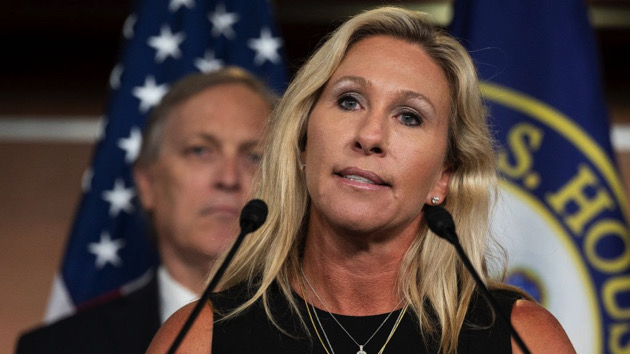
(WASHINGTON) — GOP Rep. Marjorie Taylor Greene on Friday became the first member of Congress to publicly testify under oath about the events surrounding the Jan. 6 attack on the Capitol.
Monday night, a federal judge allowed a legal challenge by a group of Georgia voters to move forward as they seek to disqualify Greene from running for reelection, citing her alleged role in supporting the attack.
The voters argue a provision of the Constitution’s Fourteenth Amendment known as the “disqualification clause” prevents Greene from holding federal office.
Passed after the Civil War, the disqualification clause bars any person from holding federal office who has previously taken an oath to protect the Constitution — including a member of Congress — who has “engaged in insurrection” against the United States or “given aid or comfort” to its “enemies.”
An avid supporter of former President Donald Trump, Greene has denied any involvement in the attack and said she is appealing.
Judge Charles Beaudrot presided over Friday’s hearing and expert witnesses were called to testify.
In his opening statement, Ron Fein, a lawyer representing five voters who made the complaint against Greene and the legal director of Free Speech For People, argued why Jan. 6 should be considered an insurrection.
“This was not the type of insurrection where the leaders were standing in Richmond, Virginia, giving long-winded speeches,” Fein said. “Rather, the leaders of this insurrection, of whom there were a number, were among us — on Facebook, Twitter and corners of social media that would make your stomach hurt. The evidence will show that Marjorie Taylor Greene was one of them.”
“The most powerful witness against Marjorie Taylor Greene’s candidacy, the most powerful witness in establishing that she crossed the line into engagement of insurrection is Marjorie Taylor Greene herself,” he said.
Fein told ABC News in an email that the Georgia “voters who filed this lawsuit have a right to have their challenge heard” and that he looked forward to questioning Greene under oath.
Inside the courtroom, he pressed the congresswoman on her oath of office.
“If you were aware that somebody was going to unlawfully interfere with the constitutional process of counting electoral votes, you would be obliged to have them arrested or stopped, right?” Fein asked.
She responded, “I had no knowledge of any examples, and so that’s the question I can’t answer.”
The time frame for the judge to render his decision on whether Greene should remain on the ballot is tight. Early voting for the Georgia primary begins May 2 and the primary itself is on May 17.
James Bopp, Greene’s attorney, told ABC News this week that the challenge to Greene is “absurd” and that it shouldn’t be up to judges to decide who represents Georgia’s 14th Congressional District.
“Those voters have a right to vote for the candidate of their choosing. And they have a right to have their vote counted,” he told the court in his opening statement Friday, adding that Greene was not a perpetrator but a “victim” of the attack, which he argued was “despicable” but not an insurrection.
“Her life was in danger, she thought,” Bopp said. “She was scared and confused.”
Bopp also represents GOP Rep. Madison Cawthorn, who is facing a similar challenge against his reelection from a group of voters in North Carolina.
Cawthorn’s lawsuit to dismiss the challenge to his reelection is set for oral arguments on May 3 before the U.S. Court of Appeals for the Fourth Circuit in Richmond, Virginia.
In an interview Tuesday with ABC News affiliate WTVC-TV, Greene called the legal challenge a “scam.”
“All I did was what I’m legally and allowed to do by the Constitution as a member of Congress, and that was I objected to Joe Biden’s Electoral College votes from a few states,” Greene said.
Greene also said she was a “victim” on Jan. 6.
Mike Rasbury, one of the voters challenging Greene’s eligibility to run for reelection, said in a statement that Greene “took an oath of office to protect democracy from all enemies foreign and domestic … However, she has flippantly ignored this oath and, based on her role in the January 6 insurrection, is disqualified under Section 3 of the 14th Amendment to the U.S. Constitution from holding any future public office.”
Rasbury was in the courtroom while Greene testified.
GOP Rep. Matt Gaetz of Florida was also present in the courtroom Friday, in an apparent show of solidarity with his fellow firebrand Republican.
Speaking on Fox News Monday night, Greene told host Tucker Carlson that Democrats are trying to keep her name off the ballot, maintaining she had nothing to do with the attack on the Capitol.
“I have to go to court on Friday and actually be questioned about something I’ve never been charged with and something I was completely against,” Greene said.
The challenges against Greene and Cawthorn are part of a larger legal effort to prevent anyone allegedly involved in the events surrounding Jan. 6 — or who supported it — from running for reelection.
Similar challenges are being brought against GOP Reps. Paul Gosar and Andy Biggs of Arizona and theoretically could be brought against Trump if he decides to run for office again in 2024.
(NEW YORK) — As the midterm elections inch closer and political conversations heat up, one organization is hoping to bring people together despite their differences.
America Talks, in partnership with Gannett and USA Today, launched in 2021 aiming to connect Americans of varying political ideologies. Participants in the online event answer a short survey and the questions ask how they feel about political topics so that they can be paired with someone who has different perspectives than their own. Then, they are matched with someone from across the country and given a guide to help foster the conversation. The idea is based on contact theory, a sociological concept that person-to-person contact can help reduce friction.
The second annual America Talks takes place on Saturday.
Brian Roy, an Independent from Benton, Kentucky, and Brian Webb, a Libertarian from Sheridan, Wyoming, found common ground and friendship during their America Talks conversation last year.
“We began to talk about the differences in Wyoming and in Kentucky. We talked about real everyday things that were not divisive and mean-spirited. And so we’ve continued that dialogue, and he sends me pictures and we talk and we talk about the weather, how cold it is in Wyoming versus how wet it is,” Roy told ABC News, adding that “he checked on us during the aftermath of the tornado back in December.”
“We just had a real genuine conversation, and you know what, we don’t enter into politics. So it’s been good and it’s refreshing, and I wish it would happen here more at home where I live, but it’s still very difficult to communicate with some people,” Roy said.
Mizell Stewart III, vice president of news performance, talent, and partnerships for Gannett told ABC News the program is about “elements of what Americans agree on rather than what divides Americans.”
“In other words, let’s engage people in conversation that is really person to person, not through a social media filter,” Stewart said.
Half of Americans who voted for Joe Biden and almost 60% who voted for Donald Trump view the opposing party as “presenting a clear and present danger to American democracy,” according to the University of Virginia Center for Politics.
And the divisions date back to before the Trump era. Since at least 2012, Americans are more likely to say conflicts between Democrats and Republicans are stronger than between other groups, according to a Pew Research Center study out of 17 countries. Americans also say the country is more divided now than it was before the pandemic.
“I am someone that enjoys politics,” said Roy. “I enjoyed talking about politics up until about two or three years ago, and then it got so contentious, and it got so unfriendly, even among family and very close friends that it got to where it was just no longer a discussion that I wanted to join in.”
While divisions run high, the Pew Research Center also found both Republicans and Democrats when questioned had certain things in common, like wanting their preferred candidates to address the needs of all Americans “even if it means disappointing some of his supporters.”
According to Mizell, those kinds of commonalities are what America Talks is all about.
“…As we begin to peel away layers of expectations, if you will, in conversations like this and really engage in dialogue, what we find is that we have much more in common than we realize,” he said.
That is the lesson Roy has taken away.
“We’re all Americans. We all care about our local communities. We care about our state, we care about our country,” he said. “And when we get down into the weeds of partisan politics, everybody… is attracted to a sound bite, most of them negative, and that’s the sad part.”
“There’s no two-way conversation and I just wish people would relax, calm down,” he added. “When they look at the flag…I wish people would look at that and try to remember that we’re all in this together. And we can agree to disagree.”
(NEW YORK) — The New York City mother of two whose body was found inside a duffel bag had asked her alleged killer to leave her house “multiple times” before she was stabbed to death, according to prosecutors.
The suspect, handyman David Bonola, was arrested early Thursday, days after he allegedly stabbed Orsolya Gaal over 50 times, slashed her throat and dumped her body in her son’s hockey bag, the NYPD said.
Bonola, 44, and Gaal 51, had been having an off-and-on affair for two years, according to police.
Bonola allegedly killed Gaal in her Queens home early Saturday while her 13-year-old son was upstairs, officials said.
“Because she knew him, she let him into the house. He then engaged her in a verbal dispute and unfortunately she had to ask him to leave multiple times,” assistant district attorney Josh Garland said.
Prosecutors said Bonola allegedly dragged Gaal’s body through “a quiet residential neighborhood,” leaving a trail of blood leading back to her home.
“Two boys are left without a mother and a young teenager faces the added trauma of being home when this heinous murder took place,” Queens District Attorney Melinda Katz said.
Police said Bonola offered to speak to authorities on Wednesday and made incriminating statements during questioning. Bonola was arrested just before 1 a.m. Thursday.
Bonola appeared in court Thursday and was ordered held without bail on second-degree murder charges. He was placed on suicide watch at the request of his defense attorney and is due back in court next week.
(GRAND RAPIDS, Mich.) — Nearly three weeks after the killing of 26-year-old Patrick Lyoya, his family, friends and activists are coming together to celebrate his life and call for justice in his death.
His funeral will take place Friday at 11 a.m. local time at the Renaissance Church of God in Christ in Grand Rapids, Michigan.
Civil rights activist Al Sharpton, civil rights attorney Ben Crump, who is representing the Lyoya family, Commissioner Robert Womack and bishop Dennis McMurray are expected to speak at the service, which is open to all masked attendees.
Lyoya, a native of Congo, was shot by an officer following a struggle outside a house in Grand Rapids on April 4 after he was pulled over for a faulty license plate, according to police.
Video of Lyoya’s death was recorded on an officer’s body camera, dashcam video, security cameras and a bystander’s cellphone and released by the police amidst community pressure last week.
The footage shows a white police officer, whose name has not yet been released, struggling with Lyoya after chasing him on foot following a traffic stop. The officer eventually forces Lyoya to the ground and is heard shouting “stop resisting,” “let go” and “drop the Taser,” before shooting him in the head.
The Grand Rapids Police Department has not yet named the officer involved in Lyoya’s death and says the investigation is “ongoing.” Michigan Gov. Gretchen Whitmer has said the investigation will be “thorough.”
Protesters have peacefully demonstrated in Grand Rapids since the release of the video footage, calling for justice for Lyoya.
(NEW YORK) — As Russia’s military gears up for what it hopes will be a decisive victory over Ukraine in the eastern part of the country, the U.S. is rushing to send weapons and equipment needed to hold off the larger invading force in the rural and open Donbas terrain — a far different battlefield from the urban fighting where Ukrainian forces held an advantage.
What could make all the difference now is the new $800 million military aid package for Ukraine President Joe Biden announced Thursday.
It’s a race against time — maybe a matter of weeks, a U.S. defense official said.
“Now they’ve launched and refocused their campaign to seize new territory in eastern Ukraine, and we’re in a critical window now of time where they’re going to set the stage for the next phase of this war,” Biden said of the Russian offensive, which U.S. military officials believe is just getting started.
“We know that time is not our friend,” Pentagon press secretary John Kirby told reporters Tuesday.
Russia gains by being closer to its border
With Ukrainian forces focused in the east, Russia intends to push down from the north, near the city of Izium, and up from the south, surrounding the Ukrainian defenders to “finish them or force them to surrender,” a senior U.S. official said Thursday.
If Russia takes the beleaguered city of Mariupol in the south, it could free up thousands of troops to join the push north to trap Ukraine forces, according to the official.
Although Russia and Ukraine have been battling over Donbas for eight years, Russia’s concentrated flow of troops and weapons into the region could bring “a whole different level of fighting,” Kirby said Tuesday.
There are now 85 battalion tactical groups (BTGs), Russia’s main fighting units, inside Ukraine, according to the official. Each BTG is made up of roughly 800-1,000 troops. About 10 of them crossed into the country this week, most heading to the Donbas region.
Kirby said the U.S. is focused on sending Ukraine weapons and systems that are not only useful for the rural eastern terrain, but that the Ukrainians can use in the fight without much training.
Russia, meanwhile, is trying not to repeat blunders it committed in northern Ukraine, and will enjoy certain geographic advantages in Donbas.
Early on, Russian invaders in the north were beset by supply problems, running out of food for troops and fuel for vehicles, failing to achieve any major victories. Pentagon officials believe they did not expect such strong resistance from Ukrainians so they didn’t adequately prepare for a prolonged fight.
But since withdrawing its troops in the north to focus on Donbas, Russia has been putting equipment and support forces in place ahead of its combat troops to favorably condition the battlefield.
“We believe that they are trying to learn from past mistakes, and you can see that in just the way they are conducting these shaping operations,” Kirby told reporters Monday. “They’re conducting themselves in ways that we didn’t see around Kyiv, for instance.”
Another advantage for Russia is that its logistics will be simplified by fighting closer to its own border, while Ukraine will now face the challenge of transporting heavy weapons and ammunition coming over its western border all the way across the country, meaning more miles for something to go wrong, and more chances for Russia to strike these vital shipments.
How US-provided artillery and radars could make a difference
To stand a chance fighting in the open Donbas landscape, Ukraine will need more long-range weapons and the ability to quickly move troops on the ground and in the air, according to Mick Mulroy, former deputy assistant secretary of defense for the Middle East and ABC News contributor.
The U.S. has sent Ukraine $3.4 billion of aid since the beginning of the invasion, including many thousands of shoulder-fired missiles, small arms and ammunition, body armor, and medical supplies. The two most recent packages, dedicating $800 million of aid each, announced April 13 and 21, were tailored to reflect the new battle space.
“It’s different,” Biden said Thursday. “It’s flat, it’s not in the mountains, and it requires different kinds of weapons to be more effective.”
To that end, the U.S. is sending 90 of its 155mm howitzers, which officials say will begin arriving over the weekend.
“This is going to be the king of battle out there,” Mulroy said.
While Ukraine already has Russian-made artillery pieces, the U.S. and most Western nations do not have the corresponding 152mm ammunition to offer as it runs through its limited stockpiles. The incoming U.S.-made 155mm guns will bring Ukrainian forces extra firepower, but also the ability to be better resupplied by the West.
To start, the U.S. is sending 184,000 artillery rounds along with the 90 weapons.
Russia has been flowing its own artillery into Donbas in preparation for its renewed offensive. To help Ukraine counter the threat, the U.S. is sending 14 radar systems that can detect incoming artillery and other indirect-fire attacks and find where they’re coming from.
“Right now the Russians are kind of just lobbing artillery without any consequence,” Mulroy said. “They want to give them a whole lot of consequence.”
The radar systems can help the Ukrainians accurately fire back.
“The counter radar is moving to theater this week,” a senior U.S. defense official said Thursday, adding that the howitzers and radar systems complement each other, but can also be used independently.
Training will be critical
About 50 Ukrainians are being trained on the U.S. howitzers outside of the country. This first group of trainees is expected to finish around the same time as the first artillery pieces arrive in their country, likely Sunday or Monday, according to a U.S. official. The U.S. is using a “train-the-trainer” approach so as not to pull too many high-demand troops away from the front — the small group of Ukrainians learning to use the new systems will return to their country to train fellow Ukrainian troops there.
The U.S. took a similar approach with the small, explosive Switchblade drones, hundreds of which are headed to Ukraine.
A small number of Ukrainians were in the U.S. for pre-scheduled military education when Russia invaded their country. The U.S. capitalized on their presence to add a couple days of training on the Switchblades, which are designed to fly directly into targets and explode.
“Although it’s not a very difficult system to operate, we took advantage of having them in the country to give them some rudimentary training on that,” a U.S. defense official said on April 6.
U.S. officials have said other systems being sent to Ukraine will also require a small period of training, likely to also take place outside of the country. Officials have declined to specify where such training could take place, citing operational security concerns.
With Russia intent on surrounding and trapping Ukrainian forces, the ability to move troops quickly by ground and air will be essential, according to Mulroy.
“They’re going to try to envelope the Ukrainians and cut them off and starve them,” he said. “So, the Ukrainians need to have the ability not to let that happen.”
Since the beginning of the invasion, the U.S. has given Ukraine 16 Mi-17 transport helicopters, each able to carry a three-person crew and up to 30 passengers.
Mulroy said an advantage of the Soviet-designed Mi-17 is that Ukrainian pilots already know how to fly them.
The U.S. has also offered Ukraine hundreds of armored personnel carriers that have tracks similar to those of tanks, as well as armored Humvees.
Weather will likely play a factor, and muddy conditions during Spring could limit vehicle mobility for both sides.
“Even just this week, the ground as it is makes it harder for them to operate off of paved roads and highways,” Kirby said.
Time is of the essence
Mulroy said the U.S. is doing a great job shipping military aid to the region, but believes more can be done to speed things up.
“We just have to take every opportunity to increase production and improve the flow, because it is going to make a difference,” he said.
The U.S. has not sent Ukraine any of its M1 Abrams tanks, officials saying they are too different from Ukraine’s T-72s to be useable in the short term. But other nations with the Soviet-era tanks have given theirs.
In total, Ukrainian forces have more tanks in their country than Russia’s military, a senior U.S. defense official said Thursday.
A less tangible but very real factor in the fighting so far has been troop morale.
The Pentagon sees evidence Russian forces are still suffering from low motivation and poor unit cohesion, according to officials.
“Almost half of their enlisted troops are conscripts who don’t receive a lot of training and who we have evidence, even recent evidence, that they’ve been disillusioned by this war,” the senior U.S. defense official said.
Meanwhile Russian officers are frustrated with the performance of other officers and of their own troops, according to the official.
Ukrainian troops have not seemed to suffer any significant morale problems, and throughout the war have been described by U.S. officials as brave and wily in defense of their homeland.
Biden praised the resolve of Ukrainians in a meeting with top military leaders at the White House Wednesday.
“I knew they were tough and proud, but I tell you what, they’re tougher and more proud than I thought,” Biden said.
(NEW YORK) — The ability for polar bears to survive in coming decades is becoming more uncertain as global warming continues to melt the Arctic at unprecedented rates, experts warn.
Now, biologists and conservationists determined to save the species have zeroed in on a plan to increase populations: focus on the survival of mothers and cubs, who find themselves increasingly vulnerable to dwindling habitat and food sources, they tell ABC News.
The “fundamental” key to the survival of polar bears is the availability of sea ice cover, Louise Archer, a researcher at the University of Toronto Scarborough’s Department of Biological Sciences, told ABC News.
The Arctic is currently warming twice as fast as the rest of the planet, according to the Arctic Report Card published by the National Oceanic and Atmospheric Administration in December, leaving the Arctic in a “dramatically different state,” with a substantial decline since 1979.
It takes an incredible amount of energy for mothers to raise their cubs, but ironically they are not the most efficient hunters, Archer said. They rely on the sea ice as a platform from which to access marine mammals from.
“So having access to sea ice is extremely important to ensure the survival of adults, but also, so that females can support the survival of their cubs,” Archer said.
One of the “biggest challenges” from global warming is bears will have to respond to sea ice conditions, or the lack thereof, that have never been experienced in the Arctic before, she said.
Polar bear mothers, especially, need nutrients because they lactate for up to two-and-a-half years, the entire time “the cubs are taking in energy from their moms,” Archer said.
When the cubs are born in the den, they only weigh about a pound or two, she said. But their mother has to raise them to about 10 to 20 pounds before she can go out onto the sea ice and hunt again.
All the months in hibernation are not spent sleeping. The mother is nursing, grooming the cubs and maintaining the den, which involves scratching the ceiling and walls with her claws to allow airflow. Otherwise, the den would get completely iced over, and no oxygen would be able to get in, Geoff York, senior director of conservation group Polar Bears International, told ABC News.
The mothers and cubs begin to emerge from their dens after four to eight months of not eating or drinking. The priority is to build up fat stores before the sea ice begins to melt in the summer. But if the sea ice is melting sooner, that’s less time for the mothers to hunt — and to teach her children to do so — and less time to regain the fat stores they lost while fasting and lactating in the den.
“Anything that sort of interrupts that sequence is potentially fatal to the reproductive attempt of the female,” Andrew Derocher, a professor of biological science at the University of Alberta, told ABC News. “It’s a chain of events that is incredibly sensitive to things like sea ice break up in the springtime — and that’s one of the key metrics that we monitor, is when is the ice breaking out.”
Derocher believes the mother-cub relationship is so integral because it is an “incredible part of their life history.” After they leave the den, the mothers have an incredible task of teaching the cubs to swim, hunt and one day survive on their own.
It is that relationship that provides a “powerful emotion and a very forceful narrative” for Disney’s new film Polar Bear, which follows a mother with her cubs as they embark on that journey, Alastair Fothergill, one of the directors of the film, told ABC News.
In the first years of a polar bear’s life, they are “extraordinarily dependent on their mother,” said Fothergill, who has been filming in the Arctic for more than 25 years.
The biggest change Fothergill has witnessed as a result of the ice melting is the new tricks mothers are teaching their cubs, such as climbing cliffs to get bird eggs and chicks, as well as learning to hunt walrus calves — a dangerous feat, as the mother walruses defend their young with their tusks. Previously, seals served as their primary source of food.
Experts have found that the health of a polar bear population can be determined by “three good winters,” York said. Last year, he witnessed a mother with triplet cubs in the Western Hudson Bay of Canada — an increasingly rare sight in a population that has declined 30% in the last 40 years.
“That’s kind of what polar bears need,” he said. “They need three good years to bring cubs from birth to sub adulthood and get them out of the sub population.”
One of the most profound phases of the mother-cub relationship is the moment the mother must leave her cubs, a “really risky and dangerous time for the polar bear,” he said.
“We say in the narrative that she knew she had taught her cubs everything she could, which is true,” he said. “But at the same time, she has to move on. She has to go and have another set of cubs.”
Researchers have found that in more solitary populations of polar bears that have had less access to sea ice, the bears are forced to fast for longer periods of time, Archer said. This has led to a decline of body condition, the decline in the survival of colds and the decline in the overall population abundance, she added.
The bears who live in the most southern regions are more at risk, and there could very well be a time when the subpopulations in the Arctic are the only ones to persist, Archer said. Places like Wrangel Island off of Russia offer a place for polar bears to retreat during times of significant ice loss, where they have access to walrus, York said.
Given the current climate change conditions, the ability for polar bears to feed and survive will become increasingly precarious — unless they can adapt and learn how to survive on terrestrial land, Archer hypothesized.
“Once the ice is inaccessible to bears, survival of bears is severely compromised,” she said.
When Derocher published a paper in 1993 about the potential effects of warming on polar bears, he did not think he would see those effects within his lifetime, he said.
“We thought this is something for future generations far away,” he said. “And what has surprised me is that the changes have been manifest in the populations so much sooner than we anticipated.”
It will be human activity and the ability for it to properly mitigate climate change that will ultimately determine the chances for polar bears to survive, York said. They are currently listed as vulnerable on the International Union for Conservation of Nature’s Red List of Threatened Species.
“That’s directly tied to actions we may or may not take to curb our greenhouse gas reductions,” he said.
You can stream Disney’s Polar Bear”starting on April 22 on Disney+. The Walt Disney Company is the parent company of ABC News.