(NEW YORK) — The coldest temperatures of this season so far have created black ice conditions in the mid-Atlantic states on Tuesday. A freeze warning was issued Tuesday along the Gulf Coast, where temperatures are near or below freezing.
A record 6.9 inches of snow fell at Reagan National Airport yesterday, with up to 10 inches of snow around the Washington, D.C., metro area.
The highest snowfall totals were in Virginia, Delaware and southern New Jersey where more than 14 inches of snow fell.
An Amtrak train with 220 passengers and six crew members is stranded in Lynchburg, Virginia, due to Monday’s storm. The train, which was headed to New York from New Orleans, was forced to return to Lynchburg after a separate train encountered downed power lines and trees, according to ABC 13 News.
A new cross-country storm could bring more snow for the Interstate 95 corridor following a heavy snowstorm. Traffic on I-95 was so bad, Virginia Sen. Tim Kane said he was trapped on the highway for 19 hours, following a multi-vehicle accident.
Interstate 84 was closed in Oregon on Monday due to whiteout conditions, leaving trucks and cars stuck on the highway.
Twenty states from California to Michigan are on alert for heavy snow and gusty winds. As much as 2 to 3 feet of snow is possible in the northern Rockies, with wind gusts over 75 miles per hour in some areas.
There is also a blizzard warning in place for the eastern Dakotas and northwestern Minnesota along with winter weather advisories and winter storm warnings. Several inches of snow is expected to fall Tuesday through Friday.
Wind chill alerts are in place from Montana to Iowa as wind chills on Wednesday morning will be well below zero. Parts of Montana and the Dakotas could see wind chills 30 to 50 degrees below zero on Tuesday night into Wednesday.
A new storm is now in the West moving through the Rockies, bringing heavy snow. This storm could reach the East Coast by Friday morning, bringing more snow to the I-95 corridor.
Both long-term storm models, European and American, are showing snow for the I-95 corridor by Friday morning.
Another bitter cold blast is on its way for the Midwest and eventually into the Northeast, behind this next storm. Temperatures could reach a low of zero degrees in Chicago and the teens in D.C. by the weekend.
(AURORA, Colo.) — A 14-year-old girl named Taniya Freeman went missing in Aurora, Colorado, over the weekend. Her family and the Aurora Police Department are now asking for the public’s help to locate her.
Taniya left her father’s home between 3 a.m. and 6 a.m. on Jan. 2 and they haven’t seen her since, her mother, Tiana Wilder, told ABC News.
Wilder urged her daughter to come home.
“We miss her. We love her, of course, and the safest place for her to be is here with us,” she said.
The Aurora Police Department said Taniya has long hair with pink streaks and may have a backpack with her. Wilder said that she believed her daughter was wearing a black hoodie and red pants.
Wilder said that her daughter doesn’t have a history of running away and that there wasn’t anything out of the ordinary, as far as arguments or yelling, that night.
“I have no idea who she is with; where she is at and that’s my concern,” Wilder said. “So as far as any harm coming, yeah, I am worried.”
Agent Matthew Longshore, a spokesperson for the Aurora Police Department, told ABC News that the department was working with limited information. “Our investigators are still following up on different leads and we’re trying to find her,” he said.
“If her friends know something, tell us. And [don’t] think that they are snitching on her or getting her trouble,” Wilder said. “Whatever they know that could be helpful is what we need to know.”
If you have any information about Taniya’s whereabouts, the police department said you can call Aurora911 at 303-627-3100.
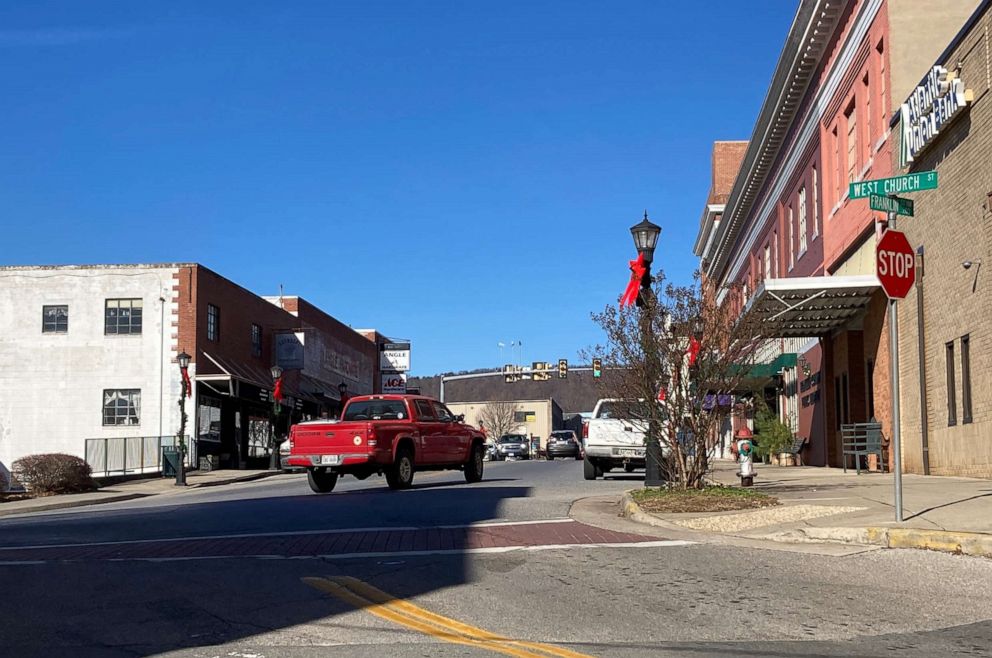
(ROCKY MOUNT, Va.) — A year after a violent mob stormed the U.S. Capitol 260 miles away, a quiet community in the foothills of the Blue Ridge Mountains is still reckoning with the fallout and ties to its Confederate past and conservative politics.
Rocky Mount, which is predominantly white and staunchly Republican, was thrust into the national spotlight on Jan. 6 after two of its active police officers were spotted among the crowd rampaging through the halls of Congress.
Jacob Fracker and Thomas Robertson, both military veterans, are among the 17 current or former law enforcement officers charged by federal authorities for alleged participation in the riot, according to an ABC News tally.
“They needed to be exposed, because it is not only just them. They’re just the body of the evil here,” said Rocky Mount native Bridgette Craighead, a small business owner, Black Lives Matter activist and former candidate for state delegate.
While the passions poured out at the Capitol surprised few – and have long since subsided, many residents say– the high-profile alleged involvement of two of their neighbors continues to roil the close-knit town.
“Everyone I’ve talked to was totally shocked that those two men would do that,” said Carol Yopp, a local artist and informal Rocky Mount historian. “In fact, I’ve never heard anyone say that they applaud them whether they agreed with what was happening or not.”
It was seven months before the riot that Fracker and Robertson were celebrated by local African American residents for standing in solidarity with demonstrators at the town’s first protest for Black Lives Matter. Cellphone video even shows the cops holding signs for racial justice and dancing the Electric Slide with organizers.
“I really felt we were the example of what a community needed to do to get through this type of trauma,” said Craighead who was encouraged by positive relationships forged that day.
On Jan. 6, however, that shining example of unity and budding personal friendships were shattered, she said. Circulation of Fracker and Robertson social media posts ripped open a deep and longstanding racial and political divide.
“I don’t see how you can support Black Lives Matter but then support the insurrection of the Capitol,” Craighead said, citing elements of racism and white power in the events that day. “It’s also hypocritical: You want us to be peaceful protesting but then you go be a part of a riot that was not so peaceful.”
Robertson wrote on Instagram that the men “attacked the government” to “stand up for their rights,” according to federal court documents. Fracker posted to Facebook: “I can protest for what I believe in.”
Craighead led calls to get the officers fired, which in turn made her a target of their supporters.
Both now-former officers have pleaded not guilty to federal charges of disorderly and disruptive conduct and obstruction of Congress. In local media interviews the men have insisted they didn’t participate in violence and that their message is not incompatible with support for black lives. Trial dates have not yet been set.
“They were both very polite gentlemen, and they were both town police officers. However, it is unfortunate that they are no longer employees of the town,” said J. Tyler Lee, a town councilman and friend of the former officers.
Lee, who at 29 is the youngest person ever elected to Rocky Mount government, has been urging his neighbors for the past year to turn the page.
“I think we have to leave the stuff a year ago, a year ago,” Lee said. “Because if we keep bringing up what happened a year ago, it’s still gonna keep punching us in the mouth. If we can just teach compassion, communication and how to balance a checkbook, those three things, I think you’re golden.”
By many accounts, healing has been slow going, and beneath the surface in Rocky Mount, emotions are still raw.
“People like to fantasize, I call it, saying you know it’s a good old Southern town and all the families get along, and everybody’s happy, etc. And I call that ‘the fantasy,’” said Franklin County school board member and Rocky Mount native Penny Blue.
Blue, who has led a campaign against the town’s Confederate monuments and symbols, considers the riot an extension of painful divisions over race, history and politics that date to the Civil War.
“It was an insurrection, and that’s what [the Confederates] did. It was an insurrection,” Blue said in an interview beside the town’s monument to Confederate dead, newly erected in 2010 after an older version was damaged.
“Trump did not radicalize these people,” she added of the rioters, “he took advantage of what was already here in Franklin County and America.”
The influence of Donald Trump is already shaping Rocky Mount’s next chapter.
Town voters last fall broke heavily for pro-Trump Republican Glen Youngkin for Virginia governor in a campaign dominated by debate over Critical Race Theory.
The town also tapped a new, more conservative representative to the state House of Delegates: a former member of Trump’s 2020 legal team who fought the election results, Wren Williams.
“Church and God is a big thing for us. History – we’re steeped in history and we feel as though people who don’t understand our way of life or they don’t resonate or connect with us,” Williams said of his landslide victory against Craighead in November.
Williams said he condemns the events of Jan. 6 as “riot” but that his constituents are not fixated on what he considers a small group of lawbreakers. “Go out into these small towns and actually see if anybody is talking about Jan six anymore because they’re not. They’re not discussing it,” he said.
While Williams is convinced Trump will run for president again in 2024, others in the community wait anxiously for word of the former president’s intentions. The omnipresence of Trump is complicating a path forward, some residents said.
“If you have any hope of healing, you’ve got to talk about what’s hurting,” said Rocky Mount United Methodist Church Pastor Will Waller. “I tend to believe honesty is the best policy. So, ripping off the band aid is the best way to move forward. So we talk about it. We’re unafraid here.”
A willingness to keep talking to each other was one of the few areas of common ground expressed by Rocky Mount residents on both sides of the political divide.
“We bringing up all these hurtful topics and subjects not to rub it in your face and bring up the past,” said Craighead, “but we have to bring up the past to learn from it, to move on and to heal.”
Lee agreed that respectful dialogue is essential. “At the end of the day, we all may disagree, but you still have to be able to stick your hand out and face it as a champ,” he said.
Waller said faith also has a role to play. “To grow some flowers, you got to disturb the dirt. This has been a disturbing year just like 2020 was, but I believe in growth, and it comes through sometimes seeing things messed up for a bit,” he said.
(WASHINGTON) — COVID treatments that work against the new omicron variant are in short supply, and Republican governors are accusing President Joe Biden of preventing their distribution by purchasing them in such bulk amounts that it prevents states from making their own purchases.
The alternative, though, could be a serious bidding war among states for treatments like antiviral pills and sotrovimab, the only monoclonal antibody believed to be effective against omicron. That’s what happened in the early days of the pandemic when governors fought over the purchase of ventilators, tests and masks and drove up prices.
Still, after an almost singular focus on buying vaccine doses, Biden is now under pressure to find new ways to boost production of treatments for people who become seriously ill from COVID, most of whom are unvaccinated.
“The federal government has cornered the entire market,” declared Florida GOP Gov. Ron DeSantis at a news conference Monday.
Likewise, in Texas, the health department there said several of its regional infusion centers had exhausted its supply of sotrovimab. Texas tied the shortage directly to Biden, noting in a statement “the federal government controls the distribution of monoclonal antibodies” and that the state ran out “due to the national shortage from the federal government.”
The Biden administration has acknowledged that life-saving treatments are in short supply because production has been unable to keep pace with omicron, which has rendered some treatments less effective and caused a sudden spike in cases.
“The low supply is something we need to worry about,” Dr. Anthony Fauci told governors in a private call last month about sotrovimab, according to a readout obtained by ABC News.
Another promising treatment — the new antiviral pill Paxlovid — is expected to begin rolling out this month, but probably won’t be widely available for several more months.
President Biden announced on Tuesday that he planned to double the federal purchase of pills from 10 million courses of treatment to 20 million with the first half available by June, rather than September. The pill is found to be 89% effective at reducing the risk of severe illness and death.
The practice of buying treatments and vaccines in bulk as a way to manage shortages and prevent bidding wars was initiated by the Trump administration. After then-President Donald Trump declared the federal government wasn’t a “shipping clerk” in early 2020, Republican and Democratic governors complained of inflated prices because they were directly competing with one another online.
Then, New York Democratic Gov. Andrew Cuomo compared it to “being on eBay with 50 other states, bidding on a ventilator.”
The Trump administration then slowly began amassing a stockpile of supplies that could be distributed around the country based on need. Trump’s Health and Human Services Department initiated bulk purchases of vaccines and therapeutics like Regeneron – a monoclonal antibody taken by Trump when he became ill with COVID.
Biden continued the practice, negotiating with companies to purchase additional vaccine shots and therapeutics and distributing to states for free based on population and risk factors.
But the spike in omicron cases has reignited a political debate on whether that’s the right approach.
Compounding the problem is that two monoclonal antibody treatments are believed not to work as well against omicron, at one point prompting the government to stop distributing them. The federal government has since resumed shipments upon finding it overestimated the number of omicron cases.
The Biden administration now says it will not distribute these types of monoclonal antibodies to regions where omicron comprises more than 80% of cases. The omicron variant is now estimated to account for 95% of new cases in the U.S., as of Jan. 1, according to new data released by the Centers for Disease Control and Prevention on Tuesday.
Not every Republican governor is blaming Biden for treatments being in short supply.
In a statement Monday, New Hampshire Gov. Chris Sununu said monoclonal antibody teams expected to arrive on Monday were delayed due to overwhelming demand.
“While we were surprised by the delay in their arrival, we are appreciative of the federal government’s assistance,” said Sununu in a statement. “Since making our initial request a month ago, their assistance has become even more critical now as we manage the peak of the winter surge.”
ABC’s Karen Travers, Will McDuffie and Arielle Mitropoulos contributed to this report.
(NEW YORK) — As the COVID-19 pandemic has swept the globe, more than 5.4 million people have died from the disease worldwide, including over 827,000 Americans, according to real-time data compiled by Johns Hopkins University’s Center for Systems Science and Engineering.
About 62% of the population in the United States is fully vaccinated against COVID-19, according to data from the Centers for Disease Control and Prevention.
Here’s how the news is developing. All times Eastern:
Jan 04, 9:54 am
Sweden’s King and Queen test positive for COVID-19
Sweden’s King Carl XVI Gustaf and Queen Silvia tested positive for COVID-19 last night, according to a palace statement.
Both are fully vaccinated and have received a third booster shot.
The king and queen said they have mild symptoms and are feeling well, in the statement.
They are isolating at home and contact tracing is ongoing.
Jan 04, 6:36 am
US reports 1 million new daily COVID cases
More than 1 million new COVID-19 cases were reported in the United States on Monday, according to Johns Hopkins University.
The 1,082,549 new infections were about double last week’s record daily cases, according to the university’s data. It was unclear whether the newly reported cases included backlogs from holiday testing.
The US recorded 1,688 deaths related to COVID-19 on Monday, below the record high of 4,442, set on Jan. 20, 2021, according to the university’s data.
Jan 04, 6:32 am
US reports record 325,000 new pediatric COVID infections last week
A record 325,000 children tested positive for COVID-19 last week amid the nation’s most significant COVID-19 infection surge yet, according to the American Academy of Pediatrics and the Children’s Hospital Association.
Children accounted for about 17.4% of last week’s reported COVID-19 cases, down from previous weeks, when children accounted for more than a quarter of all new cases.
A total of nearly 7.9 million children have tested positive for the virus, since the onset of the pandemic.
ABC News’ Arielle Mitropoulos
Jan 03, 4:02 pm
New York looking into COVID-19 hospitalizations that began for other reasons
New York’s hospitals will be required to report a breakdown of how many COVID-19 patients were admitted due to the coronavirus and how many were admitted for other needs and only discovered they were infected during their stays.
During a COVID-19 briefing on Monday, Gov. Kathy Hochul cited anecdotal reports of as many as 50% of patients at some hospitals testing positive for the virus who were actually admitted for other reasons, such as car accidents.
“I just want to always be honest with New Yorkers about how bad this is,” Hochul said. “Yes, the sheer number of people infected are high, but I want to see whether or not the hospitalizations correlate with that.”
She continued, “And I’m anticipating to see that at least a certain percentage overall are not being treated for COVID.”
Hospitals will begin reporting their breakdowns Tuesday, but it’s unclear how soon the data will be publicly available.
-ABC News’ Joshua Hoyos and Will McDuffie
Jan 03, 3:11 pm
Surgeon general warns next few weeks ‘will be tough’
U.S. Surgeon General Dr. Vivek Murthy warned that COVID-19 cases and hospitalizations will continue to increase as the omicron variant rapidly spreads across the country.
“The next few weeks are going to be tough for us,” he told ABC’s “The View” on Monday. “We’re already seeing record levels of cases, and we’re seeing hospitalizations starting to tick up. We’re seeing some of our hospital systems getting strained at this point.”
Information from South Africa and the United Kingdom indicates omicron could be less severe than previous COVID-19 variants, Murthy said.
“We’re still going to see a lot of people get sick and a lot of hospitalizations, but the overall severity may end up being significantly lower,” he said.
Murthy said both South Africa and the U.K. “had a very rapid rise, but then they had a very steep fall” in cases
“I’m hoping that that’s what happens here too,” he added.
(NEW YORK) — A research station in Antarctica is battling a COVID-19 outbreak despite being located in one of the most remote corners of the world.
Since mid-December, 16 of the 25 workers at Belgium’s Princess Elisabeth Polar Station have tested positive for the virus.
According to the French-language magazine Le Soir, the first positive COVID-19 case was confirmed on Dec. 14 in a worker who had traveled to Antarctica with a group via Belgium and South Africa.
Before arriving in South Africa, the workers were required to have a negative PCR test at least two hours prior to the flight. The employees then had to quarantine in South Africa for 10 days before taking another PCR test.
The group was again tested five days after arriving in Antarctica.
After the first infection was confirmed — seven days following arrival at the station — two more workers from the travel group tested positive.
The three patients were evacuated on Dec. 23, but the virus continued to spread throughout the station, according to Le Soir.
The workers had all been fully vaccinated against COVID-19 with at least one having received a booster shot.
All of the cases have been mild so far, Joseph Cheek, a project manager for the International Polar Foundation, which manages the outpost, told the BBC.
There are two emergency doctors on site with equipment necessary to treat patients if their symptoms become severe.
All of the scientists at the station were given the option to evacuate but they decided to stay to continue their research, according to Cheek.
“While it has been an inconvenience to have to quarantine certain members of the staff who caught the virus, it hasn’t significantly affected our work,” he said.
According to a virologist consulted by the Belgian Polar Secretariat — which manages administrative matters for the Princess Elisabeth station — it is likely that the workers were infected with the omicron variant, which makes up 99% of all COVID cases in South Africa, Le Soir reported.
All new arrivals to the Princess Elisabeth, which is the first zero emission polar station, are suspended until further notice.
The International Polar Foundation did not immediately reply to ABC News’ request for comment.
This is not the first time that a COVID-19 outbreak has been reported in Antarctica.
In December 2020, Chile announced that 36 cases of the virus had been confirmed at its Bernardo O’Higgins research station on the Antarctic Peninsula.
Despite Antarctica’s remote location, research and military stations have taken strict measures to prevent the spread COVID-19, including limiting the number of tourists and locking down bases.
(NEW YORK) — Former President Trump’s eldest son and daughter have refused to comply with subpoenas issued by the New York State attorney general’s office as it conducts a civil investigation into the way the family real estate business valued its holdings.
“A dispute has arisen between the OAG and the Individual Trump Parties regarding the Subpoenas,” a document filed Monday said.
The document, filed jointly by New York Attorney General Letitia James and an attorney for the Trump Organization, said Donald Trump Jr. and Ivanka Trump will now be named as respondents in James’ ongoing inquiry, which parallels a criminal investigation by the Manhattan District Attorney’s office.
“As her investigation into financial dealing of the Trump Organization continues, Attorney General James is seeking interviews under oath of Donald Trump, Donald Trump Jr., and Ivanka Trump,” a spokesperson for the AG’s office said. “Despite numerous attempts to delay our investigation by the Trump Organization, we are confident that our questions will be answered and the truth will be uncovered because no one is above the law.”
Donald Trump Jr. and Ivanka Trump sought to quash the subpoenas Monday evening in a motion.
Alan Futerfas, an attorney representing both Trump children, questioned James’ motives: her office is also involved in the criminal investigation of the Trump Organization.
“The goal of the subpoenas is all too clear: Attorney General James seeks to circumvent the entire grand jury process and nullify Moving Parties’ most fundamental constitutional and statutory rights by requesting that they provide non-immunized testimony to the OAG — when the OAG/DANY is jointly conducting a grand jury investigation,” Futerfas wrote in a motion to quash the subpoenas, which he said violate the rules of criminal procedure.
The former president and his company have denied wrongdoing and have attacked the investigation as political.
The ongoing criminal investigation has so far resulted in indictments against the Trump Organization and its longtime chief financial officer Allen Weisselberg on tax charges.
Prosecutors said the company had been paying Weisselberg’s rent, living expenses, private school tuition and car lease without proper reporting on tax returns. Both pleaded not guilty.
(NEW YORK) — In a hodgepodge of in-person, remote and delayed reopenings, millions of students across the country are set to head back to school after several weeks on winter break.
School districts in every state are using a variety of approaches and precautions to determine the best way to keep children and staffers safe amid the nation’s latest, and most significant, COVID-19 surge on record.
The return to school comes as the hospital admission rate among children has hit its highest point of the pandemic. Pediatric case rates are also approaching record highs.
During an appearance on ABC News’ This Week on Sunday, Dr. Anthony Fauci told George Stephanopoulos that even with the surge, he is still in support of keeping kids in school as much as possible.
“I plead with parents to please seriously consider vaccinating your children, wearing masks in the school setting, doing test-to-stay approaches when children get infected,” Fauci said. “I think all those things put together, it’s safe enough to get those kids back to school, balanced against the deleterious effects of keeping them out.”
Many districts in major cities across the country are forging ahead with reopening plans, with some requiring face masks or testing of students and staff ahead of the return as an additional precaution. However, dozens of other districts — including in Ohio, Georgia, Pennsylvania, Wisconsin and Michigan — are beginning the spring term remotely.
Atlanta
Citing a rapid surge in infections locally, Atlanta Public Schools will open virtually Tuesday for all students and all staff. The city plans to reopen in-person instruction on Jan. 10, according to the school district’s public guidance.
All staff are required to report to work on Monday, Jan. 3 for mandatory COVID-19 surveillance testing.
Boston
Students in Boston will return to the classroom Tuesday as the district rolls out its share of the state-supplied rapid COVID-19 tests.
Over the weekend, members of the Massachusetts National Guard began delivering 227,000 rapid COVID-19 tests to school districts across the state, to be used for teachers and staff.
Boston Mayor Michelle Wu and Boston Public Schools Superintendent Brenda Cassellius announced Monday that so far, 155 teachers and school staffers have reported positive COVID-19 tests.
Chicago
In Chicago, students returned to class Monday, according to the school district’s public guidance.
Testing is only mandatory for unvaccinated students who traveled to an “orange” state, per the city’s travel guidance, which now includes every state except Montana.
Unvaccinated students who are close contacts of a known COVID-19 case must stay home and quarantine for 10 days. Vaccinated students who are close contacts can attend school as long as they are not experiencing any COVID-19 symptoms.
The district also distributed 150,000 take-home test kits to schools to support the return.
Cleveland
Citing a “significant rise in COVID-19 cases in the community,” the Cleveland Metropolitan School District will move to remote learning for the week of Jan. 3.
Following a professional day for staff, students will log on and follow their class schedules Tuesday through Friday.
Detroit
The spring semester in Detroit will not begin until later this week at the earliest.
Employees will be required to take a COVID-19 test on Monday and Tuesday through the district, according to the school district’s public guidance. All students are also encouraged to take a test through the district this week.
The district said it cannot begin the semester online, due to the fact that not all of its students have laptops.
School officials said they expect to announce plans for Thursday and Friday on Wednesday afternoon or evening.
Los Angeles
Staff in all Los Angeles County schools are required to wear upgraded masks — surgical mask or higher-level PPE, according to the district’s latest guidance. Students are “strongly recommended” to wear well-fitted masks.
The district is also strongly recommending that all eligible staff and students receive a booster shot.
COVID-19 testing is required for all close contacts who are permitted to remain in school immediately after exposure, regardless of vaccination or booster status.
Miami
All staff will be required to wear face masks inside any Miami-Dade County Public School facility. Students are not required to wear face coverings, but masks are “highly encouraged.”
Protocols for the enhanced sanitization and cleaning of classrooms and common areas, which were implemented at the beginning of the pandemic, will continue, according to the district.
New York City
Beginning Monday, schools in New York City will distribute take-home COVID-19 tests to any student or staff who exhibits COVID-19 symptoms or has been potentially exposed in a classroom where a positive case has been identified.
“The numbers of transmissions are low; your children is in a safe space to learn and continue to thrive. We’ve lost almost two years of education … we can’t do it again,” New York City Mayor Eric Adams told Stephanopoulos on This Week.
Unvaccinated or not yet fully vaccinated students in kindergarten through grade 12 who were in close contact to a positive COVID-19 case will no longer have to quarantine, as long as they do not have symptoms and do not have a positive COVID-19 test.
Following an exposure, all students and adults will receive a take-home rapid test kit and take two tests over the course of five days. For students in 3-K and pre-K, the quarantine policy will remain the same, meaning students who were in close proximity to a positive case will still have to quarantine for 10 days.
Newark
Newark Public Schools began the semester Monday with remote instruction to continue through Jan. 14. The school anticipates a return to in-person instruction on Jan. 18.
Seattle
In-person school in Seattle is set to resume on Tuesday. COVID-19 testing is available Monday for students and staff.
Washington, D.C.
Last month, Mayor Muriel Bowser announced that D.C. public schools would require all students and staff to provide proof of a negative COVID-19 test result before returning to school on Thursday.
Schools were closed on Monday due to inclement weather faced by the district.
The district will make free rapid antigen tests available on Tuesday and Wednesday. DCPS families will need to upload their child’s negative test results.
(SAN DIEGO) — A California mom is entering 2022 debt-free after paying off more than $70,000 in student loan and credit card debt.
Amanda Courtney, 36, of San Diego, said she began falling into debt as soon as she entered college, nearly two decades ago.
“There was no way for me to go to college without taking out student loans, so I knew as I was applying for colleges that I was going to have to take out loans,” Courtney told Good Morning America. “I was kind of like, well, everyone takes out student loans, right? It’s fine.”
Courtney said she took out $15,000 in loans for her freshman year of college, and then also got into credit card debt when, at 18, she got a credit card without learning about how to budget and make her payments.
Over the next few years, Courtney said she transferred to two different colleges, including at one point living back at home and attending a community college, to try to lower her student loan debt.
When she graduated from college in 2008, the U.S. was in the midst of a financial crisis and Courtney said she could not find a job. Without a job, she could also not afford to pay off her student loans, she said.
“I continued to enroll in school just so I could defer my student loans because I couldn’t afford to make the minimum payments, all while continuing to accrue more credit card debt,” she said. “And I just fell deeper and deeper into debt.”
At age 25, Courtney, who now works as an administrative assistant at a San Diego high school, got a job working in education that allowed her to start to pay off her debt, but only with the minimum payments each month. She said she quickly learned that though she had deferred making payments on her student loans by taking low-cost community college classes for several years, the interest on her debt had continued to add up.
“I was deferring my loans, but I wasn’t deferring the interest, so though I was deferring making those payments, I was adding to my balance,” she said. “I didn’t have the financial literacy to understand what I was doing and the full implications of what I was doing.”
Courtney said that because federal loans and grants did not cover her full college tuition, she got a loan through a private loan company that carried what she described as an “insane interest rate.”
In the United States, Americans owe nearly $1.8 trillion in student loans, according to the Federal Reserve.
Coming from a family that did not discuss finances or budgeting, Courtney said she “truly did not know” what she was getting herself into when she signed up for student loans.
“I didn’t understand the economics of it and the commitment of it,” she said. “I think I just had this false sense of security that I’m working and I’m going to get a degree and then I’m going to have a job that can pay off the debt so it won’t be a big problem.”
“Then reality hits and you realize that’s not how any of this works and my $15,000 in loans very quickly becomes $30,000,” she said.
Things started to change for Courtney when she started dating her now-husband and they had conversations about their finances.
“I, very innocently, early in our relationship, was like so, ‘How much debt do you have?,'” she recalled. “He looked at me very plainly and said, ‘I don’t have any debt. How much do you have?'”
Courtney said she made a decision in that moment to be honest about her financial woes, and her now-husband worked with her to build a budget, the first time Courtney had done that in her life.
“I truly lived with this mindset that everybody lives with debt. Everybody has student loan debt. Everybody has credit card debt,” she said. “Having had that conversation with my now-husband, I started to think of money differently.”
With that foundation in place, Courtney spent the next nearly eight years paying off $50,000 in student loan debt and $12,000 in credit card debt.
She made her final student loan payment in September 2021.
“It took that long because I did it while still living my life,” said Courtney, who got married and gave birth to her first child and was at one point the sole income earner for her family in those eight years. “We built things into the budget so I felt this freedom to still live my life.”
Here are Courtney’s three tips for paying off debt.
1. Create a budget that works for you.
“The first thing you have to do is you have to be honest with yourself,” said Courtney. “So for me, that meant pulling out all of my credit card statements and all of my student loan balances, and really looking at where I was at, and making a plan.”
Courtney works on what she calls a zero-balance budget, which means that she directs each dollar in her paycheck to a specific location.
“Every month, a week before payday, I can actually view my paycheck, so on that day, I rebuild my budget every single month,” she said. “I look at what I have coming in versus what I have going out and I tell every dollar where to go.”
Courtney said she made sure that even while she was focused on paying off her debt, she allowed herself to continue to live her life.
“I was honest with myself, and I made a plan, but I made a realistic plan,” she said. “You have to allow yourself to go to that lunch celebration with friends. You have to allow yourself to buy yourself a new top every now and again.”
Courtney loves to travel, for example, so she created a special travel savings account that she directed money to each month. She said this allowed her to still travel while being financially responsible.
“If I want to go somewhere, I look at do I have enough in that travel account to go,” she said. “If I don’t, then I don’t get to go.”
2. Consolidate your loans, if possible.
A few years into her debt-paying journey, Courtney said she was able to consolidate her loans into one payment, which made it easier for her to track and pay off the loans.
“That was so freeing,” she said.
The U.S. Department of Education offers a Direct Consolidation loan with no fee.
3. Plan ahead instead of trying to catch up.
Courtney said she kept herself within her budget by learning to plan ahead for major events, like birthdays and holidays and vacations, instead of putting those expenses on credit cards.
“Whereas I always wanted to treat the holidays as an emergency and put it on my credit card and just make it rain in various stores, all of a sudden it was like, ‘Oh, I should be putting away money every month to get there and then look at what I have at the end of the year and look at what I can afford to do for people,'” she said. “One of the years, during my debt payoff, I made all of my Christmas presents for my friends and family.”
“I still felt like I got to give gifts, but I did so within my means,” she said.
4. Focus on small benchmarks at first.
Courtney said she at first focused on paying off her credit card with the lowest balance as a way to feel like she was making progress.
“I continued to make minimum payments on my other [credit cards], but I really focused on that one because I wanted to feel accomplished,” she said. “And when I paid off that first credit card, I remember, it felt so good.”
“It started to feel like, oh, I can do this I can make headway,” Courtney recalled. “Just with every little benchmark, it felt so great and so exciting.”
(NEW YORK) — As the COVID-19 pandemic has swept the globe, more than 5.4 million people have died from the disease worldwide, including over 827,000 Americans, according to real-time data compiled by Johns Hopkins University’s Center for Systems Science and Engineering.
About 62% of the population in the United States is fully vaccinated against COVID-19, according to data from the Centers for Disease Control and Prevention.
Here’s how the news is developing. All times Eastern:
Jan 04, 6:36 am
US reports 1 million new daily COVID cases
More than 1 million new COVID-19 cases were reported in the United States on Monday, according to Johns Hopkins University.
The 1,082,549 new infections were about double last week’s record daily cases, according to the university’s data. It was unclear whether the newly reported cases included backlogs from holiday testing.
The US recorded 1,688 deaths related to COVID-19 on Monday, below the record high of 4,442, set on Jan. 20, 2021, according to the university’s data.
Jan 04, 6:32 am
US reports record 325,000 new pediatric COVID infections last week
A record 325,000 children tested positive for COVID-19 last week amid the nation’s most significant COVID-19 infection surge yet, according to the American Academy of Pediatrics and the Children’s Hospital Association.
Children accounted for about 17.4% of last week’s reported COVID-19 cases, down from previous weeks, when children accounted for more than a quarter of all new cases.
A total of nearly 7.9 million children have tested positive for the virus, since the onset of the pandemic.
ABC News’ Arielle Mitropoulos
Jan 03, 4:02 pm
New York looking into COVID-19 hospitalizations that began for other reasons
New York’s hospitals will be required to report a breakdown of how many COVID-19 patients were admitted due to the coronavirus and how many were admitted for other needs and only discovered they were infected during their stays.
During a COVID-19 briefing on Monday, Gov. Kathy Hochul cited anecdotal reports of as many as 50% of patients at some hospitals testing positive for the virus who were actually admitted for other reasons, such as car accidents.
“I just want to always be honest with New Yorkers about how bad this is,” Hochul said. “Yes, the sheer number of people infected are high, but I want to see whether or not the hospitalizations correlate with that.”
She continued, “And I’m anticipating to see that at least a certain percentage overall are not being treated for COVID.”
Hospitals will begin reporting their breakdowns Tuesday, but it’s unclear how soon the data will be publicly available.
-ABC News’ Joshua Hoyos and Will McDuffie
Jan 03, 3:11 pm
Surgeon general warns next few weeks ‘will be tough’
U.S. Surgeon General Dr. Vivek Murthy warned that COVID-19 cases and hospitalizations will continue to increase as the omicron variant rapidly spreads across the country.
“The next few weeks are going to be tough for us,” he told ABC’s “The View” on Monday. “We’re already seeing record levels of cases, and we’re seeing hospitalizations starting to tick up. We’re seeing some of our hospital systems getting strained at this point.”
Information from South Africa and the United Kingdom indicates omicron could be less severe than previous COVID-19 variants, Murthy said.
“We’re still going to see a lot of people get sick and a lot of hospitalizations, but the overall severity may end up being significantly lower,” he said.
Murthy said both South Africa and the U.K. “had a very rapid rise, but then they had a very steep fall” in cases
“I’m hoping that that’s what happens here too,” he added.