(NEW YORK) — This year is expected to be the busiest on record for holiday travel, but rough weather can make getting to your Christmas destination even harder.
As a life-threatening storm heads to California, here’s a look at the Christmas week weather forecast:
Tuesday
Snow is falling in the Northeast on Tuesday. Up to 1 inch of snow is possible along the Interstate 95 corridor from New York City to Boston, but that snow may not accumulate much at all.
While New York City won’t have a white Christmas, this snowfall will bring a white Christmas to inland New England. Up to 6 inches of snow is possible in upstate New York, Vermont and New Hampshire, while more than 6 inches is possible in parts of Maine.
In Southern California, those driving to their Christmas destination should try to head out the door during the day on Tuesday, because a dangerous storm will move in with heavy rain on Tuesday night and continue through Wednesday.
On Christmas Eve, the weather will be calm across most of the country — but not for California.
Residents of Southern California — including densely-populated Los Angeles County — are bracing for an 18-hour-long downpour on Wednesday that’ll bring life-threatening flooding.
Four to 7 inches of rain is forecast, and some areas could even top 9 inches. This is an incredible amount of rain over an area that usually records 2.4 inches of rain in the month of December.
Wind gusts could reach 70 mph from Tuesday to Thursday.
Residents should be prepared for significant road flooding, rising rivers and mudslides and rockslides as the debris flow could impact recent burn scar areas.
Those traveling for Christmas should expect road closures and flight delays.
Thursday
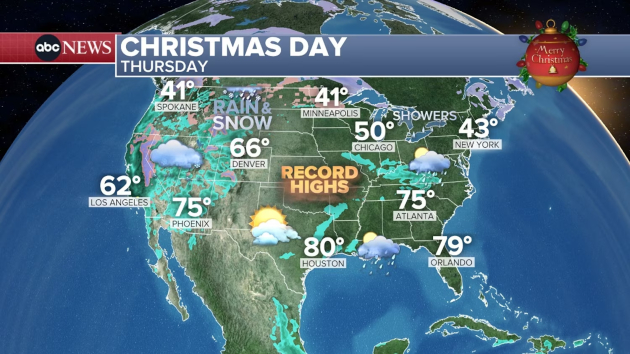
On Christmas Day, record high temperatures are possible for millions from the Midwest to the South.
Temperatures are forecast to soar to record highs of 66 degrees in Albuquerque, New Mexico; 71 degrees in Rapid City, South Dakota; 79 degrees in Midland, Texas; 78 degrees in Tulsa, Oklahoma; and 75 degrees in Atlanta.
While not record highs, temperatures could also jump to 80 degrees in Austin and Houston, 79 degrees in Miami and Orlando, Florida, and 75 degrees in Memphis, Tennessee.
One of the only parts of the country that has a good chance for a white Christmas is inland New England, where the snow from Tuesday could linger on the ground through Christmas Day.
Some mountainous areas in Washington, Oregon, Idaho, Montana, Colorado and California will also see a white Christmas.
Meanwhile, the rough weather will continue for California, with another round of rain on Christmas Day. The ground in Southern California will be so vulnerable at that point from Wednesday’s rain, so the new round of rain could trigger renewed flooding, landslides and debris flows.
(NEW YORK) — The U.S. economy expanded more than economists expected over a recent three-month period, recording robust growth despite concerns about sluggish hiring and cash-strappped shoppers, federal government data on Tuesday showed.
The U.S. economy grew at an annualized rate of 4.3% in the third quarter in the government’s initial estimate, marking an acceleration from 3.8% growth recorded in the previous quarter.
A boost in consumer spending helped propel the economic surge in gross domestic product (GDP) over three months ending in September, the U.S. Commerce Department said. Consumer spending, which accounts for about two-thirds of U.S. economic activity, is a key bellwether for the outlook of the nation’s economy.
The GDP reading stemmed in part from a rise in exports and a drop-off in imports, which may have resulted from tariffs issued earlier this year by President Donald Trump.
The government’s GDP formula subtracts imports in an effort to exclude foreign production from the calculation of total goods and services.
The strong economic growth in the third quarter appeared to defy fears about the sluggish labor market, which some observers have viewed as a warning sign for the wider economy.
Hiring slowed sharply in recent months. The unemployment rate ticked up to 4.6% in November from 4.4% in September. Unemployment remains low by historical standards but has inched up to its highest level since 2021.
Meanwhile, inflation has hovered nearly a percentage point higher than the Federal Reserve’s target rate of 2%.
Those conditions have put the Fed in a bind, since the central bank must balance a dual mandate to keep inflation under control and maximize employment. To address pressure on both of its goals, the Fed primarily holds a single tool: interest rates.
Earlier this month, the Fed cut its benchmark interest rate a quarter of a percentage point in an effort to boost hiring. The move amounted to the third rate cut this year, bringing the Fed’s benchmark rate to a level between 3.5% and 3.75%.
Interest rates have dropped significantly from a recent peak attained in 2023, but borrowing costs remain well above a 0% rate established at the outset of the COVID-19 pandemic.
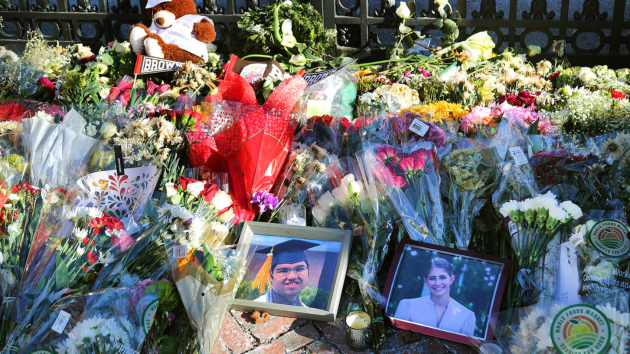
A memorial for shooting victims MukhammadAziz Umurzokov and Ella Cook at the Van Wickle Gates on the campus of Brown University on December 16, 2025. (John Tlumacki/The Boston Globe via Getty Images)
(NEW YORK) — Brown University is moving forward with a series of safety and security steps following the deadly shooting on campus this month that left two students dead and nine others injured.
The Ivy League university’s announcement comes the same day the Department of Education announced it would be reviewing the school for potential Clery Act violations.
Brown University’s review includes putting Rodney Chatman, the vice president for public safety and emergency management for the school on leave, effective immediately, the university’s president announced on Monday.
The former chief of police of the Providence Police Department, Hugh T. Clements, will serve as interim chief.
In a message to the campus community, President Christina H. Paxson said the university will first focus on immediate safety measures through a rapid response team working to ensure the campus remains secure during winter break and ahead of the Spring 2026 semester.
The university will also hire outside experts to conduct an after-action review of the shooting. That review will examine campus safety conditions leading up to the incident, how the university prepared for and responded on the day of the shooting, and how emergency response efforts were handled afterward.
The Department of Education said on Monday its Office of Federal Student Aid will investigate if Brown violated Section 485(f) of the Higher Education Act, otherwise known as the Jeanne Clery Campus Safety Act, which requires institutions of higher education to meet certain campus safety and security-related requirements as a condition of receiving federal student aid.
“The Department is initiating a review of Brown to determine if it has upheld its obligation under the law to vigilantly maintain campus security,” said U.S. Secretary of Education Linda McMahon in a statement. “Students deserve to feel safe at school, and every university across this nation must protect their students and be equipped with adequate resources to aid law enforcement.”
“The Trump Administration will fight to ensure that recipients of federal funding are vigorously protecting students’ safety and following security procedures as required under federal law,” McMahon added.
The Clery Act requires colleges and universities receiving federal student aid to annually share a report on campus crime and details about the efforts taken to improve campus safety, “including timely issuance of campus alerts and safety procedures to the campus community,” according to the Dept. of Education
The Department said it can fine universities that have violated the Clery Act and “may require them to make policy changes to come into compliance with the law.”
In the statement on Monday, Brown University also announced it will launch a comprehensive external safety and security assessment of its campus. The review will look at existing policies, procedures, training and security infrastructure, including building access, cameras, and other safety technology. The assessment will build on security improvements already underway.
Both reviews will be overseen by a committee of the Corporation of Brown University, which will approve the outside organizations conducting the work. University leaders said they plan to share key findings with the campus community and the public.
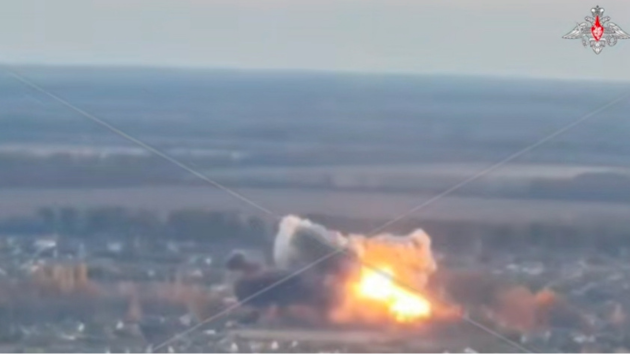
A screen grab from a video shows Russian Su-34 fighter-bomber carries out a strike in settlement of Vilcha in the Kharkiv region, Ukraine on December 23, 2025. (The Russian Ministry of Defense/Anadolu via Getty Images)
(LONDON) — Russia launched a “massive” drone and missile strike on Ukraine overnight into Tuesday morning, Ukrainian President Volodymyr Zelenskyy said in a post to Telegram, prompting power outages in several regions around the country, according to the Energy Ministry in Kyiv.
Ukraine’s air force said Russia launched 635 drones and 38 missiles into the country overnight, of which 587 drones and 34 missiles were shot down or suppressed. The impacts of missiles and drones were reported across 21 locations, the air force said.
Monday’s night’s attack was the largest Russian combined strike since Dec. 6, according to Ukrainian air force data analyzed by ABC News, and the third largest of the war to date.
Zelenskyy said Russia was “primarily targeting our energy sector, civilian infrastructure and literally all aspects of daily life.”
At least three people were killed — one person in Kyiv, one in Khmelnytskyi and a 4-year-old child in Zhytomyr — Zelenskyy said. At least 13 regions were targeted, he added. Local officials reported that at least 11 people were also injured across Ukraine.
The Energy Ministry said in a post to Telegram that “emergency power cuts have been introduced in a number of regions of Ukraine. As soon as the security situation allows, rescue workers and energy specialists will begin to repair the damage caused by the attack in order to restore power supply to the regions as quickly as possible.”
“Emergency power cuts will be lifted once the situation in the power grid has stabilized,” the ministry added.
Zelenskyy said the attack “sends an extremely clear signal about Russia’s priorities” as representatives from the warring parties engage in the latest round of U.S.-sponsored shuttle diplomacy intended to secure a peace deal.
“The attack comes just before Christmas, when people want to be with their families, at home, in safety,” he wrote. “The attack actually comes at the height of negotiations aimed at ending this war.”
Russian President Vladimir Putin, Zelenskyy said, “simply cannot accept the need to stop killing.”
“This means that the world is not putting enough pressure on Russia,” he added. “We need to react now. We need to push Russia towards peace and guaranteed security.” Zelenskyy also called for “air defense for Ukraine, funding for arms purchases, the supply of energy equipment” to help blunt Russian attacks.
Ukraine continued its own long-range strike campaign overnight, with the Russian Defense Ministry reporting the downing of at least 44 drones.
Airports in Volgograd, Grozny, Magas and Vladikavkaz were temporarily closed amid the attacks, according to Russia’s federal air transport agency, Rosaviatsiya.
In the Stavropol region, Gov. Vladimir Vladimirov said an attempted drone attack targeted facilities in Budennovsk, causing a fire in an industrial zone.
In the Rostov region, Gov. Yury Slyusar said drone debris damaged a fence and set fire to a house under construction in the village of Grushevskaya, which was later extinguished.
Meanwhile, on the diplomatic front, Ukrainian and Russian negotiators returned home after meetings with U.S. officials in Miami over the weekend.
Kremlin spokesman Dmitry Peskov said in remarks published Tuesday that Russia is waiting for information from the U.S. on talks with Ukrainian and European officials, after which he said Moscow would assess whether any developments “match the spirit of Anchorage” — referring to the summit between Putin and President Donald Trump in Alaska in August.
Russian negotiator Kirill Dmitriev said he had returned to Moscow after taking part in the Miami talks. Earlier, the Kremlin said he would brief Putin on his return.
Vice President JD Vance on Monday said recent talks had achieved a “breakthrough” in that “all the issues are actually out in the open.”
Peskov, though, told the Rossiya-1 television channel on Tuesday that Russia does not know what Vance was referring to.
Zelenskyy, meanwhile, said in social media posts on Monday that he will be briefed by the Ukrainian negotiating team on Tuesday morning. “There are 20 points of the plan,” he said. “Not everything is perfect so far, but this plan is in place.”
Zelenskyy said there is now a framework of security guarantees with European nations and the U.S. The “bilateral” and “legally binding” deal with the U.S. will need to be reviewed by Congress, he added. “As of today, this all looks quite solid and dignified. For now, however, these are working drafts prepared by our military.”
“This indicates that we are very close to a real outcome,” Zelenskyy added, noting that work was ongoing on a separate draft agreement regarding Ukraine’s economic recovery.
“There are certain things we are not prepared to accept,” Zelenskyy said. “And there are things — of that I am sure — that the Russians are not prepared to accept either. The Americans are currently continuing negotiations with Russian representatives. They will hold talks, and then we will receive feedback from them.”
Jeffrey Epstein is seen in this image released by the Department of Justice in Washington, December 19, 2025 (U.S. Justice Department)
(NEW YORK) — The Justice Department on Monday released additional documents from its files on the convicted sex offender Jeffrey Epstein.
Following a congressional mandate to release all of its Epstein files by Friday, the Justice Department on Friday released thousands of documents — ranging from investigative material to photos taken by Epstein and his friends — but said it was unable to fully release all the files by the deadline due to the vetting process required to protect Epstein’s victims.
A group of alleged Epstein victims on Monday accused the Justice Department of missteps, including violations of the law, in releasing what they said was “a fraction of the files,” which were “riddled with abnormal and extreme redactions with no explanation” while “numerous victim identities were left unredacted, causing real and immediate harm.”
Epstein, the wealthy financier and convicted sex offender, died by suicide in a New York jail in 2019.
The Epstein Transparency Act, passed last month by Congress and signed by President Donald Trump following blowback the administration received from MAGA supporters seeking the release of the materials, contains exemptions to protect victims’ identities, as well as exemptions for records that “would jeopardize an active federal investigation or ongoing prosecution, provided that such withholding is narrowly tailored and temporary.”
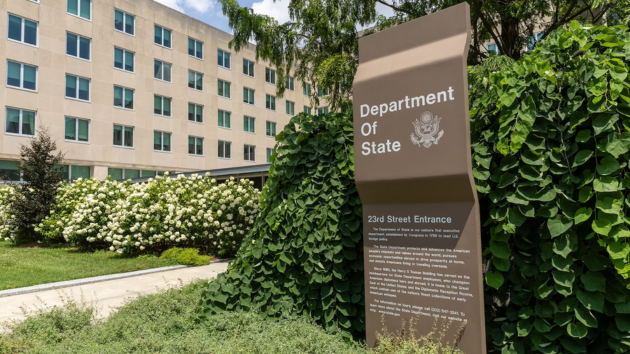
The Department of State building in Washington, July 11, 2025. Hu Yousong/Xinhua via Getty Images
(WASHINGTON) — The Trump administration is recalling dozens of career diplomats from overseas posts in the next month, according to a source familiar with the matter, the latest shakeup at the U.S. State Department.
More than two dozen senior diplomats have received notice that they must leave their roles in the next month, according to the source.
According to the American Foreign Service Association, the labor union that represents the U.S. foreign service and career diplomats, those affected by the recall report being notified by a phone call that they were being removed from their posts “abruptly,” with no explanation provided.
They were directed to vacate their posts by Jan. 15 or 16.
“This method is highly irregular,” a spokesperson for AFSA told ABC News.
“This is not normal practice. Career diplomats and ambassadors are not typically recalled in this manner. The lack of transparency and process breaks sharply with longstanding norms,” the spokesperson said.
Most of the impacted ambassadors are serving at U.S. diplomatic posts in Africa, but the removals also affect posts in Europe, Asia, the Middle East, and the Western Hemisphere.
A senior State Department official described the recall of the ambassadors as “a standard process in any administration.”
“An ambassador is a personal representative of the President, and it is the President’s right to ensure that he has individuals in these countries who advance the America First agenda,” they said.
The State Department declined to comment on specific numbers or ambassadors affected.
AFSA confirmed there is no official, verified list of recalled ambassadors.
There are various lists circulating that appear to be crowdsourced from people inside and outside the department, according AFSA.
POLITICO first reported on the removal of the diplomats.
The recall is the latest move by the Trump administration to reshape the State Department to align it more with its “America First” priorities. The recall comes after more than 1,300 officials and more than 240 foreign service officers were laid off earlier this year as part of what the administration said was a major reorganization aimed at increasing efficiency and reducing government size.
It is typically normal for new presidents to replace political appointments service in ambassador roles; however, career diplomats are typically allowed to continue serving in their roles.
The AFSA slammed the recall, saying it sends a “chilling signal” to career foreign service officers that their oaths to the Constitution take a backseat to political loyalty.
“Removing senior diplomats without cause undermines U.S. credibility abroad and sends a chilling signal to the professional Foreign Service: experience and an oath to the Constitution take a backseat to political loyalty. This is not how America leads,” the statement said.
AFSA says the recall represents “a steady erosion of norms, transparency, and professional independence in the Foreign Service.”
“Abrupt, unexplained recalls reflect the same pattern of institutional sabotage and politicization our survey data shows is already harming morale, effectiveness, and U.S. credibility abroad,” the spokesperson said.
AFSA is working with partners to confirm names one-by-one through direct contacts.
ABC News’ Luis Martinez and Josh Margolin contributed to this report.
Interior Secretary Doug Burgum speaks during an event with President Donald Trump in the Oval Office at the White House on October 06, 2025 in Washington, DC. Anna Moneymaker/Getty Images
(WASHINGTON) — The Trump administration is pausing leases for five offshore wind projects due to “national security concerns” identified by the Department of Defense, Interior Secretary Doug Burgum announced on Monday.
“Today’s action addresses emerging national security risks, including the rapid evolution of the relevant adversary technologies, and the vulnerabilities created by large-scale offshore wind projects with proximity near our east coast population centers,” Burgum said in a press release about the move.
The administration did not disclose what national security risks the wind farms posed, saying that the Department of Defense found the threats in “completed classified reports.”
“As for the national security risks inherent to large-scale offshore wind projects, unclassified reports from the U.S. Government have long found that the movement of massive turbine blades and the highly reflective towers create radar interference called ‘clutter.’ The clutter caused by offshore wind projects obscures legitimate moving targets and generates false targets in the vicinity of the wind projects,” the Department of the Interior said in its press release.
The action affects projects off the coasts of Massachusetts, Rhode Island, Connecticut, Virginia and New York.
According to the Department of the Interior, that five leases that will be affected are: Vineyard Wind 1 (OCS-A 0501), Revolution Wind (OCS-A 0486), CVOW – Commercial (OCS-A 0483), Sunrise Wind (OCS-A 0487) and Empire Wind 1 (OCS-A 0512).
Connecticut Gov. Ned Lamont called the move “yet another erratic, anti-business move by the Trump administration that will drive up the price of electricity in Connecticut and throughout the region.”
“This project is nearing completion and providing good-paying clean energy jobs,” Lamont said in a statement.
Burgum wrote in an X post about the move that the projects were “expensive, unreliable, heavily subsidized offshore wind farms.”
Trump has made clear his distaste for windmills in many public events and on the campaign trail.
“Wind is the worst,” Trump said in a speech in Pennsylvania earlier this month. He added in his remarks, “We don’t want — we don’t approve windmills. We don’t approve it. I’m sorry.”
During an overseas trip to Scotland in July, Trump told Europe to “stop the windmills.”
“You’re ruining your countries. I really mean it. It’s so sad. You fly over and you see these windmills all over the place, ruining your beautiful fields and valleys and killing your birds. And if they’re stuck in the ocean, ruining your oceans. Stop the windmills,” Trump said.
Wind is the country’s largest source of renewable energy, accounting for about 10% of electricity generated in the United States, according to the Department of Energy. Proponents say renewable energy is instrumental in reducing the global reliance on fossil fuels, and the industry continues to grow worldwide despite political challenges.
The Sierra Club, an environmental organization, criticized the Trump administration’s action on Monday.
“The Trump administration’s vengeance towards renewable energy knows no end. Instead of progressing us forward as a nation, they are obsessed with attacking a growing industry that provides good clean energy jobs and affordable, clean electricity. Americans need cheaper and more reliable energy that does not come at the expense of our health and futures,” Melinda Pierce, the group’s legislative director, said in a statement.
This screen grab taken from a video posted on the X account of U.S. Secretary of Homeland Security Kristi Noem shows a U.S. Coast Guard aircraft flying over a crude oil tanker, last docked in Venezuela, before apprehending it on Dec. 20, 2025. Handout/US Secretary of Homeland Security via Getty Images
(WASHINGTON) — President Donald Trump last week announced a “complete blockade of all sanctioned oil tankers going into and out of Venezuela,” ratcheting up the pressure on Nicolás Maduro’s regime as 15,000 U.S. troops and 11 warships stand ready in nearby waters — and leaving questions over the scope of the apparent escalation.
A naval blockade is considered an act of war under international law. But Trump’s reference to “sanctioned” tankers indicated U.S. operations would continue as a law enforcement crackdown by the U.S. Coast Guard, which seized an oil tanker off the Venezuelan coast last week and another over the weekend.
A Coast Guard interdiction is not a military operation; it is a court-authorized enforcement of U.S. sanctions.
According to retired Marine Corps Col. Steve Ganyard, a former State Department official and an ABC News contributor, the president’s orders, announced on his social media platform, amount to a legal quarantine — and not a blockade — because the post references only legally sanctioned tankers.
But Trump also referred to the Venezuelan regime as a Foreign Terrorist Organization (FTO), which could implicate any oil tanker that enters Venezuelan waters.
It wasn’t clear how the administration could designate the government as terrorists — or whether Trump was making reference to Cartel de los Soles, which the administration designated as a terror organization and has said is headed by Maduro.
What impact could a quarantine or blockade have?
Trump’s post last week “leaves more questions than answers,” said Clayton Seigle, a senior fellow at the Center for Strategic and International Studies. “What exactly are we going to do? How are we going to do it?”
“None of that is really detailed,” he said.
Whether the escalated pressure will target sanctioned vessels — or all vessels — remains an open question, but both approaches would impact Maduro, Seigle said.
“If you cut off all oil exports, and the associated revenues — and that’s a big if –then I think in a matter of weeks, the regime in Caracas would face extreme pressure,” he said.
If the U.S. continues to target only sanctioned tankers, “then I think that it could be a more prolonged runway for the regime to try to work something out, find a compromise, or even plan a deliberate exit.”
The U.S. says it has killed more than 100 people in the 25 strikes it says it has carried out on alleged drug smuggling boats since September.
Experts have pointed to President John F. Kennedy’s quarantine of Cuba in 1962 as an analogue to Trump’s approach — with unknown possibilities inviting risk.
“What if a ship doesn’t stop? This was the debate in the Cuban Missile Crisis,” Seigle said. “It’s all fun and games if they pull over and let [themselves] get boarded.”
“What if they don’t? Are you opening fire? Are you sinking ships?”
The announced blockade, though, “looks like it’s a relatively low-risk military operation” designed “to prevent” such a “quagmire,” Seigle said.
“Because if it goes smoothly and they’re able to cut off a lot of Maduro’s oil revenue, then they have a reasonable chance of getting the political outcome that they want, which is Maduro fleeing.”
Yet Trump on Wednesday wouldn’t offer a comment when asked if he sought regime change in Venezuela. Instead, he repeated a claim he said was a premise for blocking tankers.
“You remember, they took all of our energy rights,” he said of Venezuela. “They took all of our oil from not that long ago, and we want it back. But they took it. They illegally took it.”
Trump did not specify which period of nationalizations undertaken by the Venezuelan governments aggrieved the U.S. in his view.
An international arbitration court in 2013 ordered Caracas to pay $8.7 billion to U.S. firm ConocoPhillips, penalizing Venezuela for expropriation of crude assets in 2007 which it found to be unlawful.
Operating in the shadows The U.S. has sanctioned hundreds of oil tankers around the world which it says are part of an illicit network often called the “shadow fleet.”
27 of those designated tankers are operating in Venezuelan waters, according to Seigle.
Venezuela, Russia, and Iran “share that sanctioned fleet,” he added, and Venezuela’s slice is the smallest of the three.
A full quarter of China’s oil imports are produced by those sanctioned countries, Seigle said, leaving the country with “an outsized concern.”
“This is going to raise eyebrows and maybe raise concerns in Beijing among strategic planners that are responsible for making sure that they have enough oil,” he said.
Sanctioned tankers represent less than a fifth of the oil exported from Venezuela, according to Seigle.
“But I think it can have outsized effects in a number of important areas, including whether and for how long Maduro can hold out in a leadership position in Caracas, and also with regard to Venezuela’s biggest oil customer, which is China.”
Why call Maduro’s regime terrorists?
|As a part of Trump’s lengthy post on social media, the president also said the “Venezuelan regime” was an FTO, which the State Department designated it as in November.
Trump and State officials, including Secretary of State Marco Rubio, have repeatedly said Maduro is a narco-terrorist and the head of a narco-terrorist organization, adding that Maduro is not the legitimate leader of Venezuela.
Trump is likely referring to the designation of the Cartel de los Soles when he points to the “Venezuelan Regime” in his post.
The State Department alleges in its designation that Maduro and other high-ranking officials head the Cartel de los Soles and have “corrupted Venezuela’s military, intelligence, legislature, and judiciary.”
Maduro’s government categorically denies the existence of the cartel.
Secretary of Defense Pete Hegseth said in November that the designation of Maduro as a terrorist gives the U.S. more military options in its anti-trafficking operation and public pressure campaign on the Venezuelan president.
The FTO designation “brings a whole bunch of new options to the United States,” Hegseth said. “It gives more tools to our department to give options to the president.”
Legal experts have told ABC that the designation does not in itself constitute an authorization of force. But administration officials have consistently pointed to these designations publicly when disclosing strikes on alleged drug traffickers.
Notably, while the Maduro regime has been targeted as a foreign terrorist organization, the country of Venezuela has not yet been placed on the official “State Sponsor of Terrorism” list.
Only Iran, North Korea, Syria and Cuba are currently listed as state sponsors of terrorism.
(NEW YORK) — This year is expected to be the busiest on record for holiday travel, but rough weather can make getting to your Christmas destination even harder.
Here’s a look at the Christmas week weather forecast:
Tuesday
The Northeast will get some pre-Christmas snow on Tuesday. New York City will see snowfall from about 6 a.m. to noon, while Boston will get hit from 11 a.m. to 11 p.m.
About 1 inch of snow is expected along the Interstate 95 corridor and about 3 to 6 inches of snow is possible in the inland Northeast.
On the West Coast, those driving to their Christmas destination should try to head out the door during the day on Tuesday, because a storm will move in Tuesday night, bringing heavy rain and strong winds.
Wednesday
On Christmas Eve, the weather will be calm across most of the country — but not on the West Coast.
Heavy rain is forecast to fall on burn scar areas in Southern California, prompting a level 3 out of 4 risk for excessive rain and flash flooding.
Some parts of Southern California could see 9 inches of rain just on Tuesday night and Wednesday. Debris flows and landslides are also possible.
Thursday
On Christmas Day, record high temperatures are possible for millions from the Midwest to the South.
Temperatures are forecast to soar to record highs of 66 degrees in Albuquerque, New Mexico, and Rapid City, South Dakota; 79 degrees in Midland, Texas; 77 degrees in St. Louis, Missouri; and 75 degrees in Atlanta.
While not record highs, temperatures could also jump to 80 degrees in Austin and Houston, 79 degrees in Miami and Orlando, Florida, and 72 degrees in Memphis, Tennessee. It’ll even warm up to 53 degrees in Washington, D.C.
One of the only parts of the country that has a good chance for a white Christmas is inland New England, where the snow from Tuesday could linger on the ground through Christmas Day.
Some mountainous areas in Washington, Oregon, Idaho, Montana, Colorado and California will also see a white Christmas.
Meanwhile, the rough weather will continue on the West Coast, with another round of rain and mountain snow moving in on Christmas Day.
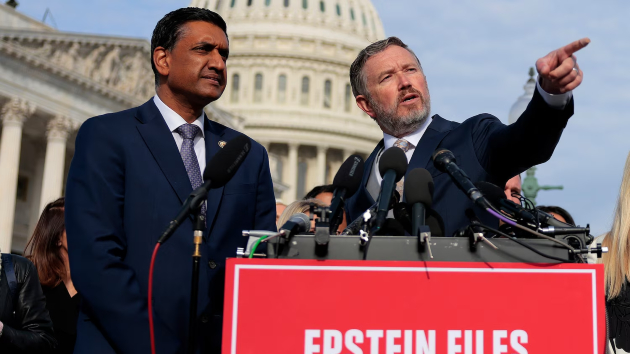
Rep. Thomas Massie speaks alongside Rep. Ro Khanna during a news conference on the Epstein Files Transparency Act outside the U.S. Capitol, November 18, 2025 in Washington. Heather Diehl/Getty Images
(WASHINGTON) — Minority Leader Chuck Schumer introduced legislation on Monday that would direct the Senate to initiate legal action to hold the Justice Department accountable for failing to release the complete files related to convicted sex offender Jeffrey Epstein by Friday’s deadline, which was mandated by the Epstein Files Transparency Act.
Schumer’s announcement came after Democratic Rep. Ro Khanna and Republican Rep. Thomas Massie announced on Sunday that they are pursuing “inherent contempt” charges against Attorney General Pam Bondi for not complying with the law to release the complete Epstein files.
If the effort passes, it could lead to Bondi’s arrest — though the pair is expected to introduce the resolution as “privileged” once the House returns in January, which would force a vote within two legislative days on the House floor, and it’s unclear if this effort would even be successful when it comes up for a vote.
“The law Congress passed is crystal clear: release the Epstein files in full so Americans can see the truth,” Schumer said in a statement. “Instead, the Trump Department of Justice dumped redactions and withheld the evidence — that breaks the law. Today, I am introducing a resolution to force the Senate to take legal action and compel this administration to comply.”
The DOJ faced a Friday deadline imposed by Congress and signed into law by the president to release a massive cache of records gathered during government investigations into the sex offender, who died in jail in 2019.
The Justice Department released thousands of files — ranging from investigative documents to grand jury testimony to snapshots taken by Epstein and his friends — but said it would fail to fully release all the files by the deadline. The law contains exceptions to protect victims and other circumstances, but critics say the DOJ is not following the letter and spirit of the law.
Schumer called the DOJ’s partial release on Friday a “blatant cover-up.”
“Pam Bondi and [Deputy Attorney General] Todd Blanche are shielding Donald Trump from accountability, and the Senate has a duty to act,” Schumer said.
Schumer is expected to force consideration of this bill on the Senate floor in January when the Senate returns from its holiday break. The bill would likely require unanimous consent to pass.
It is unclear if it would have that support, but the Senate unanimously passed the Epstein Transparency Act, which compelled the release of the Epstein documents.
On Sunday, Khanna and Massie, the co-authors of the Epstein Files Transparency Act, announced their intent to pursue inherent contempt proceedings.
The inherent contempt power permits Congress to rely on its own constitutional authority to detain and imprison a “contemnor” — someone held in contempt — until the individual complies with congressional demands like a subpoena or a monetary fine, according to the Congressional Research Service.
The power directs the Sergeant at Arms to arrest the individual who refuses to comply with a subpoena or fine, however, once the witness complies with the subpoena, they are released.
Notably, the resolution would not require passage in the Senate to be enforced.
“The quickest way, and I think most expeditious way, to get justice for these victims is to bring inherent contempt against Pam Bondi,” Massie said on “CBS News’ Face the Nation” on Sunday.
Khanna, who also appeared on the same program on Sunday, reiterated that inherent contempt is the right path at this point.
“We only need only need the House for inherent contempt, and we’re building a bipartisan coalition, and it would fine Pam Bondi for every day that she’s not releasing these documents. I’ll tell you why, I’ve talked to the survivors, why this is such a slap in the face,” Khanna said.
On NBC News’ “Meet the Press” on Sunday, Blanche said he wasn’t taking Massie and Khanna’s threats seriously because he said he believes they are in compliance with the law. Specifically regarding threats of legal action against the department, Blanche said, “Bring it on.”
A statement released Monday morning by attorneys representing a group of Epstein survivors said omissions in the files by either redactions or unreleased pages amounted to a failure.
“We are told that there are hundreds of thousands of pages of documents still unreleased,” the statement said.