
Prosecutor says cops made ‘conscious choice’ not to protect George Floyd

Prosecutor says cops made ‘conscious choice’ not to protect George Floyd
iStock/nirat

(NEW YORK) — Opening statements got underway Monday in the federal trial of three former Minnesota police officers charged in the death of George Floyd with a prosecutor telling the jury the defendants “made the conscious choice over and over again” not to protect the 46-year-old Black man.

Fired Minneapolis police officers J. Alexander Kueng, 28, Thomas Lane, 38, and Tou Thao, 35, are fighting charges stemming from their alleged roles in the deadly confrontation with Floyd who their one-time senior officer, Derek Chauvin, was convicted of murdering.

The trial, expected to last two to four weeks, is being held at the Warren E. Burger Federal Building in St. Paul.

The trial got underway just after 10 a.m. with U.S. District Court Judge Paul Magnuson swearing in the jury before calling on a federal prosecutor to give the first opening statement.

“In your custody, in your care,” Assistant U.S. Attorney Samantha Trepel told the jury, reading from the Minneapolis Police Department’s policy on how officers should treat people once taken to custody. The prosecutor added that it’s “not just a moral responsibility, it’s what the law requires under the U.S. Constitution.”

Trepel said the defendants were all trained in cardiopulmonary resuscitation, yet took no action to help save Floyd’s life as he claimed at least 25 times that he could not breathe, was rendered unconscious and lost a pulse.

“Here on May 25, 2020, for second after second, minute after minute, these three CPR-trained defendants stood or knelt next to Officer Chauvin as he slowly killed George Floyd right in front of them,” Trepel said.

She added that the officers each made the “conscious choice over and over again” not to act to protect a man they had in handcuffs and pinned to the pavement.

Trepel noted that in one of the videos of the episode, Tao, who was trying to keep a crowd at bay, was standing next to Chauvin but failed to stop the excessive force, rather telling witnesses, “This is why you don’t do drugs, kids.”

The prosecutor said Keung was kneeling on Floyd’s back the whole time and did nothing to stop Chauvin’s excessive use of force, even two minutes after he could not find Floyd’s pulse and after an ambulance crew arrived and could not detect a heartbeat.

Trepel said that despite being rookie cops, Lane and Keung had been extensively trained for 1 1/2 years, both being taught at the police academy many times to turn a subject onto their side when they are having trouble breathing.

“We will ask you to hold these men accountable for choosing to do nothing and watch a man die,” Trepel told the jury

Attorneys for each of the defendants are expected to follow with their own opening statements to the jury.

Following Trepel’s statement, Kueng’s attorney, Thomas Plunkett, made a motion for a mistrial, arguing that some of what Trepel’s told the jury was more argumentative than a preview of the evidence the prosecutors intend to present over the course of the trial.

Magnuson denied the motion.

Thao’s attorney, Robert Paule, acknowledged in his opening statement that Floyd’s death was a tragedy, but added, “a tragedy is not a crime.”

Paule told the jury that he expects the prosecution to lean heavily on the video evidence in the case, including footage taken by witness Darnella Fraizer, the then 17-year-old, who began recording when the officers already had Floyd handcuffed and prone on the ground. Paule told the jury that the video doesn’t tell the whole story and noted that Floyd was struggling and resisting the officers prior to Fraizer and other witnesses filming the encounter.

Paule told the jury that after hearing the evidence, the only verdict justified will be not guilty on all counts.

Keung’s attorney, Tom Plunkett, said Keung and Lane had only completed five shifts on the job by the time they became involved in Floyd’s fatal arrest and deferred to Chauvin, their field training officer with 19 years of law enforcement experience under his belt.

Plunkett said a field training officer “has great control over a young officer’s future in the Minneapolis Police Department.”

He said Chauvin was clearly in charge of the incident even though Lane should have been because he was the senior officer in the first squad car to arrive at the scene.

Lane’s attorney, Earl Gray, called the government’s case against his client a “perversion of justice.”

Gray said Floyd measured 6-foot-4 and 225 pounds and put the officer in a “scary” scenario when he struggled with them.

“He was all muscle,” Gray said of Floyd.

He said Lane “was totally concerned and did everything he could possibly do to help George Floyd.” He said Lane asked Chauvin and Kueng if they should turn the man on his side to help him breathe, but his suggestions were rejected.

“Not deliberatively indifferent about his health at all,” Gray said of Lane’s reactions during the episode.

Gray told the jury that Lane will testify during the trial.

Attorneys for the Floyd family released a statement earlier saying the trial is “another milestone in the long, slow journey to justice for George Floyd and his family.”

“This trial will be another painful experience for the Floyd family, who must once more relive his grueling death in excruciating detail,” the statement from the family’s attorneys said.

The 18-member jury, including six alternates, was impaneled in just one day, chosen on Thursday from a pool of 256 potential jurors. The jury is comprised of 11 women and seven men, none of whom are Black.

All three defendants are charged with using the “color of the law,” or their positions as police officers, to deprive Floyd of his civil rights by allegedly showing deliberate indifference to his medical needs as Chauvin dug his knee in the back of a handcuffed man’s neck for more than 9 minutes, ultimately killing him.

Kueng and Thao both face an additional charge alleging they knew Chauvin was kneeling on Floyd’s neck but did nothing to intervene to stop him. Lane, who was heard on police body camera footage asking if they should roll Floyd on his side to help ease his breathing, does not face that charge.

Kueng, Lane and Thao have pleaded not guilty.

Opening statements in the trial commenced a little over a month after Chauvin, 45, a former Minneapolis police officer, pleaded guilty to federal civil rights charges stemming from Floyd’s death and the abuse of a 14-year-old boy he bashed in the head with a flashlight in 2017. He admitted in the signed plea agreement with federal prosecutors that he knelt on the back of Floyd’s neck even as Floyd complained he could not breathe, fell unconscious and lost a pulse.

The guilty plea came after Chauvin was convicted in Minnesota state court in April of second-degree unintentional murder, third-degree murder and second-degree manslaughter. He was sentenced to 22 1/2 years in prison in the state case and is facing an even stiffer sentence in the federal case.

Kueng and Lane were rookies being trained by Chauvin at the time of Floyd’s fatal arrest.

The May 25, 2020, police encounter with Floyd, who was accused of using a counterfeit $20 bill to buy cigarettes at a convenience store, was recorded on video from start to finish and included multiple angles taken by bystanders with cellphones, police body cameras and surveillance cameras.

The footage showed Chauvin grinding his knee into the back of Floyd’s neck for 9 minutes and 29 seconds while Kueng helped keep Floyd down even after he stopped resisting by placing his knee on the man’s back and holding and lifting one of his handcuffed hands. Lane, according to the videos, held down Floyd’s feet.

Thao, according to footage, stood a few feet away, ordering a crowd to stand back despite several witnesses, including an off-duty firefighter, expressing concern for Floyd’s well-being.

Following the federal trial, Lane, Keung and Thao are facing a state trial on charges arising from Floyd’s death of aiding and abetting second-degree murder, and aiding and abetting second-degree manslaughter.

The three defendants have pleaded not guilty to the state charges.

ABC News’ Janel Klein contributed to this report.


Copyright © 2022, ABC Audio. All rights reserved.

Tesla files countersuit against JPMorgan, accuses bank of ‘illegitimate machinations’

Tesla files countersuit against JPMorgan, accuses bank of ‘illegitimate machinations’
iStock/jetcityimage

(NEW YORK) — Tesla filed a counterclaim against JPMorgan Chase Monday, the latest salvo in an ongoing battle between the electric automaker and the country’s biggest bank.

The lawsuit accused JPMorgan of filing “cynical litigation” when the bank sued Tesla last year, claiming it was owed $162 million when Tesla stock warrants expired.

In its counterclaim, Tesla accused JPMorgan of deploying “illegitimate machinations” and is seeking a declaratory judgment that it does not owe the bank the additional funds.

“Last year, JPM obtained billions of dollars’ worth of shares of Tesla’s common stock for a bargain price that the parties negotiated in 2014. Not content with this multibillion–dollar gain, JPM now seeks, through this cynical litigation, to extract an additional nine-figure windfall from Tesla,” the lawsuit said.

The legal dispute began after Tesla’s Elon Musk posted on Twitter that he was considering taking the company private. He took back the statement but was sued by securities regulators. Musk and the SEC settled for $20 million. Part of the settlement required him to step down as chairman of the company’s board of directors.

“JPM took improper advantage of a Twitter post from August 7, 2018 – nearly three years before the Warrants’ exercise dates – in which Elon Musk stated that he was considering taking Tesla private. Ten days after that tweet, JPM falsely asserted that the tweet constituted an announcement by Tesla of an extraordinary corporate transaction,” Tesla’s lawsuit said.

The stock warrants were arranged after JPMorgan handled a 2014 transaction for Tesla and allowed the bank to buy shares of the automaker at a fixed price, below market value, for a period of years. JPMorgan claimed Musk’s tweet impacted the value of those shares, leaving the bank entitled to an additional $162 million.

Tesla, which is represented by Quinn Emanuel’s Alex Spiro, the lawyer who successfully defended Musk from a defamation claim, is seeking to dismiss JPMorgan’s earlier lawsuit.

JPMorgan told ABC News in a statement, “There is no merit to their claim. This comes down to fulfilling contractual obligations.”

The dueling lawsuits add to the personal animus between Musk and JPMorgan’s CEO Jamie Dimon. Musk prefers to do business with other banks and JPMorgan recently inked a deal to be the primary lender to Tesla rival Rivian, The Wall Street Journal reported.


Copyright © 2022, ABC Audio. All rights reserved.

LA schools mandating non-cloth masks with nose wire, Atlanta district makes masks optional

LA schools mandating non-cloth masks with nose wire, Atlanta district makes masks optional
MoMo Productions/Getty Images

(LOS ANGELES) — Students in Los Angeles public schools must wear a non-cloth mask with a nose wire at all times, including during sports, beginning Monday, the district announced in a letter to families this weekend.

Schools will give surgical-style masks to students and employees who need them, Los Angeles Unified’s interim superintendent, Megan K. Reilly, wrote on Saturday.

The U.S. Centers for Disease Control and Prevention said this month that loosely woven cloth masks provide the least amount of protection.

LA County schools will also continue weekly testing for students and staff through February, Reilly said.

The interim superintendent said “in-school case rates dropped 7% since our baseline testing and current rates of students and staff are half of those in the general community due to the safety measures in place.”

COVID-19 cases in LA County remain high, with 39,117 new daily cases reported Saturday.

As Los Angeles County schools ban cloth masks, masks will be optional starting this week at Fulton County schools in Atlanta.

In-person learning resumed in Fulton County last week.

“Maintaining face-to-face instruction is a top priority for our district,” the school system said. “Though some employees have been out due to COVID, we intend to stay open, providing we have the staff to safely operate our schools.”

Of everyone PCR tested in Fulton County between Jan. 3 and Jan. 16, 2022, 25.2% were positive, according to county data.

Copyright © 2022, ABC Audio. All rights reserved.
NATO to put more forces on standby amid fears of Russian attack on Ukraine

NATO to put more forces on standby amid fears of Russian attack on Ukraine
Jakub Porzycki/NurPhoto via Getty Images

(KYIV, Ukraine) — Amid deepening anxiety over a possible Russian invasion of Ukraine, the United States announced it’s pulling out diplomats’ families and some staff from its embassy in the country. Meanwhile, NATO announced it was putting extra forces on standby.

As Russia continues to mass tens of thousands of troops close to Ukraine’s borders, NATO said the alliance was sending a small number of ships and fighter jets to Eastern Europe to strengthen its “deterrence” presence there and reassure its eastern members,

Denmark is sending a frigate to the Baltic Sea and four F-16 warplanes to Lithuania. At the same time, France is ready to send troops to Romania under NATO command, and Spain is considering deploying fighter jets to Bulgaria, NATO said in a statement. The Netherlands has agreed to send two F-35 jets to Bulgaria and has put a ship and land-based forces on standby for a NATO response force, officials said.

“NATO will continue to take all necessary measures to protect and defend all Allies, including by reinforcing the eastern part of the Alliance,” NATO’s Secretary General Jens Stoltenberg said in a statement.

The NATO announcement coincided with a report in The New York Times that the Biden administration may be preparing to send up to 5,000 American troops to Eastern European members of the alliance.

The White House and the Pentagon have not confirmed the report, though the administration has previously said sending more U.S. troops to Eastern Europe is on the table if Russia attacks Ukraine.

NATO on Monday said the “United States has also made clear that it is considering increasing its military presence in the eastern part of the Alliance.”

The steps to boost NATO’s readiness came as the U.S. State Department announced Sunday it was ordering the families of its diplomats at its embassy in Ukraine’s capital Kyiv to leave the country over security fears.

The State Department said it has also authorized non-emergency staff at the embassy to depart voluntarily.

The United Kingdom on Monday followed suit, with its Foreign Office saying some embassy staff and their dependents would be withdrawn “in response to the growing threat from Russia.”

Ukraine’s government criticized the U.S. evacuation calling them “premature” and “excessively cautious.”

“While we respect right of foreign nations to ensure safety & security of their diplomatic missions, we believe such a step to be a premature one & an instance of excessive caution,” Oleg Nikolenko, a spokesman for Ukraine’s foreign ministry, tweeted.

Ukrainian officials are unhappy with the message the evacuations send by suggesting that a Russian invasion could be imminent. In general, they are much more skeptical that Russia is planning to launch a major attack and worry that western countries risk helping Moscow by exaggerating the risk and spreading panic.

Privately, American officials acknowledge there is a gap between the Ukrainian and U.S. assessment of the level of threat. Speaking on condition of anonymity, a U.S. official told ABC News this weekend that Ukraine was “p—– off” over the evacuations.

A senior State Department official on Sunday insisted the embassy drawdown did not undermine America’s commitment to Ukraine, saying they were just “prudent precautions” given the heightened fear of a Russian attack.

The official said the decision was “based on this military buildup, based on how we see these developments,” calling it the “right moment.”

Those leaving the embassy will do so on commercial flights, the State Department has said, indicating it is not an emergency evacuation.

The State Department were scarred by the chaotic evacuation of Afghanistan, where thousands of Americans were stranded after the sudden Taliban takeover there caught the U.S. off guard. Officials are anxious to avoid a similar situation in Ukraine, should the worst happen.

Russia has repeatedly insisted it has no intention of attacking Ukraine. However, its military buildup continues near Ukraine’s eastern border and now in Belarus, where trainloads of Russian tanks and artillery have been arriving for joint exercises there.

A top commander of Russian-controlled separatist rebels in eastern Ukraine on Monday also accused Ukraine’s military of preparing to launch an offensive against the separatist areas.

The U.S. and Ukraine are concerned that a false claim of a Ukrainian offensive against the separatists could be used as a pretext for Russia to launch an invasion.

Eduard Basurin, the head of the militia of the separatists’ self-declared ‘People’s Republic of Donetsk’ (DNR), in local media warned it “firmly recommends the enemy to give up its criminal intentions,” promising the Ukrainian army “will suffer irreparable damage, after which it will not be able to recover.”

Ukraine’s government has insisted it will not launch any offensive and there is no evidence Ukraine is preparing to.

Copyright © 2022, ABC Audio. All rights reserved.

Fauci optimistic omicron will peak in February

Fauci optimistic omicron will peak in February
STEFANI REYNOLDS/POOL/AFP via Getty Images

(NEW YORK) — Dr. Anthony Fauci, the nation’s top infectious disease specialist, said Sunday he is “as confident as you can be” about the prospect of most states reaching a peak of omicron cases by mid-February.

“You never want to be overconfident when you’re dealing with this virus,” Fauci told ABC This Week co-anchor Martha Raddatz, adding that the COVID-19 virus has “surprised us in the past.”

“Things are looking good. We don’t want to get overconfident, but they look like they’re going in the right direction right now,” he said.

Fauci said there are states in the northeast and in the upper midwest where cases have already peaked and declined “rather sharply” but that cases are still rising in southern and western states.

“There may be a bit more pain and suffering with hospitalizations in those areas of the country that have not been fully vaccinated or have not gotten boosters,” he warned.

When Raddatz asked “what should life look like” going forward and about the “long-term strategy” for dealing with future peaks and variants, Fauci said the hope is the level of infection will be below what he calls an “area of control.”

“Control means you’re not eliminating it, you’re not eradicating it, but it gets down to such a low level, that it’s essentially integrated into the general respiratory infections that we have learned to live with.”

Fauci said the aspiration is that future variants won’t “disrupt society” or “create a fear of severe outcomes that are broad” but that the country should still be “prepared for the worst-case scenario.”

“We’d like it to get down to that level where it doesn’t disrupt us in the sense of getting back to a degree of normality. That’s the best-case scenario.”

As the Biden administration begins to ship out free COVID-19 tests to Americans and provide free masks across the country, Fauci told Raddatz these kinds of protections could help keep future variants at a “lower level.”

“What about the next booster shot?” Raddatz pressed, noting that it’s now been five months since some Americans received their booster. “How soon should we get another one?”

“We don’t know,” Fauci responded, adding that it’s unclear whether an additional booster shot will be recommended since scientists are still trying to determine how much protection is provided by the first booster. But, he said, it’s “quite conceivable, and I hope it’s true, that the third shot boost will give a much greater durability of protection.”

“We may need to boost again, but before we make that decision, we want to determine what the durability is,” Fauci added.

Data released on Tuesday shows that nearly 1 million children tested positive for COVID-19 last week, according to new a weekly report by the American Academy of Pediatrics and the Children’s Hospital Association, and 28.8 million eligible children still remain completely unvaccinated.

Some schools in the U.S. are opting to remove mask mandates, and when asked by Raddatz if it is “safe to send your kids back to school without masks,” Fauci stressed their importance, along with other mitigation efforts.

“You surround the children with people who are vaccinated. For the children who are eligible to be vaccinated, get them vaccinated. And provide in the school masks where you can have children protected, as well as ventilation to make sure that you can get a respiratory infection at its lowest level of infectivity. All of those things go together. And masking is a part of that.”

Copyright © 2022, ABC Audio. All rights reserved.

Supreme Court takes cases on future of affirmative action

Supreme Court takes cases on future of affirmative action
Mark Wilson/Getty Images

(WASHINGTON) — The U.S. Supreme Court on Monday said it would take up a pair of cases that could decide the future of affirmative action in college admissions.

The justices will hear appeals from a conservative student group that has been challenging the use of race as a factor in undergraduate admissions at Harvard University, the nation’s oldest private college, and the University of North Carolina, the nation’s oldest public state university.

It will be the first test on the issue for the court’s 6-3 conservative majority, following the retirement of Justice Anthony Kennedy and death of Justice Ruth Bader Ginsburg, both of whom defended race-conscious admissions.

The group which brought the case — Students for Fair Admissions — alleges that Asian American applicants have been illegally targeted by Harvard and rejected at a disproportionately higher rate in violation of Supreme Court precedent and the students’ constitutional rights.

Two lower federal courts have rejected these claims.

In the second case, the group alleges UNC refused to use workable race-neutral alternatives to achieve the stated goal of a diverse study body.

“Public schools have no legitimate interest in maintaining a precise racial balance,” the group wrote in its brief to the court. “The same Fourteenth Amendment that required public schools to dismantle segregation after [Brown v. Board of Education] cannot be cowed by the diktats of university administrators.”

That the Supreme Court has agreed to hear the cases is widely seen as an indication that the court could be willing to revisit its precedents on affirmative action and end the use of racial classifications in admissions altogether.

Chief Justice John Roberts has been among the most outspoken critics of affirmative action, famously declaring in a 2006 opinion, “It is a sordid business, this divvying us up by race.”

He and many of the court’s other conservatives have long argued that the best way to root out discrimination on the basis of race is to not permit discrimination on the basis of race.

“Harvard’s mistreatment of Asian-American applicants is appalling,” the plaintiffs wrote in their brief in the Harvard case. “That Harvard engages in racial balancing and ignores race-neutral alternatives also proves that Harvard does not use race as a last resort.”

In a series of decisions, beginning in 1978, the court said that race could be used as one factor among many when considering college admissions applications but that a school could not use quotas or mathematical formulas to diversify a class.

Harvard has defended the educational value and social benefits of admitting a diverse student body and rejected claims that it has given outsized importance to race.

“Harvard does not automatically award race-based tips but rather considers race only in a flexible and non-mechanical way; consideration of race benefits only highly qualified candidates; and Harvard does not discriminate against Asian-American applicants,” the school wrote the court in its brief.

The school is asking the court to affirm its precedent.

“The American public has looked to this precedent for assurance that the nation recognizes and values the benefits of diversity and that the path to leadership is open to all,” it wrote.

The cases join a blockbuster series of issues on the Supreme Court’s docket, including gun rights and abortion. It will likely be scheduled for oral argument this spring and decided by the end of June.

Copyright © 2022, ABC Audio. All rights reserved.
COVID-19 live updates: Scale of education lost ‘nearly insurmountable,’ UNICEF warns

COVID-19 live updates: Scale of education lost ‘nearly insurmountable,’ UNICEF warns
John Moore/Getty Image

(NEW YORK) — As the COVID-19 pandemic has swept the globe, more than 5.5 million people have died from the disease worldwide, including over 866,000 Americans, according to real-time data compiled by Johns Hopkins University’s Center for Systems Science and Engineering.

About 63.4% of the population in the United States is fully vaccinated against COVID-19, according to data from the Centers for Disease Control and Prevention.

Here’s how the news is developing. All times Eastern:

Jan 24, 7:45 am
Scale of education lost ‘nearly insurmountable,’ UNICEF warns

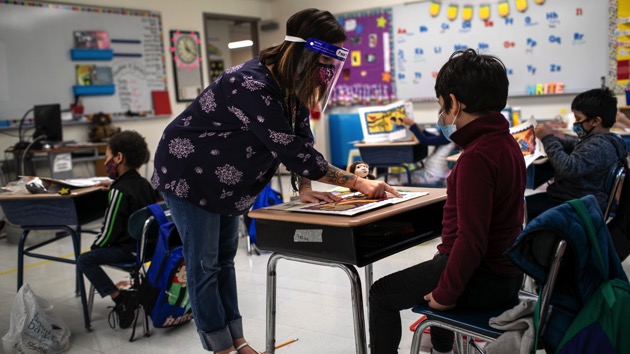
More than 635 million students around the world remain affected by full or partial school closures due to the coronavirus pandemic, according to the United Nations International Children’s Emergency Fund (UNICEF), which described the scale of education lost as “nearly insurmountable.”

“In March, we will mark two years of COVID-19-related disruptions to global education. Quite simply, we are looking at a nearly insurmountable scale of loss to children’s schooling,” Robert Jenkins, UNICEF chief of education, said in a statement Monday. “While the disruptions to learning must end, just reopening schools is not enough. Students need intensive support to recover lost education. Schools must also go beyond places of learning to rebuild children’s mental and physical health, social development and nutrition.”

As Monday marks the International Day of Education, UNICEF warned that many schoolchildren, especially the younger and more marginalized, have lost basic numeracy and literacy skills since the start of the pandemic in March 2020. In low- and middle-income countries, learning losses to school closures have left up to 70% of 10-year-olds unable to read or understand a simple text, up from 53% prior to the pandemic, according to UNICEF.

In Ethiopia, primary school children are estimated to have learned between 30% to 40% of the math they would have acquired if it had been a normal school year, UNICEF said.

In South Africa, schoolchildren are between 75% and a full school year behind where they should be. Some 400,000 to 500,000 students reportedly dropped out of school altogether between March 2020 and July 2021, according to UNICEF.

Across Brazil, one in 10 students aged 10 to 15 reported they are not planning to return to classrooms once schools reopen. In several Brazilian states, around three in four children in second grade are off-track in reading, up from one in two children prior to the pandemic, UNICEF said.

Meanwhile, learning losses have also been observed across the United States. In Texas, for example, two-thirds of children in third grade tested below their grade level in math in 2021, compared to half of children in 2019, according to UNICEF.

Copyright © 2022, ABC Audio. All rights reserved.

Stowaway survives 11-hour flight in wheel well from Africa to Europe

Stowaway survives 11-hour flight in wheel well from Africa to Europe
Jaromir Chalabala / EyeEm/Getty Images

(AMSTERDAM) — A stowaway was found alive in the nose wheel well of a cargo airplane that traveled from South Africa to the Netherlands on Sunday, according to Dutch police.

Authorities discovered the man hiding after the plane landed at Amsterdam’s Schiphol Airport on Sunday morning. He was taken to a hospital in stable condition, a Dutch police spokesperson told ABC News.

The man’s name has not been released. His age and nationality were unknown.

The freight flight flew 11 hours from Johannesburg to Amsterdam, with a stop in Nairobi. It was unclear whether the stowaway climbed into the aircraft’s landing gear in South Africa or in Kenya, the Dutch police spokesperson said.

An investigation into the incident is ongoing.

It’s unusual for stowaways to survive long flights, due to the cold temperatures and low oxygen levels at high altitudes.

Copyright © 2022, ABC Audio. All rights reserved.

House Republicans tout infrastructure funding they voted against

House Republicans tout infrastructure funding they voted against
Michael Godek/iStock

(WASHINGTON) — In November, Rep. Rob Wittman, R-Virginia, was one of 205 House Republicans to vote against the bipartisan, $1.5 trillion infrastructure bill, calling it irresponsible and the “Green New Deal in disguise.”

On Friday, he took to Twitter to tout funding from the bill he voted against — highlighting a $70 million expansion of the Port of Virginia in Norfolk — one of the busiest and deepest ports in the United States.

Wittman, who deleted the tweet Friday shortly after ABC News reached out to his office for comment, is the latest member of a growing group of Republicans celebrating new initiatives they originally opposed on the floor.

Shortly after voting against the measure last fall, Rep. Gary Palmer, R-Alabama, celebrated its hundreds of millions in funding for a stalled highway project in Birmingham.

Last week, Rep. Kay Granger, R-Texas, touted new funding for a flood control project from the package, which she opposed last year, decrying it at the time as a “so-called infrastructure bill.”

Rep. Ashley Hinson, R-Iowa, a freshman lawmaker who also voted against the infrastructure bill, celebrating new “game-changing” funding to upgrade locks along the Upper Mississippi River.

Thirteen House Republicans and 19 Senate Republicans — including Senate Minority Leader Mitch McConnell, R-Kentucky — voted with Democrats to approve the package, with many working with Democrats and the Biden White House on the details and legislative language.

“When I voted for the bipartisan infrastructure bill, I was voting for exactly this type of federal support for critical infrastructure that Iowans depend on,” Sen. Chuck Grassley, R-Iowa, said in a statement about the new lock and dam funding that Hinson also recognized.

Democrats have been quick to call out Republicans who voted against the infrastructure deal and recent COVID-19 relief package while praising elements of the legislation, criticizing them for “voting no and taking the dough.”

“When these Republicans had the chance to actually do something good for their constituents, they refused,” Nebeyatt Betre, a spokesperson for the Democratic Congressional Campaign Committee, said in a statement. “We’re not going to let them get away with this blatant attempt to rewrite history.”

Republicans have pushed back on the characterizations of their votes, arguing that they had issues with Democrats’ larger agenda that included the bipartisan package, called the Infrastructure Investment and Jobs Act.

“Congresswoman Hinson opposed the infrastructure package because it was tied to trillions of other spending in the House. Since the bill was signed into law, this money was going to be spent regardless. If there’s federal money on the table she is, of course, going to do everything she can to make sure it is reinvested in Iowa,” a spokesperson for Hinson told ABC News.

A spokesperson for Rep. Steve Scalise, R-Louisiana, the No. 2 House Republican who touted a $1 billion investment in flood protection and hurricane repairs in his home state funded by the package he opposed, told ABC News that the GOP whip has “consistently supported these flood protection projects” and approved earlier legislation to pave the way for them.

“What he did not support is tying necessary infrastructure needs to unrelated, Green New Deal policies Democrats put in their $1.2 trillion dollar bill — very little of which was dedicated to traditional infrastructure — that would cripple Louisiana’s energy economy and hurt workers and families in his state,” the spokesperson said.

“You can see why the Obama administration insisted on signage” for projects funded by the American Recovery Act, Jeff Davis, a senior fellow with the Eno Center for Transportation, told ABC News.

“People will be claiming these things for years, and it’s going to be hard to tell five years from now which projects were funded mostly or entirely with IIJA money or money out of the annual budget, he said.

Copyright © 2022, ABC Audio. All rights reserved.

Another violence interrupter killed in Baltimore as community reels from gun violence

Another violence interrupter killed in Baltimore as community reels from gun violence
Andre Chung for The Washington Post via Getty Images

(BALTIMORE) — A man who worked on the front lines of preventing gun violence in Baltimore, Maryland, was shot and killed on Wednesday night in a quadruple shooting on E. Monument Street, in the McElderry Park neighborhood.

Baltimore native DaShawn McGrier, 29, worked as a violence interrupter for Safe Streets and is the third member of the organization to be shot and killed in the last year.

“[DaShawn] was passionate about his community, and was working hard to make that community safer for his family, friends and neighbors,” said Meg Ward, Vice President of Strategic Growth and Community Partnerships at Living Classrooms — a nonprofit that operates two of the 10 Safe Streets sites in the city, including McElderry Park. “He was a son, he was a father, he was a partner. He was a brother, he was a devoted and present father to his child.”

According to Ward, McGrier was having a conversation with the other two victims while working at his post on Monument Street when the shooting occurred.

“Apparently, a tow truck came around the corner and they just shot up the block,” Ward said.

BPD identified the other victims as 28-year-old Tyrone Allen and 24-year-old Hassan Smith. A spokesperson told ABC News Friday that “no arrests have been made at this time.”

“We are dedicating every available resource to finding and apprehending the cowardly perpetrators of this act,” Baltimore Police Commissioner Michael Harrison said in a statement Wednesday.

When asked if this was a targeted shooting, police said the investigation is ongoing.

There have been more than 300 homicides in Baltimore each year for the past five years, with 338 in 2021 and 335 in 2020, BPD data shows.

Community members and Safe Streets workers gathered on E. Monument Street Saturday afternoon to honor McGrier and other victims of gun violence.

“What choices are we going to make? This is our community,” said Safe Streets violence interrupter Alex Long in a passionate speech at the event. “These shootings gotta stop.”

Baltimore Mayor Brandon Scott also attended the event and said that the city is “determined to honor DaShawn’s legacy in the best way we can — by expanding community violence interventions across the city.”

“[Safe Streets Baltimore] is not just an organization, but a calling. DaShawn believed that we could build a better Baltimore. Let’s show him that we can,” Scott tweeted, along with photos of the event.

Ward said Safe Streets organizes shooting response events to “denormalize” gun violence — especially in neighborhoods where shootings are common — by creating an opportunity for the community to come together to honor the victims and send the message that, “This is not OK.” And on Saturday, they honored one of their own.

Violence interrupters also connect individuals with resources such as job placement opportunities and financial support.

Ward said that McGrier had been working as a violence interrupter for a little over a month, but had been a part of the Safe Streets community for a long time. He was a “hard worker,” she said, who was a welding student at the North American Trade School during the day and worked at the Safe Streets McElderry Park site at night to help mediate conflicts that could lead to shootings.

“The work that is being done to stop this from happening is really, really important. And it makes it that much more important when you lose one of your own,” she said.

McGrier’s killing came as the Safe Streets community continues to mourn the deaths of two beloved longtime members who were killed over the past year and who had dedicated their lives to reducing gun violence.

Dante Barksdale, a Safe Streets outreach coordinator, and Kenyell “Benny” Wilson, a Safe Streets violence interrupter, were shot and killed in separate incidents in January and July. Two days before McGrier was killed, the community gathered to honor Barklesdale on the anniversary of his death.

“We were devastated, it was very traumatizing. It’s very difficult to say their names or to think of them, and to not feel that consistent void in our hearts, because they were definitely individuals who impacted the community in such an incredible way,” Rashad Singletary, the associate director of gun violence prevention at MONSE told ABC News last year. “And for them to lose their lives to the same thing that we tried to save thousands of lives from, it was very, very disheartening and tragic.”

How violence interrupter programs work

Safe Streets was launched in Baltimore in 2007 in the McElderry Park neighborhood. It is one of several violence prevention programs in the country that is based on a model that started in Chicago in the mid 1990s.

Violence interrupters also connect high risk individuals with resources that the organization offers, including job placement and financial support that could help alleviate some of the suffering — conditions that lead some to resort to violence.

What the data shows

Recent studies have shown that Safe Streets programs have been effective at reducing gun violence in various neighborhoods.

A 2012 study published by the Johns Hopkins Bloomberg School of Public Health found that Safe Streets workers were successful at reducing gun violence in three of four neighborhoods where the initial sites were established, Director of the Center for Gun Policy and Research at Johns Hopkins University Daniel Webster previously told ABC News.

Safe Streets workers mediated more than 2,300 conflicts in 2020, according to MONSE, and after gaining more funding from the city, the organization opened its tenth site in 2021.

“Safe Streets workers mediate the very types of conflicts we saw tonight,” Harrison said in a statement Wednesday. “All the Safe Streets workers are to be applauded for their work in reducing gun violence and promoting a message of redemption and peace to the many young people of our city.”

MONSE Director Shantay Jackson said that the mayor’s office will be providing support to the family of the victims and the staff, including grief counseling.

“This is a reminder of the courageous, yet dangerous job our frontline staff does each day when working with those at the highest risk of being a shooter or the victim of a shooting,” she said in a statement.

Ward said that the “tremendous loss” highlights the need for violence-prevention work in Baltimore.

“People are heartbroken,” she said, “and at the same time, [the] feeling or sense is this is the reason to double down.”

ABC News’ Abby Cruz and Kendall Ross contributed to this report.

Copyright © 2022, ABC Audio. All rights reserved.