(WASHINGTON) — At the dawn of the COVID-19 pandemic, vaccine makers raced to design a shot that perfectly matched the new virus’s genetic code. Their efforts were successful, resulting in highly effective vaccines in record time.
But the virus has continued to evolve into new, concerning variants, each with a slightly different genetic code. Although current vaccines still work well against new variants, they are no longer a perfect match.
Vaccine makers like Pfizer and Moderna are now exploring tweaked booster shots to match the now-dominant omicron variant, but the U.S. government is aggressively pursuing a different approach: a pan-coronavirus vaccine that would work equally well against any COVID-19 variant.
“Since September of 2020 there have been five SARS-CoV-2 variants of concern — alpha, beta, gamma, delta and now, the current, omicron,” Dr. Anthony Fauci said at a White House task force briefing Wednesday. “So, obviously, innovative approaches are needed.”
Fauci, who heads up the National Institute of Allergy and Infectious Diseases, has issued $43 million in research grants across several academic institutions to support development of a pan-coronavirus vaccine, sometimes called a “universal” coronavirus vaccine.
The idea, scientists say, is to create a vaccine that works as as a generalist rather than a specialist. A pan-coronavirus vaccine will be designed using features of the virus’s genetic code that are shared universally across all different versions of the virus — and hopefully, any new versions that will emerge.
Several research groups are already working on a pan-coronavirus vaccine, including scientists at the California Institute of Technology, Duke University, University of Washington, Brigham and Women’s Hospital in Boston and the University of Wisconsin, Madison.
But scientists at the Walter Reed Army Institute of Research are arguably the furthest along. The Army vaccine appears to work well in monkeys, and is now being tested for safety in a phase 1 study in human volunteers.
In a rare look inside the Walter Reed laboratories last year, ABC News’ Bob Woodruff spoke to a team of Army scientists hopeful that their vaccine candidate would work not only against COVID-19 variants, but also against related coronaviruses, like those that caused the SARS-1 and MERS outbreaks in 2003 and 2012, respectively.
But designing a pan-coronavirus vaccine is no easy feat. Scientists say it could take months, even years, to find a vaccine that works equally well against multiple coronavirus strains.
“I don’t want anyone to think that pan-coronavirus vaccines are literally around the corner in a month or two,” Fauci said. Current vaccines dramatically reduce the risk of hospitalization and severe illness, even against new variants like omicron. And crucially, they are available today.
“Do not wait to receive your primary vaccine regimen,” Fauci said. “If you are vaccinated, please get your booster if you are eligible.”
ABC News’ Matthew Seyler contributed to this report.
(WASHINGTON) — Officials at the Federal Reserve on Wednesday signaled that they could “soon” raise interest rates for the first time in three years, as inflation concerns cast a shadow over the pandemic-battered economy.
The central bankers said in a statement Wednesday that they were leaving rates unchanged for now, at near-zero levels, but with a recovering labor market and the threat of inflation, this will likely change in the near future.
“With inflation well above 2 percent and a strong labor market, the Committee expects it will soon be appropriate to raise the target range for the federal funds rate,” the Fed said in a statement Wednesday.
Federal Reserve Chair Jerome Powell said during his closely watched news conference Wednesday that the Fed’s “policy has been adapting to the evolving economic environment and will continue to do so,” alluding to the backdrop of elevated inflation and labor market gains.
“Economic activity expanded at a robust pace last year, reflecting progress on vaccinations and the reopening of the economy,” Powell said. “Indeed, the economy has shown great strength and resilience in the face of the ongoing pandemic.”
Powell said the sharp rise in COVID-19 cases associated with the omicron variant likely will weigh on economic growth in the short term, but he expressed hope, as health experts have suggested, that the omicron variant hasn’t been as virulent as previous strains, and that it’s expected for cases to drop off more rapidly.
Powell added that “inflation remains well above our longer run goal of 2%,” which it notably has for some time now. He attributed this largely to supply and demand imbalances related to the pandemic and the reopening of the economy.
“These problems have been larger and longer lasting than anticipated, exacerbated by waves of the virus,” Powell said Wednesday. “While the drivers of higher inflation have been predominantly connected to the dislocations caused by the pandemic, price increases have now spread to a broader range of goods and services. Wages have also risen briskly, and we are attentive to the risks that persistent real wage growth in excess of productivity could put upward pressure on inflation.”
The Fed chair said that they expect inflation to decline over the course of the year, but signaled that the central bankers are taking this issue seriously — they’re very aware of the pain it causes for consumers and will be “watching carefully” to see how the economy evolves.
“We understand that high inflation imposes significant hardship, especially on those least able to meet the higher costs of essentials like food, housing and transportation,” Powell added. “In addition, we believe that the best thing we can do to support continued labor market gains is to promote a long expansion and that will require price stability. We’re committed to our price stability goal.”
Powell continued: “We will use our tools both to support the economy and a strong labor market, and to prevent higher inflation from becoming entrenched.”
The Fed officials noted in their latest policy statement that indicators of economic activity and employment have continued to strengthen.
“The sectors most adversely affected by the pandemic have improved in recent months but are being affected by the recent sharp rise in COVID-19 cases,” the statement said. “Job gains have been solid in recent months, and the unemployment rate has declined substantially.”
Still, they noted that supply and demand imbalances related to the pandemic and reopening of the economy “have continued to contribute to elevated levels of inflation,” and that much of the economic recovery still remains at the mercy of the virus.
The unemployment rate as of last month fell to 3.9%, only slightly above the pre-pandemic rate of 3.5% in February 2020.
Soaring inflation, however, has thrown a new wrench into the economic recovery. Government data released earlier this month indicated that consumer prices have jumped 7% over the last 12 months, the largest one-year increase since 1982.
The Fed officials also reiterated Wednesday that they expect to continue to taper their pandemic-era asset purchasing program meant to buoy the economy during the health crisis and end it completely by early March.
In previous projections released last month, Fed officials indicated that they anticipated as many as three interest rate hikes starting in 2022.
(NEW YORK) — A segment of a SpaceX rocket that launched seven years ago is currently on course to crash into the moon.
The booster was part of the Falcon 9 rocket that lifted off from SpaceX’s Launch Complex 40 at Cape Canaveral Air Force Station in Florida in February 2015 as part of a mission to send a space-weather satellite more than a million miles from Earth.
However, after a long burn to release the satellite at a specific position in space, the booster didn’t have enough fuel to return to Earth’s atmosphere, meteorologist Eric Berger explained in Ars Technica.
Additionally, its orbit was not high enough to escape the gravity pull between Earth and the moon, leaving the booster in a “chaotic orbit.”
Bill Gray, creator of Project Pluto, which supplies astronomical software that tracks objects near Earth to amateur and professional astronomers, wrote in a blog post that he’s calculated the impact likely will occur on the far side of the moon on March 4 around 7:25 a.m. ET.
“It’s been up there — just an inert piece of space junk — for the past seven years,” Jonathan McDowell, an astronomer working at the Harvard-Smithsonian Center for Astrophysics, told ABC News. “Because of its orbit, it keeps coming somewhat close to the moon and that changes its orbit unpredictably, and so the moon keeps tugging on it and changes it orbit.”
He explained that the “last tug” the booster got from the moon in January set it on a path that it will come back near the Earth in early February, go beyond the moon in late February and then start falling back toward it in early March, causing the crash.
It’s not clear exactly where the booster will hit because sunlight can “push” it to slightly change course, but the four-ton segment is going to crash at 5,600 mph, likely creating a crater with a diameter several feet wide.
However, McDowell, who publishes a regularspace report, said the collision is nothing to worry about.
“This is not the the first time that we’ve smashed rocket stages into the moon,” he said. “We used to do it deliberately back in the days of Project Apollo to actually do scientific experiments to basically ring the moon like a bell and look for the interior structure with seismometers — sort of an artificial earthquake if you like — and that didn’t do any damage to the moon.”
Additionally, in 2009, NASA’s LCROSS spacecraft purposely slammed into the moon to collect data about the impact.
The impending crash also should have positive implications for science — it will offer researchers a rare opportunity to study and observe how craters are formed on the moon.
“The advantage you have of smashing a rocket into the moon and creating an artificial crater, instead of letting nature throw a rock at the moon and making an actual one, is that you know exactly what you’re throwing at the moon, you know what it’s made of and how heavy it is,” McDowell said. “If you know a four-ton aluminum rocket stage makes this big a crater, then that gives you a sense of how big a rock must have made this other crater.”
He added that the new crater created by the booster may uncover material and give a better idea of the composition of that part of the moon.
SpaceX did not immediately respond to ABC News’ request for comment.
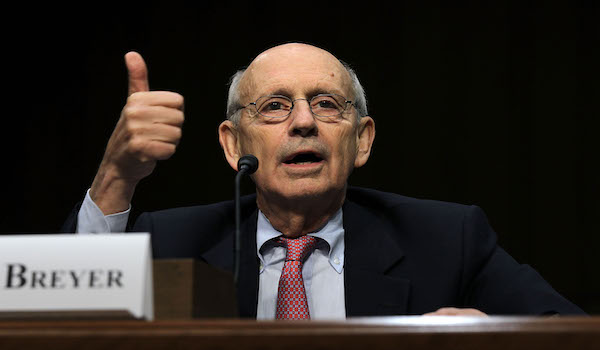
(WASHINGTON) — Justice Stephen G. Breyer, the most senior member of the U.S. Supreme Court’s liberal wing and staunch defender of a nonpartisan judiciary, is retiring from the bench, fulfilling the wish of Democrats who lobbied for his exit and clearing the way for President Joe Biden’s first high court appointment.
Breyer, the court’s oldest member at 83, will step down despite apparent good health, deep passion for the job and active involvement in cases. This term he authored major opinions upholding the Affordable Care Act, affirming free speech rights of students off-campus and resolving a multi-billion dollar copyright dispute between two titans of American technology, Google and Oracle.
“He has been operating at the peak of his powers,” said Jeffrey Rosen, law professor and president of the National Constitution Center. “It was so inspiring that this term his pragmatic vision of compromise and moderation were ascendant and all of the unanimous decisions were a moving tribute to his inspiring legacy.”
While Breyer has disavowed political considerations, many will see them in his decision to leave now. Stepping down early in the Biden presidency and while Democrats retain a razor-thin majority in the U.S. Senate will help ensure his seat is filled with someone who shares his judicial philosophy.
“It’s a highly personal decision,” Breyer told ABC News of retirement in a 2015 interview.
Progressive activists had imposed unprecedented public pressure on Breyer, who was nominated in 1994 by President Bill Clinton, to retire quickly. Senate Republican Leader Mitch McConnell said in June that the GOP may block a Democratic appointment to the court if the party retakes control of the Senate next year and a vacancy occurs in 2023 or 2024.
Many Democrats remain haunted by Republican obstruction of President Barack Obama’s nominee to the court in 2016 and the rushed confirmation of Justice Amy Coney Barrett last year, just weeks before the 2020 election and after the sudden death of Justice Ruth Bader Ginsburg.
In the lead up to his retirement, Breyer distanced himself from partisan politics.
“It is wrong to think of the court as another political institution,” he said in an April speech at Harvard Law School. “And it is doubly wrong to think of its members as junior league politicians.”
He added, justices “are loyal to the rule of law, not to the political party that helped to secure their appointment.”
“He’s very savvy,” said Rosen. “He understands that democracy is fragile and people in the past have not obeyed the court and the court doesn’t have any ability to enforce its decisions. That’s why being attentive to its legitimacy is so important to him.”
The vacancy now clears the way for Biden to nominate an African American woman to the court, a historic first and something he promised during the 2020 campaign.
There have been five female justices in Supreme Court history; three are currently serving — Justices Barrett, Elena Kagan and Sonia Sotomayor, the first and only woman of color confirmed to the high court.
U.S. Appeals Court Judge Ketanji Brown Jackson, a former Breyer clerk, public defender and Biden appointee who won three Senate Republican votes in confirmation, is considered a top contender for nomination along with Judge Leondra Kruger of the California Supreme Court, a former deputy solicitor general in the Obama administration who has argued a dozen cases before the high court.
“We are putting together a list of a group of African American women who are qualified and have the experience to be on the court,” Biden said in June 2020. “I am not going to release that until we go further down the line in vetting them.”
While Breyer never enjoyed the rock-star status held by Ginsburg, he has long been revered and celebrated as a consensus-seeker and happy warrior throughout his 27 years on the court.
“He is not a dogmatist, generating rules from some high-level theory. He is in search of workable results,” former federal appeals court Judge Richard Posner said of Breyer in the Yale Law Journal.
As a devout institutionalist, Breyer has passionately defended the Supreme Court’s reputation as an impartial and apolitical branch of American government. Later this year, he will publish a book on the subject, “The Authority of the Court and the Peril of Politics.”
“A judge has to do his best not to have an opinion on a political matter,” he told ABC News in 2015. “And if I have an opinion, I might talk to my wife about it but I’m not going to talk to you.”
He has described differences among the justices as contrasts in “philosophical outlook” rather than differences of politics and chaffed at the labeling of justices as “liberal” or “conservative.”
“Politics to me is who’s got the votes. Are you Republican or Democrat? I don’t find any of that here,” he told ABC News Chief Washington Correspondent Jonathan Karl.
Breyer has been one of the few justices to be a regular attendee at State of the Union addresses before a joint session of Congress.
“I think it is very, very, very, important — very important — for us to show up at that State of the Union,” the justice told Fox News in 2010. “Because people today, as you know, are more and more visual … and I would like them to see the judges too, because federal judges are also part of that government.”
In recent years, as the court was repeatedly thrust into an uncomfortable spotlight during the Donald Trump presidency, Breyer joined with Chief Justice John Roberts to help steer the institution away from the headlines.
“The more the political fray is hot and intense, the more we stay out of it,” Breyer explained during a 2020 interview with the Kennedy Institute.
The nine justices have handed down more unanimous opinions in 2021 than any time in at least the last seven years. Court analysts credit a narrow focus on common ground rather than sweeping, more divisive pronouncements. Some see a vindication of Breyer’s longtime approach in the results.
During oral arguments, Breyer is frequently one to lean in, animatedly challenging lawyers on both sides of a debate to address the real life consequences of a case. He has earned the moniker “king of hypotheticals” for his creative use of the technique.
“You have to have the imagination to understand how those words will affect those lives,” Breyer said in a 2017 interview with NYU School of Law. “That means you understand something about the lives of other people.”
Breyer has cultivated a reputation for pragmatism and compromise in his opinions, which have been praised for their colloquial language and avoidance of jargon.
“My job … is to write opinions,” Breyer told Fox News Sunday in 2010. “The job of 307 million Americans is to criticize those opinions. And what they say is up to them. And the words I write are carrying out my job under the law as best I see it.”
In 2014, Breyer wrote for an unanimous court to limit the scope of a president’s power to make recess appointments.
“Pro forma sessions (of Congress) count as sessions, not as periods of recess,” he said, dealing a rebuke to Obama who had tried to force appointments to the National Labor Relations Board. “The Senate is in session when it says it is.”
He has twice authored significant majority opinions on the issue of abortion.
In 2000, Breyer wrote a 5-4 decision striking down a Nebraska law criminalizing “partial-birth abortions” as “an undue burden upon a woman’s right to make an abortion decision.” Two decades later, his opinion in June Medical Services v. Russo cast a Louisiana law requiring hospital admitting privileges for abortion doctors as a “substantial obstacle” to women that violates the Constitution.
On the First Amendment, Breyer was the pivotal vote in a pair of 5-4 decisions in 2005 involving public displays of the Ten Commandments. He voted to uphold a longstanding monument at the Texas state capitol, while opposing placement of framed copies of the commandments inside Kentucky courthouses. He was the only justice to agree with both decisions.
“The government must avoid excessive interference with, or promotion of, religion. But the Establishment Clause does not compel the government to purge from the public sphere all that in any way partakes of the religious,” Breyer wrote in a concurring opinion in the Texas case. “Such absolutism is not only inconsistent with our national traditions, but would also tend to promote the kind of social conflict the Establishment Clause seeks to avoid.”
Breyer frequently championed “six basic tools” that judges should use when deciding a case — text, history, tradition, purpose, precedent and consequences. He has also urged consideration of international law.
“When you’re talking about the Constitution, different judges emphasize different ones of those,” he said in a 2017 interview, “but nobody leaves any of those out completely.”
When Breyer’s analysis put him at odds with his colleagues, he frequently wrote in dissent, defending the use of race as a factor in school admissions; pushing for deference to legislatures on gun control laws; and, opposing partisan gerrymandering.
“The use of purely political considerations in drawing district boundaries is not a necessary evil that, for lack of judicially manageable standards, the Constitution inevitably must tolerate,” Breyer wrote in a 2004 case.
In the hotly contested 2000 election, Breyer lamented the court’s decision to get involved in the dispute between George W. Bush and Al Gore.
“The Court was wrong to take this case. It was wrong to grant a stay,” he wrote at the time. “We do risk a self-inflicted wound — a wound that may harm not just the Court, but the Nation.”
Breyer has been a staunch critic of the death penalty and what he sees as unacceptably lengthy delays between sentences and executions.
In a famous 40-page dissent in 2015, Breyer urged the court to reconsider whether capital punishment violates the Eighth Amendment.
“Lack of reliability, the arbitrary application of a serious and irreversible punishment, individual suffering caused by long delays, and lack of penological purpose are quintessentially judicial matters,” he wrote.
“They concern the infliction — indeed the unfair, cruel, and unusual infliction — of a serious punishment upon an individual,” he continued. “The Eighth Amendment sets forth the relevant law, and we must interpret that law.”
Breyer’s career on the high court caps a lifetime of public service.
He grew up in San Francisco, where he attended public schools and earned the rank of Eagle Scout. In 1957, Breyer joined the U.S. Army Reserves and served a tour of active duty in the Army Strategic Intelligence during his six-year career.
He studied philosophy at Stanford University and became a Marshall Scholar at Oxford University. In 1964, he earned his law degree from Harvard University and went on to clerk for justice Arthur Goldberg on the U.S. Supreme Court.
“I’m sure they wanted me to be a lawyer,” Breyer said of his parents in a 2017 oral history. “I thought, well I’d like to be a lawyer. I sort of always knew I would be.”
After a short stint in the Justice Department antitrust division, Breyer joined the faculty at Harvard Law School in 1967, specializing in administrative law. That same year he married Joanna Hare, a member of the British aristocracy and a pediatric psychologist at the Dana-Farber Cancer Institute.
In the mid-1970s, he cut his teeth in politics, serving as an assistant special prosecutor in the Watergate investigation and later as special counsel to the Senate Judiciary Committee working alongside Sen. Ted Kennedy.
“A few lessons I learned from Kennedy. One of them: the best is the enemy of the good,” Breyer said in 2017. “If you could get an inch, it’s much better to get that inch then to complain about not getting a mile.”
He was first appointed to the federal bench in 1980 by President Jimmy Carter, going on to serve 13 years as an appellate judge until Clinton elevated him to replace Justice Harry Blackmun on the Supreme Court in 1994. The Senate confirmed Breyer 87-9.
Asked in 2017 how he would like to be remembered, Breyer told an interviewer: “You play the hand you’re dealt. You’re dealt one. And you do the best with what you have. If people say yes, he did, he tried, he did his best and was a decent person, good.”
(NEW YORK) — Dangerously cold temperatures have taken over the Midwest Wednesday before heading to the Northeast on Thursday.
Wednesday is the coldest morning so far this winter in places like Chicago, where parts of Lake Michigan are filled with ice.
The wind chill — what temperature it feels like — plunged Wednesday morning to about minus 19 in Chicago, minus 30 degrees in Minneapolis, minus 23 in Green Bay and minus 7 in Indianapolis.
The deep freeze then turns to the Northeast.
Thursday morning the wind chill is forecast to fall to minus 4 degrees in Boston, 6 degrees in New York and minus 10 degrees in Watertown, New York.
Even the South will feel the freeze. The wind chill is forecast to drop to 14 degrees in Raleigh, 23 in Atlanta and 21 in Nashville.
(NEW YORK) — In an increasingly digitized world, almost no industry has been left unscathed by the global shortage of electronic chips.
Demand for these dime-sized building blocks needed to make cars, computers, smartphones and much more was growing even before reaching a fever pitch as the COVID-19 pandemic forced swaths of the globe to rely on tech tools for work or school. The shortage also clobbered the auto industry with disproportionate furor, leading to skyrocketing new and used vehicle prices — which in turn drove one-third of all of the painful inflation Americans saw in 2021, according to the Bureau of Labor Statistics.
The crisis has exposed just how bedeviling the pandemic has been for policymakers and business leaders who failed to foresee the fallout from this shortage coming, as well as exposed the risks for U.S. business that results from a majority of the world’s chip supply being produced in Asia — and more specifically, political tripwire-ridden Taiwan.
“It is both an economic and national security imperative to solve this crisis,” Secretary of Commerce Gina M. Raimondo said in a blogpost Tuesday, sharing fresh data on the fragility of the semiconductor supply chain and calling on Congress to approve $52 billion in chips funding “as soon as possible.”
As the scarcity of semiconductors continues to dominate headlines two years into the pandemic, here is what economists say Americans should know about the chip shortage, and what its implications are for the future.
‘An essential part of almost every product that we use’: What are semiconductors?
“Semiconductors, or chips as we call them, are sort of the building blocks of any computer system,” Morris Cohen, an emeritus professor of Manufacturing and Logistics in the Operations, Information and Decisions Department, at the University of Pennsylvania’s Wharton School, told ABC News.
“There’s been incredible advancements over the years in the capabilities of these chips, in reduction of their size and power requirements,” Cohen added. “And so we see them now embedded everywhere — in your cellphone and your computer, in your home appliances, and in your automobile.”
“These devices are used to monitor performance to control function, to capture data to send instructions and so on,” Cohen added. “They’ve become sort of an essential part of almost every product that we use.”
Awi Federgruen, a professor of management at Columbia Business School, told ABC News that the chip shortage “is being felt in no less than 169 industries.”
As the tech sector continues to expand at a rapid pace and a growing array of tools and gadgets become embedded in Americans’ daily life, an increasing number of products are becoming dependent on chips. The implications of this can be felt by consumers shopping for everything from portable gaming systems to smart kitchen appliances, and many have likely already noticed higher prices or longer wait times when searching for their products.
Meanwhile, a reliance on chips for critical medical devices, military applications, cybersecurity tools and other sectors can carry more serious ramifications for both individuals and governments.
One natural disaster away from hitting American jobs: How severe is the shortage?
The median inventory held by chip consumers (such as automakers or medical device manufacturers) has sunk from a 40-day supply in 2019 to a less than five-day supply in 2021, the Commerce Department said in an industry report released Tuesday.
This means that if a natural disaster, COVID-19 outbreak or political instability disrupts a semiconductor facility abroad for even just a few weeks, it has the potential to shut down a manufacturing facility in the U.S., the agency added, putting American workers at risk.
Moreover, median demand for chips from buyers was as much as 17% higher in 2021 than in 2019, according to the report, and the majority of semiconductor manufacturing facilities are operating at or above 90% utilization — meaning there is limited additional supply to bring online without the expensive and time-consuming process of building new facilities.
The majority of chip factories are currently based in Asia, which houses about 87% of the market share of semiconductor factories (with Taiwan alone accounting for some 63%), separate industry data indicates. The political climate in the region, and tensions between Taiwan and China, has come under renewed scrutiny as the shortage has exposed how much U.S. industry relies on these sources.
“Initially, when you go back to the origins of the industry, the majority of the capacity was in the U.S. and then it shifted outside,” Cohen told ABC News. “Now, there’s a big push to re-shore that manufacturing and bring it back, and it’s not just a business decision, it’s political, it’s a highly politicized decision.”
‘A perfect storm’: What is causing the shortage?
The supply-demand imbalances in the semiconductor industry were already fragile before the pandemic, and the Commerce Department noted in its report that underlying demand for semiconductors was already growing prior to 2020, propelled by industry shifts such as the onset of 5G and electric vehicles. The pandemic then exacerbated the crisis by causing a surge in demand for products that require semiconductors while simultaneously disrupting the supply.
Columbia’s Federgruen said the current shortage is the result of multiple factors creating “a perfect storm.”
Silicon, the raw material used in chips, became harder to come by for producers during the pandemic, according to Federgruen, because it is necessary for vaccine manufacturing.
“In addition, there was the shutdown or temporary shutdown of [semiconductor] manufacturing facilities in the Far East and elsewhere, as a direct result of the of the pandemic,” Federgruen said. “And then there is the fact that on the demand side, in many industries such as the automobile industry, there’s been an unusual ramp-up of the demand.”
“All those factors have come together and compounded upon each other to create a big, big shortage,” Federgruen said.
Why is it hitting the auto industry so hard?
Most Americans by now have heard of the shortage’s impacts on the auto industry, which has been among the most severely hit by the shortage as more cars today are being fuzed with additional electronic systems than in the past, Federgruen told ABC News.
The shortage was compounded in the auto industry because many carmakers initially thought the pandemic would crush demand and planned for this by reducing semiconductor orders. An apparent desire to avoid public transportation and plan getaways closer to home during the health crisis, however, ended up having the opposite effect on demand for autos. Chip manufacturers, already suffering from pandemic-related shocks, could not keep up with the new orders coming in from the auto industry that came as a simultaneous remote-work boom spurred demand for chips needed for computers and IT tools.
Raimondo said that the so-called legacy logic chips used in automobiles — as well as medical devices — are facing the most acute shortages.
“In 2021, auto prices drove one-third of all inflation, primarily because we don’t have enough chips,” Raimando wrote in her blogpost. “Automakers produced nearly 8 million fewer cars last year than expected, which some analysts believe resulted in more than $210 billion in lost revenue.”
Cohen, from the Wharton School, added that over the last decade or so, “the amount of computer systems that are put into a car has just increased enormously.” While carmakers have become big users of chips for managing vehicles’ entertainment, climate, fuel systems and more, they have continued to rely on outsourced production and suppliers for these parts.
Automakers historically did not consider producing chips to be their core competency, but many have come to the realization now that they can’t afford to be dependent on outside suppliers for chips if their absence can bring production and assembly lines to a screeching halt.
Raimondo called new partnerships with semiconductor producers recently announced by Ford and General Motors “encouraging” in her blogpost Tuesday, saying the announcements “demonstrate that chip consumers and producers are coming together to solve their supply chain issues.”
What is being done to address the shortage, and how long will it last?
The Commerce Department’s report said that industry players do not see the significant, persistent mismatch in the supply and demand for chips going away in the next six months.
The report identified the main issue as the need for additional semiconductor factories (also called semiconductor fabrication plants or fabs). Construction of new fabs, however, is expensive and can take years before making an impact in the supply.
In addition to the steps taken by players in the auto industry such as Ford and GM, some companies have also announced new and dramatic actions to ameliorate the crisis and bring semiconductor manufacturing back to the U.S.
Intel announced late last week that it was investing more than $20 billion to build two new chip factories in Ohio — a headline-grabbing announcement that came on the heels of the firm saying last October that it had began construction on two chip factories in Arizona. Samsung similarly announced plans late last year to build a $17 billion semiconductor factory near Austin, Texas.
“It’s great that they’re doing that but it’s not going to solve today’s problems, that’s for sure,” Cohen told ABC News of the recent announcements. “It’ll take years for this to take place, and in the interim, we’re still going to have to source these products from the places they come from now. We don’t have an alternative.”
The situation may improve slightly if demand cools off, Federgruen noted, but similarly said that it will take years for the “big change” to occur when these new U.S. facilities begin actually pumping out chips.
Why should Americans care and what does this mean looking ahead?
Cohen said that having studied the industry for a long time, a lot of what we’re seeing now could have been anticipated to some degree, especially among industry players.
“Companies who operate in this environment have been aware of these issues for a long time and have dealt with it,” he said. “This is just the nature of being competitive in those industries.”
If a new fab costs billions of dollars and takes years to construct, companies in an increasingly globalized world will likely turn to offshore suppliers for chips instead. Cohen said the pandemic, however, has made Americans more aware of risks and fragility of this dependence on outside suppliers.
“Most consumers didn’t know and didn’t care where their chips came from: ‘You turn the car on, it should go, I don’t really care who made the chip and what country it was built in,'” Cohen said. “But now, all of a sudden, these issues become really important, and so I think we become more sensitized to how dependent we are, how interdependent we are, how things can be disrupted.”
“We became a globalized economy because there were a lot of advantages,” Cohen added. “Because of that, we as consumers have enjoyed access to an amazing array of products and incredibly low prices, which has increased our standard of living.”
With chip supply now just one natural disaster or major disruption away from potentially impacting American livelihoods, Cohen predicts it is “going to be difficult to maintain the status quo.”
“We will have more expensive products, we’ll have things that will take longer,” he said. “Therefore, our standard of living to some extent will be lower. It’ll cost us more time and money to earn what it takes to buy a car, to buy a house.”
Federgruen added that he hopes policymakers and business leaders can learn from the lessons exposed by the crisis and make better decisions moving forward that don’t just take into account short-term profits.
“In general, there’s been the recognition that we need to make our supply chains much more resilient, and that we need to build in safety buffers on the supply side for situations like this,” Federgruen told ABC News. “That lesson comes up with every crisis and is then forgotten, unfortunately, but hopefully it will stick now.”
(GENEVA) — Even as the omicron COVID-19 variant continues to sweep the globe, scientists are now monitoring a new mutation of omicron, dubbed BA.2.
The World Health Organization maintains that BA.2 is not a “variant of concern,” meaning there is no current evidence to suggest this new subvariant will worsen COVID-19 transmission, illness severity, or efficacy of vaccines and public health efforts like masking and social distancing.
BA.2 numbers around the world are rising, with at least 40 countries reporting cases to a global variant tracking database, but the subvariant has spread rapidly in Denmark and the UK, with almost half of recent cases in Denmark attributed to BA.2.
The subvariant has already been detected in several U.S. states, with Washington State confirming two cases Monday.
While over 8,000 BA.2 cases have been identified since November 2021, it is unclear where BA.2 originated. Even though the first sequences were submitted from the Philippines, numerous cases have since been detected in various places, from Europe to South Asia.
Given the rising numbers, health care organizations, like the WHO, are asking scientists to watch and study the new subvariant separately from omicron, to see if it behaves differently.
“It is the nature of viruses to evolve and mutate, so it’s to be expected that we will continue to see new variants emerge as the pandemic goes on,” said Dr. Meera Chand, the COVID-19 incident director at the UK Health Security Agency, in prepared remarks. “So far, there is insufficient evidence to determine whether BA.2 causes more severe illness than Omicron BA.1, but data is limited.”
The evolution of COVID-19 subvariants is not new. The delta variant also had several subvariants, but scientists referred to all of them as delta. BA.2, however, has earned its own designation due to rising numbers across several nations.
Although it’s been called the “stealth” omicron variant, the new subvariant, “can absolutely be detected through traditional surveillance mechanisms whether through rapid testing or PCR,” said Dr. John Brownstein, chief innovation officer at Harvard University’s Boston Children’s Hospital and ABC Medical Correspondent.
Conventional COVID-19 tests can show a positive or a negative result, but they can’t determine specific variants. For that, scientists need to do additional genetic sequencing. Conveniently, the omicron variant has a particular genetic signature that allows scientists to quickly and easily determine if the sample is omicron or not.
The new BA.2 subvariant does not have that feature, meaning scientists can no longer use this shortcut — though they can still identify the subvariant using genetic sequencing technology. Because of this, the BA.2 subvariant has sometimes been referred to as the “stealth” variant. But for the general public, conventional COVID-19 tests will still work to detect the new subvariant.
Ultimately, while scientists and public health officials are urging continued research and surveillance, experts say there is little reason to worry.
“BA.2 is important from a public health perspective, but it doesn’t fundamentally change at this moment, how we think about the impact in the population,” Brownstein said. “A lot more work needs to be done to understand severity, breakthrough infections, and immunizations before you can make any statement about clinical relevance.”
“While it’s important to understand that in the family of omicron, there is a sub-lineage that is potentially more transmissible, it’s not necessarily a cause for panic,” Brownstein added.
Nitya Rajeshuni, M.D., M.S., a pediatrics resident at the Children’s Hospital of Philadelphia, University of Pennsylvania, is a contributor to the ABC News Medical Unit.
(LONDON) — Two men were arrested in England on Wednesday morning as part of an ongoing investigation into a hostage-taking incident at a synagogue in the United States, British authorities said.
Counterterrorism officers detained both men in Manchester. The pair “remain in custody for questioning,” according to a statement from the Greater Manchester Police.
Two other men were arrested in connection with the probe in Manchester and Birmingham, about 85 miles south of Manchester, on Jan. 20. They “remain in custody and officers have been granted an extension of custody to continue to question them further,” the Greater Manchester Police said.
Assistant Chief Constable Dominic Scally of the Greater Manchester Police has said that counterterrorism officers are assisting their U.S. counterparts in the investigation of an hourslong standoff between American authorities and a hostage-taker at the Congregation Beth Israel in Colleyville, Texas, about 27 miles northwest of Dallas.
An armed man claiming to have planted bombs in the synagogue interrupted Shabbat services on Jan. 15 just before 11 a.m. local time, taking a rabbi and three other people hostage, according to Colleyville Police Chief Michael Miller.
One hostage was released uninjured at around 5 p.m. CT, Miller told a press conference later that night. An elite hostage rescue team from the Federal Bureau of Investigation then breached the synagogue at about 9 p.m. CT, after hearing the hostage-taker say he had guns and bombs and was “not afraid to pull the strings,” according to a joint intelligence bulletin issued on Jan. 19 and obtained by ABC News.
“As a tactical team approached to make entry to the synagogue, the hostages escaped and were secured by tactical elements,” the bulletin said. “The assault team quickly breached the facility at a separate point of entry, and the subject was killed.”
No hostages were injured during the incident, according to Miller.
The slain suspect, identified by the FBI as 44-year-old British citizen Malik Faisal Akram, was from the Blackburn area of England’s Lancashire county, about 20 miles northwest of Manchester, according to Scally.
A motive for the Jan. 15 siege is under investigation. Matthew DeSarno, the special agent in charge of the FBI’s Dallas field office, said during a press briefing on Jan. 21 that the agency is treating the incident as an act of terrorism and a hate crime.
During the negotiations with authorities, Akram “spoke repeatedly about a convicted terrorist who is serving an 86-year prison sentence in the United States on terrorisms charges,” according to the FBI.
Multiple law enforcement sources told ABC News that the hostage-taker was demanding the release of Aafia Siddiqui, who is incarcerated at Carswell Air Force Base near Fort Worth, about 16 miles southwest of Colleyville. Siddiqui, who has alleged ties to al-Qaida, was sentenced to 86 years in prison after being convicted of assault as well as attempted murder of an American soldier in 2010.
Two teenagers were arrested in southern Manchester on Jan. 16 in connection with the synagogue attack. They were questioned and later released without being charged, Greater Manchester Police said in a statement on Jan. 18. Multiple law enforcement sources told ABC News that the teens are Akram’s children.
Akram has ancestral ties to Jandeela, a village in Pakistan’s Punjab province, the local police chief told ABC News. He visited Pakistan in 2020 and stayed for five months, the police chief said, a duration that may have been necessitated by COVID-19 restrictions.
Akram has been separated from his wife for two years and has five children, according to the police chief.
Law enforcement sources told ABC News that British authorities investigated Akram about a year ago and concluded he posed no threat that would have prohibited his travel from the United Kingdom to the U.S.
After arriving in the U.S. last month via a flight from London to New York City, Akram stayed at homeless shelters at various points and may have portrayed himself as experiencing homelessness in order to gain access to the Texas synagogue during Shabbat services, multiple law enforcement sources told ABC News.
U.S. President Joe Biden, who called the hostage-taking incident “an act of terror,” told reporters on Jan. 16 that investigators suspect Akram purchased a gun on the street. While Akram is alleged to have claimed he had bombs, investigators have found no evidence that he was in possession of explosives, according to Biden.
ABC News’ Luke Barr, Aaron Katersky, Habibullah Khan, Josh Margolin and Joseph Simonetti contributed to this report.
(TALLAHASSEE, Fla.) — A Florida bill that would limit classroom discussions on sexual orientation and gender identity and encourage parents to sue schools or teachers that engage in these topics is speeding through the state House and Senate.
It’s being called a “Don’t Say Gay” bill by LGBTQ advocates, who fear that if this bill is signed into law, it could act as a complete ban on the lessons on LGBTQ oppression, history and discussions about LGBTQ identities.
“This would erase LGBTQ+ history and culture from lesson plans and it sends a chilling message to LGBTQ+ young people and communities,” said Melanie Willingham-Jaggers, the executive director of the national LGBTQ youth advocacy group GLSEN.
Activists say that erasing LGBTQ presence from schools may imply to students that their gender identity or sexual orientation is something to be ashamed of or hidden.
“We have to create a learning environment where they feel safe and healthy, or it’s not an effective learning environment,” said Heather Wilkie of the Zebra Coalition, a Central Florida LGBTQ advocacy group.
“When you have laws like this, that directly attack our kids for who they are, it prevents them from learning,” she said. “It prevents them from being able to be healthy.”
The two bills in the state legislature, HB 1557 and SB 1834, state that a school district “may not encourage classroom discussion about sexual orientation or gender identity in primary grade levels or in a manner that is not age-appropriate or developmentally appropriate for students.”
The House Education & Employment Committee has moved the bill forward, handing it off to the Judiciary Committee.
It adds that parents who violate this rule can sue, seeking damages and reimbursement for attorney fees and court costs.
Rep. Joe Harding, who is the sponsor of the legislation, hopes it will “reinforce the fundamental right of parents to make decisions regarding upbringing & control of their children,” according to the bill’s text.
Harding did not respond to ABC News’ request for comment.
Chasten Buttigieg, activist and husband of U.S. Secretary of Transportation Pete Buttigieg, denounced Florida Gov. Ron DeSantis and the state legislature for the efforts.
LGBTQ advocacy organizations say these bills are reminiscent of the “no promo homo” laws of the 1990s that barred educators from discussing queer topics in schools, but with an added mandate on parent and family involvement.
“These mandates are harmful and risk carelessly outing LGBTQ+ young people to families who do not affirm their children’s identities,” Willingham-Jaggers said.
2021 was a record-breaking year for anti-LGBTQ legislation, according to the Human Rights Campaign. More than 250 of these bills were introduced and at least 17 were enacted into law.
Several states, including Arizona, Alabama, Florida, Indiana, Kentucky, Oklahoma, New Hampshire and South Dakota, have already introduced anti-LGBTQ legislation in 2022.
This Florida legislation follows similar bills that restrict educators from teaching about oppression in the U.S.
Wilkie said that queer issues and access to supportive resources have been the priority against anti-LGBTQ attacks in recent years, and this has been a heightened effort since the Pulse nightclub shooting in 2016.
LGBTQ youth in the state, who have a higher risk for suicidal ideation, depression and anxiety, have been struggling, but Wilkie says advocacy groups will continue to fight these bills.
“We will fight,” she said. “It’s so disheartening to think that they would not be able to freely talk about themselves, or learn anything about their history.”
Ellen Weintraub, Commissioner at US Federal Election Commission, addresses the audience during the Web Summit 2021. – Bruno de Carvalho/SOPA Images/LightRocket via Getty Images)
(NEW YORK) — With everyone from giant companies to celebrities embracing the cryptocurrency phenomenon known as NFTs, political candidates are now getting into the act — but some experts say that transparency concerns could affect their use as a political fundraising tool.
Non-fungible tokens — digital assets that cannot be replicated and can be used to represent real-world items — are slowly creeping into the political world, with a few candidates already using them to raise thousands of dollars.
“NFTs are bringing more people into our fold, into our movement,” said Max Rymer, a digital consultant for Minnesota Republican gubernatorial candidate Dr. Scott Jensen.
Jensen’s campaign saw an opportunity for NFTs to be a low-dollar way for people to become engaged with their candidate and receive something of value in return for their donations, Rymer told ABC News.
Through the sale of NFTs, “we’ve added 2,500 new people that are going to support our campaign going forward,” Rymer said.
Blake Masters, a Republican U.S. Senate candidate in Arizona, is also embracing NFTs.
“I was thinking of creative ways to raise money and I thought of NFTs because [they] can give people a sense of ownership,” said Masters, who is also the co-author of “Zero to One,” a bestselling business book published in 2014.
So Masters sold his supporters limited edition NFTs depicting the cover of his book — and raised nearly $575,000.
Like collectible artwork and rare baseball cards, the value of an NFT derives from it being unique — in this case, a unique digital token in a distributed database known as a blockchain. The digital tokens are stored in the blockchain through a digital wallet and can be held as an asset — as digital memorabilia — or sold and traded for investment purposes.
Many NFTs also come with real-life perks and exclusive access to events, which makes them attractive as campaign offerings.
For example, for those who purchased Masters’ digital tokens, the perks included receiving a signed copy of his book and the opportunity to meet him and his co-author, tech billionaire Peter Thiel, who helped develop the NFT collection.
“We’ll have at least one token-holders party,” Masters told ABC News. “It’s like the Willy Wonka golden ticket.”
That kind of involvement makes NFTs a good way to help candidates build a community of supporters, said Joseph Argiro, CEO of Iron Key Capital, a digital asset hedge fund.
“[NFTs] are probably a better way than just to accept donations, because they are more of a symbolic representation of your beliefs,” said Argiro.
For those who purchased from her initial NFT collection, former first lady Melania Trump offered an audio recording with a “message of hope.” A portion of the proceeds from her collection, which was released last month, supported her Be Best initiative, a campaign focused on children’s issues and advocating against cyberbullying.
“What you’re trying to tap into with NFTs is a sense of supporters around a common cause,” said Joshua White, an assistant professor of finance at Vanderbilt University. “And so NFTs can build a community where there’s this positive feedback loop.”
In the case of Masters’ Senate campaign, said White, NFTs could attract young voters that have never voted Republican but want a younger and more tech savvy candidate to represent them.
NFTs have also been a breath of fresh air for political campaigns and fundraisers that are seeking a new way to appeal to grassroots supporters, said Brian Forde, co-founder of the online fundraising platform Numero, which is working to launch a new NFT fundraising platform for Democratic campaigns called electables.com.
“We’ve put out surveys to more than 14,000 grassroots donors and a couple things stand out: One, they’re tired of hyperbolic emails, two, they want to be recognized and connect with other grassroots supporters of that campaign,” Forde said. “So with NFTs, electables allow them to connect with other grassroots supporters and be recognized for their contribution.”
Forde said that supporting an NFT is similar to supporting a sports team — which is why NFTs have been embraced by numerous leagues.
“What surprised me the most about NFTs is how quickly and powerfully one connects and builds a community of strong supporters,” Forde said. “Pro sports leagues were some of the first to figure this out, and in many ways, campaigns are a lot like sports teams. If you own [an NFT], you feel a belonging to that community in a stronger way than you ever did before. Sports teams have been the pioneers, and campaigns are going to follow in their footsteps.
And while the number of political campaigns that have launched NFTs remains low, interest has been growing. Forde said electables.com, which will make money by providing an NFT fundraising platform for campaign clients, currently has more than 300 campaigns on its waitlist ahead of its planned launch in March.
As of now, there’s little to no official guidance on NFT fundraising from the Federal Election Commission, FEC Commissioner Ellen Weintraub said. Nor has there been any campaign or committee seeking an official advisory opinion from the agency.
“It’s not something that the agency has gotten a lot of questions on, and certainly there have been no formal request of the Commission as a whole to weigh in on this,” Weintraub told ABC News. “My sense is that it’s just not that common yet.”
As a result, the Masters campaign and the Jensen campaign both sought legal advice before they launched their NFT collections.
“We ran it through all the legal analyses,” Masters said. “I was heavily legally diligent, and we were careful with our language … we made sure that all the benefits were allowed.”
“It’s brand new territory for a lot of these regulatory bodies too,” said Rymer. “So we partnered, in essence, with the Campaign Finance Board and we treated this the same way that supporters would get a hat for a donation.”
NFTs can typically be purchased using either regular currency — like through a credit card — or with cryptocurrency, virtual tokens that allow purchasers to remain anonymous. But most political campaigns that report to the Federal Election Commission or state-level election agencies are required to report the identity of their donors — and officials say that could raise transparency concerns.
“I think we probably have to look into the transparency aspect, whether one could determine where the NFT, the ‘thing of value,’ is coming from,” Weintraub told ABC News.
White said that if a cryptocurrency user has linked their virtual wallet to their personal information, then transparency isn’t an issue. But he said that the use of cryptocurrency for political fundraising in general makes it easier to “not know where that money is coming from.”
To comply with fundraising regulations that govern contribution limits and other restrictions, some campaigns offering NFTs have turned to platforms like electables.com and the recently launched Front Row, which launched over the fall as another NFT marketplace for Democrats.
“We built this platform because we saw that that’s what needed to happen for progressive organizations, campaigns and movements that have some of these compliance regulations to participate in this ecosystem,” Front Row co-founder Parker Butterworth told ABC News. Butterworth said the platform allows political organizations to collect all the necessary information from NFT buyers, including their name, addresses, age, and U.S citizenship status.
The platform offered its first NFT collection from the Texas Democratic Party, and it’s now talking with several new clients, said Butterworth. He said the world of NFT fundraising is a “very fast moving space” that’s expected to expand the world of digital campaigning.
“NFTs are not going anywhere,” said Argiro. “I think we’re just seeing the beginning of how communities use these NFTs to drive community formation and capital formation.”