(AUSTIN, Texas) — A Texas judge is holding a hearing on whether to prevent state agencies from investigating gender-confirming care for transgender youth as child abuse.
District Judge Amy Clark Meachum will hear Friday from the parents of a 16-year-old transgender girl who were under investigation by the Texas Department of Family and Protective Services. Meachum will also hear from attorneys from the state.
According to the DFPS, there are at least nine similar investigations open as a result of the attorney general’s opinion on trans care.
The opinion written by state Attorney General Ken Paxton last month stated that “there is no doubt that these procedures are ‘abuse’ under Texas law, and thus must be halted.”
He went on: “The Texas Department of Family and Protective Services (DFPS) has a responsibility to act accordingly. I’ll do everything I can to protect against those who take advantage of and harm young Texans.”
The next day, Texas Governor Greg Abbott published a letter, ordering the DFPS to investigate such treatments as child abuse.
“Because the Texas Department of Family and Protective Services (DFPS) is responsible for protecting children from abuse, I hereby direct your agency to conduct a prompt and thorough investigation of any reported instances of these abusive procedures in the State of Texas,” Abbott said in the Feb. 22 letter.
Meachum has already blocked the Texas Department of Family and Protective Services from investigating the family of the 16-year-old girl. The family is part of a lawsuit against the state’s directive from the American Civil Liberties Union and Lambda Legal.
Several companies, including Ikea, Google, Apple, Meta, Johnson & Johnson, PayPal, Capital One and Electronic Arts have spoken out against the bill in a full-page ad in the Dallas Morning News.
“The recent attempt to criminalize a parent for helping their transgender child access medically necessary, age-appropriate healthcare in the state of Texas goes against the values of our companies,” a signed letter from the companies stated.
Cathryn Oakley, HRC’s state legislative director and senior counsel, said that misinformation is at the center of recent anti-LGBTQ efforts, including the Texas directive.
She told ABC News that she believes fear-mongering has painted a picture of trans youth that is “completely not true.”
She said that for many young children, transitioning means using a name and pronoun that feels right for them and presenting themselves in a way that feels right for them.
She says that when puberty hits is when medical intervention might begin through puberty blockers, which temporarily pause puberty while children and families assess their gender journey. “No one is performing surgery on kids. There’s no amputation happening,” she said.
“They’re literally putting trans kids lives on the line,” she said, referring to mental health conditions that trans youth face in the wake of discrimination.
“It’s incumbent on us to really educate folks about what it means to be a trans kid because I think the only reason people are buying into that kind of rhetoric is because even people who are fair-minded have questions about what it means to be a trans youth,” she said.
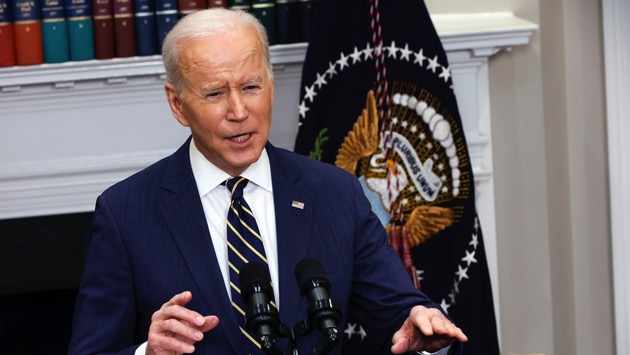
(WASHINGTON) — Stepping up the economic pressure on Russian President Vladimir Putin as he continues to attack Ukraine, President Joe Biden announced Friday that in conjunction with other G-7 nations and the European Union, the U.S. will move to revoke “most favored nation” trade status for Russia.
“As Putin continues his merciless assault, the United States and allies and partners continue to work in lockstep to ramp up the economic pressures on Putin and to further isolate Russia in the global stage,” Biden said from the White House. “Revoking PNTR (permanent normal trade relations) for Russia is gonna make it harder for Russia to do business with the United States.”
The move to strip Russia of its favored nation status would allow the U.S. and others to impose tariffs on a wide range of Russian goods.
JUST IN: Pres. Biden says U.S. and allies are taking steps to deny most favored nation status to Russia, calling it “another crushing blow to the Russian economy that’s already suffering very badly from our sanctions.” https://t.co/EPUvsRMUrDpic.twitter.com/zJIM1AZEn3
Biden also announced the U.S. is banning the export of luxury goods to Russia as well as banning imports of certain goods from Russia, including seafood, vodka and diamonds. He also said the G-7 is adding new names to the list of targeted oligarchs it was sanctioning.
“Putin is an aggressor — is the aggressor, and Putin must pay the price. He cannot pursue a war that threatens the very foundation to which he’s doing — the very foundations of international peace and stability and then ask for financial help from the international community,” Biden said. He added that the U.S. will speak to the G-7 about Russia’s ability to borrow the interpreter national monetary fund and world bank.
Additionally, Biden said he spoke with Ukrainian President Volodymyr Zelenskyy Friday morning ahead of his remarks, and “told him — as I have each and every time I’ve spoken to him — that the United States stands with Ukraine as they bravely fight to defend their country.”
While each country will have to suspend normalized trade relations on their own, the announcement is another example of Western unity against Putin as nations tighten the squeeze on Russia. It follows the U.S. imposing an immediate ban on Russian oil and other energy imports earlier this week.
Over the past two weeks, Russia has widened its attacks on major cities across Ukraine. The United Nations said Thursday that at least 549 civilians, 41 of whom were children, have died since Russia’s invasion began. At least 2.5 million have already fled the country.
“Most of the civilian casualties recorded were caused by the use of explosive weapons with a wide impact area, including shelling from heavy artillery and multi-launch rocket systems, and missile and airstrikes,” the office said.
As the threat of Russia taking over Kyiv and overthrowing Zelenskyy looms, the 40-mile Russian military convoy that was last seen northwest of Kyiv has repositioned around the capital city, appearing to take attackable positions.
“We remind Russian authorities that directing attacks against civilians and civilian objects as well as so-called bombardment in towns and villages and other forms of indiscriminate attacks are prohibited under international law and may amount to war crimes,” said the U.N. High Commissioner for Human Rights spokesperson Elizabeth Throssell on Friday.
But Russia has doubled down, instead, on its false claims that the U.S. and Ukraine are developing chemical or biological weapons for use against invading Russian forces. Russia is expected to bring the false accusation to the United Nations Security Council on Friday — one day after a senior U.S. defense official warned that the U.S. has seen “indications” of Russia using a potential false flag operation biochemical weapons as a pretext for the potential use of “these kinds of agents in an attack.”
Asked about the accusation Friday, Biden said he wouldn’t comment on intelligence but warned Russia not to make such a move.
“Your White House has said that Russia may use chemical weapons, or create a false flag operation to use them,” a reporter said. “What evidence have you seen showing that, and would the U.S. have a military response if Putin would launch a chemical attack?”
“I’m not going to speak about intelligence but – but – but Russia would pay a severe price if they used chemical weapons,” he replied.
Moments earlier, Biden reiterated his position that “we will not fight a war against Russia in Ukraine.”
“We’ll defend every single inch of the NATO territory with the full might of the united and galvanized NATO,” Biden said, but adding, “Direct confrontation between NATO and Russia is World War III, something we must strive to prevent.”
Pres. Biden says G7 countries are stepping up economic pressure on Russian oligarchs: “They support Putin. They steal from the Russian people and they seek to hide their money in our countries… and they must share in the pain of these sanctions.” https://t.co/r4gCj2PZafpic.twitter.com/MSY790DRAo
As the situation on-the-ground escalates, Republican senators have urged the Biden administration to send Ukraine 29 MiG fighter jets Poland offered to provide to Ukraine — but only if the U.S. transports them, which the Pentagon has not agreed to.
“Enough talk. People are dying. Send them the planes that they need,” Sen. Mitt Romney, R-Utah, said at a press conference Thursday. Ukraine, meanwhile, has pleaded with NATO, unsuccessfully, to enforce a no-fly zone over the country.
In response to claims that Russia may view the transfer of MiGs as escalatory on behalf of the U.S., the GOP group scoffed, saying it was time for the U.S. to project strength in this conflict and have Putin fear the U.S. for a change.
Vice President Kamala Harris, making stops across Europe to address the crisis, said Thursday that the administration is inching closer to acknowledging war crimes by Russia, saying “Absolutely there should be an investigation and we should all be watching,” while White House press secretary Jen Psaki said the U.S. must go through “the legal assessment and review to make a formal conclusion.”
Biden also noted the $13.6 billion in assistance for Ukraine included in the government funding bill passed Thursday night, which he said he looked forward to signing “immediately.”
ABC News’ Luis Martinez, Conor Finnegan, Molly Nagle, Justin Gomez and Allison Pecorin contributed to this report.
(NEW YORK) — With inflation at a 40-year high, Americans are seeking ways they can save some money on everything from gas to groceries.
The next time you hit a supermarket, there are several strategies you can use to help you stay on budget. Buying frozen meat and produce, opting for generic brands and buying in bulk are just some ways you can compensate for record-high prices.
ABC News’ Becky Worley shared more tips consumers can use the next time they shop for groceries:
(NEW YORK) — On March 26, 1997, an anonymous caller directed police to a mansion outside San Diego where authorities soon discovered the largest mass suicide on U.S. soil.
The 39 victims found within the home were all members of a strange and secretive cult called Heaven’s Gate, which had a goal to transcend to “higher beings” by spaceship.
Watch the full story on “20/20” TONIGHT at 9 p.m. ET on ABC.
The anonymous caller was Rio DiAngelo, a surviving member who left the group after three years and was to stay behind and tell the world about the group’s story.
“I was always looking for answers, looking for purpose in my life,” said DiAngelo. “I loved these people … it meant everything to me.”DiAngelo first spoke to ABC News’ Diane Sawyer in 1997.
“We lived like we were living in a monastery. We were all celibate individuals, looking forward to self advancement,” said DiAngelo.
Heaven’s Gate began in the early 1970s by co-founders Marshall Herff Applewhite and Bonnie Lou Nettles. Applewhite was the son of a Presbyterian preacher and became a talented stage actor and singer. He struggled with his sexuality and had a complicated relationship with his father.
At a moment in his life when he was depressed, hearing voices in his head and having apocalyptic visions, he met Nettles. She was a nurse and mother of four children. She had already believed in UFOs and astrology prior to meeting Applewhite.
According to former friends and colleagues, she said the voices in his head may be spirits from above telling him he one day could be a divine teacher.
Applewhite and Nettles told their followers that the human body was a “vehicle” to carry their soul and that the savior had returned in the human form of Applewhite, who was called “Do.”
They set out to start their own religion and seek out followers. They told people interested that, if they joined them, they could learn how to be pure enough to be invited to heaven too.
Over the course of several years, Applewhite and Nettles required their followers to adhere to increasingly more strange and severe rules, including severing all contact with family and friends and encouraging adopting an asexual appearance. In later years, some members of the group underwent castration.
Now nearly 25 years later, DiAngelo reflected on where his life is now. He says he still feels the presence of Applewhite and Nettles.
“Mostly, it’s just feeling. I don’t get words, but mostly it’s just feeling,” said DiAngelo.
DiAngelo said he made the choice to move on.
“I tried to get a job and people would not hire me because they thought I was part of some crazy thing. And so it’s really a matter of choice for me to get along with my career, my life, just so people would not look at me,” said DiAngelo. “It’s not about me, you know?”
DeAngelo, now a retired art director, said he’s reunited with his mother and is focusing on spending more time with his granddaughter.
“I’m a regular guy. I’m tryin’ to be more of myself,” said DeAngelo. “And a better person in every way I can.”
If you or someone you know is experiencing suicidal thoughts, the National Suicide Prevention Lifeline provides 24/7, free and confidential support. Call 1-800-273-TALK (8255) for help.
(NEW YORK) — Inside hundreds of pharmacies across the country, high-risk Americans who test positive for COVID-19 have been told they will soon be able to find and fill a prescription for oral medication directly at the store.
The new White House “test to treat” program, touted as a one-stop shop for antiviral pills from Pfizer and Merck, aims to create a free and streamlined approach to get sick people the lifesaving care they need, when they need it.
Although Pfizer and Merck’s COVID-19 pills were authorized in December, scarce supply has made them difficult to access.
Major pharmacies have already begun ordering their new “test to treat” supply directly from the federal government, and anticipate being able to start as early as this week. CVS will offer end-to-end access to the pills at their nearly 1,200 MinuteClinic locations as soon as this week, spokesperson Matthew Blanchette told ABC News, while a Walgreens spokesperson said patients will be able to get the antiviral pills at “select stores” where provider partners are available to assess and prescribe medication.
The idea is for everyday Americans to be able to visit their local pharmacy for a rapid test, and if positive, “you can be treated right there on the spot,” said Dr. Simone Wildes, an infectious disease expert from South Shore Health.
As clinic doors open to this new initiative, however, numerous puzzle pieces must align to ensure the smooth rollout the president has hoped for.
“We’re leaving no one behind or ignoring anyone’s needs as we move forward,” President Joe Biden said of the plan during his State of the Union address last week, emphasizing his administration has “ordered more pills than anyone in the world has.”
The program’s promised scope hinges on sufficient participating locations and drug supplies.
And in a development that could jeopardize the program’s future, House Speaker Nancy Pelosi announced this week that COVID-19 funding would be stripped from an upcoming government funding and Ukraine emergency aid package — an element hotly contested by some members.
Without this additional pandemic funding, the White House has warned there could be “dire” consequences: the U.S. could run out of pill supplies by the end of the summer.
The government has so far purchased 20 million doses of Pfizer’s COVID-19 pill, Paxlovid, although it’s not expected to be widely available until later this spring.
And there are other hurdles. Test to treat’s reach is bounded by the requirement that there must be a prescribing health care provider on site, a feature at a fraction of the tens of thousands of pharmacies in the country.
Some pharmacy groups have chafed against the required authority, like a nurse practitioner or physician’s assistant, who must prescribe the pills on-site.
“We were anticipating something that would really have an impact on the pandemic and on patients being able to access medications and instead we’re underwhelmed with the missed opportunity of what this could have been,” said Michael Ganio, American Society of Health-System Pharmacists’ senior director of pharmacy practice and quality.
While the plan is a step in the right direction, “further action is needed” to enhance equity and access, National Association of Chain Drug Stores’ President and CEO Steven Anderson said, adding that the current test-to-treat plan “does not leverage fully the health and wellness professionals and access points in America’s pharmacies.”
Conversely, the American Medical Association called the plan “well-intentioned” but that it “oversimplifies challenging prescribing decisions by omitting knowledge of a patient’s medical history, the complexity of drug interactions, and managing possible negative reactions.”
The drugs are not appropriate for everyone. Merck’s Molnupiravir, for example, is not recommended during pregnancy or for minors, while Pfizer’s Paxlovid runs the risk of negatively interacting with other commonly prescribed drugs, including medicines that manage heart conditions and cholesterol, and those with severe kidney or liver problems.
Another issue, doctors say, is that patients will need to start taking the pills within days of developing symptoms, which means participating stores need to be convenient enough to access quickly, and with enough rapid tests to diagnose in time.
To connect patients with convenient pickup sites, the government is developing a website to help people find a site near them, set to launch later this month.
“The biggest issue is making sure that you get seen and diagnosed rapidly because you’ve got a five-day window of opportunity for Paxlovid to be optimally effective,” said Dr. Amesh Adalja, senior scholar at Johns Hopkins Center for Health Security and an infectious disease physician.
“If you’re a high-risk individual, you want to make the diagnosis as quickly as possible,” said Dr. Todd Ellerin, director of infectious diseases at South Shore Hospital. “And then make contact with a health care provider.”
(WASHINGTON) — The last time Democrats gathered in-person for a caucus retreat, in 2019, the House majority crafted an agenda centered on plans for a bipartisan infrastructure bill and lowering prescription drug prices.
Three years later, with full control of Congress and the White House, but facing historic headwinds in the midterm elections, an ongoing pandemic and record-high inflation, Democrats argued that they had a substantive record to sell to voters, even if their agenda remained unfinished.
“If our agenda is incomplete it doesn’t mean we are broken, it means we have to keep working,” Rep. Sean Patrick Maloney, D-N.Y., the chair of House Democrats’ campaign committee, told reporters Thursday. “We know what the stakes are.”
Last year, President Joe Biden signed a $1.2 trillion infrastructure plan into law with bipartisan support, clearing the way for repairs to America’s aging roads, bridges and airports and new investments in broadband.
But the larger social policy plan has been stuck on Capitol Hill, with progressives in the House and several moderate Democrats in the Senate at odds over its scope and scale.
In his State of the Union speech, Biden, who will travel to Philadelphia on Friday to address the caucus, reframed his policy agenda as a plan to fight inflation, and urged lawmakers to revisit lowering prescription drug and child care costs.
“We just have to figure it out and see what’s possible,” Rep. Pramila Jayapal, D-Wash., a leading progressive, said Thursday. “The hard reality of 50 votes in the Senate and 218 votes in the House is the reality we’ll have to focus in on.”
Huddling after a bruising spending bill fight over coronavirus funds that delayed the start of their retreat, Democrats held several sessions with guest speakers and experts on reaching seniors and young voters, national security and immigration.
Maloney, who gave members a presentation on the midterm outlook for the party, acknowledged to reporters that although the president’s party traditionally loses seats in the midterm elections, Democrats are campaigning on more favorable terrain thanks to unexpected redistricting results that created more districts that were won by Biden in the previous election.
“We came out of redistricting with a better map than the one through which we currently hold the majority,” Maloney said, while also acknowledging that Republicans are supported by outside political groups that have outraised their Democratic counterparts.
Rep. Teresa Leger Fernandez, D-N.M., argued that Democrats also have a positive story to tell voters about the state of the pandemic, and can sell the benefits of the American Rescue Plan, the massive Democratic stimulus effort pumped into the economy after the election.
“In November of 2020 it was dark, we could not be with our families, and COVID was raging,” she told ABC News. “Now, a year and three months later, we are able to be with family and gather.”
Leaders of the Congressional Black Caucus laid out new plans to unveil proposed executive actions that the Biden administration could take to address unfinished agenda items on policing and voting rights, which have also stalled in Congress given GOP opposition and the 50-50 split Senate.
Democratic Whip Jim Clyburn, D-S.C., held out hope that some voting measures Democrats have pushed for could also be included in any potential reforms to the Electoral Count Act put forward by a bipartisan group of senators.
For their part, Republicans have continued to hammer Biden and Democrats over rising gas prices and inflation, unveiling new ads targeting swing-district Democrats and predicting that prices will only increase given the ongoing war between Russia and Ukraine.
Democrats repeatedly acknowledged the problem of inflation and rising prices but have attempted in recent days to reframe soaring gas prices as a result of Russia’s invasion of Ukraine — and a sacrifice that Americans should be prepared to make as the West sanctions Russia and supports Ukraine’s democratic government under attack.
“What is the price that we as individuals will want to contribute in solidarity with the Ukrainian people?” Rep. Raul Ruiz, D-Calif., the chair of the Congressional Hispanic Caucus, said Thursday. “If it means paying a few extra cents at the gas tank, then we’re willing to pay that.”
Maloney also told Democrats they need to think more carefully about how they communicate with voters.
“We need to talk like real people, and pass what I call the Maloney brothers test: If you go home for Thanksgiving and your brothers think you sound like a jerk — you know, what your grade point average was — it doesn’t matter to them. You have to show up and be a human being,” he said.
The president’s role in the midterms, Maloney said, is to be the “strong, decent man” who “crushed” his State of the Union address and is “leading the world to stand up to Russian aggression.”
(NEW YORK) — Russian forces are continuing their attempted push through Ukraine from multiple directions, while Ukrainians, led by President Volodymyr Zelenskyy, are putting up “stiff resistance,” according to U.S. officials.
The attack began Feb. 24, when Russian President Vladimir Putin announced a “special military operation.”
Russian forces moving from neighboring Belarus toward Ukraine’s capital, Kyiv, have advanced closer to the city center in recent days despite the resistance, coming within about 9 miles as of Friday.
Russia has been met by sanctions from the United States, Canada and countries throughout Europe, targeting the Russian economy as well as Putin himself.
Here’s how the news is developing. All times Eastern:
Mar 11, 6:48 am
UN bolstering assistance for growing number of displaced people
The U.N. said it is increasingly concerned about the nearly two million internally displaced people and nearly 13 million impacted by the Ukraine-Russia conflict.
Of particular concern are supplies of food, water, medicines and other necessities that are urgently needed in the hard-hit cities of Kharkiv and Mariupol, according to UNHCR spokesperson Matthew Saltmarsh. Access to these areas remains restricted because of military operations and hazards like land mines.
The U.N. High Commissioner for Refugees is working to provide heating stations at border crossings for those who are particularly vulnerable and is also working to roll out cash assistance.
Mar 11, 5:05 am
Number of refugees from Ukraine rises to 2.5 million
The number of refugees in the Ukraine crisis has increased to 2.5 million, according to the United Nations High Commissioner for Refugees.
Commissioner Filippo Grandi called the conflict “senseless” in a tweet and said that the number of displaced people inside Ukraine had reached about two million.
Mar 11, 4:49 am
Putin orders Russian military to help volunteer fighters from Middle East travel to Ukraine
Russian President Vladimir Putin has ordered his defense minister to assist “volunteer” fighters to travel to Ukraine to join Russian forces there.
The order appears to relate to Russian efforts to recruit Syrian fighters that U.S. officials have said are underway.
Russia’s defense minister, Sergey Shoigu, claimed to Putin that 16,000 volunteers from “the Middle East” had expressed a desire to come.
Shoigu claimed that the fighters, who he said had experience fighting ISIS, wanted to come not for money but a “sincere” desire to help.
U.S. officials have said they believe Russia is recruiting Syrians experienced in urban combat from its areas held by its ally, Syrian President Bashar Al-Assad. They are reported to be being offered just a few hundred dollars.
Mar 10, 11:08 pm
Senate approves $1.5 trillion funding bill with supplemental aid to Ukraine
The Senate passed a $1.5 trillion government funding bill late Thursday that includes $13.6 billion in supplemental aid to Ukraine by a vote of 68-31.
The legislation will now head to President Joe Biden’s desk for his signature.
In a statement, White House press secretary Jen Psaki thanked leaders for “getting this bill done” and said Biden “looks forward to signing it into law.”
“With these resources, we will be able to deliver historic support for the Ukrainian people as they defend their country and democracy,” she said in part.
The supplemental Ukrainian aid is split between defense and nondefense funding. The $1.5 trillion also includes funding for many of the administration’s priorities as well as sizable amounts for defense spending.
Mar 10, 10:43 pm
Biden to call for end to normal trade relations with Russia: Source
President Joe Biden will call for an end to normal trade relations with Russia on Friday, following their invasion of Ukraine, according to a source familiar with the matter. The decision would give the White House clearance to increase tariffs on the Kremlin.
“Tomorrow President Biden will announce that the U.S., along with the G-7, European Union, will be calling to revoke Most Favored Nation status for Russia, or called permanent normal trade relations, ‘PNTR,’ in the U.S.,” according to the source. “Each country will implement based on its own national processes. President Biden and the administration appreciate the bipartisan leadership of Congress and its calls for the revocation of the PNTR. Following the announcement tomorrow, the Admin looks forward to working with Congress on legislation to revoke PNTR.”
A bipartisan group of lawmakers has already publicly voiced support for this move.
(NEW YORK) — March marks two years since the coronavirus pandemic upended life across the globe.
Although the nationwide quarantine was initially meant to last only 14 days, in the hope of slowing down the spread of the virus, two weeks eventually turned into a two-year ordeal, lasting far longer than health experts had initially predicted.
“Two years ago, I, like many other people, thought that restrictions would be over in two months. If someone told me we would still be wearing masks after two years — and effective vaccines — I probably would have done things a little differently,” David Dowdy, an infectious disease epidemiologist at Johns Hopkins Bloomberg School of Public Health, told ABC News.
“Part of what has made this so exhausting is that we’ve thought, time and again, that the end of the pandemic was just a month or two away. But we’ve finally come to realize that a ‘pandemic end date’ just isn’t coming anytime soon,” Dowdy added.
Although studies now demonstrate that the virus had already commenced its rapid spread across the country in late 2019, many Americans were still completely unaware of what the “novel coronavirus” was, and of the looming health crisis — one that would underscore the lack of national and global preparedness to deal with such a pandemic.
It was only when positive cases reached U.S. soil that most Americans began to take notice of the growing crisis.
Former President Donald Trump was quick to try to quell concerns, repeatedly telling the public that the situation was under control.
“It’s going to disappear. One day — it’s like a miracle — it will disappear,” Trump predicted in late February 2020. “The coronavirus is very much under control in the USA.”
However, the spread of the virus would soon soar to unprecedented levels, in a rapid escalation that led states and cities to shut down, and families to retreat to their homes.
Now, despite the creation of vaccinations and treatments, there have been nearly 965,000 American lives confirmed lost to the virus.
Early predictions from the Trump Administration in late March of 2020 estimated between 100,000 and 240,000 Americans could lose their lives, though the president told reporters at a White House briefing that he believed the death toll would be “substantially below” 100,000.
Many experts believe that the current COVID-19 death totals are undercounted due to inconsistent reporting by states and localities, and also by the exclusion of records of excess deaths — a measure of how many lives have been lost beyond what would be expected if the pandemic had not occurred.
According to the Centers for Disease Control and Prevention, since Feb. 1, 2020, there have been more than one million excess deaths.
March 1, 2020: New York confirms its first COVID-19 case
New York was hit hard in the early weeks of the pandemic. On March 1, 2020, former Gov. Andrew Cuomo announced the state’s first confirmed case of COVID-19. New York City would, in a matter of weeks, become the nation’s viral epicenter, with COVID-19-positive patients soon overwhelming hospitals, and city morgues, leaving the Big Apple at a standstill, shuttering businesses and creating a mass exodus from the city’s boroughs to surrounding suburbs.
“This is a different beast that we’re dealing with. It is going to be weeks, and weeks, and weeks, weeks and weeks. This is going to be a long day, and it’s going to be a hard day, and it’s going to be an ugly day, and it’s going to be a sad day,” Cuomo warned the public during one of his press conferences that March.
March 6, 2020: Trump proclaims ‘anybody’ can get a COVID-19 test
In the days that followed, there would be a growing demand for COVID-19 tests, across the country, as more Americans began to exhibit symptoms.
However, despite a March 6, 2020, proclamation by Trump that “anybody that wants a test can get a test,” the demand for COVID-19 testing would soon outpace the supply.
It would take seven months before the U.S. would ramp up testing enough to test one million Americans a day.
“Though two years of a pandemic has yielded significant scientific achievements in vaccines, therapeutics and testing, it has also unearthed huge deficits in public health infrastructure and our health care systems’ ability to deliver high quality equitable care. We were never properly prepared and even after 24 months we consistently underestimate this virus,” John Brownstein, Ph.D., an epidemiologist at Boston Children’s Hospital and an ABC News contributor, said Wednesday.
At the time, there were still no antiviral treatments or vaccines available to support health care workers as they faced an onslaught of patients in need.
March 9, 2020: Stock market circuit breaker sends shock waves across the country
By March 9, there were more warning signs that the virus would soon wreak havoc on the country, when an automatic circuit breaker safety mechanism was activated to stop stock prices from free falling.
Markets fell rapidly within minutes of the stock market opening, forcing a temporary halt to trading. The 15-minute pause was triggered after the S&P 500 plunged by more than 7%.
“The only way to avoid a recession would be a quick and very aggressive fiscal policy response by the Trump administration,” Moody’s Investor Services chief economist Mark Zandi told ABC News’ Rebecca Jarvis at the time. “But this seems unlikely as the administration continues to significantly downplay the severity of the crisis.”
March 11, 2020: WHO declares COVID-19 a ‘pandemic’
The World Health Organization’s announcement on March 11, 202 that it had shifted its characterization of the virus to “pandemic,” marked a turning point in the pandemic.
That same day, Trump announced the U.S. was restricting travel by foreign nationals who had traveled to 26 specific European countries.
And on that night, the NBA announced it would suspend its season due to a COVID-19 outbreak, following a mid-game suspension of play between the Utah Jazz and Oklahoma City Thunder, while actors Tom Hanks and Rita Wilson, on a shoot in Australia, announced, from isolation, that they had been diagnosed with coronavirus.
March 12, 2020 and the months that followed: A national and global shutdown
Starting March 12, 2020, Broadway theaters went dark for more than a year, after New York Gov. Cuomo announced that no gatherings of more than 500 people would be allowed, excepting schools, hospitals, mass transit, and nursing homes.
The National Hockey League suspended its season, and President Trump declared a national emergency in response to the COVID-19 crisis.
In the weeks and months that followed, millions of Americans would contract the virus, and hundreds of thousands would die.
“While many would like to declare this pandemic over at the two-year mark, we are still far from an acceptable state with over a thousand dying a day from this virus. Sheer exhaustion with public health mandates is not a reason to declare victory,” Brownstein said Wednesday.
Health experts stress that the virus will not go away overnight, and it will likely take years for the globe to fully recover from the pandemic.
“It’s going to take us a long time to recover mentally and emotionally from this pandemic,” Dowdy said. “As time goes on, those ‘near normal’ times will become the norm, and waves of disease and death the exception. We just may have a few more waves to ride before we get there.”
(NEW YORK) — Alabama became the latest state to remove permit requirements to carry a concealed gun in public, as multiple states debate similar measures this session.
Known as “permitless carry” or “constitutional carry” legislation, the bills have been roundly criticized by police and gun control advocates, who argue that removing permits poses a safety risk to citizens and officers. Proponents, meanwhile, claim that the permitting process is too onerous and that the laws ensure Second Amendment rights.
At hearings across the country in recent weeks, law enforcement officials have testified against these bills, which have proliferated in Republican states during the primary season.
“Police weighing in against permitless carry matters,” Shannon Watts, founder of Everytown subsidiary Moms Demand Action for Gun Sense, told ABC News. “But I guess the question is at end of the day, those Republicans who are worried about being primaried, are they going to put public safety over their hopes for the primary election?”
Last year, six states — Arkansas, Iowa, Montana, Tennessee, Texas and Utah — enacted permitless carry measures, according to the Pew Research Center.
When Alabama’s law goes into effect next year, it will be one of 22 states where it is legal to carry a concealed gun without a permit, based on data compiled by Everytown for Gun Safety, a gun violence prevention organization.
Two other states — Indiana and Ohio — have recently passed similar bills, which await their respective governor’s signature or veto, while at least four others — Georgia, Nebraska, South Carolina and Wisconsin — are considering it.
In Ohio, Hamilton County Sheriff Charmaine McGuffey was one of more than 80 opponents to testify in December before a state Senate public safety committee against SB 215, which allows people 21 and older who are legally allowed to own a gun to conceal it without a permit. It also removes a requirement to tell officers about the firearm unless they ask.
“To allow people to carry concealed with no background check, no documentation of who they are and no training is dangerous,” McGuffey told ABC News. “I am not against the Second Amendment — the right to bear arms. What I’m asking people to do is consider that there must be some failsafe placed into the system.”
To get a concealed carry permit in Ohio requires a fee of at least $67, a background check and eight hours of training that covers safety features and public safety. The training is especially key, McGuffey said.
“I have 900 officers,” she said. “Our deputies are well-vetted for their backgrounds, their personalities, their integrity, their ability to follow rules and follow the law, and I would not hand one of them a gun with no training.”
Background checks are another important piece, McGuffey said. In 2021, Ohio issued 202,920 new or renewal concealed carry permits, denied 2,668 applicants who failed to meet state requirements and revoked another 420 licenses “for causes including felony convictions and mental incompetence,” according to a state attorney general’s report. McGuffey said she signed 93 revocations last year for people who were convicted of menacing, domestic violence, assault and other violent actions.
Despite widespread opposition from law enforcement and citizens, the bill passed the state legislature last week.
“Responsible gun owners should not be punished for lawfully practicing their constitutional rights,” state Sen. Terry Johnson, the bill’s sponsor, said in a statement.
Republican Ohio Gov. Mike DeWine has until March 15 to sign or veto SB 215 before it becomes law. He has not publicly indicated what he plans to do, though in a statement to Columbus, Ohio, ABC affiliate WSYX-TV, his spokesperson said the governor “has long supported the Second Amendment rights of law abiding citizens to keep and bear arms.”
In Indiana, a constitutional carry bill is before Republican Gov. Eric Holcomb’s desk, after passing the state legislature Tuesday. Under HB 1296, anyone at least 18 years old who can legally carry a handgun would no longer need a permit to do so in the state.
Among those speaking out against the bill included the head of the Indiana State Police, local sheriffs and county prosecutors.
“What we have done now is we’ve taken away the one tool that police officers had out on the street to be able to act quickly and efficiently for not only their personal safety but for the safety of our communities,” Patrick Flannelly, vice president of the Indiana Association of Chiefs of Police, told Indianapolis ABC affiliate WRTV.
The opposition from state police and prosecutor associations swayed Republican state Sen. Kyle Walker, a lifetime National Rifle Association member who has a concealed carry permit, to vote no to the bill, he said.
The governor must sign or veto the bill within seven days, otherwise it becomes law. He has not publicly indicated what he plans to do.
“The governor will review every piece of legislation that comes across his desk and make the best determination for all Hoosiers,” Holcomb’s press secretary, Erin Murphy, told ABC News in a statement.
Alabama became the first state to sign a permitless carry bill into law this year on Thursday. HB 272 removes the requirement to obtain a permit to carry a concealed pistol.
“Unlike states who are doing everything in their power to make it harder for law abiding citizens, Alabama is reaffirming our commitment to defending our Second Amendment rights,” Republican Gov. Kay Ivey said in a statement. “I have always stood up for the rights of law abiding gunowners, and I am proud to do that again today.”
Among those who had spoken out against the bill were the Alabama Sheriffs Association, the Alabama Association of School Resource Officers and multiple local law enforcement agencies.
Opponents of permitless carry laws point to research from the National Bureau of Economic Research, which found that states that have passed permitless carry legislation have seen increases in gun violence. The Giffords Law Center to Prevent Gun Violence has also found that states with stronger gun laws have lower gun-death rates.
As Ohio’s bill sits on the governor’s desk, McGuffey continues to push for its veto.
“My sense is the citizens of Hamilton County are depending on our elected officials to use common sense when they are legislating bills that can potentially create violence, that can potentially put a gun in the hands of someone who absolutely should never have a weapon,” she said.
(HONG KONG) — As much the rest of the world learns to live with COVID-19, the highly infectious omicron variant has finally broken through Hong Kong’s once-lauded defenses.
The city was a poster child for COVID control, after going long stretches of last year without a single reported infection. However, its death rate is now the highest in the developed world.
About 3,231 people have died as of Friday in Hong Kong’s current wave, which began at the start of this year, compared with just 213 reported deaths in the first two years of the pandemic.
China, which has exerted more direct control in the semi-autonomous territory since protests swept the city in 2019, has made it clear that Hong Kong authorities must do whatever it takes to contain the virus. China is the last major country relentlessly pursuing a “Zero COVID” policy.
Chinese President Xi Jinping last month placed Hong Kong authorities on notice, saying, “The Hong Kong SAR government must mobilize all the forces and resources that can be mobilized, and take all necessary measures to ensure the safety and health of Hong Kong citizens and the overall stability of Hong Kong society.”
Hong Kong’s leader Carrie Lam has welcomed mainland China’s direct help, including sending health experts and medical workers, and constructing make-shift isolation facilities.
Although there has been an abundance of vaccines in Hong Kong since early 2021, just 30% of Hong Kong residents over 80 were fully vaccinated when this fifth wave began at the start of the year. Hong Kong’s unvaccinated elderly have been the vast majority of recent deaths.
Professor Ivan Hung, a frontline doctor and medical advisor of the Hong Kong government, said it was a “missed opportunity” not to get enough elderly people vaccinated.
“Now there are a lot of elderly people trying to rush in and get vaccinated. But unfortunately, it’s far too late, especially in the elderly homes. So unfortunately, there will be some casualties within this wave,” Professor Hung said.
Mixed messaging from the government has also caused confusion, prompting panicked shoppers to strip bare supermarket shelves.
Hong Kong has some of the toughest social distancing and border controls in the world, with flights still banned from eight countries, including the United States.
Local tycoon Allan Zeman has called Hong Kong home for 50 years. Under the current restrictions, Zeman’s famous Lan Kwai Fong district, where he is a major property developer, looks like a ghost town.
“It’s kind of heartbreaking,” Zeman said, “Hong Kong was always a city of hustle and bustle.”
Hong Kong’s hardline approach also appears to be fueling an exodus from the Asian financial hub. In February, a record of about 71,000 people departed Hong Kong for the month.
“It’s a lot of bankers, a lot of financial industry people. Obviously, that affects every business because if tourists aren’t coming, there’s limited shopping, there’s limited dining. This brain drain has really caused a real headache, a real problem,” Zeman said.
Zeman, who is also an adviser to the Hong Kong and Beijing governments, wants to see the city earn back its reputation as a gateway to the East and West. The businessman suggested that authorities reopen the international borders.
“What I would suggest to the government is that we look at the internationalism of Hong Kong and do whatever we can,” Zeman said.
But there is no clear sign that Hong Kong will veer from its no-tolerance approach, and whether Beijing would allow it to change tack.
China is also battling a surge of cases at the moment, with daily infections at a two-year high. The country’s aggressive measures allowed it to host the Winter Games without an outbreak.
However, experts point out that China will also need an eventual road map out of isolation.
Xi is scheduled to visit Hong Kong in July for the 25th anniversary of the city’s handover from British rule. Xi will want his first trip since the 2019 protests and first outside mainland China since the beginning of the pandemic to go as smoothly as possible.