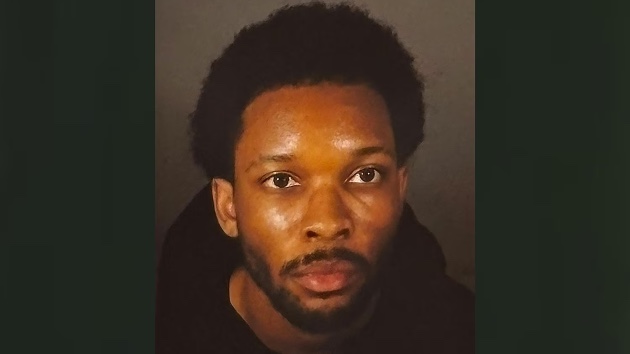
Dwight Rust Jr. was charged this week with the first-degree murder of his wife, Michelle Rust. (Baltimore County Police Department)
(BALTIMORE, Md.) — Dwight Rust Jr. this week appeared virtually for his first appearance in a Maryland court, a day after being arrested for the first-degree murder of his wife, Michelle Rust, 24 years ago.
Baltimore County District Court Judge Krystin Richardson ruled in favor of prosecutors pushing to hold Rust, 48 without bail on Wednesday afternoon. He remains held at the Baltimore County Detention Center.
Rust first reported his wife missing on July 20, 2002, as the couple was preparing for their 3-year-old son’s birthday party. He said that Michelle Rust had left around 9:30 a.m. that morning to pick up some last-minute items from Walmart, but never returned. She was 24 years old at the time, and her body has never been found.
It is unclear what evidence might have led investigators to arrest Dwight Rust Jr. early Tuesday. The criminal indictment, obtained by ABC News, reveals little about why prosecutors believe Rust was responsible for her murder. In the indictment, Rust is charged with murdering his wife sometime “on or about” July 19 and July 20, 2002.
State’s Attorney Scott Shellenberger declined to comment beyond the indictment. A spokesperson for the Baltimore County Police Department also declined to comment further.
In the bail review hearing on Wednesday, Assistant Attorney General Jacey Sheckells argued that Rust was attempting to start a new life with another woman when his wife went missing. According to Sheckells, Rust was having an affair with the woman.
Prosecutors requested that Rust be held without bail due to concerns he might try to intimidate witnesses.
Rust’s attorney, Jeremy Eldridge, denied the state’s allegations, maintaining Rust’s innocence.
“Having an affair with somebody doesn’t mean you’re going to murder,” he told ABC News after the hearing on Wednesday afternoon. “The state’s own witnesses, a lot of them, knew that he was ending the marriage. If people know that you’re breaking up with somebody, you’re not going to go and murder them. That doesn’t make any sense.”
In the years since, Rust has remarried and has been working for an HVAC company in the area.
“He has cooperated with law enforcement at every turn,” Eldridge said. “He’s given multiple statements and anything that the police have ever wanted or asked of him, he’s done without reservation.”
In cooperating over the past 24 years, Eldridge said Rust has also agreed to property searches by authorities.
When Michelle Rust failed to return from the trip to Walmart in 2002, Dwight Rust Jr. called her parents to see if she had stopped by their home. The family all together set out to search for Michelle Rust at nearby Walmart stores, but found no trace of her.
Her father-in-law, Dwight Rust Sr., found her green 1998 Dodge Caravan abandoned on a road that was just 10 minutes from their home. According to police, the ignition key had been broken off in the door. Investigators were unable to find the rest of that key chain, or any of the clothing and jewelry Michelle Rust was wearing when she went missing.
As Michelle Rust was diabetic and needed insulin, hundreds of family members, friends and volunteers quickly joined searches through woods, hospitals and pharmacies in the area to locate her.
Within months, still with no sign of Michelle Rust, police announced that they had concluded foul play was involved in her disappearance. The family also offered a $10,000 reward for any information related to the investigation.
A year after her disappearance, The Baltimore Sun reported that police had not yet ruled out Dwight Rust Jr. as a suspect.
“We pray and hope he is not responsible,” Ray Lins, Michelle’s father, told The Sun at the time.
In 2023, investigators returned to hunt for new evidence in the case. A group of forensic science students from Towson University assisted by using ground-penetrating radar to search for soil disturbance in the backyards of two properties. These homes formerly belonged to the couple and to Dwight Rust Jr.’s parents just next door.
“There’s no finality. Twenty-four hours a day, it goes through your mind: Where is she?” Michelle Rust’s father, Ray Lins, told The Sun in 2003. “People use the word closure. We love her. We miss her. And we don’t know what happened.”
When reached by phone on Wednesday afternoon, Ray and Gwen Lins declined to comment.
Rust faces a maximum penalty of life in prison for first-degree murder if convicted.
His next court appearance is scheduled for Monday, April 27.
The seal of the US Department of Justice on a podium prior to a news conference at the Department of Justice in Washington, DC, US, on Tuesday, April 7, 2026. (Graeme Sloan/Bloomberg via Getty Images)
(WASHINGTON) — The Justice Department’s internal watchdog announced Thursday it is launching an audit into the DOJ’s compliance with the Epstein Files Transparency Act that mandated the release of the department’s files on convicted sex offender Jeffrey Epstein, according to a statement from deputy inspector general William Blier.
This is a developing story. Please check back for updates.
(WASHINGTON) — Senate Republicans early Thursday morning approved a blueprint for their budget bill to fund immigration enforcement after an all-night voting marathon.
The vote marks the first step in a new plan to reopen the Department of Homeland Security, which has been shut down since mid-February — making it the longest shutdown in U.S. history.
The budget resolution, which kicks off the drafting process of a bill that Republicans said would provide billions of dollars to Immigration and Customs Enforcement and Customs and Border Protection, was approved by a vote of 50-48.
Republican Sens. Lisa Murkowski and Rand Paul joined with the Democrats in voting against the resolution. All other Republicans voted in favor of it, except for Sen. Chuck Grassley, who missed the vote as he recovers from a procedure to remove gallstones.
The Senate approved the resolution at about 3:36 a.m. after a vote-a-rama that lasted approximately six hours.
During that time, the Senate considered 17 amendments. Democrats, as promised, forced a number of votes on affordability-related items. Their amendments aimed at lowering the cost of everyday expenses — ranging from health care to electricity to childcare to gas prices.
Though a number of Democratic amendments won the occasional Republican supporter, Republicans ultimately defeated every Democratic-led amendment.
“What kind of bubble are they living in? How apart are they from people’s real needs? And instead, take that money, which should have gone to lowering people’s costs, and giving it to an agency that everyone knows needs reform,” Minority Leader Chuck Schumer, a New York Democrat, said on the Senate floor after the GOP budget blueprint passed.
Republican Sen. Lindsey Graham, the chairman of the Senate Budget Committee, vowed that Republicans are going to work to “get the job done” by June 1 — the deadline publicly set by President Donald Trump for Republicans to fund the immigration enforcement agencies.
“The vast majority of Republicans stuck together to do something Democrats are refusing to do: Fully fund the Border Patrol and ICE for three and a half years through the Trump presidency,” Graham said in a statement Thursday morning.
But the overnight vote-a-rama was just the first step in what could be a lengthy reconciliation process.
The GOP’s budget resolution now heads to the House where Speaker Mike Johnson hopes his rank and file will sign off on the Senate’s resolution next week. If approved, House members may begin directing committees to craft their bill that meets the instructions in the budget resolution. If House and Senate Republicans agree on legislation, both chambers will have to pass it again. That will include a second vote-a-rama in the Senate.
The GOP’s funding push for ICE and CBP comes amid the record-long DHS shutdown, now in its 68th day.
Many federal employees across DHS, including the Coast Guard, Secret Service, Federal Emergency Management Agency and Cybersecurity and Infrastructure Security Agency have gone without pay as Congress struggles to advance a funding deal. Throughout the shutdown, ICE and CBP have continued to receive funds due to an influx of cash provided in the so-called One Big Beautiful Bill passed by Congress last summer, and the administration has redirected other funding to support TSA workers.
Democrats have said they won’t support funding for ICE and CBP without reforms to their operating procedures, after two American citizens in Minneapolis were fatally shot by federal agents earlier this year.
Republican leaders, meanwhile, are expected to hold off on passing a full DHS funding bill until they can successfully fund the two immigration enforcement agencies.
“We’ve got to make sure that we don’t isolate and, as I say, make an orphan out of key agencies of the department. And there’s some concern on our side that if you do the bulk of the department first before that, then they could be left out. We can’t allow for that,” Speaker Johnson said earlier this week.
Chemicals are removed from a home in Syosset, New York. (WABC)
(SYOSSET, N.Y.) — A New York father and son were arrested and charged after investigators discovered chemicals at their residence that had been combined to create explosive materials, according to police.
Investigators discovered the chemicals while they were looking into a “bias incident” in which a swastika was drawn in a male bathroom at Syosset High School on Wednesday, according to the Nassau County Police Department.
Investigators alleged the 15-year-old boy drew the swastika, police said.
Francisco Sanles, 48, has been charged with two counts of criminal possession of a weapon, two counts of criminal facilitation, two counts of endangering the welfare of a child and reckless endangerment.
The unnamed teen has been charged with two counts of criminal possession of a weapon, criminal mischief, aggravated harassment and making graffiti, police said.
When the chemicals were found, officers evacuated the home and began evacuating the residents of neighboring homes.
“The Nassau County Fire Marshal, Arson Bomb Squad, Nassau County Police Emergency Service Unit (ESU) were all notified and responded to the scene. The Nassau County Hazardous Material (HAZMAT) Response Team also responded and carefully removed the hazardous material from the home,” police said in a statement Thursday.
Further investigation revealed Sanles paid for the various chemicals on several occasions. He was then arrested, according to police.
Students and staff at Syosset High School were notified of the bias graffiti and ongoing investigation in an email from the school district on Wednesday night, according to a copy obtained by WABC.
“I am writing to inform you that the District found swastikas and racial epithets above urinals at Syosset High School. The District immediately commenced an investigation and notified the Nassau County Police Department. Our investigation identified the person responsible and this is now a criminal matter with an active police investigation,” the school district wrote.
“We are cooperating fully with our partners in law enforcement and remain in constant contact with them as their investigation continues. This student will also face serious consequences pursuant to the District’s Code of Conduct,” the district said.
Sanles will be arraigned Thursday at First District Court in Hempstead, police said. The unnamed teen will be arraigned in Nassau County Family Court, police said.
No attorney information for Sanles and his son is listed in court records.
The remnants of a fire smolders near a melted fence as a result of the Brantley Highway 82 wildfire on April 23, 2026 in Atkinson, Georgia. (Sean Rayford/Getty Images)
(BRANTLEY COUNTY, Ga.) — At least 1,000 homes are being threatened by two major wildfires in Georgia that have burned more than 34,000 acres combined, according to officials.
Dry conditions from a persistent drought and gusty winds continue to fuel the wildfires in Georgia, Florida and elsewhere across the Southeast.
Georgia Gov. Brian Kemp declared a state of emergency for 91 counties in South Georgia.
The two major wildfires burning in Southeast Georgia are the Highway 82 Fire in Brantley County, and the Pinelands Road Fire in nearby Clinch County, officials said.
The Highway 82 fire, which started on Monday, had grown to nearly 5,000 acres and had destroyed at least 54 homes, County Manager Joey Carson said at a news conference on Wednesday. The fire was 15% contained on Wednesday evening, according to the Georgia Forestry Commission.
Hundreds of homes are in danger of being burned in the Highway 82 Fire, according to the Federal Emergency Management Agency (FEMA), which sent assets and personnel to the area on Wednesday to assist in fighting the fire and helping the community recover.
The Pinelands Road Fire started over the weekend on mostly private forest land, officials said. It grew from about 9,000 acres on Wednesday morning to more than 29,600 acres by Wednesday night and was spreading toward Echols County, according to officials.
The fire was threatening 64 homes and 37 other structures in the area on Wednesday evening, but there were no reports of homes being destroyed, according to the Georgia Forestry Commission, which said that fire also was 10% contained by Wednesday evening.
FEMA said on Wednesday said that the two fires are threatening 1,000 homes. The agency sent assets and personnel to assist in battling fires and helping communities recover after the agency approved a Fire Management Assistance declaration.
“Obviously, this fire became a lot larger than we thought it would be on Monday. We’ve got resources that have come in from all over South Georgia and now from the state,” Carson said Wednesday, adding that he expected more resources from the Federal Emergency Management Agency to arrive later that day.
The fire, burning northwest of Brunswick, Georgia, “continues to exhibit unpredictable behavior,” according to a statement Wednesday night from the Brantley County Sheriff’s Office.
Chuck White, director of Emergency Management in neighboring Camden County, said at the news conference on Wednesday that some homeowners in the area “have lost everything.”
“I’ll be very honest with you and say it’s a miracle that we have not had any lives lost,” Carson said Wednesday afternoon, adding the blaze was among 90 wildfires that have ignited across the state since Saturday.
Schools in Brantley County canceled classes for the second day in a row on Thursday due to the fire threat and smoke, officials said.
“This decision has been made to ensure the safety of our students, families, and employees, and to allow our Brantley County families time and space to navigate the impacts of the fire,” the local school system said in a statement on Wednesday.
On Tuesday, students and staff at two schools in the Brantley County town of Waynesville were forced to evacuate during the school day, officials said.
The Georgia Forestry Commission also issued its first mandatory burn ban in state history on Wednesday. The ban on outdoor burning, which will remain in effect for at least 30 days, is for 91 counties in the lower half of the state due to worsening drought conditions and rising wildfire activity, the agency said.
Carson noted that firefighters nearly had the Brantley County fire under control on Tuesday until afternoon wind gusts escalated the fire danger.
“Within 30 minutes, the winds picked up pretty significantly, and it went from being almost in control to a major wildfire,” Cason said. “Yesterday morning, we had 700 acres burned. It burned over 4,000 acres in a matter of hours as soon as the wind picked up.”
Persistent dry conditions have led to one of the worst droughts on record for parts of Georgia, fueling wildfires in the state.
According to the U.S. Drought Monitor, more than 48% of Brantley County is under what is called an Exceptional Drought – the highest level of drought it has experienced in more than 25 years.
Across Georgia, more than 69% of the state is under an Extreme Drought. At the start of the year, only 1% of the state was under an Extreme Drought or higher.
Georgia needs between 12 and 18 inches of rainfall to end its current drought, according to data from the National Centers for Environmental Information.
In Florida, near the Georgia-Florida line, the Railroad Fire was burning in Clay and Putnam Counties, which are also under drought conditions. As of Wednesday morning, the Railroad Fire had grown to more than 4,000 acres and was more than 50% contained on Wednesday morning, according to the Florida Forest Service.
Across the Southeast – including Florida, Alabama, Georgia, South and North Carolina and Virginia – more than 97% of the region is under a moderate drought or higher.
Florida is experiencing its worst drought in 25 years, with at least 71% of the state under an extreme or exceptional drought, the two highest levels, the Florida Forest Service said.
Fire alerts issued from Texas to Montana and Minnesota
Meanwhile, pockets of fire weather continue to linger in parts of the Rockies and Great Plains on Wednesday.
More than a dozen states across the Rockies and Plains from Texas to Montana and Minnesota were under fire weather alerts on Wednesday due to hot, dry and windy conditions.
Relative humidity in parts of the Rockies and Plains on Wednesday was expected to fall to as low as 5%, and wind gusts up to 30 to 45 mph are also forecast, allowing any wildfires to rapidly start and spread.
The wildfire threat is expected to continue Thursday in the Rockies and Plains as wind gusts are forecast to reach 60 mph and relative humidity is expected to be down to the single digits.
David Zaslav, CEO & President, Warner Bros. Discovery at TCL Chinese Theatre on April 07, 2026 in Hollywood, California. (Monica Schipper/Getty Images)
(NEW YORK) — Warner Bros. Discovery shareholders on Thursday voted to approve the Paramount Skydance takeover bid, completing a major step toward the $111 billion media mega-deal.
The offer from Paramount encompasses the HBO Max streaming service, the Warner Bros. film production company, and cable channels such as CNN. Assets owned by Paramount include CBS, Paramount Pictures and Comedy Central, among others.
Shareholders cast ballots “overwhelmingly” in support of the Paramount takeover, Warner Bros. Discovery said in a statement.
“Today’s stockholder approval is another key milestone toward completing this historic transaction that will deliver exceptional value to our stockholders. We will continue to work with Paramount to complete the remaining steps in this process that will create a leading, next-generation media and entertainment company,” Warner Bros. Discovery CEO David Zaslav said in the statement.
Shares of Paramount fell nearly 5% in the minutes following the announcement on Thursday morning.
In December, Paramount launched a hostile takeover bid to acquire Warner Bros. Discovery, just days after Netflix struck a deal to purchase a large part of the media giant.
The rival, multi-billion-dollar efforts to acquire streaming platform Warner Bros. Discovery threatened to upend the media industry and shape content viewed by hundreds of millions of people.
Paramount appeared to gain the upper hand in the bidding war in recent months. In February, the Warner Bros. Discovery board of directors voted unanimously to recommend approval of the Paramount takeover.
Under the terms of the deal, shareholders will receive $31 per share, which amounts to a 147% premium, Warner Bros. Discovery said in March.
Los Angeles County District Attorney placard. (Eric Thayer/Los Angeles Times via Getty Images)
(LOS ANGELES) — A man is charged with murder for allegedly beating an 84-year-old man with dementia and setting him on fire, Los Angeles prosecutors said.
The victim, Bang Cho, had wandered away from a senior care home when he was attacked just before midnight on Sunday in downtown LA, the Los Angeles County District Attorney’s office said.
The incident unfolded when Cho walked behind the suspect, Lavonta Wilder, and grabbed a bag Wilder was carrying, prosecutors said.
Wilder, a 40-year-old experiencing homelessness, allegedly “viciously” punched and kicked Cho, then lifted the elderly man over his shoulder and slammed him to the ground, and then set him on fire, prosecutors said.
Cho was taken to a hospital where he died the next day, prosecutors said.
Wilder is charged with murder and faces a special allegation of having a prior serious felony, prosecutors said. He’s due in court for an arraignment next month.
“The level of violence alleged here is brutal, callous and extreme,” LA County District Attorney Nathan Hochman said in a statement.
Cho “was disoriented and living with dementia, conditions that made him particularly vulnerable,” Hochman said. “Our thoughts are with the victim’s family as they endure this unimaginable tragedy.”
Christopher Gillum is seen in this undated police handout. (Okaloosa County Sheriff’s Office)
(DESTIN, Fla.) — A former police officer who allegedly was traveling to Louisiana to conduct a mass shooting at a large festival was arrested Wednesday night in a Florida hotel where investigators found a gun and nearly 200 rounds of ammunition, authorities said.
Christopher Gillum, of Chapel Hill, North Carolina, was wanted by the Louisiana Department of Public Safety “for terroristic threats” and was arrested at a hotel in Destin, Florida, the Okaloosa County Sheriff’s Office said in a statement Thursday.
“Authorities obtained information Gillum planned to travel to a festival in New Orleans to conduct a mass shooting and then commit suicide by cop,” the sheriff’s office said.
When officers arrested Gillum, they recovered a handgun and approximately 200 rounds of ammunition from his hotel room, the sheriff’s office alleged.
Attorney information for the suspect was not immediately available.
Gillum was a Chapel Hill Police officer from 2004 until 2019, when he resigned, a spokesman for the town of Chapel Hill said in a statement.
“He returned as a non-sworn employee in 2024 before leaving for another job by the end of that year,” Alex Carrasquillo, the town’s spokesman, said in a statement.
Gillum was being held in a Florida jail and awaiting extradition to Louisiana, the sheriff’s office said.
The Louisiana State Police did not say which festival the suspect was allegedly targeting, but said in a statement Thursday that “there are no known direct threats to any festivals in Louisiana.”
The state police will be conducting the ongoing investigation with the FBI, according to the department.
Close up of senior woman using cannabis at home (Getty/Emilija Manevska)
(WASHINGTON) — Acting Attorney General Todd Blanche signed an order on Thursday reclassifying state-licensed medical marijuana as a less dangerous drug.
The order moves marijuana from Schedule I to Schedule III, putting state-licensed medical marijuana in the same category as some pain medications, ketamine and testosterone.
While this change aligns federal guidelines with many state laws, marijuana is still illegal at the federal level. It does not remove cannabis from the federal controlled substance list, legalize recreational use nationwide or allow unregulated sales similar to tobacco and alcohol.
However, the move could allow for expanded research and ease many of the tax and regulatory rules placed on the cannabis industry.
“These actions will enable more targeted, rigorous research into marijuana’s safety and efficacy, expanding patients’ access to treatments and empowering doctors to make better-informed healthcare decisions,” Blanche wrote in a statement on X.
President Donald Trump announced late last year that his administration would seek to reclassify marijuana, but not legalize it for medical or recreational use under federal statutes. Over the weekend, the president appeared to express frustration that the administration was slow-walking the effort.
This is a developing story. Please check back for updates.
An Israeli artillery unit fires toward Lebanon on April 9, 2026 in northern Israel. (Amir Levy/Getty Images)
(LONDON) — Israeli and Lebanese ambassadors are expected to convene again at the State Department on Thursday for a second round of meetings amid the latest conflagration in the Middle East.
The first direct negotiations between the two states since 1993 are intended as preparatory meetings to shape future talks on a deal to normalize ties between the countries.
Thursday’s meeting is expected to focus on extending a shaky ceasefire that has halted fighting between Israel and the Iran-backed Hezbollah militia, long considered by experts as a “state within a state” wielding enormous influence over Lebanon’s political, economic and security spheres.
The technocratic government in Beirut, which came to power in 2025, is juggling dual pressure campaigns — sustained Israeli attacks and seizure of Lebanese territory on one hand and the internal threat of Hezbollah and its Iranian backers on the other.
Lebanese President Joseph Aoun said on Tuesday that the goal of the negotiations was to “stop hostilities, end the Israeli occupation of southern regions and deploy the [Lebanese] army all the way to the internationally recognized southern borders.”
“We negotiate for ourselves,” Aoun said. “We are no longer a pawn in anyone’s game, nor an arena for anyone’s wars. And we never will be again.”
Paul Salem, a senior fellow at the Middle East Institute think tank, told ABC News from Beirut that Thursday’s talks are “historically significant in what they might eventually lead to,” but framed the meetings as the first steps on a long and difficult road.
The government in Beirut is facing “a prolonged conundrum,” Salem said. “Iran is insisting on maintaining its presence and backing Hezbollah in Lebanon. Hezbollah seems to be happy to continue to play their role with Iran.”
And in southern Lebanon, Israel seems intent on a devastating campaign and seizure of land which its Defense Minister Israel Katz has repeatedly said will be modeled on the destruction of Gaza.
“The Lebanese state needs to be able to bolster its credibility by not allowing a long-term Israeli occupation,” Salem said.
On Wednesday, a spokesperson for Israeli Prime Minister Benjamin Netanyahu’s office told ABC News of the talks that there is “one obstacle: Hezbollah the Iranian proxy holding Lebanon hostage and threatening Israel. Peace through strength: remove Hezbollah and peace becomes possible.”
President Donald Trump’s administration pushed for a ceasefire in Lebanon earlier this month, as the White House sought a pause in the joint U.S.-Israeli campaign against Iran. Trump announced a 10-day ceasefire between Hezbollah and Israel following the first round of talks on April 14 — a ceasefire Netanyahu seemingly had no choice but to support.
But Trump and his top officials have also made clear that Hezbollah cannot be allowed to retain its pre-war clout within the country, nor continue to pose a military threat to Israel.
“We will make Lebanon great again. It’s about time we did so,” Trump said over the weekend.
Ahead of Thursday’s talks, a State Department official told ABC News, “The United States welcomes the productive engagement that began on April 14.”
“We will continue to facilitate direct, good-faith discussions between the two governments,” the spokesperson added.
A tentative ceasefire
Thursday’s talks in Washington will resume amid a tentative U.S.-backed ceasefire, under which Israeli strikes against alleged Hezbollah targets continue in eastern and southern Lebanon.
Under the U.S.-backed deal, Israel retains the right to fire on what it deems an “imminent threat” to its troops. The IDF has fired several times on Hezbollah targets since the ceasefire began on April 17. On Tuesday, Hezbollah said it fired rockets and drones at Israeli forces for the first time since a 10-day truce took effect.
Israeli ground forces are still operating in southern Lebanon, with the goal, according to Israeli officials, of establishing a demilitarized “buffer zone” between the Israeli border and the Litani River, around 18 miles to the north.
The IDF says it is holding approximately 15 positions about six miles deep into southern Lebanon, which it says includes about 50 Lebanese villages. Israeli officials have blamed the Lebanese government for being unable or unwilling to keep Hezbollah away from Israel’s northern border — a responsibility set out in the U.S.-brokered November ceasefire.
The campaign includes the razing of dozens of Lebanese towns and villages, plus the forced — and, at least for some, permanent — displacement of hundreds of thousands of people.
Human Rights Watch said this month that more than a million people across the country have been forced to flee their homes — nearly one-fifth of the entire population of the country. The Israeli evacuation orders have included all of southern Beirut, the suburbs of which are traditionally considered a Hezbollah stronghold.
Israeli action has killed at least 2,294 people and wounded another 7,544 people since March 2, Lebanon’s Health Ministry said last week. The strikes included a barrage of more than 100 strikes within 10 minutes on April 8, killing at least 357 people across the country, Lebanese authorities said.
Israeli health officials say Hezbollah gunfire, rockets and drones have killed 20 Israelis since March 2 and injured hundreds of others.
On March 2, Hezbollah joined Iran in its response to the U.S.-Israeli military campaign launched against Iran on Feb. 28. With those strikes, Hezbollah broke a U.S.-backed cross-border ceasefire that had been in place since November 2024. Hezbollah said the attacks were retaliation for alleged Israeli violations of the same ceasefire.
Hezbollah defied assessments it had been substantially weakened by its two-year involvement in the war in Gaza, firing more than 6,500 munitions toward Israel in the first five weeks of renewed fighting, according to the IDF.
Hezbollah fighters have also inflicted significant casualties on invading Israeli forces. Sixteen Israel Defense Forces troops had been killed in the current round of fighting in Lebanon as of Wednesday. The IDF says it has killed more than 1,800 Hezbollah operatives since March 2.
“Hezbollah is back in business,” Salem said. Israel’s operation “enables Hezbollah to resume its resistance narrative. And it certainly suits Iran to keep the Lebanon front open and active, to keep Israel distracted and to drain some of its resources and attention.”
Dual threats
Within Lebanon, Aoun and Prime Minister Nawaf Salam have faced veiled threats from Hezbollah and Tehran.
After the first round of talks in Washington, Hezbollah leader Naim Qassem said Aoun’s government was “subjecting Lebanon to these humiliations by negotiating directly with the Israeli enemy and listening to its dictates.”
Hezbollah is not a party to the U.S.-brokered ceasefire between Israel and Lebanon, which seeks to sideline the Iranian-backed militant group.
Hassan Fadlallah, a Hezbollah member of parliament, has called on Aoun to pull out of the talks. “We will reject and confront any attempt to impose political costs on Lebanon through concessions made to this Israeli enemy,” Fadlallah told AFP this week, though said the group wants “the ceasefire to continue” along with an Israeli withdrawal.
A potential clash between Beirut and Hezbollah has been brewing since the Aoun-Salam government took power last year.
In an unprecedented step, The Lebanese cabinet has repeatedly asserted its ambition for Hezbollah to disarm and has declared all military activity by the group to be illegal. Earlier this month, the cabinet ordered security forces to restrict weapons in Beirut exclusively to state institutions
The state’s all-volunteer Lebanese Armed Forces (LAF) is widely considered to be outgunned by Hezbollah, though it has around 80,000 personnel. Polls suggest the LAF is broadly popular among Lebanese people, but its multi-sectarian character has raised questions as to whether it would prove dependable in the event of renewed communal fighting.
But despite Hezbollah’s mauling in the last round of fighting with Israel and the loss of a key neighboring partner with the fall of Syrian President Bashar Assad in 2024, observers say the group — which is part of the Lebanese government and holds more than a dozen seats in parliament — retains extensive military and political power, particularly in parts of the capital Beirut and in its southern and eastern heartlands.
Before the outbreak of its latest war with Israel in 2023, estimates of Hezbollah’s military strength ranged from 30,000 to more than 50,000 operatives.
Israeli leaders have committed to an open-ended seizure of parts of southern Lebanon and demanded Beirut’s assistance in the total disarmament of Hezbollah, raising fears that Lebanon’s confessional power-sharing system could fracture and the country slide back into the kind of civil war that killed more than 100,000 people between 1975 and 1990.
Israeli leaders have been clear that they will not tolerate Hezbollah’s presence in southern Lebanon, vowing to keep troops there until the militant group is disarmed.
Risking such a calamity on behalf of Israel — a country which has invaded Lebanon six times since 1978, which is now again occupying parts of the south and which Lebanese authorities say has killed thousands of Lebanese civilians in three and a half years of war with Hezbollah — may be deeply unpopular.
LAF chief Gen. Rodolphe Haykal said on Tuesday that Lebanon “will reclaim every inch of its land under Israeli occupation,” according to a readout posted to the LAF’s X page.
Meanwhile, Hezbollah’s patrons in Iran — specifically the Islamic Revolutionary Guard Corps — appear unwilling to give up their Lebanese ally, which for decades has been perhaps the most potent proxy within of Tehran’s “forward defense” strategy by which Iran has sought to deter and punish U.S.-Israeli action against it.
Prominent Iranian leaders who survived the initial U.S.-Israeli onslaught demanded that Lebanon be included in the two-week ceasefire announced on April 8. “For years, Hezbollah has been fighting with the Zionist regime, but in the recent war, Hezbollah fought for the Islamic Republic,” parliament speaker and lead Iranian negotiator Mohammad Bagher Ghalibaf said.
Others have hinted at costs for Beirut if the government tries to defang Hezbollah. Ali Akbar Velayati — an adviser to Iran’s new Supreme Leader Mojtaba Khamanei — for example, said in a post to X this month that Salam “should know that ignoring the unique role of the resistance and the heroic Hezbollah will expose Lebanon to irreparable security risks.”
“Lebanon’s stability rests exclusively on cohesion between the government and the resistance,” Velayati said.
For many Lebanese — Shiites among them — the return to war between Israel, Hezbollah and Iran means more turmoil piled atop years of cascading economic and political crises.
Last month, Salam expressed his own frustration. “This war was imposed upon us,” the Lebanese prime minister said, adding that Beirut “could have avoided it” if Hezbollah had not resumed attacks on Israel.
ABC News’ Chris Boccia and Jordana Miller contributed to this report