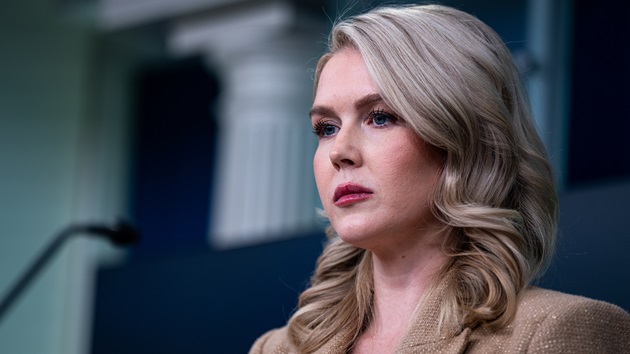
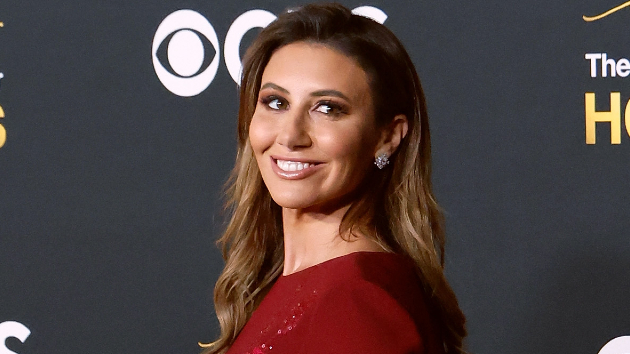
Karoline Leavitt, White House press secretary, during a news conference in the James S. Brady Press Briefing Room of the White House in Washington, DC, US, on Monday, Dec. 1, 2025. Al Drago/Bloomberg via Getty Images
(WASHINGTON) — The mother of White House press secretary Karoline Leavitt’s nephew was ordered released from immigration detention on Monday, according to her attorney.
Bruna Caroline Ferreira, who is in the process of obtaining a green card and previously held DACA status, was ordered released by an immigration judge on a minimum bond of $1,500.
Ferreira’s attorney, Todd Pomerleau, told ABC News that he argued at a hearing that his client is not a “criminal illegal alien,” as described by the Department of Homeland Security (DHS), nor that she is a flight risk.
Ferreira is expected to be released Monday or Tuesday, according to Pomerleau.
The White House did not immediately respond to an ABC News request for comment.
DHS confirmed two weeks ago that Ferreira had been detained. A reporter with ABC New Hampshire station WMUR spoke with Leavitt’s brother, Michael Leavitt, who also confirmed the arrest and said Ferreira had been detained a few weeks previously.
A DHS spokesperson then described Ferreira, a Brazilian national, as a “criminal illegal alien” who had a previous arrest for battery and had overstayed a visa that expired in 1999.
“ICE arrested Bruna Caroline Ferreria, a criminal illegal alien from Brazil. She has a previous arrest for battery. She entered the U.S. on a B2 tourist visa that required her to depart the U.S. by June 6, 1999,” the DHS spokesperson said. “She is currently at the South Louisiana ICE Processing Center and is in removal proceedings. Under President Trump and Secretary Noem, all individuals unlawfully present in the United States are subject to deportation,” the spokesperson said.
“Bruna has no criminal record whatsoever, I don’t know where that is coming from. Show us the proof,” Pomerleau told Boston ABC station WCVB after Ferreria’s arrest was announced.
Pomerleau also said then that Ferreira entered the country lawfully, previously held DACA status and was in the process of obtaining a green card. He further said that his client was arrested in her car in Massachusetts after being stopped with no warrant, adding that he now has to litigate her case in Louisiana, thousands of miles away from her home.
Pomerleau also told WCVB that he did not believe that his client’s connection to Karoline Leavitt could affect the case, adding that he believes it’s just “happenstance.”
ABC News’ Armando Garcia, Jason Volack and Hannah Demissie contributed to this story.
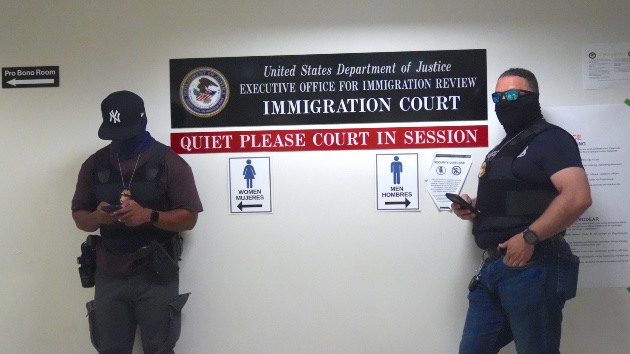
Masked ICE agents were seen stalking the corridors on the 12th floor of Lower Manhattan’s immigration court at 26 Federal Plaza, New York City, USA on September 8, 2025. (Photo by Selcuk Acar/Anadolu via Getty Images)
(NEW YORK) — An asylum seeker who fled Afghanistan last year after being persecuted by the Taliban is at risk of being deported back to his home country, according to his attorney.
Attorney Elora Mukherjee told ABC News that despite having no criminal record and having future asylum hearings scheduled, her client was apprehended by immigration authorities last Wednesday during a routine “check in” at 26 Federal Plaza in New York City.
Mukherjee and her client’s family requested his name not be used due to fear of threats.
The asylum seeker’s arrest comes after President Donald Trump directed his administration to suspend all Afghan immigration cases in response to a shooting earlier this month that killed one National Guard member and left another in critical condition in Washington, D.C. The administration has accused the Biden administration of not properly vetting asylum seekers.
The suspected shooter is an Afghan refugee named Rahmanullah Lakanwal, who previously worked with the U.S. government, including the CIA, in Afghanistan. He has pleaded not guilty.
Since the shooting, immigrant advocates and attorneys say Afghan asylum seekers and refugees have been targeted for detention and deportation.
Mukherjee told ABC News that her client applied to enter the United States through the Customs and Border Protection’s One app and received an appointment to enter the country in May 2024.
According to a habeas petition filed by Mukherjee, her client fled Afghanistan “after being subject to forced eviction and threats of potential death by the Taliban.”
The man was held in Immigration and Customs Enforcement custody for six months and then released on parole, according to court documents. Shortly after being released, he appeared before immigration court and applied for asylum, withholding of removal, and Convention Against Torture relief.
Mukherjee said her client has attended all of his immigration hearings and has one scheduled for February 2026.
But last Wednesday, Mukherjee told ABC News, her client received a notification from ICE to appear at 26 Federal Plaza, the government building that has become an epicenter for clashes between immigrants and immigration authorities, for a “check in.”
After the man entered the ICE waiting room, Mukherjee said, he was apprehended by immigration authorities and taken to a detention center in New Jersey.
“I tried to stay by his side, but officers insisted on separating us … in fact, they took [him] and detained him,” said Mukherjee.
Mukherjee told ABC News she filed a habeas petition challenging his detention.
“He’s not done anything wrong,” she said. “He has complied with all of his immigration check-in requirements. Filed a timely asylum application. He was persecuted by the Taliban and he will be very seriously harmed, tortured and killed by the Taliban if he’s forced to return to Afghanistan.”
ABC News reviewed federal and state court records and did not find a criminal record for the man.
During a hearing on Friday, a federal judge ordered the government to answer to the habeas petition by Wednesday and Mukherjee to respond by Thursday.
A representative of the Department of Homeland Security did not immediately respond to a request for comment from ABC News.
“He was not safe in his home country,” said the man’s brother, who also asked that his name not be used due to fear of threats to him and his family. “So he came to the United States and he feels safe over here, and he wants to establish a secure life for his future.”
He told ABC News that his brother was working and taking English classes before he was detained.
“Being returned to Afghanistan is on everyone’s mind,” his brother said. “I’m very worried.”
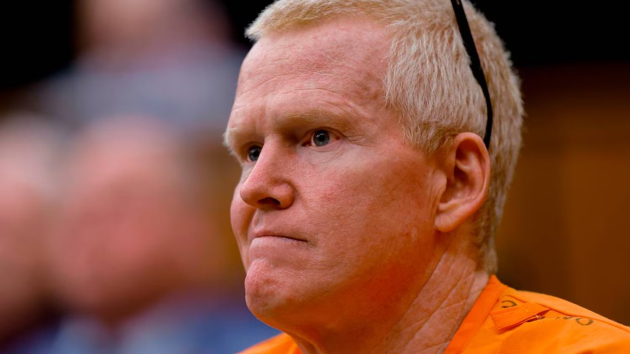
Alex Murdaugh sits during an evidentiary hearing at the Richland County Courthouse in Columbia, South Carolina, on Jan.16, 2024. Tracy Glantz/The State/Tribune News Service via Getty Images
(NEW YORK) — A former South Carolina court clerk who served during the double murder trial of Alex Murdaugh pleaded guilty on Monday to criminal charges stemming from the case — including for releasing sealed court exhibits to the press and then lying about it, and over the promotion of her book about the high-profile trial.
Former Colleton County Clerk of Court Mary Rebecca “Becky” Hill pleaded guilty to obstruction of justice, perjury and misconduct in office.
“I take full responsibility for my actions, and I know I have let down this Court, my community, and the people who placed their trust in me,” Hill said in court. “There is no excuse for my mistakes. I am ashamed of them, and I will carry that shame with me for the rest of my life.”
Judge Heath Taylor said he doesn’t believe Hill deserved incarceration and sentenced her to three years’ probation and 100 hours of community service.
Taylor said Hill has been “humiliated throughout this whole ordeal.”
“A lot of folks got swept up in the hoopla that was that trial,” Taylor said while handing down the sentence. “A lot of folks probably made a lot of money, but you didn’t.”
Hill was arrested in May, more than two years after Murdaugh was found guilty of brutally murdering his wife, Margaret “Maggie” Murdaugh, 52, and younger son, Paul Murdaugh, 22, who were found dead from multiple gunshot wounds near the dog kennels at the family’s hunting estate in 2021.
A judge imposed two sentences of life in prison, to be served consecutively for the murders.
According to the arrest warrants filed against Hill, investigators found she obstructed justice during the 2023 trial and then committed perjury during a hearing amid Murdaugh’s bid for a new trial last year.
Investigators found she obstructed justice in February 2023 during the trial by releasing or making available “‘scaled evidence’ photographs to a third party or parties, such act occurring in violation of a written court order issued to protect the ‘sealed evidence’ photographs, in violation of the law of the State of South Carolina,” the arrest warrant stated.
She then gave “false and misleading testimony” during a hearing on Jan. 29, 2024, in Richland County, as part of Murdaugh’s appeal, when she denied that she allowed anyone from the press to view the sealed exhibits in February 2023, according to the arrest warrant.
She was also charged with misconduct for using her office to promote a book she co-authored about the trial on social media, “such act being for her own financial gain and in violation of her duties, in violation of the laws of the State of South Carolina,” the arrest warrant stated. The book, “Behind the Doors of Justice: The Murdaugh Murders,” was ultimately pulled from publication over accusations of plagiarism.
The probe also found she received financial bonuses totaling nearly $12,000 between September 2021 and March 2024 for her own financial gain, “in violation of her duties, and further in violation of the laws of the State of South Carolina,” according to the arrest warrant.
Hill said in court Monday that she has “already begun the hard work of rebuilding the relationships I damaged by accepting responsibility, seeking forgiveness from those I love, and repaying any improper bonus I received.”
“I am committed to making amends, to being honest, and to living in a way that reflects the values I failed to uphold,” she said.
Her attorney, William Lewis, said they respect the judge’s decision and found the probationary sentence to be “appropriate.”
The Colleton County Clerk’s Office said it does not have any comment on Hill’s case.
Hill resigned as the Colleton County clerk of court in March 2024, amid the South Carolina Law Enforcement Division’s investigation into allegations she may have abused her government position for financial gain.
In the wake of the double murder trial, the South Carolina State Ethics Commission filed 76 counts of ethics violations against Hill over allegations she improperly sought financial gain through her position.
(WASHINGTON) — Members of Congress are tracking to pass new legislation that would compel Defense Secretary Pete Hegseth to provide lawmakers the unedited military video of 11 people being killed in the Caribbean Sea on Sept. 2 after an initial strike on a suspected drug boat left two passengers alive in the water.
A provision tucked into the annual, must-pass Pentagon spending and policy bill says the Defense Department should hand over unedited copies of video to the House and Senate Armed Services committees. If the department does not comply, Hegseth’s travel budget would be slashed by 25% until the relevant videos are turned over, according to the legislation.
The provision could be amended before the bill is voted on in either chamber.
The House is expected to hold a floor vote on the bill this week. The Senate must take it up for a floor vote by the end of the month.
At issue is whether the Sept. 2 military strike on the alleged drug boat amounted to a war crime. Officials have confirmed there were four military strikes against the boat — the first strike killing nine of the 11 people aboard. Some 40 minutes later, a second strike was ordered to kill the remaining two survivors. Two more strikes were ordered to sink the boat, officials say.
Lawmakers who have seen portions of the video of the strikes in a classified briefing last week have described the state of the survivors before being killed by the U.S. military in starkly different terms. Democrats insisted the survivors were helpless and should have been rescued to comply with international laws that call for either sides in a conflict to help combatants who fall overboard or are shipwrecked. Republican Sen. Tom Cotton, however, said the survivors were trying to “flip” the boat “so they could stay in the fight.”
President Donald Trump last week said he is open to releasing the video.
“I don’t know what they have, but whatever they have, we’d certainly release, no problem,” he told reporters in the Oval Office last Wednesday.
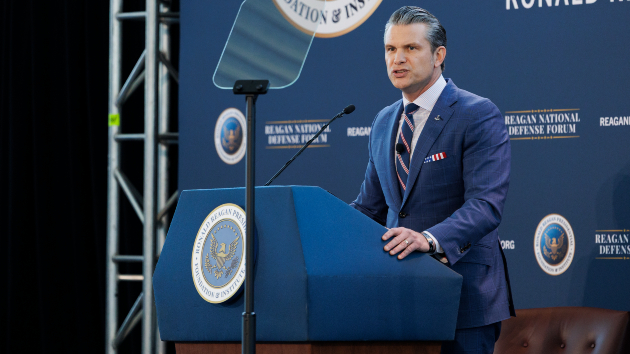
Hegseth, however, has not committed to doing so. Speaking at the Reagan National Defense Forum on Saturday, Hegseth said he was concerned that releasing the video could expose sources and methods tied to an ongoing operation. He said the military uses “bespoke capabilities, techniques, procedures” that would have to be protected.
“I’m way more interested in protecting that than anything else. So, we’re viewing the process, and we’ll see,” he said.
Hegseth also has suggested that the people killed in the strike were an imminent threat.
“I was told, ‘Hey, there had to be a reattack, because there were a couple folks who could still be in the fight [with] access to radios.’ There was a link-up point of another potential boat, drugs were still there … I said, ‘Roger, sounds good,'” Hegseth said.
Rep. Adam Smith, the top Democrat on the House Armed Services Committee who was briefed on the video, said there were no radios and called Hegseth’s description “ridiculous.”
“They ought to release the video. If they release the video, then everything that the Republicans are saying will clearly be portrayed to be completely false and people will get a look at it and they will see,” Smith said.
ABC News’ Lauren Peller and Allison Pecorin contributed to this report.
(NEW YORK) — After a three-month battle over the legality of her appointment, Alina Habba has resigned from her position as the Acting U.S. attorney for the District of New Jersey.
She announced her resignation as U.S. attorney in a social media post on Monday. She will remain serving as “Senior Adviser to the Attorney General for U.S. Attorneys.”
The resignation comes after a protracted legal fight about whether she could serve in the U.S. attorney role without Senate confirmation.
In August, a federal judge ruled that she was serving in the position “without lawful authority” and disqualified her as New Jersey’s top federal law enforcement officer. A federal appeals court unanimously upheld that decision last week, and the Department of Justice has not appealed that decision.
“As a result of the Third Circuit’s ruling, and to protect the stability and integrity of the office which I love, I have decided to step down in my role as the U.S. Attorney for the District of New Jersey,” Habba said in her statement. “But do not mistake compliance for surrender. This decision will not weaken the Justice Department and it will not weaken me.”“Following the flawed Third Circuit decision disqualifying Alina Habba from performing her duties in the U.S. Attorney’s office for the District of New Jersey, I am saddened to accept Alina’s resignation.
“Following the flawed Third Circuit decision disqualifying Alina Habba from performing her duties in the U.S. Attorney’s office for the District of New Jersey, I am saddened to accept Alina’s resignation,” Attorney General Pam Bondi said in a statement. “The Department of Justice will seek further review of this decision, and we are confident it will be reversed. Alina intends to return to lead the U.S. Attorney’s Office for the District of New Jersey if this occurs.”
Despite the rulings, Habba remained in the position after Attorney General Pam Bondi named her a “Special Attorney to the Attorney General,” though several judges delayed proceedings to consider the legality of her position.
Before she was appointed as U.S. attorney, Habba served as a personal defense attorney for President Donald Trump in his New York civil fraud case and defamation trials. Last month, a federal appeals court upheld a $1 million penalty against Habba and Trump for bringing a frivolous lawsuit against former FBI Director James Comey and Hillary Clinton.
The Trump administration has faced growing headwinds over its efforts to install Trump loyalists as top prosecutors in U.S. attorneys’ offices across the country, suffering a string of court defeats as judges raise concerns they’re actively disregarding the law.
Last month, a judge threw out both criminal cases against Comey and New York Attorney General Letitia James after determining that Lindsey Halligan, a former insurance lawyer and White House aide with no prosecutorial experience, was unlawfully appointed to lead the Eastern District of Virginia U.S. Attorney’s Office.
While Bondi previously said the administration would appeal that ruling, as of Monday, no appeal has been filed, and last week, a grand jury rejected an effort by the administration to revive its case against James.
A growing chorus of judges for the Eastern District of Virginia has raised concerns that the administration appears to be defying the order that disqualified Halligan by continuing to include her signature and title on legal filings.
On Monday morning, Attorney General Bondi and Deputy Attorney General Todd Blanche issued a joint statement attacking judges for questioning Halligan’s legitimacy in the role, and accused them of “engaging in an unconscionable campaign of bias and hostility.”
“Lindsey and our attorneys are simply doing their jobs: advocating for the Department of Justice’s positions while following guidance from the Office of Legal Counsel,” the statement said. “They do not deserve to have their reputations questioned in court for ethically advocating on behalf of their client. This Department of Justice has no tolerance for undemocratic judicial activism.”
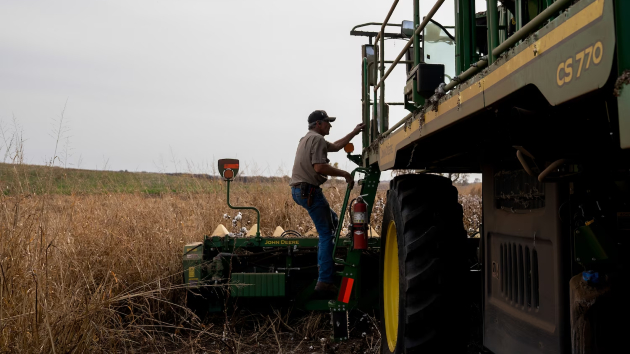
A farmer climbs onto a cotton stripper during a harvest at a farm near Corn, Okla., Nov. 19, 2025. Nick Oxford/Bloomberg via Getty Images
(WASHINGTON) — President Donald Trump is set to announce a $12 billion aid package for American farmers on Monday, a White House official confirmed to ABC News.
The package is set to include $11 billion in one-time payments to crop farmers through a new Department of Agriculture bridge payment program. The remaining funds will then go to other crops not covered by that program.
The long-promised aid package is intended to provide relief to farmers who have been hurt directly by Trump’s trade policies, including his global tariffs.
The news of the aid package announcement was first reported by Bloomberg.
A White House official confirmed that Trump will announce the package at an event with farmers at the White House on Monday afternoon.
Impact of tariffs on farmers
The aid package comes as the U.S.-China trade war has hit soybean farmers especially hard. Through most of this fall, during a bumper harvest season, China had blocked all purchases of soybeans from the U.S.
China was the biggest buyer of U.S. soybeans in 2024, accounting for $12.64 billion in sales, according to the USDA.
During Trump’s high-stakes meeting with Chinese President Xi in late October, the U.S. and China announced a framework trade agreement that included a deal on soybeans. China agreed to purchase 12 million metric tons of soybeans in the final two months of this year and 25 million metric tons in 2026, 2027 and 2028 — on par with levels before the trade war.
So far, China has purchased about 2.2 million metric tons of soybeans from the U.S. since the end of October, USDA data shows.
New package comes after Argentina bailout controversy
The administration’s new actions also come on the heels of the administration’s $20 billion bailout of Argentina, a move many American farmers and lawmakers on both sides of the political aisle criticized.
This fall, as China stopped buying all soybeans from U.S. farmers, it purchased soybeans from Argentina instead. So as the U.S. was giving a financial lifeline to Argentina, a country that directly benefited from the trade war, American farmers said they felt left behind.
“Farmers VERY upset [about] Argentina selling soybeans to China right after USA bail out Still ZERO USA soybeans sold to China,” Republican Sen. Chuck Grassley of Iowa wrote in a September social media post about the bailout.
Trump, in his first term, also took action to bail out American farmers. His administration approved two packages in 2018 and 2019 totaling $28 billion for farmers impacted by his economic policies.
(PORT ST. LUCIE, Fla.) — A 6-year-old girl died after she was injured at a trampoline adventure park in Florida, police said.
First responders were dispatched to an Urban Air Trampoline and Adventure Park in Port St. Lucie on Saturday for a “medical run” involving the child, according to local police.
The girl died from her injuries on Sunday, according to the Port St. Lucie Police Department.
“The investigation is still active and ongoing at this time and is pending the medical examiner’s findings,” a police department spokesperson said in a statement.
Police did not release any details on the incident or the nature of the injuries.
ABC News has reached out to the franchise location for comment but did not immediately receive a response.
The Port St. Lucie location includes a number of attractions in addition to trampolines, including go karts, bumper cars, a zip line and laser tag.
Stock photo of a sick child blowing their nose. Vera Livchak/STOCK PHOTO/Getty Images
(NEW YORK) — Concerns about the flu spreading in the U.S. are growing as the U.K. continues to see a spike in cases among children and young adults.
The increased number of cases in the U.K., could be a predictor for the flu season in the U.S., according to ABC News chief medical correspondent Dr. Tara Narula.
“We know that England or other places can be a marker for what is going to happen here, because their flu season happens a few weeks earlier than ours,” Narula said on “Good Morning America” Monday, adding, “We have low numbers of cases so far but they are increasing.”
Some hospitals are starting to implement flu season visitor restrictions, including the Detroit Medical Center and Children’s Hospital of Michigan, which are allowing, as of Monday, up to two visitors per patient and only those 13 years of age and older are permitted on inpatient hospital floors or in observation units.
According to data from the Centers for Disease Control and Prevention, flu activity in the U.S. is up at least 7% in the last week, and so far, there have been nearly 2 million illnesses, 19,000 hospitalizations, and 730 deaths from the flu.
Last year, the U.S. saw an extremely severe flu season, with 560,000 hospitalizations and approximately 38,000 deaths from the flu, the CDC reported in September.
Meanwhile, in the U.K., where flu season started earlier than usual this year and has yet to peak, doctors are seeing increasing flu activity that’s currently at “medium” level with hospitalizations for the flu around 7.79 per 100,000, according to UK Health Security Agency data.
Some hospitals, such as the Sherwood Forest Hospitals in Nottinghamshire, have also reintroduced face mask policies in some hospital areas in light of the uptick in flu cases.
What flu variant is circulating?
The predominant flu strain that is currently circulating the most in the U.S. is the subclade K variant.
“The strain that is circulating most … subclade K, which is a variant of H3N2, seems to have a little bit more severe symptoms and maybe more severely affects the elderly and children,” Narula said Monday.
What are the symptoms of the flu?
Flu symptoms can vary from mild to severe intensity, and according to the CDC, they can come on suddenly.
Symptoms can include as fever, chills, cough, sore throat, runny or stuffy nose, body or muscle aches, headaches, fatigue, and vomiting or diarrhea, two symptoms which tend to be more common in children rather than adults.
People who are at more at risk of developing complications from the flu, according to the CDC, include older adults over 65, children younger than 2, and people with underlying conditions such as asthma and chronic lung disease or heart disease. Complications from the flu may vary, but they may include pneumonia, sinusitis, ear infections, and kidney and respiratory failure.
How to protect against the flu
Although the subclade K flu variant is not a perfect match for this year’s flu vaccine, doctors and the CDC still recommend everyone over the age of 6 months to receive one as a protective measure.
“When they look at studies abroad in England, they have found that the vaccine lowers the risk of hospitalizations for children by about 70% to 75%, which is really good, and adults by about 30% to 40%,” Narula said.
“Everyone thinks [the flu is] not that serious, it’s just a cold, but no, it can really cause complications and death,” Narula added.
Emergency physician Dr. Stephanie Widmer also recommended practicing regular hygienic habits to stay healthy.
“On top of getting the vaccine, washing your hands often, covering your coughs and sneezes, avoid[ing] touching your face and staying home if you’re feeling sick are all things [to do],” Widmer said on “ABC News Live.”
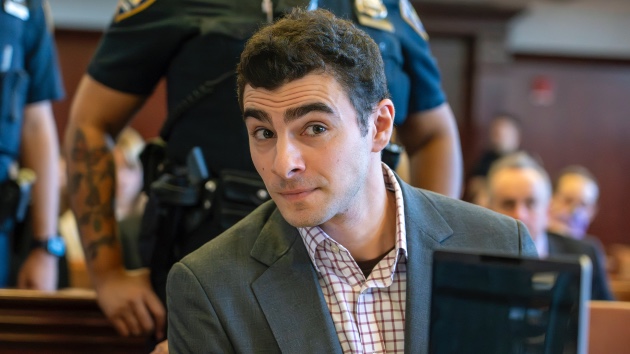
Luigi Mangione appears for a suppression of evidence hearing in the killing of UnitedHealthcare CEO Brian Thompson in Manhattan Criminal Court on December 01, 2025 in New York City. (Photo by Steven Hirsch-Pool/Getty Images)
(NEW YORK) — A police officer who searched accused CEO killer Luigi Mangione’s backpack when he was apprehended at an Pennsylvania McDonald’s took the stand on Monday for the fourth day of a crucial pretrial hearing in which Mangione’s defense lawyers are trying to exclude from trial critical evidence that they say was illegally seized from his backpack without a warrant.
“Holly Jolly Christmas” was playing in the Altoona McDonald’s on Dec. 9, 2024, when officer Christy Wasser — a 19-year Altoona Police Department veteran — searched Mangione’s backpack, immediately pulling out a pocketknife and a loaf of bread, five days after Mangione allegedly gunned down UnitedHealthcare CEO Brian Thompson on a Manhattan sidewalk.
When Mangione was formally placed under arrest at 9:58 a.m., Wasser testified that she “walked over and picked up his backpack.”
Two minutes into the search, Wasser was seen on body camera video extracting “wet, grey underwear” from the backpack. “And when I opened it up, it was a magazine,” she testified.
Prosecutor Joel Seidemann asked it was “fully loaded,” and Wasser responded, “Yes.”
Wasser also said she discovered a phone in a Faraday bag, designed to conceal its signal.
An officer was heard suggesting that the bag be brought to the police station to check for bombs. Wasser was heard joking that she preferred to check it at the McDonald’s because she “didn’t want to pull a Moser” — a sarcastic reference, she said, to a former Altoona officer who brought a bomb to the police station.
At 10:03 a.m. an officer was heard on the camera footage mentioning a search warrant. A different officer was heard saying that one was not needed at that stage.
Defense lawyers have argued Wasser’s actions violated Mangione’s constitutional rights and should justify excluding any of the evidence found in the bag, including the alleged murder weapon and writings that prosecutors say amount to a confession.
“[The officer] did not search the bag because she reasonably thought there might be a bomb, but rather this was an excuse designed to cover up an illegal warrantless search of the backpack,” defense attorneys argued in a court filing. “This made-up bomb claim further shows that even she believed at the time that there were constitutional issues with her search, forcing her to attempt to salvage this debacle by making this spurious claim.”
Although Wasser’s initial search of the backpack uncovered the magazine, she missed the loaded handgun, silencer, and journal that were buried deeper in the bag, she testified.
Wasser testified that she only discovered the two items about 15 minutes later, when she conducted a further search after driving from the McDonald’s to the Altoona police station.
“There’s a weapon!” she’s heard shouting on the video footage to the other officers in the intake area, as Mangione was being searched just feet away with his ankles shackled.
“Is that the first time you opened that zipper section on the side?” Seidemann asked Wasser on the witness stand.
“Yes, sir,” she affirmed.
With Mangione just feet away from her in the station’s intake area, she testified it would be “unwise” to continue the search near Mangione.
“Were the defendant’s hands free at the time you took out the gun?” asked Seidemann.
“Yes,” she testified.
Body camera footage showed Wasser and Deputy Chief Derek Swope take the weapon over to a nearby hallway — behind a locked door — where she cleared the gun. She mumbled — at times inaudibly — when she explained the situation to Swope on the video.
“We just checked the bag … to make sure there were no bombs or anything,” she said on the body camera footage.
As the search continued, Wasser quickly uncovered a silencer buried beneath other items in the bag. She also found a journal allegedly belonging to Mangione.
“Holy s—,” Swope can be heard saying in the body camera footage.
Wasser testified that she was cautious when checking the back because the nature of Mangione’s alleged crime “greatened [her] concern.”
“I just wanted to make sure there was nothing that could harm anybody,” she testified.
“Did any of your supervisors say, ‘Stop — go get a search warrant?'” asked Seidermann.
“No,” she said.
The stationhouse backpack search also turned up a slip of paper with a crude, handwritten map of Pittsburgh, Wasser testified, as well as what Seidemann described as possible escape routes.
The note said, “Keep momentum, FBI slower overnight” and “Break CAM continuity.” Another line read, “3+ hrs off cam, exit diff method (ex: megabus, rail)” and a note saying “check reports for current situation.” The note also said, “bus to Penn station,” “change hat” and “either taxi … or cross river.”
Wasser was also heard on body camera footage saying she pulled hair clippers from Mangione’s bag.
Earlier in the body camera video — when she was still searching the bag at the McDonald’s while “The Twelve Days of Christmas” blared in the background — prosecutors highlighted an exchange between officers and a supervisor about whether a warrant was necessary. One officer remarked that a warrant might be needed “because of the severity of the case,” but their supervisor interjected to say that no warrant was required because the incident was a “search incident to arrest” — a warrantless search conducted of an area within the arrestee’s immediate surroundings.
Prosecutor Nichole Smith of Pennsylvania’s Blair County District Attorney’s office also testified, outlining the chain of custody of items seized from Mangione after he was apprehended.
Smith recalled a lieutenant from the Altoona Police Department calling her at 9:53 a.m. to advise her “that he had the individual responsible for the CEO shooting” at McDonald’s. Smith said she was in court at the time and interrupted the proceeding to inform her boss, Blair County District Attorney Peter Weeks.
Smith said she and Weeks advised Altoona police to charge Mangione with forgery, carrying a firearm without a license, tampering with records for identification, possessing instruments of a crime and providing false identification to law enforcement.
Smith described a search warrant that obtained a court’s permission to seize Mangione’s belongings, including items in his backpack, and transfer them to the NYPD.
“Certain items in that bag were not inherently contraband, so we wanted to ensure that the court had approved,” Smith testified. “When they search the bag and they discover, for instance, the firearm, the ammunition and the suppressor, when he does not have a valid permit to carry those items concealed, they become contraband.”
Handwritten notes that police said they also discovered in Mangione’s backpack were not relevant to the local charges in Pennsylvania. Ordinarily, they would have been put aside and saved. The warrant allowed those items to be transferred as possible evidence in the New York case.
Defense attorney Karen Friedman Agnifilo objected to Seidemann referring to the writings as an alleged “manifesto” and Thompson’s killing as an “execution.” Judge Gregory Carro said it was fine for the ongoing suppression hearing but said, “You’re certainly not going to do that at trial.”
Last week, during the first week of the hearing, prosecutors called six witnesses, including the police officers who first confronted Mangione and the corrections officers who were tasked with constantly monitoring him before his transfer from a cell in Pennsylvania to New York.
Last week’s testimony shed new light on the events leading up to and following Mangione’s arrest, with the two officers who initially confronted Mangione recounting their experiences for the first time.
“It’s him. I have been seeing all the pictures. He is nervous as hell. I ask him, ‘Have you been in New York,’ he’s all quiet,” Altoona police officer Joseph Detwiler testified on Tuesday.
Prosecutors also showed in court never-before-seen security camera footage that captured the chilling moments after Mangione allegedly shot and killed Thompson in the predawn cold of New York City’s early winter. The videos provided the public with a clearer picture of the shooting and emergency response, as well as clues about the case prosecutors have built against the alleged killer.
At least three people were in the immediate vicinity of the shooting, including a woman just feet away from the suspect. The woman’s identity and whether she has spoken with police are not known.
The video also shows the suspect — after firing multiple shots — walk toward the victim, glance down at him, cross the street, then run toward a nearby alleyway. A woman holding a cup of coffee outside the famed New York Hilton on Sixth Avenue is seen flinching after hearing the first gunshot, after which she sees Thompson stumble, then appears to look straight at the gunman before running off.
Seconds later, a man inside the hotel exits, sees Thompson on the ground, then appears to point to a nearby alleyway where the suspect fled.
Luigi Mangione appears for a suppression of evidence hearing in the killing of UnitedHealthcare CEO Brian Thompson in Manhattan Criminal Court on December 01, 2025 in New York City. (Photo by Steven Hirsch-Pool/Getty Images)
(NEW YORK) – A police officer who searched accused CEO killer Luigi Mangione’s backpack when he was apprehended at an Pennsylvania McDonald’s took the stand on Monday for the fourth day of a crucial pretrial hearing in which Mangione’s defense lawyers are trying to exclude from trial critical evidence that they say was illegally seized from his backpack without a warrant.
“Holly Jolly Christmas” was playing in the Altoona McDonald’s on Dec. 9, 2024, when officer Christy Wasser — a 19-year Altoona Police Department veteran — searched Mangione’s backpack, immediately pulling a pocketknife and a loaf of bread.
When Mangione was formally placed under arrest at 9:58 a.m., Wasser testified that she “walked over and picked up his backpack.”
Two minutes into the search, Wasser was seen on body camera video extracting “wet, grey underwear” from the backpack. “And when I opened it up, it was a magazine,” she testified.
Prosecutor Joel Seidemann asked it was “fully loaded,” and Wasser responded, “Yes.”
Wasser also said she discovered a phone in a Faraday bag, designed to conceal its signal.
An officer was heard suggesting that the bag be brought to the police station to check for bombs. Wasser was heard joking that she preferred to check it at the McDonald’s because she “didn’t want to pull a Moser” — a sarcastic reference, she said, to a former Altoona officer who brought a bomb to the police station.
At 10:03 a.m. an officer was heard on the camera footage mentioning a search warrant. A different officer was heard saying that one was not needed at that stage.
Defense lawyers have argued Wasser’s actions violated Mangione’s constitutional rights and should justify excluding any of the evidence found in the bag, including the alleged murder weapon and writings that prosecutors say amount to a confession.
“[The officer] did not search the bag because she reasonably thought there might be a bomb, but rather this was an excuse designed to cover up an illegal warrantless search of the backpack,” defense attorneys argued in a court filing. “This made-up bomb claim further shows that even she believed at the time that there were constitutional issues with her search, forcing her to attempt to salvage this debacle by making this spurious claim.”
Prosecutor Nichole Smith of Pennsylvania’s Blair County District Attorney’s office also testified, outlining the chain of custody of items seized from Mangione, who was apprehended five days after he allegedly gunned down UnitedHealthcare CEO Brian Thompson on a Manhattan sidewalk.
Smith recalled a lieutenant from the Altoona Police Department calling her at 9:53 a.m. to advise her “that he had the individual responsible for the CEO shooting” at McDonald’s. Smith said she was in court at the time and interrupted the proceeding to inform her boss, Blair County District Attorney Peter Weeks.
Smith said she and Weeks advised Altoona police to charge Mangione with forgery, carrying a firearm without a license, tampering with records for identification, possessing instruments of a crime and providing false identification to law enforcement.
Smith described a search warrant that obtained a court’s permission to seize Mangione’s belongings, including items in his backpack, and transfer them to the NYPD.
“Certain items in that bag were not inherently contraband, so we wanted to ensure that the court had approved,” Smith testified. “When they search the bag and they discover, for instance, the firearm, the ammunition and the suppressor, when he does not have a valid permit to carry those items concealed, they become contraband.”
Handwritten notes that police said they also discovered in Mangione’s backpack were not relevant to the local charges in Pennsylvania. Ordinarily, they would have been put aside and saved. The warrant allowed those items to be transferred as possible evidence in the New York case.
Defense attorney Karen Friedman Agnifilo objected to Seidemann referring to the writings as an alleged “manifesto” and Thompson’s killing as an “execution.” Judge Gregory Carro said it was fine for the ongoing suppression hearing but said, “You’re certainly not going to do that at trial.”
Last week, during the first week of the hearing, prosecutors called six witnesses, including the police officers who first confronted Mangione and the corrections officers who were tasked with constantly monitoring him before his transfer from a cell in Pennsylvania to New York.
Last week’s testimony shed new light on the events leading up to and following Mangione’s arrest, with the two officers who initially confronted Mangione recounting their experiences for the first time.
“It’s him. I have been seeing all the pictures. He is nervous as hell. I ask him, ‘Have you been in New York,’ he’s all quiet,” Altoona police officer Joseph Detwiler testified on Tuesday.
Prosecutors also showed in court never-before-seen security camera footage that captured the chilling moments after Mangione allegedly shot and killed Thompson in the predawn cold of New York City’s early winter. The videos provided the public with a clearer picture of the shooting and emergency response, as well as clues about the case prosecutors have built against the alleged killer.
At least three people were in the immediate vicinity of the shooting, including a woman just feet away from the suspect. The woman’s identity and whether she has spoken with police are not known.
The video also shows the suspect — after firing multiple shots — walk toward the victim, glance down at him, cross the street, then run toward a nearby alleyway. A woman holding a cup of coffee outside the famed New York Hilton on Sixth Avenue is seen flinching after hearing the first gunshot, after which she sees Thompson stumble, then appears to look straight at the gunman before running off.
Seconds later, a man inside the hotel exits, sees Thompson on the ground, then appears to point to a nearby alleyway where the suspect fled.