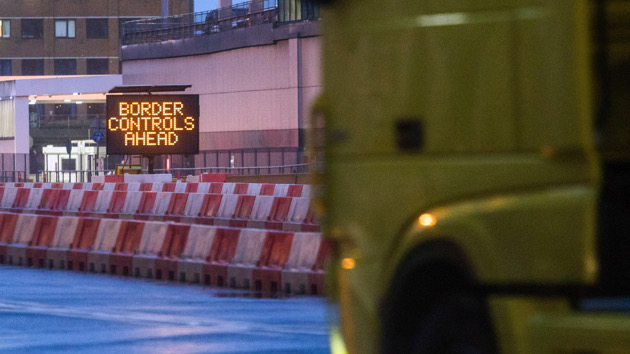
(WASHINGTON) — Mexico on Tuesday agreed to contribute $1.5 billion to a joint initiative with the U.S. to improve infrastructure along the U.S.-Mexico border, according to a person familiar with the commitment.
The agreement came on the same day President Joe Biden hosted his Mexican counterpart, Andrés Manuel López Obrador, for a meeting in the Oval Office.
Part of their discussions were expected to include a commitment from the two countries to carry out “a multi-year, joint, U.S.-Mexico border infrastructure modernization effort for projects along the 2,000 mile border,” a senior Biden administration official told reporters on Monday ahead of the meeting.
The infrastructure project is intended to improve processing and security along the border, the person familiar with the agreement said.
Biden alluded to Mexico’s investment in remarks alongside López Obrador before their meeting, saying, “We’re also making historic investments in infrastructure modernization across our 2,000-mile border with Mexico.”
He noted the $1.2 trillion infrastructure law he championed last year was “delivering $3.4 billion to major construction projects at the ports of entry between our two countries to make our border safer and more efficient for people, trade and commerce.”
“And the American people should know, Mr. President,” Biden told López Obrador, “that you’re also making a significant investment on your side of the border to improve infrastructure to meet the needs of our times and the future.”
The collaboration signifies something of a reset between Mexico and the U.S., as Biden tries to distance himself from the Trump administration’s contentious relationship with Mexico.
In 2019, then-President Donald Trump threatened to impose tariffs on Mexican imports “until Mexico substantially stops the illegal inflow of aliens coming through its territory.”
When Trump launched his presidential campaign in 2015, he promised: “I will build a great, great wall on our southern border. And I will have Mexico pay for that wall.”
It was a promise he repeated time and time again throughout his run and his presidency, ultimately building more than 450 miles of new wall with money that had originally been allocated to the Pentagon. But the project ended when Trump was voted out of office; Mexico never paid for any of it.
When asked to comment on the commitment, a White House official said, “Core to the prior administration’s immigration strategy was to build a wall, and they couldn’t even accomplish that in four years, let alone get Mexico to pay for it. By contrast, President Biden is taking unprecedented action to secure the border.”
Still, Biden has faced political roadblocks in implementing his immigration agenda.
Although the Supreme Court ruled in favor of allowing him to end “Remain in Mexico” — a Trump-era immigration policy that made more than 70,000 migrants wait in Mexico as their asylum claims were processed in the U.S. — another Trump policy, Title 42, has prevented hundreds of thousands of migrants from accessing the asylum system citing increased public health risk due to the ongoing COVID-19 pandemic.
(WASHINGTON) — President Joe Biden on Wednesday arrives in the Middle East for the first time as president, visiting Israel, the occupied West Bank and Saudi Arabia in a trip centered on encouraging the growing ties between Israel and Arab countries, while resetting his administration’s relationship with Saudi Arabia.
Coming as his administration has focused on countering China’s rise in Asia and uniting Europe against Russia’s invasion of Ukraine, Biden’s visit underscores the volatile region’s strategic importance to U.S. foreign policy and the global economy, analysts told ABC News.
From Biden’s highly-anticipated meeting with Saudi Arabia’s de-facto leader, to his efforts to address high gas prices at home and reaffirm the U.S. commitment to Israel’s security, here are seven things to watch on the trip this week.
A Saudi reset?
As a presidential candidate, Biden vowed to make oil-rich Saudi Arabia a “pariah” state over the 2018 murder of Saudi dissident and Washington Post columnist Jamal Khashoggi – an operation U.S. intelligence agencies later concluded was authorized by Crown Prince Mohammed bin Salman, who is also known as “MBS” and who effectively runs the Gulf nation.
Biden also pledged to “reassess” the traditionally close U.S.-Saudi alliance, amid calls from families of Sept. 11 attack victims to hold the kingdom “accountable” for links to the hijackers behind the terror attacks – and a push from within his own party to pressure Saudi Arabia to end its intervention in Yemen’s civil war, which according to the United Nations has led to one of the worst humanitarian crises in the world.
Since taking office, Biden has spoken twice with King Salman, the crown prince’s father, who officially rules the country.
But he had also dispatched Defense Secretary Lloyd Austin to serve as his administration’s point of contact with the crown prince, in what was widely perceived as a snub to the powerful Saudi leader.
Relations between the two countries reached a low point last spring when the Wall Street Journal reported that Prince Mohammed and his Emirati counterpart declined to schedule a phone call with Biden over frustrations with U.S. policy in the region. (The White House at the time told reporters there were “no rebuffed calls.”)
On Saturday, Biden plans to attend a summit of Arab leaders in Jeddah, a meeting that the crown prince will also attend, though it’s not yet clear how the two leaders will interact or engage.
The White House has said that Prince Mohammed is expected to attend a bilateral meeting Biden will hold with King Salman and the king’s “leadership team” on Friday. But U.S. national security adviser Jake Sullivan on Monday declined to say if the public would see Biden and the crown prince shake hands.
Oil, Ukraine force Biden’s hand, experts say
Several experts told ABC News the rapprochement between the U.S. and Saudi Arabia was inevitable, given the kingdom’s influence in the region – and its status as one of the world’s largest oil producers at a time when gas prices have skyrocketed and the West has attempted to boycott Russian oil.
“Without the Ukraine war, there would be a lot less focus [on Saudi Arabia]. There’s no question about it,” Dr. Gregory Gause, a Saudi Arabia expert and head of Department of International Affairs at The George Bush School of Government and Public Service at Texas A&M University, told ABC News.
Biden has defended his approach, writing in an op-ed for The Washington Post published Saturday that “my aim was to reorient — but not rupture — relations with a country that’s been a strategic partner for 80 years.”
“As president, it is my job to keep our country strong and secure,” he wrote. “We have to counter Russia’s aggression, put ourselves in the best possible position to outcompete China, and work for greater stability in a consequential region of the world.
“To do these things,” he continued, “we have to engage directly with countries that can impact those outcomes. Saudi Arabia is one of them, and when I meet with Saudi leaders on Friday, my aim will be to strengthen a strategic partnership going forward that’s based on mutual interests and responsibilities, while also holding true to fundamental American values.”
Will the Saudi visit itself lower gas prices? Probably not, experts say
Biden plans to attend a summit of leaders from the Gulf Cooperation Council, a union of Arab states, who will also be joined by the leaders from Egypt, Iraq, and Jordan; the grouping is being referred to as the “GCC+3.”
Sullivan said Monday the White House believes the oil-producing Gulf states have “a capacity for further steps that could be taken” to increase oil output, although he would not say if Biden planned to ask Saudi Arabia and the other countries to raise production by a certain amount.
Experts have told ABC News that it is not clear that Saudi Arabia could really do much to impact gas prices in the U.S., which have already started dropping in recent weeks — as demand falls off — from record $5 per gallon averages.
“There are things the Saudis can do,” Gause, the expert on Saudi Arabia, said. “But I don’t think that even if they really opened the spigots, it would bring prices down to, you know, where they were… in the midst of COVID.”
Amy Meyers Jaffe, the managing director of the Climate Policy Lab at The Fletcher School at Tufts University, said it’s most important to ensure “that the supply that’s already in the market stays in the market.”
“Part of that is engaging with the producers of the Middle East, because it’s not clear to me how much more they can all produce,” she told ABC News.
In fact, French President Emmanuel Macron was reportedly overheard last month telling Biden that the United Arab Emirates was already at “maximum” production capacity, and that the Saudis could only increase output by a relatively small 150,000 barrels per day in the short term.
A new Middle East?
When Biden first visited Israel nearly 50 years ago, the country was at war with much of the Arab world.
Now, following several peace agreements brokered by the Trump administration known as the Abraham Accords, Israel has diplomatic ties with the United Arab Emirates, Bahrain and Morocco — in addition to existing peace treaties with Jordan and Egypt.
Israel, Saudi Arabia and the other Gulf states share a mutual enemy in Iran: Israel considers Iran’s nuclear program an existential threat, while the country’s ballistic missiles and regional proxies have targeted Saudi and Emirati oil infrastructure.
While a major diplomatic breakthrough isn’t expected on this trip, Biden’s visit could help move Saudi Arabia and Israel toward normalized relations and greater coordination on regional security — at a time when renewed negotiations to limit Iran’s nuclear program have stalled.
“The region is watching to see how far the Saudis are willing to go,” Jacob Walles, a senior fellow at the Carnegie Endowment for International Peace who served as U.S. ambassador to Tunisia, told ABC News.
Walles said that while Saudi Arabia’s crown prince has signaled support for inching closer to Israel, significant diplomatic progress could take time, given Saudi public opinion and opposition to Israel.
The 86-year-old King Salman would also likely “limit” any breakthrough with Israel absent progress in the Israeli-Palestinian peace process, which has traditionally been a sticking point in relations between Israel and its neighbors, Walles said.
In his Washington Post op-ed, Biden noted that he will be the first U.S. president to fly from Israel to Jeddah, Saudi Arabia, describing it as a “small symbol” of the deepening ties between Israel and the Arab world.
“The Israelis believe it’s really important that I make the trip,” Biden told reporters at a press conference last month.
Walking a fine line on human rights
As Biden pursues rapprochement with Saudi Arabia and a strong relationship with Israel, he must balance economic and security interests with human rights concerns.
The U.S. has walked a fine line in the wake of the death of Palestinian American journalist Shireen Abu Akleh, a well known Al Jazeera correspondent killed in May while covering an Israeli military raid in the occupied West Bank.
During her funeral, Israeli police beat mourners and pallbearers — drawing widespread, global condemnation.
The State Department said on July 4 that after reviewing U.S. and Palestinian investigations into Abu Akleh’s death, it found that Israeli military gunfire likely killed her — but that it “found no reason to believe that this was intentional but rather the result of tragic circumstances.”
Asked if Biden planned to press Israeli officials on the case during his visit, White House press secretary Karine Jean-Pierre told reporters that “we want to see accountability.”
But Abu Akleh’s brother wrote in a letter to Biden late last week that “your administration’s engagement has served to whitewash Shireen’s killing and perpetuate impunity,” Reuters reported. He asked for Biden to meet with his family while in the region.
Meanwhile, Khashoggi’s 2018 murder was the reason Biden pledged to make Saudi Arabia a “pariah,” but the White House has repeatedly declined to say whether the president will even bring it up with the crown prince when he meets with him.
Biden constantly argues that the world is at an inflection point between democracy and autocracy, and his trip to Saudi Arabia shows that democracies may feel forced to kowtow to autocratic nations when economic and security interests are at stake.
“For an American president to go to [Saudi Arabia] is very, very humiliating,” Hossein Askari, an economist and Professor Emeritus of International Business and International Affairs at George Washington University, told ABC News.
“Maybe the American people don’t see that,” he continued. “But in the eyes of dictators around the world, and in the eyes of the Middle East, people will be laughing.”
What about the peace process?
The Abraham Accords between Israel and several Arab nations are one of the few foreign policies pursued by President Donald Trump that Biden has praised.
But the agreements cast aside longstanding doctrine that elevated the Palestinian issue in any normalization talks with Israel, cutting the Palestinians themselves out of talks — although the Arab nations did seek concessions from Israel favorable to the Palestinians.
Experts do not expect any breakthroughs in Israeli-Palestinian relations this week – nor has the Biden administration telegraphed any expected developments.
There have been, though, reports of discussions over Saudi Arabia allowing Israeli planes to fly over its territory — and U.S.-backed diplomacy aimed at resolving an international dispute over islands in the Red Sea.
And the Biden administration has reversed several Trump policies that downgraded the U.S. relationship with the Palestinians — such as resuming funding for a U.N. agency for Palestinian refugees — although he has not delivered on a promise to reopen an American consulate in Jerusalem for Palestinians that Trump closed. Other Palestinian desires – reopening an office in Washington and resolving other funding issues — are subject to congressional action that has not materialized, according to Michael Koplow, the chief policy officer of Israel Policy Forum.
Israel’s unstable political dynamics have also worked to lower expectations for the peace process on the trip, experts told ABC News — adding uncertainty and diverting attention from the U.S. commander-in-chief’s trip among Israelis.
The country will hold its fifth election in four years in November, following the collapse of Prime Minister Naftali Bennett’s fragile governing coalition — a mix of right wing, centrist, liberal and Arab parties with little in common besides a shared opposition to former prime minister Benjamin Netanyahu.
The right-wing leader, a fixture in Israeli politics for decades, could make his way back into power as prime minister this fall, despite his ongoing corruption trial.
In Israel during the campaign season, Biden will meet with interim Prime Minister Yair Lapid — a moderate serving in the role through the next election — and is expected to meet with other key leaders on the trip, including Netanyahu.
He will also meet with Palestinian Authority President Mahmoud Abbas, and is expected to visit a hospital catering to Palestinian patients, as his administration reverses the Trump administration’s decision to cut off hundreds of millions of dollars in aid to Palestinians.
Yemen war a major focus
Yemen’s civil war has paused for the last four months as the result of a negotiated truce.
It’s the longest ceasefire in the nearly eight-year war that caused what the United Nations has labeled the worst humanitarian crisis in the world.
Saudi Arabia has led a coalition that has backed Yemen’s government in its fight against a rebel group called the Houthis, who are backed by Iran. The U.S. has supported Saudi Arabia’s involvement, which has relied heavily on airstrikes.
Biden had ended offensive weapons sales to Saudi Arabia, though, over its handling of the war, and accused the kingdom of “murdering children” in Yemen as a presidential candidate.
While Sullivan told ABC News Monday that that ban would remain for now, the White House has in recent weeks praised Prince Mohammed’s role in bringing about the ongoing ceasefire as it works to improve relations with Saudi Arabia.
White House officials have said the war in Yemen will be a major focus for Biden while he visits Saudi Arabia – but human rights advocates and members of his own party have called on him to speak out more forcefully against Saudi involvement in the conflict while he’s in the region.
The battery to a Tesla Model s Plaid on display. – Munro Live, Munro & Associates
(NEW YORK) — The intense heat hitting most of the nation is already invoking warnings about power outages and health impacts.
But there is also another danger posed to drivers, as record temperatures lead to a greater risk of battery failure and degradation, according to engineers.
“Batteries are like humans, they don’t like high heat or low heat,” Anna Stefanopoulou, the William Clay Ford professor of technology at the University of Michigan, told ABC News. “The best temperature is the one humans are comfortable with.”
While there is little drivers can do to contain their cars’ temperatures during heat waves, Stefanopoulou and other experts who have been studying the advances in car technology told ABC News that manufacturers are hard at work finding new ways to beat the rising heat.
Stefanopoulou said that manufacturers constantly put their batteries to the limit during the testing phase since their vehicles are sold all over the world. Even though the batteries can withstand extreme benchmarks, she said there is only so much reliability within the laws of chemistry and engineering.
For example, if a car’s internal temperature reaches above 45 degrees Celsius, or 115 degrees Fahrenheit, the battery is prone to more wear and decreases the life of the cell, she said. Driving in those conditions will also test the limits of the battery, according to Stefanopoulou.
“High-temperature conditions are problematic because it affects the range. Some of the battery will go to keeping the AC … and that drains the battery,” she said.
This week, some parts of the country, including Palm Springs, Las Vegas and Phoenix, will see high temperatures above 110 degrees, according to the forecast.
Heat is a bigger issue when it comes to electric vehicles, which rely entirely on the power of the battery. EV batteries and systems have measures in place to prevent them from puckering under extreme temperatures, according to experts.
Cory Steuben, the president of the Michigan-based engineering consulting firm Munro & Associates, told ABC News that many EV manufacturers are using new types of batteries with thermal management.
The new batteries, such as ones with cylindrical, prismatic and pouch form factors, are engineered to keep the heat within the cell from rising too much.
“These are expensive, complex, very well-controlled machines,” Steuben, whose firm has acquired, taken apart and analyzed parts of several EVs, told ABC News.
He noted that EVs also have additional technologies to keep the car cool, particularly Teslas. The company’s models are equipped with data tracking that keeps an eye on the battery’s temperature, the ambient temperature and the temperatures of its charging stations, according to Steuben.
The car’s alert system has the option to tell a driver when and where to stop to recharge the car to prevent overheating while they’re on the road, Steuben said.
“Imagine if you had a 1980 Ford Bronco with a regular car battery. No one knows what is going on in your car and where it goes. Now we have the technology to constantly monitor the battery and make changes as you drive,” he said.
At the same time, Steuben said that some manufacturers have implemented new tech to keep batteries cool. BMW, for example, has opted to place the battery in the trunk instead of the engine to reduce the heat, he said.
“It requires an expensive cable, but it is a better climate-controlled environment,” Steuben said of the trunk. “It’s essentially the same temperature as the cabin.”
Other methods include cooling systems that pump liquid coolant throughout the engine to keep it from overheating, he said.
Stefanopoulou said the best solution for motorists is to park their vehicle in the shade or, if possible, in a location with a controlled climate — like an indoor garage.
For EVs, she recommended owners charge the car during hot days because those chargers and batteries have safeguards to prevent overheating.
Stefanopoulou acknowledged that the method can lead to bigger problems as it will tax power grids during a high heat event.
“It’s a self-propagating problem,” she said. “The higher the temperatures, the more energy we need to use to cool our vehicles. And that energy is lost and that will heat the environment.”
“That’s why it’s crucial that we continue to improve the battery technology and the power grid,” she added.
(NEW YORK) — As economists continue to predict the coming of a recession, many are left wondering what they can do to secure and potentially grow their wallets amid the chaos. For some, however, a recession may just be the perfect time to develop generational wealth that could last for years come.
Generational wealth refers to the financial assets that are passed down from one generation to the next. That could be in the form of property, investments, cash money, or other things of monetary value.
This kind of wealth can help ensure that one’s future children or relatives will have some kind of financial support.
However, building wealth isn’t and hasn’t been easy for everyone.
Because of systemic barriers — including racial discrimination in housing, employment and banking — the typical white family has eight times the wealth of the typical Black family and five times the wealth of the typical Hispanic family, according to the Federal Reserve.
Those living paycheck to paycheck make up 54% of the country, according to lending company LendingClub. A 2021 report from the Federal Reserve showed that roughly 36% of Americans likely don’t have enough money to cover a $400 emergency.
Having expendable wealth or generational wealth to build upon is a privilege, according to Jully-Alma Taveras, personal finance writer and founder of Investing Latina. It can be difficult for people with limited income to even begin taking steps toward accumulating wealth.
Catherine Collinson, CEO and president of the nonprofit financial wellness organization Transamerica Institute, says there are still ways for people to implement wealth-building practices into their routine.
“Living paycheck to paycheck can be daunting, especially now amid skyrocketing inflation and the lingering effects of the pandemic,” said Collinson. “Although it’s much easier said than done, it’s important to stay positive and avoid getting discouraged or overwhelmed — because that can be counter-productive.”
There are different routes that can be taken toward building wealth, and the path won’t look the same for everyone, financial experts say.
This journey can begin with small steps as easy as educating your children and family on financial planning, to steps as big as owning property that is likely to accumulate value.
Educate your children and family on financial literacy
Collinson recommends engaging children in family financial budgeting decisions. For example, she says planning for a vacation should include creating a budget, identifying costs, and making the necessary trade-offs to avoid overspending but maximize the amount of fun.
The same could be said for other family activities such as birthday celebrations, taking care of a pet, or grocery shopping.
Collinson said her own relationship with building wealth was influenced by her grandparents.
“Having lived through the Great Depression, they were adamant about living within one’s means and saving for the future whenever possible,” Collinson said. “They taught me that how you manage your money is just as important, perhaps even more important, than the size of your paycheck when it comes to building wealth.”
Taveras also leaned on the influence her business-owning family members had on her to put her on the right path for proper spending.
“I wanted to kind of represent myself and my family who happen to be business owners and have always been very, in many ways, financially strong,” she said.
A S&P Global FINLIT Survey found that only 57% of adults in the U.S. are financially literate.
Invest in the stock market
Investing in the stock market is another way that people can dip their toes into growing wealth.
Taveras says that investing in stocks can become a passive source of income, where an investment as little as a few bucks each month can slowly grow over time. Mobile apps have also made entering the stock market more accessible to the average user.
Taveras started investing when prices were low and said her growing stock have become “a really big part of building wealth.”
“We were in the middle of a recession — this was in the 2008 recession — and as you can imagine, since then, the market has grown exponentially,” said Taveras. “It just goes to show you that you really don’t need a lot to get started.”
As Wall Street predicts a recession in the coming year, now may be the time to start preparing to put money into the stock market.
Not only are some stock prices likely to fall, but so are the prices of some homes.
Owning property and real estate
Owning your home can also be a way of ensuring that future generations can have access to a cheaper place to live that’s already owned by the family.
Though the value of homes can shift up and down depending on a variety of factors, the Federal Housing Finance Agency found that housing markets have experienced positive annual appreciation since the start of 2012.
Not only would a house be worth more than it was when it was bought, but also if the house is passed down to a child or family member, it could save or earn future family members a big chunk of cash.
However, experts acknowledge that this is a harder goal to obtain.
As for some common mistakes to be wary of: financial experts remind employees to take advantage of 401(k) plans and other benefits that workplaces offer that they may be missing out on.
They also stress that putting off a necessary expense — such as home or car repairs — can often balloon problems into worse problems that cost a lot more than they may have originally cost.
Luiz C. Ribeiro for NY Daily News via Getty Images
(NEW YORK) — Two people, including a 7-year-old boy, died after a boat capsized on the Hudson River, the New York Police Department said.
Julian Vasquez, 7, and Lindelia Vasquez, 47, both became trapped underneath the boat, police said. The pair were unresponsive when first responders pulled them from the water and were pronounced dead, NYPD Assistant Chief James McCarthy told reporters during a press briefing Tuesday evening.
The two were part of family from Colombia travelling together, who boarded the jet boat — named Stimulus Money — in Elizabeth, New Jersey.
Eleven other family members, all from Colombia, were injured, including at least six women and three men, police said. The boat captain, who was licensed and is from Elizabeth, was also hurt, officials said.
Along with the two dead, four occupants of the boat went to Mount Sinai Hospital with non-life threatening injuries.
Two people are also hospitalized in critical condition, including the boat’s captain, authorities said.
The U.S. Coast Guard, New York Fire Department and NYPD responded shortly before 3 p.m. to reports of an overturned vessel near Pier 86, in front of the Intrepid Sea, Air & Space Museum in Manhattan.
The 27-foot boat was being chartered by family and friends, and the owner of the boat was trailing behind it on a Jet Ski, authorities said.
Authorities are investigating what caused the boat to capsize — including whether it was overloaded.
“There were 12 people on the boat, and when we bring the boat up, we’ll find out what was the capacity of the boat,” McCarthy said.
Investigators will also consider the conditions of the water.
“There’s a lot of commercial and recreational traffic during the day here,” Inspector Anthony Russo, commanding officer of NYPD’s Harbor Unit, told reporters. “We had the current, the wind. So you can have waves approaching from different directions.”
“It takes some skill to operate in the Hudson River, so it could have been a contributing factor,” he continued, though he noted it’s early in the investigation. “The Hudson River is always a dangerous place to operate.”
NY Waterway, which operates a ferry service between New York City and New Jersey, said two of its ferries responded to the scene and helped pull nine passengers from the private boat.
“We are so proud of the NY Waterway captains and crews that leapt into action today to rescue boaters following the maritime accident in the Hudson,” the company said on Twitter while sharing photos of the rescue. “Their training and professionalism saved lives, as they have countless times before.”
New York City Mayor Eric Adams commended the rescue response while warning New Yorkers to be safe in the city’s waters this summer.
“Our hearts go out to a group of people who were just using the water in our city,” he said. “This is a devastating moment for them.”
ABC News’ Will Gretsky contributed to this report.
(NEW YORK) — Russian President Vladimir Putin’s “special military operation” into neighboring Ukraine began on Feb. 24, with Russian forces invading from Belarus, to the north, and Russia, to the east. Ukrainian troops have offered “stiff resistance,” according to U.S. officials.
The Russian military has since launched a full-scale ground offensive in eastern Ukraine’s disputed Donbas region, capturing the strategic port city of Mariupol and securing a coastal corridor to the Moscow-annexed Crimean Peninsula.
Here’s how the news is developing. All times Eastern:
Jul 13, 8:27 AM EDT
Shelling continues throughout Donbas region
Shelling from both Russian and Ukrainian forces caused damage to the landscape and destroyed structures throughout the Donbas region on Tuesday and Wednesday, local officials said.
Russian strikes reportedly targeted the eastern town of Bakhmut, killing one person and wounding 5 others, the local governor said. Explosions were heard in several nearby towns too, with one missile falling near a kindergarten.
Shelling also continued in Izyum, Mykolayiv and Kharkiv on Tuesday. Russian troops reportedly conducted unsuccessful attacks north of Slovyansk and the town of Siversk on Tuesday, despite repeated rhetoric of an “operational pause” that Russia allegedly maintains, the Institute for the Study of War said in its latest report.
Russian forces continue to bomb critical areas in preparation for future ground offensive, with air and artillery strikes reported along the majority of the frontline, the experts added.
Ukrainian forces on Tuesday responded to the Russian attacks and claimed to have destroyed six Russian military facilities on occupied Ukrainian territories. Ukrainian officials claimed to have destroyed several ammunition depots, as well as a larger military unit.
Russian media reported on Tuesday that Ukrainian troops launched a “massive attack” on an air defense unit in the Luhansk region.
Ukrainian military officials also claimed to have killed at least 30 Russian troops on Tuesday, along with destroying a howitzer and a multiple rocket launcher, among other weaponry.
But the U.K. Defense Ministry in its latest intelligence update said it still expects Russian forces to “focus on taking several small towns during the coming weeks” in the Donbas region.
These towns are on the approaches to the larger cities of Slovyansk and Kramatorsk that likely remain the principal objectives for this phase of the Russian military operation, the ministry said.
-ABC News’ Edward Szekeres, Max Uzol, Yulia Drozd and Yuriy Zaliznyak
Jul 12, 10:27 PM EDT
US transfers $1.7 billion in economic assistance to Ukrainian government
The United States transferred $1.7 billion to Ukraine’s government Tuesday, the Treasury Department announced.
It’s the second tranche of money the Treasury transferred to Ukraine’s government as part of $7.5 billion approved for this purpose in the $40 billion Ukraine aid package Congress passed and President Joe Biden signed into law in May.
It’ll go, in part, to helping Ukraine’s government provide “essential health care services” and health care workers’ salaries, the Treasury Department said.
The U.S. transferred the first tranche, $1.3 billion, to Ukraine’s government two weeks ago.
-ABC News Benjamin Gittleson
Jul 12, 1:59 am
Ukraine destroys Russian ammo depot in occupied Kherson region
Ukrainian forces hit and likely destroyed a Russian ammunition depot in the Russian-occupied town of Nova Kakhovka in the Kherson region on Monday night, local officials said.
The strike resulted in a massive blast, videos of which soon circulated online. According to local reports, more than 40 trucks filled with gasoline were destroyed. Russian media didn’t verify the claims, saying instead that pro-Russian forces had destroyed a series of saltpeter warehouses.
“People’s windows are blown out, but they are still happy … because this means that the Ukrainian Armed Forces are close,” Sergey Khlan, from the Kherson Regional Military Administration, said in the aftermath of the attack.
Monday’s strike marked at least the fourth time Ukrainian forces destroyed ammunition depots in Nova Kakhovka, local media reported.
-ABC News’ Edward Szekeres, Tatiana Rymarenko, Max Uzol and Yulia Drozd
Jul 11, 10:18 pm
33 killed in missile strike on apartment complex
Thirty-three people are confirmed dead from a missile strike on an apartment complex in eastern Ukraine’s Donetsk region.
The complex was reduced to rubble from multiple rocket strikes on Sunday.
Emergency workers said others might still be alive and trapped under the debris.
Jul 11, 10:40 am
Putin clears way to fast-citizenship for Ukrainians
As Russia’s invasion of Ukraine continues, Russian President Vladimir Putin signed a decree on Monday that simplifies the procedure for any Ukrainian seeking Russian citizenship, allowing them to fast-track their applications, Russian news agency Interfax reported.
The fast-tracked citizenship applications previously only applied to residents of Ukraine’s Donetsk and Luhansk regions.
Jul 11, 10:22 am
6 dead, dozens hurt in Kharkiv shelling
Six people are dead and another 31 are injured from shelling in Kharkiv, according to the Kharkiv Prosecutor’s Office.
Two children, ages 4 and 16, are among the injured.
(AKRON, Ohio) — Jayland Walker’s funeral will take place Wednesday, as Akron, Ohio, recognizes an official citywide day of mourning for Walker declared by city officials days earlier.
“Tomorrow, Jayland Walker, a beloved son, brother, nephew, and friend will be laid to rest,” said Akron Mayor Dan Horrigan on Tuesday. “I want to thank Akron City Council for passing this resolution declaring tomorrow a day of mourning, in support of Jayland’s family and friends and to respect them in their time of grief. I know our entire city is also grieving. I offer my sincerest condolences to Jayland’s mom, sister, family, and friends during this difficult time.”
Services for Walker will begin at 3 p.m. at the Akron Civic Theatre. It will be followed by a press conference with representatives of the family, who plan to discuss Walker’s death.
Walker’s sister previously told “Good Morning America” about how she remembers her brother as a funny, kind brother who looked out for his family and had big goals for his future.
“It’s hard to just talk about somebody who you expect to live your life out with,” Jada Walker said.
The 25-year-old unarmed Black man was fatally shot by officers of the Akron Police Department on June 27.
Officials said they attempted to pull over Walker for a traffic violation and an equipment violation with his car. He allegedly refused to stop, which set off a chase that ended in his death.
Officials said a flash of light seen in body camera footage appeared to be the muzzle flash of a gun coming from the driver’s side of Walker’s car.
In a second body-camera video, officers are heard radioing that they heard a shot being fired from Walker’s car. The footage shows the officer following the Buick off Route 8 and continuing the pursuit on side streets.
At one point, Walker slowed down and jumped out of the passenger side door before it came to a full stop. As Walker ran away from police, several officers simultaneously fired several bullets, fatally shooting him.
The officers involved in the shooting are on paid administrative leave, pending the outcome of the investigation being led by the Ohio Bureau of Criminal Investigation, officials said.
His death has prompted weeks of protests across the city.
The citywide day of mourning aims to address ongoing unrest concerning Walker’s death.
“The City encourages robust discussions about difficult topics and supports advocacy to change unjust laws, and supports those who press for meaningful change, by engaging their local, state, and federal legislatures,” the resolution to enact the honorary day reads.
In it, officials also call for peaceful protesting and healing throughout the community: “The City urges that the friends and family of Jayland Walker, and the entire Akron community, be surrounded with love and peace, and that the City would begin to heal.”
(UVALDE, Texas) — Uvalde Mayor Don McLaughlin made his stance on the premature publication of the surveillance video at Robb Elementary School abundantly clear to community members in attendance at the city’s council meeting Tuesday, calling the way it was released “one of the most chicken things I’ve ever seen.”
Two Texas news outlets published disturbing surveillance video Tuesday from inside Robb Elementary School during the May 24 mass shooting, as Uvalde officials and families debate the sensitive footage’s release.
Austin ABC affiliate KVUE and the Austin American-Statesman both released an edited portion of the never-before-seen footage on Tuesday, ahead of the planned release of the video by state lawmakers.
The mayor spoke to a crowd of angry citizens, including elderly women who pounded their fists and family members of victims who shouted from the gallery.
The crowd was in agreement with the mayor, as was a fellow council member, Ernest W. “Chip” King III, who claimed the outlets’ “only reason” for releasing the video was for “ratings and money.”
The hallway footage captures the 77 minutes between when the shooter first entered Robb Elementary and when he was shot.
The edited surveillance footage shows dozens of law enforcement officers, including some with protective shields, waiting in the hallway of the school. Officers didn’t breach the classroom for more than 70 minutes, even as four additional shots were fired from the classrooms 45 minutes after police arrived on the scene, the footage released by the news organizations shows.
During the time he was inside, the gunman killed 19 children and two teachers.
The Austin American-Statesman, which is part of the USA Today network, wrote a detailed opinion piece on why it chose to publish the video.
“That video was obtained by Austin American-Statesman and KVUE Senior Reporter Tony Plohetski,” KVUE said in its reporting. “Both media outlets have elected to release that footage Tuesday to provide transparency to the community, showing what happened as officials waited to enter that classroom.”
In addition, it wrote: “KVUE and our partners have kept the families in Uvalde at the forefront in our decision-making process. Several families were included in that process and were briefed on what can be heard and seen in the video. All but one agreed the video should be made public.”
During the city council meeting Tuesday, the motion to accept council member Pete Arredondo’s resignation was also carried. Arredondo, the embattled police chief for the Uvalde Consolidated Independent School District, was elected to the Uvalde City Council in early May and was sworn in days after the school shooting.
McLaughlin on Tuesday again expressed frustration toward the investigation, calling it “the most unprofessional” he’s “ever seen.”
“I have said from day one, that every agency that was in that hallway has to be accountable for their actions that day. Everyone. No one will be exempt. That includes local school, federal, state — everyone has to explain their actions that day. Everybody has to be accountable,” he said.
The meeting began on a positive note as a community member thanked the council and McLaughlin for attending the Unheard Voices March and Rally on Sunday in “105-degree” weather.
Another community member had questions for the council regarding who the police department reports to and how the city plans to handle security and safety as the school year approaches.
McLaughlin said “the chief of police answers to the city manager who answers to the city council.” He then said he had not spoken to the school district yet, but he has “requested to have extra law enforcement… on the first two weeks of school.”
Most people in attendance were critical as they spoke before the council members.
One woman became passionate and said she was “furious” as she described a lack of a memorial in the town to pay respects to the victims. Additional community members echoed this, questioning the city’s decision to have the flowers, crosses and other gifts removed from the original memorial area.
Confusion ensued, as the mayor admitted his understanding of the removal process might not have been correct. Another council member claimed that families were asked to clear their family member’s memorial plot, which they willingly did. The crowd at the meeting questioned the truth of this, citing mumblings in the community that contradicted the claim, including Tess Mata’s mother. The council calmed the crowd by apologizing and assuring that families would be asked of their wishes and a memorial would be recreated at a location of their choosing.
The issue of the legal purchasing age for an assault rifle was also brought up by Precinct 4 County Commissioner Ronnie Garza, who is “asking Gov. [Greg] Abbott to call a special session of the legislature to consider raising the minimum age of purchase from 18 to 21 for semi-automatic assembly.”
Garza asked the mayor if he would consider adding it to the agenda of the next council meeting, to which McLaughlin agreed. The mayor also said that while he won’t attend the next meeting on July 26, the county commissioner has his vote for the anticipated movement to ask Abbott to hold a special session.
(WASHINGTON) — A favorite picnic staple is being recalled, right on the heels of Fourth of July celebrations.
“Out of an abundance of caution, Hy-Vee, Inc. is voluntarily withdrawing all varieties and all sizes of its Hy-Vee Potato Salad and Mealtime Potato Salad due to a presumptive positive microbial result on the line that the potatoes were processed on,” the U.S. Food and Drug Administration announced July 1. “While final test results are not expected for approximately 7-10 days, due to the holiday weekend Hy-Vee elected to withdraw all product today from its shelves and service cases pending final test results.”
The voluntary recall, according to the FDA, includes all 10 product varieties and sizes of Hy-Vee Potato Salad and Mealtime Potato Salad. (Click here for a full product list and more recall information from the FDA.)
The products were sold in the company’s eight-state region and available in grab-and-go refrigerated cases and/or deli service cases in all Hy-Vee, Hy-Vee Drugstore and Dollar Fresh Market locations, as well as Hy-Vee Fast and Fresh convenience stores.
Customers in Illinois, Iowa, Kansas, Minnesota, Missouri, Nebraska, South Dakota and Wisconsin who may have purchased the products are encouraged to check the expiration dates. The affected products are marked with dates between July 31, 2022, and Aug. 4, 2022, according to the FDA.
No other Hy-Vee or Mealtime branded salads are impacted and as of time of publication, there have been no reports of illness or complaints involving the products from the recall.
“Customers who have purchased any of these products are urged not to consume the product and dispose of it or return it to their local Hy-Vee for a full refund,” the FDA stated.
The company encouraged any questions be directed to Hy-Vee Customer Care at customercare@hy-vee.com.
(WASHINGTON) — The first full-color image from NASA’s James Webb Space Telescope has been released.
The images, the full set of which will be released Tuesday morning, will be the deepest and highest resolution ever taken of the universe, according to NASA.
The telescope will help scientists study the formation of the universe’s earliest galaxies, how they compare to today’s galaxies, how our solar system developed and if there is life on other planets.
Here’s how the news is developing. All times Eastern:
Jul 12, 2:00 pm
Scientists explain image of dying star
NASA scientists revealed more details about the image of the Southern Ring Nebula taken by the James Webb Space Telescope.
The image shows a planetary nebula, or a cloud of gas that encircles a dying star.
During a press conference Tuesday, Klaus Pontoppidan, one of the telescope’s project scientists, explained why the image is important.
“It’s not just any star, it’s a star much like the sun, or like the sun will be in 5 billion years when the sun dies,” he said.
Pontoppidian said the star is pushing out its outer layers, including carbon and oxygen, which helps create other cosmic objects.
“There’s a life cycle of stars,” he added. “This is the end of this star, but it’s the beginning of other stars and planetary systems.”
Jul 12, 1:15 pm
NASA scientists say Webb will be ‘revolutionary’
NASA scientists said the images and data that will be collected from the James Webb Space Telescope will be groundbreaking in our understanding of the universe.
“This going to be revolutionary,” said Jane Rigby, the operations project scientist for the telescope, during a press conference Tuesday. “These are previous capabilities we’ve never had before.”
Her comments come after NASA released five new images with never-before-seen detail of exoplanets, stars, nebulae and galaxies in the universe.
Rigby said she cried from happiness after seeing the first images that Webb captured.
“It was a combination of giddy like, ‘Oh my gosh, this is great,’ and having a sob like, ‘Oh my God, this works,'” she said.
Jul 12, 12:05 pm
NASA shows difference between Webb and Hubble
NASA revealed the difference in images taken by the James Webb Space Telescope, the first of which were revealed Tuesday, and its predecessor, the Hubble Space Telescope.
The 2009 image taken by Hubble was captured over the span of several weeks and show the galaxies surrounded by several stars.
Meanwhile, the 2022 image taken by Webb was captured in less than one week and reveals hundreds of star formations never seen before because the telescope uses infrared technology, which reveals objects invisible to the human eye due to being surrounded by clouds, gas and dust.
Jul 12, 11:46 am
Hundreds of new stars in nebula revealed in final image
The final image revealed Tuesday from the James Webb Space Telescope has revealed new details about the Carina Nebula, located in the Milky Way Galaxy.
The image, which is actually just the edge of the nebula, shows hundreds of stars never seen before within the cloud.
Because of the massive amounts of dust and gas that exist within the nebula, the stars were not visible to the human eye.
The area, referred to as the Cosmic Cliffs, shows a “giant, gaseous cavity” as young stars that were recently born push down ultraviolet radiation and create the jagged-looking edge.
Jul 12, 11:26 am
Galaxy cluster seen in new telescope image
According to the space agency, the image “contains over 150 million pixels and is constructed from almost 1,000 separate image files.”
The image provides new information about the cluster, including the birth of millions of stars — as they happened millions of years ago — and tails of gas and dust that are being pulled in different directions as the galaxies engage in a “cosmic dance.”
The “most surprising” image, NASA said, is one of the galaxies, NGC 7318B, crashing through the middle of the cluster.
President Joe Biden unveiled the first full-color image taken by the James Webb Space Telescope.
The image, revealed during a press event held at the White House Monday and also attended by Vice President Kamala Harris, shows multiple galaxies.
It is the highest-resolution image of the universe ever captured, officials said.
“Today is a historic day,” said Biden. “It’s a new window into the history of our universe and today we’re going to get a first glimpse of the light to shine through that window.”
NASA Administrator Bill Nelson said the light seen on the image has been traveling for over 13 billion years.
Jul 11, 4:46 pm
NASA says all of the telescope’s instruments are ‘ready’
NASA announced Monday all four of the James Webb Space Telescope’s scientific instruments are ready to start being used.
The space agency said there are 17 modes, or ways, to operate the instruments. All have been examined and are “ready to begin full scientific operations.”
The last step was was checking the the telescope’s NIRCam, which block starlight so scientists can detect other nearby structures, such as exoplanets.
Jul 11, 4:00 pm
Test image from telescope offers preview
A test image taken by the James Webb Telescope offers a preview of what’s to come ahead of the release of the first full-color images.
NASA shared the photo last week taken by one of the telescope’s instruments, the Fine Guidance Sensor, or FGS, to demonstrate how strong, clear and sharp Webb’s images will be.
According to the space agency, the “false-color mosaic” is made up of 72 exposures taken over a 32-hour period.
NASA noted that the primary focus of the FGS is not even to capture images but to make sure the telescope is pointing precisely at its target.
Jul 11, 3:30 pm
What to know about the Webb telescope
The James Webb Space Telescope was jointly developed by NASA, the European Space Agency and the Canadian Space Agency.
Development began in 1996 but ran into several delays before it was completed in 2016 at a final cost of $10 billion.
The telescope was launched on Christmas Day and is orbiting 1 million miles from Earth.
It used infrared radiation to detect objects that are invisible to the human eye.
The four goals of the telescope are to study how the first stars and galaxies formed right after the Big Bang, comparing the galaxies from the past to those of today, how planetary systems formed and if there is any sign of life on other planets.