
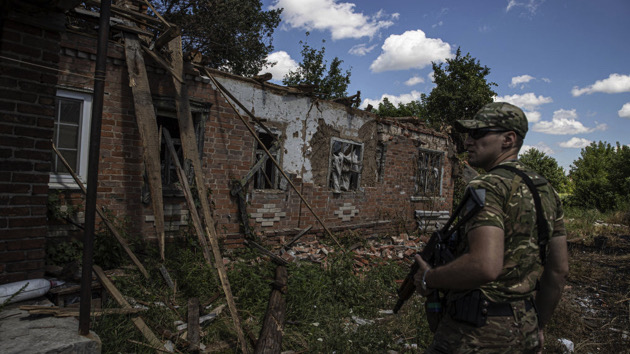
Russia-Ukraine live updates: Zelenskyy calls latest missile strike ‘act of terrorism’

Russia-Ukraine live updates: Zelenskyy calls latest missile strike ‘act of terrorism’
Metin Aktas/Anadolu Agency via Getty Images

(NEW YORK) — Russian President Vladimir Putin’s “special military operation” into neighboring Ukraine began on Feb. 24, with Russian forces invading from Belarus, to the north, and Russia, to the east. Ukrainian troops have offered “stiff resistance,” according to U.S. officials.

The Russian military has since launched a full-scale ground offensive in eastern Ukraine’s disputed Donbas region, capturing the strategic port city of Mariupol and securing a coastal corridor to the Moscow-annexed Crimean Peninsula.

Here’s how the news is developing. All times Eastern:

Jul 14, 7:15 AM EDT
Russian missile strike kills at least 17 in Vinnytsia

Russian missiles hit the heart of the central Ukrainian city of Vinnytsia on Thursday morning, killing at least 17 people and wounding more than 30 others, according to the Prosecutor General’s Office of Ukraine.

Two children were among the dead, the prosecutor’s office said.

The missiles struck an office building and damaged nearby residential buildings in Vinnytsia, located about 155 miles southwest of the Ukrainian capital, Kyiv. The strike also ignited a massive fire that engulfed 50 cars in an adjacent parking lot, according to the National Police of Ukraine.

The national police said about 90 victims in Vinnytsia sought medical attention, and 50 of them are in serious condition.

Ukrainian President Volodymyr Zelenskyy called the attack “an open act of terrorism” on civilians.

“Every day Russia is destroying the civilian population, killing Ukrainian children, directing missiles at civilian objects. Where there is no military (targets). What is it if not an open act of terrorism?” Zelenskyy said in a statement via Telegram on Thursday.

Russian missile strikes targeted several other Ukrainian cities on Wednesday and early Thursday, including Kharkiv, Zaporizhia and Mykolaiv.

At least 12 people died in the Zaporizhia strike, which hit two industrial workshops on Wednesday, according to local authorities.

At least five civilians were killed and 30 others injured in Mykolaiv on Wednesday after Russian missiles destroyed a hotel and a shopping mall, the local mayor said. The southern Ukrainian city was shelled again on Thursday morning, but no casualties were immediately reported.

-ABC News’ Edward Szekeres, Fidel Pavlenko, Max Uzol, and Yulia Drozd

Jul 13, 6:30 PM EDT
State Department aware of reports on another American detained by Russian proxies

The State Department said Wednesday it is aware of unconfirmed reports that another American has been detained by pro-Russian separatists in Ukraine.

The statement follows a [report from the Guardian] () on 35-year-old Suedi Murekezi, who is believed to have gone missing in Ukraine in early June.

According to the Guardian, Murekezi was able to make contact with a family member on July 7 and told them he was being held in the same prison as Alexander Drueke and Andy Tai Ngoc Huynh, two American veterans captured while volunteering for Ukrainian forces. Murekezi has lived in Ukraine since 2020 and was falsely accused of participating in pro-Ukraine protests, according to the report.

“We have been in contact with the Ukrainian and Russian authorities regarding U.S. citizens who may have been captured by Russia’s forces or proxies while fighting in Ukraine,” a State Department spokesperson said Wednesday. “We call on Russia to live up to its international obligations to treat all individuals captured fighting with Ukraine’s armed forces as prisoners of war.”

Another American — Grady Kurpasi — is also missing in Ukraine. A family spokesperson said the veteran was last seen fighting with Ukrainian forces in late April and is feared to have been either killed or captured.

-ABC News’ Shannon Crawford

Jul 13, 8:27 AM EDT
Shelling continues throughout Donbas region

Shelling from both Russian and Ukrainian forces caused damage to the landscape and destroyed structures throughout the Donbas region on Tuesday and Wednesday, local officials said.

Russian strikes reportedly targeted the eastern town of Bakhmut, killing one person and wounding 5 others, the local governor said. Explosions were heard in several nearby towns too, with one missile falling near a kindergarten.

Shelling also continued in Izyum, Mykolayiv and Kharkiv on Tuesday. Russian troops reportedly conducted unsuccessful attacks north of Slovyansk and the town of Siversk on Tuesday, despite repeated rhetoric of an “operational pause” that Russia allegedly maintains, the Institute for the Study of War said in its latest report.

Russian forces continue to bomb critical areas in preparation for future ground offensive, with air and artillery strikes reported along the majority of the frontline, the experts added.

Ukrainian forces on Tuesday responded to the Russian attacks and claimed to have destroyed six Russian military facilities on occupied Ukrainian territories. Ukrainian officials claimed to have destroyed several ammunition depots, as well as a larger military unit.

Russian media reported on Tuesday that Ukrainian troops launched a “massive attack” on an air defense unit in the Luhansk region.

Ukrainian military officials also claimed to have killed at least 30 Russian troops on Tuesday, along with destroying a howitzer and a multiple rocket launcher, among other weaponry.

But the U.K. Defense Ministry in its latest intelligence update said it still expects Russian forces to “focus on taking several small towns during the coming weeks” in the Donbas region.

These towns are on the approaches to the larger cities of Slovyansk and Kramatorsk that likely remain the principal objectives for this phase of the Russian military operation, the ministry said.

-ABC News’ Edward Szekeres, Max Uzol, Yulia Drozd and Yuriy Zaliznyak

Jul 12, 10:27 PM EDT
US transfers $1.7 billion in economic assistance to Ukrainian government

The United States transferred $1.7 billion to Ukraine’s government Tuesday, the Treasury Department announced.

It’s the second tranche of money the Treasury transferred to Ukraine’s government as part of $7.5 billion approved for this purpose in the $40 billion Ukraine aid package Congress passed and President Joe Biden signed into law in May.

It’ll go, in part, to helping Ukraine’s government provide “essential health care services” and health care workers’ salaries, the Treasury Department said.

The U.S. transferred the first tranche, $1.3 billion, to Ukraine’s government two weeks ago.

-ABC News Benjamin Gittleson

Jul 12, 1:59 AM EDT
Ukraine destroys Russian ammo depot in occupied Kherson region

Ukrainian forces hit and likely destroyed a Russian ammunition depot in the Russian-occupied town of Nova Kakhovka in the Kherson region on Monday night, local officials said.

The strike resulted in a massive blast, videos of which soon circulated online. According to local reports, more than 40 trucks filled with gasoline were destroyed. Russian media didn’t verify the claims, saying instead that pro-Russian forces had destroyed a series of saltpeter warehouses.

“People’s windows are blown out, but they are still happy … because this means that the Ukrainian Armed Forces are close,” Sergey Khlan, from the Kherson Regional Military Administration, said in the aftermath of the attack.

Monday’s strike marked at least the fourth time Ukrainian forces destroyed ammunition depots in Nova Kakhovka, local media reported.

-ABC News’ Edward Szekeres, Tatiana Rymarenko, Max Uzol and Yulia Drozd

Copyright © 2022, ABC Audio. All rights reserved.

Jan. 6 witness Trump allegedly tried to call was White House support staff, sources say

Jan. 6 witness Trump allegedly tried to call was White House support staff, sources say
Drew Angerer/POOL/AFP via Getty Images

(WASHINGTON) — The person whom former President Donald Trump was accused of having contacted following the Jan. 6 hearing when former administration aide Cassidy Hutchinson testified was a member of the White House support staff, sources told ABC News.

Trump’s alleged contact with the individual was described on Tuesday by the House Jan. 6 committee’s vice chair, Wyoming Republican Rep. Liz Cheney, who did not name the person.

“After our last hearing, President Trump tried to call a witness in our investigation — a witness you have not yet seen in these hearings,” she said at the close of the most recent committee hearing.

Cheney said the witness did not answer the call.

“Their lawyer alerted us, and this committee has supplied that information to the Department of Justice,” she said.

“Let me say one more time, we will take any effort to influence witness testimony very seriously,” Cheney added, as the committee continually warns against witness tampering in its ongoing investigation.

This person was not someone Trump would typically call. Many members of the support staff are those who work from administration to administration and would have not necessarily left when Trump left office.

When asked Tuesday night how he knew that the alleged phone call from Trump to a witness amounted to witness tampering, the committee chair, Mississippi Democrat Bennie Thompson, said “I don’t” and that’s why they alerted the DOJ.

CNN first reported the new details about the witness.

ABC News’ Libby Cathey contributed to this report.

Copyright © 2022, ABC Audio. All rights reserved.

Three still unaccounted for in wake of Virginia flooding

Three still unaccounted for in wake of Virginia flooding
BanksPhotos/Getty Images

(BUCHANAN COUNTY, Va.) — Three people remain unaccounted for in Buchanan County, Virginia, on Thursday after a severe storm struck the area, bringing heavy rain and flooding, officials said.

At the height of the flooding, 44 people were unaccounted for on Wednesday. Floodwaters are now receding, said authorities in Buchanan County, which sits at the borders of Virginia, West Virginia and Kentucky.

The declining number of unaccounted for is due to a combination of increased cellphone service and access to previously unreachable areas, Buchanan County Emergency Management Coordinator Bart Chambers told ABC News.

There are no reports of deaths or injuries, the sheriff’s office said.

The flooding came after 4 to 6 inches of rain pounded the area within hours Tuesday night. Some spots reported 3 inches of rain in just 90 minutes. A frontal system stalled over the region, which can produce copious amounts of rain in a very short period of time.

The damage spreads across about 10 miles, officials said, adding that the worst impact was downstream of where several streams join together.

Virginia Gov. Glenn Youngkin has declared a state of emergency.

“I want Virginians in Buchanan County to know that we are making every resource available to help those impacted by this storm. As we continue to assess the situation, I want to thank our first responders and the personnel on the ground for providing assistance with our ongoing operations,” he said in a statement.

Copyright © 2022, ABC Audio. All rights reserved.

Biden to announce appointees to Cancer Panel, part of initiative to cut death rate

Biden to announce appointees to Cancer Panel, part of initiative to cut death rate
Official White House Photo by Adam Schultz

(WASHINGTON) — President Joe Biden will announce Wednesday his appointees to the President’s Cancer Panel, ABC News can exclusively reveal.

The Cancer Panel is part of Biden’s Cancer Moonshot Initiative, which was relaunched in February, with a goal of slashing the national cancer death rate by 50% over the next 25 years.

Biden will appoint Dr. Elizabeth Jaffee, Dr. Mitchel Berger and Dr. Carol Brown to the panel, which will advise him and the White House on how to use resources of the federal government to advance cancer research and reduce the burden of cancer in the United States.

Jaffee, who will serve as chair of the panel, is an expert in cancer immunology and pancreatic cancer, according to the White House. She is currently the deputy director of the Sidney Kimmel Comprehensive Cancer Center at Johns Hopkins University and previously led the American Association for Cancer Research.

Berger, a neurological surgeon, directs the University of California, San Francisco Brain Tumor Center and previously spent 23 years at the school as a professor of neurological surgery.

Brown, a gynecologic oncologist, is the senior vice president and chief health equity officer at Memorial Sloan Kettering Cancer Center in New York City. According to the White House, much of her career has been focused on eliminating cancer care disparities due to racial, ethnic, cultural or socioeconomic factors.

Additionally, First Lady Jill Biden, members of the Cabinet and other administration officials are holding a meeting Wednesday of the Cancer Cabinet, made up of officials across several governmental departments and agencies, the White House said.

The Cabinet will introduce new members and discuss priorities in the battle against cancer including closing the screening gap, addressing potential environmental exposures, reducing the number of preventable cancer and expanding access to cancer research.

It is the second meeting of the cabinet since Biden relaunched the initiative in February, which he originally began in 2016 when he was vice president.

Both Jaffee and Berger were members of the Blue Ribbon Panel for the Cancer Moonshot Initiative led by Biden.

The initiative has personal meaning for Biden, whose son, Beau, died of glioblastoma — one of the most aggressive forms of brain cancer — in 2015.

“I committed to this fight when I was vice president,” Biden said at the time, during an event at the White House announcing the relaunch. “It’s one of the reasons why, quite frankly, I ran for president. Let there be no doubt, now that I am president, this is a presidential, White House priority. Period.”

The initiative has several priority actions including diagnosing cancer sooner; preventing cancer; addressing inequities; and supporting patients, caregivers and survivors.

The White House has also issued a call to action to get cancer screenings back to pre-pandemic levels.

More than 9.5 million cancer screenings that would have taken place in 2020 were missed due to the COVID-19 pandemic, according to the National Institutes of Health.

“We have to get cancer screenings back on track and make sure they’re accessible to all Americans,” Biden said at the time.

Since the first meeting of the Cancer Cabinet, the Centers for Disease Control and Prevention has issued more than $200 million in grants to cancer prevention programs, the Centers for Medicaid & Medicare Services implemented a new model to reduce the cost of cancer care, and the U.S. Patent and Trademark Office said it will fast-track applications for cancer immunotherapies.

ABC News’ Sasha Pezenik contributed to this report.

Copyright © 2022, ABC Audio. All rights reserved.

Buffalo supermarket to reopen two months after mass shooting left 10 dead

Buffalo supermarket to reopen two months after mass shooting left 10 dead
Spencer Platt/Getty Images

(BUFFALO, N.Y.) — Two months after a white teenager allegedly killed 10 Black people in what authorities described as a racially motivated mass shooting, the Buffalo, New York, supermarket where the massacre occurred is set to reopen.

The store will open to the public again on Friday following a prayer service and a moment of silence scheduled on Thursday afternoon to honor the victims, store workers and community members affected by the May shooting, Tops Friendly Markets said in a statement. Tops executives, along with community members, local dignitaries and other guests are expected to be on-hand Thursday, two months to the day of the shooting, and the company said the store “will quietly and respectfully reopen to the public,” in its statement.

Thursday’s ceremony is scheduled to begin at 2:30 p.m., marking the time the mass shooting began on May 14.

The store has undergone extensive renovations to repair the damage left by the mass shooting, in which the suspected gunman fired more than 60 shots from a high-powered, AR-15-style rifle, killing people inside and outside the Jefferson Avenue store and leaving three wounded.

The store was turned back over to Tops after investigators spent five days combing through it for evidence. FBI officials said investigators used state-of-the-art, scene-scanning tools, spherical and drone photography, conducted a bullet trajectory analysis of the shooting and reconstructed the shooting while the store was declared a crime scene.

During a May 19 news conference, Tops president John Persons promised the community that the store would “open it in a respectful manner for our associates, our employees and for the community at large.”

At the time, Persons said the renovations would include some way to memorialize the victims of the shooting.

“We have been committed to the city of Buffalo since our founding 60 years ago and this event doesn’t stop that commitment,” Persons said. “We will be here. We will be in this store.”

The market has served as a vital part of the east Buffalo neighborhood, local leaders said. In the predominantly Black neighborhood, which has struggled to thrive after years of historic segregation and divestment, residents said the area’s lone grocery store has been a central resource and gathering place providing access to fresh food and medicine. One Buffalo city councilman described the store to ABC News as “an oasis in the middle of a food desert.”

Investigators said the suspected shooter, 18-year-old Payton Gendron, allegedly targeted the store after conducting reconnaissance on it for at least two months.

Gendron drove three hours from his home in Conklin, New York, a day before the shooting and allegedly spent time conducting a final reconnaissance on the store before allegedly committing the mass shooting on a Saturday afternoon.

Authorities allege Gendron stormed the store wielding a Bushmaster XM-15 .223-caliber rifle and dressed in military fatigues, body armor and wearing a tactical helmet with a camera attached. Gendron allegedly livestreamed the attack on the gaming website Twitch before the company took down the live feed two minutes into the shooting.

Among those killed was 55-year-old Aaron Salter Jr., a retired Buffalo police officer who was working as a security guard at the supermarket. Authorities said Salter fired at the gunman, but the bullets had no effect due to the bulletproof vest the suspect wore.

Gendron was indicted on 25 counts, including 10 counts of first-degree murder, 10 counts of second-degree murder as a hate crime, three counts of attempted murder as a hate crime, and one count of criminal possession of a weapon. He is also the first person in New York history charged with domestic terrorism motivated by hate, a crime enacted in November 2020.

He has pleaded not guilty to the charges and faces life in prison without the possibility of parole if convicted.

Gendron has also been charged with 26 federal counts, including 10 counts of committing a hate crime resulting in death. He has yet to enter a plea to the federal charges.

Federal prosecutors have not yet announced whether they will seek the death penalty in the case.

Copyright © 2022, ABC Audio. All rights reserved.

Experts reveal how likely reinfection is from COVID with spread of omicron subvariant BA.5

Experts reveal how likely reinfection is from COVID with spread of omicron subvariant BA.5
VALERIE MACON/AFP via Getty Images

(NEW YORK) — Early in the COVID-19 pandemic, the prevailing theory was that if someone was infected with the virus, they were immune — at least for a while.

But a growing number of Americans seem to be contracting the virus more than once.

A recent ABC News analysis of state data found that, as of June 8, there have been more than 1.6 million reinfections across 24 states, but experts say the number is likely much higher.

“These are not the real numbers because many people are not reporting cases,” Dr. Ali Mokdad, an epidemiologist with the University of Washington’s Institute for Health Metrics and Evaluation in Seattle, told ABC News.

The latest variant, BA.5, has become the dominant strain in the U.S., making up more than 65% of all COVID-19 cases as of Wednesday, according to data from the Centers for Disease Control and Prevention.

What’s more, studies have suggested that vaccines and previous infection do not offer as much protection against BA.5 compared to past variants.

However, there is little evidence to suggest that BA.5 causes more serious disease or is more deadly than previous variants.

Experts say the risk of reinfection has also increased due to the sheer number of Americans who’ve had a first infection and the dropping of mitigation measures, like mask-wearing, across the country.

Risk of reinfection was different pre-omicron

Before the omicron variant arrived in the U.S., experts said reinfection was far less likely.

“I would say that before the omicron variant, it was pretty rare for me to see reinfection,” Dr. Shira Doron, an infectious disease physician and hospital epidemiologist at Tufts Medical Center in Boston, told ABC News. “Sometimes we would see someone who appeared to have reinfection and we’d repeat the test and it turned out that the new test was a false positive.

“And PCR tests can stay positive for months so sometimes clinicians would say a patient had reinfection, but it was a persistent positive from their infection a few months earlier,” Doron said.

In fact, an April 2021 study from England published in The Lancet found that people with a previous history of COVID-19 infection were 84% less likely to be reinfected.

But that changed post-omicron. A March 2022 study from South Africa found an increased risk of reinfection with the emergence of omicron, BA.1, due to the variant’s “marked ability to evade immunity from prior infection.”

This has also rung true for the original omicron variant’s several offshoots, including BA.5.

“There are two things going for BA.5,” Mokdad said. “One is, it evades protection from vaccines and previous infection due to its mutation and it’s a super-spreader.”

“When you look at BA.5 specifically, your antibodies from BA.1 and BA.2 are not great at neutralizing BA.5,” Doron added.

However, she did point to a preprint study from researchers in Qatar, which has not yet been peer-reviewed, suggesting effectiveness from infection with pre-omicron strains was only about 15.1-28.3% effective against reinfection with omicron.

“I still believe from what I’ve seen that if you were infected with omicron — sure, you can get reinfected — but it’s much less likely you will” than if you were previously infected with delta, Doron said.

More people infected means higher chance of reinfection

Experts told ABC News the risk of reinfection hasn’t just risen because of the emergence of the BA.5 variant. It’s also because the total number of overall infections has increased.

In April, a CDC analysis estimated 58% of all Americans had antibodies indicating a prior COVID infection, meaning people never sickened by the virus are in the minority.

Doron said that by the nature of more people infected, especially two-and-a-half years into the pandemic, it means there will be more reinfections as well.

“In the pre-omicron era, the proportion of people who were infected is smaller than the proportion today, which is the majority of people,” Doron said. “As you increase the proportion of people who have been infected, you’re going to — by definition — increase the proportion of reinfections.”

People have changed their behaviors

Mokdad said another reason that the risk of reinfection is higher is because people’s behaviors have changed.

He said after the initial omicron wave in winter 2021-22, most Americans stopped wearing masks indoors and all states lifted their remaining mitigation measures.

The IHME, where Mokdad works, has tracked mask use over time and as of May 30, 2022 — the latest date for which data is available — found that just 18% of Americans say they always wear a mask in public. At the same time one year ago, that figure was 44%.

“Mask-wearing is the lowest since we started tracking it,” he said. “Even on planes, people don’t wear them. And now you have an invasive and an immune-escape variant and people not wearing a mask indoors.”

He said previous waves from different COVID strains — including alpha, delta and the original omicron variant — were likely mitigated due to a higher percentage of the public wearing masks in indoor spaces.

Copyright © 2022, ABC Audio. All rights reserved.

FDA authorizes Novavax COVID-19 vaccine for emergency use in US

FDA authorizes Novavax COVID-19 vaccine for emergency use in US
Pavlo Gonchar/SOPA Images/LightRocket via Getty Images

(WASHINGTON) — Americans will likely have one more COVID-19 vaccine to choose from after the Food and Drug Administration issued an emergency use authorization for Novavax’s COVID-19 vaccine Wednesday.

The two-shot vaccine was authorized for use in people 18 years and older.

Novavax is the fourth COVID-19 vaccine to receive emergency use authorization in the U.S. by the FDA. The Centers for Disease Control and Prevention is now expected to review data on the vaccine before providing its recommendation for authorization.

“Authorizing an additional COVID-19 vaccine expands the available vaccine options for the prevention of COVID-19, including the most severe outcomes that can occur such as hospitalization and death,” FDA Commissioner Dr. Robert M. Califf said in a statement on Wednesday. “Today’s authorization offers adults in the United States who have not yet received a COVID-19 vaccine another option that meets the FDA’s rigorous standards for safety, effectiveness and manufacturing quality needed to support emergency use authorization.”

The FDA said it had determined that the Novavax vaccine met the criteria for authorization, and that the data showed that the potential benefits of the vaccine outweighed any potential risks.

“The American public can trust that this vaccine, like all vaccines that are used in the United States, has undergone the FDA’s rigorous and comprehensive scientific and regulatory review,” said Dr. Peter Marks, director of the FDA’s Center for Biologics Evaluation and Research.

Some health experts have suggested that some hesitant Americans may be more inclined to get the Novavax vaccine, as it is based on a more traditional protein-based technology, one already used for the flu vaccine and other shots, while Pfizer, Moderna and Johnson & Johnson’s vaccine platforms use more modern genetic technology.

The company applauded the agency’s decision to authorize the vaccine for emergency use.

“Today’s FDA emergency use authorization of our COVID-19 vaccine provides the U.S. with access to the first protein-based COVID-19 vaccine,” Stanley C. Erck, president and chief executive officer of Novavax, said in a statement. “This authorization reflects the strength of our COVID-19 vaccine’s efficacy and safety data, and it underscores the critical need to offer another vaccine option for the U.S. population while the pandemic continues.”

On Monday, the U.S. Department of Health and Human Services announced that the Biden administration had secured 3.2 million doses of Novavax’s COVID-19 vaccine. The vaccine will be made available for free to U.S. states and jurisdictions.

If the CDC signs off on use of the vaccine, the shots could be made available shortly thereafter.

To date, approximately two-thirds of the U.S. population has been fully vaccinated against COVID-19, according to federal data. However, more than 26.5 million American adults remain completely unvaccinated.

Copyright © 2022, ABC Audio. All rights reserved.

COVID hospitalizations forecast to increase amid concerns over new omicron subvariants

COVID hospitalizations forecast to increase amid concerns over new omicron subvariants
VioletaStoimenova/Getty Images

(NEW YORK) — For the first time since May, COVID-19-related hospital admissions are forecasted to increase again in the U.S., as highly infectious omicron subvariants continue to spread, according to updated forecasting models used by the Centers for Disease Control and Prevention.

The models show that nearly 40 states and territories are currently projected to see increases in new hospitalizations over the next two weeks. States in the South, including Arkansas, Louisiana, Mississippi and Texas, are expected to see the greatest increases in hospitalizations.

Nationally, between 3,200 to 13,800 daily confirmed COVID-19 hospital admissions are expected to be reported on Aug. 5. As of Wednesday, the U.S. is reporting nearly 5,800 virus-related hospital admissions each day, according to the CDC.

Hospitalization levels have already been increasing, with nearly 40,000 virus-positive Americans currently hospitalized, according to federal data. Totals are more than double the level they were at this time last summer, when the delta surge was beginning to emerge, and a growing number of COVID-19 positive people are also showing up to emergency departments, data shows.

In the South, where many states are forecasted to see notable increases, hospital admissions have risen by more than 20% in the last week.

Although the overall total remains significantly lower than at the nation’s peak, when more than 160,000 patients were hospitalized with the virus, hospitalizations are still at their highest point since early March.

The forecast also predicts that virus-related deaths will have either a stable or an uncertain trend in the next four weeks.

Even so, more than 5,700 deaths are still expected to occur nationally over the next two weeks. Texas, Oklahoma and California are projected to see the largest death tolls in the weeks to come.

“Deaths are still around 300, but hospitalizations are ticking up. This is something you don’t want to panic about, but we really need to pay attention to it because there are things that we can do to blunt that,” Dr. Anthony Fauci, a senior adviser to the president on the pandemic, told CNN on Wednesday.

Fauci and other federal health officials have been raising the alarm about omicron subvariant BA.5, which they say has been causing a resurgence of infections.

The U.S. is currently reporting more than 118,000 new cases a day, marking the country’s highest daily infection average since mid-February.

Fauci said the current reported case total is likely a “gross underestimate” as the majority of Americans are testing with home kits and not reporting their results to their local jurisdictions.

BA.5 is now the dominant variant in the U.S, accounting for an estimated 65% of new cases in the country. Scientists say it does appear to have a transmission advantage over the original omicron strain, although they do not believe it is more severe than prior strains.

“[BA.5] is certainly the most immune evasive. What we’re seeing is people who were previously infected getting reinfected at high rates, people who were vaccinated last year having a ton of breakthrough infections. It’s something we’re paying a lot of attention to,” White House COVID-19 Response Coordinator Dr. Ashish Jha told ABC News’ George Stephanopoulos on Good Morning America Wednesday.

However, Jha said the vaccines and boosters are still helping blunt the impact of severe disease.

Copyright © 2022, ABC Audio. All rights reserved.

A timeline of Elon Musk’s tumultuous Twitter acquisition attempt

A timeline of Elon Musk’s tumultuous Twitter acquisition attempt
Michael M. Santiago/Getty Images, FILE

(NEW YORK) — The richest person in the world said he wanted to own one of the most popular social media platforms — until he said he didn’t.

Tesla CEO Elon Musk on Friday moved to terminate his $44 billion deal to buy Twitter. In response, Twitter sued Musk on Tuesday to force him to complete the deal.

The standoff marks the latest chapter in a monthslong saga that began in January when Musk started investing in Twitter.

Musk reached an acquisition deal with Twitter in April, but over the weeks since, he has raised concerns over spam accounts on the platform, claiming Twitter has not provided him with an accurate estimate of their number. Twitter has rebuked that claim, saying it has provided Musk with information in accordance with conditions set out in the acquisition deal.

In May, when Musk said the deal was on “temporary hold” over bot concerns, Dan Ives, a managing director of equity research at Wedbush, an investment firm, told ABC News the grievance could serve as a pretext for Musk to renegotiate or abandon the deal amid a market downturn that had proven especially pronounced for tech stocks.

Over the course of the saga, Musk has been cast as a suitor, critic and now legal adversary of Twitter, where he boasts more than 100 million followers. Below is a timeline of Musk’s bid to acquire the social media platform.

Late January – Musk begins investing in Twitter, according to information filed with the Securities and Exchange Commission in April.

March 14 – Musk’s stake in Twitter reaches 9.2%, making him the largest shareholder in the company, according to a securities filing.

April 4 – In a securities filing, Musk discloses his stake in Twitter. Based on the price of Twitter shares at close of the previous trading day, his stake was worth $2.89 billion. Twitter shares rise more than 27% on the announcement.

April 5 – Twitter announces Musk will join the company’s board of directors.

“He’s both a passionate believer and intense critic of the service which is exactly what we need on @Twitter, and in the boardroom, to make us stronger in the long-term,” Twitter CEO Parag Agrawal said on the platform. “Welcome Elon!”

April 10 – Musk says he will not join the Twitter board after all.

“There will be distractions ahead but our goals and priorities remain unchanged,” Agrawal said in a statement announcing Musk’s choice. “The decisions we make and how we make them remain in our hands, no one else’s.”

April 14 – Musk offers to buy Twitter at $54.20 per share, valuing the company at about $43 billion, according to a securities filing. The offer amounts to a 38% premium above where the price stood a day before Musk’s investment in Twitter became public.

“I invested in Twitter as I believe in its potential to be the platform for free speech around the globe, and I believe free speech is a societal imperative for a functioning democracy,” Musk said in a filing with the Securities and Exchange Commission. “Twitter needs to be transformed as a private company.”

April 15 – Twitter adopts a poison pill provision to prevent the Musk acquisition. A poison pill allows current stockholders to purchase additional shares at a discounted price, diluting the shares owned by Musk and making it more expensive for him to buy the company. In an announcement, Twitter said the poison pill will be triggered if any individual or entity acquires at least 15% of the company’s shares.

April 21 – Musk says in a securities filing that he has garnered commitments of about $46.5 billion in financing for a possible Twitter acquisition.

April 25 – Twitter accepts Musk’s offer to acquire the company and values the deal at $44 billion, according to an announcement from the company.
MORE: Twitter says it will sue Elon Musk to complete the $44B merger he just rejected and is “confident” it will prevail

April 29 – Over a three-day period after Musk and Twitter reach a deal, and he sells about $8.5 billion worth in Tesla stock to help finance the bid.

May 4 – Musk secures more than $7 billion in financing for the deal, including commitments from Oracle co-founder Larry Ellison, venture capital firm Sequoia Capital and cryptocurrency exchange Binance, according to a securities filing.

May 6 – In a pitch deck for investors, Musk says he will quintuple Twitter’s revenue by 2028, increasing annual earnings to $26.4 billion, the New York Times reports.

May 10 – Musk says he would reverse Twitter’s ban of the account that belongs to former President Donald Trump. The remarks from Musk were made virtually at an auto conference.

May 12 – Twitter announces a temporary hiring freeze, pending Musk’s acquisition; and two top executives leave the company.

May 13 – Musk tweets that the Twitter deal is “temporarily on hold,” ​​citing concern over what he says is the prevalence of bot and spam accounts on the platform.

Along with his tweet, Musk posts a Reuters report about a public filing from Twitter earlier in May that said fake accounts made up less than 5% of users on the platform. Apparently skeptical of the finding, Musk says he wants “details supporting calculation that spam/fake accounts do indeed represent less than 5% of users.”

Roughly two hours later, Musk says he’s “still committed” to the deal.

At the time, market analysts told ABC News the worry over fake accounts could serve as a pretext for Musk to bargain a lower price for the acquisition or abandon the effort altogether.

May 26 – Twitter shareholders bring a class-action lawsuit against Musk over alleged stock manipulation tied to the tumultuous acquisition process. At the time, Twitter’s stock had fallen more than 12% since Musk announced his bid.

June 6 – Musk threatens to pull out of the deal if Twitter doesn’t provide additional information about the prevalence of bots on its platform. In a statement, Twitter said it had been sharing information with Musk “in accordance with the terms of the merger agreement.”

July 8 – Musk moves to terminate his acquisition of Twitter, pointing to the issue of fake accounts.

“Mr. Musk has sought the data and information necessary to ‘make an independent assessment of the prevalence of fake or spam accounts on Twitter’s platform'” and did not receive it, a securities filing said.

In an email on disclosed in a securities filing on Sunday, an attorney representing Twitter rejected Musk’s effort to abandon the acquisition. “The purported termination is invalid,” the attorney wrote, arguing that Musk had “knowingly, intentionally, willfully, and materially breached the Agreement.”

“As it has done, Twitter will continue to provide information reasonably requested by Mr. Musk under the Agreement,” the attorneys added.

July 12 – Twitter sues Musk in Chancery Court in Delaware to force him to complete the deal.

“Musk refuses to honor his obligations to Twitter and its stockholders because the deal he signed no longer serves his personal interests,” Twitter said in the lawsuit. “Musk apparently believes that he — unlike every other party subject to Delaware contract law — is free to change his mind, trash the company, disrupt its operations, destroy stockholder value, and walk away.”

Musk did not immediately respond to a request for comment on the lawsuit.

If permitted to abandon the deal, Musk may be forced to pay a $1 billion termination fee.

Shares in Twitter were up more than 7% in early trading on Wednesday morning.

Copyright © 2022, ABC Audio. All rights reserved.

TikTok to launch rating system that will filter ‘mature’ posts

TikTok to launch rating system that will filter ‘mature’ posts
5./15 WEST/Getty Images

(NEW YORK) — Popular social media platform TikTok on Wednesday announced plans for a rating system aimed at protecting young users from inappropriate content.

The move comes after sharp criticism from lawmakers and advocates in recent months over the prevalence of harmful posts on the app, especially those that appear in the feeds of young users.

The rating system, called “Content Levels,” will categorize videos based on the age-appropriateness of their material, preventing users under 18 from seeing certain content deemed mature, the company said. The system will be launched in the coming weeks and operate like similar approaches in the film and gaming industries, TikTok added.

“We want to play a positive role in the lives of the people who use our app, and we’re committed to fostering an environment where people can express themselves on a variety of topics, while also protecting against potentially challenging or triggering viewing experiences,” the company said.

In February, Wisconsin Sen. Tammy Baldwin and Minnesota Sen. Amy Klobuchar, both Democrats, sent a letter to TikTok saying its “algorithm of ‘nonstop stream of videos’ increases the likelihood that viewers will encounter harmful content even without seeking it out.”

The letter followed an investigation from The Wall Street Journal in December that found the platform surfaced tens of thousands of weight loss videos to a dozen automated accounts registered as 13 year olds within a few weeks of their joining the app.

Since last year, TikTok has been testing solutions that prevent users from seeing a flood of content focused on sensitive topics like dieting and sadness, the company said in a statement on Wednesday. In addition to the ratings system, the company is readying to launch a feature that will recognize and limit such sensitive topics from appearing in a user’s feed, it said.

In general, scrutiny over the harmful effects of content on social media, especially for young people, has intensified since leaks from whistleblower Frances Haugen last year revealed that an internal Facebook study had shown damaging mental health effects of Instagram for teen girls.

In September, Facebook suspended plans to offer a version of Instagram for kids.

The following month, officials from Snapchat, TikTok and YouTube told lawmakers they would work with them on proposals to help protect young users from harmful content on their platforms.

A bipartisan Senate bill introduced in February aims to tackle the harmful effects of social media for young people through a variety of measures, including mandatory privacy options that would allow users to disable addictive features and a tool for parents to track time spent on apps. So far, eight senators have signed on in support of the legislation.

A separate bipartisan Senate bill would fund a study of the effects of social media. Six senators have formally supported the bill.

Copyright © 2022, ABC Audio. All rights reserved.