
Biden is weighing a public health emergency over abortion, but experts are skeptical

Biden is weighing a public health emergency over abortion, but experts are skeptical
Justin Sullivan/Getty Images

(WASHINGTON) — President Joe Biden has said he is looking into declaring a public health emergency over abortion, nearly a month after the Supreme Court majority voted to overturn Roe v. Wade — landmark legislation that established federal protections for a woman’s right to abortion.

The Center for Reproductive Rights told ABC News that implementing a public health emergency over abortion would be crucial for the secretary of Health and Human Services to include in the plan Biden directed the department to create.

The CFRR said the emergency declaration would narrowly focus on abortion medication, which is approved at the federal level for pregnancies up to 10 weeks, allowing people to not have to travel across state lines to get access to abortions.

Experts told ABC News it is unclear how the Biden administration plans on using a public health emergency or whether they would be able to use it to increase access to abortion or abortion services.

Experts and the CFRR agree that there are a lot of potential legal challenges the Biden administration could face in taking this action.

“It’s clear to me and to a lot of experts, that what we are facing here is a true public health emergency. So I’m not worried about the ability of the administration to declare a public health emergency here and use authority,” Katherine Gillespie, acting director of the Senior Federal Policy Counsel at the CFRR told ABC News in an interview.

Gillespie added: “I think, unfortunately, we are we are in a situation where any option that the administration, or even Congress for that matter, would take will be subject to some legal challenge. But I think that there, the fact that there’s some legal risk, it doesn’t mean that the administration shouldn’t take this important action.”

In a statement to ABC News, the White House said the Biden-Harris administration will never stop fighting to protect access to abortion care.

What can a public health emergency do?

Declaring a public health emergency does two things: It frees up money from a range of funds appropriated specifically for health emergencies and it gives the administration, particularly the secretary of Health and Human Services, a fair amount of authority to shorten and wave rules or regulations that exist under federal law, according to Georges Benjamin, executive director of the American Public Health Association.

But, public health emergencies are temporary, lasting just 90 days. After that period is over, the administration could choose to renew.

The status of how many dollars are currently in those funds is unclear, according to several experts.

“We have been using all those dollars already for COVID and those are the same pots of money that one would use, should a hurricane or tornado hit a community and you had to respond for other health emergencies,” Benjamin said.

“The administration has been actively trying to find money for the next generation COVID vaccines and next generation medications for COVID. So, my understanding is that they pretty much have scoured almost all that money that they had that they can move around,” he said.

Lawrence Gostin, the faculty director of the O’Neil Institute for National and Global Health Law at Georgetown Law, told ABC News that, on the margins, under one emergency statute, Health and Human Services could provide immunity to people who provide abortion services or abortion medications.

However, this would likely face many legal challenges as the authority to decide who is licensed to practice medicine lies with states, not the federal government.

“It would be very, very hard to win that kind of case in court,” he said.

Gostin warned that the declaration would “utterly politicize public health.”

“The CDC and other public health agencies have already been battered and bruised from the COVID 19 pandemic and this would utterly make them political bodies and public trust in the CDC would go even lower,” Gostin added.

Even though he agrees that abortion has become a medical emergency, and the avalanche of state laws limiting or banning abortions will result in hundreds of thousands of women dying every year, Gostin said it is unlikely the declaration would do much.

“Emergency powers would do very little to help ordinary women in red states, it would unleash very low amounts of funding and powers. And the downsides of litigation and of loss of public trust and politicizing public health is, I believe, a step too far,” Gostin said.

“And you can be sure that if President Biden declares an emergency over abortion access, then the next Republican incumbent the Oval Office, will declare an emergency for fetuses and the right to life and the politicization of public health will be endless,” he added.

Legal Challenges

Gostin said Biden would face rapid and multiple legal challenges that could end up before the same conservative supermajority that overturned Roe.

There are three or four different statutes that Biden could use to declare a public health emergency, all of which would be “on very vulnerable legal ground,” Gostin said.

Despite supporting any action that would expand access to abortion, Benjamin said there are a lot of legal issues that the administration would need to address before they make this move.

Medication-prescribing physician practices are regulated at the state level, but the federal government has, in the past, given physicians the authority to practice medicine across state lines under a federal umbrella. But states still have to validate that physicians are authorized providers under that umbrella, Benjamin said.

Benjamin said this could come to the forefront of abortion when it comes to telemedicine appointments across state lines.

“If I’m up here in a state where abortion is legal, I do a telemedicine visit with a patient in a state that were there as abortion restriction. Am I practicing across state lines? Is it legal? Does that still relieve the patient of their legal liability?” Benjamin said.

Benjamin also said there is a risk of attorneys general taking that administration to court, as they have done for mask and vaccine mandates, which could deal federal agencies losses.

He also highlighted that a judge has already said that the CDC does not have the authority to require people to wear masks, which he thinks the agency has very clear authority to do.

“The courts are a real wildcard here,” he said.

Benjamin said the administration could take action to make sure that insurance plans cannot deny patients coverage for abortions. Biden could also make sure that adequate coverage is available and that there is reimbursement for providers.

The administration could also make sure that providers under the federal umbrella, like military providers, allow for a full range of reproductive services.

Copyright © 2022, ABC Audio. All rights reserved.
Case of 10-year-old rape victim challenges anti-abortion rights movement

Case of 10-year-old rape victim challenges anti-abortion rights movement
Tasos Katopodis/Getty Images

(WASHINGTON) — In a House hearing on Capitol Hill this week, an anti-abortion rights advocate said ending a pregnancy isn’t an abortion when it involves a 10-year-old rape victim.

The comment stunned the Democratic lawmaker questioning her.

The American College of Obstetricians and Gynecologists defines abortion as a “medical intervention provided to individuals who need to end the medical condition of pregnancy.”

“Wait, it would not be an abortion?” said Rep. Eric Swalwell, D-Calif.

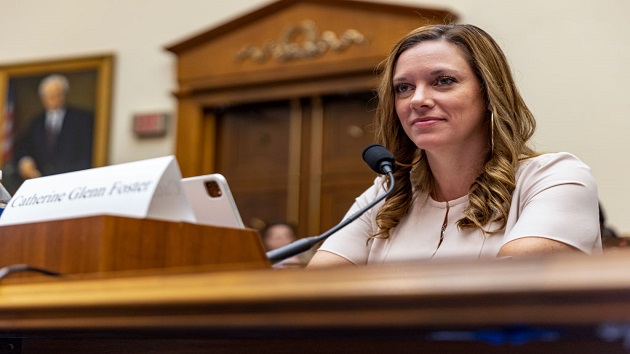
Catherine Glenn Foster, head of the anti-abortion group Americans United for Life, told Swalwell she didn’t think it was.

“If a 10-year-old with her parents made the decision not to have a baby that was a result of a rape, if a 10-year-old became pregnant as a result of rape, and it was threatening her life then that’s not an abortion,” Foster told the House Judiciary Committee on Thursday.

Around the same time as Foster’s testimony, the top lawyer for the National Right to Life Committee, had a decidedly different take.

In a phone interview with Politico, James Bopp said the girl should have been forced to carry the pregnancy to term under model legislation he wrote last June as NRLC’s general counsel. That legislation is being used by states to adopt abortion restrictions.

“She would have had the baby, and as many women who have had babies as a result of rape, we would hope that she would understand the reason and ultimately the benefit of having the child,” Bopp is quoted as saying.

Bopp did not respond to requests for an interview.

After spending decades united in a quest to overturn Roe v. Wade, the conservative movement is facing tough questions about what it means to oppose abortion.

Should there be exemptions for rape and incest? Does the age of the victim matter? What does it mean to protect the “life of the mother”? How imminent should death be before a doctor can legally intervene?

Other questions: Should states enact laws preventing women from traveling out of state for abortions? Should they ban IUDs and the emergency contraceptives like Plan B?

Conservatives praising the Supreme Court ruling say those details should be decided by voters in states. Abortion rights proponents say rights to liberty and privacy should not be up to voters to decide, but are guaranteed in the Constitution.

“In case we’ve forgotten, this is what democracy looks like,” said Rep. Michelle Fischbach, R-Minn,, in defending the Supreme Court’s decision.

But no case has challenged the anti-abortion rights movement more than the rape of a 10-year-old Ohio girl.

Following the arrest of a 27-year-old man in her case, a detective testified in a court hearing this week that the girl became pregnant as a result of the rape and traveled to Indianapolis to undergo an abortion. Ohio has banned abortion after cardiac activity is detected, which is at about six weeks into pregnancy. The state does not provide exceptions in cases of rape or incest.

Indiana’s Republican attorney general said he planned to investigate the doctor who helped the girl get an abortion. An attorney representing Dr. Caitlin Bernard said she followed reporting procedures, and Indiana University Health said an investigation found that she was in compliance with privacy laws.

Several Republican politicians, including Rep. Jim Jordan, a House Judiciary Committee member, had questioned whether the case had been fabricated for political reasons. Jordan did not reference the case in his questioning at the hearing on Thursday, instead speaking about violent attacks against anti-abortion pregnancy centers.

Jennifer Holland, a history professor at the University of Oklahoma, said she thinks conservatives are struggling to talk about the rape case of such a young victim because they never had to before.

“For 50 years, the focus has been as much as possible on the fetus,” she said. “They chose never to reckon with hard cases. Now that they have the power of the state, that’s very different.”

Daniel Williams, a history professor at the University of West Georgia who studies politics and religion, said support among conservatives for exceptions to rape and incest have changed over time. In this case, leaders in the anti-abortion rights movement probably weren’t prepared for such a case to confront them so soon after the reversal of Roe vs. Wade, he said.

“I doubt, though, that this will be a substantial setback for the movement,” said Williams. “At most, it may make some conservative states that are considering an abortion ban to think about including a rape (or) incest exception clause, but even that is uncertain. But we’re in uncharted territory here, so predictions about future developments are difficult to make.”

Sarah Warbelow, the legal director of the Human Rights Campaign, said it’s disinformation to suggest an abortion wouldn’t be an abortion for a 10-year-old rape victim.

“Abortion is a medical procedure. It’s a medical procedure that individuals undergo for a wide range of circumstances, including because they have been sexually assaulted, raped in the case of the 10-year-old,” she said.

Dr. Rachel Boren, a member of the ABC News Medical Unit, contributed to this report.

Copyright © 2022, ABC Audio. All rights reserved.

Indiana AG told to ‘cease and desist’ over doctor

Indiana AG told to ‘cease and desist’ over doctor
ilbusca/Getty Images/Stock

(INDIANAPOLIS) — The attorney for an Indiana physician who performed an abortion for a 10-year-old girl from Ohio has sent a cease and desist letter to the Indiana attorney general over “false” and “defamatory” statements made about the doctor.

The cease and desist letter, which was sent Friday and obtained by ABC News, is the latest development stemming from the unsettling case, which has become a flash point in the national debate on abortion post-Roe v. Wade.

The incident first came to light in a July 1 report by the Indianapolis Star. Dr. Caitlin Bernard, an OB-GYN at Indiana University Health Medical Center in Indianapolis, recounted to the publication that she had a 10-year-old patient from Ohio who, at over 6 weeks pregnant, traveled to Indianapolis for an abortion after her state’s so-called heartbeat law banning most abortions went into effect after the Supreme Court overturned Roe.

The report gained national attention, with President Joe Biden referencing the IndyStar report during remarks made while signing an executive order on abortion access last week.

Meanwhile, some Republican leaders, including the Ohio attorney general, doubted the veracity of the report. The Wall Street Journal editorial board said it was “too good to confirm.”

On Tuesday, Columbus police arrested a 27-year-old suspect who allegedly confessed to raping the 10-year-old victim, who police said had traveled to Indianapolis to obtain a medical abortion on June 30. The suspect was ordered held on $2 million bond on Wednesday.

After the suspect was arraigned on the felony rape charge, Indiana Attorney General Todd Rokita, a Republican, said his office was investigating Bernard “to prove if the abortion and/or the abuse were reported,” as is required under Indiana law.

“The failure to do so constitutes a crime in Indiana, and her behavior could also affect her licensure,” he said in a statement. “Additionally, if a HIPAA violation did occur, that may affect next steps as well. I will not relent in the pursuit of the truth.”

A termination of pregnancy report filed with the Indiana Department of Health obtained by ABC News shows that Bernard did report the abortion within three days of the procedure, as required by state law. Indiana University Health also released a statement Friday that an investigation has found Bernard to be in compliance with privacy laws.

The Columbus Division of Police, which was alerted to the girl’s pregnancy on June 22, was already investigating the rape case by the time the abortion was performed.

The cease and desist from Bernard’s attorney, Kathleen DeLaney, cites “false and defamatory statements” Rokita made to Fox News on Wednesday that “cast Dr. Bernard in a false light and allege misconduct in her profession.”

While appearing on Fox News Wednesday night, Rokita claimed that Bernard was an “activist acting as a doctor with a history of failing to report.”

“So, we’re gathering the information, we’re gathering the evidence as we speak and we’re going to fight this to the end, including looking at her licensure, if she failed to report,” he said. “And in Indiana it’s a crime to not report to intentionally not report.”

The cease and desist states that Rokita continued to make statements that “further cast Dr. Bernard in a false light and mislead consumers and patients,” even after the release of the termination of pregnancy report showed she complied with reporting laws.

“We are especially concerned that, given the controversial political context of the statements, such inflammatory accusations have the potential to incite harassment or violence from the public which could prevent Dr. Bernard, an Indiana licensed physician, from providing care to her patients safely,” DeLaney stated.

“Moreover, to the extent that any statement you make exceeds the general scope of your authority as Indiana’s Attorney General, such a statement forms the basis of an actionable defamation claim,” she continued.

The cease and desist comes a day after DeLaney said they were considering legal action “against those who have smeared my client, including Indiana Attorney General Todd Rokita.”

In a statement to ABC News, a spokesperson for Rokita’s office said it will review the cease and desist “if and when it arrives.”

“Regardless, no false or misleading statements have been made,” the spokesperson said.

On Friday, Bernard’s colleague, Dr. Tracey Wilkinson, detailed in a guest essay in the New York Times how Bernard “became a target of a national smear campaign for speaking out about her 10-year-old patient.”

Bernard was supposed to co-write the essay, about the “chilling effect” the Supreme Court’s decision has had on medicine, until Rokita said his office will be investigating her, according to Wilkinson, an assistant professor of pediatrics at Indiana University School of Medicine.

“So I’m writing this essay myself, not only to bring attention to the chilling effect on medicine we’re seeing at this moment — but also because I’m terrified that I or any one of our colleagues could soon face what Dr. Bernard is going through after delivering care to our patients,” Wilkinson wrote.

After news broke of the arrest in the rape case, Bernard commented on Twitter Wednesday that her “heart breaks for all survivors of sexual assault and abuse.”

“I am so sad that our country is failing them when they need us most,” she said. “Doctors must be able to give people the medical care they need, when and where they need it.”

ABC News’ Will McDuffie and Kevin Kraus contributed to this report.

Copyright © 2022, ABC Audio. All rights reserved.

Jan. 6 committee subpoenas Secret Service over deleted texts

Jan. 6 committee subpoenas Secret Service over deleted texts
Anna Moneymaker/Getty Images

(WASHINGTON) — The House select committee investigating the Jan. 6 attack on the Capitol announced on Friday that it had issued a subpoena for records from the United States Secret Service over deleted text messages.

Chairman Bennie Thompson sought information about Secret Service text messages from January 5 and 6, 2021 that were reportedly erased and reiterated three previous requests from congressional committees for information.

Chairman Thompson wrote, “The Select Committee has been informed that the USSS erased text messages from January 5 and 6, 2021 as part of a ‘device-replacement program.’ In a statement issued July 14, 2022, the USSS stated that it ‘began to reset its mobile phones to factory settings as part of a pre-planned, three-month system migration. In that process, data resident on some phones was lost.’ However, according to that USSS statement, ‘none of the texts it [DHS Office of Inspector General] was seeking had been lost in the migration.’

“Accordingly, the Select Committee seeks the relevant text messages, as well as any after action reports that have been issued in any and all divisions of the USSS pertaining or relating in any way to the events of January 6, 2021.”

This week, Department of Homeland Security Inspector General Joseph V. Cuffari offered a briefing to the House Committee on Homeland Security and the Senate Committee on Homeland Security and Government Affairs about “ongoing access issues” with the Department of Homeland Security, specifically that “many U.S. Secret Service (USSS) text messages, from January 5 and 6, 2021, were erased as part of a device-replacement program.”

Friday, Inspector General Cuffari briefed the Select Committee on this and other matters.

ABC News has reached out to USSS for comment on the subpoena.

Please check back for updates. This is a developing story.

Copyright © 2022, ABC Audio. All rights reserved.

Food deserts impact New Jersey

Food deserts impact New Jersey
Aaron Ferrer, ABC News

(NEWARK, N.J.) — If you travel more than a mile to a supermarket, supercenter, or large grocery store with affordable and healthy food options in an urban area, and more than 20 miles in a rural area, you live in what’s considered the definition of a food desert by the U.S Department of Agriculture.

This lack of access impacts roughly 17 million Americans according to the Food Access Research Atlas. The data also shows people who live a half mile or more from food options in urban areas, or 10 miles in rural areas, increases that number to more than 53 million Americans, including those in New Jersey.

In January 2021, New Jersey Governor, Phil Murphy, signed into law the Food Desert Relief Act, part of the Economic Recovery Act, which will provide about $240 million in funding to combat this issue in the state.

The Food Desert Relief Act provides tax breaks to stores that open in under-served areas, grants loans and other assistance for stores of all types to operate in food deserts.

The Community Food Bank of New Jersey estimates that 800,000 New Jersey residents are dealing with food insecurity, and almost 200,000 of them are children.

53-year-old Robert Brown from Newark, NJ, makes a two-mile commute from his home to a ShopRite, without a car, telling ABC News that pricing and options are a factor “I live like 20 blocks away, but we have a store downstairs, where I live at, but they’re so high, I come here. There’s no need in spending my money there, and I’m getting a little bit of nothing when I can get everything I need.”

45-year-old Katrina Moseley must take it a step farther, as the two-mile journey to ShopRite, is her second grocery shopping trip of the day, “I started at 8oclock this morning, I went to Walmart, got back home like 1130, rest for a little bit, caught the bus what time is it, I got here like 12 something, 12 or one something. Shopped. I take my time in the store to go thru stuff, and now I’m waiting for transportation to go home.”

Moseley depends on two different bus lines, taxis, and relatives to pick her up, as she spends her day-off from work to feed her family of four, including a daughter with a baby on the way, “So I go to Walmart to get the bulk of the meat because it lasts, you can make like… One of their packets of meat you can make like 2-3 meals out of it, all depends on how you do it.”

Transportation back is also an issue for Brown, knowing some options are not practical, “f I would’ve tried to get on the bus with this, it would be too much, it would be too much.”

Tara Colton, the Executive Vice President for Economic Security for New Jersey’s Economic Development Authority, says that addressing food deserts, a product of structural racism, neighborhood redlining, and disinvestment, is not as simple as building a supermarket, “You can live next door to the most amazing market or farmer’s market but if you can’t afford to buy

the food that’s in there, or they don’t accept federal nutrition programs like snap, then its inaccessible to you.”

Sustain & Serve NJ initially began as a $2million pilot program to help with food security, in conjunction with supporting the states restaurant industry in 2020. The program has evolved into a $45 million initiative, paying restaurants to deliver ready to eat meals directly to those in need. Colton told ABC News, “I often say it isn’t about bringing people to food, it’s about bringing food to people. And there’s a lot of ways to do that. They can go into a big building, and buy it put it into the truck of a car, but you can also bring it to them more centrally.”

Colton touts the program, “That one dollar you’re spending is keeping the restaurant open, the workers employed and is giving people who often can’t access this kind of food, a healthy fresh nutritious homemade meal.”

For those like Moseley who prefer to cook their own meals, despite the miles long odyssey to multiple supermarkets, the focus isn’t on feeling disenfranchised, but doing what’s necessary for her family, “Those who I gotta worry about, so this is what I do for them, shop. Getting it done, out of the way.”

Copyright © 2022, ABC Audio. All rights reserved.
DHS inspector general meets with Jan. 6 committee about deleted Secret Service texts

DHS inspector general meets with Jan. 6 committee about deleted Secret Service texts
Chip Somodevilla/Getty Images

(WASHINGTON) — The Department of Homeland Security inspector general met with members of the Jan. 6 committee behind closed doors on Friday amid revelations about deleted Secret Service texts from the day before and the day of the attack on the U.S. Capitol.

The meeting comes after Inspector General Joseph Cuffari earlier this week sent a memo to the committee notifying them the Secret Service had deleted text messages from Jan. 5 and 6, 2021.

After Friday’s meeting, members called for transparency, with Rep. Jamie Raskin, D-Md., telling ABC News Congressional Correspondent Rachel Scott, “We need to get to the bottom of it, but if those texts are gone, we are determined to find them.

“We just don’t know where the texts are. We don’t know whether the texts have vanished or not vanished. We don’t know what the context was for their vanishing if they did vanish — we just don’t know,” he said. “But we’re going to get to the bottom of it and we’re going to make a full report to the American people.”

Committee chair Rep. Bennie Thompson, D-Miss., said lawmakers still don’t know if there are more messages missing beyond those from Jan 5 and 6.

“We’re not sure. The IG indicated that they had made a significant request for information. And obviously, since he was not able to get it — we just really don’t know,” Thompson said.

Thompson said it’s “obvious” the Secret Service is not being cooperative.

In earlier testimony, former Trump White House aide Cassidy Hutchinson alleged she was told then-President Donald Trump physically assaulted members of his Secret Service detail when they declined to take him to the Capitol on Jan. 6.

A source close to the Secret Service does not dispute the former president demanded to go to the Capitol just after his rally on the Ellipse that day.

The Secret Service, in a lengthy statement on Thursday night, blasted the inspector general’s letter to the committee.

“The insinuation that the Secret Service maliciously deleted text messages following a request is false,” Anthony Gugliemi, the agency’s chief of communications, said in a statement. “In fact, the Secret Service has been fully cooperating with the Department of Homeland Security Office of Inspector General (DHS OIG) in every respect — whether it be interviews, documents, emails, or texts.”

Gugliemi said that in February 2021, the Secret Service began to reset its mobile phones to factory settings as part of a previously planned, three-month system migration. In that process, data resident on some phones was lost, he said.

The DHS inspector general did not immediately respond to an ABC News request for comment.

ABC News’ Katherine Faulders, Rachel Scott and Allison Pecorin contributed to this report.

Copyright © 2022, ABC Audio. All rights reserved.

Mexican drug kingpin wanted in killing of DEA agent captured: Sources

Mexican drug kingpin wanted in killing of DEA agent captured: Sources
Douglas Sacha/Getty Images/Stock

(NEW YORK) — Mexican drug kingpin Rafael Caro-Quintero, wanted in the 1985 killing of a U.S. anti-narcotics agent, has been detained in Mexico, multiple law enforcement sources told ABC News Friday evening.

Caro-Quintero, the former leader of the Guadalajara Cartel, has been wanted over his alleged involvement in the kidnapping and murder of Drug Enforcement Administration Special Agent Enrique Camarena in Mexico. Camarena’s capture and torture were dramatized in the Netflix show “Narcos.”

Caro-Quintero has been on the FBI’s 10 Most Wanted Fugitives list since 2018. In addition to the kidnapping and murder of a federal agent, he was wanted for violent crimes in aid of racketeering, among other alleged federal violations.

The FBI was offering a $20 million reward for information leading to his arrest or capture and warned that he should be considered “armed and extremely dangerous.”

Caro-Quintero allegedly is involved in the Sinaloa Cartel and the Caro-Quintero Drug Trafficking Organization in the region of Badiraguato in Sinaloa, Mexico, the FBI said.

It wasn’t immediately clear whether Caro-Quintero would be extradited to the United States.

Word of the capture comes just days after President Joe Biden met with his Mexican counterpart in Washington, D.C.

Mexican President Mexican President Andrés Manuel López Obrador has been loath to go after cartel leaders because, he has said, he is more interested in reducing violence in Mexico.

Copyright © 2022, ABC Audio. All rights reserved.

Elon Musk responds to Twitter’s $44 billion lawsuit

Elon Musk responds to Twitter’s  billion lawsuit
Patrick Pleul/picture alliance via Getty Images

(NEW YORK) — Elon Musk asked a Delaware court on Friday to reject Twitter’s attempt to put the $44 billion merger case on trial in September, arguing it’s an “unjustifiable” timeframe.

Twitter sued Musk in an attempt to force him to complete his purchase of the company, after declaring he was walking away from the deal.

Twitter sought a four-day trial in September, arguing the deal faces an October deadline to close.

“Twitter’s bid for extreme expedition rests on the false premise that the Termination Date in the merger agreement is October 24, glossing over that this date is automatically stayed if either party files litigation. By filing its complaint, Plaintiff has rendered its supposed need for a September trial moot,” Musk’s attorney, Alex Spiro, wrote in a Friday court filing.

Delaware Chancery Court will determine whether Musk remains obligated to purchase Twitter or whether he was entitled to walk away because the company failed to provide him data he requested.

“Twitter’s sudden request for warp speed after two months of foot-dragging and obfuscation is its latest tactic to shroud the truth about spam accounts long enough to railroad Defendants into closing,” the filing said.

Musk has claimed Twitter failed to disclose the number of fake accounts on the platform. Twitter has said 5% of active users are bots but Musk has said he does not believe the figure.

“Post-signing, Defendants promptly sought to understand Twitter’s process for identifying false or spam accounts. In a May 6 meeting with Twitter executives, Musk was flabbergasted to learn just how meager Twitter’s process was,” Musk’s filing said.

Musk asked the court to set a trial date no earlier than mid-February.

Copyright © 2022, ABC Audio. All rights reserved.

Wyoming struggles for answers amid growing suicide rate

Wyoming struggles for answers amid growing suicide rate
Nine OK/Getty Images/Stock

(CHEYENNE, Wyo.) — Lyle Neiberger would have turned 33 this year. But he is forever 17, frozen in his father Lance’s memory.

“I’ve never been angry at my son. I’ve always been angry at me. Why didn’t I see it? What if I would have done something different?” he lamented, while sitting in his woodshop at his home in central Wyoming.

It’s been 16 years since Lyle died by suicide. Lance Neiberger had no idea his son was contemplating suicide and Lyle left no note behind.

Memories of Lyle line the walls of Neiberger’s woodshop – a hobby father and son bonded over. “We’re all in the cowboy-up attitude, you know. Real men don’t cry. Real men don’t have problems,” he said.

Here in Wyoming, nicknamed the Cowboy State, “real men” are taught that when they have a problem, they pick up and fix it without looking back, Neiberger said.

“We all have something go wrong, and we all need help at times. And when you learn that you don’t need help and you just go on, maybe that makes life a lot tougher,” Neiberger said.

U.S. suicide rates are the highest they’ve been since World War II. At 30.5 per 100,000 persons in 2020, Wyoming’s rate is more than double that of the national average and the highest rate per capita in the nation, according to the Wyoming Department of Health.

At 71, Neiberger has taken on the responsibility of helping to curb Wyoming’s high suicide rate by telling Lyle’s story to schools in the surrounding area and by heading the Natrona County Suicide Prevention Task Force. He hopes he can save at least one life.

The task force meets once a month in Casper, Wyoming, to plan events, pool resources and keep track of the lives lost.

At nearly 60,000 residents, Casper is Wyoming’s second largest city. Casper Police Chief Keith McPheeters told ABC News that his officers respond to suicide calls twice as often as they do for shoplifting.

“I just want to go over the statistics that we are showing. Year to date last year, my officers had responded to 256 persons who were considering suicide and, this year, we have seen an absolute negligible change; so, year to date from May 15, 253,” he said at a recent task force meeting.

Sixteen years ago, one of those calls came from Lance Neiberger – when he found Lyle at home. Neiberger said he had no idea his son was suicidal.

“There isn’t a day that goes by that I don’t think about him. Now, after his death, it was horrible. It was just miserable. It was crying. It was the whys, the kicking yourself, everything. Today, I can often think about Lyle just with a smile on my face. I came to a point where I realized that it was Lyle’s decision and his decision only,” he said.

When asked why he thinks the suicide rate in Wyoming is so high, he had many reasons, one of them the state’s rural landscape.

Wyoming, accounting for its land mass, is the tenth largest state in the country; by population, it’s the smallest. So, even if you wanted help – help might be a long way from you.

Andrea Summerville, the executive director of the Wyoming Association of Mental Health & Substance Abuse Centers, showed ABC News’ Trevor Ault the area right outside of Casper. She pointed out miles and miles of sweeping plains with very few people in sight.

“You’ll hit a major town about every hundred miles. And when I say a town, I mean a town of 5,000 people,” she said. “You might get a call from somebody that’s 100 miles away from the nearest town, but you might also just not have the mental health professionals. Wyoming has been a mental health professional shortage area, always, designated by the Rural Health Agency. The entire state. Not just an area, not just a town, but the entire state.”

Now federal legislation to help any American in crisis reach a counselor by phone is set to launch July 16. It will transition the ten-digit suicide hotline into a three-digit number, 988. But in Wyoming, even that will be an uphill climb to adopt.

“There are some logistics tied with 988, specifically things like geo location. So with 911, everybody knows if you call 911 they know where you’re at to locate your cellphone. You’re not going to find a cell tower every 50 miles or so here. And so making sure that we are meeting those infrastructure challenges is probably going to be our biggest, most expensive long-term project,” Summerville said.

The 988 hotline is being touted as a one stop shop for anyone experiencing a mental health crisis, but funding the project so that health care providers are ready for the influx of calls is proving to be challenging.

Similarly to 911, 988 will be funded by a monthly fee on all phone lines. The fee is determined by each state.

The Department of Health and Human Services expects the volume of calls to double within the first year. However, according to the National Alliance on Mental Illness, only Colorado, Nevada, Washington, and Virginia have enacted a comprehensive plan for funding.

The Central Wyoming Counseling Center is one of two suicide hotlines centers already up and running in Wyoming. It opened two years ago.

The workers know this state’s layout, its culture, its resources or lack thereof– which is essential in a crisis.

They’ve secured $2.1 million to expand the suicide hotline to a 24-hour service, most of it federal money from the American Rescue Plan Act that Wisconsin Gov. Mark Gordon appropriated, but with the state legislature refusing to expand Medicaid, federal funding will soon run out.

Summerville told ABC News they currently only have the funding to continue 988 for two more years. “In terms of putting it into operation in Wyoming, It’s going to take a lot of work. We only have four crisis stabilization centers across the state. So how do we move people across the state?”

According to the Centers for Disease Control and Prevention, of the 45,979 who died by suicide in the United States in 2020, nearly 70% were white men. Men are less likely to reach out for help, a fact that Dr. Amanda DeDiego, an Assistant Professor at the University of Wyoming, is all too aware of.

“There’s that heavy, heavy stigma about help seeking behavior. And then there’s not a lot of options for you to be able to seek care in these rural communities and have your confidentiality. It’s not that your provider is not honoring the confidentiality. It’s just that everybody knows everything,” DeDeigo said.

Along with Lisa Scroggins, the Executive Director of the Natrona County Library, she is spearheading a new project to create spaces that sidestep the issue of stigma. It’s called Wyoming Public Access to Telehealth Services or WyPATHS. It will be a booth placed in local libraries that is soundproof and provides a space for people to be able to connect through telehealth to their health care providers.

They plan on training library staff across Wyoming in suicide prevention.

“A big part of the training is being empathetic to your fellow citizen or resident. So seeing the person who walks into the door and realizing their situation may be different than yours and looking for signs that a person may be needing help and then saying, ‘Hey, right here, here’s your help,’” said Scroggins.

Lance Neiberger still thinks about how Lyle didn’t come to him about his negative thoughts when he reflects on the loss of his son.

“He didn’t feel comfortable enough to come to me and say, ‘Dad, life’s kicking my butt. I’m really struggling here.’ So, I think what he was doing was acting up and as his drama increased, I got angry. I didn’t like the drama. We weren’t communicating about the problem. So he took his drama to another level and I took my anger to another level. And at the time of his death and when he needed me the most, I wasn’t there for him because we were going in opposite directions instead of working together,” he said.

Neiberger said he considered taking his own life during the six months after Lyle died. “It wasn’t until our daughter gave birth to our granddaughter that I really realized what I would have missed had I not lived back then.”

As Neiberger stared at Lyle’s gravestone, decorated with mementos from friends and family, he couldn’t help but wonder what his son’s life would have been like had he lived past 17. But he is determined to keep having these very uncomfortable conversations in the hopes that Lyle’s death will not be in vain.

“That’s what keeps me going. My faith in the fact that I truly believe I’ll see him again someday. I’ll be with him. That’s what’s given me the hope to continue,” he said.

If you are struggling with thoughts of suicide or worried about a friend or loved one, help is available. Call the National Suicide Prevention Lifeline at 1-800-273-8255 [TALK] for free, confidential emotional support 24 hours a day, 7 days a week. The rollout of the national 988 mental health hotline is expected on July 16.

Copyright © 2022, ABC Audio. All rights reserved.

New 988 number for National Suicide Prevention Lifeline launches Saturday, expanding access amid funding concerns

New 988 number for National Suicide Prevention Lifeline launches Saturday, expanding access amid funding concerns
Substance Abuse and Mental Health Services Administration

(NEW YORK) — As the National Suicide Prevention Lifeline prepared for the launch of a nationwide three-digit number on Saturday, local, state and federal government officials gathered in Philadelphia Friday to discuss the effort to get the new nationwide 988 calling code.

“There’s been a lot of work to get to this day,” Jessica Rosenworcel, chairwoman of the Federal Communications Commission, said. “But what we’ve done is we’ve made it easy. 988 is easy to remember. Now we have to make it clear to the entire country that it is a sign of strength to call it and use it, and not a sign of weakness.”

The Lifeline has been in operation at a ten-digit number (1-800-283-TALK) since 2005, has taken over 20 million calls in that time, and that number will continue to route callers to the Lifeline following the launch of 988. However, the Substance Abuse and Mental Health Services Administration (a division of HHS) anticipates the increased ease of use for the three-digit number will dramatically increase calls to the service.

Tim Jansen, chief executive officer of Community Crisis Services Inc. in Hyattsville, Maryland, told ABC News that call volume at his facility has gone up over the last few years, and he expects the increase will continue amid the launch of 988.

“I think we’re going to see a significant uptick in calls,” Jansen said, adding that his facility has been working to increase their staff over the last six months in preparation. “I think the big thing is [988 will] make the number much easier to remember.”

The Biden administration has put an unprecedented amount of funding toward launching the new number for the Lifeline. Following the addition of $150 million for the Lifeline as part of the recently passed gun safety legislation, the federal investment in 988 stands at $432 million.

Jansen says that funding, along with about $5 million in funding from Maryland that will be distributed across the state this fiscal year, has helped his facility increase the salary of existing staff and hire about 150 new employees. CCSI now has about 225 employees available to answer calls, chats and texts for the Lifeline in its capacity as both a local center and one of the national backup call centers.

Experts say that, ideally, Lifeline calls should be answered at the local level so callers can be more easily connected with follow-up resources in their area, but there are several national backup centers (such as CCSI) that can field calls from anywhere in the country if a particular center is unable to answer.

Jansen explained that local centers have about 30 seconds to answer a call before it is forwarded to the next nearest local or regional call center. If it is not answered by that center within about three minutes, he added, it then goes to the national backup network.

Nationwide, HHS officials say, the influx of federal funding for the Lifeline has enabled call centers to field 17,000 more calls, 37,000 more chats and 3,000 more texts in June of this year, compared to 2021.

While the federal funding has increased the ability of the Lifeline to respond nationwide, answer rates still vary from state to state, as much of the funding for these call centers happens at the state level.

When Congress designated 988 as the new number for the Lifeline in 2020, it gave states the authority to levy fees on cell phone bills to help sustainably fund the service, similar to how 911 call centers are funded.

So far, only four states have passed that legislation. Some others, like Maryland, have allocated some funding for the launch. Experts worry, however, that many states will not be able to accommodate the volume of calls anticipated after the new number launches.

HHS officials continue to emphasize the need for state-level investment for this system to be built out long-term and able to handle the volume of calls.

“Failure is not an option,” HHS Secretary Xavier Becerra said at the launch news conference on Friday.

“988 is a three digit number, but it really is more.” Becerra said. “It’s a message — when you need someone, we will be there.”

The transition to a fully reimagined mental health crisis care system — the ultimate goal of 988 — will take time, officials say.

While most of the callers reaching out to the Lifeline during a mental health crisis can be deescalated over the phone, some require additional care, which can include a visit from a mobile crisis response team, a trip to a crisis stabilization unit or in some cases, inpatient hospitalization.

Those additional elements of what experts call the “crisis care continuum” are currently available in some cities across the country, but that portion of the crisis care system will take additional time to build out, they say.

“One of the challenges with 988 is it’s going to expose the fact that there are not enough vendors, not enough therapists, not enough counselors,” Jansen said.

Despite the expected hiccups in the overall nationwide rollout, he said, “To me, one life saved is success,” adding, “But I think that the ultimate gauge of what makes [988] successful is if we ultimately see a reduction in the rates of suicide. That’s going to take some time.”

An employee for nearly 26 years at the center he now runs, Jansen said, “It’s one call, one text, one chat at a time … [Every day] You can walk out of here knowing that I helped somebody with a safety plan. Somebody said that their only option was dying and now they have other options.”

If you are experiencing suicidal, substance use or other mental health crises please call or text the new three digit code at 9-8-8. You will reach a trained crisis counselor for free, 24 hours a day, seven days a week. You can also go to 988lifeline.org or dial the current toll free number 800-273-8255 [TALK].

Copyright © 2022, ABC Audio. All rights reserved.