
Russia-Ukraine live updates: Putin declares martial law in occupied Ukrainian territories

Russia-Ukraine live updates: Putin declares martial law in occupied Ukrainian territories
SERGEI SUPINSKY/AFP via Getty Images

(NEW YORK) — More than six months after Russian President Vladimir Putin launched an invasion into neighboring Ukraine, the two countries are engaged in a struggle for control of areas throughout eastern and southern Ukraine.

Ukrainian President Volodymyr Zelenskyy, whose forces began an offensive in August, has vowed to take back all Russian-occupied territory. But Putin in September announced a mobilization of reservists, which is expected to call up as many as 300,000 additional troops.

Here’s how the news is developing. All times Eastern:

Oct 19, 8:31 AM EDT
Putin announces he is imposing martial law in four occupied Ukrainian territories

Russian President Vladimir Putin announced that he will impose martial law in four Ukrainian territories occupied by Russian forces — Donetsk, Luhansk, Kherson and Zaporozhye. All four regions were illegally annexed by Putin last month.

Marital law grants Russia’s authorities huge powers over the civilian population in the regions it is imposed. Martial law is set to go into effect on Thursday.

The decree, which Putin announced during a televised meeting with his security council, will now be sent to be rubber stamped by Russia’s upper chamber of parliament, the Federation Council.

Putin has also granted new powers to governors in several regions bordering Ukraine.

Putin’s decree includes other points ordering the rest of Russia itself put into various levels of “readiness.”

The decree puts eight regions bordering Ukraine into a state of “moderate level of response,” but also imposes a “level of heightened readiness” in the southern and central regions that include Moscow. All other Russians regions are put on a “basic level of readiness.”

The decree says these statuses grant special powers to local authorities that are similar to martial law and includes points imposing increased security at key facilities, puts transport and communications into a special regime and also envisages the creation of “territorial defense headquarters” in some regions.

Oct 19, 7:35 AM EDT
Russian civilians to evacuate Kherson

Russia has announced the mass evacuation of civilians from the key city of Kherson, as well as all of its civilian occupation administration there.

Russia’s newly appointed overall commander for its war in Ukraine, Gen. Sergey Surovikin, said on Tuesday that “difficult decisions” may have to be made in the near future regarding Russia’s position in Kherson. In his first public remarks since his appointment, he said the situation around Kherson was already “extremely difficult.”

The evacuation combined with Surovikin’s comments has fueled speculation that Russia may be preparing to retreat from the city in the face of a Ukrainian offensive, in what would be a major defeat for President Vladimir Putin.

Other Russian officials though have suggested the evacuation is in preparation of Russian defense of the city. Kherson’s Russian-appointed governor on Wednesday denied Russia was planning to “give up” the city.

Another senior occupation official has said the battle for Kherson will begin in the “very near future.”

Kherson is the only regional capital Russia managed to seize in its invasion and is a capital of one of the regions Putin annexed last month.

The city is located on the western side of the Dnieper river and Russian forces’ position there has become increasingly difficult, after Ukraine succeeded in destroying the bridges needed to supply it.

With the bridges destroyed, thousands of Russian troops risk becoming surrounded in Kherson city and cut off from any supplies.

Russia has already begun evacuating civilians to the eastern side of the Dneipr river. Independent military researchers said Russia has quickly built a pontoon bridge near Kherson that could be used for evacuation or re-supplies.

The Russian-appointed governor said around 60,000 civilians will be evacuated, over the course of seven days.

Oct 18, 5:14 PM EDT
Russia trying to make Ukrainians ‘suffer,’ US officials say

White House press secretary Karine Jean-Pierre said that Russia’s attacks on Ukrainian power stations shows Russian President Vladimir Putin wants to make Ukrainians “suffer” with deliberate attacks, speaking of attacks on Ukrainian power stations.

“He is trying to make sure that the Ukrainian people suffer,” Jean-Pierre said during a press briefing on Tuesday. “He’s making it very difficult for them.”

Pentagon press secretary Brig. Gen. Pat Ryder echoed those comments, saying Russia is trying to “inflict pain” on Ukrainian civilians with its strikes on population centers and infrastructure.

“We do continue to see them target, among other things, civilian infrastructure, to include energy related targets — power grids, for example,” Ryder said.

He added, “In terms of why we think they’re targeting those areas, I think obviously trying to inflict pain on the civilian society as well as try to have an impact on Ukrainian forces.”

ABC News’ Ben Gittleson and Matt Seyler

Oct 18, 4:59 PM EDT
UN commission releases detailed report on war crimes in Ukraine

The United Nations’ Independent International Commission of Inquiry on Ukraine has released its first in-depth, written report on what it calls “an array of war crimes, violations of human rights and international humanitarian law” committed in the country during the first weeks of Russia’s brutal invasion.

The report outlines what investigators say are “documented patterns of summary executions, unlawful confinement, torture, ill-treatment, rape and other sexual violence.”

The inquiry zeroed in on four regions of Ukraine– Kyiv, Chernihiv, Kharkiv and Sumy–and focused on incidents that took place following Russia’s invasion on Feb. 24 through the end of March.

Investigators traveled to 27 cities and towns, conducted nearly 200 interviews and “inspected sites of destruction, graves, places of detention and torture, as well as weapon remnants, and consulted a large number of documents and reports.”

Due to the sheer number of allegations, the commission could not investigate all the claims it received. The commission said it intends to “gradually devote more of its resources” to a broader investigation within the country, according to the report.

ABC News’ Shannon Crawford

Oct 18, 2:25 PM EDT
NATO to send Ukraine anti-drone systems: NATO Secretary General

Ukraine will receive anti-drone systems from NATO in the coming days according to NATO Secretary General Jens Stoltenberg.

“The most important thing we can do is deliver on what allies have promised, to step up and deliver even more air defense systems,” Stoltenberg said, according to Reuters.

He added, “NATO will in the coming days deliver counter-drone systems to counter the specific threat of drones, including those from Iran.”

ABC News’ Will Gretsky

Oct 18, 7:00 AM EDT
30% of Ukraine’s power stations destroyed

About a third of Ukraine’s power stations have been destroyed by Russian attacks in the last week, President Volodymyr Zelensky said on Tuesday.

“Since Oct. 10, 30% of Ukraine’s power stations have been destroyed, causing massive blackouts across the country,” he said on Twitter. “No space left for negotiations with Putin’s regime.”

ABC News’ Guy Davies


Copyright © 2022, ABC Audio. All rights reserved.

Nord Stream pipeline leaks caused by ‘powerful explosions,’ Danish police say

Nord Stream pipeline leaks caused by ‘powerful explosions,’ Danish police say
picture alliance/Getty Images

(NEW YORK) — A preliminary investigation of damages to the two Nord Stream gas pipelines in the Danish part of the Baltic Sea shows that the leaks were caused by “powerful explosions,” Copenhagen police said Tuesday.

Swedish and Danish authorities are investigating four holes in the Nord Stream 1 and Nord Stream 2 pipelines, which link Russia and Germany through the Baltic Sea. The investigations confirmed there is extensive damage to the pipelines, according to police.

Copenhagen police have set up a joint investigation group handling the investigation of the incidents which includes the Norwegian Police Intelligence Service and the Norwegian Armed Forces.

Danish officials said it is not possible to determine when the investigation can be expected to be completed, declining to reveal any other information from the investigation into the gas leaks.

Last week, Germany announced it has also opened an investigation into the damage to the pipelines.

Last month, President Joe Biden called the damage to the pipelines a “deliberate act of sabotage,” vowing to work with allies to get to the bottom of what exactly happened.

Russian President Vladimir Putin has accused the West of sabotaging the Russian-built pipelines, a charge vehemently denied by the United States and its allies.

The dispatchers of the Nord Stream 1 control center registered a pressure drop on both strings of the gas pipeline on Sept. 26. Pressure in both pipelines was stabilized on Oct. 3, according to the company that operates the pipelines.

Last week, Putin said Russia is ready to resume supplying gas to Germany through Nord Stream 2, but Berlin rejected the offer. Berlin claimed Russia halted supplies through Nord Stream 1 as a political gambit and questioned why supplies through Nord Stream 2 would be any more reliable, according to Reuters.

According to Swedish newspaper Expressen, at least 50 meters, or 160 feet, of the pipeline appears to be missing after the explosion.

NATO has doubled its presence in the Baltic and North Seas to over 30 ships supported by aircraft and undersea activities, Secretary General Jens Stoltenberg said last week.

“We will further increase protection of critical infrastructure in light of the sabotage of the Nord Stream pipelines,” he said.


Copyright © 2022, ABC Audio. All rights reserved.

Soaring inflation may mean lower tax bills for some as IRS raises brackets

Soaring inflation may mean lower tax bills for some as IRS raises brackets
Javier Ghersi/Getty Images

(NEW YORK) — Some Americans may have lower tax bills when they file for 2023 after the IRS adjusted tax brackets and increased deductions to counter the soaring price tags on groceries and other daily staples.

Tax brackets will increase by about 7% in an attempt to counter rapid inflation, the IRS said in a statement on Tuesday.

Those updated brackets could mean that Americans whose wages haven’t kept pace with inflation will land in lower brackets and owe relatively less when they file.

Consumer prices rose by about 8.2% in September from the year-earlier period, with grocery prices spiking 13%, the Bureau of Labor Statistics said. Increases in pay haven’t kept pace for many workers, with average hourly wages decreasing 3% year over year in September, when seasonally adjusted, according to the bureau’s statistics.

About 60 tax provisions will be updated to counter those rising costs, including standard deductions for single and married filers, the IRS said.

The standard deduction for married couples will increase to $27,700, up $1,800 from the previous year. For single filers, it will be $13,850, up $900, the IRS said. Those increases mark an acceleration from the previous year’s standard deduction hikes, which were $800 for married filers and $400 for single ones.

Heads of household will see an increase of $1,400 to $20,800 for their standard deduction, the IRS said.

Marginal tax rates are being adjusted for inflation, with the lowest tax rate of 10% now applying to single filers making $11,000 or less per year, up from $10,275. Couples would need to make less than $22,000, up from $20,550.

The top tax rate will remain unchanged at 37%, but will now be applied to single filers earning more than $578,125 and couples making over $693,750. That highest rate had been applied to filers making $539,900 or couples making $647,850 in the previous tax year, the IRS said.

The monthly limit for qualified transportation and parking benefits will climb to $300, up $20. Gift exclusions will jump $1,000 to $17,000.

Copyright © 2022, ABC Audio. All rights reserved.

Russia-Ukraine live updates: Russian civilians to evacuate from key city

Russia-Ukraine live updates: Putin declares martial law in occupied Ukrainian territories
SERGEI SUPINSKY/AFP via Getty Images

(NEW YORK) — More than six months after Russian President Vladimir Putin launched an invasion into neighboring Ukraine, the two countries are engaged in a struggle for control of areas throughout eastern and southern Ukraine.

Ukrainian President Volodymyr Zelenskyy, whose forces began an offensive in August, has vowed to take back all Russian-occupied territory. But Putin in September announced a mobilization of reservists, which is expected to call up as many as 300,000 additional troops.

Here’s how the news is developing. All times Eastern:

Oct 19, 7:35 AM EDT
Russian civilians to evacuate Kherson

Russia has announced the mass evacuation of civilians from the key city of Kherson, as well as all of its civilian occupation administration there.

Russia’s newly appointed overall commander for its war in Ukraine, Gen. Sergey Surovikin, said on Tuesday that “difficult decisions” may have to be made in the near future regarding Russia’s position in Kherson. In his first public remarks since his appointment, he said the situation around Kherson was already “extremely difficult.”

The evacuation combined with Surovikin’s comments has fueled speculation that Russia may be preparing to retreat from the city in the face of a Ukrainian offensive, in what would be a major defeat for President Vladimir Putin.

Other Russian officials though have suggested the evacuation is in preparation of Russian defense of the city. Kherson’s Russian-appointed governor on Wednesday denied Russia was planning to “give up” the city.

Another senior occupation official has said the battle for Kherson will begin in the “very near future.”

Kherson is the only regional capital Russia managed to seize in its invasion and is a capital of one of the regions Putin annexed last month.

The city is located on the western side of the Dnieper river and Russian forces’ position there has become increasingly difficult, after Ukraine succeeded in destroying the bridges needed to supply it.

With the bridges destroyed, thousands of Russian troops risk becoming surrounded in Kherson city and cut off from any supplies.

Russia has already begun evacuating civilians to the eastern side of the Dneipr river. Independent military researchers said Russia has quickly built a pontoon bridge near Kherson that could be used for evacuation or re-supplies.

The Russian-appointed governor said around 60,000 civilians will be evacuated, over the course of seven days.

Oct 18, 5:14 PM EDT
Russia trying to make Ukrainians ‘suffer,’ US officials say

White House press secretary Karine Jean-Pierre said that Russia’s attacks on Ukrainian power stations shows Russian President Vladimir Putin wants to make Ukrainians “suffer” with deliberate attacks, speaking of attacks on Ukrainian power stations.

“He is trying to make sure that the Ukrainian people suffer,” Jean-Pierre said during a press briefing on Tuesday. “He’s making it very difficult for them.”

Pentagon press secretary Brig. Gen. Pat Ryder echoed those comments, saying Russia is trying to “inflict pain” on Ukrainian civilians with its strikes on population centers and infrastructure.

“We do continue to see them target, among other things, civilian infrastructure, to include energy related targets — power grids, for example,” Ryder said.

He added, “In terms of why we think they’re targeting those areas, I think obviously trying to inflict pain on the civilian society as well as try to have an impact on Ukrainian forces.”

ABC News’ Ben Gittleson and Matt Seyler

Oct 18, 4:59 PM EDT
UN commission releases detailed report on war crimes in Ukraine

The United Nations’ Independent International Commission of Inquiry on Ukraine has released its first in-depth, written report on what it calls “an array of war crimes, violations of human rights and international humanitarian law” committed in the country during the first weeks of Russia’s brutal invasion.

The report outlines what investigators say are “documented patterns of summary executions, unlawful confinement, torture, ill-treatment, rape and other sexual violence.”

The inquiry zeroed in on four regions of Ukraine– Kyiv, Chernihiv, Kharkiv and Sumy–and focused on incidents that took place following Russia’s invasion on Feb. 24 through the end of March.

Investigators traveled to 27 cities and towns, conducted nearly 200 interviews and “inspected sites of destruction, graves, places of detention and torture, as well as weapon remnants, and consulted a large number of documents and reports.”

Due to the sheer number of allegations, the commission could not investigate all the claims it received. The commission said it intends to “gradually devote more of its resources” to a broader investigation within the country, according to the report.

ABC News’ Shannon Crawford

Oct 18, 2:25 PM EDT
NATO to send Ukraine anti-drone systems: NATO Secretary General

Ukraine will receive anti-drone systems from NATO in the coming days according to NATO Secretary General Jens Stoltenberg.

“The most important thing we can do is deliver on what allies have promised, to step up and deliver even more air defense systems,” Stoltenberg said, according to Reuters.

He added, “NATO will in the coming days deliver counter-drone systems to counter the specific threat of drones, including those from Iran.”

ABC News’ Will Gretsky

Oct 18, 7:00 AM EDT
30% of Ukraine’s power stations destroyed

About a third of Ukraine’s power stations have been destroyed by Russian attacks in the last week, President Volodymyr Zelensky said on Tuesday.

“Since Oct. 10, 30% of Ukraine’s power stations have been destroyed, causing massive blackouts across the country,” he said on Twitter. “No space left for negotiations with Putin’s regime.”

ABC News’ Guy Davies


Copyright © 2022, ABC Audio. All rights reserved.

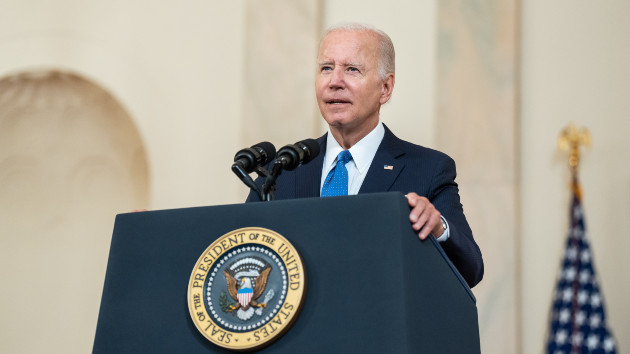
Biden announcing more steps to try and lower gas prices, including the next oil release from reserve

Biden announcing more steps to try and lower gas prices, including the next oil release from reserve
Official White House Photo by Adam Schultz

(WASHINGTON) — President Joe Biden on Wednesday will announce a series of steps that, administration officials say, will address the oil supply crunch and lower gas prices, which have become a major domestic concern ahead of the November midterms.

ABC News previously reported that among those moves, Biden will confirm his administration is releasing 15 million barrels of oil from the nation’s stockpile — known as the strategic petroleum reserve — in December.

Officials said this isn’t a new tranche but rather the final 15 million barrels from the 180 million that Biden pledged this spring to release over six months.

In addition, officials told reporters on Tuesday as they previewed the announcement, the administration will take the unusual step of planning to buy oil to rebuild the strategic reserve once crude hits between $67 and $72 per barrel. The officials said that step is meant to send a clear signal to the market and incentivize domestic oil production.

To that end Biden will also go after oil companies in remarks on Wednesday — accusing them, as he has in the past, of price gouging at a time of historic profits.

Oil executives previously testified before Congress to address concerns about their prices but have insisted it is the result of larger economic forces, including supply and demand.

“The president’s committed to doing everything in his power to respond to the price increases resulting from [Vladimir] Putin’s war. That’s what he’s done,” one senior official said on Tuesday, referring to the administration’s view that Russia’s invasion of Ukraine and the resulting U.S.-led opposition have upended energy markets.

“These new announcements are a continuation of that commitment,” the official said.

Other actions potentially include some limits on oil companies’ exports to other markets, the officials said — with the first official telling reporters: “We’re keeping all tools on the table, anything that could potentially help ensure stable domestic supply.”

The administration has also not ruled out additional releases from the U.S. reserve, the officials said, with a decision on a January release to be made in November.

Gas prices have started to drop in the last week, but the national average for a gallon of gas is 20 cents higher than one month ago, according to AAA — with gas prices also 56 cents higher than one year ago, though down from their summer high of more than $5 per gallon.

The administration officials claimed some success in lowering prices over the summer and continued to blame Putin’s invasion and “other actors in the market” for the rising prices this fall.

The cost of gas, paired with overall high inflation, have led to months of withering criticism by Republicans as polls show voters are sour on Biden’s handling of economic issues.

“The president’s actions have ensured that prices — even if they temporarily go up for a few days — have stayed on a trajectory of coming down,” a second senior official argued on Tuesday. “He’s just not satisfied that they’re done enough and is taking these additional steps to make sure that we can continue the trend of declining prices.”

While the officials didn’t address the decision by the oil-producing alliance OPEC+ to slow production starting in November — even when asked — they did dig at oil companies, arguing they’ve increased their profit margins on each gallon of gas.

Biden “is calling on the companies to take advantage of what he’s doing and to make sure that they don’t take those profits and just give them back to shareholders [but] rather pass them on to consumers at the pump. We are not in line with where the price at the pump should be based on the prices,” the second official said.

“Outsized profit margins are inappropriate, especially at a time of war,” the first official said.

The oil companies and some energy analysts have repeatedly pushed back, saying that increasing production is not so simple or easy and that other factors are at play.

The companies have also denied price gouging, arguing that it’s market volatility that has helped drive prices up.

While Biden’s 180 million-barrel release from the domestic reserve was supposed to be completed by this month, the administration had extended it after prices dropped over the summer, a third senior official said on Tuesday.

“We’ve very consciously extended the bridge and made those 180 million barrels last longer because that’s what made the most sense in terms of the supply disruptions and the market challenges,” this official said.

Though the midterm elections loom, and while the 15 million more barrels of oil won’t be released until December, the administration officials said Biden is making an announcement now because of standard Department of Energy policy that requires a notification of the release a month-and-a-half in advance.

Still, administration officials were quick to tout Biden’s actions as an all-out campaign to ease Americans’ pain at the pump, with the third official saying, “We’re trying to do whatever we can using the tools we have to be helpful.”

Copyright © 2022, ABC Audio. All rights reserved.
COVID subvariants: What to know and should you be concerned?

COVID subvariants: What to know and should you be concerned?
SONGPHOL THESAKIT/Getty Images

(NEW YORK) — Even as COVID-19 cases and hospitalizations driven by the omicron subvariant BA.5 continue to fall in the United States, the proportion of infections attributed to other omicron offshoots is rising.

According to data from the Centers for Disease Control and Prevention, BA.5 currently makes up 67.9% of new virus cases as of last Friday.

The remaining cases are made up of BA.4.6 — which has been circulating in the U.S. for weeks — as well as newly identified subvariants like BQ.1, B.Q.1.1 and BF.7, which have been spreading mainly in Europe.

The subvariants have been attributed to an increase in infections in Europe. According to the latest weekly report from the World Health Organization, published Oct. 12, there were more than 1.66 million COVID-19 cases recorded across the continent, up from more than 1.53 million cases recorded in the previous report published on Oct. 5

Throughout the course of the pandemic, Europe has been considered a bellwether of what’s to come in the U.S.

Should we be concerned about the new subvariants? Experts told ABC News that the U.S. may see a new wave as we enter the colder weather months and move indoors and it’s important to remain vigilant.

“In the next few months, I think there’s reasonable expectation that we’ll probably see a fall wave,” said Dr. John Brownstein, an epidemiologist and chief innovation officer at Boston Children’s Hospital and an ABC News contributor. “But the magnitude of that wave, I think, is still very much in question.”

What are the new subvariants?

The subvariant that makes up the most cases after BA.5 is BA.4.6. An offshoot of the omicron subvariant BA.4, it’s estimated to account for 12% of new cases, according to the CDC.

Then there are newer subvariants, which have recently begun steadily spreading in the U.S: BQ.1 and BQ.1.1, Both are offshoots of BA.5 and make up 12% of new cases together. This is a rapid rate of increase considering they made up just 3% of new cases for the week ending Oct. 1.

“It seems to have come out of nowhere,” Dr. Peter Chin-Hong, an infectious diseases specialist at the University of California, San Francisco, told ABC News. “But it didn’t really come of nowhere. It was first seen in Nigeria in summer and then spread to other countries in Europe and Asia, and now in the United States.”

Another offshoot of BA.5 that is picking up speed is BF.7. It makes up 5.3% of new cases in the U.S., up from 3.2% just two weeks prior.

Meanwhile, there have been reports of another subvariant called XBB, which combines multiple strains of the omicron variant and other COVID-19 variants and has been detected mostly in Asia. So far, it has not been detected in the U.S.

Not much is known about any of these newer subvariants. Preliminary data suggests they have mutations that are better at evading immunity, whether from vaccination or prior infection, and may be more transmissible.

Another reason these offshoots could be spreading more rapidly is because human behavior has changed. Travel is reaching pre-pandemic levels, children are back in school and most restrictions — including masking, social distancing and vaccinations requirements — have ended.

There is some good news. Since September, bivalent boosters that target BA.4 and BA.5 have been approved in the U.S. for those aged 12 and older and for those aged 5 and older since last week. Early data suggests the booster increases antibody response.

Because these subvariants are related to BA.4 and BA.5, it’s likely that the booster will provide at least some protection against them as well.

“I think there’s a very reasonable expectation that the vaccines, especially with the new boosters, will provide good protection,” said Brownstein. “But we’re still missing a lot of real-world data, especially given that these new sort of omicron variants of BA.5 and BA.4 are starting to take hold in various parts of the world.”

“We’ll hopefully have reasonable insight from other countries that will help inform some of the forecast for the coming months, but that data is still being compiled,” he continued.

Chin-Hong said it’s also reasonable to expect, as with previous variants, that those most at risk are Americans with the least amount of protection.

“For people who are unvaccinated, those over age 65 who’ve never gotten a booster, or people who are immunocompromised, they may become more seriously ill and die if they don’t protect themselves,” Chin-Hong said.

Should we be concerned?

Brownstein said he thinks public health officials should remain vigilant and keep tracking the spread of these subvariants but the public should not yet worry.

“I think it’s too early to tell the level of concern,” Brownstein said. “Of course, everyone should be concerned about how new variants emerge, especially when there’s uneven vaccination across the U.S and then across the globe.”

He added, “The brunt of that concern should be on public health and scientists right now, as we try to work out [what’s happening].”

Brownstein said Americans should be willing to modify their behavior — like masking indoors again — if cases spike or a new variant emerges.

According to CDC data, the daily average of COVID-19 cases sits at 35,000 as of Oct.16 and the average estimate of new hospital admissions is 2,990 as of Oct. 15.

Brownstein said if the health care system becomes overwhelmed by a surge, city- or state-level officials might consider masking to reduce the number of patients entering hospitals.

“I think that clearly targeted masking, especially in high-risk places like health care settings and long-term care facilities, will be critical, because those places are charged with protecting the most vulnerable,” Brownstein said. “Beyond that, I think it’s going to be really driven by local level cases.”

Copyright © 2022, ABC Audio. All rights reserved.

Study: 3 in 10 uninsured Americans with diabetes may ration insulin

Study: 3 in 10 uninsured Americans with diabetes may ration insulin
Caíque de Abreu/Getty Images

(NEW YORK) — Nearly 30% of Americans living with diabetes who are uninsured may ration their insulin to save money, according to a new study.

Researchers at Harvard Medical School, the City University of New York’s Hunter College and consumer advocacy organization Public Citizen determined the prevalence of insulin rationing by analyzing the Centers for Disease Control and Prevention’s 2021 National Health Interview Survey in the study, published in the Annals of Internal Medicine on Monday.

Overall, researchers found that 16.5% of adults with diabetes who use insulin — some 1.3 million Americans — rationed insulin by either skipping doses, taking less or delaying buying it to save money in the past year.

Rates of insulin rationing were highest among those with no insurance, at 29.2%, the study found. Among those with private insurance, it was nearly 19%.

Rationing was lower among those with public coverage, such as Medicare (13.5%), and those ages 65 and older (11.2%), who would be largely eligible for Medicare.

Insulin rationing was also found to be more common among Black Americans (23.2%) than white and Hispanic (16%), as well as among middle-income insulin users (19.8%) than higher-income (10.8%) and low-income (14.6%), researchers found.

There was no data provided on the health consequences of insulin rationing, though prior research has shown cost-associated non-adherence to insulin can have serious negative consequences.

The study “provides the first national estimate of how many Americans with diabetes are rationing their insulin now due to cost,” Public Citizen said in a news release, noting that soaring insulin costs can average at least $1,000 each month.

Rationing insulin can put people at risk for serious and even deadly complications, experts say.

“In the ICU, I have cared for patients who have life-threatening complications of diabetes because they couldn’t afford this life-saving drug,” Dr. Adam Gaffney, a pulmonary and critical care physician at Harvard Medical School and the Cambridge Health Alliance and the lead author of the study, said in a statement. “Universal access to insulin, without cost barriers, is urgently needed.”

The findings of the study come amid policy debates around the price of insulin.

The Biden administration’s Inflation Reduction Act, which goes into effect next year, includes a provision to cap the monthly cost of insulin for people on Medicare at $35, though the bill excludes those on private insurance or the uninsured.

The initial draft of the bill would have also capped insulin costs for those with private insurance, though Republicans stripped that provision from the bill due to a technicality in the reconciliation process.

More than 37 million Americans have diabetes, according to the American Diabetes Association. Among them, 8.4 million use insulin, which costs 10 times more in the U.S. than anywhere else in the world, according to the association.

Copyright © 2022, ABC Audio. All rights reserved.

Black, Hispanic adults more likely to be hospitalized with flu than white adults

Black, Hispanic adults more likely to be hospitalized with flu than white adults
Peter Dazeley/Getty Images

(NEW YORK) — Racial and ethnic minorities are more likely to be hospitalized with the flu in the United States, new federal data shows.

A new report published by the Centers for Disease Control and Prevention Tuesday looked at data from the 2009-10 through the 2021-22 flu seasons — excluding the 2020-21 season — and flu vaccination coverage from the 2010-11 season through the 2021-22 season.

They found that compared to white adults, influenza-related hospitalizations were 80% higher among Black adults.

Although there was some variation by season, during most seasons, hospitalization rates for Black adults were between 1.5 and 2.4 times the rates among white adults.

Additionally, American Indian and Alaska Natives (Ai/AN) flu-related hospitalizations were 30% higher and hospitalizations among Hispanics were 20% higher.

For AI/AN adults, rates were highest during the 2011-12 season and the 2021-22 seasons with rates 2.7 times those of white adults.

Meanwhile for Hispanics, the highest rates were seen during the 2009-10 and 2021-22 seasons and were 2.1 times those of their white counterparts.

The report also found that Asian/Pacific Islander adults had the lowest rates of hospitalization of all the racial and ethnic groups, ranging from 60% to 90% of hospitalization rates of white adults.

Although experts say flu vaccination is the best protection against the flu, rates are lower among racial and ethnic minorities.

“Every year, the flu continues to cause severe illness hospitalization and death,” said CDC Acting Principal Deputy Director Dr. Debra Houry in a press briefing to reporters Tuesday.

“Unfortunately, flu vaccination rates have been consistently lower among black, Hispanic, and American Indian, Alaska Native adults in the United States since 2010,” Houry said.

During the 2021-22 season, 49.4% of white adults were vaccinated against flu. By comparison, just 42% of Black adults, 37.9% of Hispanic minorities and 40.9% of AI/AN adults were vaccinated.

Asian and Pacific Islander adults had the highest rate of vaccination at 54.2%.

According to the CDC, there are several reasons for racial and ethnic disparities, including lack of access to health care and insurance, which in turn leads to less vaccine access.

Another reason for the disparities is missed opportunities to vaccinate.

“For adults who reported a recent medical checkup, vaccination coverage was still lower for Black, Hispanic, American Indian and Alaska Native and adults of other races than for white adults,” Dr. Carla Black, an epidemiologist from the CDC’s Immunization Services Division, said during the press conference. “This suggests that health care providers are missing opportunities during routine medical appointments to vaccinate people from certain groups.”

She added there may be misinformation about how serious flu is and vaccine safety as well as distrust due to past racist health policies that have negatively affected America’s communities of color.

CDC officials recommend that doctors encourage their patients, including those of color, to get the flu shot and that public health officials host outreach events including town halls and pop-up clinics to increase access to flu vaccines.

Black also encouraged flu vaccination due to the risk of a potentially severe flu season this year after the U.S. had two years of little to no flu activity:

“Well, what we can so far is that we’ve had mild flu season, and this means we might be ripe for a severe season, because people are not, you know taking all the measures they took for COVID which also had an impact on flu like masking and social distancing,” she said. “People haven’t had natural disease in two years. So, you know, there’s less natural immunity out there. People are going back to work. People are traveling again; all of these factors could contribute to us having a more severe flu season.”

Copyright © 2022, ABC Audio. All rights reserved.

Family of Raleigh mass shooting suspect says ‘never any indications or warning signs’

Family of Raleigh mass shooting suspect says ‘never any indications or warning signs’
Sheila Paras/Getty Images

(RALEIGH, N.C.) — The parents of the 15-year-old suspected of killing five people, including a police officer, on a nature trail in Raleigh, North Carolina, said there weren’t “any indications or warning signs” their son “was capable of doing anything like this.”

“Words cannot begin to describe our anguish and sorrow,” Alan and Elise Thompson said in a statement issued Tuesday. “Our son Austin inflicted immeasurable pain on the Raleigh community, and we are overcome with grief for the innocent lives lost. We pray for the families and loved ones of Nicole Conners, Susan Karnatz, Mary Marshall, and Raleigh Police Officer Gabriel Torres. We mourn for their loss and for the loss of our son, James.”

“We pray that Marcille ‘Lynn’ Gardner and Raleigh Police Officer Casey Clark fully recover from their injuries, and we pray for everyone who was traumatized by these senseless acts of violence,” they continued. “We have so many unanswered questions. There were never any indications or warning signs that Austin was capable of doing anything like this. Our family will continue to cooperate fully with law enforcement officials and do whatever we can to help them understand why and how this happened.”

The 15-year-old was taken into custody with life-threatening injuries following a standoff with police last Thursday after the shootings occurred, according to a memo issued by the Department of Homeland Security and obtained by ABC News. It’s not clear whether the suspect’s injuries were self-inflicted, the memo said.

The teen, who has not been named by authorities, was in the hospital in critical condition with life-threatening injuries as of Sunday, a law enforcement official briefed on the investigation told ABC News. Detectives believe responding police fired at the suspect, so officer-involved-shooting protocols are being followed, the official said.

Among the victims was officer Gabriel Torres, 29, who was on his way to work when he was shot and killed, according to Raleigh Police Chief Estella Patterson. Torres, a former Marine, was a husband with a young daughter, according to ABC station WTVD-TV.

The four others killed were identified as Nicole Connors, 52; Susan Karnatz, 49; Mary Marshall, 34; and James Roger Thompson, 16.

Two people were also injured during the shooting, which took place in the vicinity of the Neuse River Greenway Trail, authorities said.

Chief Patterson will file a five-day report to the city manager on Thursday, which will include a detailed outline of the events during the shooting, Julia Milstead, public information officer for the city of Raleigh, told ABC News.

The report will include details on the suspect’s injuries and the type of weapon that was used in the shooting, Milstead said.

Copyright © 2022, ABC Audio. All rights reserved.

Three people still missing in hard-hit Florida county in wake of Hurricane Ian, sheriff says

Three people still missing in hard-hit Florida county in wake of Hurricane Ian, sheriff says
Al Diaz/Miami Herald/Tribune News Service via Getty Images

(NEW YORK) — Three people are still missing from a Florida county weeks after Hurricane Ian slammed into the state as a Category 4 storm, according to the Lee County Sheriff’s Office.

According to Sheriff Carmine Marceno on Tuesday, Fort Myers Beach residents James Hurst and Ivonka Knes, and North Fort Myers resident Gary Luke are still unaccounted for in the aftermath of Ian.

The Lee County Sheriff’s Office has responded to 4,866 well-being checks as of Sept. 27, officials wrote on Facebook.

On Sept. 28, Hurricane Ian made landfall on Florida’s west coast, destroying homes with merciless winds topping 150 mph.

At least 127 people in Florida have died due to Hurricane Ian, according to local officials.

Additionally, Hurricane Ian caused 61 deaths in Lee County, the sheriff’s office said.

According to the governor’s office, five more people were also reported dead due to the storm in North Carolina.

The sheriff’s office further confirmed that 34 people were also arrested for looting.

Hurricane Ian demolished homes and businesses, damaged infrastructures like roads and bridges, and harmed citrus fruit trees that make up a key industry in the state.

The economic damage created by the hurricane could reach up to $75 billion, according to a projection by data firm Enki Research, which studies the financial impact of storms.

Copyright © 2022, ABC Audio. All rights reserved.