(LONDON) — An American held in Afghanistan has been freed, the Taliban said Tuesday.
Dennis Coyle of Colorado was released after a letter from his family was sent requesting his release on the occasion of Eid Al-Fitr, the Taliban foreign ministry said. His period of detention was then deemed “sufficient” and his release was approved by a court, according to the ministry.
The Taliban claimed Coyle had been detained for “violating the applicable laws of Afghanistan.”
The Taliban thanked the United Arab Emirates for helping to facilitate Coyle’s release.
Earlier this month, U.S. special envoy for hostage response Adam Boehler said three innocent Americans were currently being held in Afghanistan.
This is a developing story. Please check back for updates.
NTSB investigators walk the scene of the March 22 collision between an Air Canada Express plane and a firefighting vehicle on Runway 4 at LaGuardia Airport in New York City, March 23, 2026. (NTSB)
(NEW YORK) — Antoine Forest has been identified by his family as one of the two pilots killed when a regional Air Canada jet collided with a Port Authority airport vehicle at LaGuardia Airport in New York City.
Sunday night’s on-the-ground crash killed both pilots, left dozens injured and prompted LaGuardia to shut down for more than 12 hours.
The collision happened shortly after Air Canada Flight 8646, which was carrying four crew members and 72 passengers, touched down from Montreal around 11:45 p.m., according to Port Authority Executive Director Kathryn Garcia. The plane, which was operated by Jazz Aviation, struck a rescue-and-firefighting vehicle responding to another aircraft, officials said.
Preliminary data shows the plane was traveling between 93 and 105 mph when it impacted the fire truck, FlightRadar24 told ABC News.
At least 43 people — from the plane and the fire truck — were taken to hospitals, officials said.
One passenger on the flight, Joe, said that as the plane was landing, he noticed some emergency vehicles on the tarmac.
“Right before the impacts, we felt something, maybe like an emergency brake that was pulled, or some kind of hard stop, before we hit the truck,” Joe, who did not want to use his last name, told ABC News Live. “But prior to that, there was nothing out of the ordinary that I had noticed.”
“Because I was seated in the emergency aisle, somebody in the plane had shouted, ‘Emergency exits open,'” Joe said. “So at that time, I pulled the lever down, attached the door, put it to the side of the plane, and a few of us had exited through the emergency exit onto the wing of the plane. And FDNY and Port Authority Police directed us to slide down the wing. … It was very low to the ground and easy to get off.”
Joe, who was on the flight with his fiancé, said Monday evening that they were “pretty shaken up, still kind of in shock.”
“And just heartbroken for, obviously, the pilots, and all those that are injured,” Joe said.
He said he believes the pilots “saved many lives on that flight — and my heart’s just broken for them.”
LaGuardia shut down after the crash and slowly resumed flights at 2 p.m. Monday. The runway where the collision occurred will remain closed until 7 a.m. Friday, according to the Federal Aviation Administration.
The National Transportation Safety Board is investigating the crash.
(WASHINGTON) — A federal judge is allowing the release of deposition videos of two former DOGE staffers, ruling that the risk of “embarrassment and reputational harm” is not enough to overcome the public interest in the videos.
U.S. District Judge Colleen McMahon on Monday lifted an earlier order requiring a group of nonprofits to remove the videos from the internet after lawyers with the Justice Department argued that the former Department of Government Efficiency staffers faced threats because of the depositions’ release.
While Judge McMahon acknowledged that the former staffers faced threats, she said the DOJ could not prove a “particularized harm” to the former staffers that would overcome the public interest in their official conduct as government employees.
“Here, the testimony in the videos concerns the conduct of public officials acting in their official capacities — a context in which the public interest in transparency and accountability is at its apex,” she wrote.
Judge McMahon concluded that ordering the videos removed would have little impact on the alleged threats because the videos had been already shared hundreds of thousands of times online.
The DOJ, she said, failed to prove that ordering the removal of the videos “would materially reduce the alleged risk of harm or embarrassment.”
“The videos have already been widely disseminated across multiple platforms, including YouTube, X, TikTok, Instagram, and Reddit, where they have been shared, reposted, and viewed by at least hundreds of thousands of users, resulting in near-instantaneous and effectively permanent global distribution,” she said.
“This is a predictable consequence of dissemination in the modern digital environment, where content can be copied, redistributed, and indefinitely preserved beyond the control of any single actor,” wrote the judge.
“This decision validates our position that the publication of the videos, which document a process to destroy knowledge and access to vital public programs, was indeed in the public’s interest,” said Joy Connolly, president of the American Council of Learned Societies, one of the nonprofits that released the videos. “We look forward to continuing the pursuit of justice in reclaiming government support for important humanities research, education, and sustainability initiatives.”
The videos were initially released as part of an ongoing civil lawsuit related to the funding cuts carried out by DOGE as part of President Donald Trump’s efforts to trim the size of the federal government. In the videos, two former DOGE staffer. — Justin Fox and Nate Cavanaugh — were questioned about their push to cut more than $100 million in humanities grants, and acknowledged they used DEI keywords and ChatGPT to identify grants to eliminate.
“You don’t regret that people might have lost important income … to support their lives?” an attorney asked one of the staffers about the grant cancellations.
“No. I think it was more important to reduce the federal deficit from $2 trillion to close to zero,” the staffer said.
“Did you reduce the federal deficit?” the attorney asked.
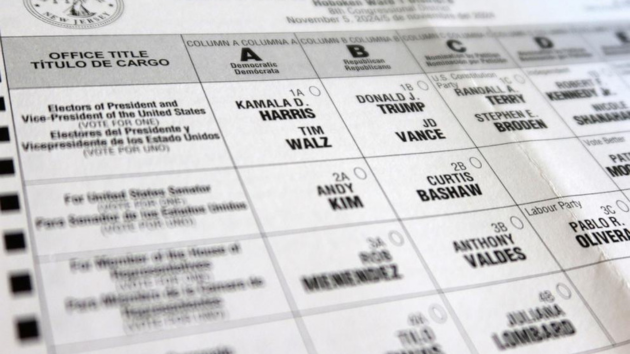
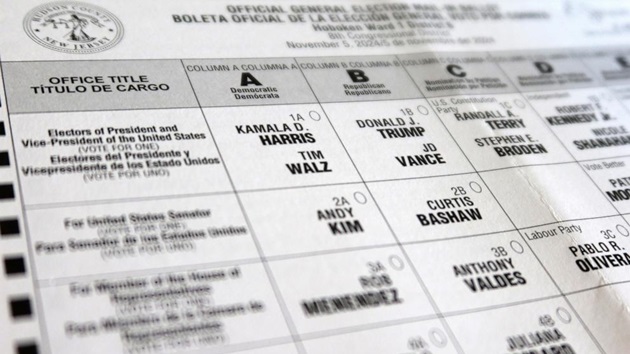
A mail-in ballot issued by Hudson County, New Jersey, for the 2024 U.S. general election is seen on September 22, 2024, in Hoboken, New Jersey. (Gary Hershorn/ABC News)
(WASHINGTON) — The Supreme Court’s conservative majority on Monday appeared sympathetic to arguments by the Republican National Committee seeking to limit the counting of mail-in ballots that arrive after Election Day, even if they were postmarked on or before.
Many justices voiced concerns about a Mississippi law being challenged by the RNC for allowing tabulation of absentee ballots that arrive as late as five days after polls close. “Both sides agree there needs to be a final decision by the voter and receipt [of the ballot] — by somebody — by Election Day,” said Justice Neil Gorsuch. “I think the disagreement is receipt by whom.”
For more than a century, Congress has established the Tuesday after the first Monday in November as the day for election of members of the House, Senate, and presidential electors, in specified years.
Republicans argue that the term “election” means both “ballot submission and receipt” by state election officials. Mississippi and several voter advocacy groups defending the state law insist “election” means when voters make their “choice” by marking and submitting their ballots to a mailbox, drop box, or polling place.
“I think if you were looking at the text in isolation — day for the election — your first instinct might be in-person voting on that day, is what that text literally meant,” posited Justice Brett Kavanaugh, who sounded skeptical of the state law.
Thirty states plus D.C. have measures providing a grace period for voters, including military service members overseas, who rely on the Postal Service or other commercial letter carriers, according to the National Conference of State Legislatures.
Justice Samuel Alito suggested that allowing each state to set its own policy for late -arriving ballots has created challenges for administering a national election. “We don’t have Election Day anymore. We have election month or we have election months,” he said, skeptically.
Justice Amy Coney Barrett raised the potentially thorny prospect of states allowing voters to recall — or, change — their ballots once mailed. “Would that be illegal?” she asked Mississippi Solicitor General Scott Stewart. He said he was unaware of any instance of that happening.
The court’s three liberal justices were largely united in support of states’ ability to develop their own voting guidelines, pushing back on claims by lawyers for the RNC and Trump administration, which has advocated for “getting rid of mail-in ballots” altogether.
“The Constitution vests the issue of elections in states, unless superseded by Congress,” said Justice Sonia Sotomayor. “If there is a policy he people who should decide this issue is not the courts.”
Justice Ketanji Brown Jackson noted that, despite decades of precedent of states counting some timely-cast but late-arriving ballots, Congress has never sought to override the laws. “The idea of votes being cast and counted after an election is not new,” she said.
Justice Elena Kagan warned that the Republicans’ rationale for eliminating some mail-in ballots could also implicate early voting. “How are you not taking issue with early voting?” she asked RNC attorney Paul Clement. “You say casting and receipt [of ballots] has to be on Election Day.”
“These things have to be consummated by Election Day,” Clement replied.
“Once we go down this road,” said Kagan, “where are we going to end up?”
Most Americans, 58%, support allowing any voter to cast a ballot by mail, according to a Pew Research Center survey late last year. But there is sharp division among parties, with 83% of Democrats and Democratic-leaning voters favoring mail-voting with 68% of Republicans and Republican-leaning voters opposed.
In March 2025, President Donald Trump signed an executive order that attempted to cut federal election funding to states that have mail ballot receipt grace periods, but it has largely been blocked by federal courts for now.
Trump has also been pushing Republicans in Congress to approve the Safeguard American Voter Eligibility (SAVE America) Act, which would — in part — outlaw voting by mail for anyone without a legitimate excuse, such as military service, illness, or disability, making it impossible to vote in person.
In a nod to Trump and fraud concerns raised by many conservatives, Justice Kavanaugh suggested late-arriving ballots might “open up a risk of what might destabilize election results” — namely, a swing in election outcome as tardy votes are tabulated.
“Is that a real concern?” Kavanaugh asked Stewart. “Does that factor into how we think about how to resolve the scant text and the maybe conflicting or 21 evolving history here?”
“I certainly respect the perception,” replied Stewart, a Republican. “I think one thing notable in this case and I think helpful is that there has not been much of a showing about actual fraud from post-Election Day ballot receipt itself.”
Hundreds of thousands of mail-in ballots in the 2024 general election arrived after Election Day but were still legally counted that year across 22 states and territories with a post-election grace period, according to the U.S. Election Assistance Commssion.
Data on which party benefitted more from those ballots is not clear, neither is the impact of any possible changes to mail ballot rules following a Court decision.
Voting rights advocates warn that an abrupt change in policy could lead to widespread rejection of ballots that were properly cast by well-intended voters but experienced unintended delivery delays by the Postal Service or other circumstances.
Republicans insist there is ample time to educate the public on timely submission of mail-in ballots ahead of the November vote and that limiting late-arriving ballots could bolster election integrity.
A decision from the high court is expected by the end of June.
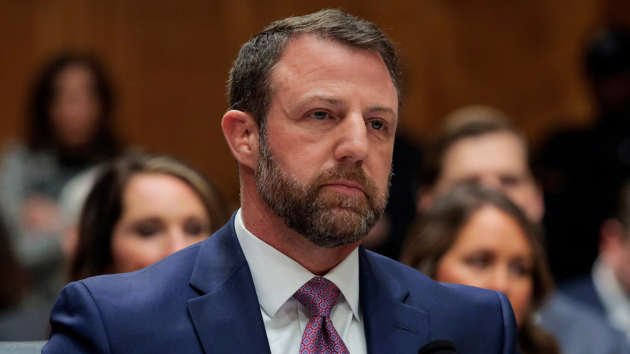
Sen. Markwayne Mullin, nominee to be Secretary of Homeland Security, testifies during a Senate Committee on Homeland Security and Governmental Affairs confirmation hearing on Capitol Hill in Washington, March 18, 2026. (Chip Somodevilla/Getty Images)
(WASHINGTON) — The Senate is set to vote to confirm Sen. Markwayne Mullin to replace Department of Homeland Security Secretary Kristi Noem on Monday night.
The vote comes amid backlash over the immigration crackdown and deportations under DHS as well as the ongoing partial shutdown of the department.
A simple majority is needed to confirm Mullin for the job; he is expected to be approved.
Mullin, a first-term Republican senator and ardent supporter of President Donald Trump, will take over DHS with little homeland security experience. During his confirmation hearing last week, Mullin said that he will work hard to earn the respect of people at the department.
“I’ll work beside them every single day to not just secure a homeland, to bring peace of mind and confidence to the agency. My goal in six months is that we’re not in the lead story every single day. My goal is for people to understand we’re out there, we’re protecting them, and we’re working with them,” Mullin said at his confirmation hearing.
Mullin’s confirmation vote comes during ongoing DHS partial shutdown — with employees of Transportation Security Administration, Federal Emergency Management Agency and other agencies under DHS not getting paid.
Travelers are experiencing long TSA lines at airports around the country during a busy spring travel season as TSA agents call out. Sunday set a new record with the highest call out rate from TSA officers since the partial government shutdown began at 11.76%, according to newly released data by the agency.
President Donald Trump announced over the weekend that he would send Immigration and Customs Enforcement agents to airports starting on Monday to assist TSA officers.
Trump nominated Mullin to lead the agency earlier this month, after firing Secretary Kristi Noem. His decision came after a week of disastrous hearings on Capitol Hill for Noem and questions about her personal and professional relationships while leading DHS.
Noem has faced criticism over her handling of ICE operations in Minneapolis after the killings of Renee Good and Alex Pretti by federal law enforcement. She was removed from leading operations in Minnesota following the scrutiny, and Border Czar Tom Homan was sent in to take over.
Noem later walked back her comments, claiming she did not have all of the facts at the time.
“I think I said this privately when we had a conversation. Those words probably should have been retracted. I shouldn’t have said that,” Mullin said to Democratic Sen. Gary Peters, adding he was “responding immediately without the facts.”
“That’s my fault. That won’t happen as secretary,” Mullin said.
Homan told ABC News’ Kyra Phillips on Monday that he is behind Mullin and looks forward to working with him as DHS secretary.
“We talk every day, if not several times a day. I think he’s the right guy, the right time and the right job,” Homan said. “I think he’s going to come in and you can work across the aisle, and I think, I think we got a lot of good things coming in the near future.”
Photo taken on Aug. 12, 2024 shows the trading floor of the New York Stock Exchange NYSE in New York, the United States. (Liu Yanan/Xinhua via Getty Images)
(NEW YORK) — The Dow Jones Industrial average closed up more than 600 points on Monday after President Donald Trump claimed “productive conversations” had been held between the United States and Iran.
The major stock indexes each soared more than 2% in early trading but gave up some of those gains as a flurry of headlines about the U.S.-Israeli war with Iran elicited price fluctuations.
The peace talks — which Iranian officials denied — sent the price of oil plunging on Monday on hopes that negotiations could reopen the Strait of Hormuz and end a weeks-long global energy shock.
The Dow closed up 631 points or 1.3%, while the S&P 500 jumped 1.1%. The tech-heavy Nasdaq increased 1.3%.
Each of the indexes remained below where it stood before the U.S.-Israeli war with Iran began on Feb. 28.
A selloff cascaded across global markets in recent weeks as stockholders feared economic fallout from a potentially prolonged bout of elevated oil prices.
Global oil prices plunged more than 10% on Monday after Trump made his claim about ongoing negotiations with Iran. Still, the price of oil stood above $100 a barrel, marking a steep rise since the outbreak of war.
Trump, after postponing U.S. strikes on Iran’s energy infrastructure citing new negotiations with Tehran, said on Monday that talks will continue and that there are “major points of agreement.”
According to Iranian state media, Iran’s Parliament Speaker Mohammad Qalibaf said, “no talks with the U.S. have taken place; reports claiming otherwise are fake news aimed at influencing financial and oil markets and distracting from the challenges facing the U.S. and Israel.”
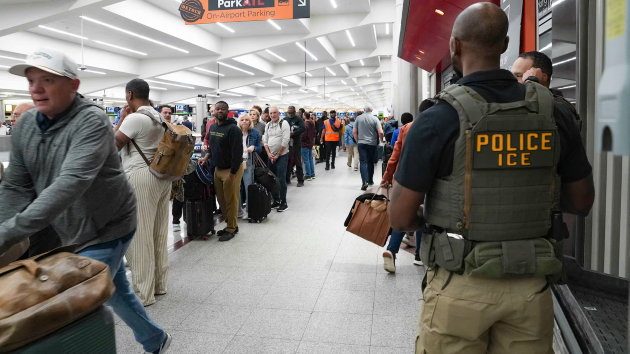
Ice agents look on as travelers stand in long lines at Atlanta Hartsfield-Jackson International Airport, March 23, 2026 in Atlanta. (Megan Varner/Getty Images)
(WASHINGTON) — Immigration and Customs Enforcement agents began fanning out at more than a dozen airports across the nation on Monday to assume some of the duties of Transportation Security Administration officers affected by a federal government funding crisis.
“What I see ICE agents doing is helping TSA plug the holes of security,” White House Border Czar Tom Homan told ABC News on Monday.
President Donald Trump told reporters on Monday that the ICE agents assigned to airports will also continue to enforce immigration laws.
“They really are a high-level group of people and they love it because they’re able to now arrest illegals as they come into the country. That’s very fertile territory,” Trump said during a gaggle with reporters on the tarmac in Palm Beach, Florida. “But that’s not why they’re there. They’re really there to help.”
Homan said that if ICE agents see “illegal activity,” they will take action because they are federal law enforcement officers.
Asked whether the ICE agents will be carrying out immigration enforcement at airports, Homan said, “We’re not going to ignore illegal conduct in the airport whether it’s human trafficking, whether it’s alien smuggling with somebody that’s wanted, whether it’s … someone that they believe they have reasonable suspicion to talk to because they feel there’s a criminal activity in front of them.”
“Of course, anybody would need probable cause to make any arrests, but yeah, their law enforcement officers and they’re not going to ignore the law while we’re there,” Homan said.
“I’m leaving it up to the TSA Administrator, who’s an expert airport operations,” Homan added. “Where can we plug the holes? Where can we increase security, especially in this heightened security environment, because what’s going on the world? Where can we help you to move those lines and American people quicker to inspections while the same time maintaining security at the airport?”
As ICE agents began showing up at airports on Monday, Trump earlier posted a message on social media asking them to refrain from wearing masks while helping with airport security.
“I would greatly appreciate, however, NO MASKS, when helping our Country out of the Democrat caused MESS at the airports,” Trump said in his post, adding that he is a “BIG proponent” of ICE agents wearing masks when they “search for, and are forced to deal with, hardened criminals.”
Asked by reporters on Monday on Air Force One why he wants ICE agents to remove their masks at airports, Trump replied, “Because the people coming into the airport, typically speaking, aren’t murderers, killers, drug dealers, etc. There may be a few of them. But there aren’t many.”
Immigration officials wearing masks has been a key issue for critics in Trump’s nationwide mass deportation program.
Trump added that typical travelers at airports are “people that want to come into the country, and that want to leave the country, going to maybe their home countries, so I didn’t think it was an appropriate look for an airport.”
ICE agents were spotted by ABC News at the Hartsfield-Jackson Atlanta International Airport early Monday.
The agents appeared to be helping with crowd control at the airport amid long lines of travelers trying to get through security. At one point, lines stretched outside the Atlanta airport’s terminals.
DHS funding battle continues
Democrats have blocked funding for the Department of Homeland Security in an effort to push for policy reforms to ICE, whose aggressive tactics in enforcing immigration laws have prompted protests and lawsuits across the country.
The DHS reforms that Democratic lawmakers have proposed include requiring ICE agents not to wear face masks, be equipped with body cameras and have warrants signed by a judge before entering homes and businesses.
Republicans have, so far, rejected those proposals.
ICE and TSA are both under the umbrella of DHS. But while ICE has remained funded through appropriations from Trump’s tax and spending bill passed last summer, key DHS agencies like TSA, the Federal Emergency Management Agency and the Coast Guard are left unfunded.
Approximately 60,000 TSA officers have gone over a month with partial pay and last week began getting no paychecks as the stalemate over DHS funding continues.
Some TSA officers have begun calling out sick or quitting as they missed their first paycheck since the shutdown began on Feb. 14. DHS said that more than 400 TSA officers have quit so far.
Confusion over duties of ICE agents
On Sunday, Homan said the deployment of ICE would largely free up TSA agents for specialized tasks, like passenger and bag screening.
Homan, however, said ICE agents are not trained to do specialized work like screening passengers and running X-ray machines.
“But there are roles we can play to release TSA officers from the non-significant role, such as guarding an exit, so they can get back to the scanning machines and move people quicker,” Homan said on CNN’s “State of the Union.”
Speaking on Fox News Sunday, Homan said that “ICE can check identification before people enter the screening area.”
But in an interview Sunday on ABC’s “This Week,” Transportation Secretary Sean Duffy seemed to contradict Homan.
Asked by Jon Karl, ABC News’ chief Washington correspondent, whether the ICE agents have any practical experience in manning airport security lines, Duffy said, “They run those same type of security machines at the Southern border, right? Packages come through or people come through. They run similar assets.”
Duffy added that ICE agents could also manage the flow of travelers through airport security and help TSA with administrative tasks.
“It depends on who shows up. Every single day will dictate how long these lines are,” Duffy said. “And you don’t know as travelers are trying to figure out, do I have to come an hour-and-a-half early? Do I have to come four hours early? They don’t know until the day of or the afternoon of their flight.”
Homan attempted to clarify what duties ICE agents would have at the airports during an interview on Monday with ABC News. Homan said that Duffy might have been referring to machines used for luggage and other packages that ICE agents already run at airports.
Homan told ABC News that ICE and Homeland Security Investigations (HSI) “have a footprint of all the airports, because that’s where we open investigations on currency smuggling and human trafficking.”
“So ICE is involved with baggage investigations on that. So there is a sort of screening,” Homan said.
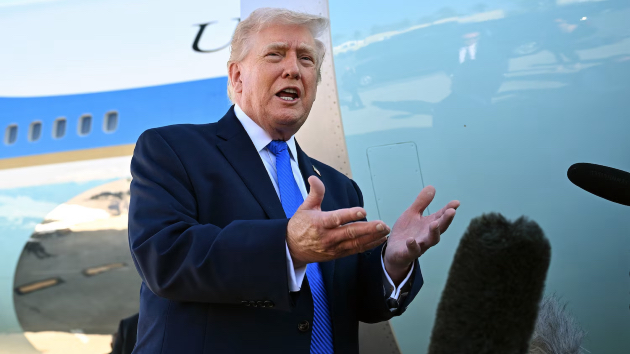
President Donald Trump speaks to reporters before boarding Air Force One at Palm Beach International Airport, March 23, 2026 in West Palm Beach, Florida. (Roberto Schmidt/Getty Images)
(WASHINGTON) — President Donald Trump, after postponing U.S. strikes on Iran’s energy infrastructure citing new negotiations with Tehran, said on Monday that talks will continue and that there are “major points of agreement.”
“They’re not going to have a nuclear weapon, that’s number one,” Trump told reporters in Florida.
“That’s number one, two and three. They will never have a nuclear weapon,” the president said. “They’ve agreed to that,” he added.
According to Iranian state media, Iran’s Parliament Speaker Mohammad Qalibaf said “no talks with the U.S. have taken place; reports claiming otherwise are fake news aimed at influencing financial and oil markets and distracting from the challenges facing the U.S. and Israel.”
Iran has previously committed not to build a nuclear weapon as part of negotiations with the West, yet continued to enrich nuclear material to levels nearing weapons grade.
Iran’s intent to build a nuclear weapon, according to Trump, was a central justification for the war.
This was despite the U.S. intelligence community’s assessment that Iran was not pursuing a nuclear weapon in the wake of last summer’s Operation Midnight Hammer, which Trump said “obliterated” the country’s nuclear weapons program.
When asked on Monday how the U.S. would get Iran’s enriched uranium if these talks go well, Trump suggested Americans would go in to seize it. Experts previously told ABC News that a large American force on the ground would likely be needed to take the nuclear material, which is believed to be buried deep underground at facilities bombed by the U.S. last year.
“Very easy, if we have a deal with them, we’re going down and we’ll take it,” Trump said.
Trump also said he wanted to see a “very serious form of regime change” in Iran.
Over the weekend, Trump had issued an ultimatum to Iran to reopen the critical Strait of Hormuz within 48 hours or face major attacks on its power plants and other energy sites.
Trump changed course on Monday morning, announcing on social media that he ordered the Defense Department to postpone the strikes for five days following what he described as productive conversations about ending the war.
Iran’s foreign ministry denied talks with the U.S., Iran’s semi-official Mehr News Agency reported.
Trump told reporters that the U.S. is talking with a “top person” in Iran, but not the new supreme leader, Mojtaba Khamenei.
The president did not offer specifics on who exactly the U.S. is negotiating with, only saying he is “a man who I believe is the most respected.” Just on Friday, Trump had said there was “nobody to talk to” after U.S. and Israeli strikes killed much of the Iranian leadership.
Steve Witkoff, White House special envoy, and Jared Kushner, the president’s son-in-law, led the talks for the U.S., Trump said. The president added that the talks went “perfectly” and would continue by phone on Monday. He said that a meeting would take place “soon.”
“We’re doing a five-day period. We’ll see how that goes, and if it goes well, we’re going to end up with settling this, otherwise we just keep bombing our little hearts out,” Trump added.
Trump said there is a “very serious chance of making a deal,” but that he is not “guaranteeing anything.”
“All I’m saying is we are in the throes of a real possibility of making a deal,” he said. “And I think, if I were a betting man, I’d bet for it. But again, I’m not guaranteeing anything.”
Trump, when asked whether he believed Israel would abide by any peace deal, said that Israel would be “very happy.”
Trump’s pause on attacks on Iranian energy infrastructure prompted a positive reaction in the stock and oil markets. The Dow Jones Industrial Average soared on Monday, and the price of oil dropped about 10% to about $90 a barrel.
Still, Iran’s stranglehold on the Strait of Hormuz remains in place.
When asked who will be in control of the strait after the conflict, Trump said it would be “jointly controlled.”
“Maybe me, me and the next ayatollah, whoever that is,” the president said.
Meanwhile, thousands more U.S. Marines and several Navy ships are heading to the Middle East, and the Pentagon is seeking $200 billion in supplemental funding.
When asked whether the administration would still request that $200 billion if these talks end the war, Trump replied, “It would be nice to have.”
Photo taken on Aug. 12, 2024 shows the trading floor of the New York Stock Exchange NYSE in New York, the United States. (Liu Yanan/Xinhua via Getty Images)
(NEW YORK) — The Dow Jones Industrial average soared more than 1,000 points on Monday after President Donald Trump claimed “productive conversations” had been held between the U.S. and Iran.
The major stock indexes shed some of the morning’s gains by midday as a flurry of headlines about the Middle East conflict appeared to elicit volatile price fluctuations.
The peace talks — which Iranian officials denied — sent the price of oil plunging on Monday on hopes that negotiations could reopen the Strait of Hormuz and end a weeks-long global energy shock.
The Dow surged 700 points or 1.5%, while the S&P 500 jumped 1.2%. The tech-heavy Nasdaq increased 1.3%.
This is a developing story. Please check back for updates.
A mail-in ballot issued by Hudson County, New Jersey, for the 2024 U.S. general election is seen on September 22, 2024, in Hoboken, New Jersey. (Gary Hershorn/ABC News)
(WASHINGTON) — In a case with potentially major ramifications for the 2026 midterm elections and all federal elections going forward, the U.S. Supreme Court on Monday is considering a Republican Party bid to prevent states from counting mail-in ballots received after Election Day even if they were postmarked on or before.
Thirty states plus D.C. and several U.S. territories have laws allowing tabulation of some late-arriving ballots provided that they were timely cast and received within a specified post-election timeframe, according to the National Conference of State Legislatures.
The case before the justices centers on Mississippi’s acceptance of absentee ballots up to five days after Election Day so long as they were received by the Postal Service on or before.
The Republican National Committee, which brought the lawsuit, alleges the policy violates federal law establishing the Tuesday after the first Monday in November as the day for election of members of the House, Senate, and presidential electors, in specified years.
Republicans argue that the term “election” means both “ballot submission and receipt” and that Congress intended that it be completed on a single day.
“Allowing states to count large numbers of mail-in ballots that are received after Election Day undermines trust and confidence in our elections,” said RNC chair Joe Gruters in a statement on the case. “Elections must end on Election Day.”
Mississippi and several voter advocacy groups defending the state law insist “election” has historically meant when voters make their “choice” by marking and submitting their ballots — not necessarily when they are received and counted.
“The weight of the law and the weight of the precedent is on our side,” said Marc Elias, a prominent Democratic election law attorney representing some of the parties defending the Mississippi law.
A Supreme Court decision in favor of the RNC could upend voting policies and procedures in dozens of states five months before voters head to the polls for the midterm elections.
Voting rights advocates also warn that an abrupt change in policy could lead to widespread rejection of ballots that were properly cast by well-intended voters but experienced unintended delivery delays by the Postal Service or other circumstances.
Hundreds of thousands of mail-in ballots in the 2024 general election arrived after Election Day but were still legally counted that year across 22 states and territories with a post-election grace period, according to the U.S. Election Assistance Commission.
Extended ballot receipt deadlines have also been aimed at helping active duty military service members and other Americans living overseas who cast their ballots from afar.
Elias said he believes the RNC suit — against a Republican-led state with minimal absentee voting — was part of a broader effort on the part of President Donald Trump and his allies to make it more difficult to vote by mail under the belief the practice favors Democrats.
“I don’t suspect that spending millions of dollars to affect the handful of ballots in the state of Mississippi that only allows excuse absentee voting anyway to be counted after Election Day is what the RNC is really after,” said Elias. “This is just a partisan effort to undermine mail-in voting.”
In March 2025, Trump signed an executive order that attempted to cut federal election funding to states that have mail ballot receipt grace periods, but it has largely been blocked by federal courts for now.
The president later said on social media that he is leading a “movement to get rid of MAIL-IN BALLOTS,” claiming, without providing evidence, that they lead to voter fraud.
Trump has also been pushing Republicans in Congress to approve the Safeguard American Voter Eligibility (SAVE America) Act, which would — in part — outlaw voting by mail for anyone without a legitimate excuse, such as military service, illness, or disability, making it impossible to vote in person.
Data on which party would potentially benefit from changes to mail ballot rules is not clear.
Most Americans, 58%, support allowing any voter to cast a ballot by mail, according to a Pew Research Center survey late last year. But there is sharp division among parties, with 83% of Democrats and Democratic-leaning voters favoring mail-voting with 68% of Republicans and Republican-leaning voters opposed.
The Trump administration, which is not a party to the case, told the court in an amicus brief that it strongly supports a decision striking down Mississippi’s law and others like it.
“Ensuring all ballot boxes close on the same day eliminates incentives and opportunities for fraudulent abuse,” wrote Solicitor General John Sauer. “Leaving them open conflicts not only with the ordinary meaning of ‘election day,’ but also with the very integrity of the election.”
Mississippi Attorney General Lynn Fitch, a Republican, dismissed that claim in a filing with the court, arguing that neither ballot receipt nor ballot counting is part of the “election” and that both have historically extended beyond Election Day.
“Counting votes is not part of the election,” Fitch told the court. “That is why counting votes lawfully can and does occur after Election Day. So, too, with ballot receipt: it is vital — but it is not part of the election itself. So, states may do what the Mississippi legislature has done: make a ‘policy choice’ to require only that absentee ballots be mailed by election day.”
A decision is expected in the case by the end of June.