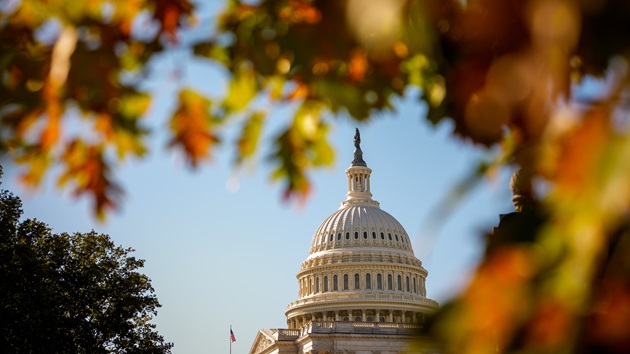
The Library of Congress is seen on the second day of the federal government shutdown on October 2, 2025, in Washington D.C. Efforts to end the shutdown stalled as Democrats left Capitol Hill without reaching a funding agreement with President Donald Trump, while the White House warned of potential impacts on public sector jobs. (Photo by Mehmet Eser/Anadolu via Getty Images)
(WASHINGTON) — The Trump administration on Monday asked the Supreme Court to uphold the president’s removal of the Register of Copyrights Shira Perlmutter from her influential post earlier this year inside the Library of Congress that oversees and enforces the United States’ copyright system.
The request is the latest appeal to the justices over President Donald Trump’s expansive view of presidential control over the federal government. Next month, the Supreme Court will consider the president’s ability to fire members of independent federal agencies without cause; early next year, it will also examine the president’s control over members of the Federal Reserve.
Under federal law, the Register of Copyrights is appointed by and reports to the Librarian of Congress, who in turn is appointed by the president for a 10-year term after confirmation by the Senate.
Trump fired the Biden-appointed Librarian Carla Hayden without cause shortly after taking office and replaced her on an acting basis with Deputy Attorney General Todd Blanche. Blanche then removed Perlmutter.
Perlmutter alleges Blanche lacks the authority to remove her.
A federal appeals court in a 2-1 decision ordered Perlmutter reinstated, concluding the offices of Librarian of Congress and Register of Copyrights are “legislative officers” not “executive officers” under the Constitution — both requiring congressional input.
The administration is asking the justices to overturn that decision — at least on an interim basis — and ultimately to take up the bigger legal questions surrounding the status of the Library of Congress and those who lead it.
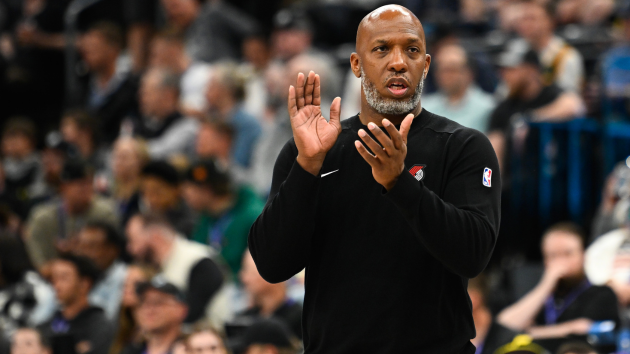
Head coach Chauncey Billups of the Portland Trail Blazers looks on during the first half against the Utah Jazz at Delta Center on April 09, 2025, in Salt Lake City, Utah. (Photo by Alex Goodlett/Getty Images)
(NEW YORK) — Following last week’s arrests of Portland Trail Blazers head coach Chauncey Billups and Miami Heat guard Terry Rozier, the National Basketball Association on Monday said it’s undertaking a review of how the league can protect itself from sports betting and whether it’s doing enough to educate coaches, players and other personnel about the “dire risks” gambling could pose to their careers, according to an NBA league memo obtained by ABC News.
The memo, dated Monday and sent to all 30 teams from NBA general counsel Rick Buchanan and Dan Spillane, the NBA’s EVP of League Governance and Policy, said that the criminal cases against Billups, Rozier and more than two dozen other defendants “is an opportune time to carefully reassess how sports betting should be regulated and how sports leagues can best protect themselves, their players and their fans.”
The memo also said the NBA is reviewing policies about injury reporting after Rozier allegedly faked an injury in a March 23, 2023, game, when he played with the Charlotte Hornets, after, according to investigators, giving advance notice to gamblers who made $200,000 in bets against his statistics.
“While the unusual betting [on the game] was detected in real time because the bets were placed legally, we believe there is more that can be done from a legal/regulatory perspective to protect the integrity of the NBA and our affiliated leagues,” the memo said.
Billups is among those charged last week in an alleged illegal poker operation tied to the Mafia, while Rozier is among several people charged in a separate but related alleged illegal gambling case. Billups has been charged with wire fraud conspiracy and money laundering conspiracy and both were immediately placed on leave by their teams, the NBA said.
Monday’s memo further said that the NBA is “exploring ways to enhance our existing internal and external integrity monitoring programs” including the use of “AI and other tools” to “identify betting activity of concern.”
“With sports betting now occupying such a significant part of the current sports landscape, every effort must be made to ensure that players, coaches, and other NBA personnel are fully aware of the dire risks that gambling can impose upon their careers and livelihoods; that our injury disclosure rules are appropriate; and that players are protected from harassment from bettors,” according to the memo.
(CALIFORNIA) — Populations of an invasive species of disease-carrying mosquitoes are continuing to spread throughout Northern California, including the San Francisco Bay Area, according to health officials.
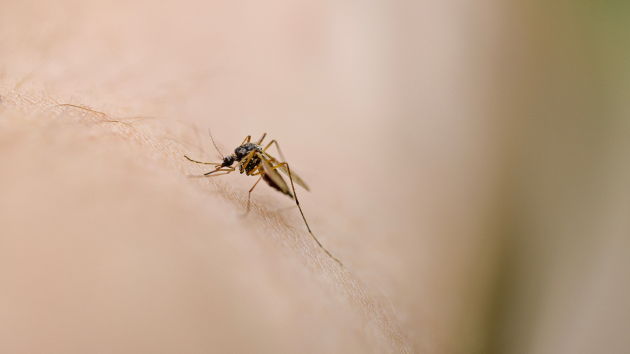
Aedes aegypti — known for its capability to transmit diseases such as dengue, yellow fever, chikungunya and Zika — were detected in San Jose near Kelley Park, the County of Santa Clara Vector Control District announced on Friday.
This is the first time A. aegypti was found in that particular area of San Jose, Taylor Kelly, the scientific-technical services manager of the Santa Clara County Mosquito and Vector Control District, told ABC News.
“This year in particular, we’ve had so many detections throughout new parts of the county,” Kelly said.
In the U.S., A. aegypti is typically found in the South, Southwest and Puerto Rico. It is also commonly found in tropical and subtropical areas of the world, including countries in Africa, Asia and southern Europe, according to the U.S. Centers for Disease Control and Prevention.
The species was first detected in California in 2013 and has been detected throughout 27 counties since — especially in Southern California and the Central Valley, according to the California Department of Public Health. Earlier this month, Los Angeles County reported its first case of locally acquired dengue for the 2025 mosquito season — with A. aegypti the likely culprit, Kelly said.
Populations have been spreading steadily throughout Northern California since the spring, according to health officials. A. aegypti, in particular, has the ability to “move with people,” whether it be following them into their car or home or breeding in extremely small containers.
In Santa Clara County, it appears A. aegypti has become established, Kelly said.
“I do think it’s something that residents are going to be notice because of the nuisance biting,” she said.
The species has been linked to local transmission of the dengue virus in California, according to the California Department of Health.
Climate change may be playing a role in the spread of mosquito populations and vector-borne diseases all over the world, as the insects thrive in warm and humid conditions, according to the World Mosquito Program. Mosquitoes have been discovered in Iceland for the first time, leaving Antarctica as the only region in the world where the insect does not reside.
In California, climate has likely played a “very important role,” but other factors have likely facilitated the spread in the Bay Area, such as a developed resistance to insecticides, Kelly said.
A. aegypti is characterized by the white bands on its legs, white spots on the body and stripes on the upper body. They are “aggressive daytime biters,” according to Santa Clara County.
In addition, A. aegypti can lay eggs in container-like flowerpots, pet bowls and backyards, which can exacerbate the spread, officials said, urging residents to dump any standing water in their yards and scrub out containers that could catch rainfall.
“Everybody should dump and drain any standing water on their property at least once a week,” Kelly said.
The species can pose as a “top public health threat,” said Roberto Barrera, lead entomologist at the CDC’s Dengue Branch.
“These tiny troublemakers are responsible for spreading viruses that affect millions of people,” Barrera said in a statement.
California health officials have encouraged residents to report bites that happen during the day immediately and to document and send photos of mosquitoes that have black and white stripes.
(NEW YORK) — President Donald Trump arrived in Japan on Monday, the second stop on his Asia tour that will culminate in a high-stakes meeting with Chinese President Xi Jinping later this week.
Trump visited with Japan’s Emperor Naruhito on Monday after landing in Tokyo.
On Tuesday in Japan, or late Monday eastern time, Trump will meet with new Prime Minister Sanae Takaichi.
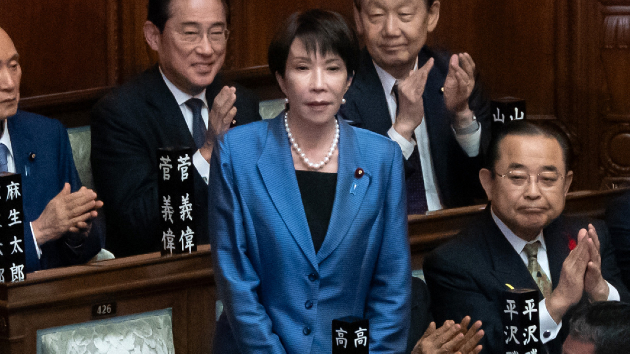
Takaichi, a conservative, is the country’s first woman to service as prime minister. Trump congratulated her on her election victory earlier this month, calling it “incredible news” for Japan. Takaichi is a protege of the late Shinzo Abe, with whom Trump developed a close diplomatic relationship during his first term.
Trump and Takaichi are set to talk trade, with Japan’s previous leadership having agreed to a $550 billion investment in the U.S. in exchange for a 15% tariff rate, as well as security.
But Trump’s most anticipated meeting on the three-country tour is with China’s Xi on Thursday, with a goal to end a monthslong trade war between the world’s two largest economics.
Trump and Xi are set to meet on the sidelines of the Asia-Pacific Economic Cooperation Summit in Busan, South Korea, according to the White House. It will be their first face-to-face meeting since Trump’s return to office.
Trump’s expressed optimism on striking a deal with Xi, telling reporters on Air Force One that he thinks there will be a “successful transaction.”
“We’re going to have a great talk. I have a lot of respect for President Xi. I like him a lot. He likes me a lot,” Trump said as he flew to Japan.
Treasury Secretary Scott Bessent, on ABC’s “This Week” on Sunday, said the administration reached a “substantial framework” in tariff negotiations with Chinese counterparts ahead of Thursday.
“The president had given me maximum leverage when he threatened 100% tariffs if the Chinese imposed their rare earth global export controls, so I think we have averted that,” Bessent said, adding that the levies on Chinese goods would be avoided if the deal holds.
Bessent didn’t provide specifics on the framework, but suggested American soybean farmers would be happy. Farmers have been caught in the administration’s global tariff fight, particularly with China importing more soybeans than any other country but currently buying none from the U.S.
“I believe, when the announcement of the deal with China is made public, that our soybean farmers will feel very good about what’s going on, both for this season and the coming seasons, for several years,” Bessent said.
While in Asia, Trump has faced questions on whether he will try to meet with North Korea’s Kim Jong Un. The two men met three times during Trump’s first term, and Trump was the first sitting U.S. president to step into North Korea.
“I’d love to meet with him if he’d like to meet. I got along great with Kim Jong Un. I liked him. He liked me. If he wants to meet, I’ll be in South Korea,” Trump said on Air Force One.
Trump even said he was open to possibly extending his trip, which is set to wrap on Thursday.
“I think the answer would be yeah. I would do that, sure,” Trump told reporters when asked if he’d stay in Asia longer to make such a meeting happen.
(NEW YORK) — Japan’s Prime Minister Sanae Takaichi’s meeting Tuesday in Tokyo with U.S. President Donald Trump will be a major test for the new leader.
She’s a hardline conservative and the first woman to serve as prime minister of Japan. Takaichi is a protégé of former Prime Minister Shinzo Abe and will likely lean into her ties with him to build rapport and chemistry with Trump. Abe, who was assassinated in 2022, had a famously close relationship with Trump.
Geopolitical experts, including Ian Bremmer, president of Eurasia Group, note that Takaichi is politically aligned with Trump on key issues, including immigration and defense. Bremmer even expects her meeting with Trump to go “exceptionally well” — even predicting that she will endorse Trump for the Nobel Peace Prize.
For Takaichi, trade will be front and center. Japan managed to strike a lower tariff rate than other countries at 15 percent. But in return it has pledged to invest $550 billion in the U.S. That’s a staggering amount, equal to more than one-tenth of Japan’s economy.
Under the agreement, the U.S. has broad discretion over how those funds are allocated, raising concerns in Tokyo about how and where that money will ultimately be used.
Takaichi is also expected to raise concerns about China’s expanding military and economic influence in Asia while seeking Trump to reaffirm the U.S.’s commitment to its economic and military alliance with Japan.
Takaichi, 64, defeated four other candidates to succeed outgoing Japanese Prime Minister Shigeru Ishiba, who resigned in September after poor election results, as leader of Japan’s ruling Liberal Democratic Party (LDP). During a runoff in an intraparty vote by the LDP, Takaichi won 185 votes, beating Agriculture Minister Shinjiro Koizumi, who received 156 votes.
She is the first first woman to head the party, which has dominated Japanese politics since its founding in 1955.
She was elected prime minister by Japan’s parliament last week.
First elected to parliament in 1993, Takaichi has served as minister of economic security, internal affairs and gender equality.
She has cited former British Prime Minister Margaret Thatcher as an inspiration.
Takaichi played drums in a heavy metal band in college and lists scuba diving, playing musical instruments, martial arts and watching baseball as hobbies.
ABC News’ Morgan Winsor contributed to this report.
(NEW YORK) — Over 20 “ill-prepared” hikers were rescued from New Hampshire’s Mount Washington after they were trapped in “full winter conditions” without the proper gear, with some developing hypothermia, according to the Mount Washington Cog Railway.
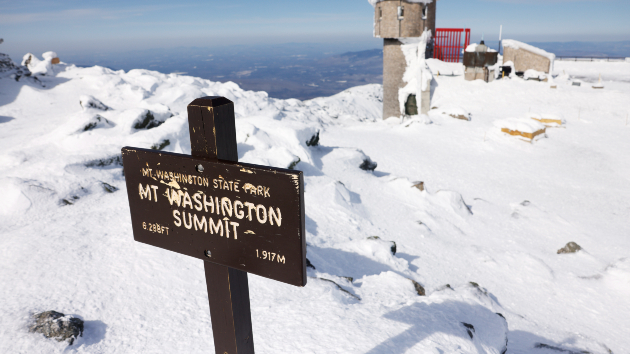
The hikers, who were rescued on Saturday by railway officials, had reached the mountain’s 6,288-foot summit, but “most had no idea that summit services would be unavailable and that the state park was closed for the season,” Andy Vilaine, the assistant general manager for the Mount Washington Cog Railway, said in a statement on Saturday.
The train was heading to the summit as normal when crew members discovered “several distressed hikers,” Vilaine said in a statement to ABC News.
The hikers told the train officials they “didn’t think they would be able to hike back down,” with Vilaine agreeing after “assessing some of their conditions and outward appearance,” he said.
Many of the hikers were showing the “beginning signs of hypothermia” due to their “poor choice of clothing, including non-waterproof layers and sneakers,” Vilaine told ABC News.
Some of the hikers even admitted it was “their first hike ever,” Vilaine said.
Near the summit, temperatures on Saturday reached roughly between 15 to 18 degrees, with a wind chill anywhere between minus 5 and zero degrees, Vilaine said.
Train crew members created space “anywhere we could” for the hikers, with some even placed in locomotive cabs “with the heat on full-blast so they could start to reverse the effects of hypothermia,” Vilaine said.
“Had we not been able to assist the hikers with the one-way ride, there is little doubt in my mind that several more complex rescue efforts may have needed to be undertaken,” Vilaine told ABC News.
After the hikers were rescued, New Hampshire State Parks released a statement on Sunday urging those hiking in the winter conditions to be responsible as “multiple people have arrived at the summit the last few days very unprepared for winter and required assistance.”
Another hiker was rescued from Mount Washington on Sunday after he was “caught in a windblown snow with a dying light and cellphone near the summit,” according to the New Hampshire Fish and Game Department.
The 20-year-old hiker from Rhode Island was “on the upper reaches of the Tuckerman Ravine Trail,” which is approximately 0.3 miles below the mountain’s summit, when he alerted rescuers that his headlamp and cellphone were “rapidly dying,” the fish and game department said in a press release on Monday.
The hiker was “found to have done some research on his hike, but was absolutely unprepared for the conditions that he encountered,” the department said. The 20-year-old was found uninjured and “thanked the rescuers multiple times in the aftermath of this event,” the department said.
“This situation could have had a very bad outcome, and everyone involved recognized that fact,” the department said.
Officials emphasized that hikers must bring “everything needed to hike in winter conditions,” or to simply “just hike another day.”
“It’s literally a life or death situation if they go up there unprepared,” Lt. Mark Ober with the New Hampshire Fish and Game Department told Manchester, New Hampshire, ABC affiliate WMUR.
Cris Hazzard, a professional hiking guide and author, known as “The Hiking Guy,” previously told ABC News that several minutes of “homework” before embarking on an outdoor excursion — including checking the website of the trail or park or downloading an app like AllTrails — can help hikers avoid challenging conditions or become aware of specific closures.
The Dome of the U.S. Capitol Building is visible on October 22, 2025 in Washington, DC. Andrew Harnik/Getty Images
(WASHINGTON) — A critical food assistance program will soon halt for millions of Americans in need and air traffic controllers will miss a paycheck this week as the government shutdown enters its fourth week — with all eyes on congressional lawmakers to see if the added pressure will be enough to push them to strike a deal.
The Department of Agriculture posted a notice on its website that Supplemental Nutrition Assistance Program benefits will not be issued on Nov. 1 amid the ongoing government shutdown, saying “Bottom line, the well has run dry.”
SNAP, often referred to as “food stamps,” serves roughly 42 million low-income Americans.
SNAP has traditionally been entirely federally funded, but is administered by states. That means the shutdown’s impact on SNAP and when benefits will start to dry up will vary by state.
Over the weekend, the Trump administration said it won’t be giving a lifeline to SNAP funding, and blamed the Democrats for the ongoing shutdown.
The Trump administration’s position that it cannot extend SNAP benefits during the shutdown is a reversal from the USDA’s stated shutdown contingency plan from late September, which said that “Congressional intent is evident that SNAP’s operations should continue since the program has been provided with multi-year contingency funds that can be used for State Administrative Expenses to ensure that the State can also continue operations during a Federal Government shutdown.”
But in a new memo issued late last week and obtained by ABC News, USDA said contingency funds are “only available” when SNAP funds have been approved by Congress.
Earlier in the shutdown, the Trump administration redirected others funds to pay service members — even as it says it can’t do the same with SNAP funding.
On Monday, House Speaker Mike Johnson argued the contingency funds for SNAP are “not legally available right now” to cover the benefits and pleaded with Democrats to support the clean continuing resolution to reopen the government.
“The reason is because it’s a finite source of funds. It was appropriated by Congress, and if they transfer funds from these other sources, it pulls it away immediately from school meals… So … it’s a trade off,” he said. “There has to be a pre-existing appropriation for the contingency fund to be used.”
Airline travelers are feeling effects of the shutdown as well.
Over the weekend, the Federal Aviation Administration was forced to slow air traffic around Chicago, Dallas, Southern California, Newark and other cities because of staffing issues. Some air traffic controllers called out as many are forced to work without pay during the shutdown.
Air traffic controllers will miss their first paycheck on Tuesday.
Another critical deadline approaches around health care premiums. Democrats are continuing their fight over health care subsidies as the Nov. 1 open enrollment date approaches.
As the shutdown continues to impact Americans and key deadlines loom, all eyes are on Capitol Hill where lawmakers are still in a stalemate.
On Monday, Johnson slammed Democrats and said the administration has worked “creatively” to limit the “pain on the Americans.”
“We need five more Democrats in the Senate to do the right thing — wake up and say, ‘I’m going to say no to the Marxist far-left pressure, and I’m going to do what’s right by the people of 42 million Americans in this country who rely upon this essential nutrition assistance. Or am I going to starve my constituents? Or am I going to appease the Marxist?’” Johnson said.
It doesn’t appear President Donald Trump will be negotiating with Democrats either.
“Well, what good does it do, Martha? They dug in. The American people are hostage to Chuck Schumer and Hakeem Jeffries’ poll numbers because what’s changed between now and the last time there was a clean, continuing resolution is Chuck Schumer has tanked in the polls. They both of the two guys from Brooklyn, like I call them, are worried about being primaried from the left,” Bessent said.
Meanwhile, the president of the country’s largest union representing federal workers is calling on lawmakers to pass a short-term spending bill to end the shutdown.
“It’s time to pass a clean continuing resolution and end this shutdown today. No half measures, and no gamesmanship. Put every single federal worker back on the job with full back pay — today,” American Federation of Government Employees National President Everett Kelley said in a statement.
The AFGE represents more than 800,000 federal and D.C. government workers.
“It’s time for our leaders to start focusing on how to solve problems for the American people, rather than on who is going to get the blame for a shutdown that Americans dislike,” she added.
A woman runs along a palm tree-lined street in La Jolla as the sun sets on the horizon of the Pacific Ocean on October 23, 2025 in San Diego, California. Kevin Carter/Getty Images
(NEW YORK) — Women may need less exercise than men to gain similar protection against coronary heart disease, according to a new study published in Nature Cardiovascular Research.
The findings come from an observational study of more than 85,000 adults in the United Kingdom who were followed for about seven years. Researchers used data from a one-time “snapshot” — a weeklong period of wrist-worn fitness tracker measurements — to examine how physical activity relates to heart disease risk and death rates.
The study found that women who got around four hours of moderate exercise each week lowered their risk of coronary heart disease by about 30%. However, men needed nearly twice as much — about eight hours of similar activity — to achieve the same level of heart protection. Additionally, women who already had heart disease experienced a threefold decrease in the risk of death compared with men with similar medical histories, who needed nearly twice as much weekly exercise to achieve a similar reduction in the risk of dying from any cause.
Moderate-intensity exercise includes activities like brisk walking or gardening — enough to get the heart pumping but not to the point of exhaustion, according to Dr. Jennifer Miao, a board-certified cardiologist and fellow of the ABC News Medical Unit. More vigorous workouts such as running, swimming laps or hiking uphill push the body harder and lead to a greater rise in heart rate, she explained.
The American Heart Association recommends that adults get at least two-and-a-half hours per week of moderate-intensity physical activity, or one-and-a-half hours per week of vigorous activity, or a combination of both. But even when following those exercise recommendations, the study found that differences between the sexes emerged.
Across all groups, the study confirmed that being active at any level was associated with a lower risk of heart disease compared with leading a sedentary lifestyle, with active women experiencing a 5% greater reduction in risk than active men.
And the more exercise someone got, the lower their risk of heart disease and death, highlighting what experts refer to as a clear dose-response relationship between physical activity and heart health.
There are two possible reasons women may benefit more from physical activity than men, according to the study authors. One explanation could be hormones.
“Physiologically, circulating estrogen levels are much higher in females than in males, and estrogen can promote body fat loss during exercise,” Dr. Jiajin Chen, one of the study’s authors and a researcher at the Institute of Cardiovascular Diseases in China, told ABC News.
Another possible reason has to do with muscle type. Men tend to have more “fast-twitch” muscles, which are great for quick, powerful movements. Women, on the other hand, usually have more “slow-twitch” muscles, which may help their bodies work a bit more efficiently during workouts.
“These physiological differences may partly explain the increased sensitivity to physical activity and greater cardiovascular benefit observed in females,” Chen said.
It’s also important to recognize how men and women can experience and be treated for coronary artery disease differently, Miao noted.
Women often develop the condition later in life, face a higher risk of death following a heart attack, and are less likely than men to undergo diagnostic procedures such as coronary angiography or receive standard medical care for coronary artery disease, she said.
Public health guidelines will benefit from acknowledging these sex-based differences to more effectively prevent cardiovascular disease, which is the world’s leading cause of death, the study authors suggest.
Miao agreed. She advised talking with your doctor before starting a new exercise routine, since physical activity recommendations depend on your fitness level, medical conditions, recent events like a stroke or heart attack, and overall mobility.
“Exercise routines should be personalized; it’s not a one-size-fits-all plan,” Miao said.
Dr. Cyrus Mowdawalla, MD, is a resident physician in internal medicine from Montefiore Medical Center and a contributing correspondent of the ABC News Medical Unit.
ndiana Gov. Mike Braun speaks before U.S. Agriculture Secretary Brooke Rollins signs three new SNAP food choice waivers for the states of Idaho, Utah, and Arkansas in her office at the United States Department of Agriculture Whitten Building on June 10, 2025 in Washington, DC. (Andrew Harnik/Getty Images_
(INDIANAPOLIS) –Indiana Republican Gov. Mike Braun announced on Monday that he will call for a special legislative session to begin next week that will include considering redrawing Indiana’s congressional map — drawing the state more deeply into the mid-cycle redistricting battle occurring across the country.
“I am calling a special legislative session to protect Hoosiers from efforts in other states that seek to diminish their voice in Washington and ensure their representation in Congress is fair,” Braun wrote in a statement.
The special session — which is set to begin Monday, Nov. 3 — will also deal with tax issues, according to Braun.
The White House has openly pushed for Indiana, which currently has seven Republican and two Democratic members of the U.S. House, to redraw its congressional map. Vice President JD Vance has visited the state twice in recent months for discussions with state lawmakers and figures.
As of Monday, three states have finished redrawing their congressional maps: Texas, Missouri and North Carolina. Analysts believe that Republicans stand to gain up to seven congressional seats in these redrawn maps — significant changes in a Congress with a razor-thin Republican majority.
A spokesperson for Republican state Sen. Rodric Bray, the Senate President pro tempore, told ABC News on Wednesday, “the votes aren’t there for redistricting.”
President Donald Trump spoke with Republican state legislators from Indiana on Friday about redistricting.
Braun later indicated that he’s still confident to get support for “fair representation.”
“I am still having positive conversations with members of the legislature. I am confident the majority of Indiana Statehouse Republicans will support efforts to ensure fair representation in congress for every Hoosier,” Braun wrote on X on Wednesday.
His lieutenant governor, Micah Beckwith — who is the state Senate’s president — went further in a statement: “I am calling on my Republican colleagues in the Indiana Senate to find your backbone, to remember who sent you here, and to reclaim Indiana’s rightful voice in Congress by drawing a 9-0 map.”
President of the National Democratic Redistricting Committee John Bisognano on Monday slammed Braun’s move.
“Governor Braun clearly called this special session solely because he got orders from Washington,” Bisognano said in a statement. “Hoosiers do not want a mid-decade gerrymander. Indiana legislators now have a choice: stand up for their constituents by rejecting a mid-decade gerrymander or cave to the White House by undermining the voting rights of their constituents.”
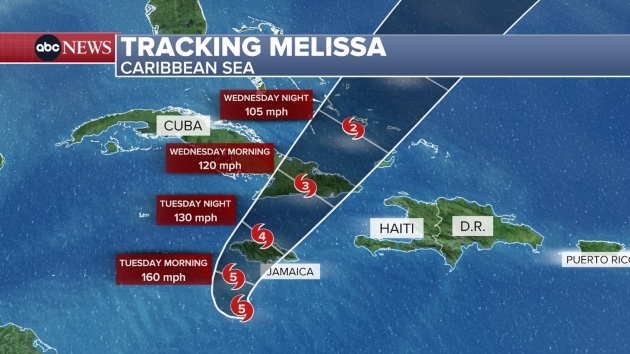
This ABC News graphic shows the forecast for Hurricane Melissa as of Oct. 27, 2025. (ABC News)
(NEW YORK) — Hurricane Melissa, now a powerful Category 5 storm, will slam into Jamaica on Monday as the worst storm the island has ever seen.
Here is Melissa’s forecasted path:
Melissa is expected to make landfall in central or western Jamaica late Monday night or early Tuesday morning, likely as a Category 4 or 5 hurricane. Most of the destruction will unfold from noon on Monday to noon on Tuesday.
Tropical storm-force winds are already underway and will steadily increase throughout the day. Winds are expected to reach hurricane strength by Monday night and will last through Tuesday afternoon.
The rain and storm surge will be even more dangerous than the wind for some. Melissa is moving very slowly, so it will bring a deluge of rain to Jamaica, with totals forecast to reach 15 to 30 inches and even up to 40 inches in localized areas. This will spark catastrophic and life-threatening flash flooding on Monday and Tuesday.
Storm surge will decimate parts of the southern coast with water surging up to 13 feet above ground level.
Next, the heavy rain will move to Haiti and the Dominican Republic, where 8 to 16 inches of rainfall is possible. Catastrophic flash flooding and landslides are also in the forecast.
Melissa will then hit southeastern Cuba on Tuesday night and Wednesday morning as a major hurricane, dumping 10 to 20 inches of rain and leading to catastrophic flooding and numerous landslides.
On Wednesday, the southeastern Bahamas will see rain totals of 4 to 8 inches, hurricane-force winds and life-threatening storm surge.
Melissa may still be a Category 1 hurricane on Thursday night or Friday morning when it passes near or over Bermuda.