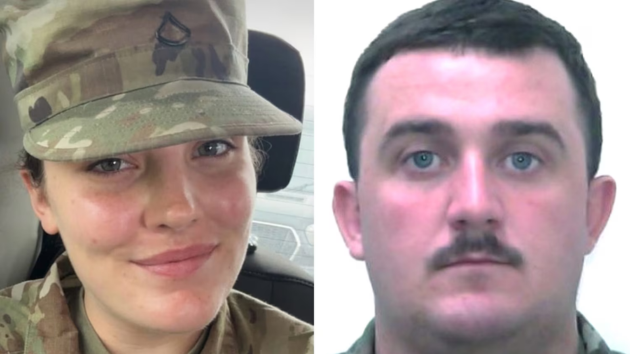
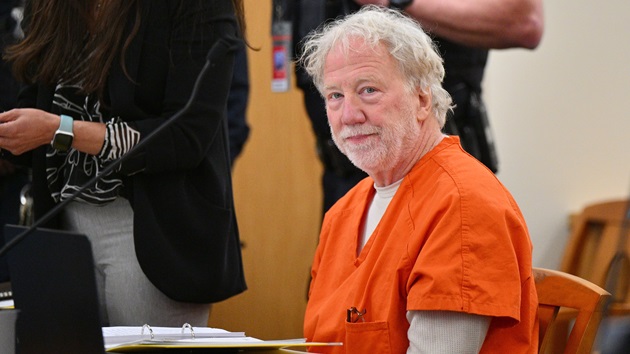
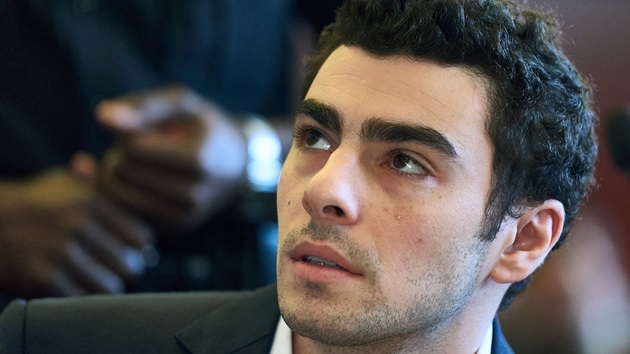
National Guard members Sarah Beckstrom and Andrew Wolfe. (U.S. Department of Justice)
(WASHINGTON) – -The two West Virginia National Guard members shot in November will receive the Purple Heart, Defense Secretary Pete Hegseth announced Friday while addressing troops at the base of the Washington Monument.
Army Spc. Sarah Beckstrom, 20, died of her injuries on Nov. 26, the day before Thanksgiving. Air Force Staff Sgt. Andrew Wolfe was shot in the head and remains in recovery, with skull reconstruction surgery scheduled for March.
“One lost, one recovering, both soon to be Purple Heart recipients,” Hegseth said, “because they were attacked by a radical.”
The suspected gunman, Rahmanullah Lakanwal, a 29-year-old Afghan national who previously worked with the CIA in Afghanistan, was arraigned on nine charges Wednesday, including first-degree murder, assault with intent to kill and illegal possession of a firearm.
Prosecutors say they are seeking additional charges that would make Lakanwal eligible for the death penalty. He has pleaded not guilty.
Purple Hearts are typically reserved for troops wounded or killed by clearly identified enemy combatants in war zones, with awards for attacks on American soil relatively rare.
The question of eligibility resurfaced after the 2015 shootings in Chattanooga, Tennessee, when Muhammad Youssef Abdulazeez opened fire on a Navy Reserve center and a nearby recruiting station. Four Marines and a sailor died, Abdulazeez was killed by law enforcement.
For months, that attack sat in a bureaucratic gray zone for the Purple Heart. FBI Director James Comey eventually determined the shootings were motivated by foreign terrorist propaganda.
The determination cleared the way for then- Navy Secretary Ray Mabus to announce Purple Hearts would be awarded to the victims of the shooting.
The Trump administration has labeled Lakanwal a terrorist, though it has not publicly produced evidence tying him to any designated terrorist organization.
Lakanwal was among thousands of Afghans evacuated to the United States after the Taliban’s takeover in 2021, and his asylum application was approved in 2025 during the Trump administration.
In Afghanistan, Lakanwal was affiliated with a so-called Zero Unit that worked closely with the CIA and elite special operations units, ABC News reported in December.
Officials with direct knowledge of the matter said he was considered a trusted member of the unit, which carried out American counterterrorism missions.
Investigators also believe Lakanwal was under financial strain after his work permit expired and may have been experiencing a mental health crisis.
“This announcement brings long-overdue honor to their service, offers meaning and reassurance to their families, and stands as a solemn reminder that West Virginia will never forget those who sacrifice in defense of others,” West Virginia GOP Gov. Patrick Morrisey, who called for Purple Hearts to be awarded after the ambush, said in a statement to ABC News.
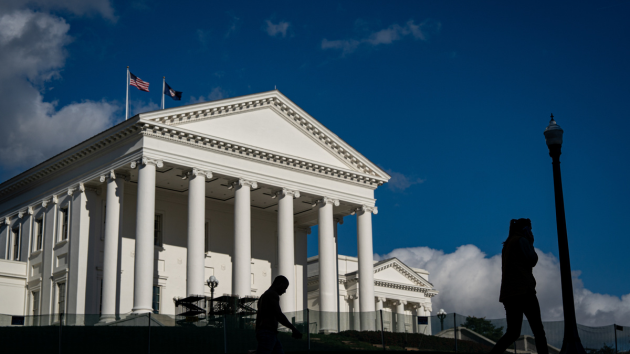
The Virginia State Capitol in Richmond, Virginia, US, on Monday, Nov. 3, 2025. Abigail Spanberger will face off with Winsome Earle-Sears on November 4, giving the state its first female governor. (Photographer: Al Drago/Bloomberg via Getty Images)
(VIRGINIA) — Virginia residents could soon vote on whether the legislature can redraw the state’s congressional map mid-decade, a key development in a larger push by both parties to redraw U.S. House seats in their favor ahead of the 2026 midterms.
Virginia Gov. Abigail Spanberger on Friday signed a bill that sets an April 21 statewide vote on a constitutional amendment that would allow legislators to redraw congressional districts in the middle of the decade. Congressional maps are usually only drawn after the release of data from the census.
Democrats have framed the potential redraw as a response to how Republicans have redrawn U.S. House seats in their favor through mid-decade redistricting already in Texas, North Carolina, Ohio and Missouri. Democrats have netted potential seats in California and Utah so far, but have fewer opportunities overall to redistrict.
Spanberger’s bill signing came the day after Democrats in Virginia’s state legislature unveiled the proposed congressional map that they hope to implement in time for the 2026 midterms, which could allow Democrats to potentially flip up to four GOP-held seats if implemented.
The map itself will not be voted on in the April referendum, but Democrats indicated they wanted to have a map proposal made public beforehand so that voters could know what may be passed into law if the referendum goes in their favor.
Democratic legislators will need to get through ongoing legal challenges as well, as a state court in Virginia ruled last month that the constitutional amendment is illegal because of the procedures the Democrats used to move the amendment through the legislature. The case is being taken up by the state’s Supreme Court.
Republicans opposing the Democratic-led redistricting effort slammed the proposed map as a partisan gerrymander.
“Only those who crave complete political control and are willing to silence millions of Virginians will attempt to defend this abomination,” Jason Miyares, the former Republican Attorney General of Virginia who is a co-chair of the Virginians for Fair Maps group, wrote on X on Thursday.
Meanwhile, in nearby Maryland, Democrats are split over whether the state should take part in the mid-decade redistricting scramble.
Maryland’s House of Delegates recently passed a bill containing a new congressional map that could allow Democrats to flip the state’s lone GOP-held congressional district.
But that effort, championed by Maryland’s Gov. Wes Moore, is held up in the state Senate, where Senate leader Bill Ferguson has said he remains opposed to mid-decade redistricting. Ferguson told reporters on Tuesday that it “is a path towards mutually assured destruction.”
ABC News’ Ford McCracken and Halle Troadec contributed to this report.
The Dow Jones Industrial Average logo appears on the screen of a smartphone in Reno, United States, on December 1, 2024. (Photo by Jaque Silva/NurPhoto via Getty Images)
(NEW YORK) — The Dow Jones Industrial Average closed above 50,000 for the first time ever on Friday.
A surge in markets reversed a selloff that hammered tech stocks earlier in the week.
The Dow closed up 1,206 points, or 2.4%, while the S&P 500 climbed 1.9%. The tech-heavy Nasdaq increased 2.1%.
In a post on social media, President Donald Trump touted the high-water mark for the Dow, celebrating the feat as “the first time in History.”
“CONGRATULATIONS AMERICA!” Trump said.
Shares of some tech companies worldwide plummeted in recent days after Anthropic unveiled an artificial intelligence tool viewed by some investors as a potential replacement for widely-used software products.
The selloff came in response to a set of new plugins for a digital tool called Claude Cowork, an AI-fueled workplace assistant that can author documents and organize files. The plugins, released last Friday, allow customers to adapt the tool for narrow sectors like legal, finance or data marketing.
Investors appeared to shrug off the AI-related worries in a buying spree on Friday.
AI chip giant Nvidia surged nearly 8%, recovering most of its losses earlier in the week.
Enterprise-software company Workday ticked up more than 2% on Friday, after a selloff in previous days triggered by the release of Claude Cowork.
Some crypto prices also rallied on Friday, ending a days-long plunge for many digital currencies. Bitcoin and Ether — the world’s two largest cryptocurrencies — each soared about 10% on Friday.
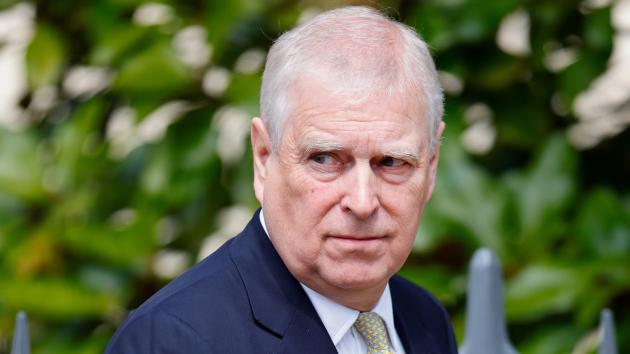
Prince Andrew, Duke of York attends the traditional Easter Sunday Mattins Service at St George’s Chapel, Windsor Castle, April 20, 2025, in Windsor, England. (Max Mumby/Indigo/Getty Images)
(NEW YORK) — While the latest release of Epstein files has touched off another round of controversy in the U.S., it has ignited a veritable firestorm in Europe, where the new tranche of emails, text messages, videos on photographs released by the Department of Justice has painted a far more comprehensive picture of the late sex offender Jeffrey Epstein’s relationship with members of the global elite.
And while a mention in the files does not immediately imply wrongdoing, last week’s data dump has led to a chorus of high-profile figures explaining, and in many cases apologizing for, their connection to Epstein. Reputations have been tarnished, in some cases irrevocably.
These latest files show the range and depth of Epstein’s extraordinary reach into the upper echelons of society. Among the new names from the European elite are Norway’s crown princess and the Slovak national security adviser.
For now, the repercussions are being felt the most acutely in the U.K., where a prince of the realm has lost his title and his home, a senior member of the governing Labour party has lost his position in the House of Lords, a police investigation has been launched into misconduct in public office, and Prime Minister Keir Starmer — whose name has not appeared in the released files — is now fighting for his political survival.
The recently published files have laid bare the extent of Epstein’s contact with the former Prince Andrew and former British Ambassador Peter Mandelson — touching off a crisis at both the heart of the government and the monarchy.
“The scandal seems to matter more here, with graver consequences, because it strikes at the monarchy, the British establishment and the political elite. It’s not just about the behavior of one disgraced man,” Robert Jobson, royal author and ABC royal contributor told ABC News.
There are difficult questions for the monarchy to face, Jobson said, “If senior royal family members and courtiers knew about Epstein’s activities and did nothing” and if they “chose to protect the monarchy at the expense of vulnerable young women.”
“If they did not know, then the institution they oversee is not merely flawed but dangerously incompetent. Neither explanation is excusable,” Jobson said.
Buckingham Palace’s most recent statement on the matter, which came on Oct. 25, announced the stripping of Andrew’s titles and said, “Their Majesties wish to make clear that their thoughts and utmost sympathies have been, and will remain with, the victims and survivors of any and all forms of abuse.”
In rare public hecklings, both the king and queen have been asked whether they will help with the Epstein investigation. Neither responded. It is extremely unusual for them to be approached in this way, and royals very rarely respond to such questions.
The only senior royal to address these latest revelations has been Prince Edward, who responded to a reporter’s question by emphasizing his support for the victims, saying, “I think it’s all really important always to remember the victims and who are the victims in all this? A lot of victims in this.”
“The central issue in the Epstein scandal has never been Andrew alone,” Jobson said. “It is the question the Palace has spent more than a decade avoiding: What did the late queen and King Charles know? And when did they know it?”
Andrew Mountbatten-Windsor
Andrew Mountbatten-Windsor, formerly Prince Andrew, was stripped of all his titles last October after some of his email exchanges with Epstein were leaked to the press. He vacated his home at Royal Lodge on Monday, and will now live on the King’s privately owned Sandringham Estate.
The scandal, which has hounded the royal family for decades, erupted after one of Epstein’s victims, Virginia Giuffre, accused Mountbatten-Windsor of sexual assault. In 2022, Mountbatten-Windsor, who has always denied any wrongdoing, settled a civil suit with Giuffre.
“The Queen personally funded Andrew’s legal defense. She later allowed him to walk beside her at the Duke of Edinburgh’s memorial service in 2022, a move widely interpreted as an attempt at rehabilitation. It has now backfired, blown up in the King’s face,” Jobson told ABC News.
Mountbatten-Windsor, then Prince Andrew, told the BBC’s Emily Maitlis that he cut off all contact with Epstein in 2010, shortly after Epstein completed his sentence for solicitation of a minor in Florida — but last week the Department of Justice released emails between the two dating from 2011 and correspondence between his team and Epstein as recently as 2017.
“The press is piling on me in the states.. nothing to do. just want to make sure you’re ok,” Epstein wrote to Andrew on Feb 28, 2011.
“I’m just as concerned for you! Don’t worry about me!” Andrew replied to Epstein. “It would seem we are in this together and will have to rise above it!…keep in close touch and we’ll play some more soon!!!!”
In another exchange, Epstein sent Mountbatten-Windsor a message encouraging him to have dinner with a friend, about whom he said, “She 26, russian, clevere [sic] beautiful, trustworthy.”
Mountbatten-Windsor replied he would be “delighted.”
Last week, following the emails’ release, a second woman came forward to accuse Epstein of trafficking her to have sex with Mountbatten-Windsor, according to the BBC. Her lawyer, Brad Edwards told the BBC, “We’re talking about at least one woman who was sent by Jeffrey Epstein over to Prince Andrew. And she even had, after a night with Prince Andrew, a tour of Buckingham Palace.”
Thames Valley Police released a statement saying, “We are aware of reports about a woman said to have been taken to an address in Windsor in 2010 for sexual purposes. We are assessing the information in line with our established procedures.”
Buckingham Palace has not commented on any of the latest revelations, telling ABC News that they no longer represent Andrew Mountbatten-Windsor.
The former prince has yet to publicly comment on these latest documents.
“The scandal is not defined only by what Prince Andrew may have done,” Jobson said. “It is defined by what the institution chose to conceal. And that question has still not been answered.”
Peter Mandelson
While the monarchy has been trying to contain the damage, British Prime Minister Keir Starmer has been fending off criticism for his appointment of Lord Peter Mandelson as the British ambassador to the U.S. in 2024.
“I regret appointing him. If I knew then what I know now, he would never been anywhere near government,” Starmer told the House of Commons on Wednesday.
Nicknamed the “Prince of Darkness” by the British press, Mandelson has long been a controversial figure and many questioned Starmer’s choice of ambassador at the time — but the prime minister maintains he did not know “the depth and the darkness” of Mandelson’s relationship with Epstein.
He apologized twice on Thursday for his misjudgment, telling reporters, “The victims of Epstein have lived with trauma that most of us can barely comprehend, and they’ve had to relive it again and again.”
“They have seen accountability delayed and too often denied,” Starmer said. “To them, I want to say this: I am sorry. Sorry for what was done to you. Sorry that so many people with power failed you. Sorry for having believed Mandelson’s lies and appointed him.”
The prime minister told the press that Mandelson had downplayed his friendship with Epstein, saying, “He portrayed Epstein as someone he barely knew, and when that became clear, and it was not true, I sacked him. Such deceit is incompatible with public service.”
Mandelson was removed from his post as British ambassador last September, following the release by the U.S. House Oversight Committee of Epstein’s so-called “Birthday Book,” in which Mandelson referred to Epstein as his “best pal”.
The emails released last Friday show that Epstein and the former ambassador and government minister communicated for years, including after Epstein had pleaded guilty to sex crimes in Florida in 2008. The exchanges between the pair have led police to launch an investigation into potential misconduct in office.
On May 9, 2010, while Epstein was still on probation in Florida, he emailed Mandelson to say that “sources tell” him about an imminent 500 billion euro bailout. A person whose identity is redacted replied that the bailout will “be announced tonight.” The person says later that they are “just leaving No10”, presumably referring to the prime minister’s residence at Number 10 Downing Street.
The European Union announced a 500 billion Euro fund to stabilize the Euro that day.
The Metropolitan Police said in a statement on Monday that it had “received a number of reports into alleged misconduct in public office including a referral from the UK Government” and that “the Metropolitan Police has now launched an investigation into a 72-year-old man, a former Government Minister, for misconduct in public office offences.”
The statement does not mention the Mandelson, 72, by name.
On Friday the Metropolitan Police announced they were searching two properties in connection with the investigation.
Bank statements also appeared in the recently released documents which appear to show Epstein transferred as much as $75,000 to Mandelson between 2003 and 2004.
Mandelson submitted his resignation to the Labour Party on Monday, writing in his resignation letter, “I have been further linked this weekend to the understandable furore surrounding Jeffrey Epstein and I feel regretful and sorry about this.”
The Speaker for the House of Lords in Parliament also announced that Mandelson had submitted his resignation from the chamber.
“Britain has dethroned a prince, forced Mandelson to resign, & lost confidence in Starmer because @RepThomasMassie & I forced the release of the Epstein files,” U.S. Rep. Ro Khanna posted on X Friday. “What is America doing to hold the Epstein class accountable?”
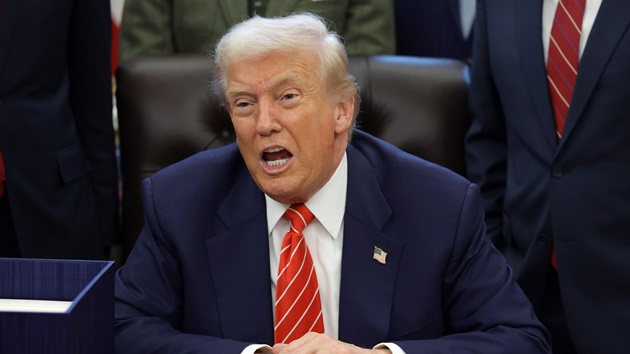
U.S. President Donald Trump speaks during a bill signing in the Oval Office of the White House on February 03, 2026 in Washington, DC. Alex Wong/Getty Images
(WASHINGTON) — President Donald Trump shared on his social media platform late Thursday night a video that included a racist animation of former President Barack Obama and former first lady Michelle Obama depicted with the bodies of apes.
After backlash, the White House at about noon Friday said the post had been taken down from the president’s page.
The roughly minutelong video, shared by Trump at 11:44 p.m. ET on Thursday, largely focused on debunked claims about the 2020 election.
At the end of the video, the Obamas’ faces appear abruptly and without explanation for seconds with the song “The Lion Sleeps Tonight” playing over it. The video then ends back on similar imagery of the conspiracy video footage.
The Obamas had no comment when ABC News reached out to their representatives for a response.
White House press secretary Karoline Leavitt, when first asked for comment early Friday, had said, “This is from an internet meme video depicting President Trump as the King of the Jungle and Democrats as characters from the Lion King. Please stop the fake outrage and report on something today that actually matters to the American public.”
Though later Friday afternoon, a White House official told ABC News that a “staffer erroneously made the post.”
The video reposted by Trump overnight included only imagery of the Obamas.
The meme video referenced by Leavitt was shared in October by the Hardin County Republican Party of Kentucky on Facebook, which led the chairman to issue an apology and deleted the post after swift backlash noting the long history of racist tropes depicting Black people as apes or monkeys — a tool of slave traders and segregationists to dehumanize them.
Trump’s overnight repost was condemned by lawmakers on Capitol Hill, some of whom had called for it to be taken down and for the president to apologize.
House Democratic Leader Hakeem Jeffries, the first Black leader of a party in Congress, wrote on X: “President Obama and Michelle Obama are brilliant, compassionate and patriotic Americans. They represent the best of this country. Donald Trump is a vile, unhinged and malignant bottom feeder.”
“Every single Republican must immediately denounce Donald Trump’s disgusting bigotry,” Jeffries wrote.
Republican Sen. Tim Scott, the only Black Republican in the Senate and also the head of the National Republican Senatorial Committee, posted on X: “Praying it was fake because it’s the most racist thing I’ve seen out of this White House. The President should remove it.”
Republican Sen. Roger Wicker wrote in a post: “This is totally unacceptable. The president should take it down and apologize.”
Senate Minority Leader Chuck Schumer, a Democrat, wrote in a post: “Racist. Vile. Abhorrent. This is dangerous and degrades our country — where are Senate Republicans? The President must immediately delete the post and apologize to Barack and Michelle Obama, two great Americans who make Donald Trump look like a small, envious man.”
Director and actor Timothy Busfield looks on before a hearing in the Second District Judicial Court at the Bernalillo County Courthouse on January 20, 2026 in Albuquerque, New Mexico. Sam Wasson/Getty Images
(ALBUQUERQUE, N.M.) — A grand jury has indicted actor Timothy Busfield on child sex abuse contact charges after his arrest last month, according to officials.
Busfield is facing multiple counts of criminal sexual contact of a child, according to Bernalillo County District Attorney Sam Bregman.
“District Attorney Sam Bregman emphasized that protecting children remains a top priority for his office. The Bernalillo County District Attorney’s Office remains committed to doing everything possible to protect children and ensure justice for victims,” the district attorney’s office said in a statement Friday.
Luigi Mangione appears for a suppression of evidence hearing in the killing of UnitedHealthcare CEO Brian Thompson in Manhattan Criminal Court on December 18, 2025 in New York City. Curtis Means-Pool/Getty Images
(NEW YORK) — Luigi Mangione spoke out in court on Friday as Judge Gregory Carro tentatively scheduled his state murder case to begin on June 8.
Last week, U.S. District Judge Margaret Garnett announced that Mangione’s federal trial will begin with jury selection on Sept. 8 and opening statements on Oct. 13. But Carro said Friday that he believes the state case should go to trial first.
“It appears that the federal government has reneged on their agreement to let the state, who did most of the work in this case, to go first,” he remarked at the beginning of the hearing.
Carro ended the hearing with a stern directive to defense lawyers, who repeatedly pushed back on the June 8 trial date.
“You have done a great job, so be ready on June 8,” Carro told the defense. “That’s it.”
Seconds later, Mangione himself protested the judge’s decision as he was escorted out of court.
Mangione, shackled and wearing tan jail attire, looked toward the gallery and loudly said, “One plus one is two. Double jeopardy, by any common-sense definition.”
Defense attorney Karen Friedman Agnifilo repeatedly argued during the hearing that the June date would leave them unprepared and would be unfair to Mangione.
“The defense will not be ready on June 8,” she said. “Mr. Mangione is being put in an untenable situation that is a tug of war between two different prosecution officers.”
Prosecutor Joel Seidemann responded by arguing that the defense is trying to deprive [them] of a right to try the case” by creating a double jeopardy issue.
“It is absolutely unfair that Mr. Seidemann wants two bites of the apple,” Friedman Agnifilo said. “New York state has a double jeopardy law for a reason.”
“Counsel is seeking to jeopardize us out of the federal case,” Seidemann responded. “We have every reason to be the prosecuting authority.”
Seidemann argued that state prosecutors and investigators have done the bulk of the investigation and should be able to try a murder that took place on the streets of Manhattan. He claimed that the family of the victim, UnitedHealthcare CEO Brian Thompson, requested that the state case go first.
“That’s something certainly to be considered,” Seidemann said.
While Carro suggested that defense lawyers could resolve the conflict by asking the federal judge to delay the federal case, Friedman Agnifilo said she would not do so.
“It would be legal malpractice for us to do something that is not in our client’s best interest,” she said. “We have been working round the clock in both cases, fighting both cases.”
Carro said he could push the trial date to Sept. 8 if the Department of Justice decides to appeal a ruling in Mangione’s federal case.
Mangione, who is accused of gunning down Thompson outside a Midtown Manhattan hotel in December 2024, has pleaded not guilty to the state and federal charges. The federal judge last week took the death penalty off the table in the federal case.
U.S. President Donald Trump speaks during a bill signing in the Oval Office of the White House on February 03, 2026 in Washington, DC. Alex Wong/Getty Images
(WASHINGTON) — President Donald Trump shared on his social media platform overnight a video that includes a racist animation of former President Barack Obama and former first lady Michelle Obama depicted with the bodies of apes, sparking condemnation from some lawmakers and demands that the post be taken down.
Trump reposted the roughly minutelong video, which focused on debunked claims about the 2020 election, to his social media platform.
At the end of the video, the Obamas’ faces appear abruptly and without explanation for seconds with the song “The Lion Sleeps Tonight” playing over it. The video then ends back on similar imagery of the conspiracy video footage.
The Obamas had no comment when ABC News reached out to their representatives for a response.
White House press secretary Karoline Leavitt, when asked for comment, said, “This is from an internet meme video depicting President Trump as the King of the Jungle and Democrats as characters from the Lion King. Please stop the fake outrage and report on something today that actually matters to the American public.”
The video reposted by Trump overnight includes only imagery of the Obamas.
The meme video referenced by Leavitt was shared in October by the Hardin County Republican Party of Kentucky on Facebook, which led the chairman to issue an apology and deleted the post after swift backlash noting the long history of racist tropes depicting Black people as apes or monkeys — a tool of slave traders and segregationists to dehumanize them.
Trump’s overnight repost was condemned by some lawmakers on Capitol Hill.
House Democratic Leader Hakeem Jeffries, the first Black leader of a party in Congress, wrote on X: “President Obama and Michelle Obama are brilliant, compassionate and patriotic Americans. They represent the best of this country. Donald Trump is a vile, unhinged and malignant bottom feeder.”
“Every single Republican must immediately denounce Donald Trump’s disgusting bigotry,” Jeffries wrote.
Republican Sen. Tim Scott, the only Black Republican in the Senate and also the head of the National Republican Senatorial Committee, posted on X: “Praying it was fake because it’s the most racist thing I’ve seen out of this White House. The President should remove it.”
Senate Minority Leader Chuck Schumer, a Democrat, wrote in a post: “Racist. Vile. Abhorrent. This is dangerous and degrades our country — where are Senate Republicans? The President must immediately delete the post and apologize to Barack and Michelle Obama, two great Americans who make Donald Trump look like a small, envious man.”
Luigi Mangione appears for a suppression of evidence hearing in the killing of UnitedHealthcare CEO Brian Thompson in Manhattan Criminal Court on December 18, 2025 in New York City. Curtis Means-Pool/Getty Images
(NEW YORK) — Luigi Mangione’s state murder case is tentatively scheduled to begin on June 8, Judge Gregory Carro said on Friday.
Carro said he could push the trial date to Sept. 8 if the Department of Justice decides to appeal a ruling in Mangione’s federal case.
Mangione, who is accused of gunning down UnitedHealthcare CEO Brian Thompson in Midtown Manhattan in December 2024, has pleaded not guilty to state and federal charges.
This is a developing story. Please check back for updates.
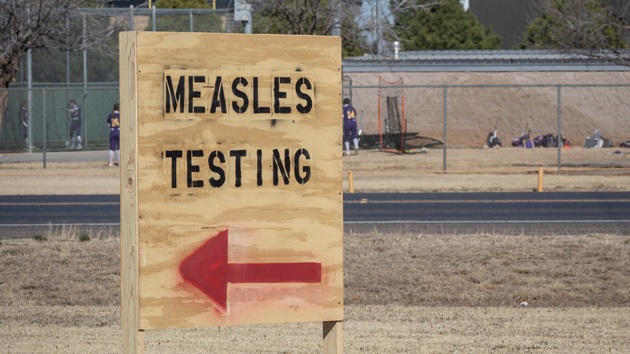
Signs point the way to measles testing in the parking lot of the Seminole Hospital District across from Wigwam Stadium on February 27, 2025 in Seminole, Texas. Jan Sonnenmair/Getty Images
(NEW YORK) — There have been at least 733 confirmed measles cases reported across the nation, the latest data from the Centers for Disease Control and Prevention showed Friday.
In just a few weeks, the United States reported four times as many cases than typically seen throughout an entire calendar year.
Before last year, which had a record breaking 2,276 cases, the U.S. averaged 180 cases annually since measles was declared eliminated in 2000.
The record numbers come as South Carolina is dealing with the largest outbreak recorded in recent memory.
Other states that have reported cases and are dealing with ongoing outbreaks include Arizona, California, Florida, Georgia, Idaho, Kentucky, Minnesota, Nebraska, North Carolina, North Dakota, Ohio, Oklahoma, Oregon, Pennsylvania, South Dakota, Utah, Virginia, Washington, and Wisconsin.
Most of the outbreaks occurring across the country are in pockets of under-vaccinated or unvaccinated communities.
The rate of kindergartners vaccinated with the measles, mumps, and rubella (MMR) vaccine has fallen from 95% in 2019 to below 93% in 2025, CDC data shows. Herd immunity, a threshold for vaccination rates that slow a virus’ ability to spread, is typically achieved at 95% vaccination rates, public health experts say.
Declining vaccination rates have left approximately 300,000 kindergarteners unprotected from measles infection.
The MMR vaccine is given in two doses, the initial shot given after the first year of life and the second shot given after the fourth year of life.
This is a developing story. Check back for updates.