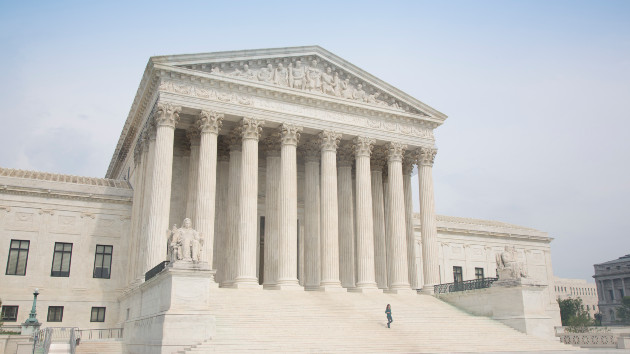
(WASHINGTON) — The Supreme Court on Monday denied a bid from former Kentucky county clerk Kim Davis to appeal her $100,000 damages suit and get the justices to revisit the landmark 2015 decision in Obergefell v Hodges.
The court did not explain its decision.
Davis gained international attention after she refused to issue a marriage license to a gay couple on religious grounds in open defiance of the high court’s ruling and was subsequently jailed for six days. A jury later awarded the couple $100,000 for emotional damages plus $260,000 for attorneys fees.
In a petition for writ of certiorari filed in August, Davis argued First Amendment protection for free exercise of religion immunizes her from personal liability for the denial of marriage licenses.
She also claimed the court’s decision in Obergefell v Hodges — which rooted marriage rights for LGBTQ couples in the 14th Amendment’s due process protections — was “legal fiction.”
Lower courts had dismissed Davis’ claims and most legal experts considered her bid a long shot.
Davis’ appeal to the Supreme Court comes as conservative opponents of marriage rights for same-sex couples pursue a renewed campaign to reverse legal precedent and allow each state to set its own policy.
This is a developing story. Please check back for updates.
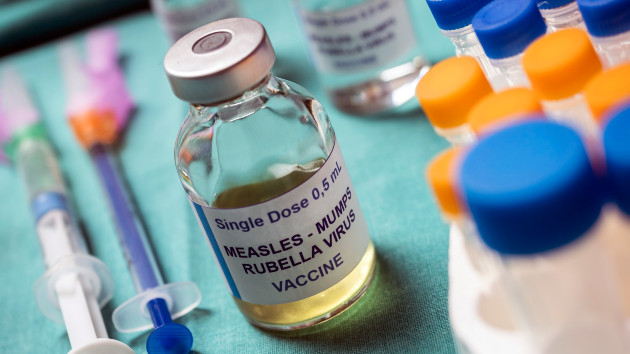
(NEW YORK) — Canada has lost its measles elimination status after struggling to contain a year-long outbreak, the country’s public health agency announced on Monday.
The Public Health Agency of Canada said it was informed of the loss by the Pan American Health Organization (PAHO) after more than 12 months of continuous measles transmission. Canada’s outbreak began in late October 2024 with more than 5,100 measles cases recorded, the health agency said.
Cases have been confirmed in most of Canada’s 10 provinces as well as the northwest territories.
Canada is able to re-establish its measles elimination status if measles transmission related to the current outbreak is “interrupted” for at least 12 months, according to health officials.
This is a developing story. Please check back for updates.
(NEW YORK) — The first snow of the season struck the Midwest this weekend, and more snow is on the way for the North in the next few days while freeze warnings hit the South.
The snow forecast
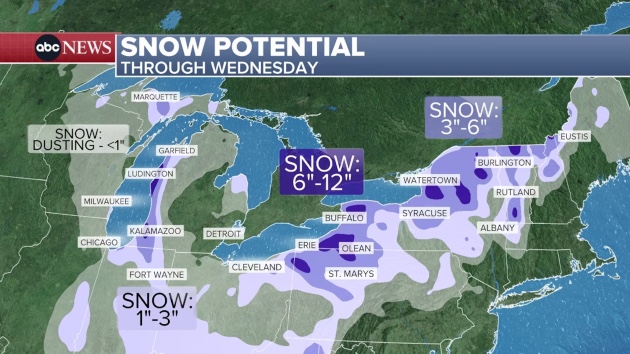
Very heavy snow — at rates of 2 inches per hour — fell overnight in Valparaiso, Indiana, with more than 9 inches of snow reported as of early Monday.
South Bend, Indiana, has reported more than 8 inches of snow, while more than 1 foot of snow has fallen in some parts of Michigan and Wisconsin.
Chicagoans are waking up to 1 to 2 inches of snow, with another brief round of light snow expected Monday morning.
This lake effect snow event will continue along eastern and southern Lake Michigan through Monday afternoon. Some areas along the eastern side of Lake Michigan could get more than 6 inches of snow on Monday.
One to 2 inches of snow is possible in Indianapolis, and even Louisville, Kentucky, could get up to 1 inch of snow.
In the Smoky Mountains, places like Gatlinburg, Tennessee, could see up to 8 inches of snow, and higher elevations could get up to 15 inches of snow and strong wind gusts.
Further east, areas downwind of Lake Erie and Lake Ontario will see major lake effect snow on Monday night.
The deep freeze forecast
Parts of the South are waking up to their coldest weather of the season on Monday, with temperatures dropping below freezing in Texas, Oklahoma and Arkansas.
Dozens of daily record low temperatures are possible across the Southeast on Tuesday morning. The temperature is forecast to plunge to 28 degrees in Wilmington, North Carolina; 31 degrees in Savannah, Georgia; 30 degrees in Mobile, Alabama; and 26 degrees in Montgomery, Alabama. Even Miami is forecast to drop to 48 degrees.
Traders work on the floor of the New York Stock Exchange (NYSE) on Nov. 7, 2025 in New York City. (Spencer Platt/Getty Images)
(NEW YORK) — Stocks rose in early trading on Monday after the Senate voted hours earlier to advance a potential deal on the government shutdown, which has weighed on economic output and cast uncertainty over markets for well over a month.
The Dow Jones Industrial Average jumped 240 points, or 0.5%, while the S&P 500 climbed 1%. The tech-heavy Nasdaq increased 1.6%.
Lawmakers in a rare Sunday session cleared a key hurdle toward potentially reopening the government by advancing a short-term funding bill by a razor-thin vote of 60-40, just meeting the threshold for it to pass.
Stocks rebounded on Monday after major indices registered a loss over the previous week, a rare blemish that hadn’t happened in four weeks prior.
The economy has shown some signs of strain during the shutdown.
The Senate is scheduled on Monday to reconvene at 11 a.m. ET to continue working toward ending the federal government shutdown, which is now in its 41st day.
There are still some procedural measures necessary for the Senate to pass a deal on the government shutdown and send it for potential approval in the Republican-controlled House.
A potential resolution of the government shutdown would restore jobs and backpay for thousands of federal employees, which is expected to provide a jolt for the U.S. economy.
The federal government would also resume the collection and release of key government day in the event of shutdown deal, allowing investors to observe monthly inflation and hiring reports.
The Federal Reserve is set to issue a decision on the level of interest rates early next month. The central bank has slashed interest rates a quarter of a percentage point at each of its last two meetings.
(WASHINGTON) — The Senate passed a key test vote Sunday night on a plan that would be a major step toward reopening the government.
After 40 days of a standoff, the bill advanced by a vote of 60-40, just barely meeting the 60 votes needed to keep it moving forward.
The vote was gaveled down to applause in the chamber at 10:49 p.m. ET.
Democratic Sens. Tim Kaine, Dick Durbin, Maggie Hassan, Jeanne Shaheen and Jacky Rosen were the Democrats who flipped to vote for this bill.
They join Democrats Catherine Cortez Masto, John Fetterman and Independent Angus King, who have been voting in favor of a government funding bill for weeks. Sen. Rand Paul was the only Republican to vote against it.
The vote was a big test to gauge whether enough Democrats would vote with Republicans to break the impasse, even though they wouldn’t get an extension of Obamacare subsidies that expire at the end of the year, which they have been holding out for through the 40-day shutdown, the longest in U.S. history.
Multiple Senate sources told ABC News’ Jonathan Karl earlier on Sunday that the bill would extend funding to Jan. 31 as well as provide funding for the remainder of the fiscal year to other agencies like the Department of Agriculture to pay for SNAP benefits and the Department of Veterans Affairs.
A senior Democratic senator told Karl there would be more than enough Democratic votes to pass this, although a majority of Democrats, including most of the leadership, voted against it.
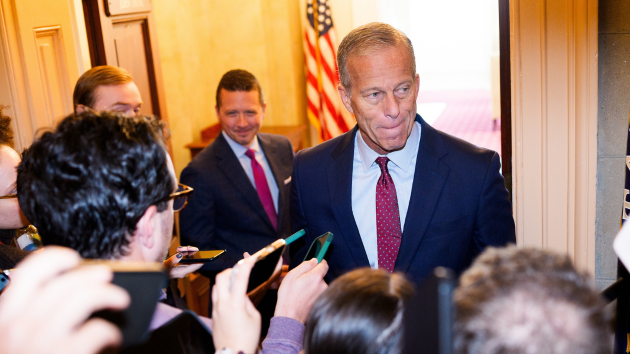
Democrats would get nothing on health care beyond a promise that the Senate will vote on extending Affordable Care Act subsidies before the end of the year — essentially what Senate Majority Leader John Thune offered more than a month ago and Democrats objected to.
Although most Senate Democrats may have opposed this bill, they were resigned to the fact that this part of the fight is over, sources said. They will take the battle over health care to the midterms and argue that Republicans refused to do anything for the millions of Americans who will see their health insurance premiums skyrocket.
Passage of the bill does not immediately reopen the government. The House will also have to approve the bill. The House has been out of session since September and Speaker Mike Johnson would need to call his members back to Washington to consider this bill before it could head to President Donald Trump’s desk.
The Senate wants to modify the bill in a number of ways. Now that the bill has passed the test vote, the debate can begin. There are some key modifications that senators want to make to the bill:
They want to change its expiration date from Nov. 21 to the end of January.
They want to attach three full-year funding bills to it. The government is usually funded through 12 full-year appropriations bills. The three that senators hope to include are Military Construction and Veterans Affairs, the Legislative Branch, and the Department of Agriculture. If lawmakers fail to fund the government by the new deadline, programs covered by these bills would be fully funded through the end of the fiscal year.
There could be the inclusion of some sort of language guaranteeing Democrats a vote by a certain date on a bill to address health care. There could also be some sort of language to reverse some of the administration’s reductions in force of government workers that occurred during the shutdown.
Unless there’s total agreement by all senators to quickly adjust the bill, it could take the Senate up to a week to process it.
(WASHINGTON) — President Donald Trump issued a sweeping pardon to key figures allegedly involved in the plan to arrange an alternate slate of electors and “expose voting fraud” during the 2020 election, according to U.S. Pardon Attorney Ed Martin.
Trump pardoned high-profile individuals allegedly involved in his attempt to overturn the election, including Rudy Giuliani, Sidney Powell, Boris Epshteyn, John Eastman and Mark Meadows — and 72 other individuals allegedly associated with the effort to challenge the 2020 election results.
The pardon, which Trump appears to have signed on Friday, covers each of the president’s co-defendants who were charged in Georgia for a sweeping scheme to overturn election results.
Four of the pardon recipients pleaded guilty in the Georgia case.
“This proclamation ends a grave national injustice perpetrated upon the American people following the 2020 Presidential Election and continues the process of national reconciliation,” the pardon says.
The pardon language explicitly states that it does not apply to Trump himself. “This pardon does not apply to the president of the United States,” according to the pardon.
(NEW YORK) — For the first time in more than two decades, the Pentagon has begun sending conventional ground forces to Panama to train in the jungle there, returning U.S. soldiers and Marines to a three-week course once called the “Green Hell” because of its similarities to Vietnam.
The training program at Base Aeronaval Cristóbal Colón, formerly known as Fort Sherman, is relatively small in scope but is expected to ramp up over the next year, according to one defense official.
The program began earlier this year and is not intended to prepare troops for a potential mission, including inside Venezuela, the official said.
Still, the military’s interest in jungle warfare in Latin America is noteworthy given Trump’s heightened focus there. Since taking office, Trump has vowed to “take back” the Panama Canal and repeatedly threatened to attack Venezuela because of its alleged role in transiting illegal narcotics.
“If you can train and fight in one of the most difficult and challenging locations in the world, you build a really lethal, effective force,” the defense official said of the rationale behind the new training program.
Alex Plitsas, a former Pentagon official and senior fellow at The Atlantic Council, said the new training course wouldn’t likely play a role in potential operations inside Venezuela. The training effort appears to be more about building Panama’s capacity to handle security threats in the region.
But the move signals a shift in priorities by the Trump administration, he said.
“It’s an expansion of an existing military relationship, but it’s not happening in a vacuum,” Plitsas said. “It’s happening as a broader change in policy. There’s a renewed interest in South America, where the president sees the drug flow to the United States as a national security issue with the intention of potential military action.”
Jungle training hasn’t been a priority for the military since 9/11, when the nation’s focus shifted to counterterrorism operations in the Middle East. The Defense Department in recent years has relied on a smaller Army jungle training center in Hawaii and at a Marine Corps site in Okinawa, Japan.
During the Vietnam War, however, Fort Sherman was considered a prime location where most troops could hone their jungle survival skills before shipping off to war.
Conditions at the Panamanian training site are considered among the harshest in the world, including venomous snakes and several layers of thick, towering vegetation that can make it difficult to operate communications and night-vision equipment or evacuate wounded personnel.
By 1999, the training site shuttered and the last of the U.S. military departed Panama as part of an agreement ceding U.S. control of the Panama Canal.
Shortly after taking office, though, Trump expressed renewed interest in the region, declaring the U.S. would be “reclaiming” the Panama Canal. That effort has since been couched by Pentagon officials as a renewed “partnership” with Panama to prevent Chinese influence over the canal, which the U.S. relies on heavily for shipping.
Trump also has overseen an unprecedented buildup of U.S. troops to the region, deploying 10,000 troops and, more recently, the USS Gerald R. Ford, the world’s largest aircraft carrier. The public display of force appears to be a kind of pressure campaign aimed at forcing out Venezuelan President Nicolás Maduro.
By August, the military had set up the “Combined Jungle Operations Training Course” with Marines and Panamanian forces training as part of a pilot program. A military spokesperson said there have since been 46 graduates of the three-week course: 18 Marines, one Army soldier and 27 personnel from Panama’s National Aeronaval Service, National Border Service and National Police.
According to the Defense official, the Army plans to ramp up training over the next year, eventually sending in platoons of some 40 soldiers at a time to train.
Steve Ganyard, a retired Marine Corps colonel and ABC contributor, said the renewed interest in Panama is likely a practical one, but it also can be used to send a message.
“From a practical perspective, it’s easier to get to Panama than Okinawa. And the jungles of Central and South America have their own unique challenges,” he said. “That said, no doubt a message is being sent to Maduro by conducting combat training in his neighborhood.”
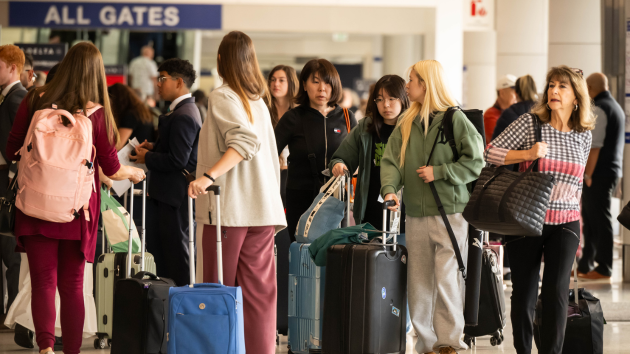
(NEW YORK) — More than 1,500 flights were canceled across the country early on Monday amid the Federal Aviation Administration’s limiting capacity at 40 major U.S. airports.
Another 881 flights were expected to be delayed on Monday, according to FlightAware, an airline traffic tracker, which also logged some 1,509 cancellations for flights within, into or out of the United States.
The travel chaos, which comes amid a record-length shutdown of the federal government, was expected to continue into Tuesday, according to the tracker. At leat 987 flights that had been planned for Tuesday were canceled, FlightAware said.
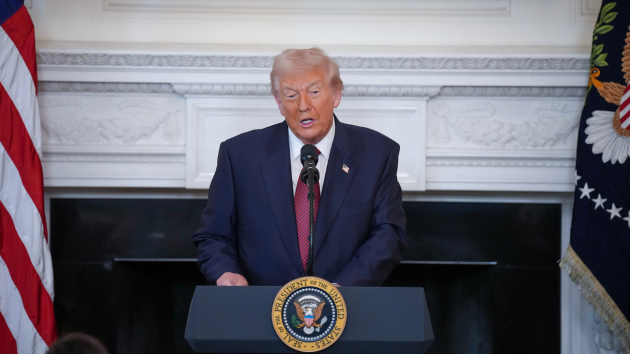
(WASHINGTON) — President Donald Trump on Sunday claimed that a “dividend of at least $2000 a person” will be paid to all Americans except for “high-income people,” saying the country is now wealthy as a result of his tariff policies.
“People that are against Tariffs are FOOLS! We are now the Richest, Most Respected Country In the World, With Almost No Inflation, and A Record Stock Market Price. 401k’s are Highest EVER,” the president wrote.
“A dividend of at least $2000 a person (not including high income people!) will be paid to everyone,” he added.
In an interview on ABC News’ “This Week” on Sunday, Treasury Secretary Scott Bessent said that he had not spoken with Trump about the proposed dividend.
Calling opponents to tariffs “fools,” Trump claimed “A dividend of at least $2000 a person (not including high income people!) will be paid to everyone.”
“The $2,000 dividend could come in lots of forms, in lots of ways, George,” Bessent told anchor George Stephanopoulos. “You know, it could be just the tax decreases that we are seeing on the president’s agenda — you know, no tax on tips, no tax on overtime, no tax on Social Security, deductibility of auto loans.”
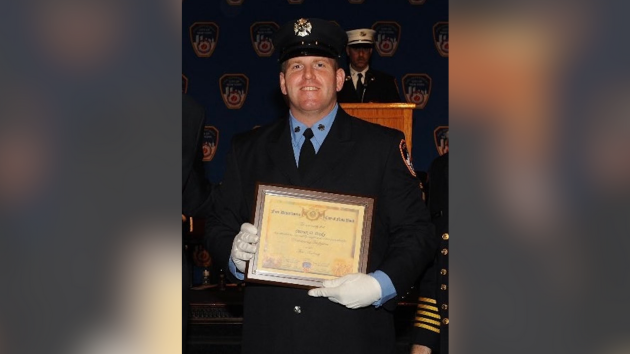
(NEW YORK) — Patrick Brady, a New York City firefighter, had a “medical episode” while battling a five-alarm fire in Brooklyn on Saturday and later died at the hospital, officials said.
Brady, 42, was an 11-year veteran of the department, FDNY Commissioner Robert S. Tucker said in a joint press release with Mayor Eric Adams.
“Firefighter Patrick Brady gave his life protecting the city we all love; there is no sacrifice that is more selfless than the actions that took place this evening,” Adams said in a statement.
Brady had been battling a fire on the roof of 9407 Kings Highway in Brooklyn on Saturday when he had a “medical episode” and went into cardiac arrest, the department said. He was treated on the scene and then rushed to Brookdale hospital, where he later died, officials said.
“A resident of Queens, he is survived by his wife, Kara, and his two brothers, Jimmy and Brian, who are both FDNY Firefighters,” the department said. Other members of his family, including cousins and uncles, are also FDNY Firefighters, according to the department.
“This family is a firefighter family,” Adams said during a somber press conference held at Brookdale hospital in Brooklyn early Sunday morning.
“They’ve been dedicated to protecting the lives of New Yorkers, and we will all cherish Patrick’s memory,” Adams added.