Traders work on the floor of the New York Stock Exchange (NYSE) in New York City. (Photo by Spencer Platt/Getty Images)
(NEW YORK) — The Dow Jones Industrial Average plummeted more than 650 points in early trading on Friday as the Iran war continued to spike oil prices.
The Dow fell 657 points, or 1.3%, while the S&P 500 dropped 1.2%. The tech-heavy Nasdaq declined 1%.
In a post on social media on Friday morning, President Donald Trump appeared to rule out a compromise with Iran.
Trump said there would be “no deal with Iran except UNCONDITIONAL SURRENDER!”
Oil prices soared as traders feared a prolonged blockade of the Strait of Hormuz, a trading route that facilitates the transport of about one-fifth of global oil supply.
U.S. crude oil prices topped $88 on Friday, marking a staggering 35% increase from a week earlier.
The stock selloff on Friday extended losses from a day earlier, when the Dow closed down 785 points.
This is a developing story. Please check back for updates.
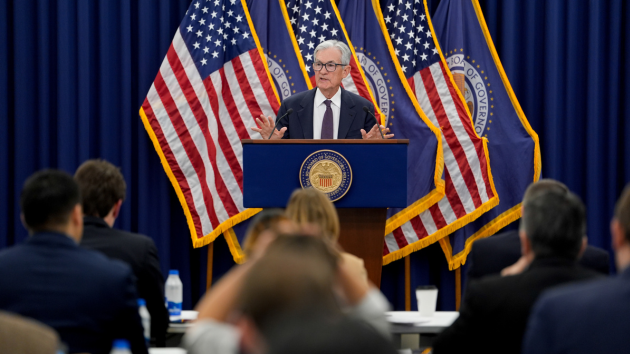
Jerome Powell, chairman of the US Federal Reserve, speaks during a news conference following a Federal Open Market Committee (FOMC) meeting in Washington, DC, US, on Wednesday, Jan. 28, 2026. (Photographer: Kent Nishimura/Bloomberg via Getty Images)
(NEW YORK) — The U.S. economy lost jobs in February, marking a major reversal of fortunes for the labor market and nearly erasing all of the job gains delivered a month earlier, government data on Friday showed. The reading came in well below economists’ expectations.
The U.S. lost 92,000 jobs in February, according to the report from the U.S. Bureau of Labor Statistics (BLS), which marked a significant dropoff from 130,000 jobs added in the previous month.
The unemployment rate ticked up from 4.3% in January to 4.4% in February, the BLS said. Unemployment remains low by historical standards.
The new jobs report arrived as markets roil and gasoline prices surge in response to the war with Iran. The Middle East conflict cast fresh uncertainty over the economic outlook.
A hiring cooldown last year prompted interest rate cuts at the Federal Reserve and concern among some observers about the nation’s economic prospects. The U.S. added an average of about 15,000 jobs per month in 2025, U.S. Bureau of Labor Statistics data showed.
Sluggish hiring has coincided with elevated inflation, threatening a period of “stagflation.”
Those economic headwinds helped set the conditions before the outbreak of war with Iran, which spiked oil prices and risked price increases for a host of diesel-fuel transported goods.
The Dow Jones Industrial Average plunged 785 points on Thursday as U.S. crude prices rose to their highest level since June.
Still, the overall economic picture remains mixed.
A government report in February on gross domestic product (GDP) showed the economy grew at a tepid annualized pace of 1.4% over the final three months of 2025. That reading indicated a dramatic cooldown from the strong annualized growth of 4.4% recorded in the previous quarter, U.S. Commerce Department data showed.
Price increases, meanwhile, have softened. In January, inflation fell to 2.4%, its lowest level in nine months. It remains slightly higher than the Federal Reserve’s target rate of 2%.
The Iran war threatens to slow U.S. economic growth since oil-driven price increases could weigh on consumers and businesses, analysts previously told ABC News.
The potential combination of higher inflation and slower growth could also pose a challenge for the Fed, putting pressure on both sides of its dual mandate to manage prices and maintain maximum employment.
If the Fed opts to lower borrowing costs, it could spur growth but risk higher inflation. On the other hand, the choice to raise interest rates may slow price increases but risks a cooldown of economic performance.
The central bank held interest rates steady at its most recent meeting in January, ending a string of three consecutive quarter-point rate cuts. Policymakers will make their next interest-rate decision on March 18.
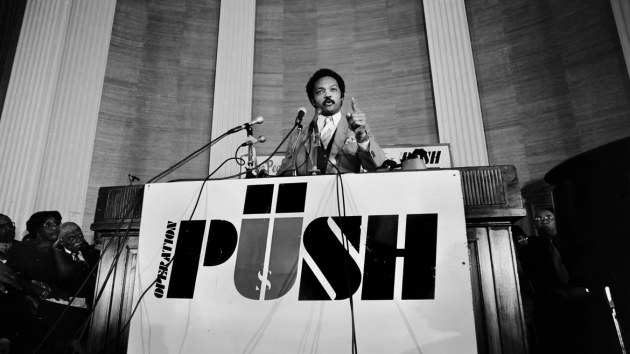
American religious & Civil Rights leader and politician Reverend Jesse Jackson points as he speaks from a lectern at the headquarters of Operation PUSH (People United to Save Humanity), Chicago, Illinois, July 17, 1981. (Photo by Antonio Dickey/Getty Images)
(NEW YORK) — Three former American presidents and a former vice president are set to honor the late Rev. Jesse Jackson at a memorial service in Chicago on Friday morning – a “Celebration of Hope” that is being held by the family of the pioneering civil rights leader, who died on Feb. 17 at the age of 86.
Former Presidents Bill Clinton, Barack Obama and Joe Biden and former Vice President Kamala Harris are expected to deliver remarks at the homegoing services on Friday, according to the Jackson family. Former Secretary of State Hillary Clinton and former first lady Jill Biden are also expected to attend the services, the family said.
ABC News reached out to representatives for Clinton, Obama, Biden and Harris for further comment.
“Jesse Jackson, Sr. marched beside Martin Luther King, Jr. for civil rights for all people. He traveled the world fighting economic and gender inequity. Until his last days, he fought for better healthcare, education, and peace in Chicago, Illinois, the United States, and beyond,” the Jackson family said in a statement on Wednesday. “I hope everyone who joins us to honor his legacy will also continue to champion these causes. That would be the best possible tribute and celebration they could offer.”
Friday’s public homegoing service will take place at the House of Hope event center. A private service will take place on Saturday morning in Chicago.
The services come after thousands paid their respects to Jackson as he lay in honor at the headquarters of the Rainbow PUSH Coalition in Chicago last week. He was also honored in his birth state of South Carolina on Monday, where he laid in state at the state house in Columbia.
“Jesse Jackson, Sr. changed the United States — and the world,” the Jackson family said in a statement. “We are deeply honored to know there are people from every walk of life who want to join us to pay their respects.”
Other scheduled speakers at the service on Friday include Chicago Mayor Brandon Johnson, Illinois Gov. J.B. Pritzker, Rep. Maxine Waters, D-Ill., and Chicago Cubs owner Tom Ricketts. Singer and actress Jennifer Hudson and gospel legends Bebe Winans and Pastor Marvin Winans are also expected to perform on Friday. Stevie Wonder is set to perform at the private service on Saturday.
Jackson died after experiencing health issues over the past several years, including a battle with Parkinson’s disease and progressive supranuclear palsy (PSP), a rare neurological disorder.
Jackson’s children honored their father’s legacy at a press conference last month, reflecting on his 1984 and 1988 presidential runs and how he dedicated his career to advancing economic justice and building political power for Black Americans.
Jackson’s son, Jesse Jackson, Jr., called for unity in the Feb. 18 press conference ahead of his father’s funeral services.
“Do not bring your politics out of respect to Rev. Jesse Jackson and the life that he lived to these home going services,” he said. “Come respectful and come to say thank you, but these homegoing services are welcome to all Democrat, Republican, liberal and conservative, right wing, left wing, because his life is broad enough to cover the full spectrum of what it means to be an American.”
In this U.S. Navy released handout, Arleigh Burke-class guided-missile destroyer USS Thomas Hudner (DDG 116) fires a Tomahawk land attack missile in support of Operation Epic Fury, on March 1, 2026 at Sea. (Photo by U.S. Navy via Getty Images)
(NEW YORK) — The sinking of an Iranian warship Tuesday by a U.S. submarine thousands of miles from the war zone in international waters raises questions about whether the attack was legal under the rules of war.
Military law experts said the Iranian ship, which was in the Indian Ocean in international waters off Sri Lanka, would have been a lawful target had the U.S. declared war. The fact that it hasn’t done so makes the issue a murky one.
Iranian Foreign Minister Abbas Araghchi called the attack an “atrocity.”
“The U.S. will come to bitterly regret precedent it has set,” he said.
Experts say the incident highlights the reason that a declaration of war by Congress is needed for the growing conflict, which has involved more than 12 countries, as Iran continues launching drones and missiles at countries beyond the Persian Gulf region.
The House of Representatives on Thursday voted against a war powers resolution. Similar legislation failed Wednesday in the Senate. Both votes largely followed party lines.
The submarine strike in international waters “underscores why Congress should have approved this in the first place,” said Retired Lt. Col. Rachel VanLandingham, a former judge advocate general in the U.S. Air Force, “because this is a war [in which they’re] going to go after the Iranian Navy,” even when naval assets are outside the Middle East.
“The Iranian Navy is not small, right? It could be in places like outside of Sri Lanka and international water.”
Under the laws of armed conflict, were the U.S. and Iran in a declared war, the warship would represent a lawful target, former U.S. government lawyers told ABC News.
The issue with the submarine’s attacking the warship in international waters, VanLandingham said, was “political” in nature and not legal.
“When you’re going to have such global implications — that’s one of the reasons the founding fathers said Congress gets to decide wars of choice,” she said.
Brian Finucane, who was attorney-adviser at the State Department from 2011 to 2021, also said the submarine attack would have been lawful if the conflict was authorized.
According to Finucane, the U.S. would have an obligation under the Geneva Conventions to conduct search and rescue operations for survivors of the sinking.
A source familiar with Tuesday’s operation said the submarine took measures to support life-saving efforts before and after the ship sank in line with international law.
The military’s compliance with that international law was called into question when a second strike on an alleged drug boat killed survivors in international waters in the Caribbean Sea in September.
“The fundamental legal problems under both U.S. and international law” of the submarine engagement, Finucane said, “relate to the underlying use of force in this war against Iran.”
Authorization by Congress for the war is required by law because the U.S. offensive against Iran is not a response to an imminent threat, experts said.
President Donald Trump and his administration have said Iran posed such a threat. Secretary Marco Rubio said the threat became more imminent because Israel planned to strike Iran and Iran would retailiate against Israel and the U.S.
While the president has called the conflict a “war,” senior officials in his administration — and top leadership in Congress — have refrained from using the word.
Speaker of the House Mike Johnson said Wednesday the U.S. “is not at war now.”
The Pentagon’s top policy official, asked whether the U.S. was at war with Iran in a congressional hearing Thursday, would not use the term.
“I think we’re in a military action at this point,” said Undersecretary of Defense for Policy Elbridge Colby. “I will leave to Congress and lawyers from the administration, et cetera, to determine.”
Ambiguity about the conflict’s label from across the government comes as Pentagon officials say the conflict will only “accelerate” in intensity — and potentially grow in scope.
The U.S. military mission is in a “throttle-up” posture, said Defense Secretary Pete Hegseth, who would not confine the campaign to a time limit.
“The only limits we have in this is President Trump’s desire to achieve specific effects on behalf of the American people,” Hegseth said.
Job applicant with resume (Narisara Nami/Getty Images)
(NEW YORK) — The U.S. economy lost jobs in February, marking a major reversal of fortunes for the labor market and nearly erasing all of the job gains delivered a month earlier, government data on Friday showed. The reading came in well below economists’ expectations.
The U.S. lost 92,000 jobs in February, according to the report from the U.S. Bureau of Labor Statistics (BLS), which marked a significant dropoff from 130,000 jobs added in the previous month.
The unemployment rate ticked up from 4.3% in January to 4.4% in February, the BLS said. Unemployment remains low by historical standards.
The new jobs report arrived as markets roil and gasoline prices surge in response to the war with Iran. The Middle East conflict cast fresh uncertainty over the economic outlook.
A hiring cooldown last year prompted interest rate cuts at the Federal Reserve and concern among some observers about the nation’s economic prospects. The U.S. added an average of about 15,000 jobs per month in 2025, U.S. Bureau of Labor Statistics data showed.
Sluggish hiring has coincided with elevated inflation, threatening a period of “stagflation.”
Those economic headwinds helped set the conditions before the outbreak of war with Iran, which spiked oil prices and risked price increases for a host of diesel-fuel transported goods.
The Dow Jones Industrial Average plunged 785 points on Thursday as U.S. crude prices rose to their highest level since June.
Still, the overall economic picture remains mixed.
A government report in February on gross domestic product (GDP) showed the economy grew at a tepid annualized pace of 1.4% over the final three months of 2025. That reading indicated a dramatic cooldown from the strong annualized growth of 4.4% recorded in the previous quarter, U.S. Commerce Department data showed.
Price increases, meanwhile, have softened. In January, inflation fell to 2.4%, its lowest level in nine months. It remains slightly higher than the Federal Reserve’s target rate of 2%.
The Iran war threatens to slow U.S. economic growth since oil-driven price increases could weigh on consumers and businesses, analysts previously told ABC News.
The potential combination of higher inflation and slower growth could also pose a challenge for the Fed, putting pressure on both sides of its dual mandate to manage prices and maintain maximum employment.
If the Fed opts to lower borrowing costs, it could spur growth but risk higher inflation. On the other hand, the choice to raise interest rates may slow price increases but risks a cooldown of economic performance.
The central bank held interest rates steady at its most recent meeting in January, ending a string of three consecutive quarter-point rate cuts. Policymakers will make their next interest-rate decision on March 18.
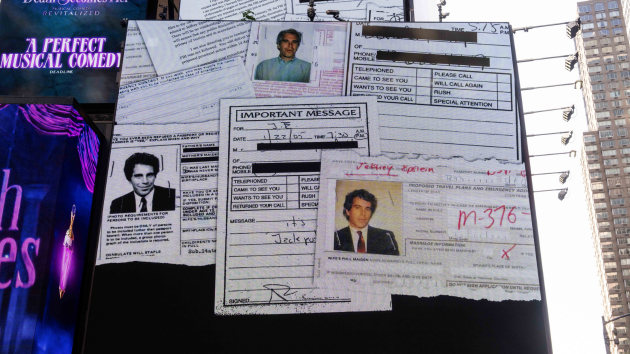
A billboard in Times Square calls for the release of the Epstein Files on July 23, 2025 in New York City. (Photo by Adam Gray/Getty Images)
(WASHINGTON) — The Department of Justice on Thursday released three previously withheld FBI interview reports from 2019 related to a woman who made uncorroborated allegations that she was abused by Donald Trump in the 1980s, when she was a minor.
In a statement on social media, the Department of Justice said the interview summaries — known as FBI 302 reports — were initially withheld from the January release of millions of pages of DOJ documents related to Jeffrey Epstein because they were believed to be duplicative of other documents.
“What we found through extensive review is that a published 302 — additionally disclosed in a published spreadsheet — had subsequent 302s that were coded as ‘duplicative.’ After this was brought to our attention, we reviewed the entire batch with the similar coding and discovered 15 documents were incorrectly coded as duplicative,” the DOJ account said.
The statement did not appear to explain why, beyond possible human error, the records were marked as duplicative. As of Thursday evening, the DOJ database still does not include the handwritten notes from the interviews themselves.
According to the reports, the FBI interviewed the woman four times between July and October 2019. During each of the interviews with the woman, whose identity is redacted, she made allegations of abuse against Epstein.
In her second interview with federal investigators, she claimed that Epstein once took her to either New York or New Jersey where he introduced to Trump when she was between the ages of 13 and 15 years old. According to the report, she claimed Trump abused her during that trip.
In the fourth interview in October 2019, the woman declined to provide additional details about the alleged interaction with Trump when asked by agents, according to the summary of that interview.
Her statements to the federal agents allege that the incident with Trump took place in the early-to-mid 1980s — a period when Epstein and Trump did not appear to be in contact.
Trump has denied any wrongdoing related to his relationship with Epstein or any knowledge of Epstein’s criminal activity.
In her initial interview with the FBI, the woman claims she was sexually abused by Epstein after being hired for what she thought was a babysitting job, but she said there were no children present. Similar abuse occurred, she said, on several more occasions, according to the summary of the first report, which was released by the DOJ in January.
The witness said multiple alleged incidents with Epstein took place in South Carolina, a location not known to have been frequented by Epstein. The timing of the allegations would place them two decades before law enforcement in Florida began investigating Epstein for sexual exploitation of minors.
Before the additional records were released Thursday, Congressional Democrats had accused the Justice Department of illegally withholding the documents to protect the president.
“It is unconscionable, it is illegal, and [Attorney General] Pam Bondi and the president need to answer where those files are,” California Democrat Robert Garcia, D-Calif. said last week.
In a statement in January, the Department of Justice said that some investigative files in the massive tranche released would include unsubstantiated claims about Trump.
“Some of the documents contain untrue and sensationalist claims against President Trump that were submitted to the FBI right before the 2020 election. To be clear, the claims are unfounded and false, and if they have a shred of credibility, they certainly would have been weaponized against President Trump already,” the statement said.
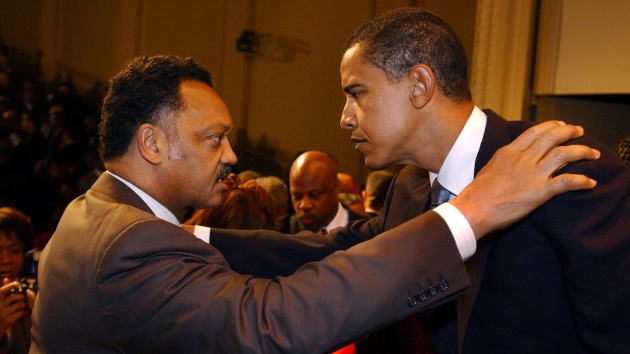
Rev. Jesse Jackson has a word with Sen. Barrack Obama, after a Congressional Black Caucus ceremony at the Library of Congress, in which members where sworn into the CBC for the109th Congress, Jan. 4, 2005. (Tom Williams/CQ-Roll Call via Getty Images)
(CHICAGO) — Three former American presidents and a former vice president are set to honor the late Rev. Jesse Jackson at a memorial service in Chicago on Friday morning – a “Celebration of Hope” that is being held by the family of the pioneering civil rights leader, who died on Feb. 17 at the age of 86.
Former Presidents Bill Clinton, Barack Obama and Joe Biden and former Vice President Kamala Harris are expected to deliver remarks at the homegoing services on Friday, according to the Jackson family. Former Secretary of State Hillary Clinton and former first lady Jill Biden are also expected to attend the services, the family said.
ABC News reached out to representatives for Clinton, Obama, Biden and Harris for further comment.
“Jesse Jackson, Sr. marched beside Martin Luther King, Jr. for civil rights for all people. He traveled the world fighting economic and gender inequity. Until his last days, he fought for better healthcare, education, and peace in Chicago, Illinois, the United States, and beyond,” the Jackson family said in a statement on Wednesday. “I hope everyone who joins us to honor his legacy will also continue to champion these causes. That would be the best possible tribute and celebration they could offer.”
Friday’s public homegoing service will take place at the House of Hope event center. A private service will take place on Saturday morning in Chicago.
The services come after thousands paid their respects to Jackson as he lay in honor at the headquarters of the Rainbow PUSH Coalition in Chicago last week. He was also honored in his birth state of South Carolina on Monday, where he laid in state at the state house in Columbia.
“Jesse Jackson, Sr. changed the United States — and the world,” the Jackson family said in a statement. “We are deeply honored to know there are people from every walk of life who want to join us to pay their respects.”
Other scheduled speakers at the service on Friday include Chicago Mayor Brandon Johnson, Illinois Gov. J.B. Pritzker, Rep. Maxine Waters, D-Ill., and Chicago Cubs owner Tom Ricketts. Singer and actress Jennifer Hudson and gospel legends Bebe Winans and Pastor Marvin Winans are also expected to perform on Friday. Stevie Wonder is set to perform at the private service on Saturday.
Jackson died after experiencing health issues over the past several years, including a battle with Parkinson’s disease and progressive supranuclear palsy (PSP), a rare neurological disorder.
Jackson’s children honored their father’s legacy at a press conference last month, reflecting on his 1984 and 1988 presidential runs and how he dedicated his career to advancing economic justice and building political power for Black Americans.
Jackson’s son, Jesse Jackson, Jr., called for unity in the Feb. 18 press conference ahead of his father’s funeral services.
“Do not bring your politics out of respect to Rev. Jesse Jackson and the life that he lived to these home going services,” he said. “Come respectful and come to say thank you, but these homegoing services are welcome to all Democrat, Republican, liberal and conservative, right wing, left wing, because his life is broad enough to cover the full spectrum of what it means to be an American.”
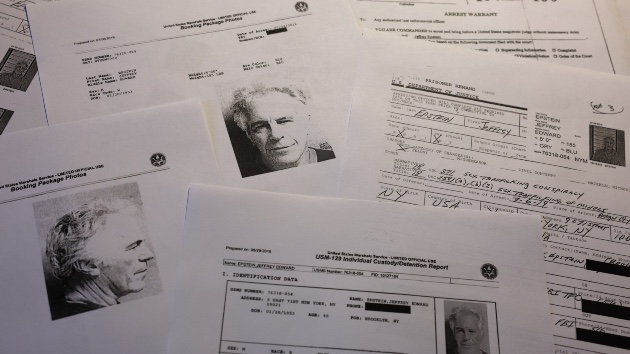
Printed documents available at Epstein Library on the U.S. Department of Justice website are seen in this illustration photo taken in Krakow, Poland on February 6, 2026. (Photo by Jakub Porzycki/NurPhoto via Getty Images)
(NEW YORK) — The Department of Justice on Thursday released three previously withheld FBI interview reports from 2019 related to a woman who made uncorroborated allegations that she was abused by Donald Trump in the 1980s, when she was a minor.
In a statement on social media, the Department of Justice said the interview summaries — known as FBI 302 reports — were initially withheld from the January release of millions of pages of DOJ documents related to Jeffrey Epstein because they were believed to be duplicative of other documents.
“What we found through extensive review is that a published 302 — additionally disclosed in a published spreadsheet — had subsequent 302s that were coded as ‘duplicative.’ After this was brought to our attention, we reviewed the entire batch with the similar coding and discovered 15 documents were incorrectly coded as duplicative,” the DOJ account said.
The statement did not appear to explain why, beyond possible human error, the records were marked as duplicative. As of Thursday evening, the DOJ database still does not include the handwritten notes from the interviews themselves.
According to the reports, the FBI interviewed the woman four times between July and October 2019. During each of the interviews with the woman, whose identity is redacted, she made allegations of abuse against Epstein.
In her second interview with federal investigators, she claimed that Epstein once took her to either New York or New Jersey where he introduced to Trump when she was between the ages of 13 and 15 years old. According to the report, she claimed Trump abused her during that trip.
In the fourth interview in October 2019, the woman declined to provide additional details about the alleged interaction with Trump when asked by agents, according to the summary of that interview.
Her statements to the federal agents allege that the incident with Trump took place in the early-to-mid 1980s — a period when Epstein and Trump did not appear to be in contact.
Trump has denied any wrongdoing related to his relationship with Epstein or any knowledge of Epstein’s criminal activity.
In her initial interview with the FBI, the woman claims she was sexually abused by Epstein after being hired for what she thought was a babysitting job, but she said there were no children present. Similar abuse occurred, she said, on several more occasions, according to the summary of the first report, which was released by the DOJ in January.
The witness said multiple alleged incidents with Epstein took place in South Carolina, a location not known to have been frequented by Epstein. The timing of the allegations would place them two decades before law enforcement in Florida began investigating Epstein for sexual exploitation of minors.
Before the additional records were released Thursday, Congressional Democrats had accused the Justice Department of illegally withholding the documents to protect the president.
“It is unconscionable, it is illegal, and [Attorney General] Pam Bondi and the president need to answer where those files are,” California Democrat Robert Garcia, D-Calif. said last week.
In a statement in January, the Department of Justice said that some investigative files in the massive tranche released would include unsubstantiated claims about Trump.
“Some of the documents contain untrue and sensationalist claims against President Trump that were submitted to the FBI right before the 2020 election. To be clear, the claims are unfounded and false, and if they have a shred of credibility, they certainly would have been weaponized against President Trump already,” the statement said.
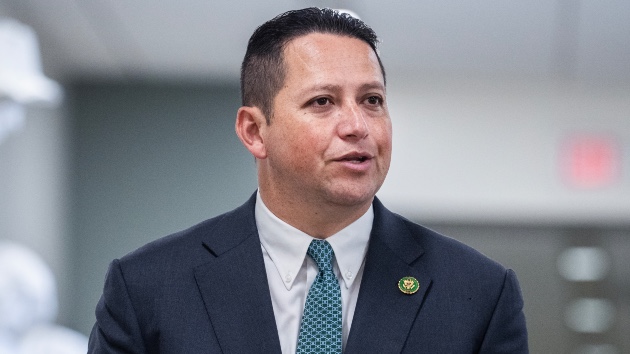
Rep. Tony Gonzales, R-Texas, makes his way to House votes in the U.S. Capitol on Wednesday, June 5, 2024. (Tom Williams/CQ-Roll Call, Inc via Getty Images)
(WASHINGTON) — Embattled Rep. Tony Gonzales announced Thursday evening that he will no longer seek reelection in Texas’ 23rd Congressional District, following calls from House Republican leadership to drop out of the race after the congressman admitted to having a relationship with a staffer.
“After deep reflection and with the support of my loving family, I have decided not to seek re-election while serving out the rest of this Congress with the same commitment I’ve always had to my district,” Gonzales wrote in a statement on X. “Through the rest of my term, I will continue fighting for my constituents, for whom I am eternally grateful.”
Gonzales’ statement touted various accomplishments from his three terms in Congress, with an emphasis on his “absolute dedication” to the U.S.
“My philosophy has never changed: do as much as you can, and always fight for the greater good,” he wrote.
Gonzales’ announcement came the same day House Republican leadership on Thursday asked Gonzales to drop out of the race.
“The Ethics Committee has announced an investigation into Congressman Tony Gonzales’s conduct, and we urge them to act expeditiously,” House Speaker Mike Johnson, Majority Leader Steve Scalise, Republican Whip Tom Emmer and Republican Conference Chairwoman Lisa McClain said in a joint statement.
“Congressman Gonzales has said he will fully cooperate with the investigation. We have encouraged him to address these very serious allegations directly with his constituents and his colleagues. In the meantime, Leadership has asked Congressman Gonzales to withdraw from his race for re-election,” they added.
Johnson told reporters later that the GOP’s call for Gonzales to drop his reelection bid — rather than resign from Congress — amounts to “a death penalty” for Gonzales.
“Leadership put out a statement. It speaks for itself. We’ve encouraged him to drop out of the race for reelection,” Johnson said. “Politically, that’s a death penalty.”
Gonzales on Tuesday night advanced to a runoff primary election on May 26 against conservative activist Brandon Herrera.
The next day, Gonzales spoke with talk show host Joe “Pags” Pagliarulo who asked if he had a relationship with his district director, Regina Santos-Aviles, who later died by suicide.
“Was there a relationship with this young lady, um, who was working in your office?” Pagliarulo asked Gonzales at the outset of the interview on Wednesday.
“I made a mistake, and I had a lapse in judgment, and there was a lack of faith, and I take full responsibility for those actions,” Gonzales answered. “Since then, I’ve reconciled with my wife Angel. I’ve asked God to forgive me, which he has. And my faith is as strong as ever. When you make mistakes like this, you know, it’s never easy. It humbles you.”
Gonzales said he looks forward to the House Ethics Committee’s investigation into the allegations.
The panel said it has established an investigative subcommittee to examine allegations that Gonzales “may have: (1) engaged in sexual misconduct towards an individual employed in his congressional office; and/or (2) discriminated unfairly by dispensing special favors or privileges.”
“I appreciate the opportunity to be able to provide all the facts and all the details that lead to exactly what occurred in the entire situation,” said Gonzales, who has declined to withdraw from his reelection bid.
The congressman had previously denied the relationship with Santos-Aviles.
Despite now admitting his relationship with her, Gonzales distanced himself from her death, claiming that he had not spoken with her since June of 2024, before she ultimately died the following year.
“You know, the facts are, I hadn’t spoken with Ms. Santos since June of 2024. She passed September of 2025. That was over a year ago. So, this is what I think is important as well — is this whole notion that I had anything to do with her death. I had absolutely nothing to do with her tragic passing. And in fact, I was shocked just as much as everyone else,” Gonzales said.
Congressional payroll records show that Santos-Aviles was still employed in Gonzales’ office on the date of her death, Sept. 14, 2025.
Gonzales insisted that Santos-Aviles was treated well in his office and showed no signs of distress leading up to her death, claiming that she was “thriving at work.”
“I’ve always highlighted the great work that she had done for our office and the community,” Gonzales said, before pinning blame on the media coverage of the matter.
ABC News previously obtained explicit text messages from May of 2024 appearing to show Gonzales repeatedly request photos and ask Santos-Aviles about her sexual preferences.
Asked by Pagliarulo about the text messages, Gonzales insisted that there is “a lot more to the story that isn’t out there,” without commenting further on the content of any other communications with Santos-Aviles.
Asked if he understands the issues surrounding a boss having a relationship with his subordinate, Gonzales acknowledged that it’s an “important” and “serious issue that we have to talk about,” before again emphasizing the need for “all the facts.”
ABC News has obtained the Uvalde police report on Santos-Aviles death through a records request, but the report has not been posted publicly.
During Wednesday’s interview, Gonzales brushed off concerns from fellow House Republicans that have called for his resignation, saying, “you’re always going to have political enemies.”
“I don’t speak with those two on a regular basis, that we operate in different … groups, if you will,” Gonzales said, referring to Republican Reps. Nancy Mace and Rep. Anna Paulina Luna, who have voiced concerns over the allegations against him. “But what I will say is you can never let those people slow you down in any form or fashion.”
Gonzales, who maintains President Donald Trump’s endorsement despite the allegations and ethics inquiry, said he has not spoken directly with Trump about the matter.
“I appreciate the president’s support,” Gonzales said.
“I was just actually in Corpus [Christi] when he came down to Texas. That was an incredible event. Everybody was energized,” Gonzales added, referring to the president’s trip last week where Trump gave the congressman a shoutout and congratulated him before the crowd.
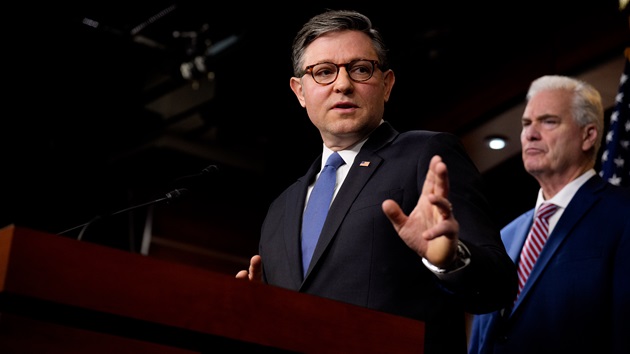
Speaker of the House Mike Johnson (R-LA) speaks to members of the media during a news conference on Capitol Hill on March 4, 2026 in Washington, DC. (Andrew Harnik/Getty Images)
(WASHINGTON) — The House failed to adopt a war powers resolution that attempted to curtail President Donald Trump’s military actions in Iran.
It failed by a vote of 212-219. Republican Reps. Thomas Massie and Warren Davidson bucked GOP leaders by voting in favor; four Democrats voted against the resolution, including Reps. Greg Landsman, Henry Cuellar and Jared Golden.
The resolution, which only expresses the sentiment of Congress, called on the president to terminate the use of U.S. armed forces in hostilities against Iran or any part of the Iranian government or military unless a declaration of war or authorization to use military force is enacted.
The measure was non-binding and not subject to the president’s signature or veto.
Speaker Mike Johnson argued Wednesday that the United States is “not at war” but only engaged in a “defensive operation” in Iran.
“We’re not at war right now,” Johnson told reporters at the Capitol. “We’re in — four days into a very specific, clear mission and operation.”
Later on Wednesday, Trump contradicted Johnson, repeatedly referring to the conflict in Iran as a “war” hours after Johnson said it wasn’t.
Sitting next to Johnson during a roundtable on energy prices, Trump said “we’re doing very well on — on the war front, to put it mildly.”
Johnson had said that the “passage of a war powers resolution right now would be a terrible, dangerous idea.”
“It would empower our enemies. It would kneecap our own forces, and it would take the ability of the U.S. military and the commander in chief away from completing this critical mission to keep everybody safe,” he said Wednesday.
On Wednesday, Senate Democrats failed to meet a 51-vote threshold on an alternate Iran war powers resolution sponsored by Democratic Sen. Tim Kaine and Republican Sen. Rand Paul. The resolution failed behind a 47-53 tally.