The Department of Justice logo is displayed on May 6, 2025 in Washington, DC. (Andrew Harnik/Getty Images)
(WASHINGTON) — The Southern Poverty Law Center is facing an investigation and potential criminal charges by the Justice Department, apparently stemming from its past use of paid informants, the organization’s interim CEO said in a statement Tuesday.
A Justice Department spokesperson did not immediately respond to a request for comment from ABC News.
“For 55 years, the Southern Poverty Law Center has stood as a beacon of hope fighting white supremacy and various forms of injustice to create a multi-racial democracy where we can all live and thrive,” SPLC interim CEO Bryan Fair said in the statement.
“We are therefore unsurprised to be the latest organization targeted by this administration. They have made no secret of who they want to protect and who they want to destroy,” the statement said.
Fair did not elaborate in the statement on how the SPLC was alerted to the DOJ inquiry, though he said, “the focus appears to be on the SPLC’s prior use of paid confidential informants to gather credible intelligence on extremely violent groups.”
Fair, in the statement, outlined the organization’s history in explaining why the SPLC for years used informants to infiltrate far-right and domestic extremist groups, and denied any criminal wrongdoing on the part of the SPLC.
He also sought to frame the criminal inquiry as a continuation of the Trump Justice Department’s efforts to crack down on groups opposed to the administration’s policies.
This is a developing story. Please check back for updates.
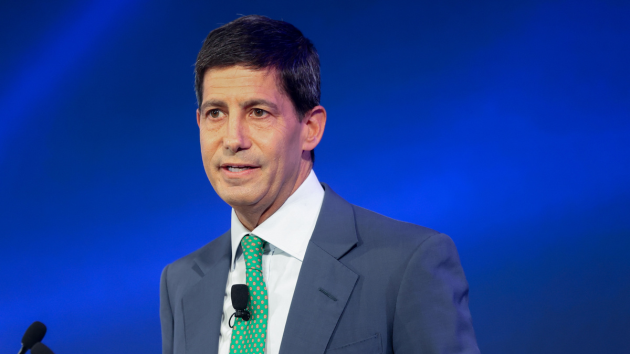
Kevin Warsh, former governor of the US Federal Reserve, during the International Monetary Fund (IMF) and World Bank Spring meetings on Friday, April 25, 2025. (Tierney L. Cross/Bloomberg via Getty Images)
(WASHINGTON) — President Donald Trump’s selection to chair the Federal Reserve, Kevin Warsh, testified in a Senate confirmation hearing on Tuesday as his nomination faces bipartisan opposition centered on a federal criminal investigation into the central bank’s current leader.
The probe into Fed Chair Jerome Powell, which focuses on alleged false testimony to Congress about an office renovation, threatens to derail or delay Warsh’s nomination.
Powell, who was appointed by Trump in 2017, has rebuked the probe as a politically motivated effort to influence interest-rate policy.
In his opening remarks, Warsh voiced support for the independence of the Fed in its role setting interest rates. He used the term “monetary policy” to describe the central bank’s task of adjusting benchmark borrowing costs.
“Monetary policy independence is essential. Monetary policymakers must act in the nation’s interest,” said Warsh, a former Fed official.
Still, Warsh defended the right of public officials, including presidents, to voice their views on interest-rate policy, saying such comments do not infringe on Fed independence.
“Central bankers must be strong enough to listen to a diversity of views from all corners,” Warsh said.
Warsh said he welcomes collaboration with the White House and Congress on “non-monetary matters that are part of the Fed’s remit,” such as banking regulation.
Sen. Elizabeth Warren, D-Mass., the top Democrat on the committee, responded directly to Warsh’s defense of a president’s right to criticize the Fed, saying the federal investigation of Powell amounts to a pressure campaign that extends beyond public criticism of Fed policies.
“You said it’s perfectly fine for elected officials to state their views on interest rates. But that’s not what Donald Trump is doing,” Warren said, addressing Warsh.
The investigation of Powell, Warren added, is “designed to threaten all the members of the Fed to do Trump’s bidding.”
Warsh may become Trump’s “sock puppet” atop the Fed, Warren said.
By contrast, Sen. Tim Scott, R-S.C., the chairman of the Senate Banking Committee, praised Warsh, saying the Fed nominee would focus Fed policy on economic stewardship. During the tenure of President Joe Biden, Scott claimed, the Fed shifted some of its attention to the implications of issues like climate change.
“An independent Federal Reserve is essential to achieving its mission. That independence must be protected,” Scott said.
“Kevin Warsh is battle-tested and brings the necessary experience,” Scott added.
Sen. Thom Tillis, R-N.C., a potentially decisive vote on the committee, says he will not move to advance Warsh’s nomination until the Department of Justice resolves its unprecedented investigation into Powell.
Powell’s term as Fed chair ends on May 15, but he said last month he would stay in the position until Warsh is confirmed. For his part, Trump told Fox Business last week he would fire Powell if the current Fed chair attempts to remain in office past the end of his term.
Warsh, who previously worked on Wall Street and in the President George W. Bush administration, brings experience in finance and policymaking.
He is currently a fellow at a conservative think tank called the Hoover Institution, which is based at Stanford University. He also works as a partner at the Duquesne Family Office, an investment firm founded by billionaire and former hedge fund manager Stanley Druckenmiller.
In 2006, Bush appointed Warsh to serve on the Fed’s Board of Governors, a top policymaking body that helps set the level of interest rates, where he served until 2011. His tenure overlapped with the 2008 financial crisis, during which he helped manage the central bank’s response under then-Chair Ben Bernanke.
The nomination of Warsh arrives at a delicate moment for the Fed, as it grapples with a challenging combination of elevated inflation and sluggish hiring. An interest-rate hike could help ease inflation but risks a further cooldown of the labor market, while a rate cut may boost hiring but threatens higher inflation.
During his term as a Fed governor in the late 2000s and early 2010s, Warsh gained a reputation as an interest-rate “hawk,” meaning he generally preferred higher interest rates as a means of ensuring low and stable inflation.
In recent months, however, Warsh has voiced support for lower interest rates, rebuking the Fed’s concern about inflation risk posed by a flurry of new tariffs issued last year.
Those remarks came before the U.S.-Israeli war with Iran, however, which sent inflation soaring last month.
The rapid acceleration of price increases could complicate interest rate policy at the Fed, which may be reluctant to lower borrowing costs as inflation climbs.
Members of the Johnson family attend a candlelight vigil, April 19, 2026, in Shreveport, Louisiana, for eight children were killed and two women were wounded during a domestic violence incident. (Brandon Bell/Getty Images)
(SHREVEPORT, La.) — As an investigation continued into the motive of Sunday’s fatal shootings of eight children in Shreveport, Louisiana, allegedly by the father of seven of the victims, police officials released a timeline detailing the 68-minute massacre.
“April 19 … will be written in the pages of history as one of the worst days that could have ever happened here in Shreveport,” Chief Wayne Smith of the Shreveport Police Department said at a news conference on Monday.
Smith said the suspect, Shamar Elkins, a former member of the Louisiana Army National Guard, allegedly used an assault-style pistol to kill seven of his children and an eighth child related to him. A teenage boy was also injured when he jumped off the roof of a house to escape the shooting, police said.
While Elkins died after police opened fire on him following a car chase, Smith said it remains unclear whether he was shot to death or died by suicide.
Smith said domestic violence is believed to be the primary motive behind the killings. The chief said two women, including the mother of seven of the children who were killed, were wounded in the incident and remain hospitalized.
He said investigators are probing five different crime scenes connected to the shootings.
Police said the children killed, siblings and one cousin, ranged in age from 3 to 11. The victims, according to the Caddo Parish Coroner’s Office, were identified by their mothers as Jayla Elkins, 3; Shayla Elkins, 5; Kayla Pugh, 6; Layla Pugh, 7; Markaydon Pugh, 10; Sariahh Snow, 11; Khedarrion Snow, 6; and Braylon Snow, 5.
Louisiana Gov. Jeff Landry announced on Monday that the Love One Louisiana Foundation, a nonprofit founded by his wife, Sharon, will pay all expenses for the children’s funerals, according to ABC affiliate station KTSB.
“Both she and I recognize no amount of money or act of charity can repair the pain, but [what] we can lean on is that this act of charity can stand as a beacon of faith and belief that good things still happen in this world,” Gov. Landry said during a visit to Shreveport.
Timeline of the deadly rampage During Monday’s press conference, Smith went over a timeline of the deadly attacks that occurred before sunrise on Sunday:
5:55 a.m. — Shreveport Police received the first call regarding a disturbance at a residence on W. 79th Street in the Ceder Grove neighborhood of South Shreveport. The caller stated that they were on top of the house while the suspect was inside, and a male had been shot.
5:58 a.m. — A police dispatcher received an additional call from the same 911 caller, indicating the suspect was a relative of the caller.
5:59 a.m. — A dispatcher was advised by the caller that approximately nine individuals resided at the W. 79th Street location. The caller stated that the suspect, Elkins, had shot everyone inside the home.
6 a.m. — The caller advised the dispatcher that she and her children fled the W. 79th Street house onto the roof and that they were in the backyard.
6:01 a.m. — Shreveport officers arrived at the W. 79th Street residence.
6:03 a.m. — Officers made contact with the 911 caller at the West 79th Street residence.
6:05 a.m. — Officers requested the Shreveport Fire Department stage at a location near the West 79th Street home, close to Linwood Avenue.
6:07 a.m. — A second 911 caller reported a shooting at a home on Harrison Street in Shreveport. The caller stated that her boyfriend shot her and fled the scene with her three children.
6:08 a.m.– The second caller identified the suspect who shot her and took her children as Elkins.
6:10 a.m. — A police dispatcher links the Harrison Street shooting with the shooting on West 79th Street and determines that they were related.
6:15 a.m. — Officers received information that the suspect had carjacked a red Kia Sportage at West 79th Street near Linwood Avenue.
6:17 a.m. — Shreveport police traffic units out on random patrol observed the carjacked Kia heading southbound on Interstate 49.
6:18 a.m. — Officer radioed in that they were chasing the stolen car over a bridge in crossing the Red River into Bossier City.
6:20 a.m. — Officers involved in the chase reported that the children taken from the Harrison Street residence may be inside the fleeing vehicle.
6:23 a.m. — Officers advised dispatch that they were exiting the interstate near the Swan Lake area of Bossier City.
6:25 a.m. — Officers back in Shreveport find the victim injured in the Harrison Street shooting.
6:29 a.m. — Officers report and exchange of gunfire with the suspect on Brompton Lane in Bossier City.
6:40 a.m. — Police officers advised a dispatcher that the suspect vehicle was empty and no children were located inside. Chief Smith did not say during Monday’s news conference what happened to the children taken from the Harrison Street residence.
6:43 a.m. — Officers in Shreveport cleared the West 79th Street home and found multiple deceased victims.
7:03 a.m. — The suspect, Elkins, is pronounced dead at the scene on Brompton Lane in Bossier City.
Kevin Warsh, former governor of the US Federal Reserve, during the International Monetary Fund (IMF) and World Bank Spring meetings on Friday, April 25, 2025. (Tierney L. Cross/Bloomberg via Getty Images)
(WASHINGTON) — President Donald Trump’s selection to chair the Federal Reserve, Kevin Warsh, will testify in a Senate confirmation hearing on Tuesday as his nomination faces bipartisan opposition centered on a federal criminal investigation into the central bank’s current leader.
The probe into Fed Chair Jerome Powell, which focuses on alleged false testimony to Congress about an office renovation, threatens to derail or delay Warsh’s nomination.
Powell, who was appointed by Trump in 2017, has rebuked the probe as a politically motivated effort to influence interest-rate policy.
Warsh, a former Fed official, will likely face scrutiny from some lawmakers eager for assurance that he will set interest rates based on economic conditions, even if it puts him out of step with Trump’s preference for low interest rates.
Sen. Thom Tillis, R-N.C., a potentially decisive vote on the committee, says he will not move to advance the nomination until the Department of Justice resolves its unprecedented investigation into Fed Chair Jerome Powell.
Powell’s term as Fed chair ends on May 15, but he said last month he would stay in the position until Warsh is confirmed. For his part, Trump told Fox Business last week he would fire Powell if the current Fed chair attempts to remain in office past the end of his term.
Sen. Elizabeth Warren, D-Mass., the top Democrat on the committee, voiced concern in a statement last week about what she considers Warsh’s perceived lack of independence, saying he may end up being “Donald Trump’s sock puppet.”
By contrast, Sen. Tim Scott, R-S.C., the chairman of the Senate Banking Committee, has dismissed such worries in a post on X last week.
Under Warsh, Scott said, the Fed will “be focused solely on strengthening the American economy.”
Warsh, who previously worked on Wall Street and in the George W. Bush administration, brings experience in finance and policymaking.
He is currently a fellow at a conservative think tank called the Hoover Institution, which is based at Stanford University. He also works as a partner at the Duquesne Family Office, an investment firm founded by billionaire and former hedge fund manager Stanley Druckenmiller.
In 2006, Bush appointed Warsh to serve on the Fed’s Board of Governors, a top policymaking body that helps set the level of interest rates, where he served until 2011. His tenure overlapped with the 2008 financial crisis, during which he helped manage the central bank’s response under then-Chair Ben Bernanke.
The nomination of Warsh arrives at a delicate moment for the Fed, as it grapples with a challenging combination of elevated inflation and sluggish hiring. An interest-rate hike could help ease inflation but risks a further cooldown of the labor market, while a rate cut may boost hiring but threatens higher inflation.
During his term as a Fed governor in the late 2000s and early 2010s, Warsh gained a reputation as an interest-rate “hawk,” meaning he generally preferred higher interest rates as a means of ensuring low and stable inflation.
In recent months, however, Warsh has voiced support for lower interest rates, rebuking the Fed’s concern about inflation risk posed by a flurry of new tariffs issued last year.
Those remarks came before the U.S.-Israeli war with Iran, however, which sent inflation soaring last month.
The rapid acceleration of price increases could complicate interest rate policy at the Fed, which may be reluctant to lower borrowing costs as inflation climbs.
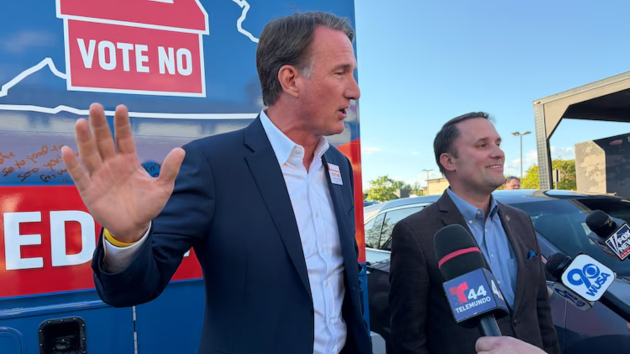
Former Virginia Gov. Glenn Youngkin (left) and former Virginia Attorney General Jason Miyares (right) campaign in Leesburg, VA on Monday, April 20, 2026. (ABC News)
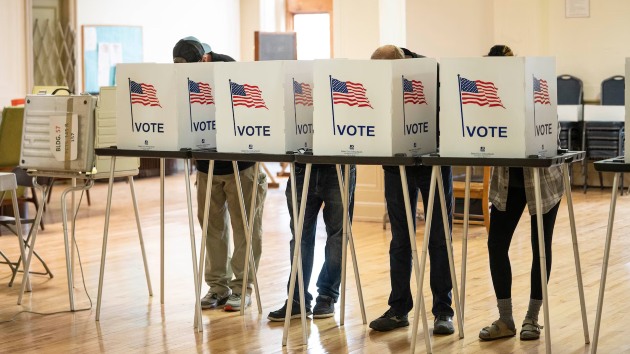
(RICHMOND, Va.) — Voters in Virginia head to the polls Tuesday to vote on a redistricting ballot measure referendum that could have major implications for the midterm elections.
The referendum will decide if the Democratic-controlled legislature should be allowed to redraw the state’s congressional map. That would allow the legislature to implement a map that would reconfigure four congressional seats to favor Democrats, which could have major implications for control of the U.S. House after November’s midterm election.
Democrats have said they need the measure in Virginia to pass in order to continue to counter previous mid-decade redistricting that benefited Republicans in Texas and other states. But Republicans have called it a power grab in a state that is relatively split even politically, and say it sidelines a redistricting commission voters previously approved.
Surrogates for both sides of the measure have been campaigning in full force ahead of election day, and President Donald Trump weighed in on Monday night in a rally held by telephone.
“This referendum is a blatant partisan power grab… if it passes, Virginia Democrats will eliminate four out of five congressional seats [held by Republicans in Virginia], so you’re going to get just wiped out in terms of representation in Washington,” Trump said on Monday.
But House Minority Leader Hakeem Jeffries, D-N.Y., a strong proponent of the measure, said earlier Monday that the redistricting was because of Trump, who encouraged Texas and other states to redistrict in 2025.
“We believe that it’s the voters of Virginia and the people of this country who should decide which party is in the majority… not Donald Trump and his extreme MAGA sycophants in state legislative bodies across the country who were ordered by Donald Trump to gerrymander the national congressional map as part of the effort to rig the midterm elections,” he told reporters on Monday.
During mid-decade redistricting in 2025, nine seats were redrawn to benefit Republicans, while six seats were redrawn to benefit Democrats. If Democrats add four seats to their count, then Democrats might only net one new seat if all seats flip as expected in November. But Florida is also set to consider mid-decade redistricting, which is expected to help Republicans bolster their count.
In the Virginia election, the Democratic-supported side of the measure far outfundraised and outspent the main group supporting a “no” vote, according to campaign finance filings, although both sides raised and spent millions. As of April 10, Virginians for Fair Elections, the flagship organization campaigning in favor of redistricting, has raised over $64 million, while Virginians for Fair Maps Referendum Committee, the largest organization campaigning against redistricting, has raised under $20 million.
While Democrats framed many of their arguments in favor of the redraw as meant to counter Trump, the president himself did not campaign for the “no” side in person and did not engage much with the election until the day before Election Day.
Former Virginia Gov. Glenn Youngkin, asked by ABC News outside of an anti-redistricting campaign event in Leesburg, Virginia, on Monday if he thinks Trump or national Republicans should have gotten more involved with the race, downplayed the need for that, saying that the opposition to redistricting could go across party lines.
“I think what we’ve seen is that, first of all, it’s been a grassroots effort across the Commonwealth,” Youngkin told ABC News. “There are so many [vote] ‘no’ signs around the Commonwealth… and at the heart of it, that’s Virginians standing up, not just Republicans.”
(NEW YORK) — Apple CEO Tim Cook is stepping down, with the company announcing on Monday that John Ternus will take his place as the head of the technology giant.
Cook will become the executive chairman of Apple’s board of directors, the company said. Ternus will officially become CEO on Sept. 1.
“It has been the greatest privilege of my life to be the CEO of Apple and to have been trusted to lead such an extraordinary company,” Cook said in a statement on Monday.
“John Ternus has the mind of an engineer, the soul of an innovator, and the heart to lead with integrity and with honor. He is a visionary whose contributions to Apple over 25 years are already too numerous to count, and he is without question the right person to lead Apple into the future,” Cook added.
Cook has served as Apple’s CEO since 2011.
This is a developing story. Please check back for updates.
Table indicating the escape route in the case of tsunamis. (Getty stock photo)
(TOKYO) — A 7.4 magnitude earthquake struck on Monday off Japan’s northeastern coast, the U.S. Geological Survey said, prompting authorities to issue tsunami warnings and advisories along parts of the coast that were later downgraded to advisories and then cancelled.
“Based on the preliminary earthquake parameters, hazardous tsunami waves are possible for coasts located within 300 km of the earthquake epicenter,” USGS said after the quake was detected.
The Japan Meteorological Agency initially said tsunami warnings were in place for some of the coast along the Pacific, along with lesser advisories and forecasts farther away from the quake’s center.
“Residents in areas where tsunami warnings have been issued should immediately evacuate to higher ground or evacuation buildings and other higher, safer locations,” Prime Minister Sanae Takaichi said.
The tsunami waves that were expected to have been the highest struck the coast within hours, with the largest one registering about 80 cm, or about 2.5 feet, but officials said they had not ruled out further waves. Official warnings were still in place, although the U.S. weather officials said in an update that, based on available data, “the tsunami threat from this earthquake has now passed.”
Preliminary U.S. data pinpointed the quake about 100 km, or about 62 miles, off the eastern coast of Miyako, USGS said. Light rumbling could be felt as far away as Tokyo. A 5.6 magnitude earthquake struck nearby about 40 minutes afterward, according to USGS data.
The Japanese agency held a press conference on Monday, during which it identified the quake as having been a 7.5 magnitude one. The depth was 10 km, or about 6.2 miles. It occurred at 4:53 p.m. local time, the agency said.
A tsunami warning was issued under twenty seconds after the initial earthquake, an official said. Officials warned people to stay on the alert for about week, as an equal or lesser than quake may occur. The risk was especially elevated for the next two or three days, officials said.
The U.S. Tsunami Warning System said a “destructive” Pacific-wide tsunami was not expected “and there is no threat to Hawaii.”
ABC News’ Joe Simonetti and Victoria Beaule contributed to this report.
Stock Market Wall Street (Matteo Colombo/Getty Images)
(NEW YORK) — Stocks closed slightly lower and oil prices rose on Monday as tensions mounted in the Strait of Hormuz, putting pressure on the ceasefire between the U.S and Iran a day before it’s set to expire.
The Dow Jones Industrial Average ticked down 4 points, or 0.01%, while the S&P 500 dipped 0.2%. The tech-heavy Nasdaq declined 0.2%.
U.S. Marines seized an Iran-flagged container ship in the Gulf of Oman on Sunday, according to CENTOM, just a day after two Indian ships came under fire in the Strait of Hormuz.
A potential second round of peace talks between the U.S. and Iran remained in doubt on Monday. Iranian Foreign Ministry spokesperson Esmaeil Baghaei said Monday that Iran has not yet made any decision regarding additional talks.
West Texas Intermediate futures, the benchmark index for U.S. oil prices, climbed more than 5% on Monday, registering at about $88 a barrel. U.S. oil prices stand about 35% higher than before the war.
The escalating tensions appeared to undo a brief thaw on Friday, when a senior Iranian official declared the strait “completely open” for tanker traffic. Within minutes, President Donald Trump celebrated the announcement as a major breakthrough.
The glimmer of relief for the critical waterway sent stock prices soaring and oil prices plummeting on Friday.
Markets have swung dramatically over the weeks following the start of the U.S.-Israel attacks on Iran on Feb. 28, as investors weathered a historic global oil shock and digested mixed signals from Trump.
Stocks have moved higher on a largely consistent basis in April, however, in response to an apparent willingness on the part of both sides to end fighting and negotiate a temporary truce.
The U.S. continues to mount a naval blockade of Iranian ports in the Strait of Hormuz, exerting pressure on Tehran by choking off a key source of revenue.
Last week, the commander of the Khatam Al-Anbiya Central Headquarters of Iran’s armed forces said the U.S. blockade of Iranian ports is a “violation of the ceasefire,” in a statement published by the official Islamic Republic News Agency.
The war prompted Iran’s effective closure of the Strait of Hormuz, a vital maritime trading route that facilitates the transport of about one-fifth of the global supply of oil and natural gas.
The disruption amounted to the “most severe oil supply shock in history,” the International Energy Agency (IEA) said in a report last week. Oil and gasoline prices soared, prompting some economists to warn of a possible recession.
The US Capitol in Washington, DC, US, on Monday, April 20, 2026. House Republicans will send their first funding bills for the next fiscal year to the floor this week, while the Senate GOP plots a blueprint for patching up missing money for the current one. (Photographer: Graeme Sloan/Bloomberg via Getty Images)
(WASHINGTON) — The bipartisan House Ethics Committee on Monday released a rare statement encouraging anyone who may have experienced sexual misconduct by a House member or staffer to contact them, the Office of Congressional Workplace Rights or the Office of Employee Advocacy.
“There should be zero tolerance for sexual misconduct, harassment, or discrimination in the halls of Congress, or in any employment setting,” the committee said in a lengthy statement.
“The greatest hurdle the Committee faces in evaluating allegations of sexual misconduct is in convincing the most vulnerable witnesses to share their stories,” the statement read. “Accordingly, the Committee’s practice has been to release only the information that is necessary to hold Members accountable for misconduct and address public reporting that impacts the integrity of the House.”
The statement comes after allegations of sexual misconduct led to the resignations of California Democrat Eric Swalwell and Texas Republican Tony Gonzales last week.
Gonzales and Swalwell were about to face efforts by their colleagues to have them expelled from the House. The House Ethics Committee had announced investigations into both men, which ended when they resigned.
Gonzales dropped his reelection bid earlier this year after admitting to a relationship with a staffer who later died by suicide. Gonzales said he “made a mistake” and “had a lapse in judgement.”
Swalwell suspended his campaign for governor of California amid the accusations against him, including allegations of sexual assault, which he’s denied. Swalwell’s attorney, Sara Azari, last week said the allegations are “false.”
The committee said that since 2017, it has initiated investigations in 20 matters involving sexual misconduct by a lawmaker.
“The Committee has also investigated several Members for their handling of allegations of sexual misconduct by their senior staff,” the statement read.
In its history, the committee has conducted 28 sexual misconduct investigations. Several members who were being investigated resigned and even some were cleared.
The panel noted that it does not handle sexual harassment lawsuits or have “any involvement in settlements of such claims.”
“The Committee has taken the position that conduct that falls short of legal definitions of sexual harassment or assault under federal or state statutes can still be a violation of the Code of Official Conduct, which imposes a higher standard on Members of the House,” the statement read. “The Committee has also consistently publicly announced its investigations into publicly reported allegations of sexual misconduct and has announced any findings in those matters.”
Voters cast ballots at the polls inside Central United Methodist Church on November 5, 2024 in Detroit, Michigan. (Sarah Rice/Getty Images)
(WAYNE COUNTY, Mich.) — The Justice Department has demanded 2024 federal election ballots and records from Wayne County, Michigan, according to a letter posted online by state officials early Monday morning.
The letter, from Assistant Attorney General Harmeet Dhillon, references three voter fraud convictions from the 2020 election and a civil case alleging fraud that was dismissed in 2020.
“Based on this history of fraud convictions and other allegations concerning the election procedures in Wayne County and, for the purpose of ensuring that the foregoing federal election laws were not violated in the November 2024 federal election, we are requesting that you produce the following election-related records from that election: all ballots (including absentee and provisional), ballot receipts, and ballot envelopes,” the DOJ letter said.
State officials said the letter is a continuation of President Donald Trump’s efforts to interfere with the election process, following his recent executive order regarding mail-in voting and the FBI’s seizure of 2020 election ballots in Fulton County, Georgia.
“Once again, President Trump is weaponizing the Justice Department in an attempt to sabotage our democratic process and turn it into his own personal agency to interfere in state elections. This request is as absurd as it is baseless,” Michigan Attorney General Dana Nessel said in a statement. “Successful convictions underline that Michigan’s safeguards work and that instances of voter fraud are rare and addressed.”
“Using these prosecutions and recycling debunked 2020 election conspiracy theories as justification to demand copies of the ballots of Michigan residents is a clear attempt to bully clerks and spread fear, even after Donald Trump won Michigan in 2024. If this administration wants to bring this circus to our state, my office is prepared to protect the people’s right to vote,” Nessel said.
Michigan state officials also say that none of the examples provided in the letter were from the 2024 election cycle.
Representatives from the Justice Department and the White House did not immediately respond to a request for comment from ABC News.
FBI agents in January removed 700 boxes containing ballots and other materials associated with the 2020 election from a Fulton County election site after obtaining a search warrant based on unproven claims of widespread voting irregularities.
Trump has long criticized the outcome of the 2020 election, personally pushing to overturn the results after his loss and later being indicted in two criminal cases over his actions. Those cases have since been dismissed, and Trump has continued to push for criminal accountability for what he baselessly alleged was a stolen election.