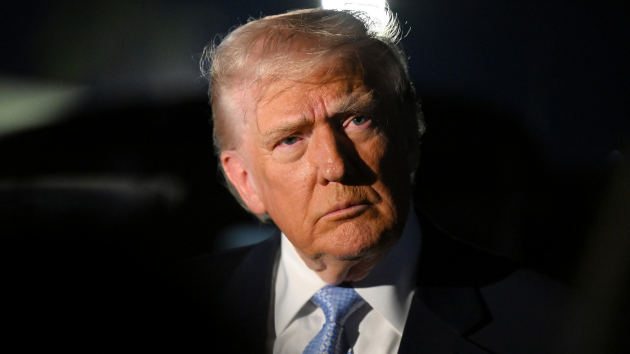
U.S. President Donald Trump speaks to reporters before boarding Air Force One on November 16, 2025, at Palm Beach International Airport in West Palm Beach, Florida. Trump spent the weekend at his Mar-A-Lago Club in Palm Beach, Florida. (Photo by Roberto Schmidt/Getty Images)
(WASHINGTON) — The White House released the results of President Donald Trump’s recent advanced imaging tests on Monday, describing them as “perfectly normal.”
The memo from Dr. Sean Barbabella, physician to the president, said Trump underwent the scans during a medical examination in October “because men in his age group benefit from a thorough evaluation of cardiovascular and abdominal health” and that the tests are “preventative.”
Barbabella said the imaging helps confirm Trump’s overall health and identifies any early issues before they become serious.
Although Trump referred to the tests as an MRI, Barbarella did not use the term in his memo.
The cardiac imaging test, which looks at the heart and its blood vessels, showed no evidence of arterial narrowing, Barbabella wrote. Arterial narrowing is a condition that occurs when plaque builds up and reduces blood flow, causing symptoms including chest pain and shortness of breath.
Additionally, Trump’s cardiac scan did not show abnormalities in the heart or major vessels, according to Barbabella, and his heart chambers were described as normal in size with no signs of inflammation or clotting.
When the chambers of the heart are either too big or too small, this can cause the organ to work harder than usual to pump blood throughout the body.
“Overall, his cardiovascular system shows excellent health,” Barbabella wrote.
Barbabella also wrote in the memo that Trump’s abdominal imaging scan was normal with all major organs appearing healthy and well-perfused, meaning with a high blood flow relative to their size.
“Everything evaluated is functioning within normal limits with no acute or chronic concerns,” he wrote. “This level of detailed assessment is standard for an executive physical at President Trump’s age and confirms that he remains in excellent overall health.”
Trump said during a gaggle with reporters on Air Force One in late October that he received an MRI as part of “advanced imaging” tests at Walter Reed National Military Medical Center, but didn’t answer questions on what the scan was for.
On Sunday, Trump said he was fine with the MRI results being released, but was unsure of the area of the body that was scanned.
“So, if they want to release it, it’s okay with me to release it. It’s perfect,” Trump told reporters on Air Force One. “But if you want to have it released, I’ll release it, absolutely.”
When asked which body part received MRI scanning, Trump replied, “I have no idea. It was just an MRI — what part of the body? It wasn’t the brain, because I took a cognitive test and I aced it.”
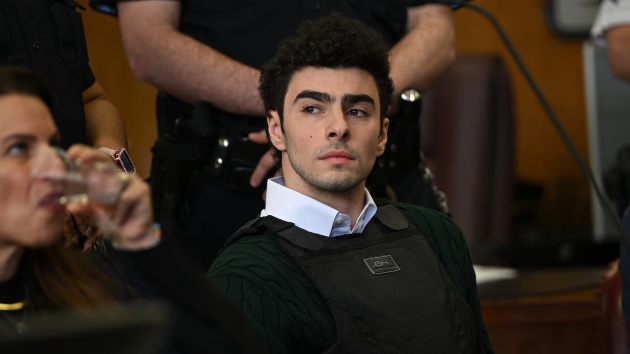
Luigi Mangione appears at a hearing for the murder of UHC CEO Brian Thompson at Manhattan Criminal Court, Feb. 21, 2025, in New York. (Curtis Means/Pool/Getty Images)
(NEW YORK) — For the first time, prosecutors played the 911 call that led to the arrest of Luigi Mangione, as the alleged killer of UnitedHealthcare CEO Brian Thompson is in court in New York City on Monday for a multi-day hearing that could determine the balance of evidence in his state murder trial.
Mangione, 27, was arrested at a McDonald’s in Altoona, Pennsylvania, five days after the fatal shooting of Thompson in midtown Manhattan last year.
“I have a customer here that some other customers were suspicious of, that he looks like the CEO shooter from New York,” an unnamed McDonald’s manager told a Blair County emergency dispatcher, according to a recording of the 911 call played in open court in Manhattan.
The recording was played during the testimony of Emily States, the 911 Coordinator for Blair County Emergency Services. She authenticated the video before prosecutors played it for the judge.
According to the manager, an older female customer was “really upset” and “frantic” after seeing Mangione eating breakfast in the rear of the McDonald’s. She noted that the customer was trying to be “non-discreet” while she scoped out the suspected killer.
“I can’t approach him,” the female manager told the dispatcher, identifying Mangione by his black jacket, surgical mask and tan beanie.
“He shot the CEO. I got you,” the dispatcher responds at one point.
The manager tried to identify Mangione by his size — “mid height” and “mid weight” — but appeared to struggle to list any identifiable characteristics beyond his clothing, according to the recording.
“The only thing you can see are his eyebrows,” the manager said. “I don’t know what to do here, guys.”
The recording itself is occasionally muffled and interrupted by the sounds of a bustling McDonald’s in the background, including breakfast orders being placed. Toward the end of the recording, the dispatcher confirms that an officer is en route to the McDonald’s.
“I do have an officer on the way for you. Just keep an eye on him. If he leaves, let us know,” the dispatcher said.
Mangione, sitting in the courtroom, leaned forward in his chair while the audio played, occasionally writing down notes of the call.
The judge has not yet ruled on whether to allow the audio into the trial.
Mangione’s attorneys are trying to limit prosecutors from using key evidence — including a 3D-printed gun and purported journal writings — police say they obtained when they arrested him in Pennsylvania last year.
Earlier during Monday’s hearing, Mangione leaned on his left hand and stared at a large screen at the front of the courtroom, gazing at images police in New York City disseminated following the murder of Thompson.
The images allegedly depict Mangione at a Starbucks, on a bicycle, at a hostel, in the back of a taxi and with a gun taking aim at Thompson as the United Healthcare chief executive strolled toward the Hilton in Midtown.
The NYPD posted the images to social media following the killing as it asked the public for help identifying the suspect wanted for a “premeditated targeted attack” and announced a $10,000 reward for information leading to arrest.
With Sgt. Christopher McLaughlin on the witness stand, prosecutor Joel Seidemann played a video of the shooting allegedly depicting Mangione firing more than once, Thompson buckling against the building facade, and Mangione calmly walking by the victim.
Prosecutors seem intent on firmly establishing Mangione as the definitive suspect as the defense raises questions about officers approaching him five days later at the McDonald’s in Altoona.
Bernard Pyles, who works for the company that installed security cameras at the McDonald’s, testified Monday that he was asked to retrieve footage for the police.
“We were told there was an arrest made and they need footage,” Pyles said. “We were looking for a certain individual on the footage in order to cut out the pieces they needed.”
On Dec. 9, McDonalds cameras allegedly captured Mangione ordering from a kiosk, waiting at the counter and picking up his order. Mangione is allegedly seen on a different camera carrying his food, taking a seat in a back corner table and wiping it down.
The individual that police identified as Mangione remained at the table 25 minutes before camera showed police officers arriving and confronting him.
Defense attorneys have argued Altoona police officers questioned Mangione for 20 minutes before reading him his rights, and also searched his backpack without a warrant.
Nearly two dozen Mangione supporters seated in the back row of the courtroom craned their necks to get a look at the accused killer as he entered the courtroom at the start of Monday’s hearing. Some were dressed in T-shirts displaying slogans about the case, including one saying “Justice is not a spectacle.”
Though no trial date has been set for either Mangione’s state or federal criminal cases, the outcome of this week’s hearing will determine the shape of the case Mangione and his lawyers will face at trial. If they succeed in limiting key evidence, prosecutors could lose the ability to use Mangione’s writings — which prosecutors say paint a clear motive for the crime — and the alleged murder weapon.
“I finally feel confident about what I will do,” Mangione allegedly wrote in a notebook seized from his backpack, later included in court filings. “The target is insurance. It checks every box.”
This week’s hearing in New York’s State Supreme Court — where Mangione is charged with second-degree murder — follows a legal victory for Mangione’s defense when the judge in September tossed two murder charges related to an act of terrorism. He is still charged with second-degree murder and other offenses, as well as a separate criminal case in federal court. If convicted in state court, Mangione faces a potential life sentence, and he could face the death penalty in his federal case.
Mangione is accused of gunning down Thompson — a father of two who spent two decades working for UnitedHealthcare before being named its CEO — last December outside a Midtown Manhattan hotel before allegedly fleeing the city. He was arrested on Dec. 9 at the McDonald’s in Altoona after someone reported seeing a “suspicious male that looked like the shooter from New York City.”
Defense lawyers are trying to bar prosecutors from using any of the evidence recovered from the backpack — including electronic devices, a 3D-printed gun, silencer, and a journal — as well as referencing any statements Mangione made to police. Lawyers with the Manhattan District Attorney’s Office have defended the lawfulness of the arrest and search and are expected to argue that the evidence would have inevitably been recovered during the discovery process ahead of trial.
“Despite the gravest of consequences for Mr. Mangione, law enforcement has methodically and purposefully trampled his constitutional rights,” Mangione’s attorney argued in their motion.
Defense lawyers argue the constitutional issues began almost immediately after officers approached Mangione, who was seated in the McDonald’s to have breakfast. After Mangione allegedly provided officers with a fake driver’s license, they immediately began questioning Mangione about whether he was recently in New York and why he lied about his identity, defense lawyers say. As he was questioned, defense lawyers say officers filled the restaurant to form an “armed human wall trapping Mr. Mangione at the back of the restaurant.”
Citing time-stamped police body camera footage, Mangione’s attorneys allege police waited 20 minutes to read his Miranda Rights and extensively questioned him without informing him he was under investigation or that he had the right to remain silent. They have asked New York State Supreme Court Judge Gregory Carro to prohibit prosecutors from introducing any evidence or testimony related to what they say was an illegal interrogation at the McDonald’s.
Defense lawyers also contend that an officer illegally searched Mangione’s bag while he was being interrogated, eventually discovering a loaded magazine and handgun. Despite another officer commenting, “at this point we probably need a search warrant” for the bag, Mangione’s attorneys argue that the officer continued searching the bag and claimed she was trying to make sure there “wasn’t a bomb or anything” in the bag.
“[The officer] did not search the bag because she reasonably thought there might be a bomb, but rather this was an excuse designed to cover up an illegal warrantless search of the backpack,” they argue. “This made-up bomb claim further shows that even she believed at the time that there were constitutional issues with her search, forcing her to attempt to salvage this debacle by making this spurious claim.”
Mangione’s attorneys argue that any of the items recovered from the backpack, including his alleged writings and weapon, should be limited as “fruit” of an illegal search.
Ahead of the hearing, Mangione’s attorneys have previewed plans to call at least two witnesses from the Altoona Police Department. During an unrelated court hearing last week, one of Mangione’s attorneys claimed that the hearing could include more than two dozen witnesses and hours of body camera footage.
Judge Carro has set aside several days beginning Monday to hear arguments about whether the testimony and evidence can be suppressed.
Luigi Mangione appears at a hearing for the murder of UHC CEO Brian Thompson at Manhattan Criminal Court, Feb. 21, 2025, in New York. (Curtis Means/Pool/Getty Images)
(NEW YORK) — One year after prosecutors say Luigi Mangione brazenly assassinated UnitedHealthcare CEO Brian Thompson in midtown Manhattan, the 27-year-old is back in court Monday for a multi-day hearing that could determine the balance of evidence in his state murder trial.
Mangione’s attorneys are trying to limit prosecutors from using key evidence — including a 3D-printed gun and purported journal writings — police say they obtained when they arrested him in Pennsylvania last year.
Mangione entered the courtroom and took a seat next to his attorneys, Karen Friedman Agnifilo and Marc Agnifilo, as nearly two dozen Mangione supporters seated in the back row of the courtroom craned their necks to get a look at the accused killer. Some were dressed in T-shirts displaying slogans about the case, including one saying “Justice is not a spectacle.”
During the hearing, Mangione leaned on his left hand and stared at a large screen at the front of the courtroom, gazing at images police in New York City disseminated following the murder of Thompson.
The images allegedly depict Mangione at a Starbucks, on a bicycle, at a hostel, in the back of a taxi and with a gun taking aim at Thompson as the United Healthcare chief executive strolled toward the Hilton in Midtown.
The NYPD posted the images to social media following the killing as it asked the public for help identifying the suspect wanted for a “premeditated targeted attack” and announced a $10,000 reward for information leading to arrest.
With Sgt. Christopher McLaughlin on the witness stand, prosecutor Joel Seidemann played a video of the shooting allegedly depicting Mangione firing more than once, Thompson buckling against the building facade, and Mangione calmly walking by the victim.
Prosecutors seem intent on firmly establishing Mangione as the definitive suspect as the defense raises questions about officers approaching him five days later at a McDonald’s in Altoona, Pennsylvania.
Bernard Pyles, who works for the company that installed security cameras at the McDonald’s, testified Monday that he was asked to retrieve footage for the police.
“We were told there was an arrest made and they need footage,” Pyles said. “We were looking for a certain individual on the footage in order to cut out the pieces they needed.”
On Dec. 9, McDonalds cameras allegedly captured Mangione ordering from a kiosk, waiting at the counter and picking up his order. Mangione is allegedly seen on a different camera carrying his food, taking a seat in a back corner table and wiping it down.
The individual that police identified as Mangione remained at the table 25 minutes before camera showed police officers arriving and confronting him.
Defense attorneys have argued Altoona police officers questioned Mangione for 20 minutes before reading him his rights, and also searched his backpack without a warrant.
Though no trial date has been set for either Mangione’s state or federal criminal cases, the outcome of this week’s hearing will determine the shape of the case Mangione and his lawyers will face at trial. If they succeed in limiting key evidence, prosecutors could lose the ability to use Mangione’s writings — which prosecutors say paint a clear motive for the crime — and the alleged murder weapon.
“I finally feel confident about what I will do,” Mangione allegedly wrote in a notebook seized from his backpack, later included in court filings. “The target is insurance. It checks every box.”
This week’s hearing in New York’s State Supreme Court — where Mangione is charged with second-degree murder — follows a legal victory for Mangione’s defense when the judge in September tossed two murder charges related to an act of terrorism. He is still charged with second-degree murder and other offenses, as well as a separate criminal case in federal court. If convicted in state court, Mangione faces a potential life sentence, and he could face the death penalty in his federal case.
Mangione is accused of gunning down Thompson — a father of two who spent two decades working for UnitedHealthcare before being named its CEO — last December outside a Midtown Manhattan hotel before allegedly fleeing the city. He was arrested on Dec. 9 at the McDonald’s in Altoona after someone reported seeing a “suspicious male that looked like the shooter from New York City.”
Defense lawyers are trying to bar prosecutors from using any of the evidence recovered from the backpack — including electronic devices, a 3D-printed gun, silencer, and a journal — as well as referencing any statements Mangione made to police. Lawyers with the Manhattan District Attorney’s Office have defended the lawfulness of the arrest and search and are expected to argue that the evidence would have inevitably been recovered during the discovery process ahead of trial.
“Despite the gravest of consequences for Mr. Mangione, law enforcement has methodically and purposefully trampled his constitutional rights,” Mangione’s attorney argued in their motion.
Defense lawyers argue the constitutional issues began almost immediately after officers approached Mangione, who was seated in the McDonald’s to have breakfast. After Mangione allegedly provided officers with a fake driver’s license, they immediately began questioning Mangione about whether he was recently in New York and why he lied about his identity, defense lawyers say. As he was questioned, defense lawyers say officers filled the restaurant to form an “armed human wall trapping Mr. Mangione at the back of the restaurant.”
Citing time-stamped police body camera footage, Mangione’s attorneys allege police waited 20 minutes to read his Miranda Rights and extensively questioned him without informing him he was under investigation or that he had the right to remain silent. They have asked New York State Supreme Court Judge Gregory Carro to prohibit prosecutors from introducing any evidence or testimony related to what they say was an illegal interrogation at the McDonald’s.
Defense lawyers also contend that an officer illegally searched Mangione’s bag while he was being interrogated, eventually discovering a loaded magazine and handgun. Despite another officer commenting, “at this point we probably need a search warrant” for the bag, Mangione’s attorneys argue that the officer continued searching the bag and claimed she was trying to make sure there “wasn’t a bomb or anything” in the bag.
“[The officer] did not search the bag because she reasonably thought there might be a bomb, but rather this was an excuse designed to cover up an illegal warrantless search of the backpack,” they argue. “This made-up bomb claim further shows that even she believed at the time that there were constitutional issues with her search, forcing her to attempt to salvage this debacle by making this spurious claim.”
Mangione’s attorneys argue that any of the items recovered from the backpack, including his alleged writings and weapon, should be limited as “fruit” of an illegal search.
Ahead of the hearing, Mangione’s attorneys have previewed plans to call at least two witnesses from the Altoona Police Department. During an unrelated court hearing last week, one of Mangione’s attorneys claimed that the hearing could include more than two dozen witnesses and hours of body camera footage.
Judge Carro has set aside several days beginning Monday to hear arguments about whether the testimony and evidence can be suppressed.
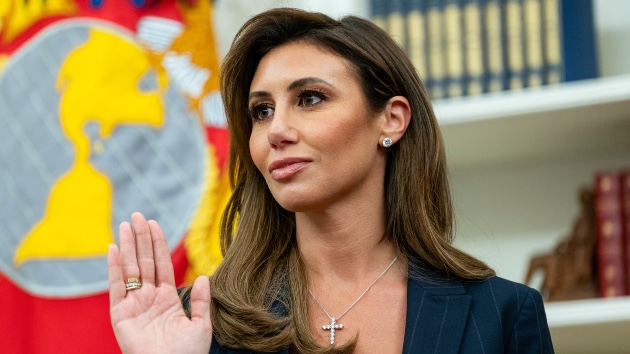
Alina Habba, interim US attorney for New Jersey, is sworn-in during a ceremony in the Oval Office of the White House in Washington, DC, US, on Friday, March 28, 2025. (Photographer: Bonnie Cash/UPI/Bloomberg via Getty Images)
(WASHINGTON) — A federal appeals court has disqualified President Donald Trump’s former personal attorney Alina Habba from serving as the U.S. attorney for New Jersey.
The 3rd U.S. Circuit Court of Appeals upheld a district court decision that found her appointment violated the Federal Vacancies Reform Act.
Trump nominated Habba to the U.S. attorney post but she was not confirmed by the Senate. When district court judges declined to appoint her to the position, the administration installed her by formally withdrawing her nomination then placing her in a role that allowed her to serve in the position, in what a U.S. district judge called a “novel series of legal and personnel moves.”
The appeals court ruled the maneuver was improper.
“Habba is not the Acting U.S. Attorney for the District of New Jersey by virtue of her appointment as First Assistant U.S. Attorney because only the first assistant in place at the time the vacancy arises automatically assumes the functions and duties of the office under the FVRA,” the court wrote, referring to the Federal Vacancies Reform Act.
“Additionally, because Habba was nominated for the vacant U.S. Attorney position, the FVRA’s nomination bar prevents her from assuming the role of Acting U.S. Attorney. Finally, the Attorney General’s delegation of all the powers of a U.S. Attorney to Habba is prohibited by the FVRA’s exclusivity provision,” the opinion said.
The ruling marks the first time a federal appeals court has ruled against the Trump administration’s attempt to keep interim U.S. attorneys in their posts after their temporary appointments lapse, potentially resulting in nationwide implications for federal prosecutors installed in the same way as Habba.
After Habba’s interim appointment expired and the district court sought to put in a new top prosecutor, the Trump administration placed her in a lower position — First Assistant U.S. Attorney — that allowed her to assume the top job once her original nomination was withdrawn.
In a 3-0 decision, the appeals court concluded that Habba’s original nomination for the U.S. attorney position barred her from assuming the acting job. The court also rejected the argument that the attorney general has the power to delegate the powers of U.S. attorney to Habba.
The ruling from the three-judge panel — composed of two judges put on the bench by George W. Bush and one by Joe Biden — comes on the heels of a high-profile decision last week disqualifying Trump’s handpicked prosecutor in the Eastern District of Virginia, Lindsey Halligan, who had brought criminal cases against former FBI Director James Comey and New York Attorney General Letitia James.
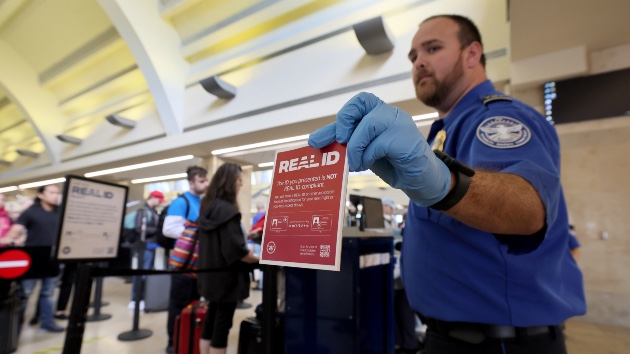
A TSA agent holds a card that is given to travelers not having a Real ID, stating that are not compliant and escorted by a TSA agent through security and allowed to fly at John Wayne Airport in Santa Ana Wednesday, May 7, 2025. (Allen J. Schaben / Los Angeles Times via Getty Images)
(NEW YORK) — Travelers going through airport security checkpoints without a REAL ID or passport will face a $45 fee starting Feb. 1, the Transportation Security Administration announced Monday.
This fee is part of the agency’s next phase of the REAL ID implementation process and will require individuals to verify their identity through a biometric or biographic system if they don’t have a compliant form of identification before they’re permitted to cross through the checkpoint.
The announcement follows a proposed rule published in the Federal Register last month, but the agency increased the fee from its previously proposed amount of $18.
“The fee was necessary because we needed to modernize the system. We needed to make sure that the system is safe,” Steve Lorincz, TSA’s deputy executive assistant administrator for security operations, told ABC News.
TSA says the fee will cover the administrative and IT costs associated with the ID verification program and ensure the expense is covered by the travelers and not the taxpayers.
Individuals traveling without a REAL ID can go online at TSA.gov and follow the instructions listed to verify their identity and pay the fees once it goes into effect next year.
After completing the steps, they will receive an email confirmation to show the TSA officer before they can pass through the checkpoint. The whole process should typically take between 10 to 15 minutes, but could also take as much as 30 minutes or even longer.
The agency warns that even then, there is no guarantee that individuals will be cleared to cross through the security checkpoint.
“We still need to go through the process to make sure that we verify who you are. And for whatever reason, if we can’t do that, then you can’t go through the process,” Lorincz said.
Travelers in line who get to the checkpoint without an acceptable form of ID will be sent out of the line to complete the online verification process before they can proceed. TSA says those with a lost or stolen REAL ID or passport will also have to pay fees.
Once verified, the fees will cover access through the TSA checkpoint for up to ten days. After that, if the individual travels without a REAL ID again, they will have to pay the fees.
The agency says around 94% of travelers are already using a REAL ID or another acceptable form of ID.
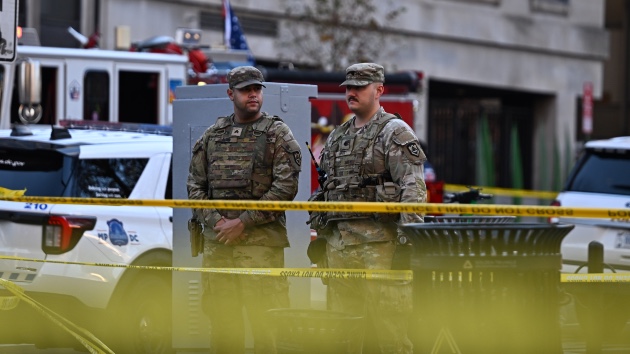
A view of the scene after two members of the US National Guard were shot and ‘critically wounded’ near the White House in Washington DC, United States on November 26, 2025. A suspect was in custody. (Photo by Celal Gunes/Anadolu via Getty Images)
(WASHINGTON) — As investigators continue to delve into what may have motivated the suspect in the deadly National Guardsmen shooting last week, a portrait of a life of increasing financial stress and a potential mental health crisis has emerged, sources familiar told ABC News.
Additionally, multiple sources said that investigators are looking into the impact of the recent death of an Afghan commander, who allegedly worked with the suspect, 29-year-old Rahmanullah Lakanwal.
The death of the commander — whom Lakanwal is said to have revered — had deeply saddened the suspect, sources said.
This may have compounded on Lakanwal’s financial burdens, including not being employed, having an expired work permit and allegedly struggling to pay rent and feed his children, sources said.
Officials said the suspect has a wife and five children. He drove from his residence in Washington state to the nation’s capital prior to the shooting and targeted the Guardsmen, officials said.
A senior law enforcement source told ABC News on Sunday that investigators are looking at everything and are closely examining the role of an apparently deteriorating situation at home.
The FBI, Homeland Security and intelligence officials are also investigating the possibility that the attack was directed by or inspired by international terrorists. But thus far, authorities have not publicly released any specific evidence tying Lakanwal to a terrorist organization and no terror charges have been filed.
The investigation into the deadly shooting is still in its early phases.
Two members of the National Guard were shot and seriously wounded just blocks from the White House in Washington, D.C., on Nov. 26, with one guard dying as a result of her sustained injuries the next day.
President Donald Trump called the shooting “an act of evil, an act of hatred and an act of terror,” adding, “It was a crime against our entire nation.”
Trump, citing information from the Department of Homeland Security, said the suspect entered the U.S. from Afghanistan in September 2021, and criticized the prior administration of President Joe Biden.
The suspect previously worked with the U.S. government, including the CIA, as a member of a partner force in Kandahar, “which ended in 2021 following the withdrawal from Afghanistan,” according to CIA Director John Ratcliffe.
He applied for asylum in 2024 and was granted asylum in April, under the Trump administration, according to the sources.
In Afghanistan, the suspect was involved with the Zero Unit, working closely with the CIA and the Joint Special Operations Command, according to sources familiar with the investigation. The suspect was a trusted member of that team, which went after U.S. counterterrorism targets, according to sources.
The FBI over the weekend continued to interview family and associates of the suspect and tried to exploit documents and other material obtained through searches of mobile devices, his social media footprint and properties tied to him.
Lakanwal remains hospitalized under heavy guard, sources told ABC News on Sunday.
Luigi Mangione appears at a hearing for the murder of UHC CEO Brian Thompson at Manhattan Criminal Court, Feb. 21, 2025, in New York. (Curtis Means/Pool/Getty Images)
(NEW YORK) — One year after prosecutors say Luigi Mangione brazenly assassinated UnitedHealthcare CEO Brian Thompson in midtown Manhattan, the 27-year-old is due in court for a multi-day hearing that could determine the balance of evidence in his state murder trial.
Mangione’s attorneys are trying to limit prosecutors from using key evidence — including a 3D-printed gun and purported journal writings — police say they obtained when they arrested him in Pennsylvania last year.
Though no trial date has been set for either Mangione’s state or federal criminal cases, the outcome of this week’s hearing will determine the shape of the case Mangione and his lawyers will face at trial. If they succeed in limiting key evidence, prosecutors could lose the ability to use Mangione’s writings — which prosecutors say paint a clear motive for the crime — and the alleged murder weapon.
“I finally feel confident about what I will do,” Mangione allegedly wrote in a notebook seized from his backpack, later included in court filings. “The target is insurance. It checks every box.”
This week’s hearing in New York’s State Supreme Court — where Mangione is charged with second-degree murder — follows a legal victory for Mangione’s defense when the judge in September tossed two murder charges related to an act of terrorism. He is still charged with second-degree murder and other offenses, as well as a separate criminal case in federal court. If convicted in state court, Mangione faces a potential life sentence, and he could face the death penalty in his federal case.
Mangione is accused of gunning down Thompson — a father of two who spent two decades working for UnitedHealthcare before being named its CEO — last December outside a Midtown Manhattan hotel before allegedly fleeing the city. He was arrested five days later in a McDonald’s in Altoona, Pennsylvania, after someone reported seeing a “suspicious male that looked like the shooter from New York City.”
Mangione’s arrest is expected to be at the center of this week’s hearing, with defense lawyers arguing that police extensively questioned him without reading him his rights and searched his backpack without a warrant.
Defense lawyers are trying to bar prosecutors from using any of the evidence recovered from the backpack — including electronic devices, a 3D-printed gun, silencer, and a journal — as well as referencing any statements Mangione made to police. Lawyers with the Manhattan District Attorney’s Office have defended the lawfulness of the arrest and search and are expected to argue that the evidence would have inevitably been recovered during the discovery process ahead of trial.
“Despite the gravest of consequences for Mr. Mangione, law enforcement has methodically and purposefully trampled his constitutional rights,” Mangione’s attorney argued in their motion.
Defense lawyers argue the constitutional issues began almost immediately after officers approached Mangione, who was seated in the McDonald’s to have breakfast. After Mangione allegedly provided officers with a fake driver’s license, they immediately began questioning Mangione about whether he was recently in New York and why he lied about his identity, defense lawyers say. As he was questioned, defense lawyers say officers filled the restaurant to form an “armed human wall trapping Mr. Mangione at the back of the restaurant.”
Citing time-stamped police body camera footage, Mangione’s attorneys allege police waited 20 minutes to read his Miranda Rights and extensively questioned him without informing him he was under investigation or that he had the right to remain silent. They have asked New York State Supreme Court Judge Gregory Carro to prohibit prosecutors from introducing any evidence or testimony related to what they say was an illegal interrogation at the McDonald’s.
Defense lawyers also contend that an officer illegally searched Mangione’s bag while he was being interrogated, eventually discovering a loaded magazine and handgun. Despite another officer commenting, “at this point we probably need a search warrant” for the bag, Mangione’s attorneys argue that the officer continued searching the bag and claimed she was trying to make sure there “wasn’t a bomb or anything” in the bag.
“[The officer] did not search the bag because she reasonably thought there might be a bomb, but rather this was an excuse designed to cover up an illegal warrantless search of the backpack,” they argue. “This made-up bomb claim further shows that even she believed at the time that there were constitutional issues with her search, forcing her to attempt to salvage this debacle by making this spurious claim.”
Mangione’s attorneys argue that any of the items recovered from the backpack, including his alleged writings and weapon, should be limited as “fruit” of an illegal search.
Ahead of the hearing, Mangione’s attorneys have previewed plans to call at least two witnesses from the Altoona Police Department. During an unrelated court hearing last week, one of Mangione’s attorneys claimed that the hearing could include more than two dozen witnesses and hours of body camera footage.
Judge Carro has set aside several days beginning Monday to hear arguments about whether the testimony and evidence can be suppressed.
(WASHINGTON) — As billions of people worldwide use the internet to illegally stream or download copyrighted material like music, movies and TV shows, the entertainment industry is trying to crack down on American internet service providers for complicity in the alleged crimes of their customers.
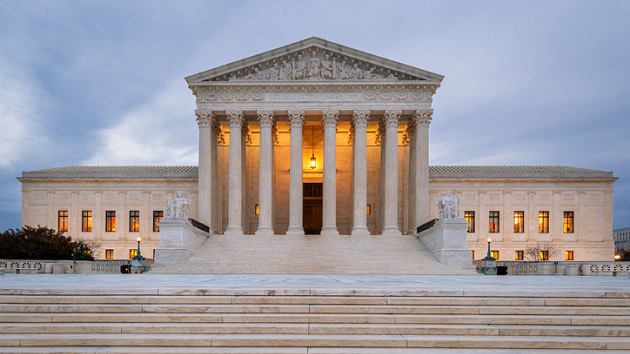
A major case before the Supreme Court on Monday could determine whether those providers can be held financially liable to the tune of hundreds of millions of dollars for “contributing” to copyright infringement if they fail to cut off internet access to any account suspected of engaging in piracy.
Cox Communications, the third largest broadband provider in the U.S. and a party in the case, faces a $1 billion penalty awarded by a jury to Sony Music Entertainment and other media companies that sued over the distribution of pirated content online. It was upheld by a federal appeals court.
The company is asking the justices to toss out the verdict and put limits on contributory liability.
If the judgment is upheld, Cox says it could go bankrupt, potentially eliminating internet access entirely in some communities and leading to “mass evictions from the internet” in places where piracy has been suspected, such as “homes, barracks, hospitals, and hotels upon bare accusation.”
Cox says it opposes copyright infringement and takes steps to prevent it, but that it cannot be held responsible for the actions of individual users, who are impossible to pinpoint and trace.
“Your [internet service provider] does not purposefully participate in, or try to bring about, what you do online any more than your phone company or FedEx do in communications they transmit,” Cox attorneys wrote the high court in a legal brief.
Federal law makes it a crime to directly infringe on a copyright, but secondary liability by another party involved in copyright infringement — such as internet service providers — remains an evolving area of law.
As a general rule, anyone who “materially contributes to the infringing conduct of another may be held liable as a contributory infringer,” lawyers for the Motion Picture Association of America (MPAA), an entertainment industry trade group, told the court in a legal brief.
Copyright owners insist the risk of being sued creates an incentive for internet service providers to help root out online piracy and suspend the accounts of those suspected of dealing in protected material.
“Cox made a deliberate and egregious decision to elevate its own profits over compliance with the law,” attorneys for Sony Music Entertainment argue in a legal brief, “supplying the means for massive copyright infringement to specific users that it knew were habitual offenders because [it wanted to] to hold on to every subscriber [it] can.”
Nearly 19 billion downloads of pirated movies and TV shows were made using online peer-to-peer software in 2023, according to the MPAA. The copyright violations cost the U.S. economy more than $29 billion and “hundreds of thousands of jobs,” the group estimates.
Justices will hear oral arguments over the scope of potential “contributory liability” of internet service providers on Monday and issue a decision in the dispute by the end of June 2026.
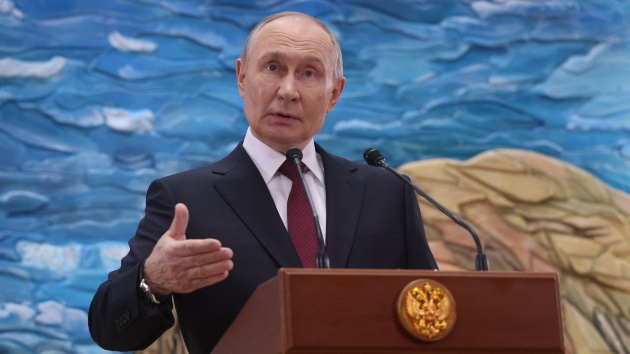
Russian President Vladimir Putin speaks during his press conference after the Summit of Collective Security Treaty Organization, on November 27, 2025 in Bishkek, Kyrgyzstan. (Photo by Contributor/Getty Images)
(KHARKIV, Ukraine and LONDON) — President Donald Trump’s special envoy Steve Witkoff is due to travel to Moscow on Monday to present a peace plan proposal to Russian President Vladimir Putin in what is expected to be a crucial test for the Trump administration’s efforts to end the war in Ukraine.
Witkoff is travelling to Putin a day after taking part in talks with a high-level Ukrainian delegation in Florida, aimed at trying to find a deal to end the war that Ukraine and Russia might accept. The Kremlin on Monday said a meeting between Witkoff and Putin was scheduled for Tuesday.
“The president will hold several closed-door meetings today in preparation for the Russian-American contacts,” spokesperson Dmitry Peskov told reporters in Moscow.
There is little expectation Putin will agree to a deal. The Russian leader has already signalled he will not compromise, last week making hardline remarks where he repeated his demands that Ukraine withdraw from territory he claims and saying it is “pointless” to negotiate with Ukrainian President Volodymyr Zelenskyy. He suggested the Kremlin believes it is making sufficient progress on the battlefield and is content to wait until Kyiv concedes to its conditions.
Zelenskyy is expected to be in Paris today to meet with French President Emmanuel Macron, with whom he’s expected to discuss the negotiations with the U.S. Zelenskyy and Europe appear to be signaling solidarity on a day when the U.S. and Putin are expected to dominate the airwaves.
“It will be a very substantive day,” Zelenskyy said on Monday morning. “Diplomacy, defense, energy — the priorities are clear.”
Zelenskyy on Sunday said his emissaries in Florida had reported back the “main parameters” of what had been discussed, along with “some preliminary results.” But the full details were still to be relayed, he said.
“I look forward to receiving a full report from our team during a personal meeting,” Zelenskyy said on social media.
U.S. Secretary of State Marco Rubio said on Sunday after taking part in the talks with Ukraine the next steps in the negotiations were “delicate,” adding that “it’s complicated, there are a lot of moving parts.”
There was “another party involved here that’ll have to be a part of the equation — and that’ll continue later this week when Mr. Witkoff travels to Moscow, although we’ve also been in touch in varying degrees with the Russian side,” Rubio said.
“We have a pretty good understanding of their views as well,” Rubio said.
Officials from Ukraine and the United States both said the about 2-hour meeting at Shell Bay Golf Course in Hallandale Beach were productive, but neither side released details about what agreements were made and there is no indication a breakthrough was made on the most difficult issues that would allow an end to the war.
The meeting discussed a revised 19-point peace plan that was developed a week ago during another round of negotiations in Geneva between the U.S. and Ukraine. Those talks reworked an earlier 28-point plan that the Trump administration had presented and that had alarmed Kyiv and European allies as heavily favoring Russia.
Officials on Sunday did not release details about whether the proposal had again been updated.
A source familiar with the talks said they had discussed security guarantees for Ukraine, as well as including the fate of billions of dollars of Russian assets frozen by Western countries and possible elections in Ukraine. The issue of the frozen assets was a “key” one for the Russians, the source said.
On the crucial issue, though, of Russia’s demand that Ukraine surrender unoccupied territory in the Donbas region, there was no sign of progress. The source said Russia was still unwilling to discuss any form of ceasefire and Ukraine is not willing to cede territory.
Rubio said the talks had been “a very productive and useful session where additional progress was made.”
“I think there is a shared vision here that this is not just about ending the war, which is very important; it is about securing Ukraine’s future, a future that we hope will be more prosperous than it’s ever been,” he told reporters after emerging from the talks with Rustem Umerov, the secretary of Ukraine’s National Security and Defense Council, who had been the lead negotiator from Kyiv.
“We worked — we already had a successful meeting in Geneva, and today we continued this success,” Umerov said, adding that there would be “later stages” to the talks.
Zelenskyy on Monday said initial reports from his team appeared to show that the meeting on Sunday had been “very constructive.”
“There are some tough issues that still have to be worked through,” he added.
ABC News’ Joe Simonetti contributed to this report.
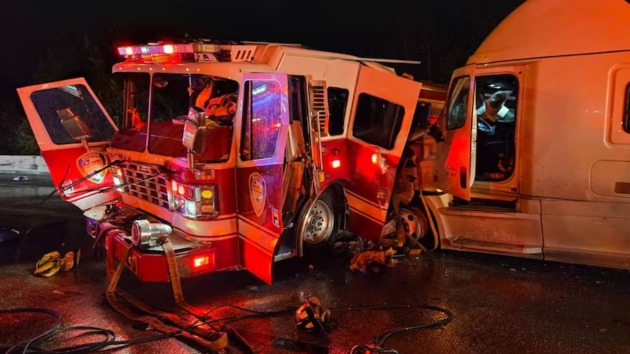
(NEW YORK) — Four Texas firefighters were injured early Sunday when an 18-wheeler slammed into their fire engine as they were blocking traffic to a freeway entrance following a car crash, authorities said.
The incident unfolded around 2 a.m. in north Houston, according to the Houston Fire Department.
The injured firefighters were taken by ambulance to a hospital, officials said.
“We are asking for prayers for our four injured firefighters,” Patrick M. “Marty” Lancton, president of the Houston Professional Fire Fighters Association, said in a social media post.
The fire crew had responded to a traffic accident on the Eastex Freeway and was blocking the entrance to the freeway at Northpark Drive with a Houston Fire Department pumper engine when they were hit by the big rig, authorities said.
The firefighters suffered “injuries of varying severities,” according to a statement from the fire department. “All are expected to fully recover.”
Three of the injured firefighters remained hospitalized on Sunday afternoon, officials said.
It was not immediately clear what injuries the driver of the big rig sustained.
The crash remains under investigation.
“Blocking traffic on the freeway is one of the most dangerous tasks we do,” Houston Fire Chief Thomas Muñoz said in a statement on social media. “We’re extremely grateful that every member of Engine 104 is expected to recover, and we ask drivers to slow down and move over when they see emergency crews working.”